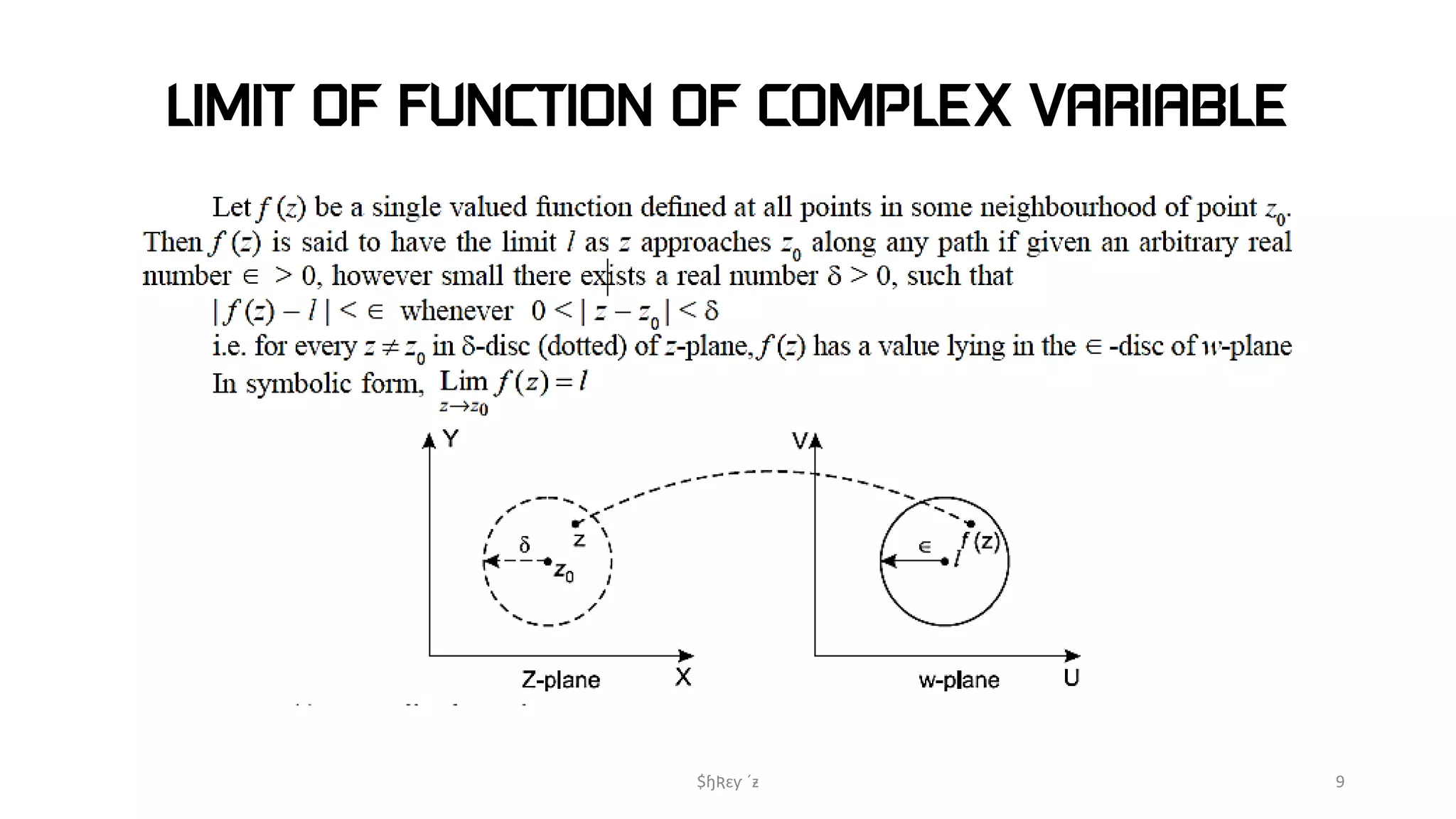
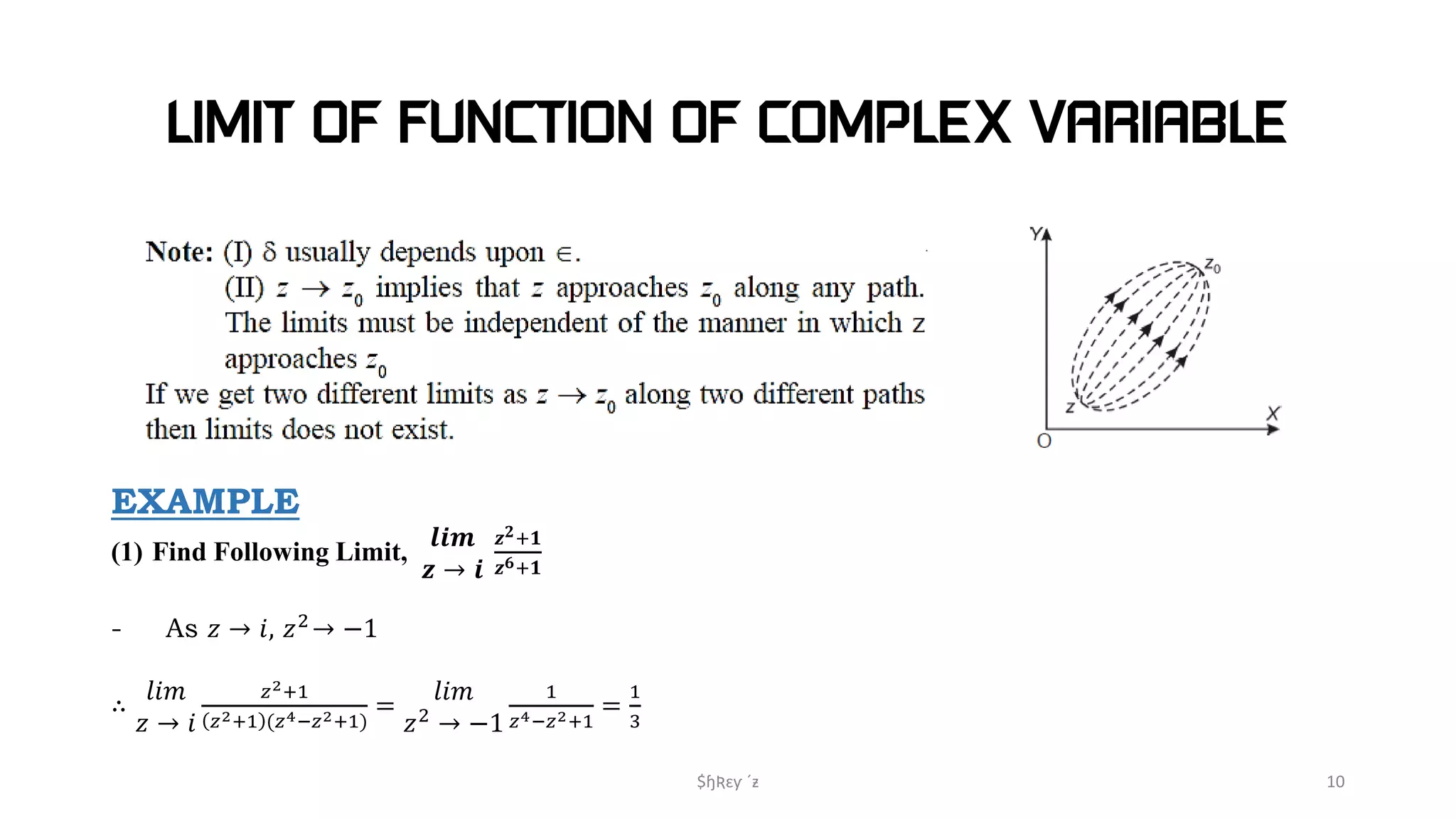
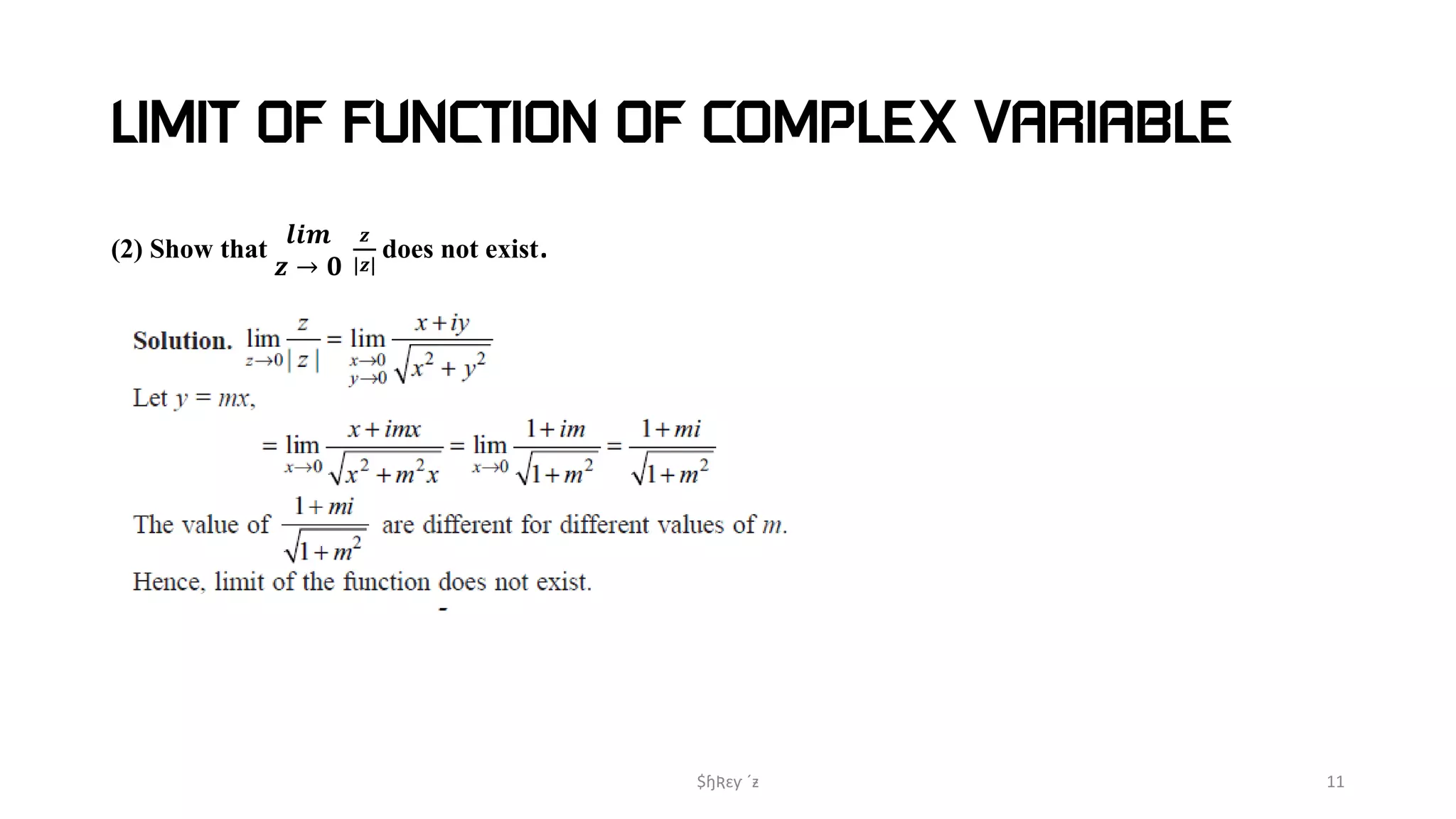
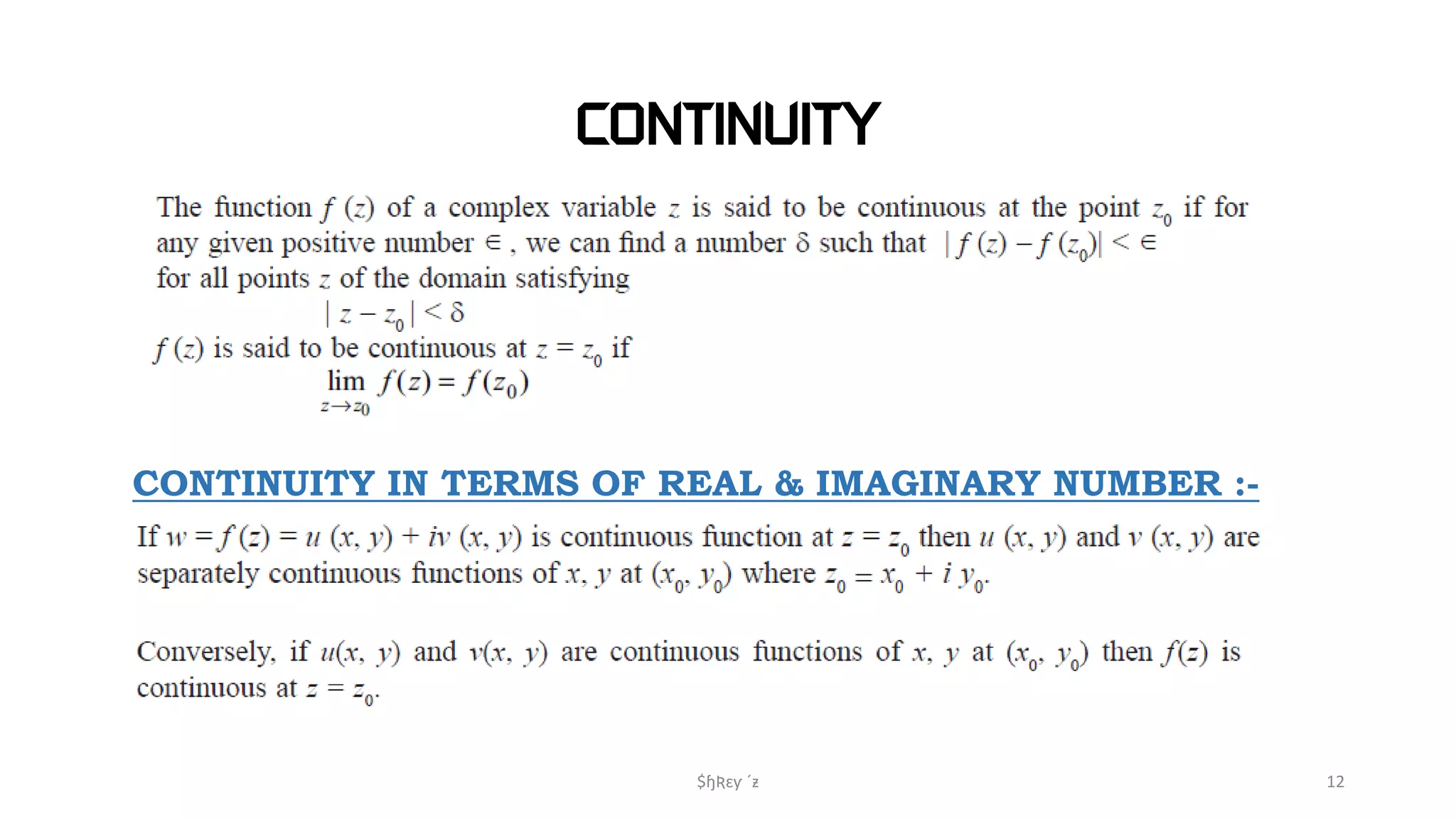
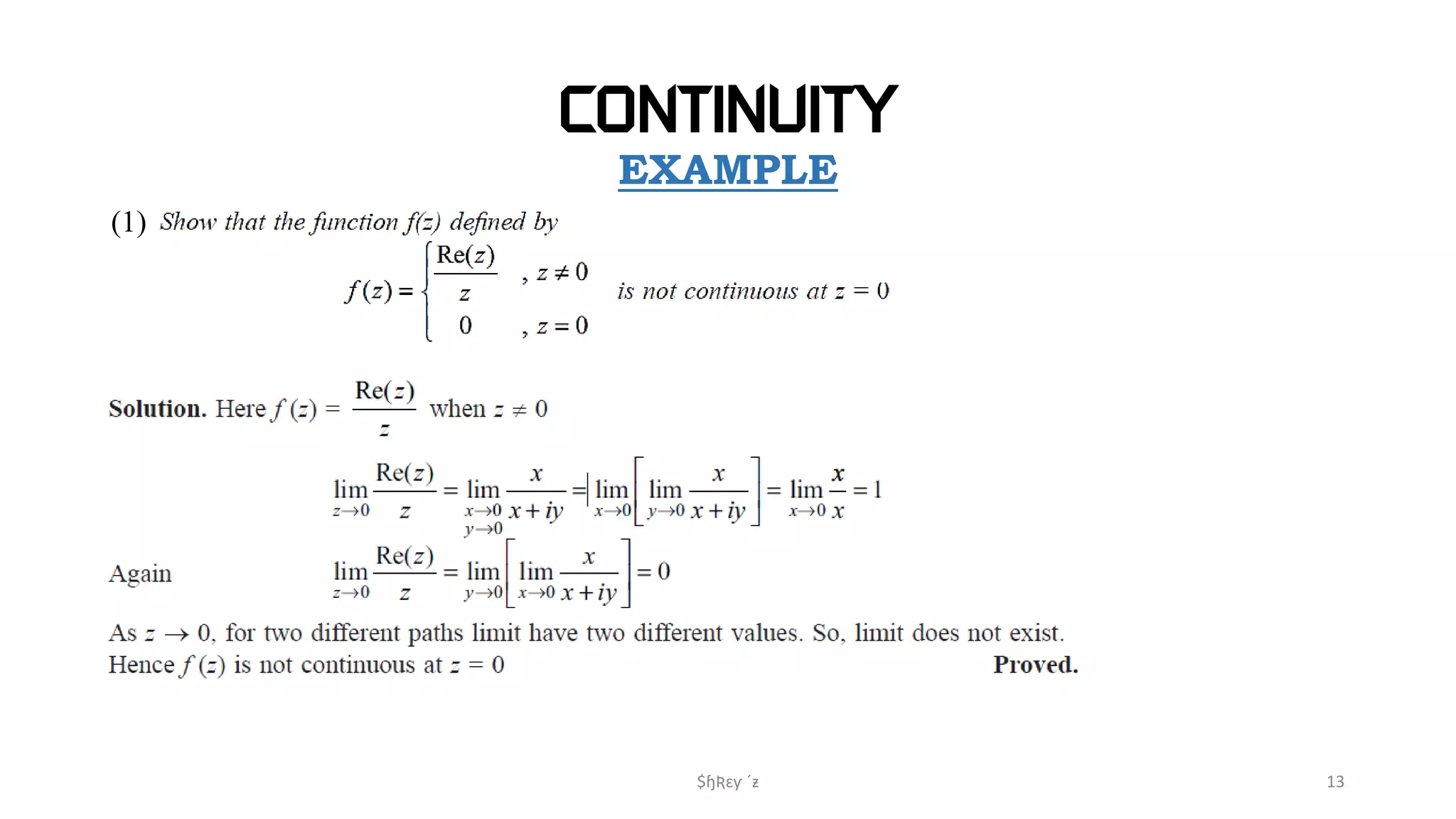
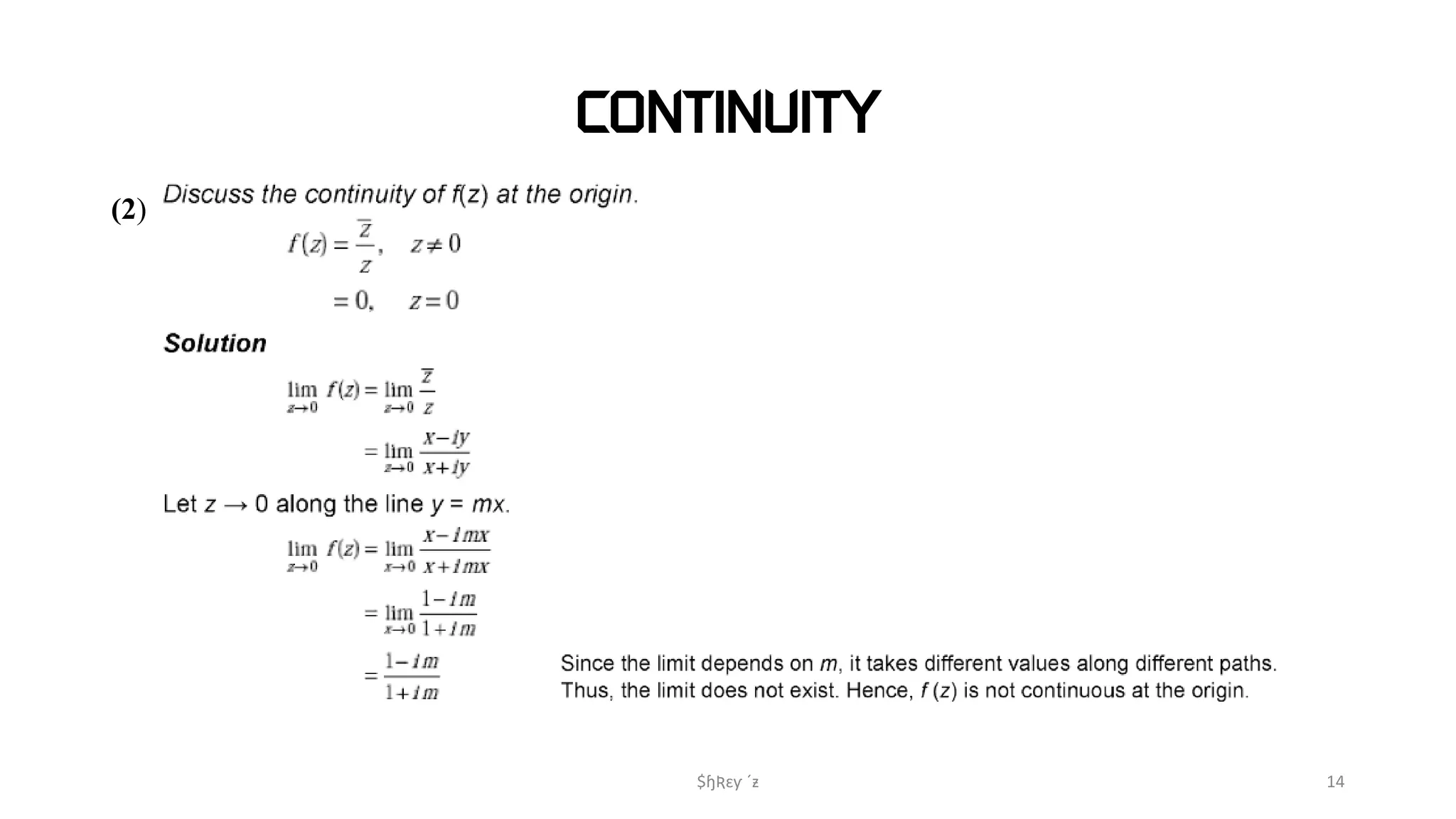
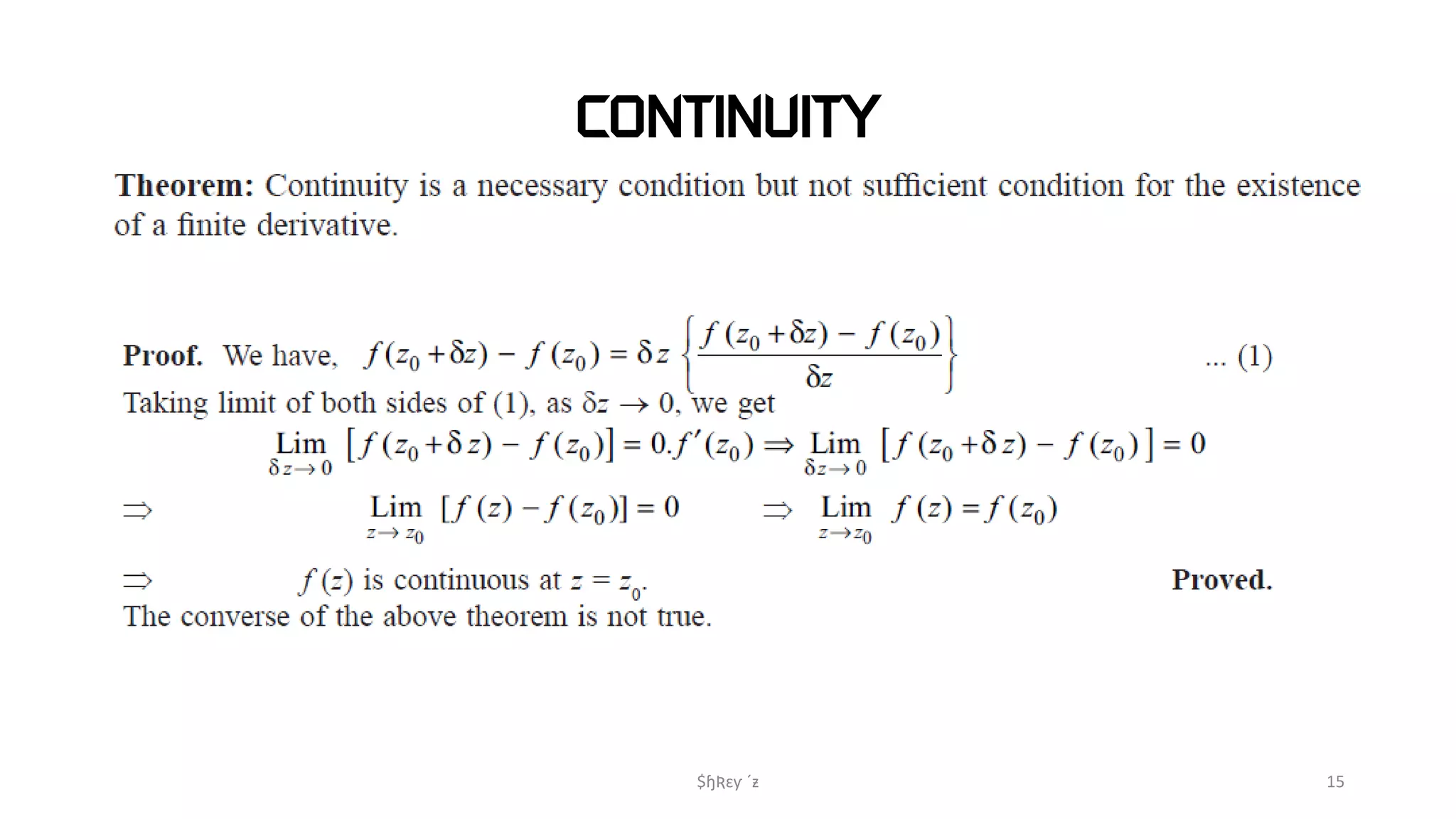
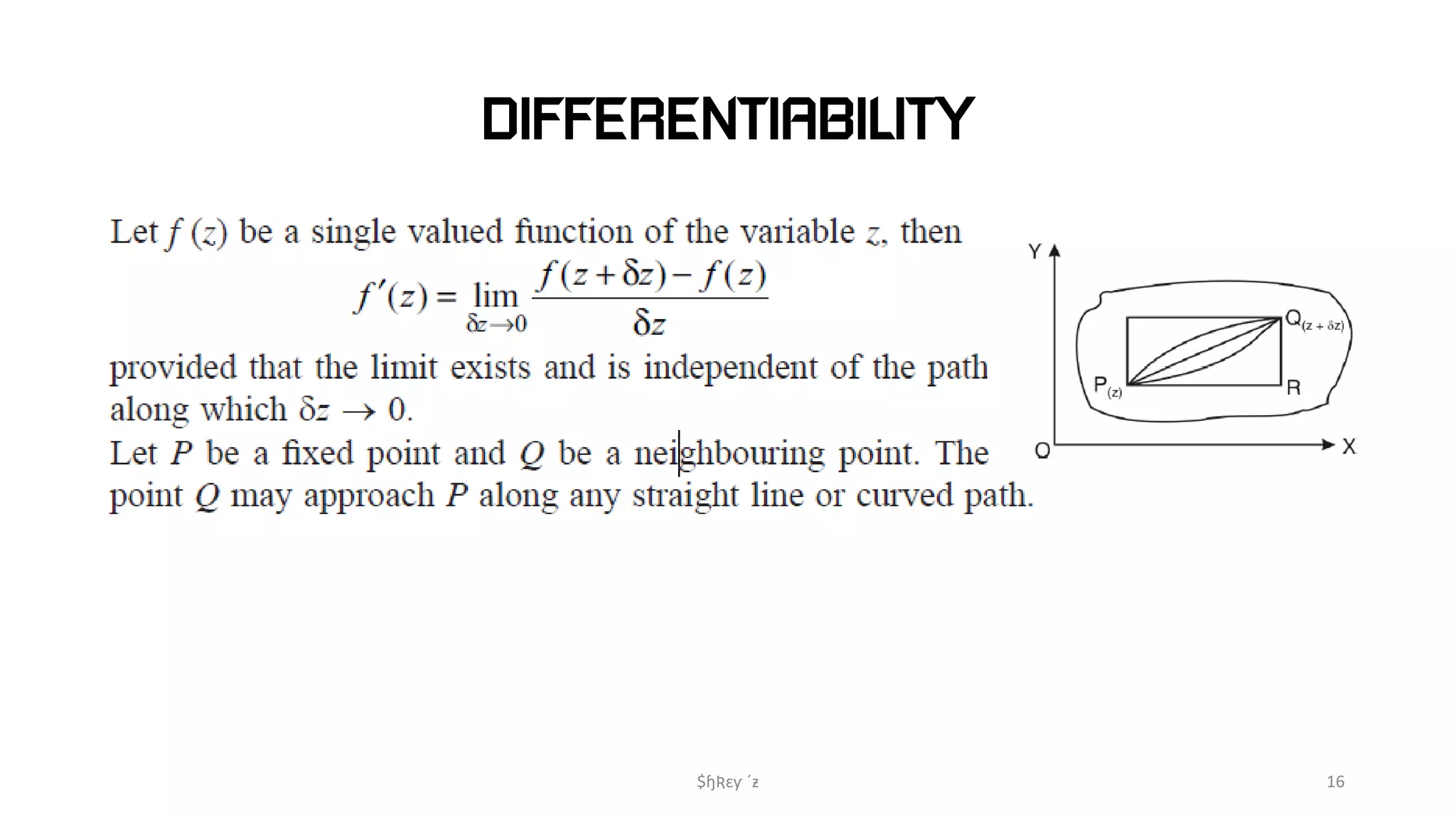
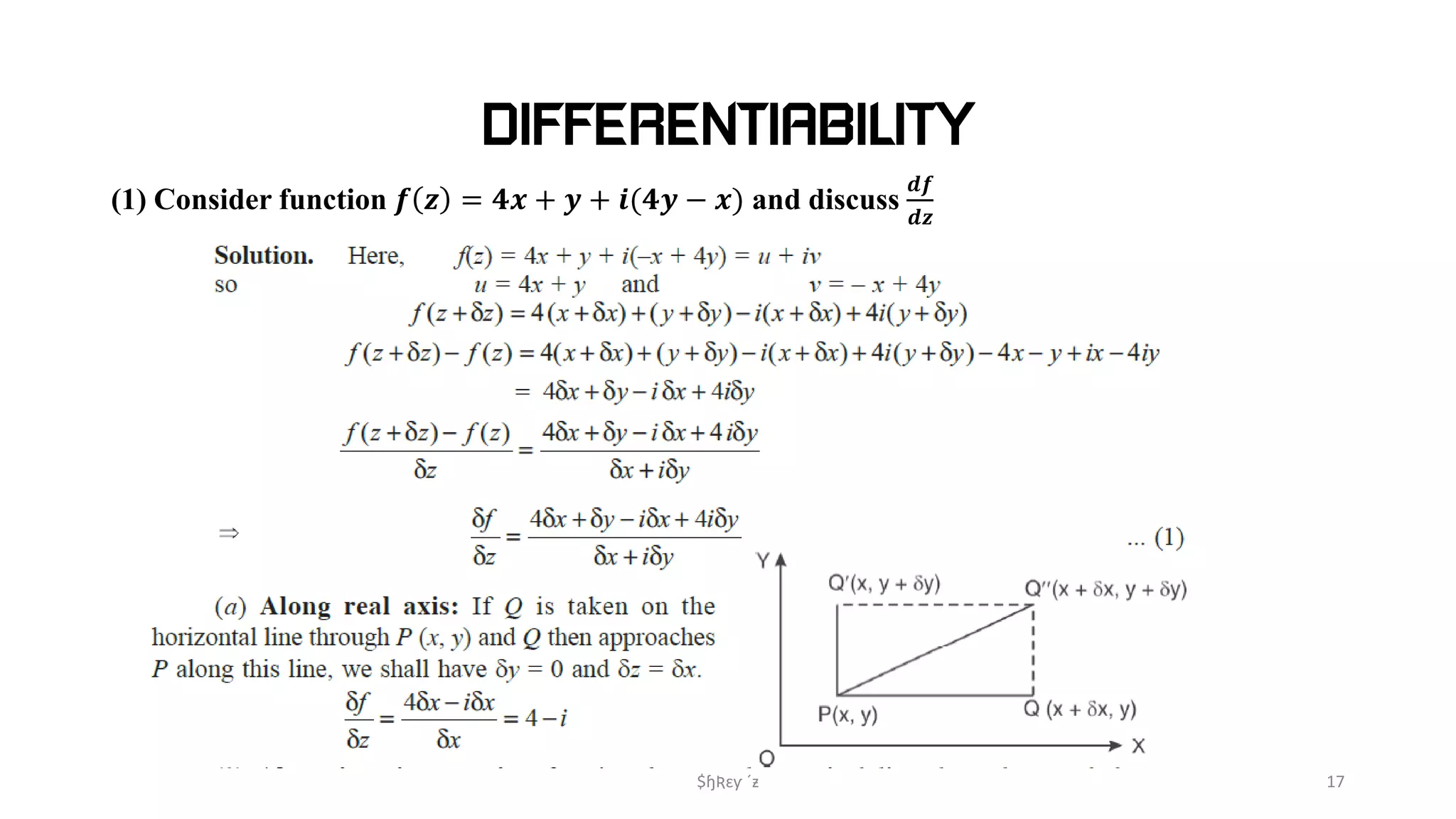
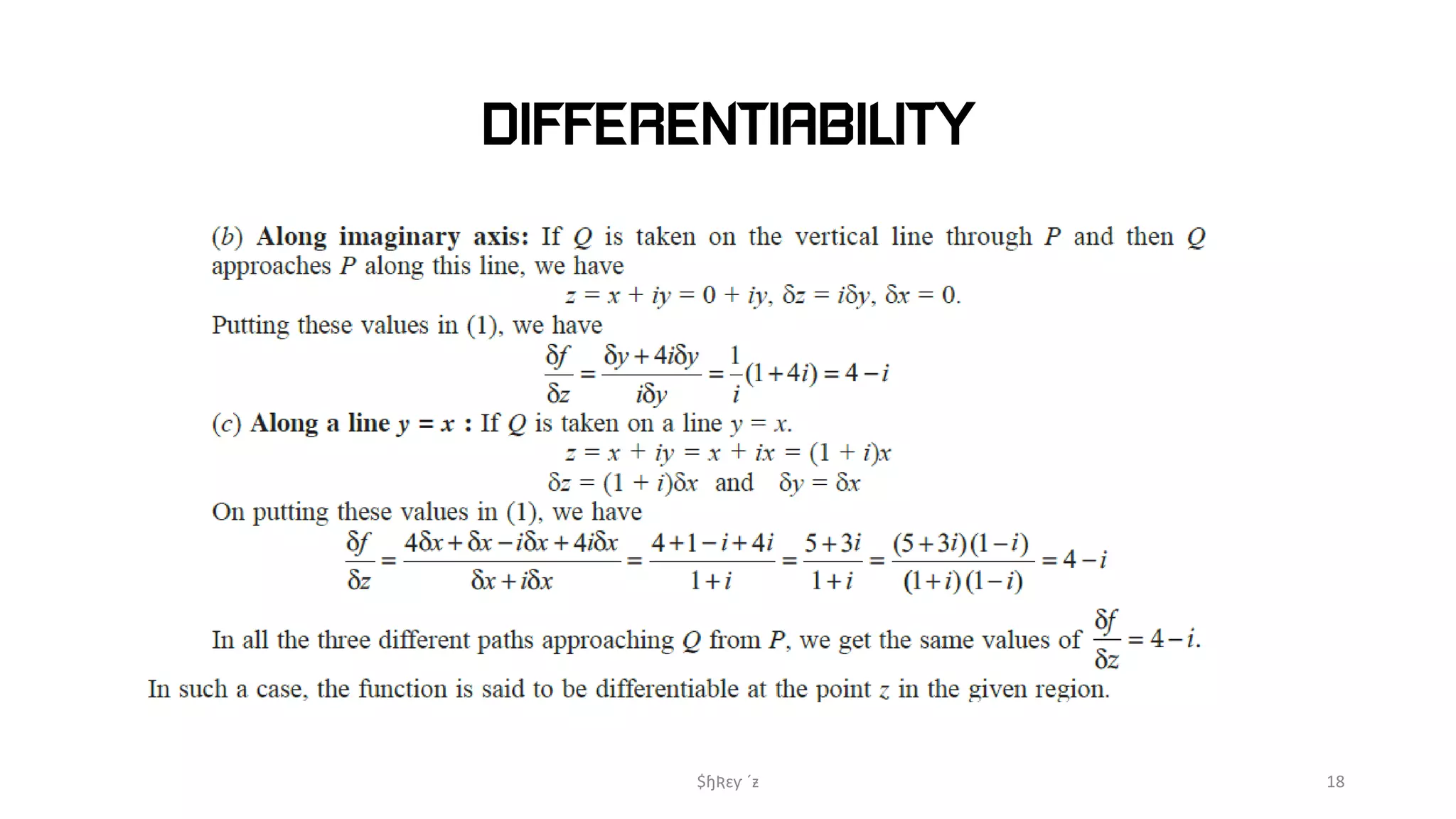
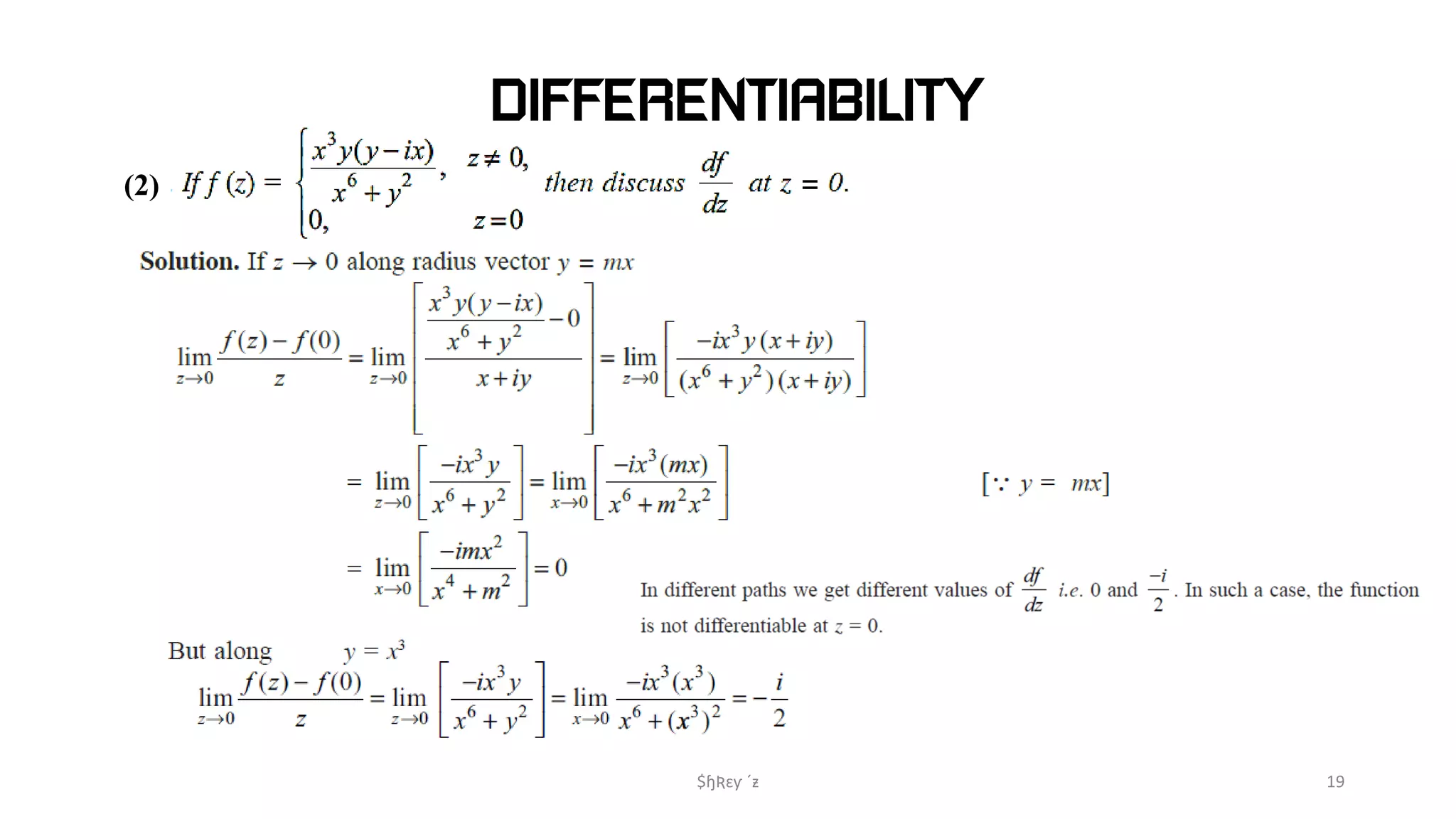
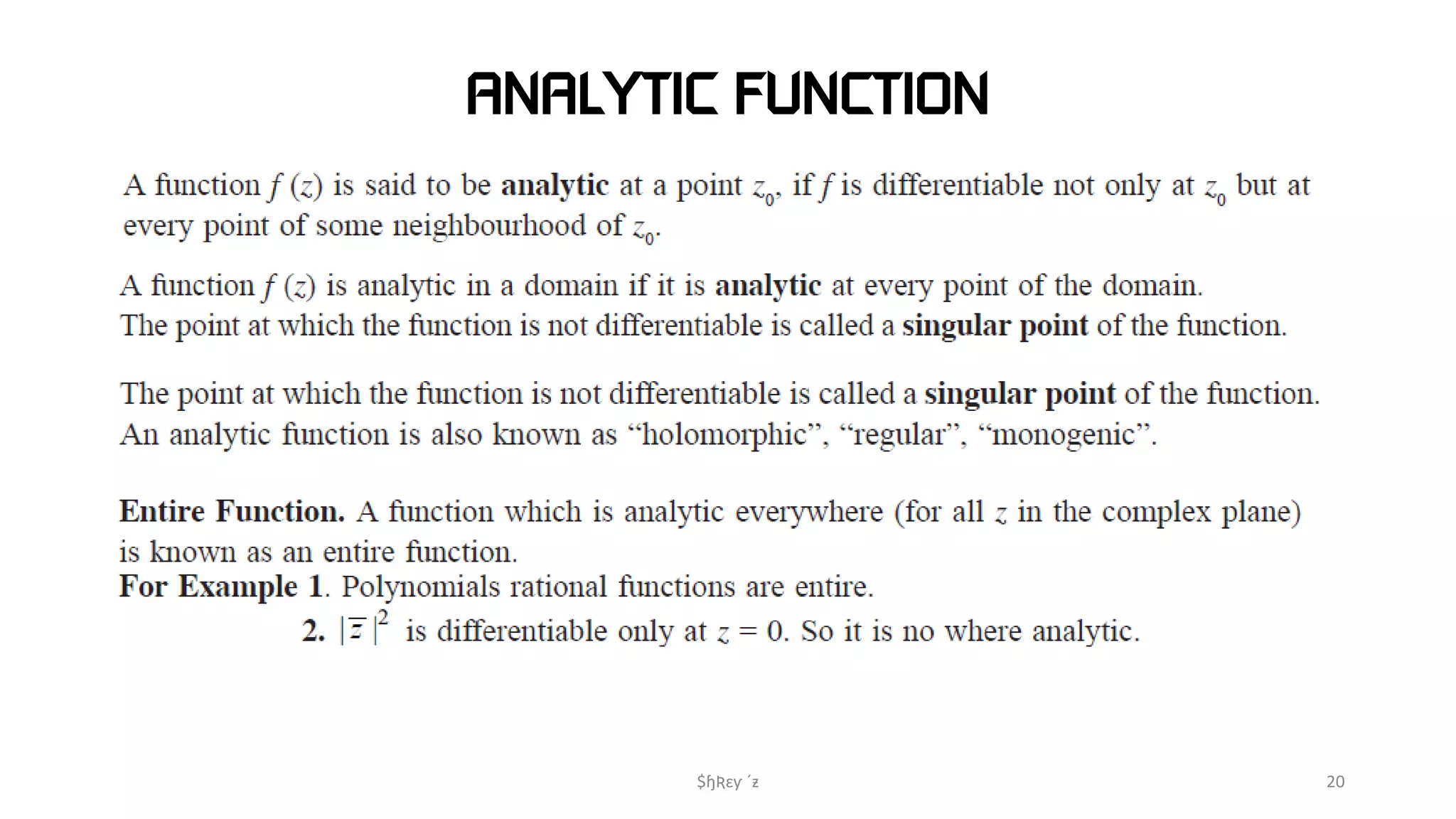
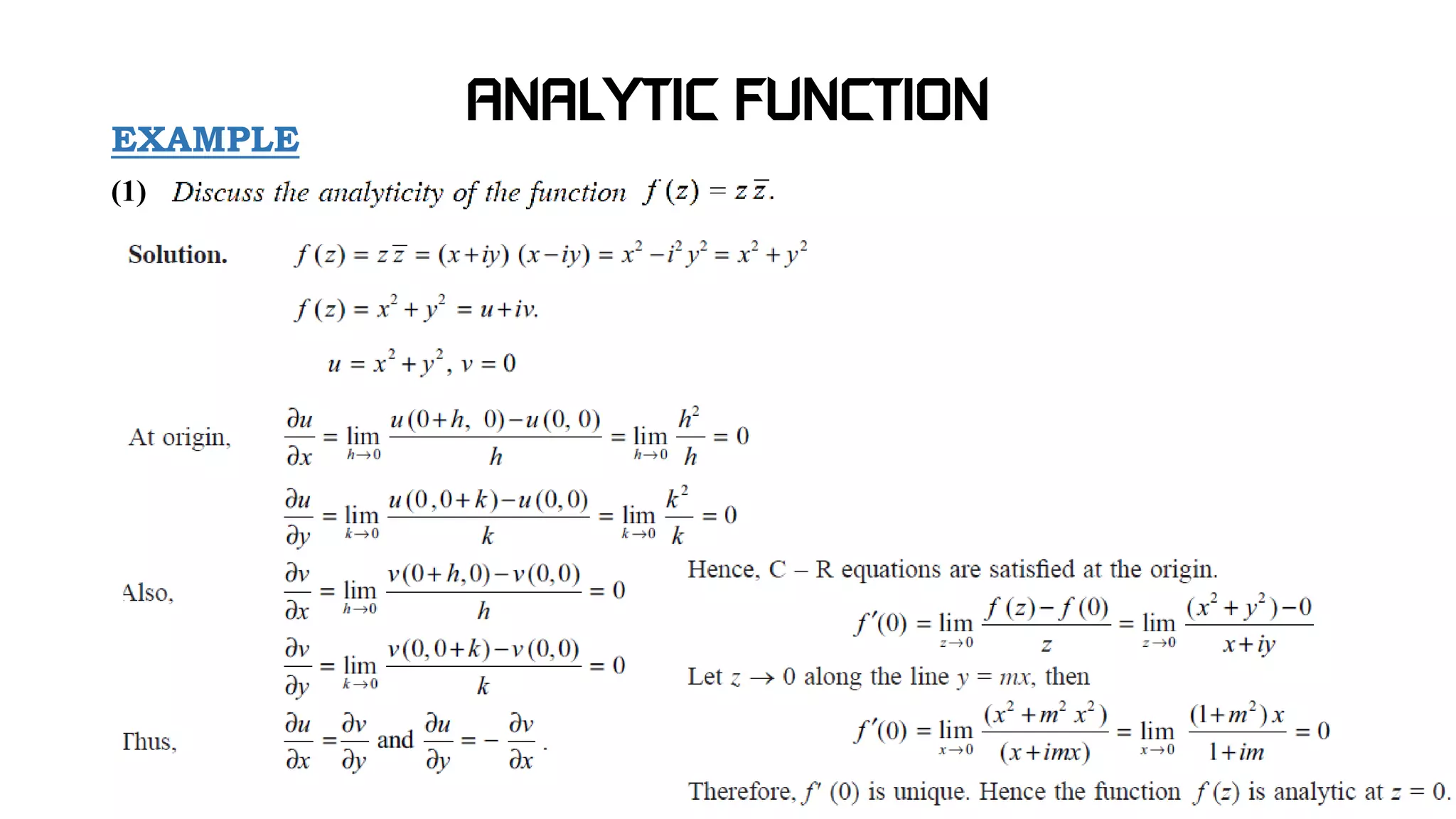
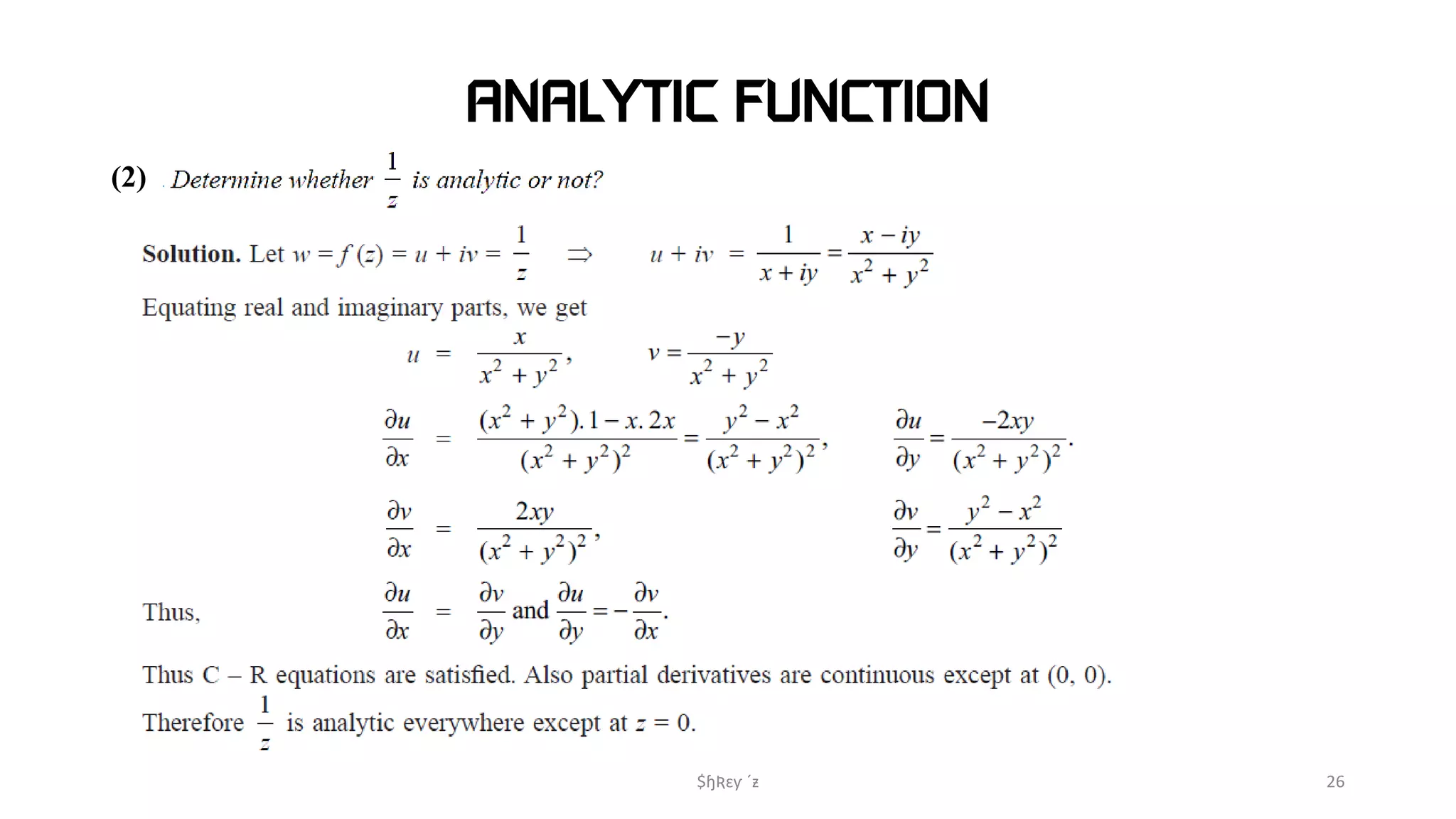
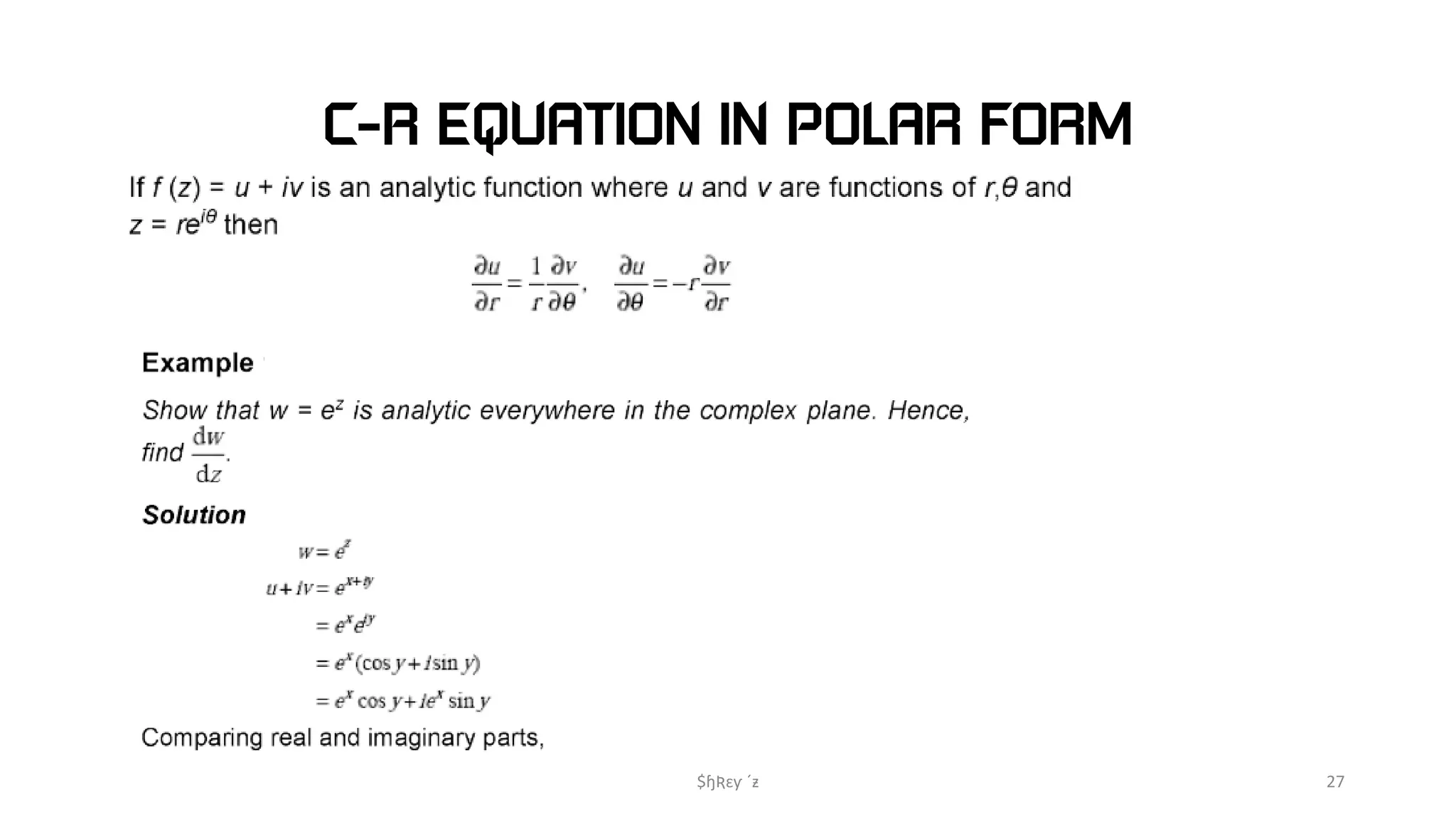
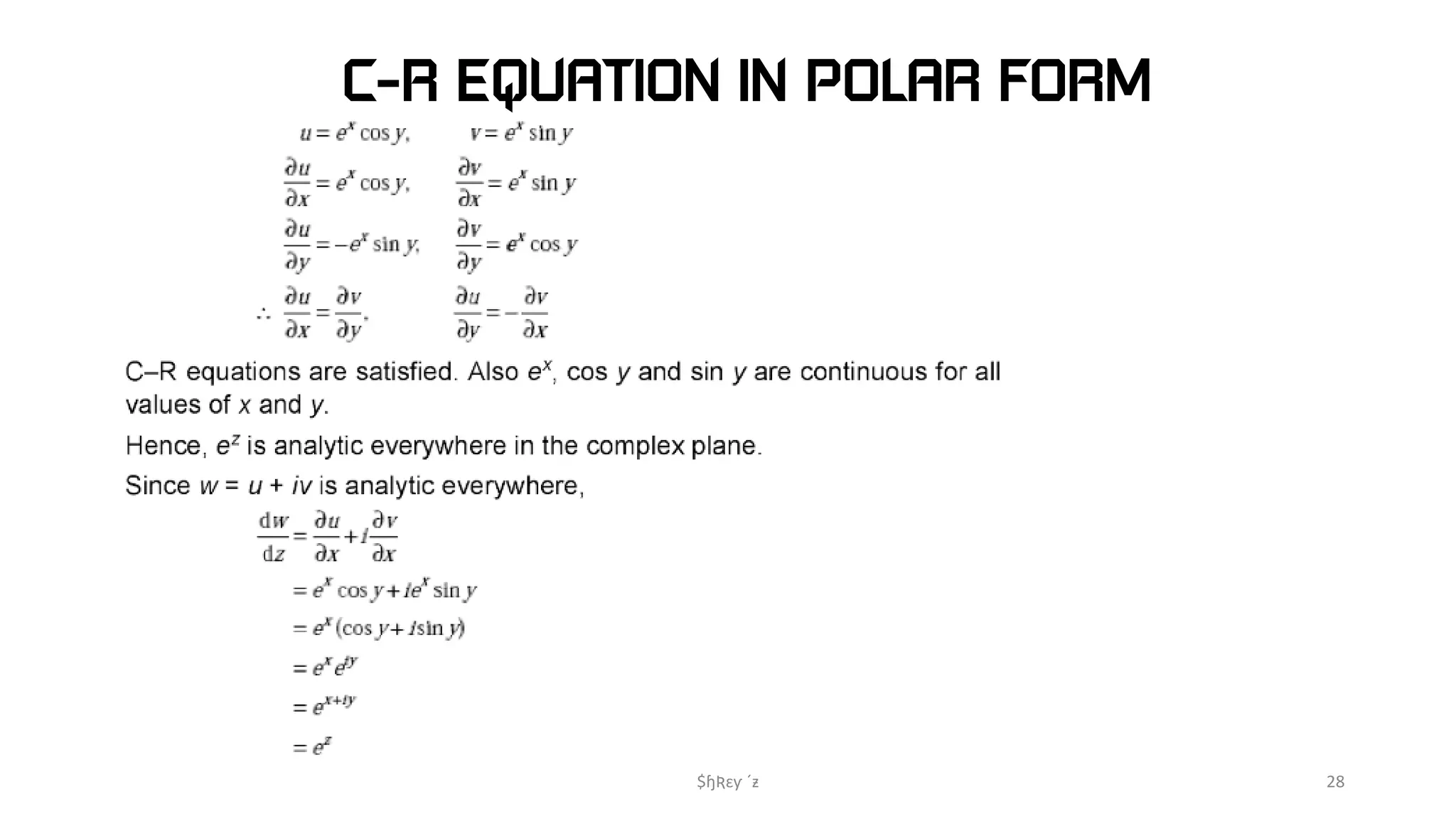
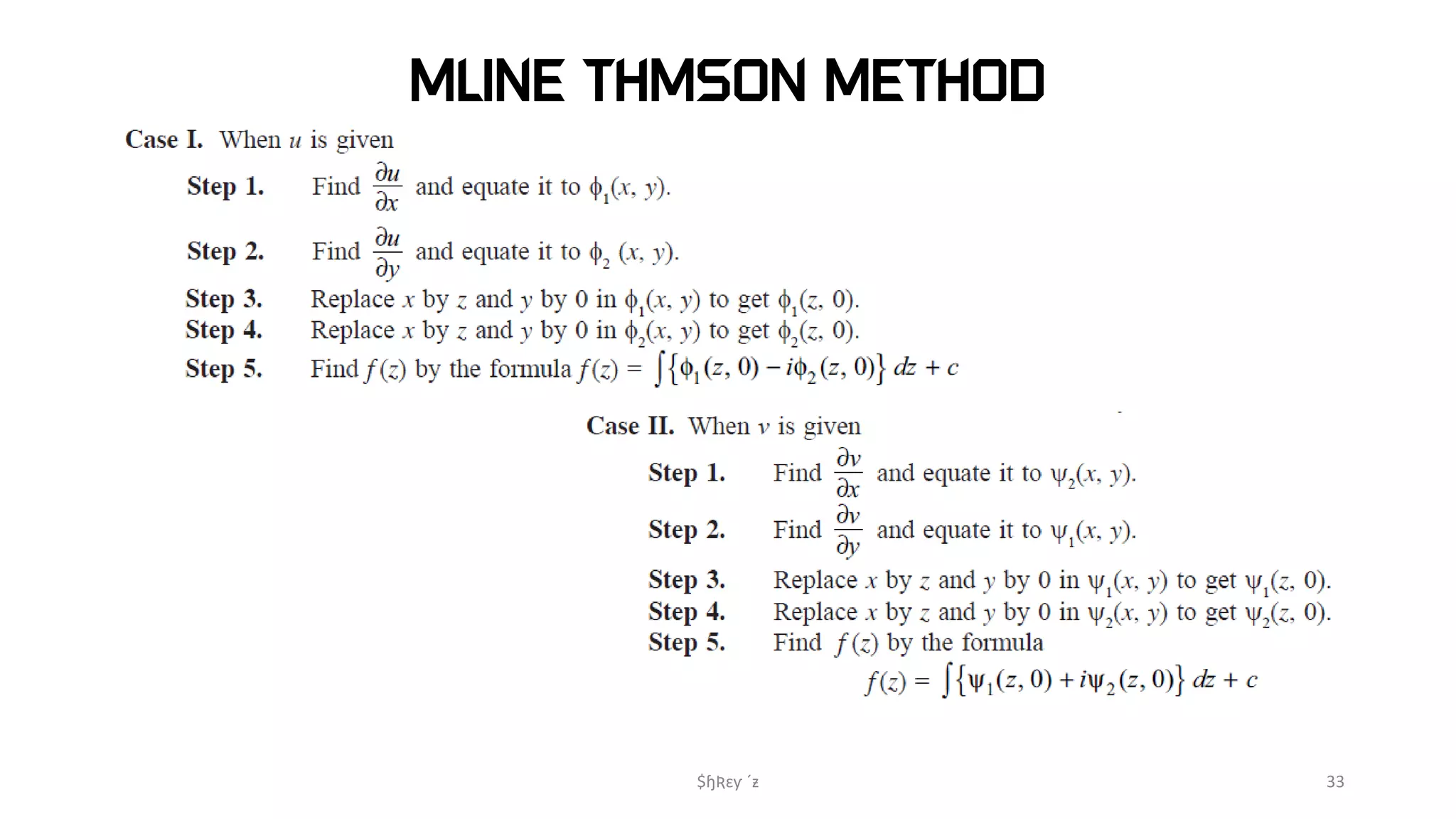
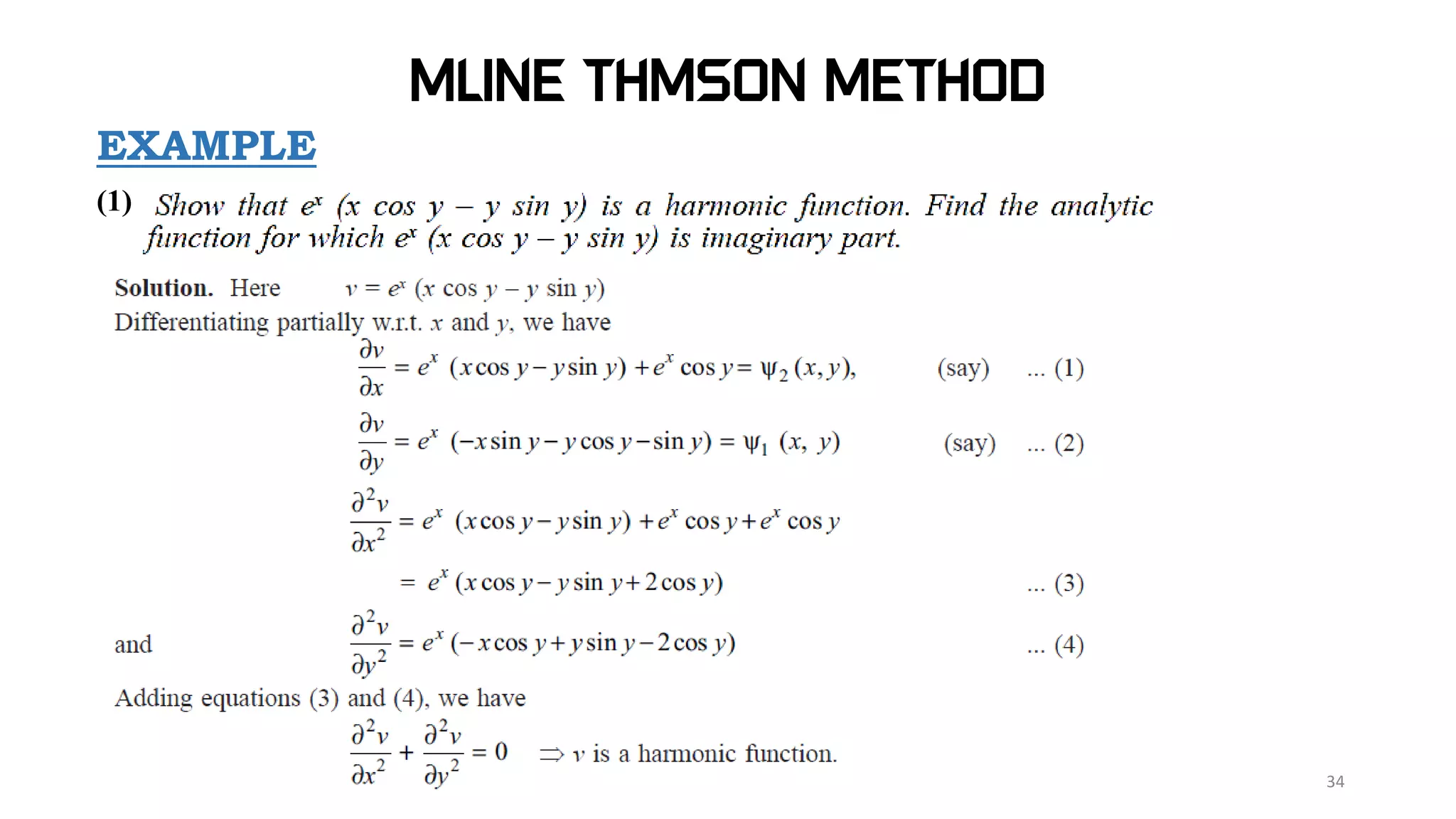
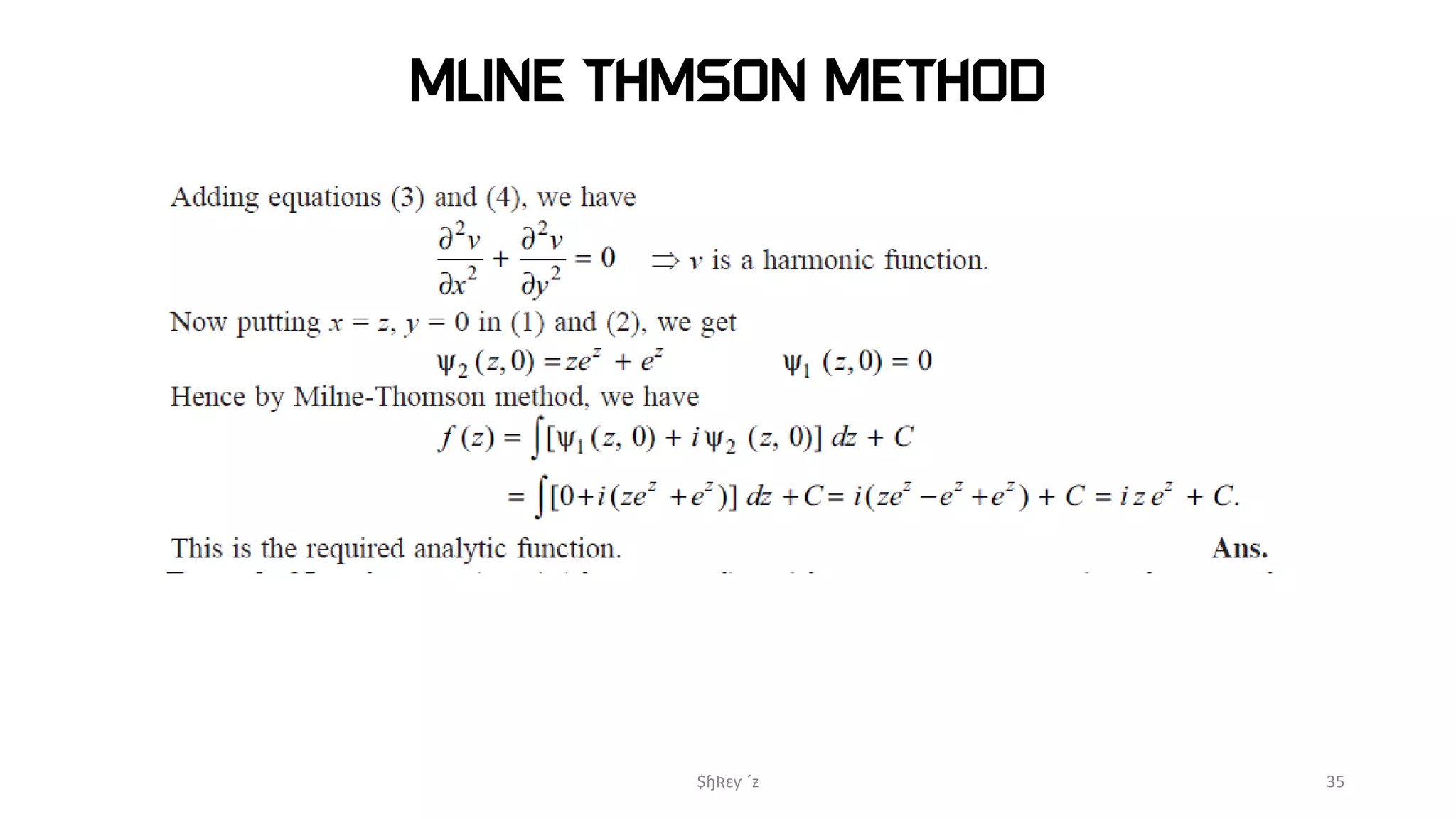
This document is a report on Complex Variable & Numerical Method prepared by 5 students and guided by Miss. Chaitali Shah. It contains the following topics: complex numbers, complex variable, basic definitions, limits, continuity, differentiability, analytic functions, Cauchy-Riemann equations, harmonic functions, Milne-Thomson method, and applications of complex functions/variables in engineering. Examples are provided to illustrate several concepts.

Complex Variable &Numerical Method (2141905)
B.E. MECH – Sem IV th
Prepared by,
Patel Jeet R (170953119029)
Patel Meet (170953119030)
Patel Shrey B (170953119031)
Pathak Jeet (170953119032)
Patil Gaurav (170953119033)
Guided by,
Miss. Chaitali Shah
(Applied Mathematics Deptt.)
2.
content
Complex Number
Complex Variable
Basic Defination
Limits
Continuity
Differentiability
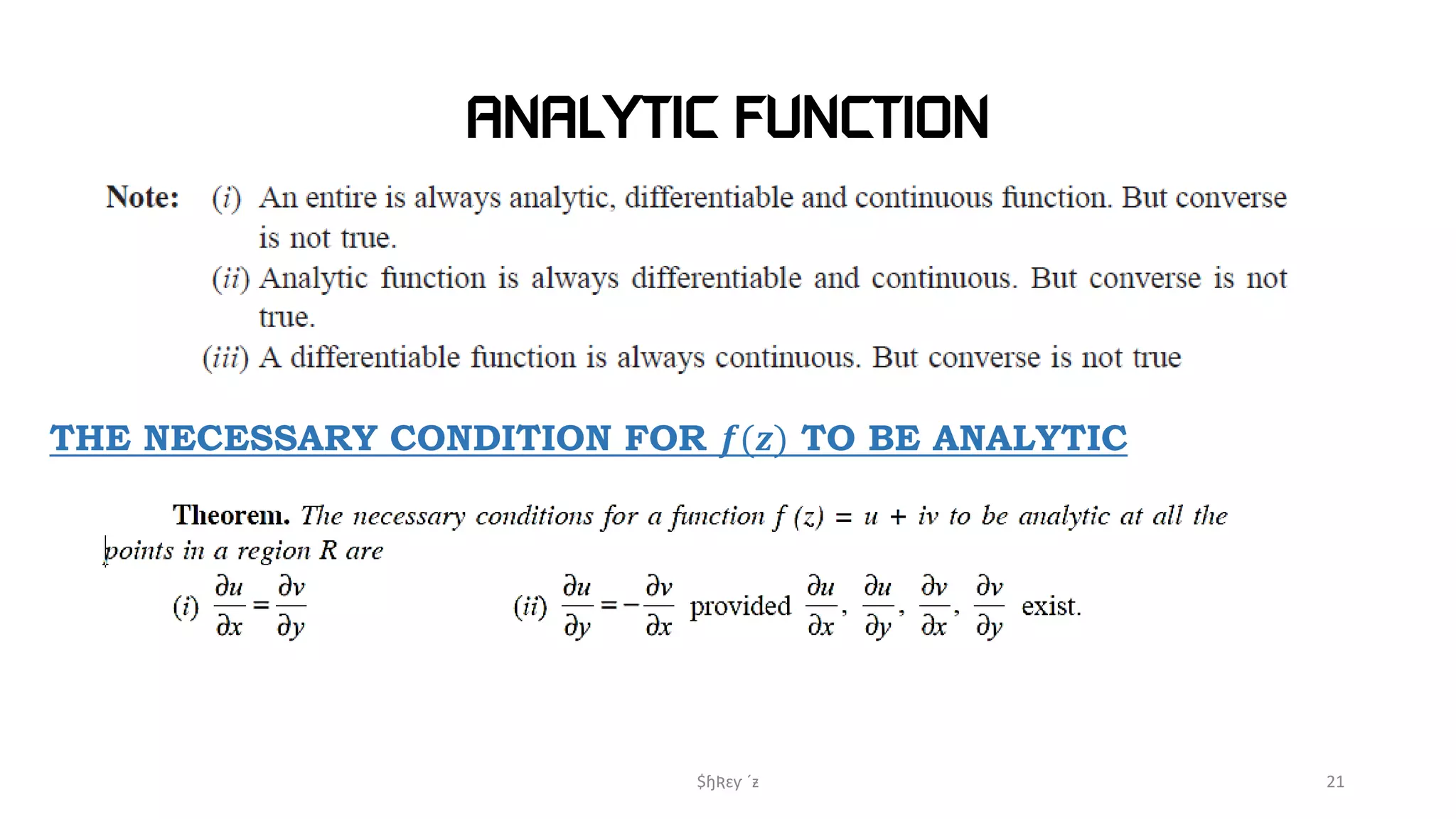
Analytic Function
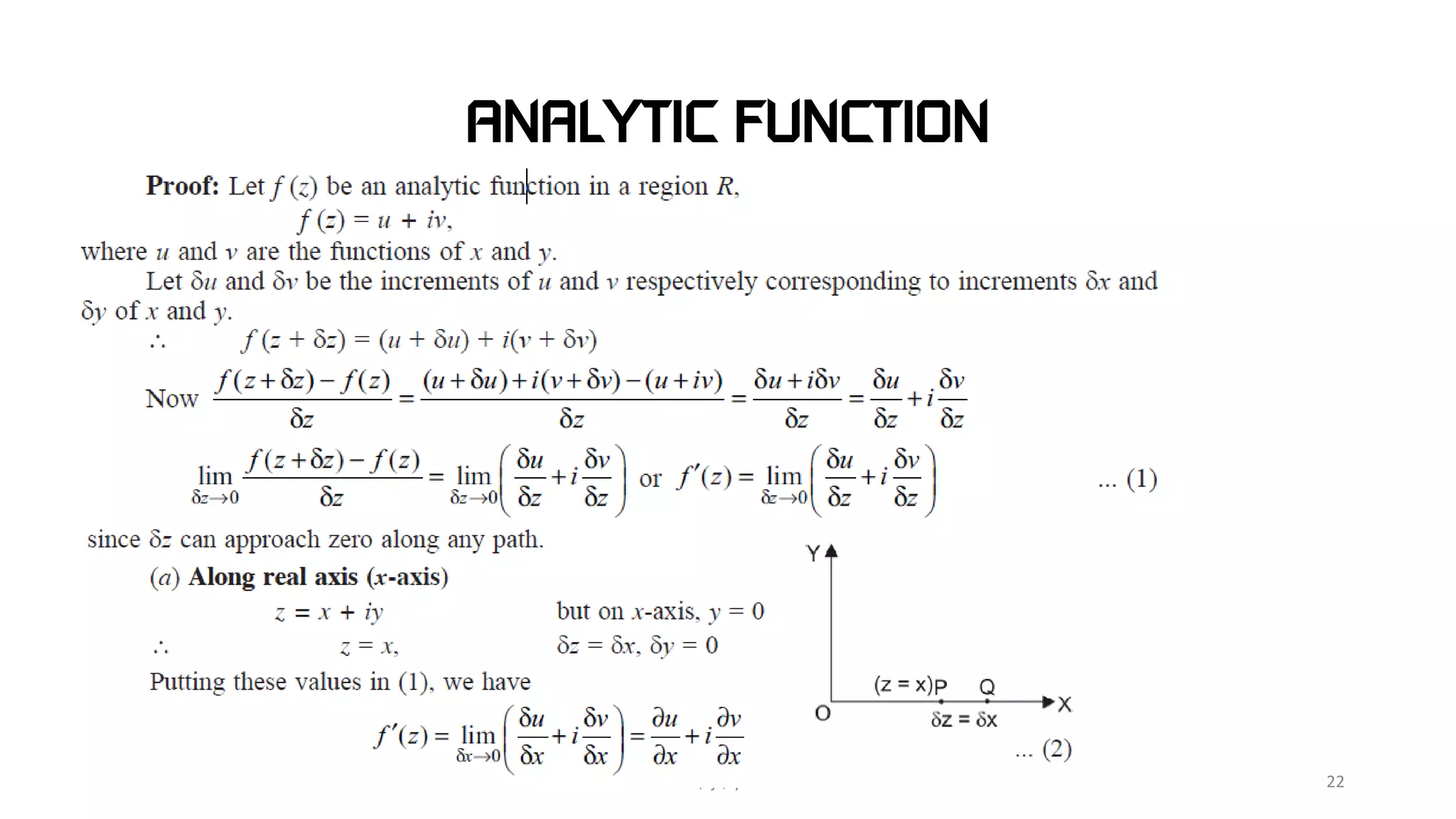
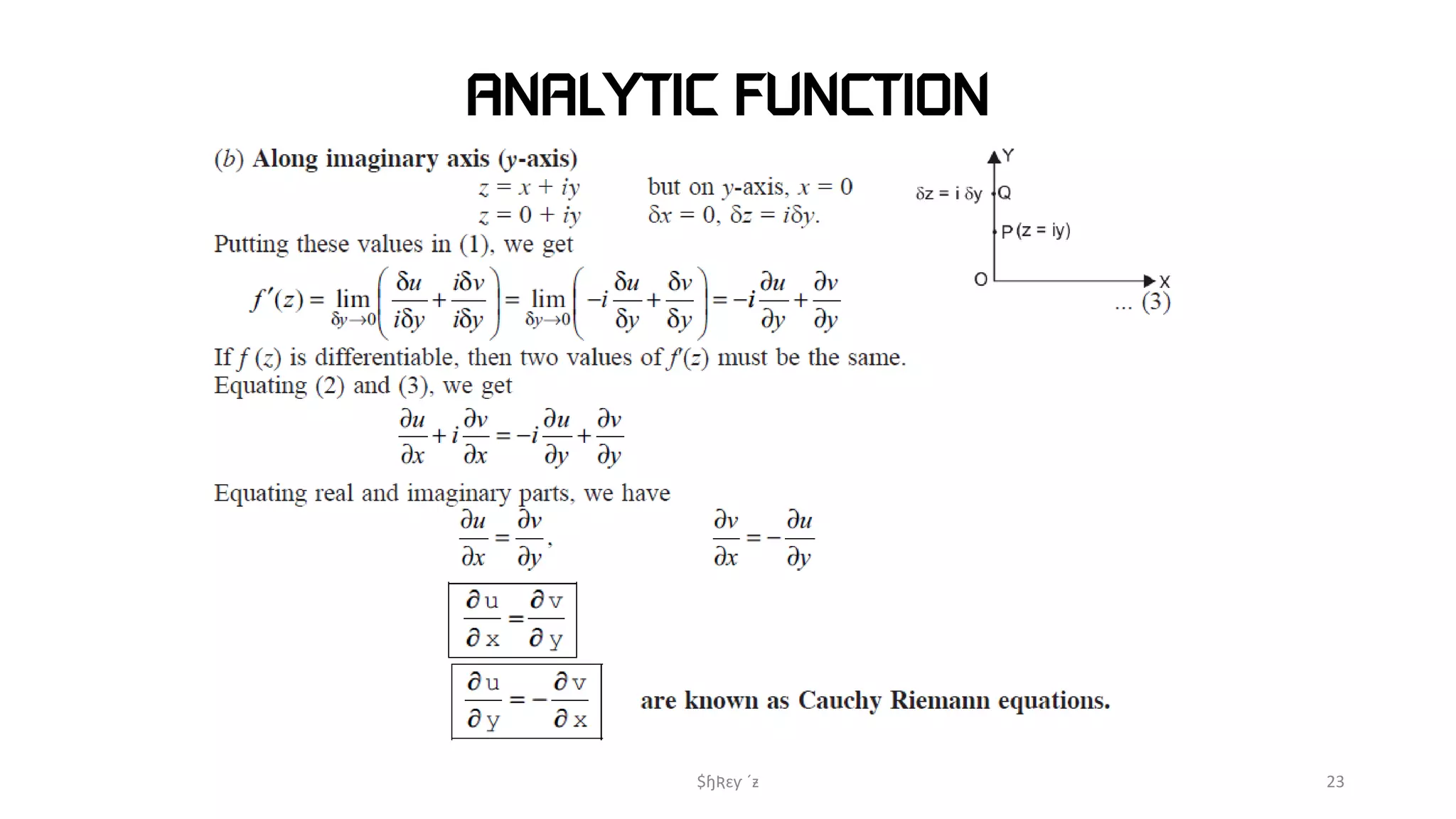
Necessary condition for f(z) CR Equation
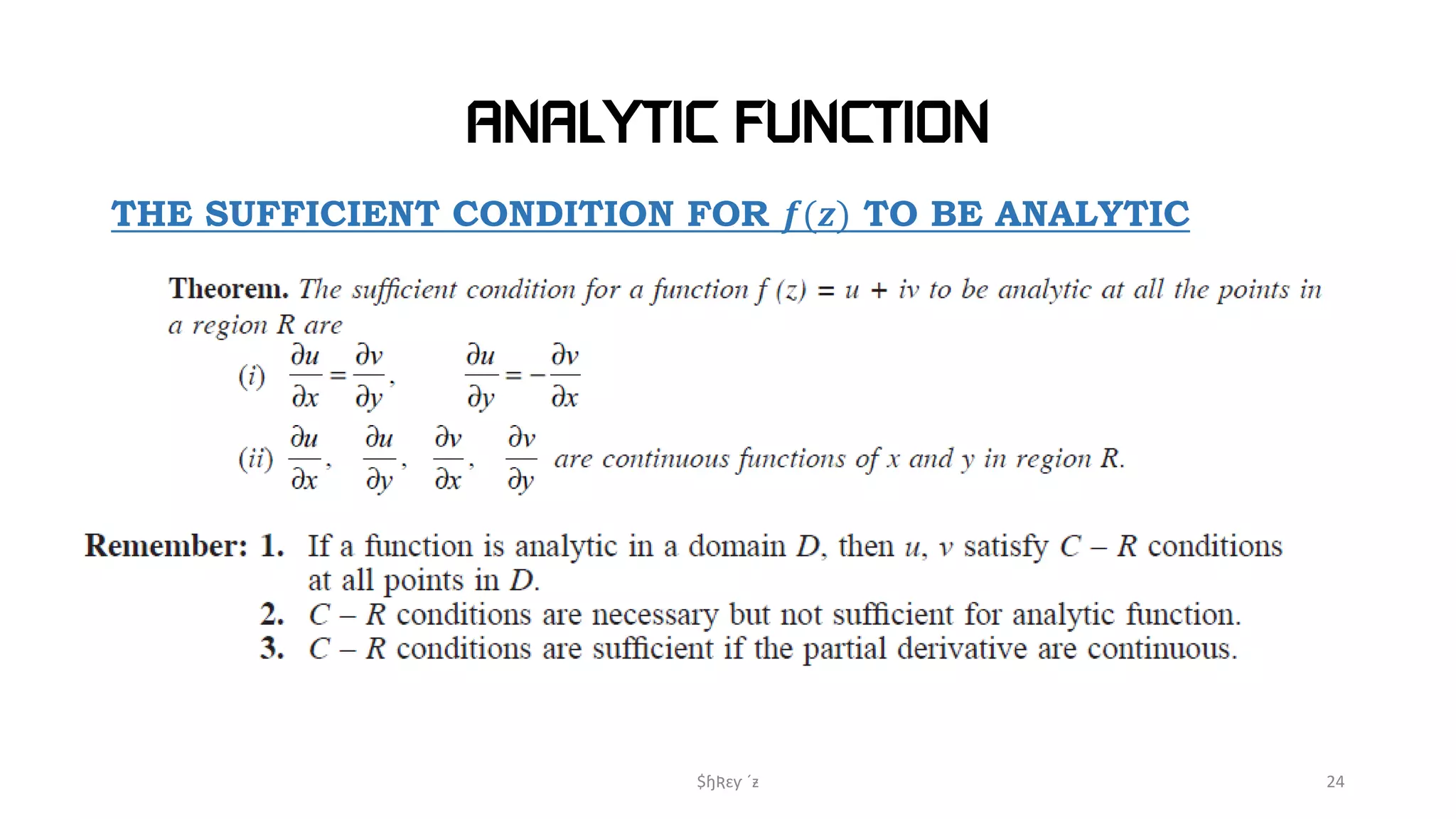
Sufficient Condition for f(z) to be analytic
Polar form of CR Equation
Harmonic Function
Propertied of Analytic Function
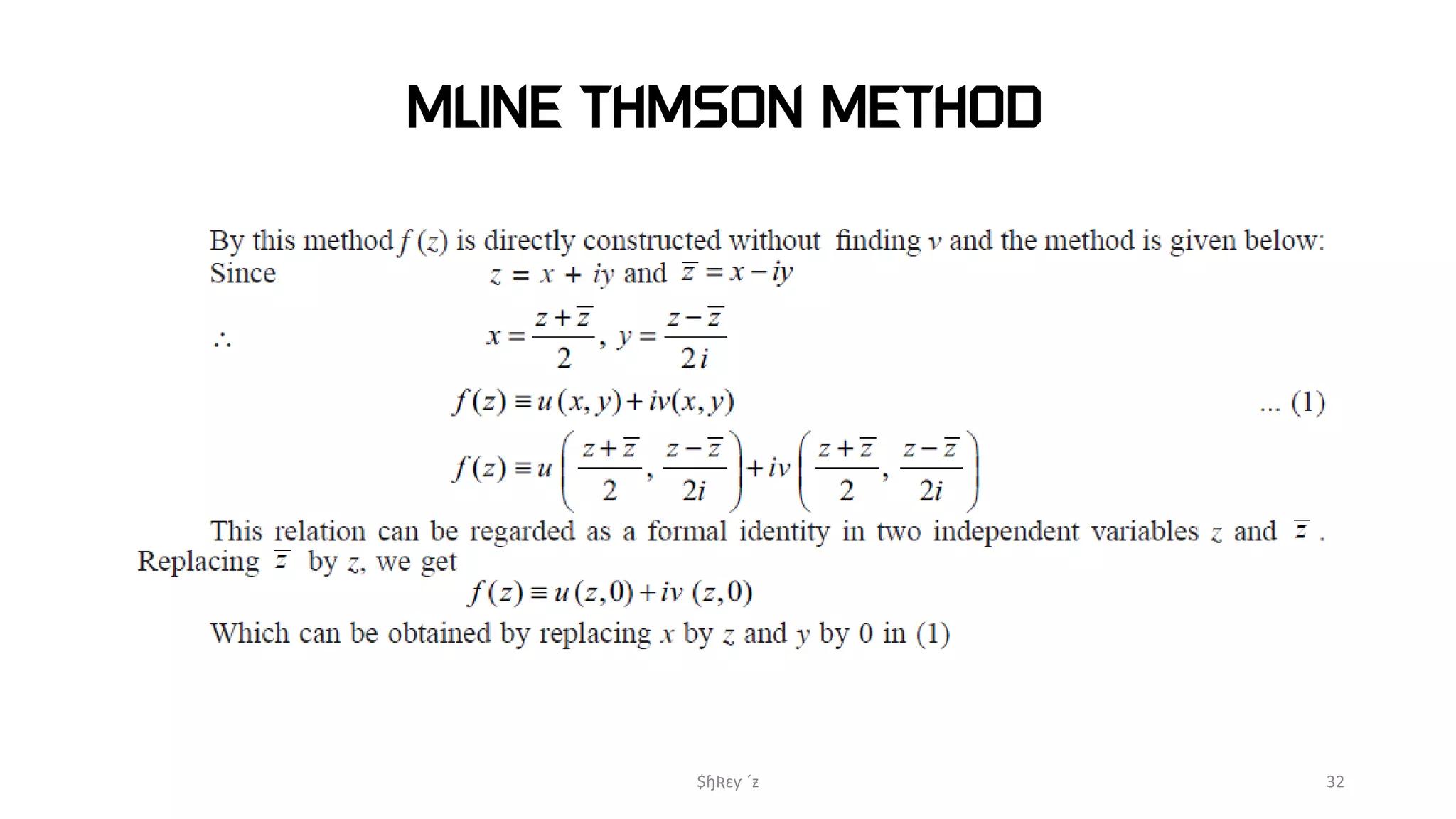
Milne-Thomson Method
Application of complex
Function/Variable in
Engineering
$ɧƦɛƴ ´ƶ 2
3.
COMPLEX NUMBER
WHY WESTUDY ?
For most human tasks, real numbers (or even rational numbers) offer an adequate
description of data. Fractions such as 2/3 and 1/8 are meaningless to a person counting stones,
but essential to a person comparing the sizes of different collections of stones. Negative numbers
such as -3 and -5 are meaningless when measuring the mass of an object, but essential when
keeping track of monetary debits and credits.
All numbers are imaginary (even "zero" was contentious once). Introducing the square
root(s) of minus one is convenient because (i) all n-degree polynomials with real coefficients
then have n roots, making algebra "complete"; (ii) it saves using matrix representations for
objects that square to -1 (such objects representing an important part of the structure of linear
equations which appear in quantum mechanics, heat diffusion, optics, etc). The hottest
contenders for numbers without purpose are probably the p-adic numbers (an extension of the
rationals), and perhaps the expiry dates on army ration packs
$ɧƦɛƴ ´ƶ 3
4.
COMPLEX NUMBER
INTRODUCTION
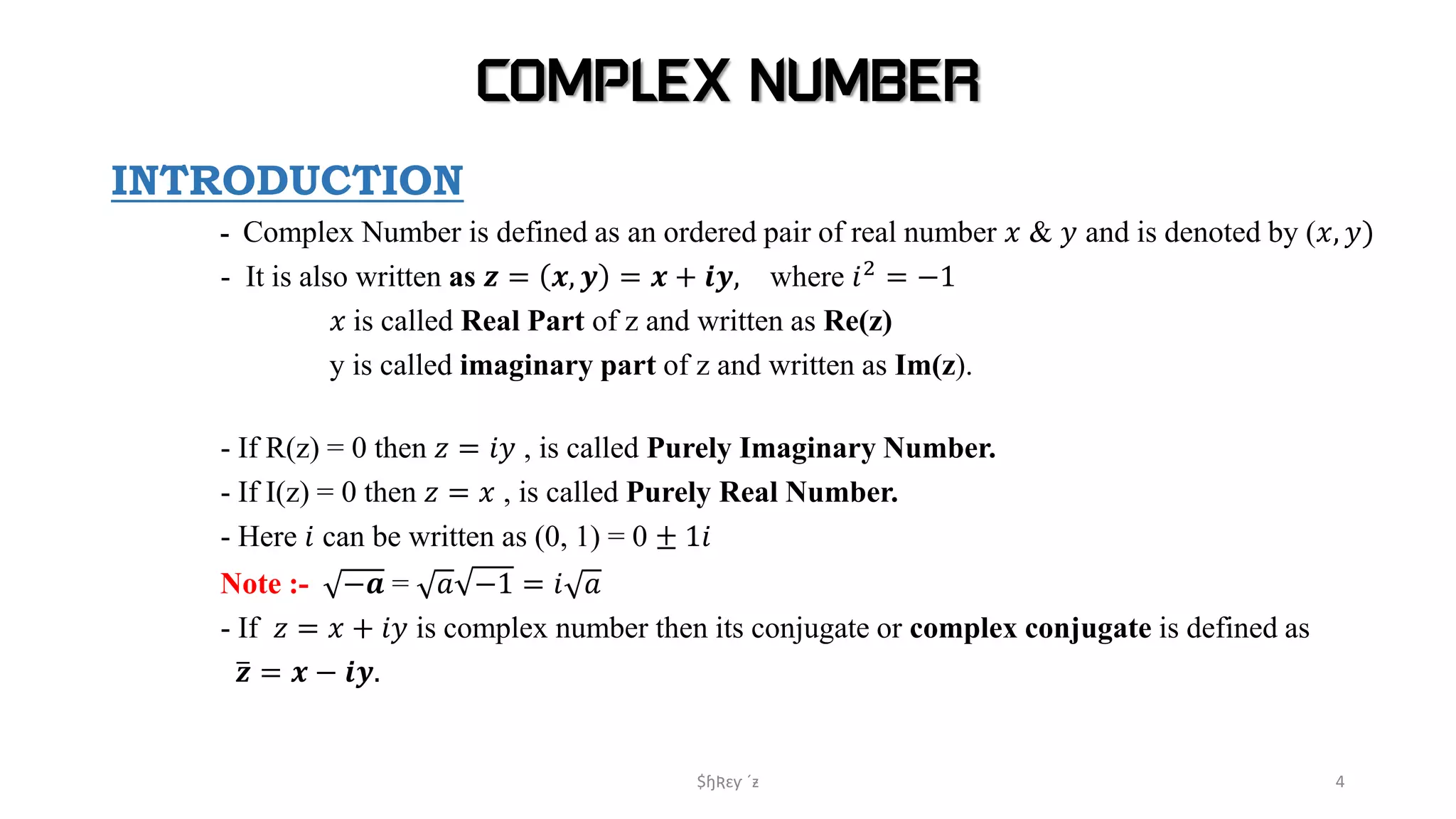
- ComplexNumber is defined as an ordered pair of real number 𝑥 & 𝑦 and is denoted by (𝑥, 𝑦)
- It is also written as 𝒛 = 𝒙, 𝒚 = 𝒙 + 𝒊𝒚, where 𝑖2 = −1
𝑥 is called Real Part of z and written as Re(z)
y is called imaginary part of z and written as Im(z).
- If R(z) = 0 then 𝑧 = 𝑖𝑦 , is called Purely Imaginary Number.
- If I(z) = 0 then 𝑧 = 𝑥 , is called Purely Real Number.
- Here 𝑖 can be written as (0, 1) = 0 ± 1𝑖
Note :- −𝒂 = 𝑎 −1 = 𝑖 𝑎
- If 𝑧 = 𝑥 + 𝑖𝑦 is complex number then its conjugate or complex conjugate is defined as
𝒛 = 𝒙 − 𝒊𝒚.
$ɧƦɛƴ ´ƶ 4
5.
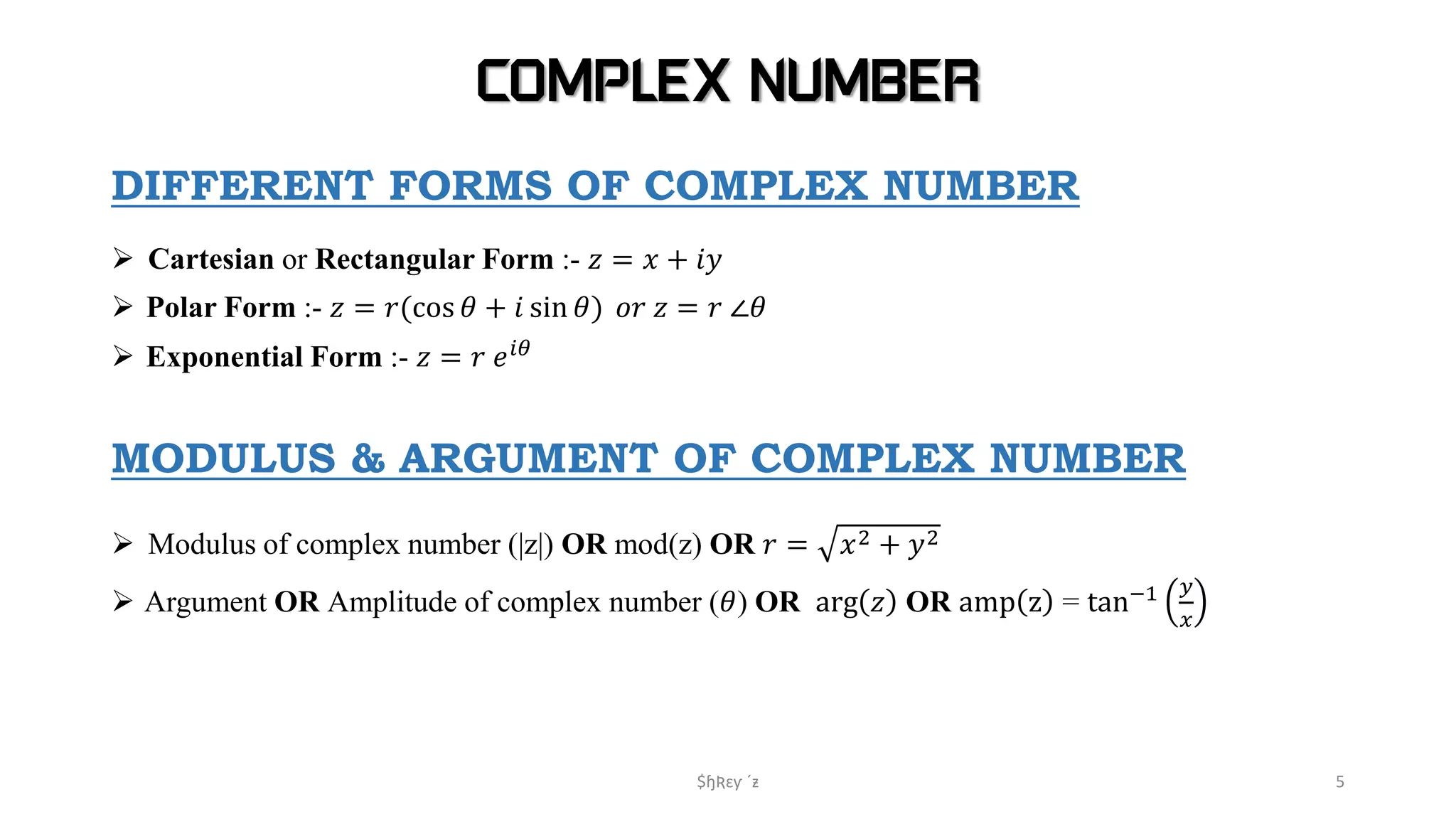
COMPLEX NUMBER
DIFFERENT FORMSOF COMPLEX NUMBER
Cartesian or Rectangular Form :- 𝑧 = 𝑥 + 𝑖𝑦
Polar Form :- 𝑧 = 𝑟(cos 𝜃 + 𝑖 sin 𝜃) 𝑜𝑟 𝑧 = 𝑟 ∠𝜃
Exponential Form :- 𝑧 = 𝑟 𝑒 𝑖𝜃
MODULUS & ARGUMENT OF COMPLEX NUMBER
Modulus of complex number (|z|) OR mod(z) OR 𝑟 = 𝑥2 + 𝑦2
Argument OR Amplitude of complex number (𝜃) OR arg 𝑧 OR amp z = tan−1 𝑦
𝑥
$ɧƦɛƴ ´ƶ 5
6.
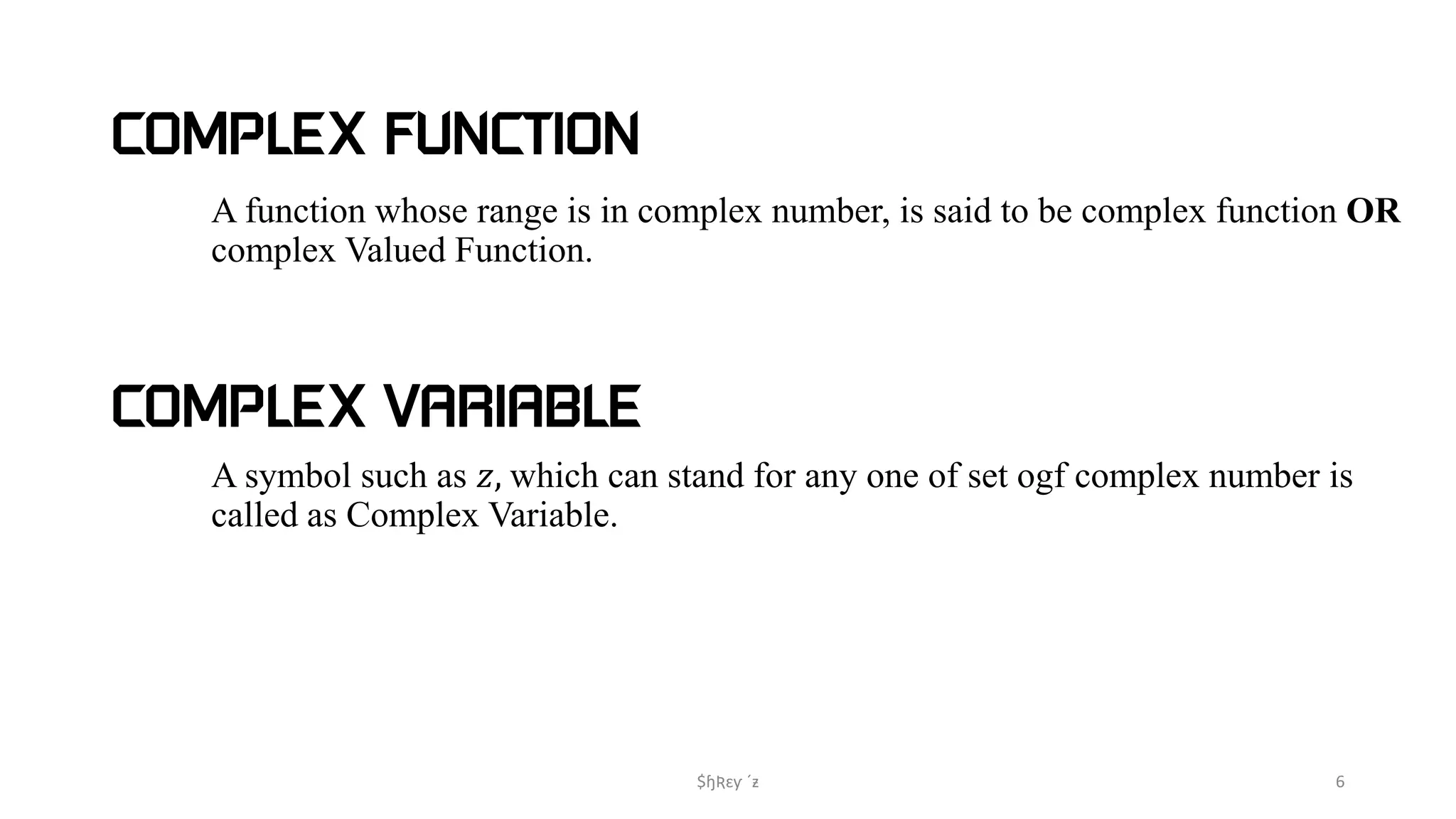
COMPLEX FUNCTION
A functionwhose range is in complex number, is said to be complex function OR
complex Valued Function.
$ɧƦɛƴ ´ƶ 6
COMPLEX VARIABLE
A symbol such as 𝑧, which can stand for any one of set ogf complex number is
called as Complex Variable.
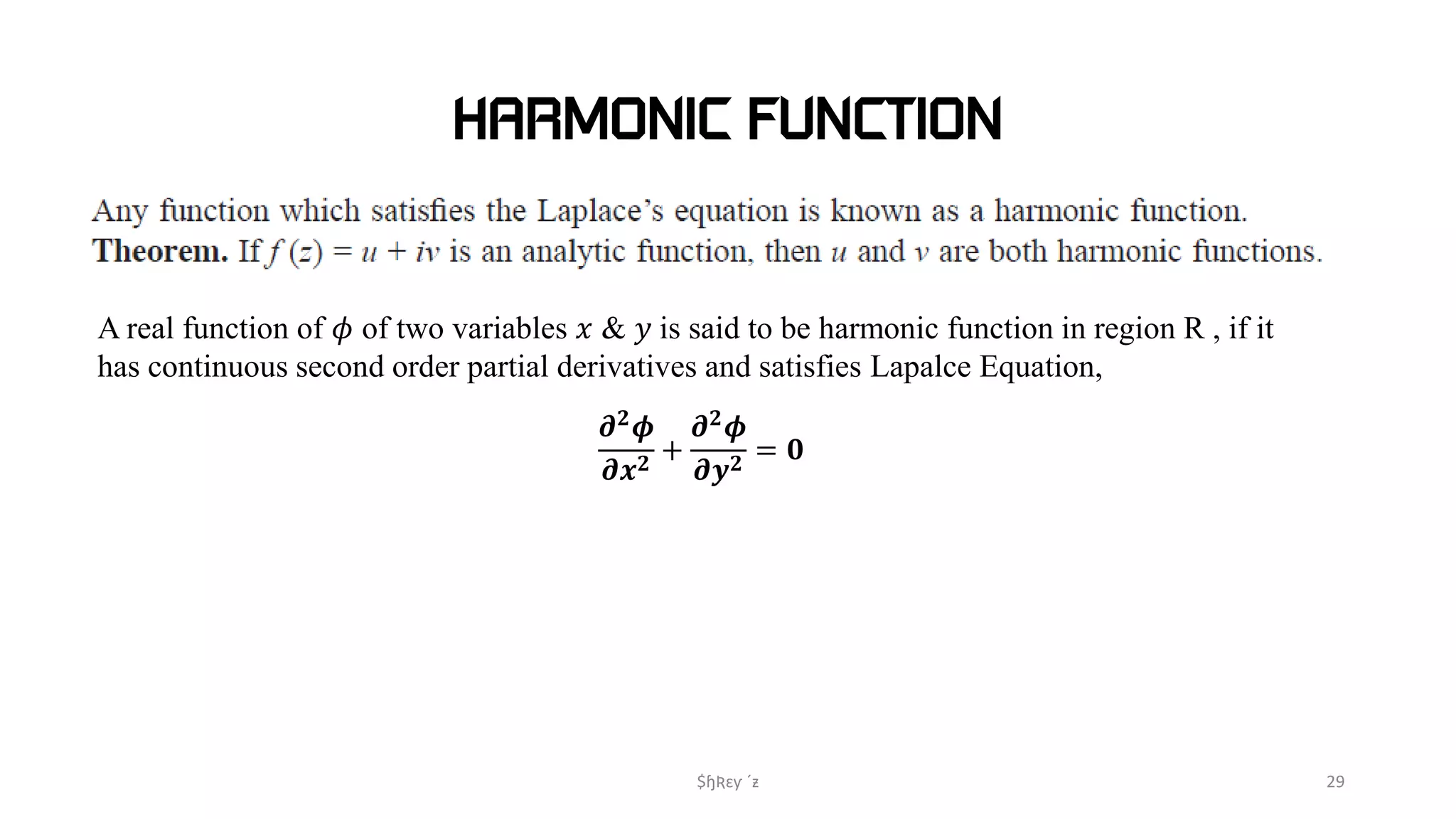
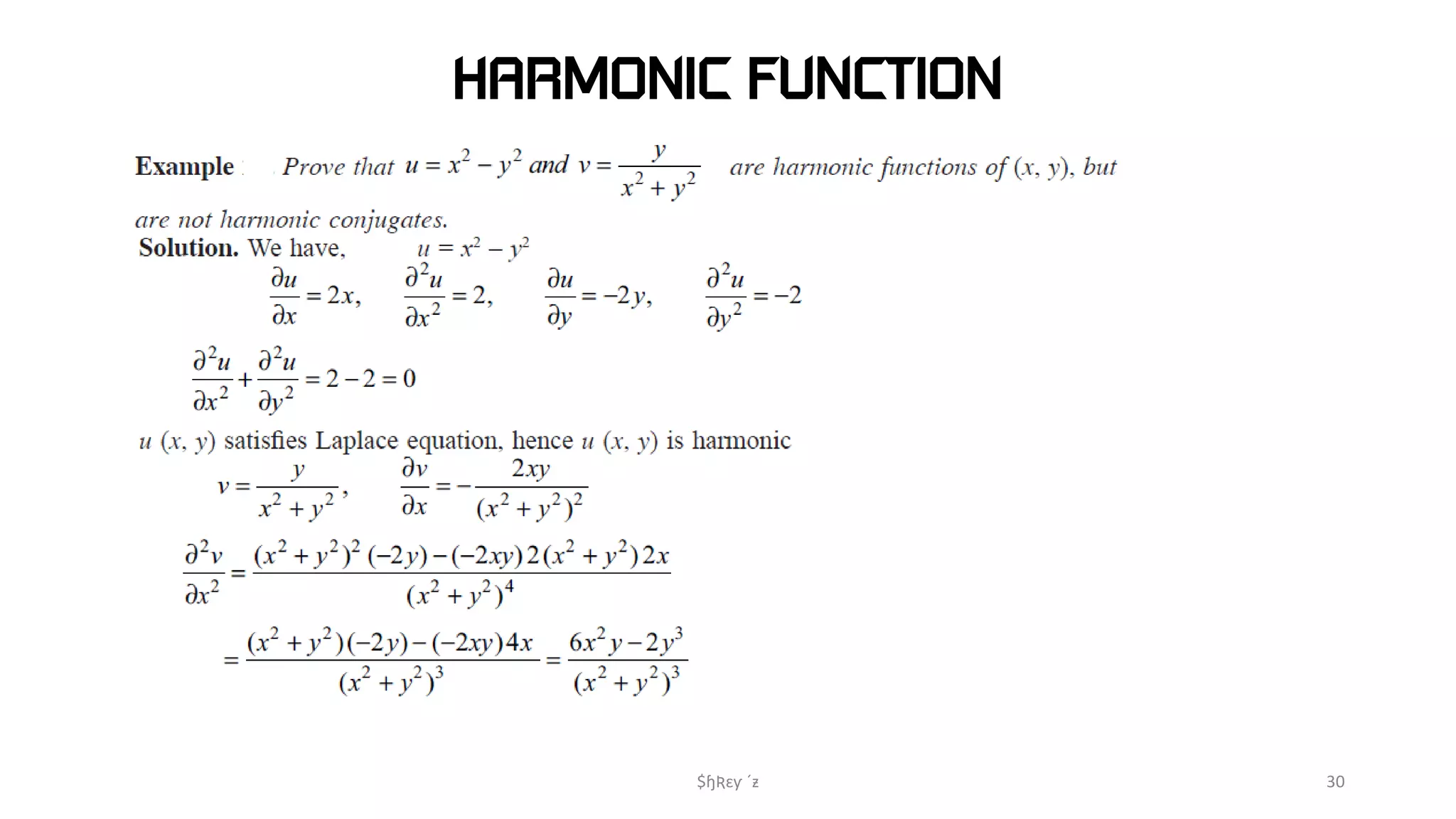
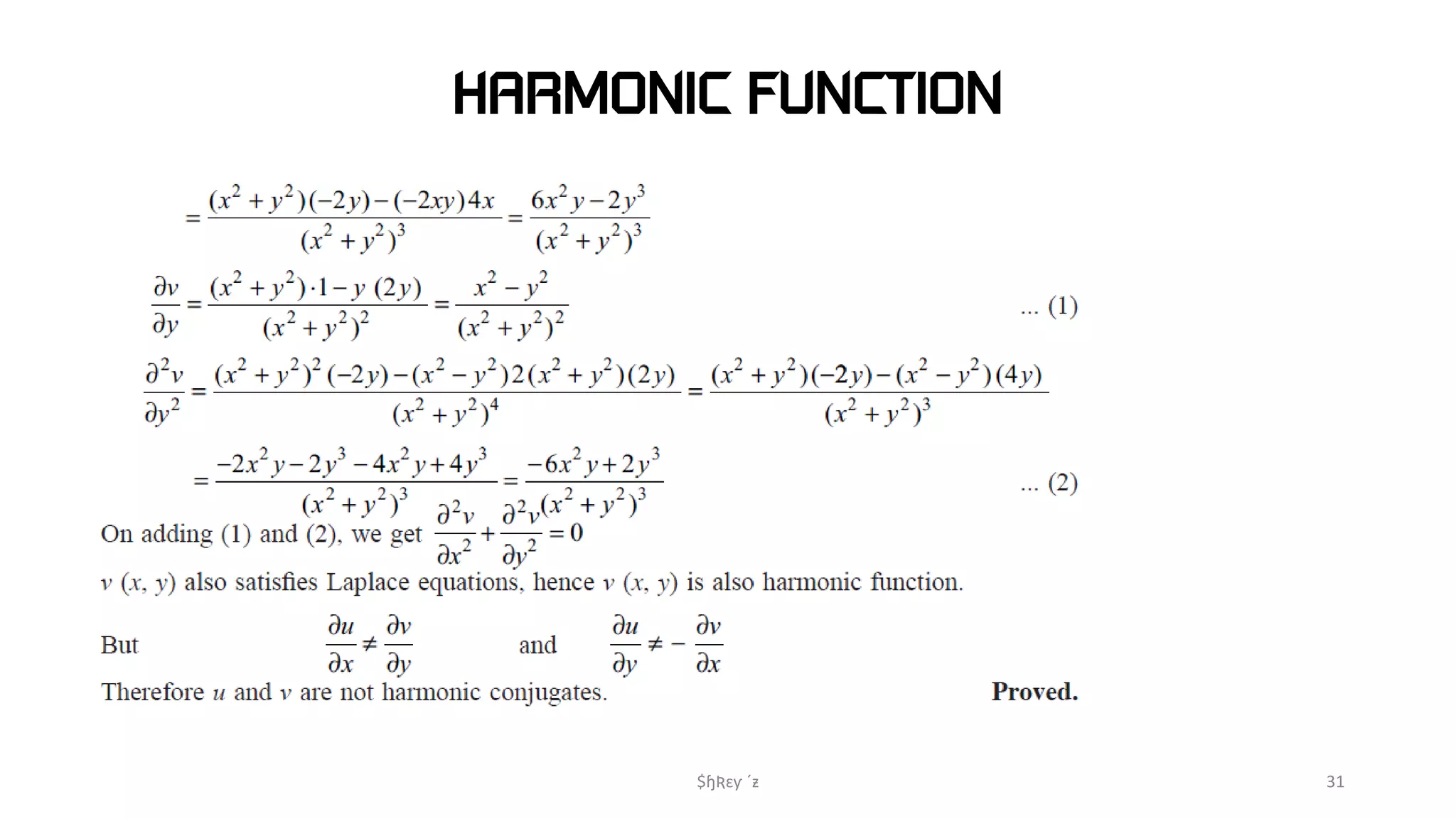
HARMONIC FUNCTION
$ɧƦɛƴ ´ƶ29
A real function of 𝜙 of two variables 𝑥 & 𝑦 is said to be harmonic function in region R , if it
has continuous second order partial derivatives and satisfies Lapalce Equation,
𝝏 𝟐 𝝓
𝝏𝒙 𝟐
+
𝝏 𝟐 𝝓
𝝏𝒚 𝟐
= 𝟎
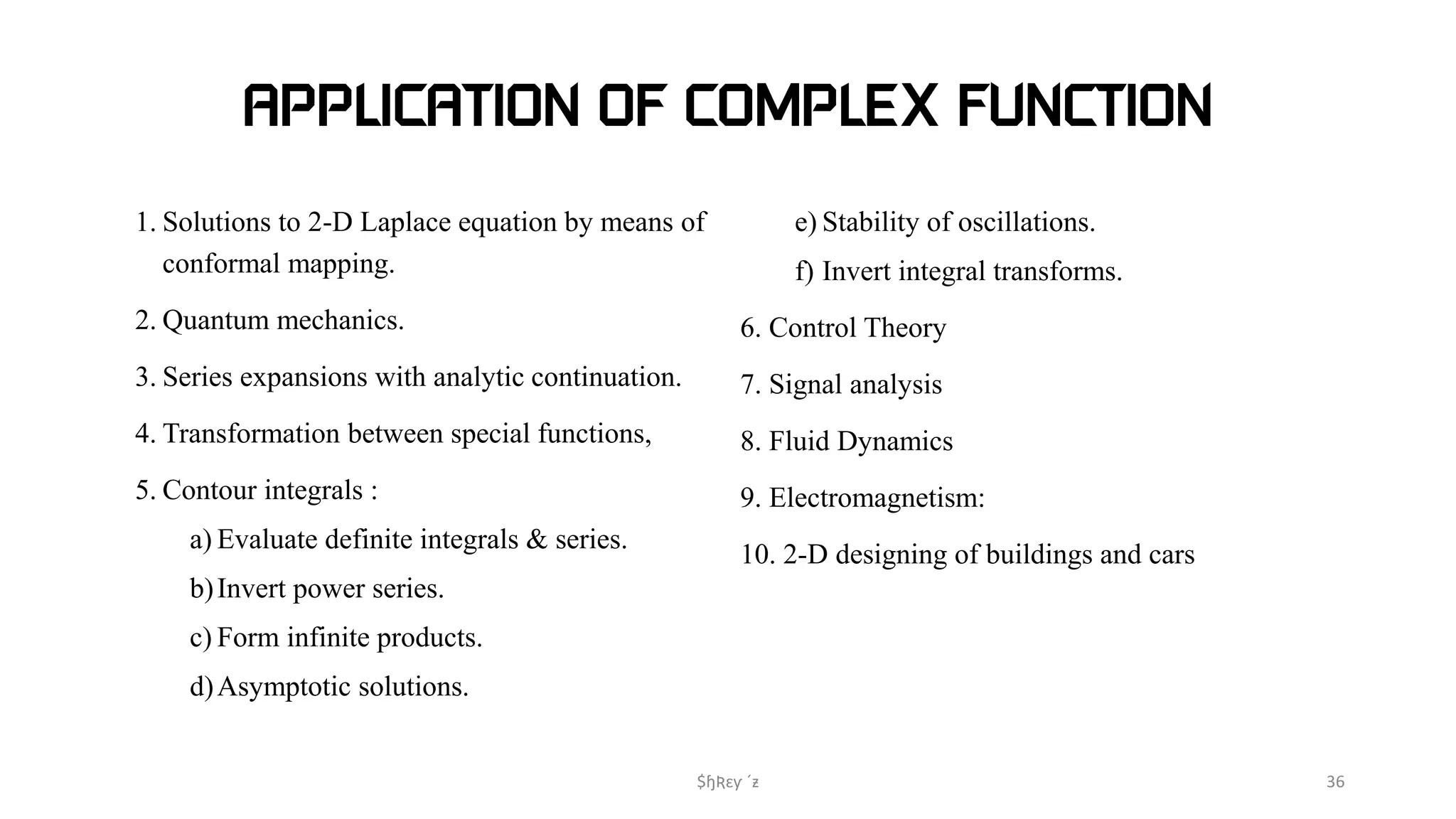
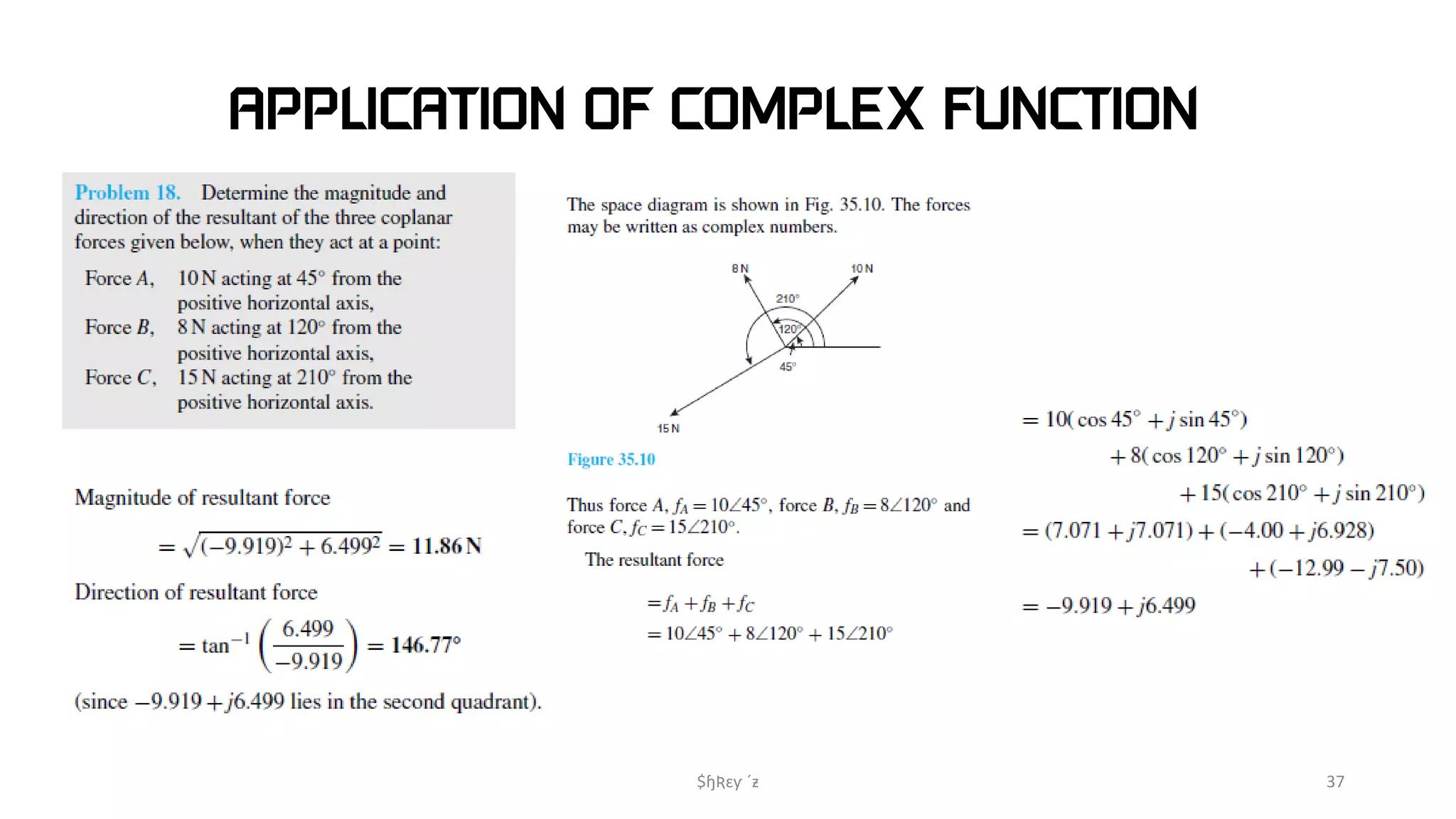
APPLICATION OF COMPLEXFUNCTION
1. Solutions to 2-D Laplace equation by means of
conformal mapping.
2. Quantum mechanics.
3. Series expansions with analytic continuation.
4. Transformation between special functions,
5. Contour integrals :
a) Evaluate definite integrals & series.
b)Invert power series.
c) Form infinite products.
d)Asymptotic solutions.
e) Stability of oscillations.
f) Invert integral transforms.
6. Control Theory
7. Signal analysis
8. Fluid Dynamics
9. Electromagnetism:
10. 2-D designing of buildings and cars
$ɧƦɛƴ ´ƶ 36