We here go through the complex algebra briefly.
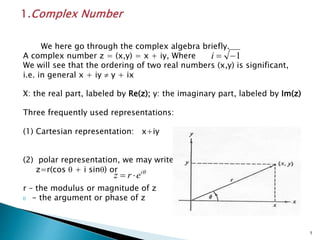
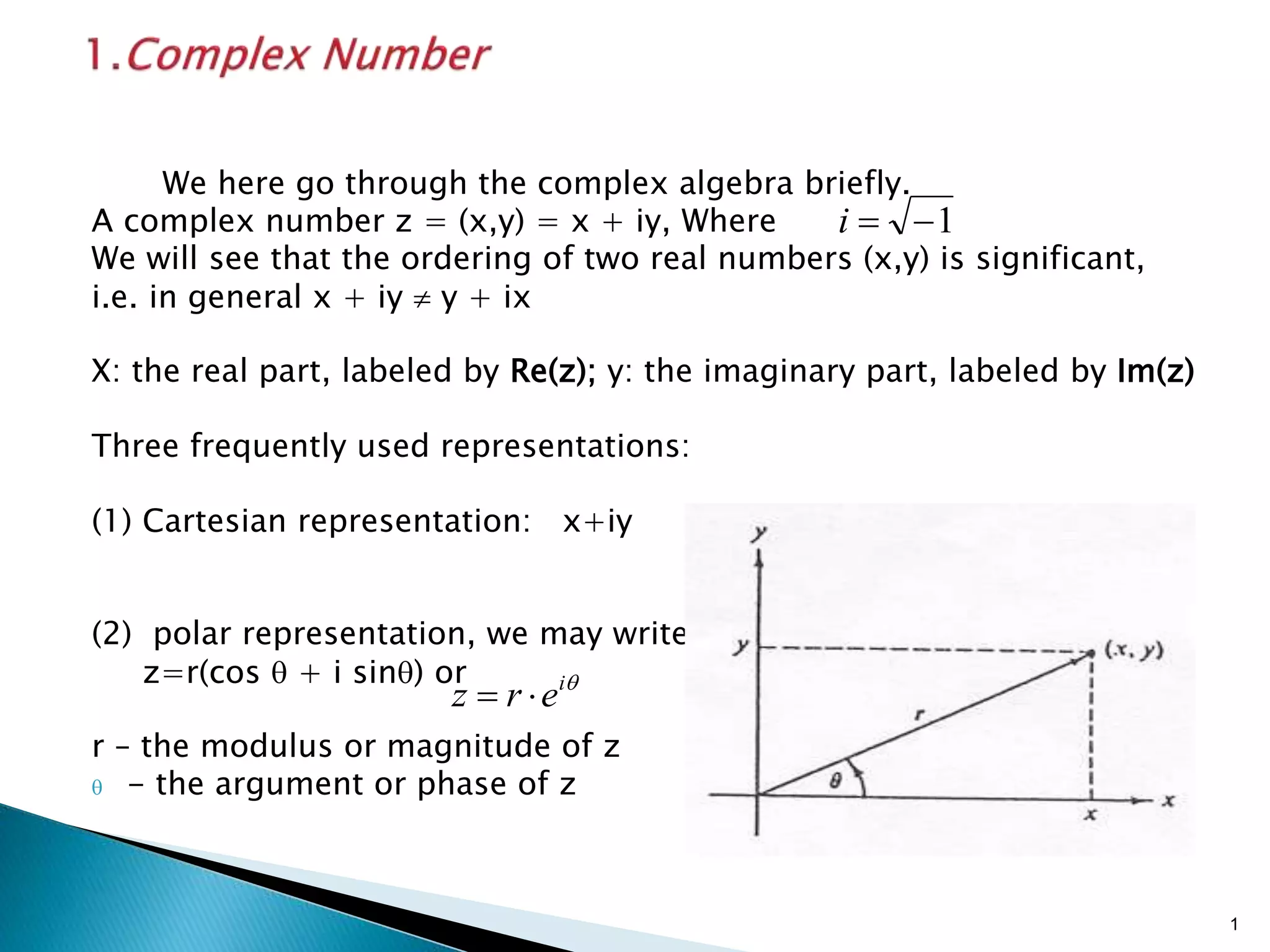
A complex number z = (x,y) = x + iy, Where
We will see that the ordering of two real numbers (x,y) is significant,
i.e. in general x + iy  y + ix
X: the real part, labeled by Re(z); y: the imaginary part, labeled by Im(z)
Three frequently used representations:
(1) Cartesian representation: x+iy
(2) polar representation, we may write
z=r(cos  + i sin) or
r – the modulus or magnitude of z
 - the argument or phase of z
1


i
1

i
e
r
z 

2
r – the modulus or magnitude of z
 - the argument or phase of z
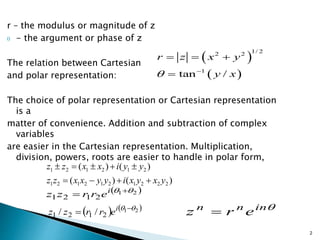
The relation between Cartesian
and polar representation:
The choice of polar representation or Cartesian representation
is a
matter of convenience. Addition and subtraction of complex
variables
are easier in the Cartesian representation. Multiplication,
division, powers, roots are easier to handle in polar form,
 
 
1/ 2
2 2
1
tan /
r z x y
y x
 
  

 
2
1
2
1
2
1

 
 i
e
r
r
z
z
   
2
1
2
1
2
1 /
/ 
 
 i
e
r
r
z
z

in
n
n
e
r
z 
)
(
)
(
)
(
)
(
2
2
2
1
2
1
2
1
2
1
2
1
2
1
2
1
y
x
y
x
i
y
y
x
x
z
z
y
y
i
x
x
z
z









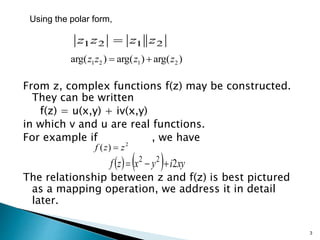
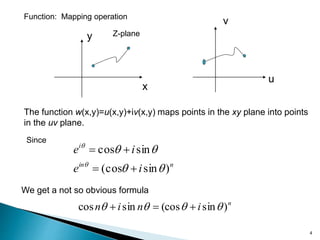
From z, complex functions f(z) may be constructed.
They can be written
f(z) = u(x,y) + iv(x,y)
in which v and u are real functions.
For example if , we have
The relationship between z and f(z) is best pictured
as a mapping operation, we address it in detail
later.
)
arg(
)
arg(
)
arg( 2
1
2
1 z
z
z
z 

3
2
1
2
1 z
z
z
z 
    xy
i
y
x
z
f 2
2
2



Using the polar form,
2
)
( z
z
f 
4
Function: Mapping operation
x
y Z-plane
u
v
The function w(x,y)=u(x,y)+iv(x,y) maps points in the xy plane into points
in the uv plane.
n
in
i
i
e
i
e
)
sin
(cos
sin
cos










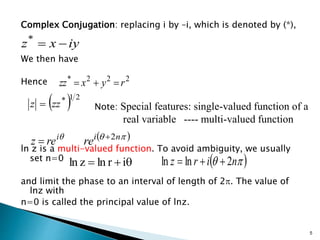
We get a not so obvious formula
Since
n
i
n
i
n )
sin
(cos
sin
cos 


 


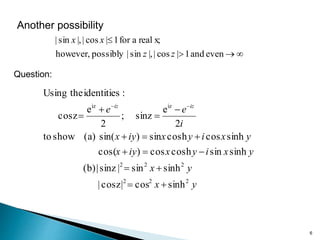
Complex Conjugation: replacing i by –i, which is denoted by (*),
We then have
Hence
Note:
ln z is a multi-valued function. To avoid ambiguity, we usually
set n=0
and limit the phase to an interval of length of 2. The value of
lnz with
n=0 is called the principal value of lnz.
5
iy
x
z 

*
2
2
2
*
r
y
x
zz 


  2
1
*
zz
z  Special features: single-valued function of a
real variable ---- multi-valued function

i
re
z   

 n
i
re 2



 i
r
ln
z
ln  

 n
i
r
z 2
ln
ln 


6
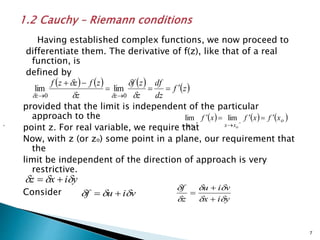
Another possibility




even
and
1
|
cos
|
|,
sin
|
possibly
however,
x;
real
a
for
1
|
cos
|
|,
sin
|
z
z
x
x
Question:
y
x
y
x
y
x
i
y
x
iy
x
y
x
i
y
x
iy
x
i
e
e iz
iz
2
2
2
2
2
2
iz
iz
sinh
cos
|
cosz
|
sinh
sin
|
sinz
|
(b)
sinh
sin
cosh
cos
)
cos(
sinh
cos
cosh
sin
)
sin(
(a)
show
to
2
e
sinz
;
2
e
cosz
:
identities
the
Using
















Having established complex functions, we now proceed to
differentiate them. The derivative of f(z), like that of a real
function, is
defined by
provided that the limit is independent of the particular
approach to the
point z. For real variable, we require that
Now, with z (or zo) some point in a plane, our requirement that
the
limit be independent of the direction of approach is very
restrictive.
Consider
7
       
z
f
dz
df
z
z
f
z
z
f
z
z
f
z
z







 




 0
0
lim
lim
     
o
x
x
x
x
x
f
x
f
x
f
o
o









lim
lim
y
i
x
z 

 

v
i
u
f 

 

,
y
i
x
v
i
u
z
f









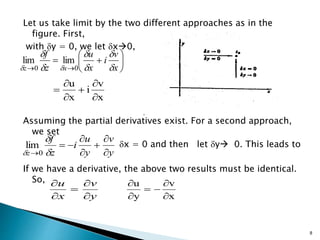
Let us take limit by the two different approaches as in the
figure. First,
with y = 0, we let x0,
Assuming the partial derivatives exist. For a second approach,
we set
x = 0 and then let y 0. This leads to
If we have a derivative, the above two results must be identical.
So,
8









 x
v
i
x
u
z
f
x
z 






 0
0
lim
lim
x
v
i
x
u






y
v
y
u
i
z
f
z 






 

 0
lim
y
v
x
u





,
x
v
y
u






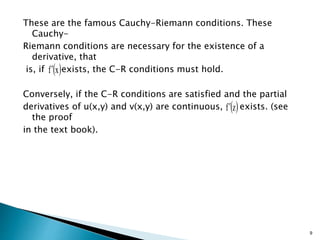
These are the famous Cauchy-Riemann conditions. These
Cauchy-
Riemann conditions are necessary for the existence of a
derivative, that
is, if exists, the C-R conditions must hold.
Conversely, if the C-R conditions are satisfied and the partial
derivatives of u(x,y) and v(x,y) are continuous, exists. (see
the proof
in the text book).
9
 
x
f
 
z
f
10
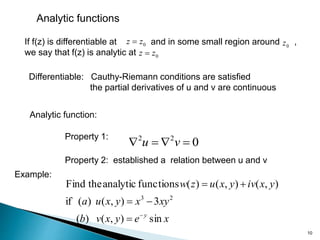
Analytic functions
If f(z) is differentiable at and in some small region around ,
we say that f(z) is analytic at
Differentiable: Cauthy-Riemann conditions are satisfied
the partial derivatives of u and v are continuous
Analytic function:
Property 1:
Property 2: established a relation between u and v
0
2
2



 v
u
Example:
x
e
y
x
v
b
xy
x
y
x
u
a
y
x
iv
y
x
u
z
w
y
sin
)
,
(
)
(
3
)
,
(
)
(
if
)
,
(
)
,
(
)
(
functions
analytic
the
Find
2
3






0
z
z 
0
z
z 
0
z

ComplexNumber.ppt

  • 1.
    We here gothrough the complex algebra briefly. A complex number z = (x,y) = x + iy, Where We will see that the ordering of two real numbers (x,y) is significant, i.e. in general x + iy  y + ix X: the real part, labeled by Re(z); y: the imaginary part, labeled by Im(z) Three frequently used representations: (1) Cartesian representation: x+iy (2) polar representation, we may write z=r(cos  + i sin) or r – the modulus or magnitude of z  - the argument or phase of z 1   i 1  i e r z  
  • 2.
    2 r – themodulus or magnitude of z  - the argument or phase of z The relation between Cartesian and polar representation: The choice of polar representation or Cartesian representation is a matter of convenience. Addition and subtraction of complex variables are easier in the Cartesian representation. Multiplication, division, powers, roots are easier to handle in polar form,     1/ 2 2 2 1 tan / r z x y y x         2 1 2 1 2 1     i e r r z z     2 1 2 1 2 1 / /     i e r r z z  in n n e r z  ) ( ) ( ) ( ) ( 2 2 2 1 2 1 2 1 2 1 2 1 2 1 2 1 y x y x i y y x x z z y y i x x z z         
  • 3.
    From z, complexfunctions f(z) may be constructed. They can be written f(z) = u(x,y) + iv(x,y) in which v and u are real functions. For example if , we have The relationship between z and f(z) is best pictured as a mapping operation, we address it in detail later. ) arg( ) arg( ) arg( 2 1 2 1 z z z z   3 2 1 2 1 z z z z      xy i y x z f 2 2 2    Using the polar form, 2 ) ( z z f 
  • 4.
    4 Function: Mapping operation x yZ-plane u v The function w(x,y)=u(x,y)+iv(x,y) maps points in the xy plane into points in the uv plane. n in i i e i e ) sin (cos sin cos           We get a not so obvious formula Since n i n i n ) sin (cos sin cos       
  • 5.
    Complex Conjugation: replacingi by –i, which is denoted by (*), We then have Hence Note: ln z is a multi-valued function. To avoid ambiguity, we usually set n=0 and limit the phase to an interval of length of 2. The value of lnz with n=0 is called the principal value of lnz. 5 iy x z   * 2 2 2 * r y x zz      2 1 * zz z  Special features: single-valued function of a real variable ---- multi-valued function  i re z      n i re 2     i r ln z ln     n i r z 2 ln ln   
  • 6.
  • 7.
    Having established complexfunctions, we now proceed to differentiate them. The derivative of f(z), like that of a real function, is defined by provided that the limit is independent of the particular approach to the point z. For real variable, we require that Now, with z (or zo) some point in a plane, our requirement that the limit be independent of the direction of approach is very restrictive. Consider 7         z f dz df z z f z z f z z f z z               0 0 lim lim       o x x x x x f x f x f o o          lim lim y i x z      v i u f      , y i x v i u z f         
  • 8.
    Let us takelimit by the two different approaches as in the figure. First, with y = 0, we let x0, Assuming the partial derivatives exist. For a second approach, we set x = 0 and then let y 0. This leads to If we have a derivative, the above two results must be identical. So, 8           x v i x u z f x z         0 0 lim lim x v i x u       y v y u i z f z            0 lim y v x u      , x v y u      
  • 9.
    These are thefamous Cauchy-Riemann conditions. These Cauchy- Riemann conditions are necessary for the existence of a derivative, that is, if exists, the C-R conditions must hold. Conversely, if the C-R conditions are satisfied and the partial derivatives of u(x,y) and v(x,y) are continuous, exists. (see the proof in the text book). 9   x f   z f
  • 10.
    10 Analytic functions If f(z)is differentiable at and in some small region around , we say that f(z) is analytic at Differentiable: Cauthy-Riemann conditions are satisfied the partial derivatives of u and v are continuous Analytic function: Property 1: Property 2: established a relation between u and v 0 2 2     v u Example: x e y x v b xy x y x u a y x iv y x u z w y sin ) , ( ) ( 3 ) , ( ) ( if ) , ( ) , ( ) ( functions analytic the Find 2 3       0 z z  0 z z  0 z