Chp13 Complex Numbers and Functions.
Complex Differentiation
Prepared By
Hesham Ali
Marwa Ghaith
COMPLEX NUMBERS AND
THEIR GEOMETRIC
REPRESENTATION
Introduction
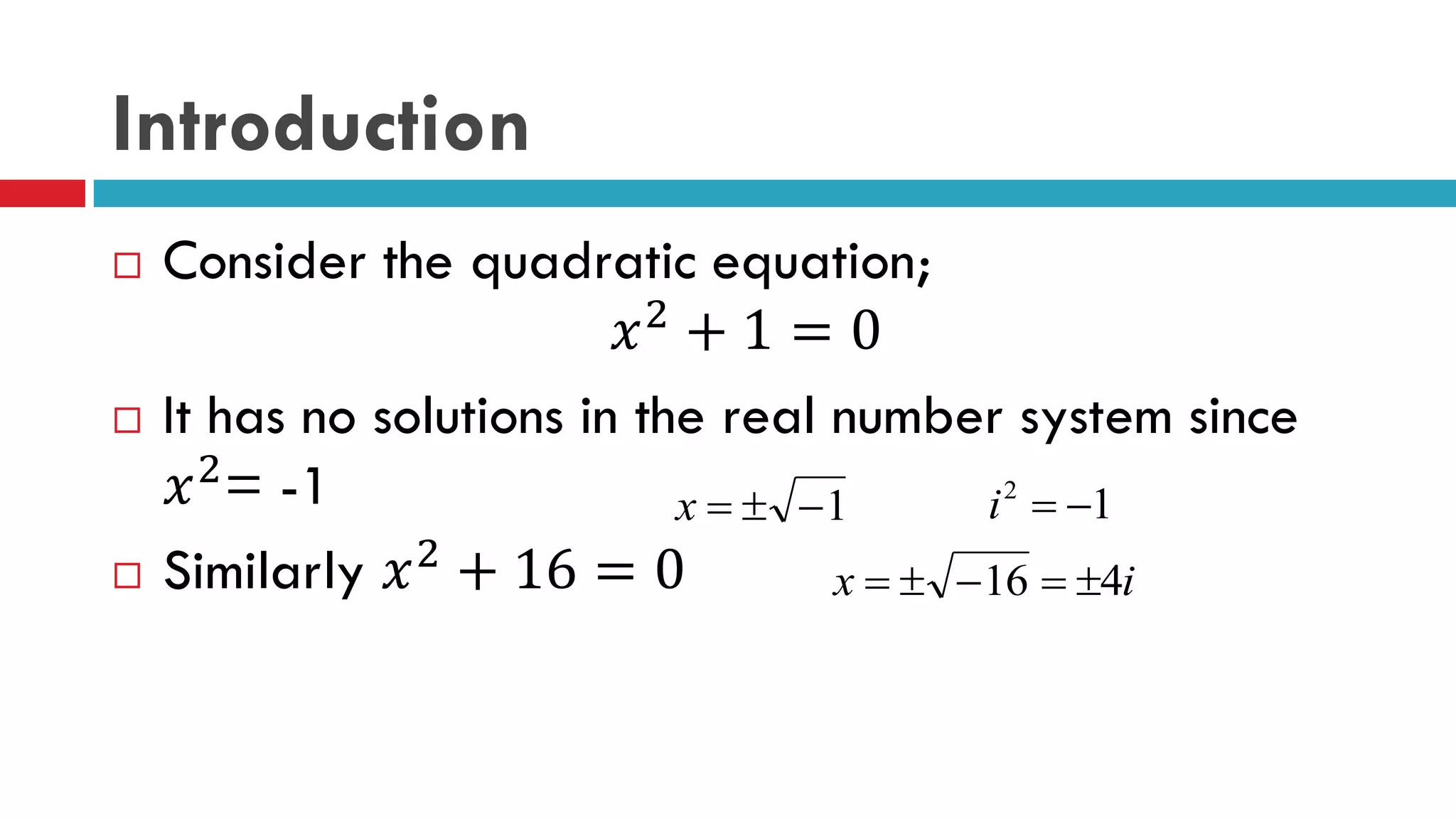
 Consider the quadratic equation;
𝑥2
+ 1 = 0
 It has no solutions in the real number system since
𝑥2
= -1
 Similarly 𝑥2
+ 16 = 0
1x 12
i
ix 416 
Introduction
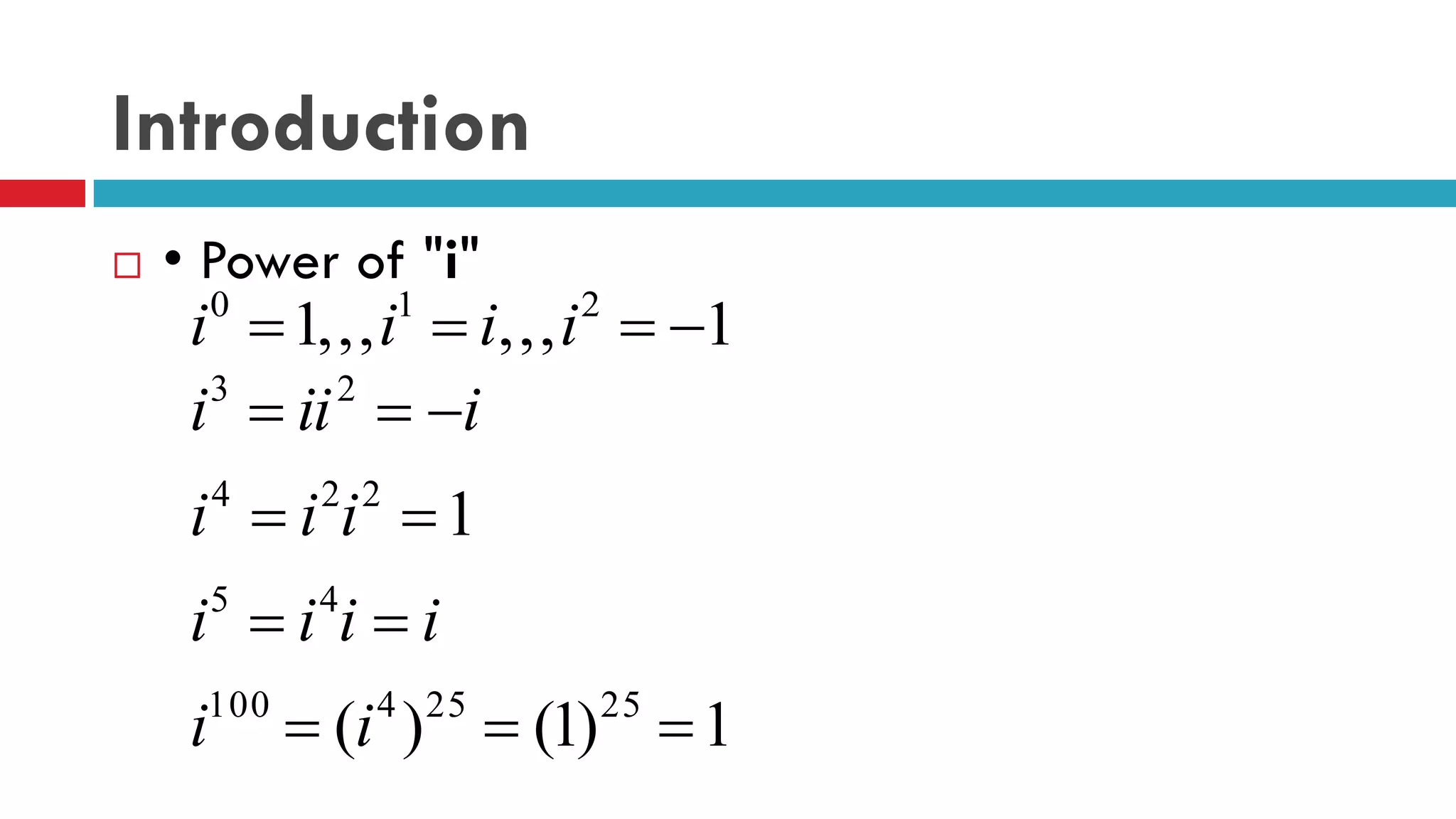
 • Power of "i"
1,,,,,,1 210
 iiii
1)1()(
1
25254100
45
224
23




ii
iiii
iii
iiii
Introduction
 A complex numbers is a number consisting a Real
and Imaginary part. z = (x, y).
 It can be written in the form(Cartesian form) :
Z = x + yi
Real Imaginary
Introduction
 Then x is known as the real part of z and y as the
imaginary part. We write x = Re z and y = Im z.
 Note that real numbers are complex – a real number
is simply a complex number with zero imaginary part.
Introduction
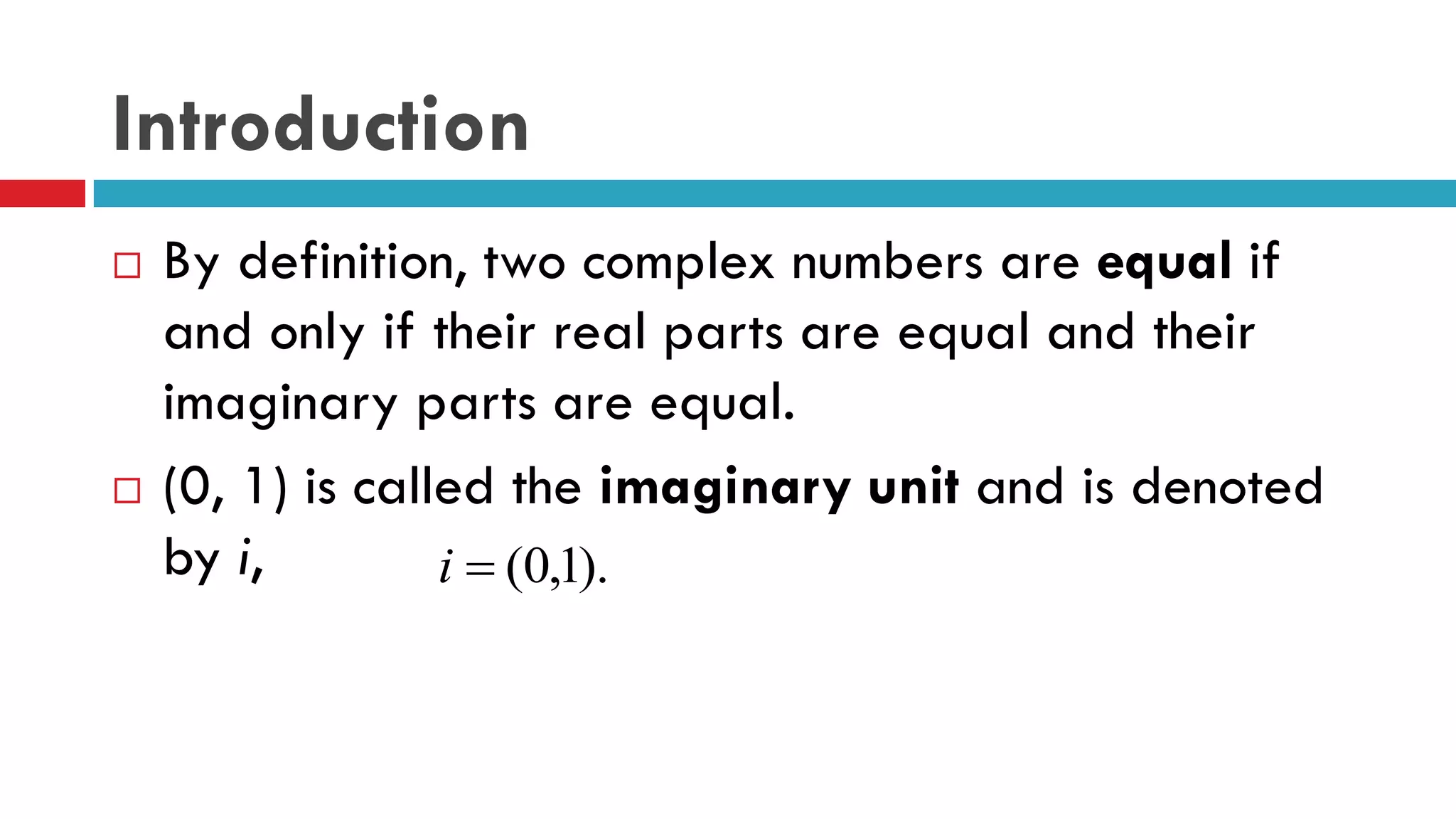
 By definition, two complex numbers are equal if
and only if their real parts are equal and their
imaginary parts are equal.
 (0, 1) is called the imaginary unit and is denoted
by i, ).1,0(i
Algebra of complex numbers
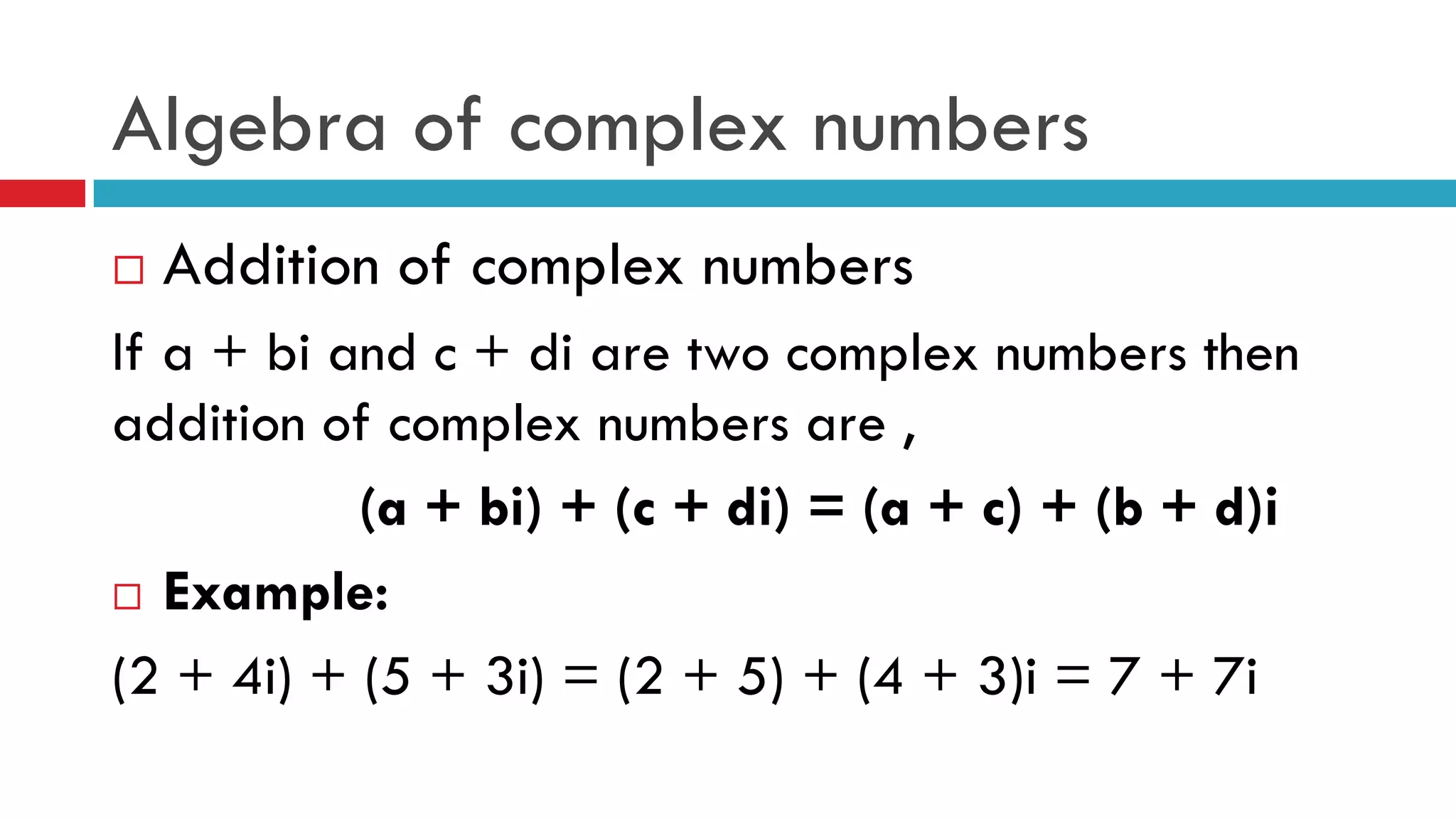
 Addition of complex numbers
If a + bi and c + di are two complex numbers then
addition of complex numbers are ,
(a + bi) + (c + di) = (a + c) + (b + d)i
 Example:
(2 + 4i) + (5 + 3i) = (2 + 5) + (4 + 3)i = 7 + 7i
Algebra of complex numbers
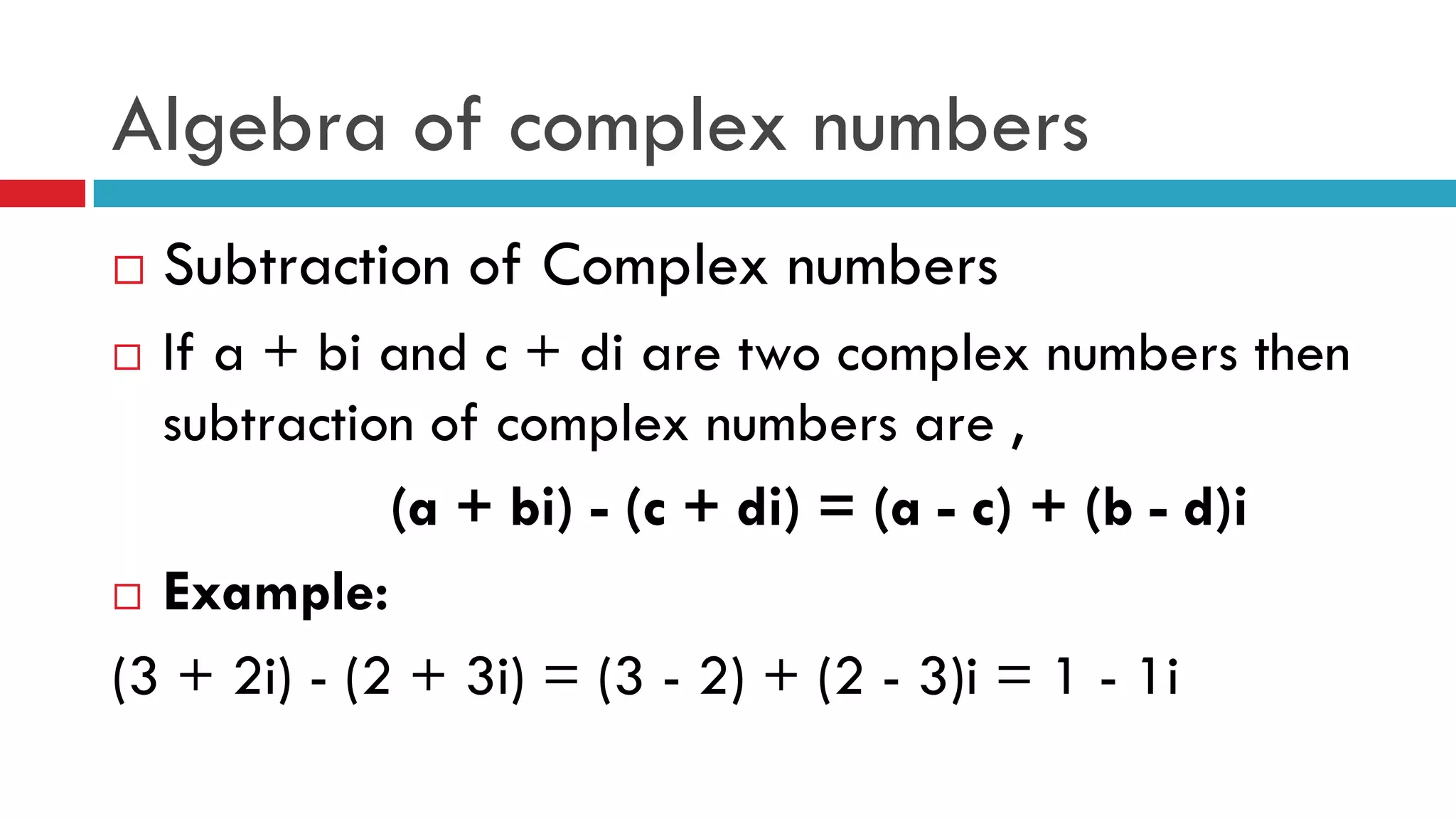
 Subtraction of Complex numbers
 If a + bi and c + di are two complex numbers then
subtraction of complex numbers are ,
(a + bi) - (c + di) = (a - c) + (b - d)i
 Example:
(3 + 2i) - (2 + 3i) = (3 - 2) + (2 - 3)i = 1 - 1i
Algebra of complex numbers
 Multiplication of Complex numbers
 If a + bi and c + di are two complex numbers then
multiplication of complex numbers is,
(a + bi)(c + di) = (ac -bd) + ( ad + bc)i
Example:
 (2 + 3i)(4 + 5i)=(2x4- 3x5)+(2x5+ 3x4)i =-7+22i
Algebra of complex numbers
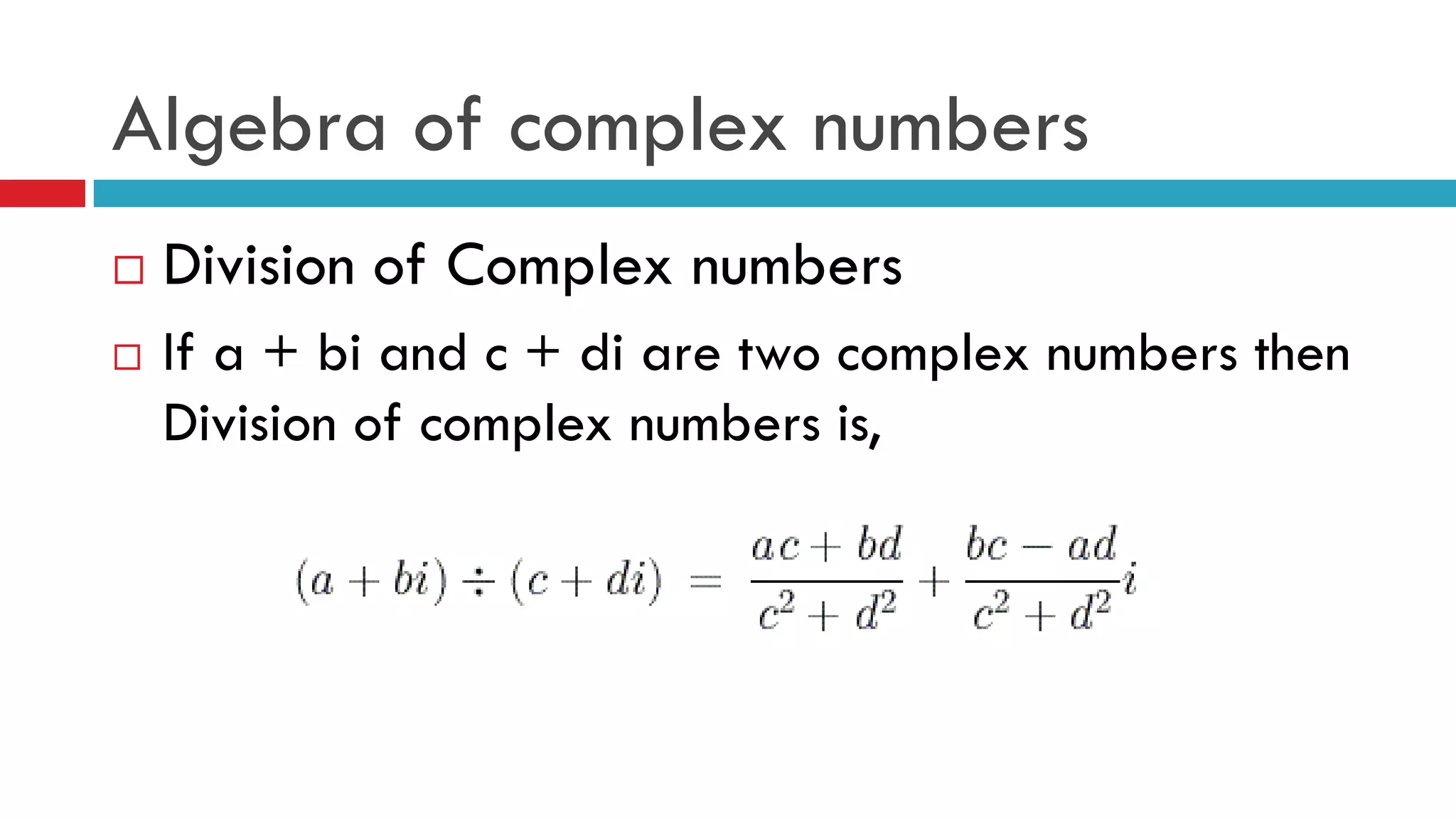
 Division of Complex numbers
 If a + bi and c + di are two complex numbers then
Division of complex numbers is,
Complex Plane (Argand diagram)
We choose two perpendicular
coordinate axes, the horizontal
x-axis, called the real axis,
and the vertical y-axis, called
the imaginary axis.
Complex Plane (Argand diagram)
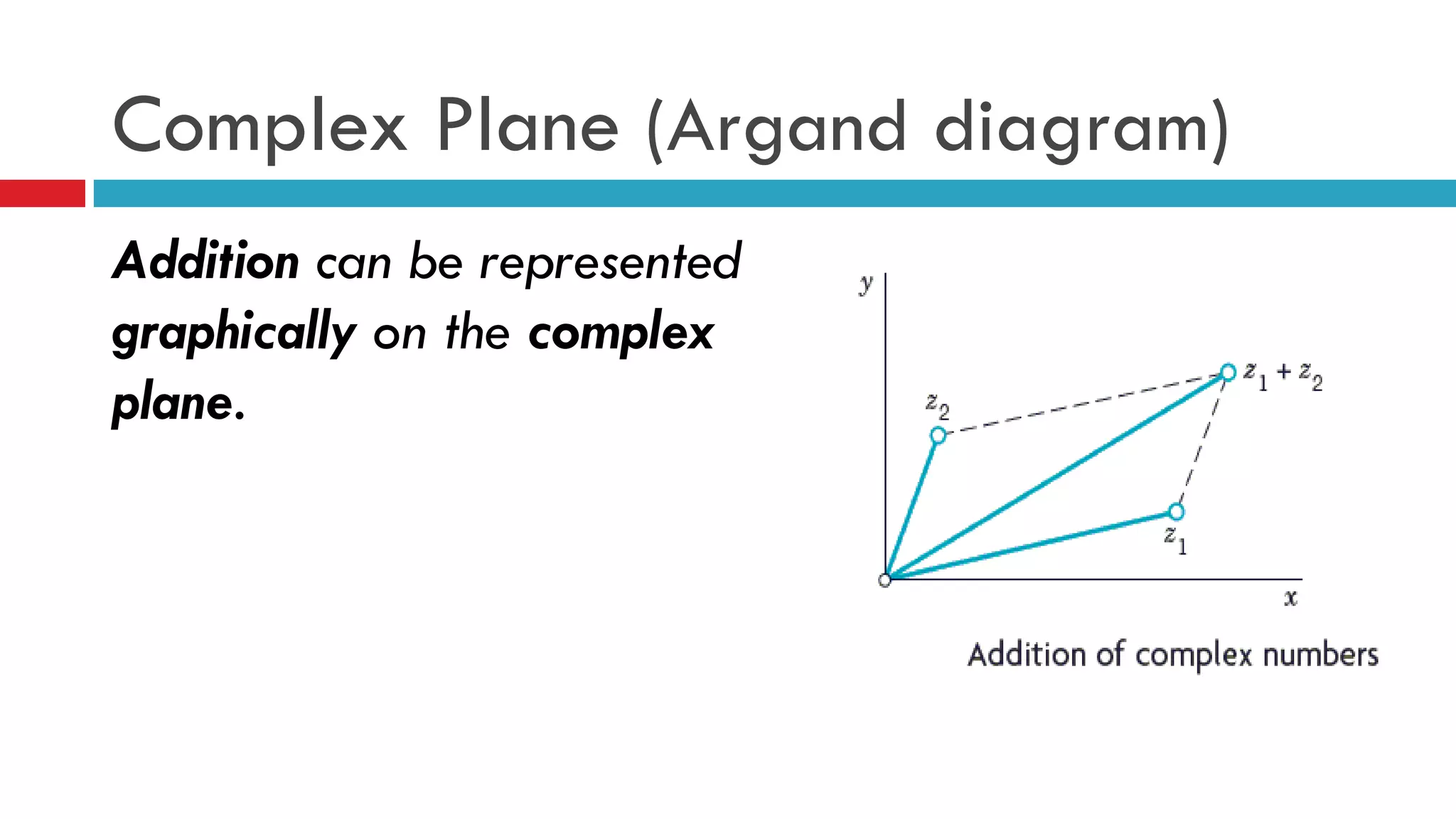
Addition can be represented
graphically on the complex
plane.
Complex Plane (Argand diagram)
Subtraction can be represented
graphically on the complex
plane.
Complex Conjugate Numbers
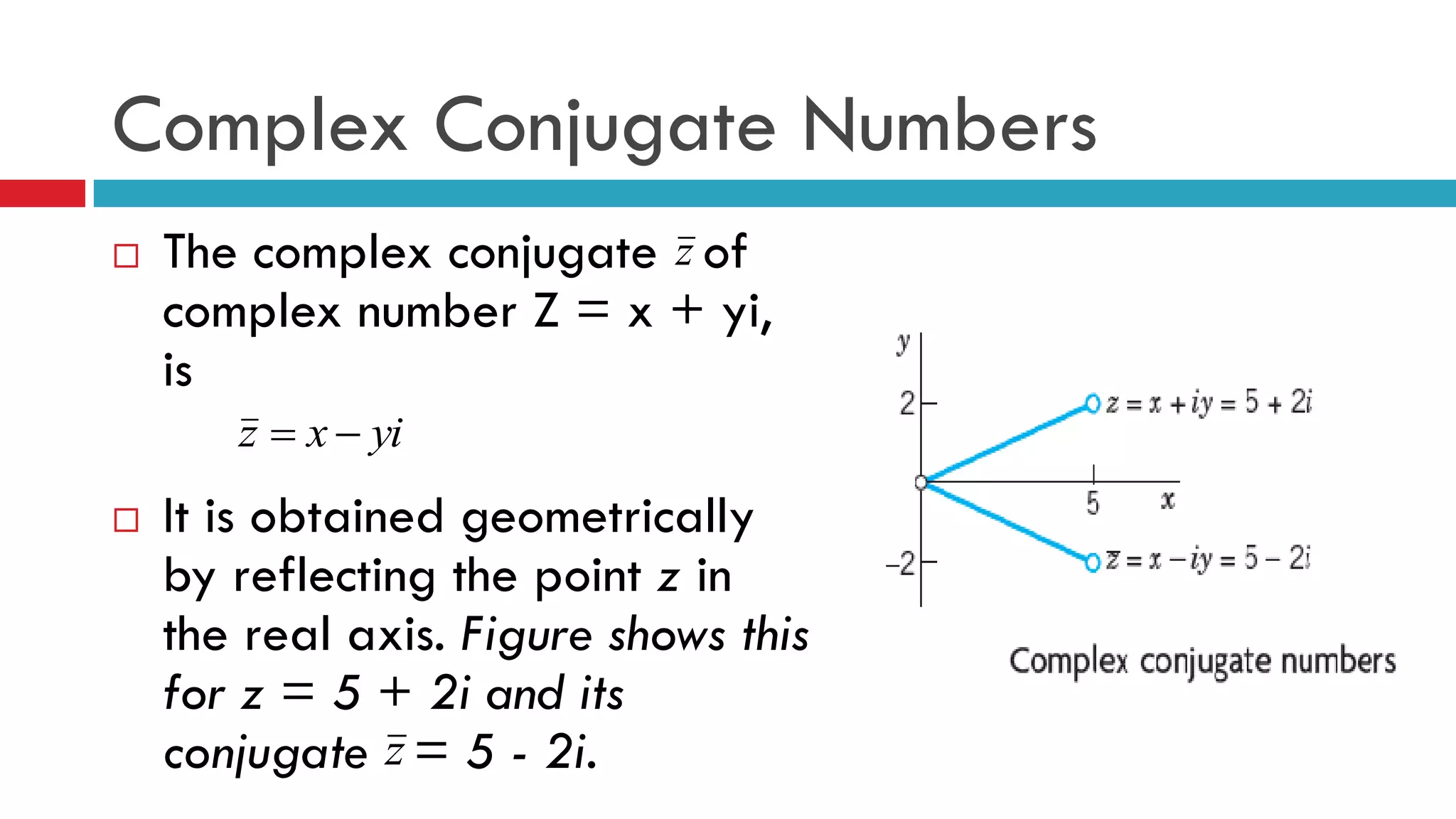
 The complex conjugate of
complex number Z = x + yi,
is
 It is obtained geometrically
by reflecting the point z in
the real axis. Figure shows this
for z = 5 + 2i and its
conjugate = 5 - 2i.
yixz 
z
z
Complex Conjugate Numbers
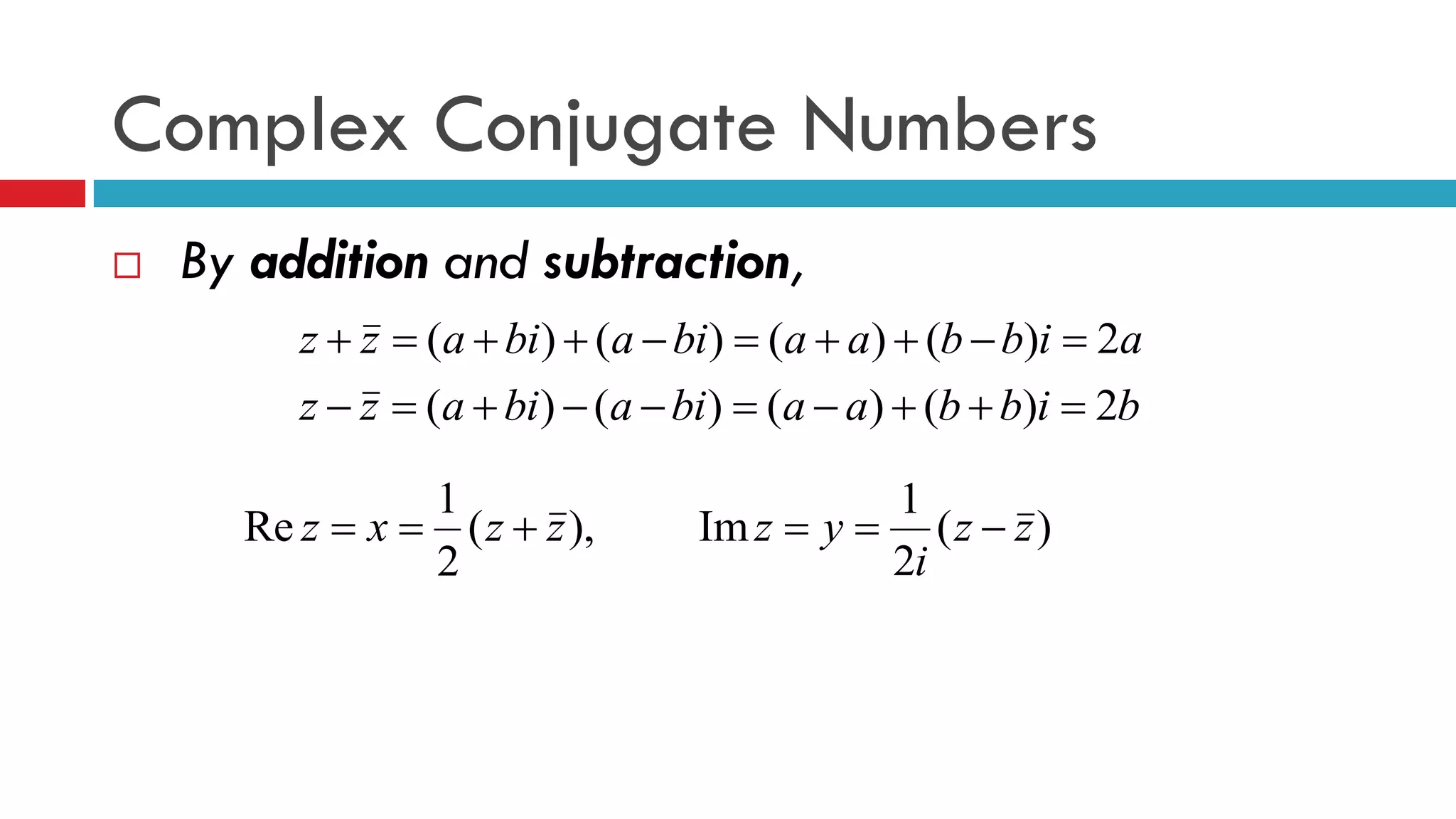
 By addition and subtraction,
bibbaabiabiazz
aibbaabiabiazz
2)()()()(
2)()()()(


),(
2
1
Re zzxz  )(
2
1
Im zz
i
yz 
Complex Conjugate Numbers
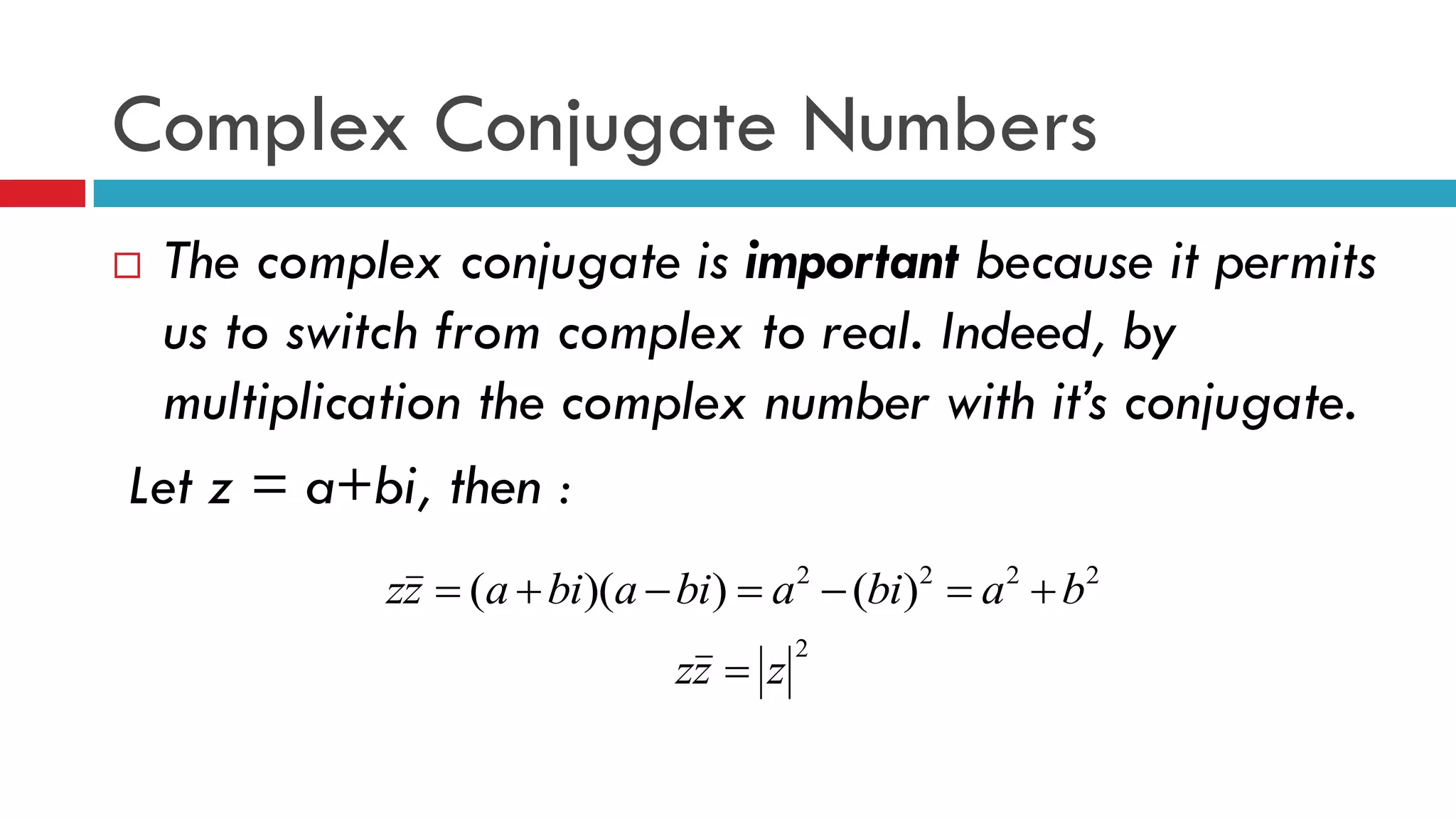
 The complex conjugate is important because it permits
us to switch from complex to real. Indeed, by
multiplication the complex number with it’s conjugate.
Let z = a+bi, then :
2222
)())(( babiabiabiazz 
2
zzz 
Complex Conjugate Numbers
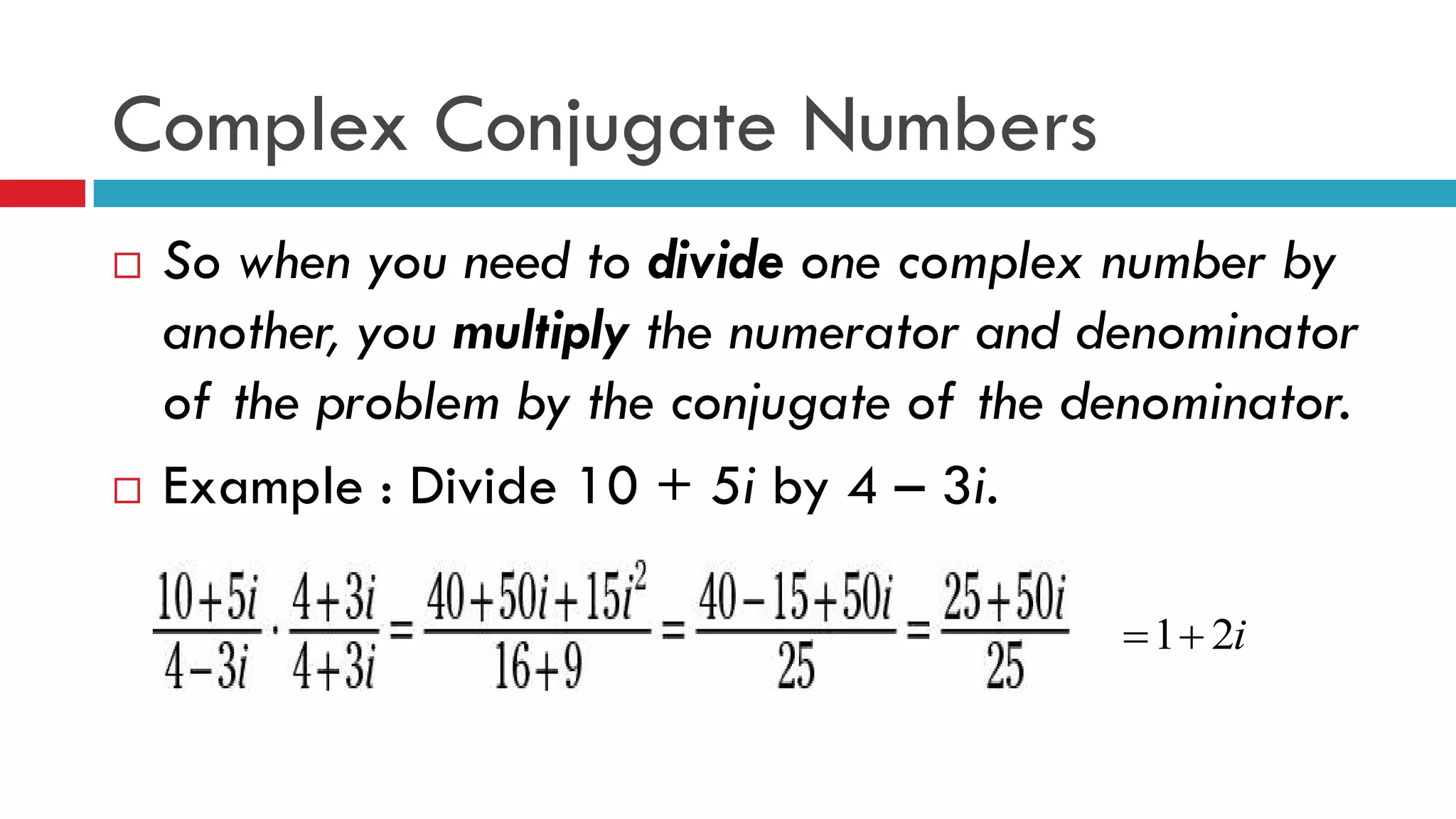
 So when you need to divide one complex number by
another, you multiply the numerator and denominator
of the problem by the conjugate of the denominator.
 Example : Divide 10 + 5i by 4 – 3i.
i21
Complex Conjugate Numbers
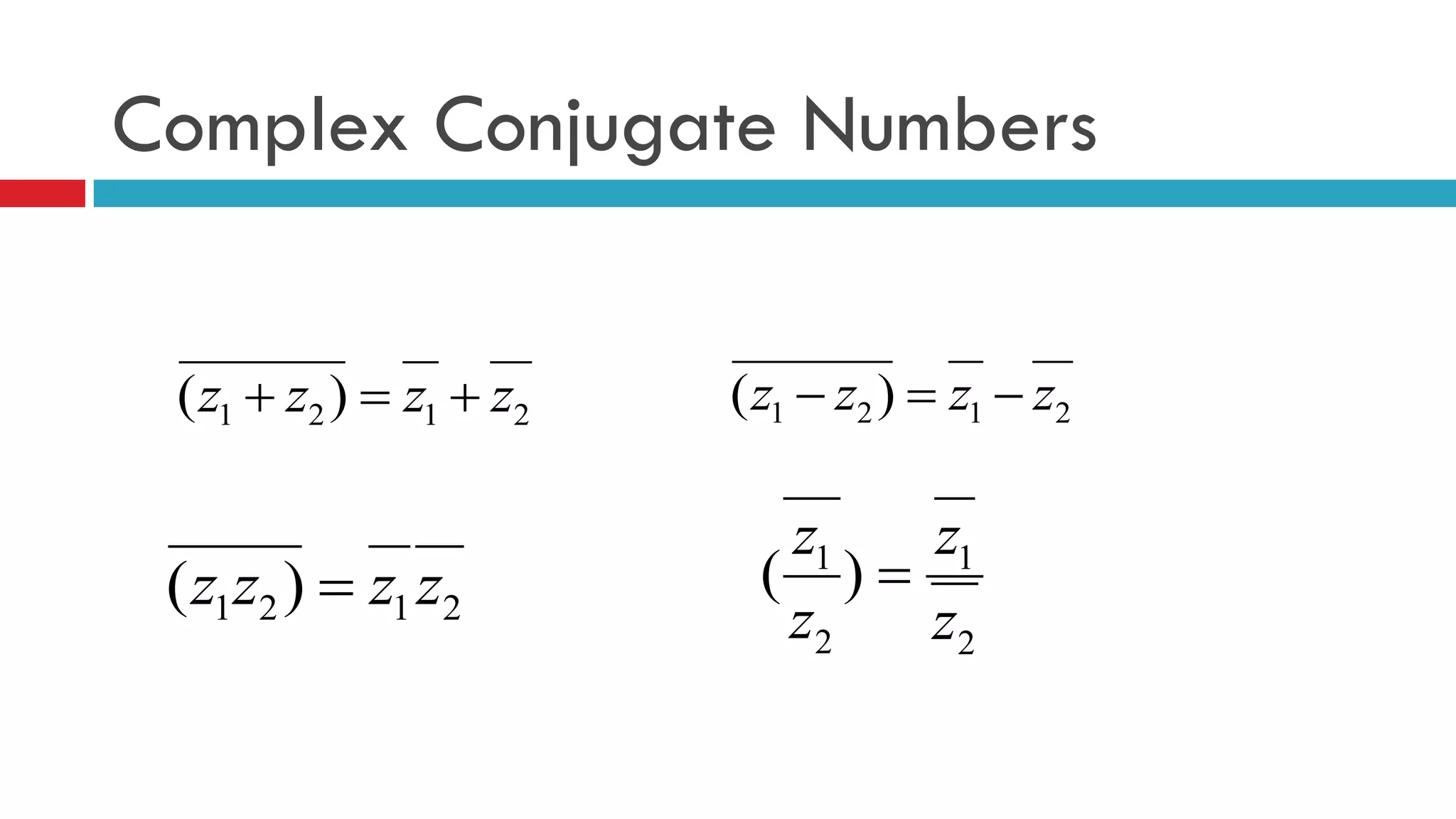
2121 )( zzzz  2121 )( zzzz 
2121 )( zzzz 
2
1
2
1
)(
z
z
z
z

POLAR FORM OF COMPLEX
NUMBERS.
POWERS AND ROOTS
Polar form
 Polar coordinates will help
us understand complex
numbers geometrically
,cosrx  sinry 
Polar form
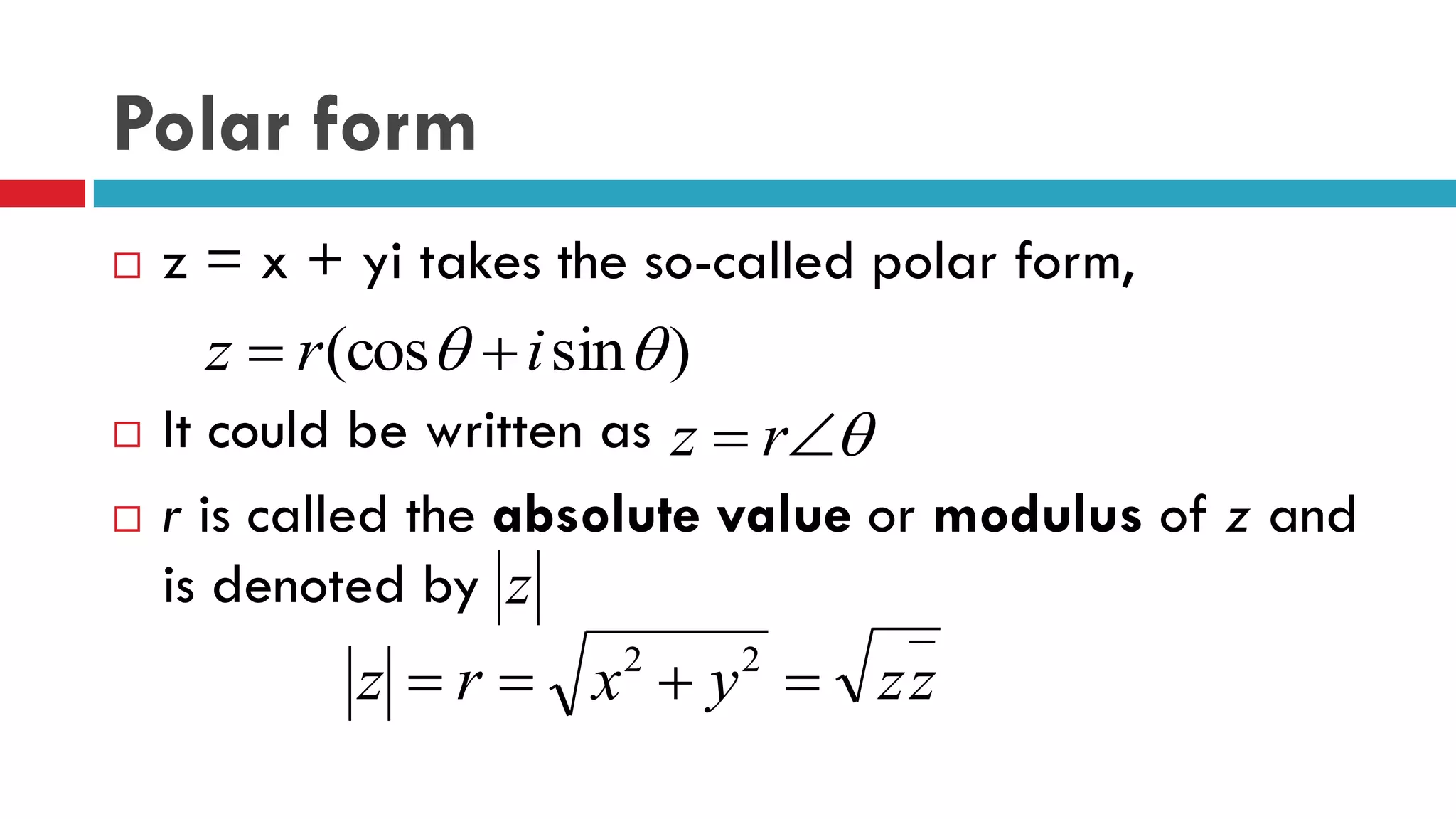
 z = x + yi takes the so-called polar form,
 It could be written as
 r is called the absolute value or modulus of z and
is denoted by
)sin(cos  irz 
z
zzyxrz  22
 rz
Polar form
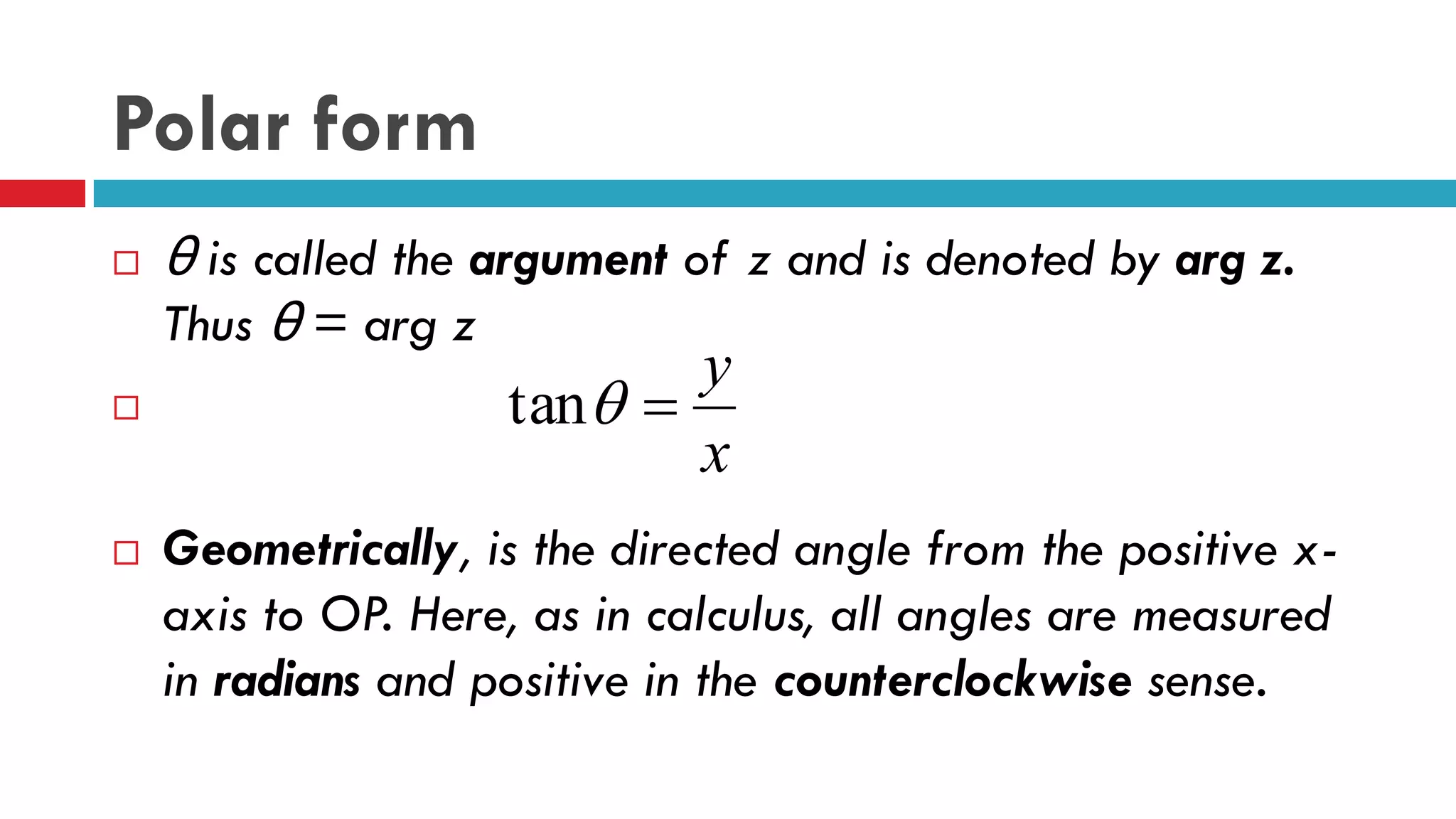
 θ is called the argument of z and is denoted by arg z.
Thus θ = arg z

 Geometrically, is the directed angle from the positive x-
axis to OP. Here, as in calculus, all angles are measured
in radians and positive in the counterclockwise sense.
x
y
tan
Polar form
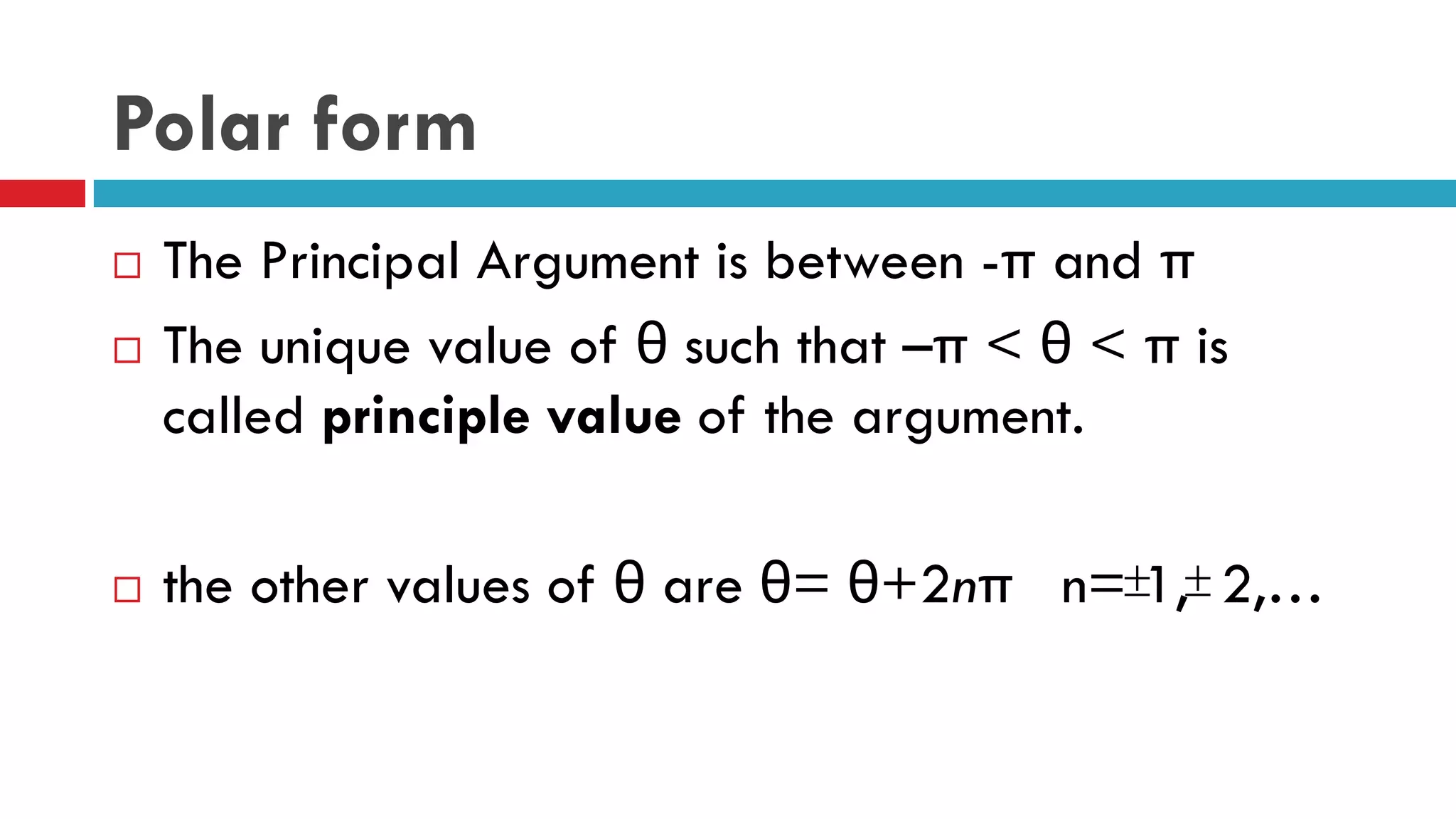
 The Principal Argument is between -π and π
 The unique value of θ such that –π < θ < π is
called principle value of the argument.
 the other values of θ are θ= θ+2nπ n= 1, 2,… 
Polar form
 Pr6: Represent in polar form,
 Ans :
i
i
53
2
1
103


 cos2)sin(cos2 i
Triangle Inequality
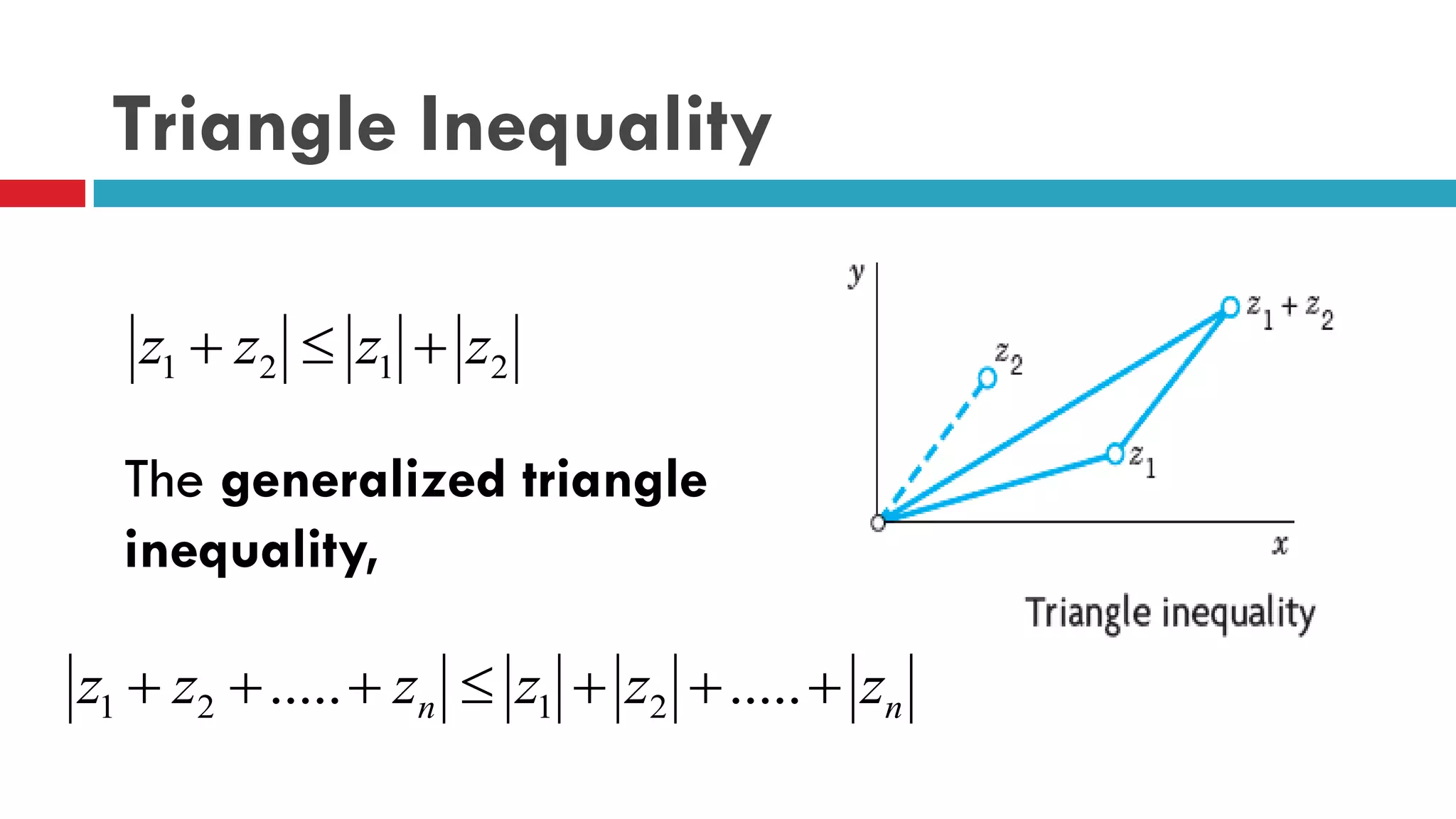
2121 zzzz 
The generalized triangle
inequality,
nn zzzzzz  .......... 2121
Multiplication and Division in Polar Form
 Let,
 Then ,
 the absolute value of a product equals the product of
the absolute values of the factors,
),sin(cos 1111  irz  )sin(cos 2222  irz 
)]sin()[cos( 21212121   irrzz
2121 zzzz 
Multiplication and Division in Polar Form
 the argument of a product equals the sum of the
 arguments of the factors,
 Division.
2121 argarg)arg( zzzz 
)]sin()[cos( 2121
2
1
2
1
  i
r
r
z
z
Multiplication and Division in Polar Form
 the argument of a division equals the subtraction of
the arguments of the factors,
21
2
1
argarg)arg( zz
z
z

2
1
2
1
z
z
z
z

Integer Powers of z
 De Moivre’s Formula
If n is an integer,
Then,
),sin(cos  ninrz nn

,)]sin(cos[ nn
irz  
Roots of z
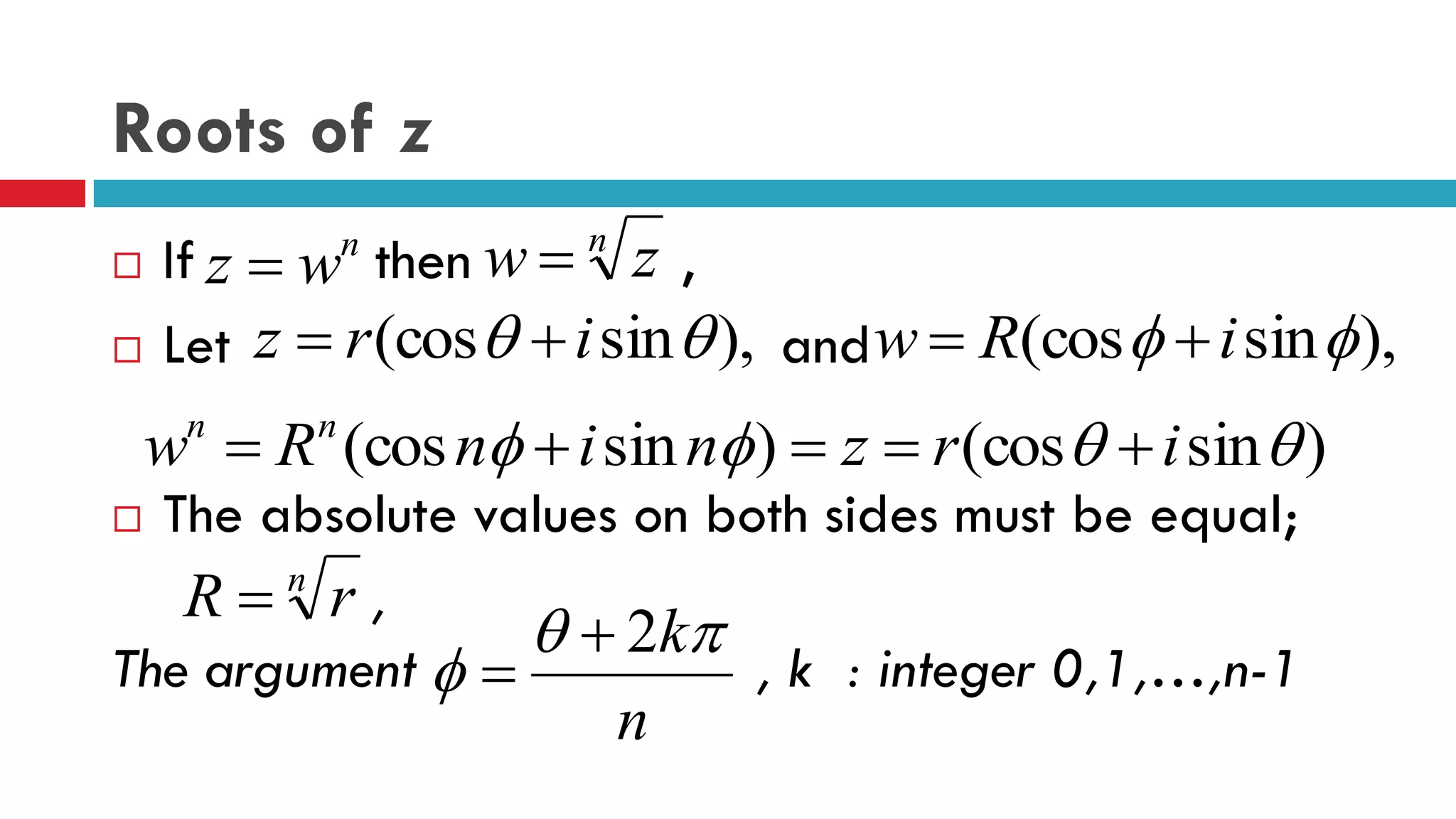
 If then ,
 Let and
 The absolute values on both sides must be equal;
,
The argument , k : integer 0,1,…,n-1
),sin(cos  irz 
n
wz 
n
zw 
),sin(cos  iRw 
)sin(cos)sin(cos  irzninRw nn

n
rR 
n
k

2

Roots of z

 These n values lie on a circle of radius with center at
the origin and constitute the vertices of a regular
polygon of n sides.
 The principal value of w when k=0
,
2
sin
2
cos 




 



n
k
i
n
k
rz nn 
Roots of z
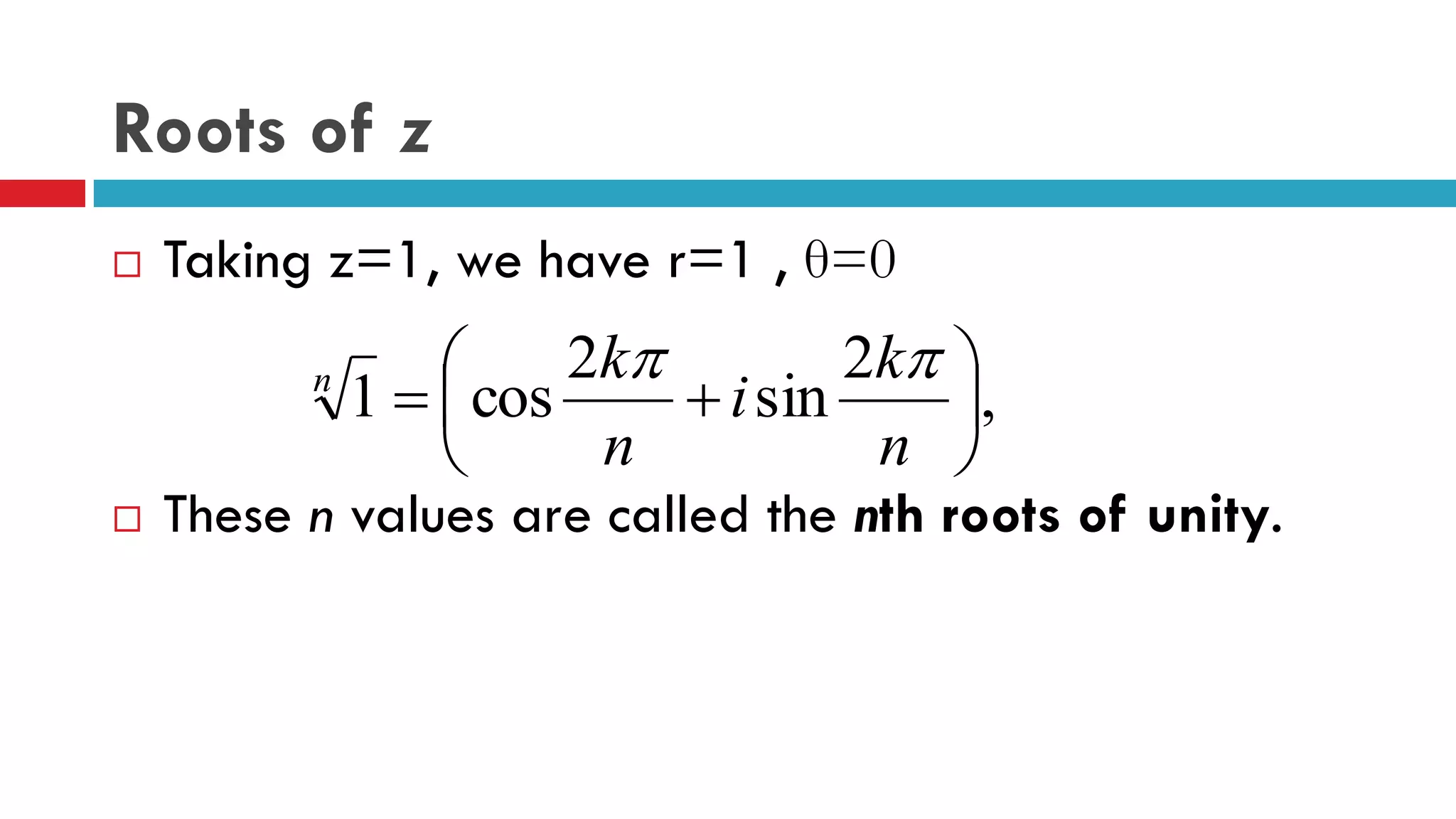
 Taking z=1, we have r=1 , θ=0
 These n values are called the nth roots of unity.
,
2
sin
2
cos1 






n
k
i
n
kn 
Roots of z
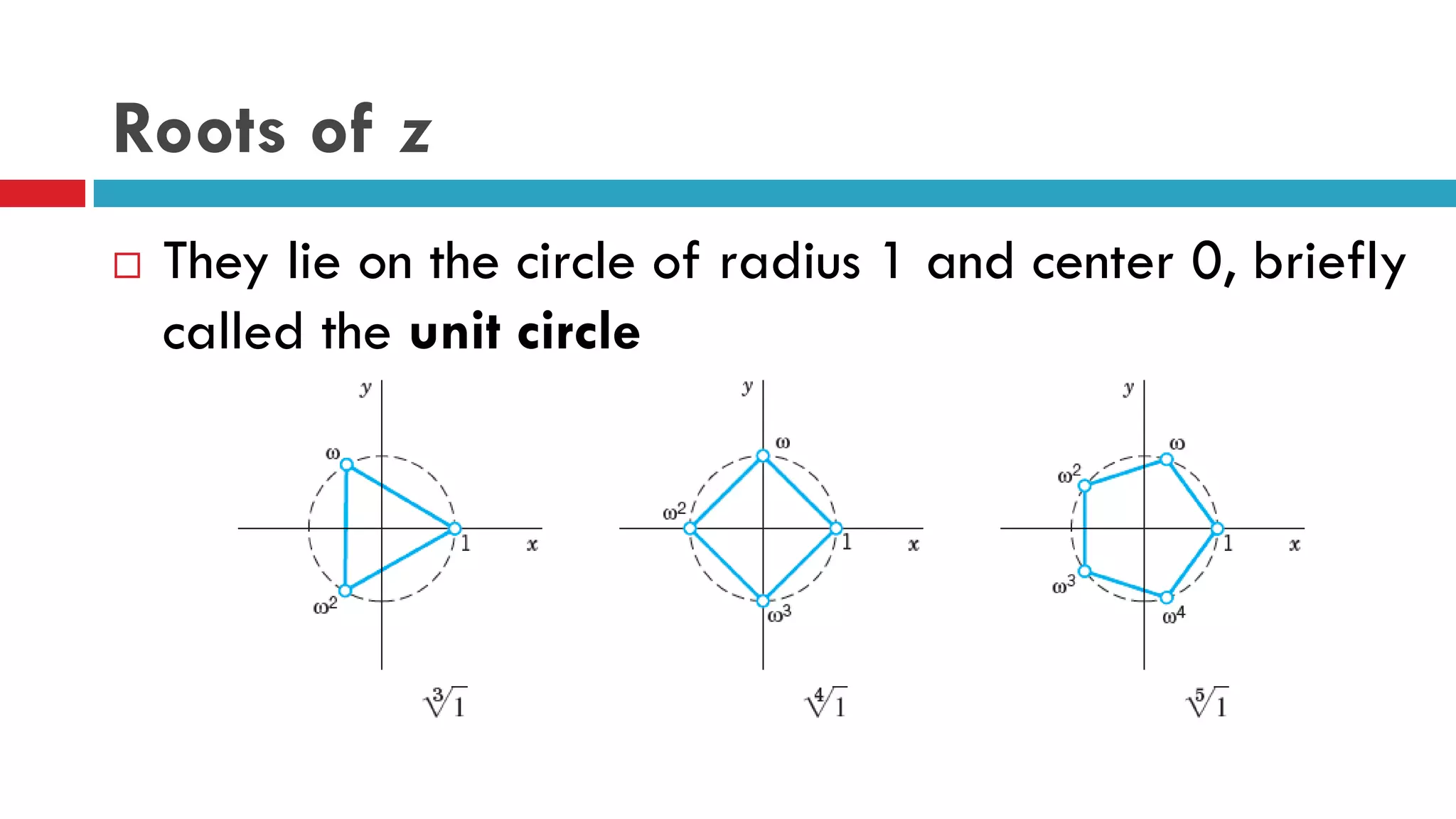
 They lie on the circle of radius 1 and center 0, briefly
called the unit circle
Roots of z
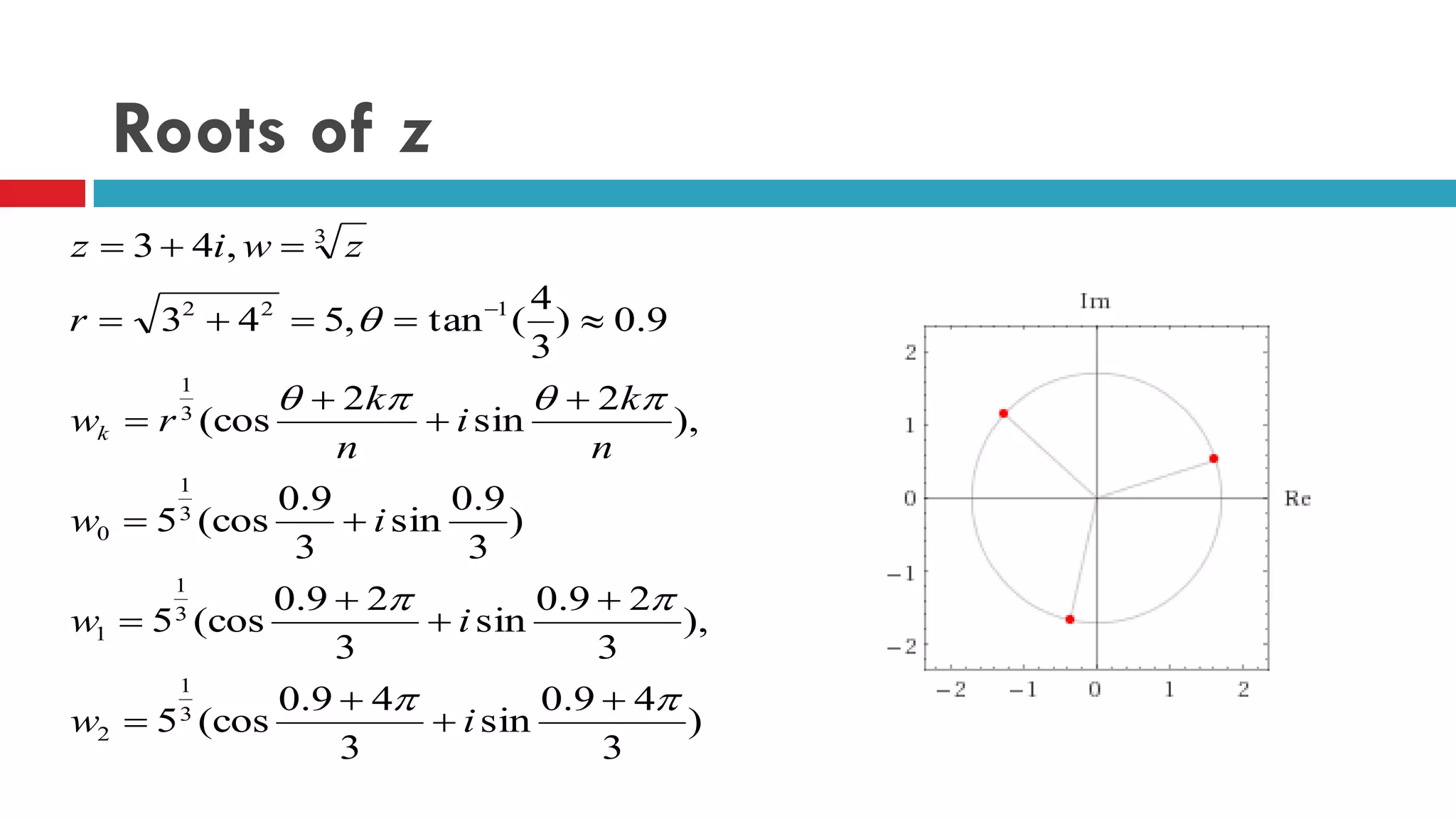
 Pr 22) Find and graph all roots .
3
43 i
Roots of z
)
3
49.0
sin
3
49.0
(cos5
),
3
29.0
sin
3
29.0
(cos5
)
3
9.0
sin
3
9.0
(cos5
),
2
sin
2
(cos
9.0)
3
4
(tan,543
,43
3
1
2
3
1
1
3
1
0
3
1
122
3




















iw
iw
iw
n
k
i
n
k
rw
r
zwiz
k
DERIVATIVE. ANALYTIC
FUNCTION
Circles and Disks. Half-Planes
 open circular disk :The set of
all points z which satisfy the
inequality |z – a|<, where 
is a positive real number is
called an open disk or
neighborhood of a .
Circles and Disks. Half-Planes
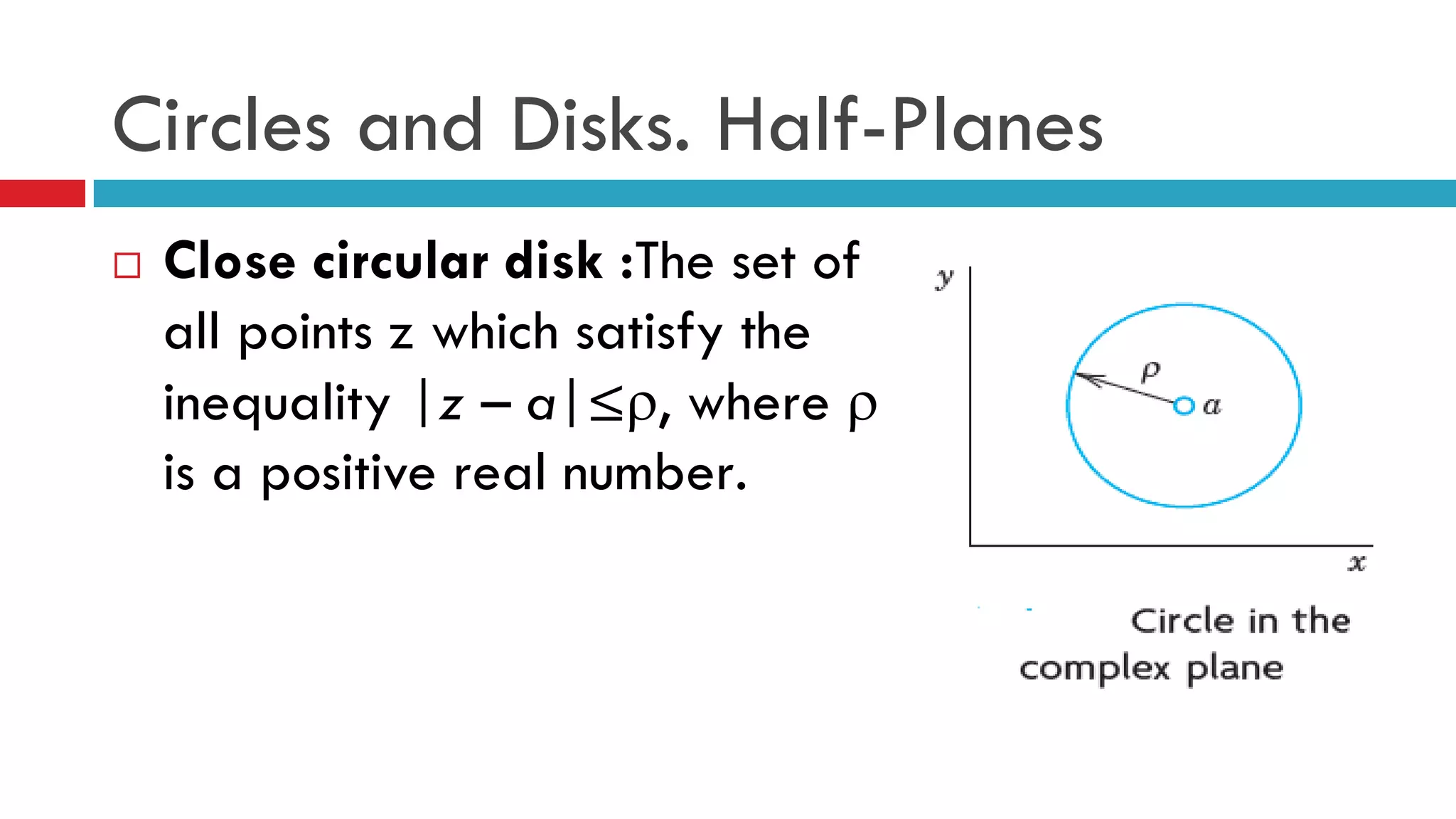
 Close circular disk :The set of
all points z which satisfy the
inequality |z – a|≤, where 
is a positive real number.
Circles and Disks. Half-Planes
 Open annulus This is the set of
all z whose distance |z – a|
from a is greater than 1 but
less than 2 . Similarly, the
closed annulus 1≤|z – a|≤2
Circles and Disks. Half-Planes
 Half-Planes. By the (open)
upper half-plane we mean the
set of all points z=x+yi such
that y>0 . Similarly, the
condition y<0 defines the lower
half-plane, x>0 the right half-
plane, and x<0 the left half-
plane.
Concepts on Sets in the Complex Plane
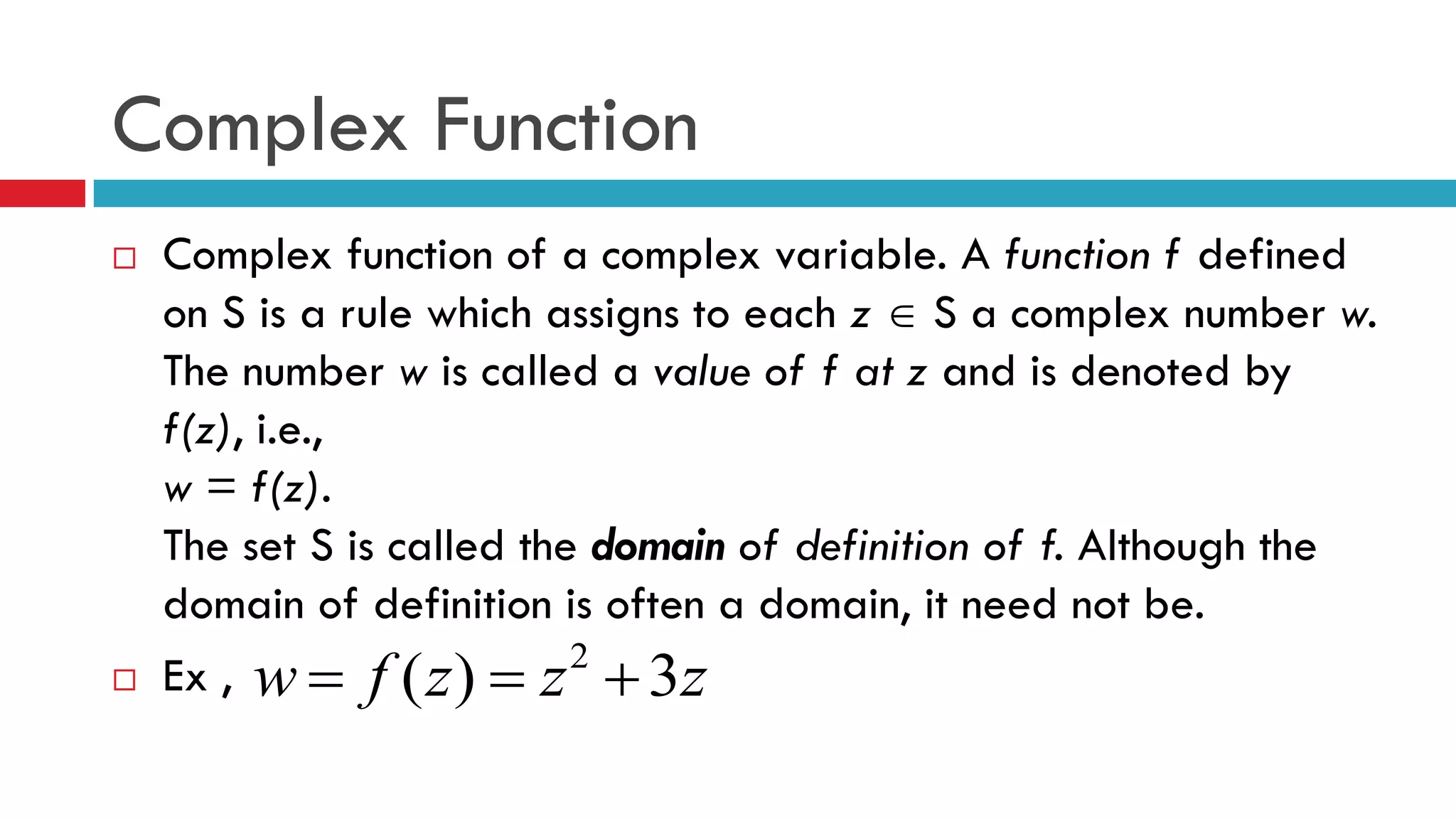
 point set in the complex plane we mean any sort of
collection of finitely many or infinitely many points.
 Interior Point A point is called an interior point
of S if and only if there exists at least one
neighborhood of z0 which is completely contained in
S.
Sz 0
Concepts on Sets in the Complex Plane
 Open Set If every point of a set S is an interior point
of S, we say that S is an open set.
 Closed Set if S contains all of its boundary points,
then it is called a closed set.
 Sets may be neither open nor closed. Neither
ClosedOpen
Concepts on Sets in the Complex Plane
 Connected An open set S is said to be connected if
every pair of points z1 and z2 in S can be joined by a
polygonal line that lies entirely in S. .
S
z
1
z
2
Complex Function
 Complex function of a complex variable. A function f defined
on S is a rule which assigns to each z  S a complex number w.
The number w is called a value of f at z and is denoted by
f(z), i.e.,
w = f(z).
The set S is called the domain of definition of f. Although the
domain of definition is often a domain, it need not be.
 Ex , zzzfw 3)( 2

Complex Function
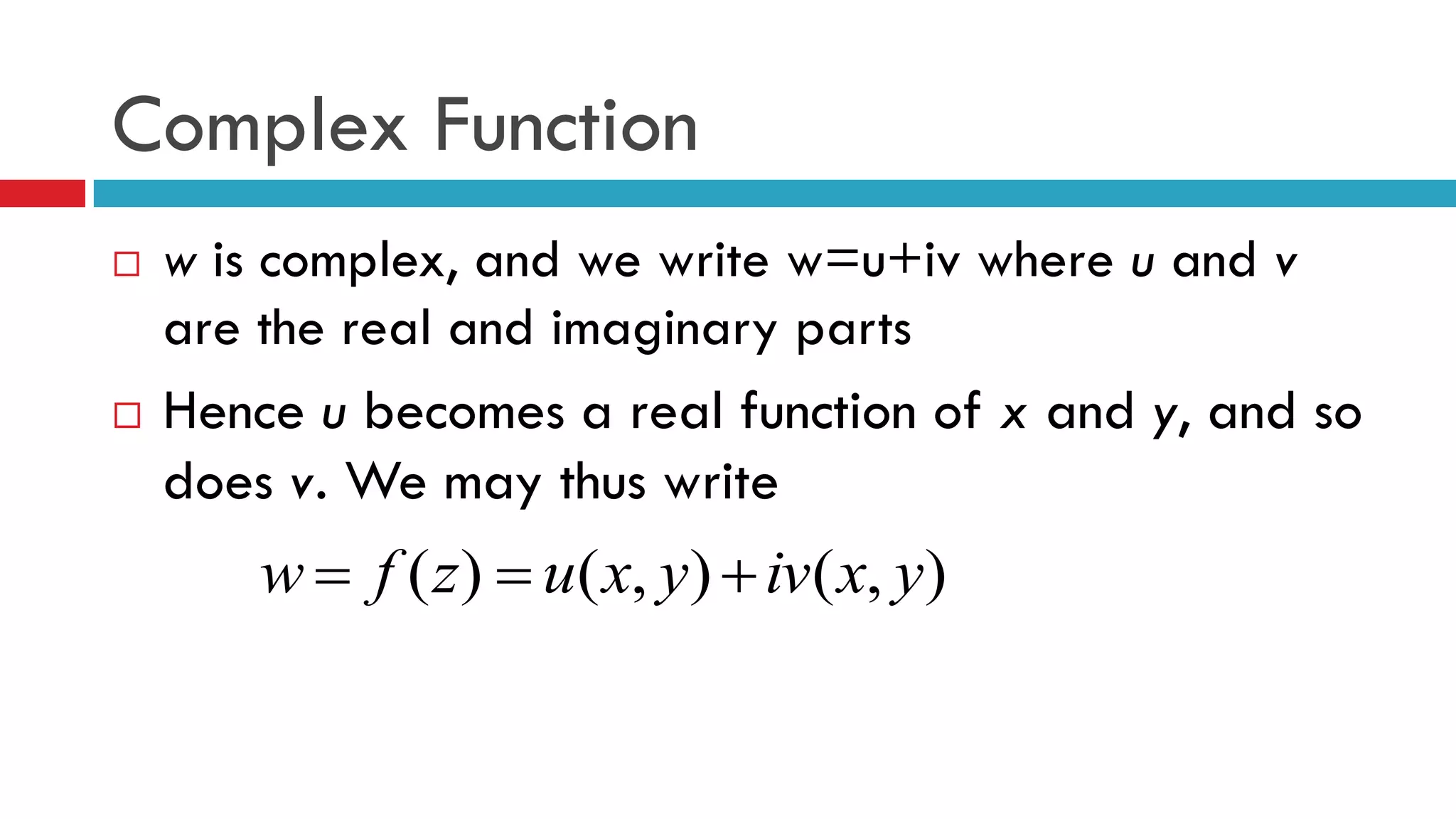
 w is complex, and we write w=u+iv where u and v
are the real and imaginary parts
 Hence u becomes a real function of x and y, and so
does v. We may thus write
),(),()( yxivyxuzfw 
Complex Function
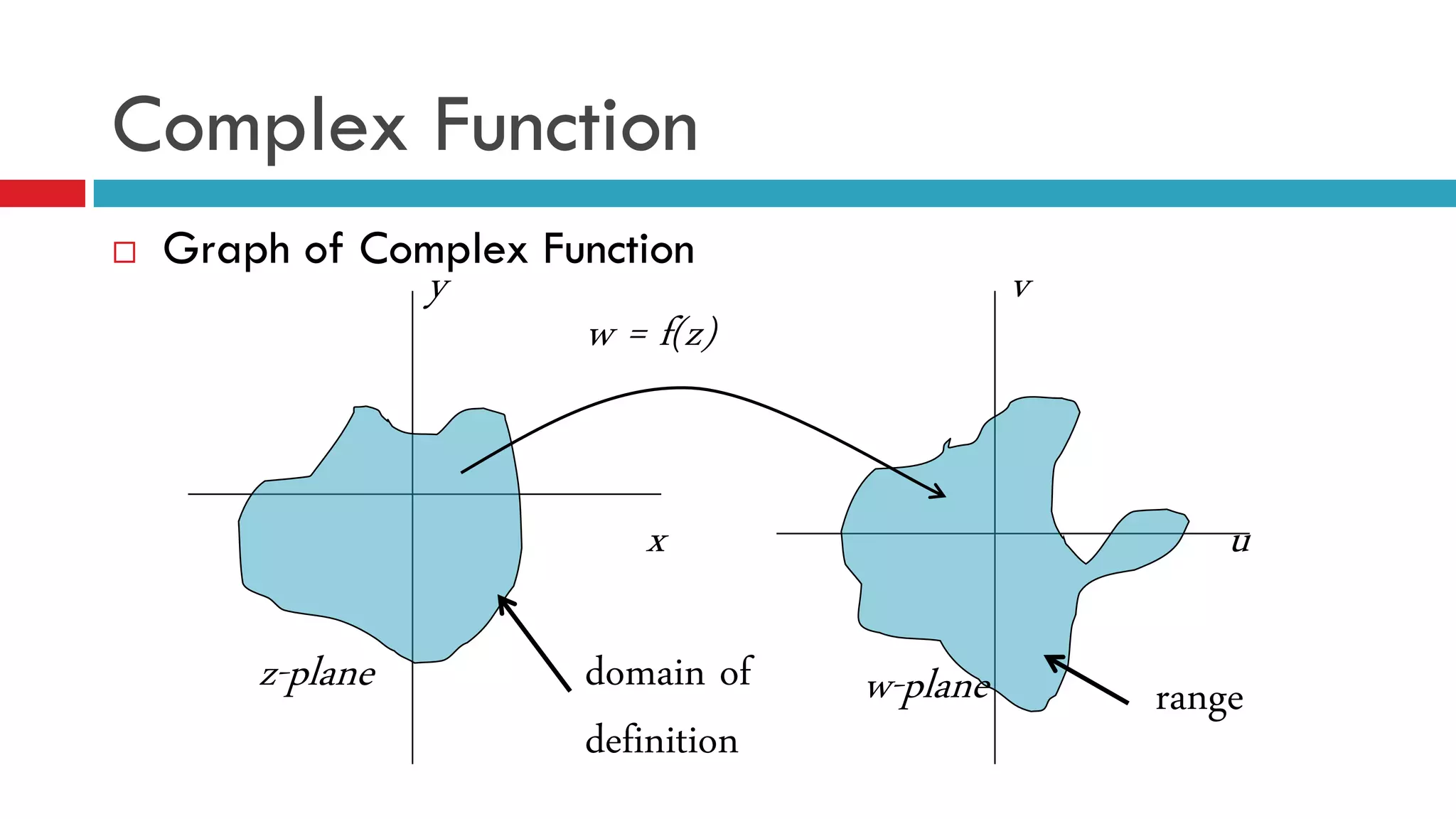
 Properties of a real-valued function of a real
variable are often exhibited by the graph of the
function. But when w = f(z), where z and w are
complex, no such convenient graphical representation
is available because each of the numbers z and w is
located in a plane rather than a line.
Complex Function
 Graph of Complex Function
x u
y v
z-plane w-planedomain of
definition
range
w = f(z)
Limit, Continuity
 A function w = f(z) is said to have the limit l as z
approaches a point z0 if for given small positive
number we can find positive number such that for
all in a disk we have
 z may approach z0 from any direction in the complex
plane.

0zz   0zz lzf )(
Limit, Continuity
 We call f(z) continuous at z0 if:
 F is defined in a neighborhood of z0,
 The limit exists, and

 A function f is said to be continuous on a set S if it is
continuous at each point of S. If a function is not
continuous at a point, then it is said to be singular at
the point.
)()(lim 0
0
zfzf
zz


Limit, Continuity
 One can show that f(z) approaches a limit precisely
when its real and imaginary parts approach limits,
and the continuity of f(z) is equivalent to the
continuity of its real and imaginary parts.
Derivatives
 Differentiation of complex-valued functions is completely
analogous to the real case:
 Definition. Derivative. Let f(z) be a complex-valued function
defined in a neighborhood of z0. Then the derivative of f(z)
at z0 is given by
Provided this limit exists. F(z) is said to be differentiable at
z0.
z
zfzzf
zf
z 



)()(
lim)( 00
0
0
Derivatives
 The function is differentiable for all z and has the
derivative because
zzz
z
zzzzz
zf
z
zzzf
zf
zz
z
2)2(lim
)(2
lim)(
)(
lim)(
0
222
0
0
2
0
0









2
)( zzf 
zzf 2)( 
Derivatives
 not Differentiable
yixzzzf  ,)(
z
iyx
iyx
z
z
z
zzz
z
zzzf










 )()(
Derivatives
 Properties of Derivatives
       
     
           
         
  
 
        Rule.Chain''
.0if,
''
'
'''
.constantanyfor''
'''
000
02
0
0000
0
00000
00
000
zgzgfzgf
dz
d
zg
zg
zgzfzfzg
z
g
f
zgzfzgzfzfg
czcfzcf
zgzfzgf












Analytic. (Holomorphic).
 Definition. A complex-valued function f (z) is said to be
analytic, or equivalently, holomorphic, on an open set  if it
has a derivative at every point of . (The term “regular” is
also used.)
 If f (z) is analytic on the whole complex plane, then it is said to
be an entire function.
Analytic. (Holomorphic).
 Rational Function.
 Definition. If f and g are polynomials in z, then h (z) = f
(z)/g(z), g(z)  0 is called a rational function.
 Remarks.
 All polynomial functions of z are entire.
 A rational function of z is analytic at every point for which
its denominator is nonzero.
 If a function can be reduced to a polynomial function which
does not involve z , then it is analytic.
CAUCHY–RIEMANN
EQUATIONS.
LAPLACE’S EQUATION
Cauchy-Riemann Equations
 If the function f (z) = u(x,y) + iv(x,y) is differentiable at z0 =
x0 + iy0, then the limit
 can be evaluated by allowing z to approach zero from any
direction in the complex plane.
z
zfzzf
zf
z 



)()(
lim)( 00
0
0
Cauchy-Riemann Equations
 If it approaches along the x-axis, then z = x, and we obtain
But the limits of the bracketed expression are just the first partial
derivatives of u and v with respect to x, so that:
   
x
yxivyxuyxxivyxxu
zf
x 



),(),(),(),(
lim)(' 00000000
0
0













 x
yxvyxxv
i
x
yxuyxxu
zf
xx
),(),(
lim
),(),(
lim)(' 0000
0
0000
0
0
).,(),()(' 00000 yx
x
v
iyx
x
u
zf






Cauchy-Riemann Equations
 If it approaches along the y-axis, then z =iy, and we obtain
 And, therefore









 yi
yxuyyxu
zf
y
),(),(
lim)(' 0000
0
0 








 yi
yxvyyxv
i
y
),(),(
lim 0000
0
).,(),()(' 00000 yx
y
v
yx
y
u
izf






Cauchy-Riemann Equations
 By definition, a limit exists only if it is unique. Therefore, these
two expressions must be equivalent. Equating real and
imaginary parts, we have that
x
v
y
u
y
v
x
u










and
Cauchy-Riemann Equations
 We mention that, if we use the polar form
and set , then the Cauchy–Riemann
equations are


u
r
v
v
r
u
r
r
1
1
,


)sin(cos  irz 
),(),()(  rivruzf 
Cauchy-Riemann Equations
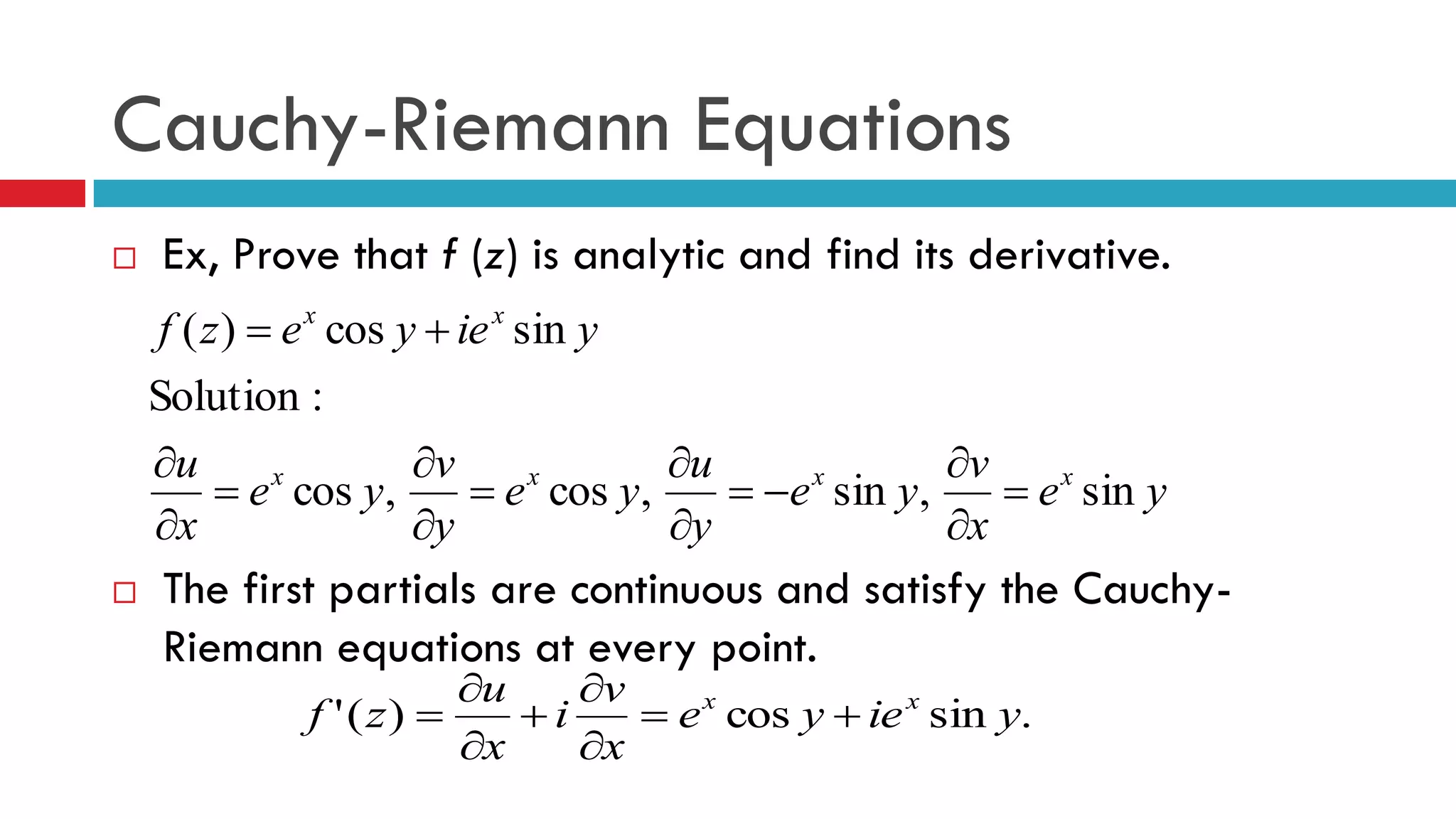
 Ex, Prove that f (z) is analytic and find its derivative.
 The first partials are continuous and satisfy the Cauchy-
Riemann equations at every point.
ye
x
v
ye
y
u
ye
y
v
ye
x
u
yieyezf
xxxx
xx
sin,sin,cos,cos
:Solution
sincos)(













.sincos)(' yieye
x
v
i
x
u
zf xx







Laplace’s Equation. Harmonic Functions
 Harmonic Conjugate;
 Given a function u(x,y) harmonic in, say, an open disk, then we
can find another harmonic function v(x,y) so that u + iv is an
analytic function of z in the disk. Such a function v is called a
harmonic conjugate of u.
Laplace’s Equation. Harmonic Functions
 Ex, Construct an analytic function whose real part is:
 Solution: First verify that this function is harmonic.
.3),( 23
yxyxyxu 
.066
6and16
6and33
2
2
2
2
2
2
2
2
22


















xx
y
u
x
u
and
x
y
u
xy
y
u
x
x
u
yx
x
u
Laplace’s Equation. Harmonic Functions
 Integrate (1) with respect to y:
16)2(
33)1( 22












xy
y
u
x
v
andyx
x
u
y
v
 
 
)(3),()3(
33
33
32
22
22
xhyyxyxv
yyxv
yyxv




Laplace’s Equation. Harmonic Functions
 Now take the derivative of v(x,y) with respect to x:
 According to equation (2), this equals 6xy – 1. Thus,
).('6 xhxy
x
v



.3),(
.)(and,)(So
.1ly,Equivalent.1)('and
16)('6
32
CxyyxyxvAnd
Cxxhxxh
x
h
xh
xyxhxy







 
Laplace’s Equation. Harmonic Functions
 The desired analytic function f (z) = u + iv is:
   Cxyyxiyxyxzf  3223
33)(
EXPONENTIAL FUNCTION
Exponential Function
 The complex exponential function is one of the
most important analytic functions
 If z = 3 + 4i then
Exponential Function
 For real z = x, imaginary part y = 0
 is analytic for all z
1 0
Exponential Function
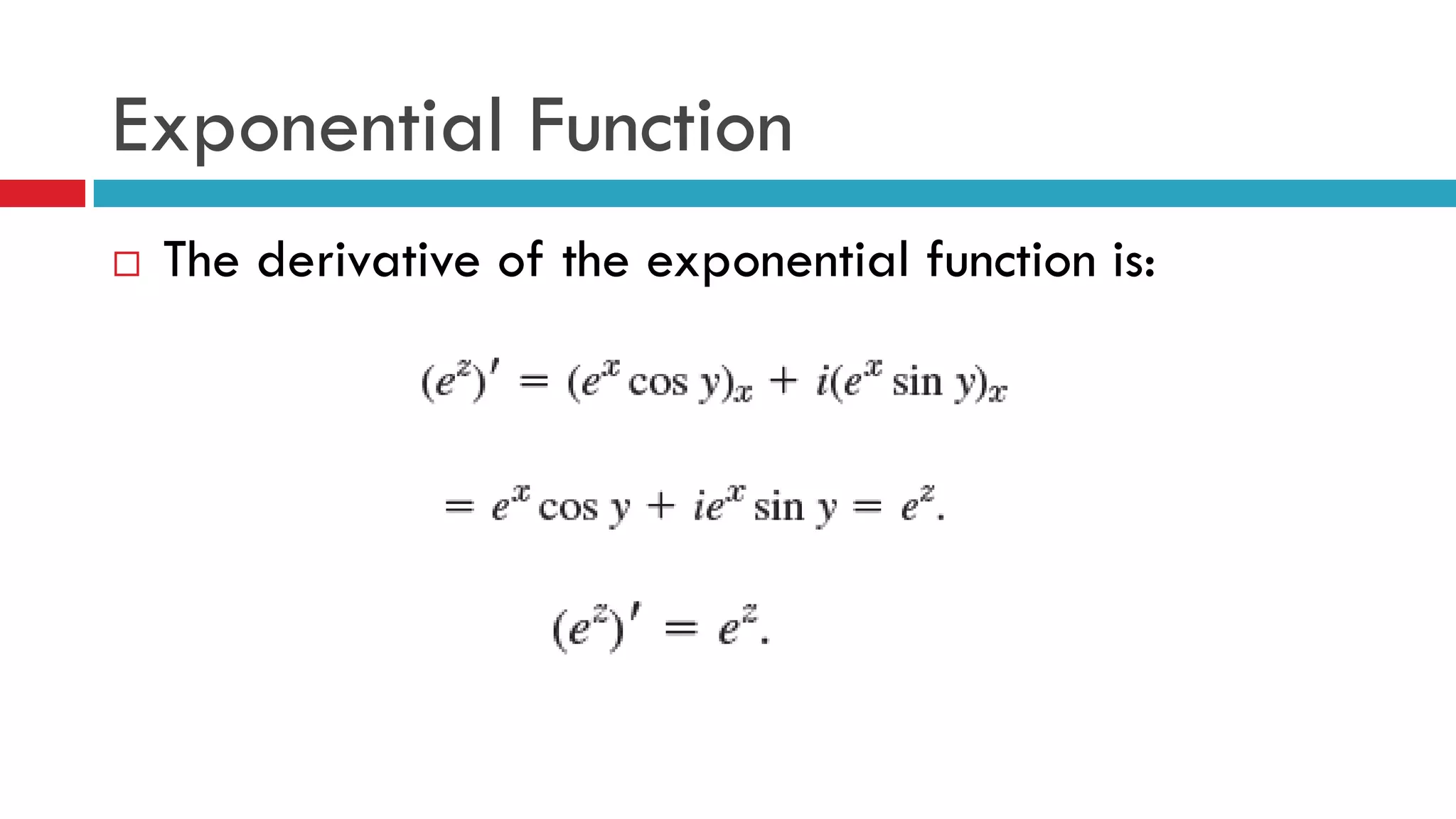
 The derivative of the exponential function is:
Exponential Function
 General rule of the exponential functions that
ea × eb = e(a +b)
Exponential Function
 Since z = x + iy
ez = e(x +iy)= ex eiy
 For pure imaginary complex number where z = iy
Euler Formula
 The polar form of a complex number, z = r (cosӨ + i sinӨ(
Can be written:
Exponential Function
 Substitution of in
 Substitution of will yield
01
Exponential Function
For pure imaginary exponent the exponential function has
absolute value of 1
Q:What is the absolute value of exponential function if x
doesn’t equal to zero ?
Exponential Function
 Periodicity of with period
1
Exponential Function
 Example 1:
In the polar form :
Exponential Function
 Solve :
Exponential Function
 It is obvious that many properties of exp z are
the same as the properties of exp x with an
exception in the periodicity of exp z with
TRIGONOMETRIC AND
HYPERBOLIC FUNCTIONS.
EULER’S FORMULA
Trigonometric and Hyperbolic Functions.
Euler’s Formula
Real trigonometric
function
Complex
trigonometric
function
Trigonometric and Hyperbolic Functions.
Euler’s Formula
By addition and subtraction we obtain
Trigonometric and Hyperbolic Functions.
Euler’s Formula
 Substitute ( z= x+iy) instead of x, we obtain
 functions in this formula are unrelated in real
Trigonometric and Hyperbolic Functions.
Euler’s Formula
 Example 1: Prove that :
Trigonometric and Hyperbolic Functions.
Euler’s Formula
Example 2:
Solve cos z = 5 (which has no real solution)
Trigonometric and Hyperbolic Functions.
Euler’s Formula
 General formula for trigonometric functions:
Trigonometric and Hyperbolic Functions.
Euler’s Formula
 The complex hyperbolic cosine and sine are defined
by the formulas:
 Complex Trigonometric and Hyperbolic Functions
are related:
LOGARITHM. GENERAL
POWER. PRINCIPAL VALUE
Logarithm. General power. Principal
value
 The natural logarithm of z = x+ iy is donated by ln
z or log z
Logarithm. General power. Principal
value
 Where
 the complex natural logarithm is infinitely many-
valued. The value of ln z corresponding to the
principle value Arg z is denoted by Ln z and it is
called the principle value of ln z, given by
Logarithm. General power. Principal
value
 Ln z is a single- valued since the other values of arg z differ
by integer multiples of . the other values of ln z given by:
 All the values of ln z have the same real part but their imaginary parts differ by integer
multiples of .If z is a positive real then Arg z= 0 and Ln z becomes same as the real
natural logarithm in calculus but if it is a negative number then Arg z = and
Logarithm. General power. Principal
value
Logarithm. General power. Principal
value
 From and for positive real r we
obtain
 Since arg ( ) is multivalued so:
Logarithm. General power. Principal
value
 The familiar relations of natural logarithm are still
applicable for complex value:
Logarithm. General power. Principal
value
 Analyticity of the Logarithm
Logarithm. General power. Principal
value
 General Powers:
The general power of a complex number z= x +iy
are defined by the formula:
Where c complex and
Logarithm. General power. Principal
value
 If c = 1/n then,
=
THANK YOU

Complex Numbers and Functions. Complex Differentiation

  • 1.
    Chp13 Complex Numbersand Functions. Complex Differentiation Prepared By Hesham Ali Marwa Ghaith
  • 2.
    COMPLEX NUMBERS AND THEIRGEOMETRIC REPRESENTATION
  • 3.
    Introduction  Consider thequadratic equation; 𝑥2 + 1 = 0  It has no solutions in the real number system since 𝑥2 = -1  Similarly 𝑥2 + 16 = 0 1x 12 i ix 416 
  • 4.
    Introduction  • Powerof "i" 1,,,,,,1 210  iiii 1)1()( 1 25254100 45 224 23     ii iiii iii iiii
  • 5.
    Introduction  A complexnumbers is a number consisting a Real and Imaginary part. z = (x, y).  It can be written in the form(Cartesian form) : Z = x + yi Real Imaginary
  • 6.
    Introduction  Then xis known as the real part of z and y as the imaginary part. We write x = Re z and y = Im z.  Note that real numbers are complex – a real number is simply a complex number with zero imaginary part.
  • 7.
    Introduction  By definition,two complex numbers are equal if and only if their real parts are equal and their imaginary parts are equal.  (0, 1) is called the imaginary unit and is denoted by i, ).1,0(i
  • 8.
    Algebra of complexnumbers  Addition of complex numbers If a + bi and c + di are two complex numbers then addition of complex numbers are , (a + bi) + (c + di) = (a + c) + (b + d)i  Example: (2 + 4i) + (5 + 3i) = (2 + 5) + (4 + 3)i = 7 + 7i
  • 9.
    Algebra of complexnumbers  Subtraction of Complex numbers  If a + bi and c + di are two complex numbers then subtraction of complex numbers are , (a + bi) - (c + di) = (a - c) + (b - d)i  Example: (3 + 2i) - (2 + 3i) = (3 - 2) + (2 - 3)i = 1 - 1i
  • 10.
    Algebra of complexnumbers  Multiplication of Complex numbers  If a + bi and c + di are two complex numbers then multiplication of complex numbers is, (a + bi)(c + di) = (ac -bd) + ( ad + bc)i Example:  (2 + 3i)(4 + 5i)=(2x4- 3x5)+(2x5+ 3x4)i =-7+22i
  • 11.
    Algebra of complexnumbers  Division of Complex numbers  If a + bi and c + di are two complex numbers then Division of complex numbers is,
  • 12.
    Complex Plane (Arganddiagram) We choose two perpendicular coordinate axes, the horizontal x-axis, called the real axis, and the vertical y-axis, called the imaginary axis.
  • 13.
    Complex Plane (Arganddiagram) Addition can be represented graphically on the complex plane.
  • 14.
    Complex Plane (Arganddiagram) Subtraction can be represented graphically on the complex plane.
  • 15.
    Complex Conjugate Numbers The complex conjugate of complex number Z = x + yi, is  It is obtained geometrically by reflecting the point z in the real axis. Figure shows this for z = 5 + 2i and its conjugate = 5 - 2i. yixz  z z
  • 16.
    Complex Conjugate Numbers By addition and subtraction, bibbaabiabiazz aibbaabiabiazz 2)()()()( 2)()()()(   ),( 2 1 Re zzxz  )( 2 1 Im zz i yz 
  • 17.
    Complex Conjugate Numbers The complex conjugate is important because it permits us to switch from complex to real. Indeed, by multiplication the complex number with it’s conjugate. Let z = a+bi, then : 2222 )())(( babiabiabiazz  2 zzz 
  • 18.
    Complex Conjugate Numbers So when you need to divide one complex number by another, you multiply the numerator and denominator of the problem by the conjugate of the denominator.  Example : Divide 10 + 5i by 4 – 3i. i21
  • 19.
    Complex Conjugate Numbers 2121)( zzzz  2121 )( zzzz  2121 )( zzzz  2 1 2 1 )( z z z z 
  • 20.
    POLAR FORM OFCOMPLEX NUMBERS. POWERS AND ROOTS
  • 21.
    Polar form  Polarcoordinates will help us understand complex numbers geometrically ,cosrx  sinry 
  • 22.
    Polar form  z= x + yi takes the so-called polar form,  It could be written as  r is called the absolute value or modulus of z and is denoted by )sin(cos  irz  z zzyxrz  22  rz
  • 23.
    Polar form  θis called the argument of z and is denoted by arg z. Thus θ = arg z   Geometrically, is the directed angle from the positive x- axis to OP. Here, as in calculus, all angles are measured in radians and positive in the counterclockwise sense. x y tan
  • 24.
    Polar form  ThePrincipal Argument is between -π and π  The unique value of θ such that –π < θ < π is called principle value of the argument.  the other values of θ are θ= θ+2nπ n= 1, 2,… 
  • 25.
    Polar form  Pr6:Represent in polar form,  Ans : i i 53 2 1 103    cos2)sin(cos2 i
  • 26.
    Triangle Inequality 2121 zzzz The generalized triangle inequality, nn zzzzzz  .......... 2121
  • 27.
    Multiplication and Divisionin Polar Form  Let,  Then ,  the absolute value of a product equals the product of the absolute values of the factors, ),sin(cos 1111  irz  )sin(cos 2222  irz  )]sin()[cos( 21212121   irrzz 2121 zzzz 
  • 28.
    Multiplication and Divisionin Polar Form  the argument of a product equals the sum of the  arguments of the factors,  Division. 2121 argarg)arg( zzzz  )]sin()[cos( 2121 2 1 2 1   i r r z z
  • 29.
    Multiplication and Divisionin Polar Form  the argument of a division equals the subtraction of the arguments of the factors, 21 2 1 argarg)arg( zz z z  2 1 2 1 z z z z 
  • 30.
    Integer Powers ofz  De Moivre’s Formula If n is an integer, Then, ),sin(cos  ninrz nn  ,)]sin(cos[ nn irz  
  • 31.
    Roots of z If then ,  Let and  The absolute values on both sides must be equal; , The argument , k : integer 0,1,…,n-1 ),sin(cos  irz  n wz  n zw  ),sin(cos  iRw  )sin(cos)sin(cos  irzninRw nn  n rR  n k  2 
  • 32.
    Roots of z  These n values lie on a circle of radius with center at the origin and constitute the vertices of a regular polygon of n sides.  The principal value of w when k=0 , 2 sin 2 cos           n k i n k rz nn 
  • 33.
    Roots of z Taking z=1, we have r=1 , θ=0  These n values are called the nth roots of unity. , 2 sin 2 cos1        n k i n kn 
  • 34.
    Roots of z They lie on the circle of radius 1 and center 0, briefly called the unit circle
  • 35.
    Roots of z Pr 22) Find and graph all roots . 3 43 i
  • 36.
  • 37.
  • 38.
    Circles and Disks.Half-Planes  open circular disk :The set of all points z which satisfy the inequality |z – a|<, where  is a positive real number is called an open disk or neighborhood of a .
  • 39.
    Circles and Disks.Half-Planes  Close circular disk :The set of all points z which satisfy the inequality |z – a|≤, where  is a positive real number.
  • 40.
    Circles and Disks.Half-Planes  Open annulus This is the set of all z whose distance |z – a| from a is greater than 1 but less than 2 . Similarly, the closed annulus 1≤|z – a|≤2
  • 41.
    Circles and Disks.Half-Planes  Half-Planes. By the (open) upper half-plane we mean the set of all points z=x+yi such that y>0 . Similarly, the condition y<0 defines the lower half-plane, x>0 the right half- plane, and x<0 the left half- plane.
  • 42.
    Concepts on Setsin the Complex Plane  point set in the complex plane we mean any sort of collection of finitely many or infinitely many points.  Interior Point A point is called an interior point of S if and only if there exists at least one neighborhood of z0 which is completely contained in S. Sz 0
  • 43.
    Concepts on Setsin the Complex Plane  Open Set If every point of a set S is an interior point of S, we say that S is an open set.  Closed Set if S contains all of its boundary points, then it is called a closed set.  Sets may be neither open nor closed. Neither ClosedOpen
  • 44.
    Concepts on Setsin the Complex Plane  Connected An open set S is said to be connected if every pair of points z1 and z2 in S can be joined by a polygonal line that lies entirely in S. . S z 1 z 2
  • 45.
    Complex Function  Complexfunction of a complex variable. A function f defined on S is a rule which assigns to each z  S a complex number w. The number w is called a value of f at z and is denoted by f(z), i.e., w = f(z). The set S is called the domain of definition of f. Although the domain of definition is often a domain, it need not be.  Ex , zzzfw 3)( 2 
  • 46.
    Complex Function  wis complex, and we write w=u+iv where u and v are the real and imaginary parts  Hence u becomes a real function of x and y, and so does v. We may thus write ),(),()( yxivyxuzfw 
  • 47.
    Complex Function  Propertiesof a real-valued function of a real variable are often exhibited by the graph of the function. But when w = f(z), where z and w are complex, no such convenient graphical representation is available because each of the numbers z and w is located in a plane rather than a line.
  • 48.
    Complex Function  Graphof Complex Function x u y v z-plane w-planedomain of definition range w = f(z)
  • 49.
    Limit, Continuity  Afunction w = f(z) is said to have the limit l as z approaches a point z0 if for given small positive number we can find positive number such that for all in a disk we have  z may approach z0 from any direction in the complex plane.  0zz   0zz lzf )(
  • 50.
    Limit, Continuity  Wecall f(z) continuous at z0 if:  F is defined in a neighborhood of z0,  The limit exists, and   A function f is said to be continuous on a set S if it is continuous at each point of S. If a function is not continuous at a point, then it is said to be singular at the point. )()(lim 0 0 zfzf zz  
  • 51.
    Limit, Continuity  Onecan show that f(z) approaches a limit precisely when its real and imaginary parts approach limits, and the continuity of f(z) is equivalent to the continuity of its real and imaginary parts.
  • 52.
    Derivatives  Differentiation ofcomplex-valued functions is completely analogous to the real case:  Definition. Derivative. Let f(z) be a complex-valued function defined in a neighborhood of z0. Then the derivative of f(z) at z0 is given by Provided this limit exists. F(z) is said to be differentiable at z0. z zfzzf zf z     )()( lim)( 00 0 0
  • 53.
    Derivatives  The functionis differentiable for all z and has the derivative because zzz z zzzzz zf z zzzf zf zz z 2)2(lim )(2 lim)( )( lim)( 0 222 0 0 2 0 0          2 )( zzf  zzf 2)( 
  • 54.
    Derivatives  not Differentiable yixzzzf ,)( z iyx iyx z z z zzz z zzzf            )()(
  • 55.
    Derivatives  Properties ofDerivatives                                                  Rule.Chain'' .0if, '' ' ''' .constantanyfor'' ''' 000 02 0 0000 0 00000 00 000 zgzgfzgf dz d zg zg zgzfzfzg z g f zgzfzgzfzfg czcfzcf zgzfzgf            
  • 56.
    Analytic. (Holomorphic).  Definition.A complex-valued function f (z) is said to be analytic, or equivalently, holomorphic, on an open set  if it has a derivative at every point of . (The term “regular” is also used.)  If f (z) is analytic on the whole complex plane, then it is said to be an entire function.
  • 57.
    Analytic. (Holomorphic).  RationalFunction.  Definition. If f and g are polynomials in z, then h (z) = f (z)/g(z), g(z)  0 is called a rational function.  Remarks.  All polynomial functions of z are entire.  A rational function of z is analytic at every point for which its denominator is nonzero.  If a function can be reduced to a polynomial function which does not involve z , then it is analytic.
  • 58.
  • 59.
    Cauchy-Riemann Equations  Ifthe function f (z) = u(x,y) + iv(x,y) is differentiable at z0 = x0 + iy0, then the limit  can be evaluated by allowing z to approach zero from any direction in the complex plane. z zfzzf zf z     )()( lim)( 00 0 0
  • 60.
    Cauchy-Riemann Equations  Ifit approaches along the x-axis, then z = x, and we obtain But the limits of the bracketed expression are just the first partial derivatives of u and v with respect to x, so that:     x yxivyxuyxxivyxxu zf x     ),(),(),(),( lim)(' 00000000 0 0               x yxvyxxv i x yxuyxxu zf xx ),(),( lim ),(),( lim)(' 0000 0 0000 0 0 ).,(),()(' 00000 yx x v iyx x u zf      
  • 61.
    Cauchy-Riemann Equations  Ifit approaches along the y-axis, then z =iy, and we obtain  And, therefore           yi yxuyyxu zf y ),(),( lim)(' 0000 0 0           yi yxvyyxv i y ),(),( lim 0000 0 ).,(),()(' 00000 yx y v yx y u izf      
  • 62.
    Cauchy-Riemann Equations  Bydefinition, a limit exists only if it is unique. Therefore, these two expressions must be equivalent. Equating real and imaginary parts, we have that x v y u y v x u           and
  • 63.
  • 64.
    Cauchy-Riemann Equations  Wemention that, if we use the polar form and set , then the Cauchy–Riemann equations are   u r v v r u r r 1 1 ,   )sin(cos  irz  ),(),()(  rivruzf 
  • 65.
    Cauchy-Riemann Equations  Ex,Prove that f (z) is analytic and find its derivative.  The first partials are continuous and satisfy the Cauchy- Riemann equations at every point. ye x v ye y u ye y v ye x u yieyezf xxxx xx sin,sin,cos,cos :Solution sincos)(              .sincos)(' yieye x v i x u zf xx       
  • 66.
  • 67.
    Laplace’s Equation. HarmonicFunctions  Harmonic Conjugate;  Given a function u(x,y) harmonic in, say, an open disk, then we can find another harmonic function v(x,y) so that u + iv is an analytic function of z in the disk. Such a function v is called a harmonic conjugate of u.
  • 68.
    Laplace’s Equation. HarmonicFunctions  Ex, Construct an analytic function whose real part is:  Solution: First verify that this function is harmonic. .3),( 23 yxyxyxu  .066 6and16 6and33 2 2 2 2 2 2 2 2 22                   xx y u x u and x y u xy y u x x u yx x u
  • 69.
    Laplace’s Equation. HarmonicFunctions  Integrate (1) with respect to y: 16)2( 33)1( 22             xy y u x v andyx x u y v     )(3),()3( 33 33 32 22 22 xhyyxyxv yyxv yyxv    
  • 70.
    Laplace’s Equation. HarmonicFunctions  Now take the derivative of v(x,y) with respect to x:  According to equation (2), this equals 6xy – 1. Thus, ).('6 xhxy x v    .3),( .)(and,)(So .1ly,Equivalent.1)('and 16)('6 32 CxyyxyxvAnd Cxxhxxh x h xh xyxhxy         
  • 71.
    Laplace’s Equation. HarmonicFunctions  The desired analytic function f (z) = u + iv is:    Cxyyxiyxyxzf  3223 33)(
  • 72.
  • 73.
    Exponential Function  Thecomplex exponential function is one of the most important analytic functions  If z = 3 + 4i then
  • 74.
    Exponential Function  Forreal z = x, imaginary part y = 0  is analytic for all z 1 0
  • 75.
    Exponential Function  Thederivative of the exponential function is:
  • 76.
    Exponential Function  Generalrule of the exponential functions that ea × eb = e(a +b)
  • 77.
    Exponential Function  Sincez = x + iy ez = e(x +iy)= ex eiy  For pure imaginary complex number where z = iy Euler Formula  The polar form of a complex number, z = r (cosӨ + i sinӨ( Can be written:
  • 78.
    Exponential Function  Substitutionof in  Substitution of will yield 01
  • 79.
    Exponential Function For pureimaginary exponent the exponential function has absolute value of 1 Q:What is the absolute value of exponential function if x doesn’t equal to zero ?
  • 80.
  • 81.
    Exponential Function  Example1: In the polar form :
  • 82.
  • 83.
    Exponential Function  Itis obvious that many properties of exp z are the same as the properties of exp x with an exception in the periodicity of exp z with
  • 84.
  • 85.
    Trigonometric and HyperbolicFunctions. Euler’s Formula Real trigonometric function Complex trigonometric function
  • 86.
    Trigonometric and HyperbolicFunctions. Euler’s Formula By addition and subtraction we obtain
  • 87.
    Trigonometric and HyperbolicFunctions. Euler’s Formula  Substitute ( z= x+iy) instead of x, we obtain  functions in this formula are unrelated in real
  • 88.
    Trigonometric and HyperbolicFunctions. Euler’s Formula  Example 1: Prove that :
  • 89.
    Trigonometric and HyperbolicFunctions. Euler’s Formula Example 2: Solve cos z = 5 (which has no real solution)
  • 90.
    Trigonometric and HyperbolicFunctions. Euler’s Formula  General formula for trigonometric functions:
  • 91.
    Trigonometric and HyperbolicFunctions. Euler’s Formula  The complex hyperbolic cosine and sine are defined by the formulas:  Complex Trigonometric and Hyperbolic Functions are related:
  • 92.
  • 93.
    Logarithm. General power.Principal value  The natural logarithm of z = x+ iy is donated by ln z or log z
  • 94.
    Logarithm. General power.Principal value  Where  the complex natural logarithm is infinitely many- valued. The value of ln z corresponding to the principle value Arg z is denoted by Ln z and it is called the principle value of ln z, given by
  • 95.
    Logarithm. General power.Principal value  Ln z is a single- valued since the other values of arg z differ by integer multiples of . the other values of ln z given by:  All the values of ln z have the same real part but their imaginary parts differ by integer multiples of .If z is a positive real then Arg z= 0 and Ln z becomes same as the real natural logarithm in calculus but if it is a negative number then Arg z = and
  • 96.
  • 97.
    Logarithm. General power.Principal value  From and for positive real r we obtain  Since arg ( ) is multivalued so:
  • 98.
    Logarithm. General power.Principal value  The familiar relations of natural logarithm are still applicable for complex value:
  • 99.
    Logarithm. General power.Principal value  Analyticity of the Logarithm
  • 100.
    Logarithm. General power.Principal value  General Powers: The general power of a complex number z= x +iy are defined by the formula: Where c complex and
  • 101.
    Logarithm. General power.Principal value  If c = 1/n then, =
  • 102.