1
Functions of a Complex Variable
Sumita Gulati
Assistant Professor
S. A. Jain College, Ambala City
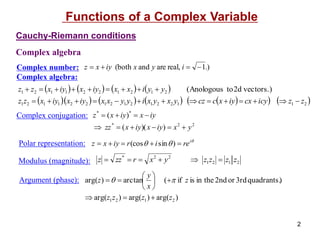
Complex number:
Complex algebra:
Complex conjugation:
2
.)1real,areand(both  iyxiyxz
Cauchy-Riemann conditions
Complex algebra
Functions of a Complex Variable
       
           2112212121221121
2121221121 vectors.)2dto(Anologous
zzicycxiyxcczyxyxiyyxxiyxiyxzz
yyixxiyxiyxzz


iyxiyxz  **
)(
22*
))(( yxiyxiyxzz 
Modulus (magnitude): 2121
22*
zzzzyxrzzz 
Polar representation: 
 i
reiriyxz  )sin(cos
Argument (phase):
)arg()arg()arg(
)quadrants.3rdor2ndin theisif(arctan)arg(
2121 zzzz
z
x
y
z







 
3
Functions of a complex variable:
All elementary functions of real variables may be extended into the complex plane.






0
2
0
2
!!2!1
1
!!2!1
1:Example
n
n
z
n
n
x
n
zzz
e
n
xxx
e 
A complex function can be resolved into its real part and imaginary part:
2222
2222
11
2)()(:Examples
),(),()(
yx
y
i
yx
x
iyxz
xyiyxiyxz
yxivyxuzf









Multi-valued functions and branch cuts:
ivunirrerez nii
 
)2(ln]ln[)ln(ln:1Example )2(

To remove the ambiguity, we can limit all phases to (-,).
 = - is the branch cut.
lnz with n = 0 is the principle value.
  2/)2(2121)2(2121
)(:2Example  ninii
errerez 

We can let z move on 2 Riemann sheets so that is single valued everywhere.21
)()( i
rezf 
4
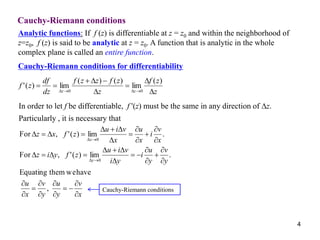
Analytic functions: If f (z) is differentiable at z = z0 and within the neighborhood of
z=z0, f (z) is said to be analytic at z = z0. A function that is analytic in the whole
complex plane is called an entire function.
Cauchy-Riemann conditions for differentiability
Cauchy-Riemann conditions
z
zf
z
zfzzf
dz
df
zf
zz 






)(
lim
)()(
lim)('
00
In order to let f be differentiable, f '(z) must be the same in any direction of z.
Particularly , it is necessary that
x
v
y
u
y
v
x
u
y
v
y
u
i
yi
viu
zfyiz
x
v
i
x
u
x
viu
zfxz
y
x






























,
havewethemEquating
.lim)(',For
.lim)(',For
0
0
Cauchy-Riemann conditions
x
v
y
u
y
v
x
u










,
5
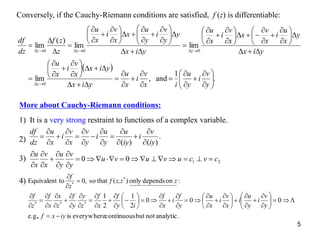
Conversely, if the Cauchy-Riemann conditions are satisfied, f (z) is differentiable:
 
.
1
and,lim
limlim
)(
lim
0
000




















































































y
v
i
y
u
ix
v
i
x
u
yix
yix
x
v
i
x
u
yix
y
x
u
i
x
v
x
x
v
i
x
u
yix
y
y
v
i
y
u
x
x
v
i
x
u
z
zf
dz
df
z
zzz
More about Cauchy-Riemann conditions:
1) It is a very strong restraint to functions of a complex variable.
2)
3)
4)
2100 cvcuvuvu
y
v
y
u
x
v
x
u










.
)()( iy
v
i
iy
u
y
u
i
y
v
x
v
i
x
u
dz
df


















analytic.notbutcontinuouseverywhereis,e.g.
000
2
1
2
1
:ondependsonly)(thatso,0toEquivalent
***
*
iyxf
y
v
i
y
u
i
x
v
i
x
u
y
f
i
x
f
iy
f
x
f
z
y
y
f
z
x
x
f
z
f
zz,zf
z
f *


























































6
Cauchy-Riemann conditions:
Our Cauchy-Riemann conditions were derived by requiring f '(z) be the same when z
changes along x or y directions. How about other directions?
Here I do a general search for the conditions of differentiability.
 
 
 
























































































































































x
v
y
u
zf
y
v
x
u
ip
x
u
y
v
i
x
v
y
u
ip
p
y
v
x
v
p
y
u
x
u
iip
y
v
i
y
u
ip
p
y
v
x
v
ip
y
u
x
u
dp
d
dp
zdf
pzf
zp
dx
dy
dx
dy
i
dx
dy
y
v
x
v
i
dx
dy
y
u
x
u
idydx
dy
y
v
dx
x
v
idy
y
u
dx
x
u
idydx
idvdu
dz
df
zf
.conditionsRiemann-Cauchysameget thewe
,directionsallatsamethebe)('requireweifis,That
1
1
1
1
0
)('
.ondependnotdoes)('
hunder whicconditionthefindwant toWe.ofchangetheofdirectionthe,letNow
1
)('
2
2
7
Singularities
Poles: In a Laurent expansion
then z0 is said to be a pole of order n.
A pole of order 1 is called a simple pole.
A pole of infinite order (when expanded about z0) is called an essential singularity.
The behavior of a function f (z) at infinity is defined using the behavior of f (1/t) at t = 0.
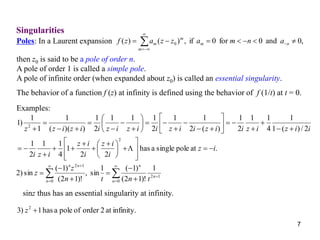
Examples:
,0and0for0if,)()( 0  


 nm
m
m
m anmazzazf
12
00
12
1
)!12(
)1(1
sin,
)!12(
)1(
sin)2 





 




 n
n
n
n
nn
tntn
z
z
.atpolesingleahas
22
1
4
11
2
1
2/)(1
1
4
11
2
1
)(2
11
2
111
2
1
))((
1
1
1
)1
2
2
iz
i
iz
i
iz
izi
iiziziiziiziiziziizizz














 































sinz thus has an essential singularity at infinity.
infinity.at2orderofpoleahas1)3 2
z
8
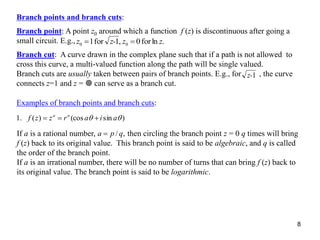
Branch points and branch cuts:
Branch point: A point z0 around which a function f (z) is discontinuous after going a
small circuit. E.g.,
Branch cut: A curve drawn in the complex plane such that if a path is not allowed to
cross this curve, a multi-valued function along the path will be single valued.
Branch cuts are usually taken between pairs of branch points. E.g., for , the curve
connects z=1 and z =  can serve as a branch cut.
.lnfor0,1for1 00 zzz-z 
1z-
Examples of branch points and branch cuts:
)sin(cos)(.1  aiarzzf aa

If a is a rational number, then circling the branch point z = 0 q times will bring
f (z) back to its original value. This branch point is said to be algebraic, and q is called
the order of the branch point.
If a is an irrational number, there will be no number of turns that can bring f (z) back to
its original value. The branch point is said to be logarithmic.
,/ qpa 
9
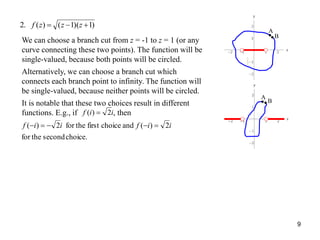
)1)(1()(.2  zzzf
We can choose a branch cut from z = -1 to z = 1 (or any
curve connecting these two points). The function will be
single-valued, because both points will be circled.
Alternatively, we can choose a branch cut which
connects each branch point to infinity. The function will
be single-valued, because neither points will be circled.
It is notable that these two choices result in different
functions. E.g., if , theniif 2)( 
choice.secondfor the
2)(andchoicefirstfor the2)( iifiif 
A
B
A
B
10
Mapping
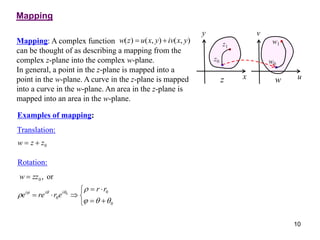
Mapping: A complex function
can be thought of as describing a mapping from the
complex z-plane into the complex w-plane.
In general, a point in the z-plane is mapped into a
point in the w-plane. A curve in the z-plane is mapped
into a curve in the w-plane. An area in the z-plane is
mapped into an area in the w-plane.
),(),()( yxivyxuzw 
z0
z1
z
y
x
w0
w1
w
v
u
Examples of mapping:
Translation:
0zzw 
Rotation:







0
0
0
0
0
or,


 
rr
erree
zzw
iii
11
Inversion:










 

r
re
e
z
w
i
i
1
1
or,
1
In Cartesian coordinates:
.,
11
22
22
22
22
























vu
v
y
vu
u
x
yx
y
v
yx
x
u
iyx
ivu
z
w
A straight line is mapped into a circle:
.0)( 22
2222






vauvub
b
vu
au
vu
v
baxy
12
Conformal mapping
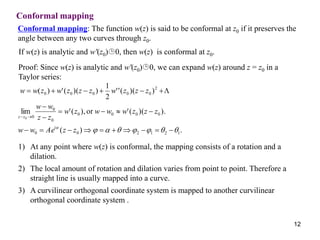
Conformal mapping: The function w(z) is said to be conformal at z0 if it preserves the
angle between any two curves through z0.
If w(z) is analytic and w'(z0)0, then w(z) is conformal at z0.
Proof: Since w(z) is analytic and w'(z0)0, we can expand w(z) around z = z0 in a
Taylor series:
.)(
).)(('or),('lim
))((''
2
1
))((')(
121200
0000
0
0
0
2
00000
0







zzAeww
zzzwwwzw
zz
ww
zzzwzzzwzww
i
zz

1) At any point where w(z) is conformal, the mapping consists of a rotation and a
dilation.
2) The local amount of rotation and dilation varies from point to point. Therefore a
straight line is usually mapped into a curve.
3) A curvilinear orthogonal coordinate system is mapped to another curvilinear
orthogonal coordinate system .
13
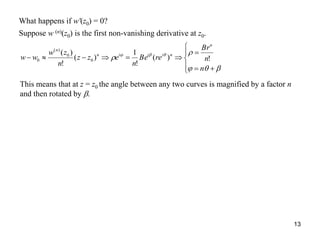
What happens if w'(z0) = 0?
Suppose w (n)(z0) is the first non-vanishing derivative at z0.










 
n
n
Br
reBe
n
ezz
n
zw
ww
n
niiin
n
!)(
!
1
)(
!
)(
0
0
)(
0
This means that at z = z0 the angle between any two curves is magnified by a factor n
and then rotated by .
14
Thank You

Real and complex

  • 1.
    1 Functions of aComplex Variable Sumita Gulati Assistant Professor S. A. Jain College, Ambala City
  • 2.
    Complex number: Complex algebra: Complexconjugation: 2 .)1real,areand(both  iyxiyxz Cauchy-Riemann conditions Complex algebra Functions of a Complex Variable                    2112212121221121 2121221121 vectors.)2dto(Anologous zzicycxiyxcczyxyxiyyxxiyxiyxzz yyixxiyxiyxzz   iyxiyxz  ** )( 22* ))(( yxiyxiyxzz  Modulus (magnitude): 2121 22* zzzzyxrzzz  Polar representation:   i reiriyxz  )sin(cos Argument (phase): )arg()arg()arg( )quadrants.3rdor2ndin theisif(arctan)arg( 2121 zzzz z x y z         
  • 3.
    3 Functions of acomplex variable: All elementary functions of real variables may be extended into the complex plane.       0 2 0 2 !!2!1 1 !!2!1 1:Example n n z n n x n zzz e n xxx e  A complex function can be resolved into its real part and imaginary part: 2222 2222 11 2)()(:Examples ),(),()( yx y i yx x iyxz xyiyxiyxz yxivyxuzf          Multi-valued functions and branch cuts: ivunirrerez nii   )2(ln]ln[)ln(ln:1Example )2(  To remove the ambiguity, we can limit all phases to (-,).  = - is the branch cut. lnz with n = 0 is the principle value.   2/)2(2121)2(2121 )(:2Example  ninii errerez   We can let z move on 2 Riemann sheets so that is single valued everywhere.21 )()( i rezf 
  • 4.
    4 Analytic functions: Iff (z) is differentiable at z = z0 and within the neighborhood of z=z0, f (z) is said to be analytic at z = z0. A function that is analytic in the whole complex plane is called an entire function. Cauchy-Riemann conditions for differentiability Cauchy-Riemann conditions z zf z zfzzf dz df zf zz        )( lim )()( lim)(' 00 In order to let f be differentiable, f '(z) must be the same in any direction of z. Particularly , it is necessary that x v y u y v x u y v y u i yi viu zfyiz x v i x u x viu zfxz y x                               , havewethemEquating .lim)(',For .lim)(',For 0 0 Cauchy-Riemann conditions x v y u y v x u           ,
  • 5.
    5 Conversely, if theCauchy-Riemann conditions are satisfied, f (z) is differentiable:   . 1 and,lim limlim )( lim 0 000                                                                                     y v i y u ix v i x u yix yix x v i x u yix y x u i x v x x v i x u yix y y v i y u x x v i x u z zf dz df z zzz More about Cauchy-Riemann conditions: 1) It is a very strong restraint to functions of a complex variable. 2) 3) 4) 2100 cvcuvuvu y v y u x v x u           . )()( iy v i iy u y u i y v x v i x u dz df                   analytic.notbutcontinuouseverywhereis,e.g. 000 2 1 2 1 :ondependsonly)(thatso,0toEquivalent *** * iyxf y v i y u i x v i x u y f i x f iy f x f z y y f z x x f z f zz,zf z f *                                                          
  • 6.
    6 Cauchy-Riemann conditions: Our Cauchy-Riemannconditions were derived by requiring f '(z) be the same when z changes along x or y directions. How about other directions? Here I do a general search for the conditions of differentiability.                                                                                                                                                               x v y u zf y v x u ip x u y v i x v y u ip p y v x v p y u x u iip y v i y u ip p y v x v ip y u x u dp d dp zdf pzf zp dx dy dx dy i dx dy y v x v i dx dy y u x u idydx dy y v dx x v idy y u dx x u idydx idvdu dz df zf .conditionsRiemann-Cauchysameget thewe ,directionsallatsamethebe)('requireweifis,That 1 1 1 1 0 )(' .ondependnotdoes)(' hunder whicconditionthefindwant toWe.ofchangetheofdirectionthe,letNow 1 )(' 2 2
  • 7.
    7 Singularities Poles: In aLaurent expansion then z0 is said to be a pole of order n. A pole of order 1 is called a simple pole. A pole of infinite order (when expanded about z0) is called an essential singularity. The behavior of a function f (z) at infinity is defined using the behavior of f (1/t) at t = 0. Examples: ,0and0for0if,)()( 0      nm m m m anmazzazf 12 00 12 1 )!12( )1(1 sin, )!12( )1( sin)2              n n n n nn tntn z z .atpolesingleahas 22 1 4 11 2 1 2/)(1 1 4 11 2 1 )(2 11 2 111 2 1 ))(( 1 1 1 )1 2 2 iz i iz i iz izi iiziziiziiziiziziizizz                                                sinz thus has an essential singularity at infinity. infinity.at2orderofpoleahas1)3 2 z
  • 8.
    8 Branch points andbranch cuts: Branch point: A point z0 around which a function f (z) is discontinuous after going a small circuit. E.g., Branch cut: A curve drawn in the complex plane such that if a path is not allowed to cross this curve, a multi-valued function along the path will be single valued. Branch cuts are usually taken between pairs of branch points. E.g., for , the curve connects z=1 and z =  can serve as a branch cut. .lnfor0,1for1 00 zzz-z  1z- Examples of branch points and branch cuts: )sin(cos)(.1  aiarzzf aa  If a is a rational number, then circling the branch point z = 0 q times will bring f (z) back to its original value. This branch point is said to be algebraic, and q is called the order of the branch point. If a is an irrational number, there will be no number of turns that can bring f (z) back to its original value. The branch point is said to be logarithmic. ,/ qpa 
  • 9.
    9 )1)(1()(.2  zzzf Wecan choose a branch cut from z = -1 to z = 1 (or any curve connecting these two points). The function will be single-valued, because both points will be circled. Alternatively, we can choose a branch cut which connects each branch point to infinity. The function will be single-valued, because neither points will be circled. It is notable that these two choices result in different functions. E.g., if , theniif 2)(  choice.secondfor the 2)(andchoicefirstfor the2)( iifiif  A B A B
  • 10.
    10 Mapping Mapping: A complexfunction can be thought of as describing a mapping from the complex z-plane into the complex w-plane. In general, a point in the z-plane is mapped into a point in the w-plane. A curve in the z-plane is mapped into a curve in the w-plane. An area in the z-plane is mapped into an area in the w-plane. ),(),()( yxivyxuzw  z0 z1 z y x w0 w1 w v u Examples of mapping: Translation: 0zzw  Rotation:        0 0 0 0 0 or,     rr erree zzw iii
  • 11.
    11 Inversion:              r re e z w i i 1 1 or, 1 In Cartesiancoordinates: ., 11 22 22 22 22                         vu v y vu u x yx y v yx x u iyx ivu z w A straight line is mapped into a circle: .0)( 22 2222       vauvub b vu au vu v baxy
  • 12.
    12 Conformal mapping Conformal mapping:The function w(z) is said to be conformal at z0 if it preserves the angle between any two curves through z0. If w(z) is analytic and w'(z0)0, then w(z) is conformal at z0. Proof: Since w(z) is analytic and w'(z0)0, we can expand w(z) around z = z0 in a Taylor series: .)( ).)(('or),('lim ))(('' 2 1 ))((')( 121200 0000 0 0 0 2 00000 0        zzAeww zzzwwwzw zz ww zzzwzzzwzww i zz  1) At any point where w(z) is conformal, the mapping consists of a rotation and a dilation. 2) The local amount of rotation and dilation varies from point to point. Therefore a straight line is usually mapped into a curve. 3) A curvilinear orthogonal coordinate system is mapped to another curvilinear orthogonal coordinate system .
  • 13.
    13 What happens ifw'(z0) = 0? Suppose w (n)(z0) is the first non-vanishing derivative at z0.             n n Br reBe n ezz n zw ww n niiin n !)( ! 1 )( ! )( 0 0 )( 0 This means that at z = z0 the angle between any two curves is magnified by a factor n and then rotated by .
  • 14.