NPTEL – Physics – Mathematical Physics - 1
Lecture 34
Analytic function of a complex variable (continued)
Example 1.
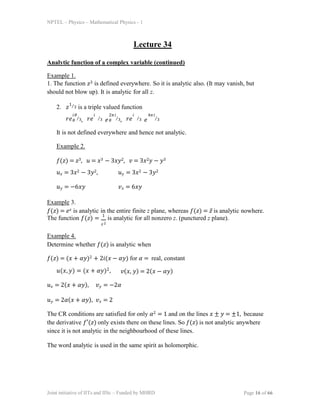
1. The function 𝑧3 is defined everywhere. So it is analytic also. (It may vanish, but
should not blow up). It is analytic for all z.
2. 𝑧 ⁄3 is a triple valued function
1
𝑟𝑒
𝑖𝜃 𝑖
𝜃 ⁄3, ⁄3 𝑒 ⁄3,
𝑟𝑒 𝑟𝑒
2𝜋𝑖 𝑖
𝜃 ⁄3 𝑒 ⁄3
4𝜋𝑖
It is not defined everywhere and hence not analytic.
Example 2.
𝑓(𝑧) = 𝑧3, 𝑢 = 𝑥3 − 3𝑥𝑦2, 𝑣 = 3𝑥2𝑦 − 𝑦3
𝑢𝑥 = 3𝑥2 − 3𝑦2,
𝑢𝑦 = −6𝑥𝑦
𝑢𝑦 = 3𝑥2 − 3𝑦2
𝑣𝑥 = 6𝑥𝑦
Example 3.
𝑓(𝑧) = 𝑒𝑧 is analytic in the entire finite z plane, whereas 𝑓(𝑧) = 𝑧̅ is analytic nowhere.
𝑧2
The function 𝑓(𝑧) = 1
is analytic for all nonzero z. (punctured z plane).
Joint initiative of IITs and IISc – Funded by MHRD Page 16 of 66
Example 4.
Determine whether 𝑓(𝑧) is analytic when
𝑓(𝑧) = (𝑥 + 𝛼𝑦)2 + 2𝑖(𝑥 − 𝛼𝑦) for 𝛼 = real, constant
𝑢(𝑥, 𝑦) = (𝑥 + 𝛼𝑦)2, 𝑣(𝑥, 𝑦) = 2(𝑥 − 𝛼𝑦)
𝑢𝑥 = 2(𝑥 + 𝛼𝑦), 𝑣𝑦 = −2𝛼
𝑢𝑦 = 2𝛼(𝑥 + 𝛼𝑦), 𝑣𝑥 = 2
The CR conditions are satisfied for only 𝛼2 = 1 and on the lines 𝑥 ± 𝑦 = ±1, because
the derivative 𝑓′(𝑧) only exists there on these lines. So 𝑓(𝑧) is not analytic anywhere
since it is not analytic in the neighbourhood of these lines.
The word analytic is used in the same spirit as holomorphic.
NPTEL – Physics – Mathematical Physics - 1
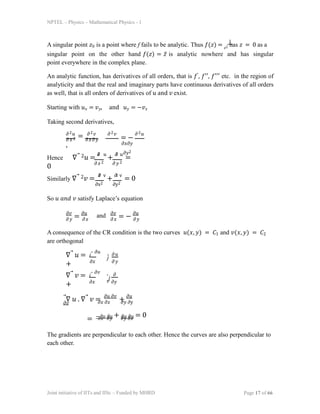
A singular point 𝑧0 is a point where f fails to be analytic. Thus 𝑓(𝑧) = 𝑧2 has 𝑧 = 0 as a
singular point on the other hand 𝑓(𝑧) = 𝑧̅ is analytic nowhere and has singular
point everywhere in the complex plane.
An analytic function, has derivatives of all orders, that is 𝑓′, 𝑓′′, 𝑓′′′ etc. in the region of
analyticity and that the real and imaginary parts have continuous derivatives of all orders
as well, that is all orders of derivatives of 𝑢 and 𝑣 exist.
1
Starting with 𝑢𝑥 = 𝑣𝑦, and 𝑢𝑦 = −𝑣𝑥
Taking second derivatives,
𝜕2𝑢 𝜕2𝑣 𝜕2𝑣
𝜕𝑥2 = 𝜕𝑥𝜕𝑦
,
= −
𝜕𝑥𝜕𝑦
𝜕𝑦2
𝜕2𝑢
Hence ∇⃗ 2𝑢 =
𝜕 𝑢
+
𝜕 𝑢
=
0
2
𝜕𝑥2 𝜕𝑦2
2
Similarly ∇⃗ 2𝑣 =
∂ v
+
∂ v
= 0
2 2
∂x2 ∂y2
So 𝑢 𝑎𝑛𝑑 𝑣 satisfy Laplace’s equation
𝜕𝑣
= 𝜕𝑢 𝜕𝑣
= − 𝜕𝑢
𝜕𝑦 𝜕𝑥 𝜕𝑥 𝜕𝑦
and
A consequence of the CR condition is the two curves 𝑢(𝑥, 𝑦) = 𝐶1 and 𝑣(𝑥, 𝑦) = 𝐶2
are orthogonal
∇⃗ 𝑢 = iˆ ∂𝑢
+ ∂𝑥
ĵ
𝜕𝑢
𝜕𝑦
∇⃗ 𝑣 = iˆ ∂𝑣
+ ∂𝑥 ∂𝑦
ˆj
∂
𝑣
⃗∇ 𝑢 . ∇⃗ 𝑣 = ∂𝑢 ∂𝑣
+ 𝜕𝑢
∂𝑣
Joint initiative of IITs and IISc – Funded by MHRD Page 17 of 66
∂𝑥 ∂𝑥 𝜕𝑦 ∂y
= −𝜕𝑢 𝜕𝑢 𝜕𝑢 𝜕𝑢
𝜕𝑥 𝜕𝑦
+ 𝜕𝑦 𝜕𝑥
= 0
The gradients are perpendicular to each other. Hence the curves are also perpendicular to
each other.
NPTEL – Physics – Mathematical Physics - 1
Example 5.
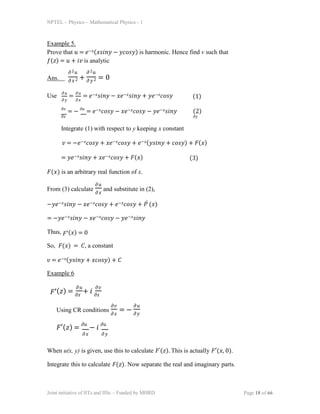
Prove that 𝑢 = 𝑒−𝑥(𝑥𝑠𝑖𝑛𝑦 − 𝑦𝑐𝑜𝑠𝑦) is harmonic. Hence find v such that
𝑓(𝑧) = 𝑢 + 𝑖𝑣 is analytic
Ans.
𝜕2𝑢 𝜕2𝑢
𝜕𝑥2 𝜕𝑦 2
+ = 0
Use = = 𝑒−𝑥𝑠𝑖𝑛𝑦 − 𝑥𝑒−𝑥𝑠𝑖𝑛𝑦 + 𝑦𝑒−𝑥𝑐𝑜𝑠𝑦
𝜕𝑢
𝜕𝑦 𝜕𝑥
𝜕𝑢
(1)
𝜕𝑣
= − 𝜕𝑢
= 𝑒−𝑥𝑐𝑜𝑠𝑦 − 𝑥𝑒−𝑥𝑐𝑜𝑠𝑦 − 𝑦𝑒−𝑥𝑠𝑖𝑛𝑦 (2)
𝜕𝑥 𝜕𝑦
Integrate (1) with respect to y keeping x constant
𝑣 = −𝑒−𝑥𝑐𝑜𝑠𝑦 + 𝑥𝑒−𝑥𝑐𝑜𝑠𝑦 + 𝑒−𝑥(𝑦𝑠𝑖𝑛𝑦 + 𝑐𝑜𝑠𝑦) + 𝐹(𝑥)
= 𝑦𝑒−𝑥𝑠𝑖𝑛𝑦 + 𝑥𝑒−𝑥𝑐𝑜𝑠𝑦 + 𝐹(𝑥) (3)
𝐹(𝑥) is an arbitrary real function of x.
From (3) calculate and substitute in (2),
𝜕𝑢
𝜕𝑥
−𝑦𝑒−𝑥𝑠𝑖𝑛𝑦 − 𝑥𝑒−𝑥𝑐𝑜𝑠𝑦 + 𝑒−𝑥𝑐𝑜𝑠𝑦 + 𝑃́ (𝑥)
= −𝑦𝑒−𝑥𝑠𝑖𝑛𝑦 − 𝑥𝑒−𝑥𝑐𝑜𝑠𝑦 − 𝑦𝑒−𝑥𝑠𝑖𝑛𝑦
Thus, 𝐹′(𝑥) = 0
So, 𝐹(𝑥) = 𝐶, a constant
𝜐 = 𝑒−𝑥(𝑦𝑠𝑖𝑛𝑦 + 𝑥𝑐𝑜𝑠𝑦) + 𝐶
Example 6
𝐹′(𝑧) = 𝜕𝑥
+ 𝑖 𝜕𝑥
𝜕𝑢 𝜕𝑣
Using CR conditions = −
𝜕𝑣
𝜕𝑥
𝜕𝑢
𝜕𝑦
𝐹′(𝑧) =
𝜕𝑢
− 𝑖
𝜕𝑢
𝜕𝑥 𝜕𝑦
When u(x, y) is given, use this to calculate 𝐹′(𝑧). This is actually 𝐹′(𝑥, 0).
Integrate this to calculate 𝐹(𝑧). Now separate the real and imaginary parts.
Joint initiative of IITs and IISc – Funded by MHRD Page 18 of 66
NPTEL – Physics – Mathematical Physics - 1
Example 7.
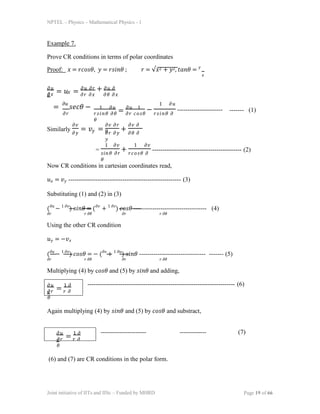
Prove CR conditions in terms of polar coordinates
Proof: 𝑥 = 𝑟𝑐𝑜𝑠𝜃, 𝑦 = 𝑟𝑠𝑖𝑛𝜃 ; 𝑟 = √𝑥2 + 𝑦2, 𝑡𝑎𝑛𝜃 = 𝑦
𝑥
𝜕𝑢
= 𝑢 = 𝜕𝑢 𝜕𝑟 𝜕𝑢 𝜕
𝜃
𝜕𝑥 𝑥
+
𝜕𝑟 𝜕𝑥 𝜕𝜃 𝜕𝑥
=
𝜕𝑢
𝑠𝑒𝑐𝜃 −
𝜕𝑟
1 𝜕𝑢
= 𝜕𝑢 1
𝑟𝑠𝑖𝑛𝜃 𝜕𝜃 𝜕𝑟 𝑐𝑜𝑠𝜃 𝑟𝑠𝑖𝑛𝜃 𝜕
𝜃
−
1 𝜕𝑢
---------------------- ------- (1)
Similarly = 𝑣𝑦 =
𝜕𝑣
𝜕𝑦
𝜕𝑣 𝜕𝑟 𝜕𝑣 𝜕
𝜃
𝜕𝑟 𝜕𝑦 𝜕𝜃 𝜕
𝑦
+
=
1 𝜕𝑣 1
𝑠𝑖𝑛𝜃 𝜕𝑟 𝑟𝑐𝑜𝑠𝜃 𝜕
𝜃
+
𝜕𝑣
------------------------------------------- (2)
Now CR conditions in cartesian coordinates read,
𝑢𝑥 = 𝑣𝑦 ------------------------------------------------------ (3)
Substituting (1) and (2) in (3)
(𝜕𝑢
− 1 𝜕𝑣
) 𝑠𝑖𝑛𝜃 = (𝜕𝑣
+ 1 𝜕𝑣
) 𝑐𝑜𝑠𝜃 ----------------------------------- (4)
𝜕𝑟 𝑟 𝜕𝜃 𝜕𝑟 𝑟 𝜕𝜃
Using the other CR condition
𝑢𝑦 = −𝑣𝑥
(𝜕𝑢
− 1 𝜕𝑣
) 𝑐𝑜𝑠𝜃 = − (𝜕𝑣
+ 1 𝜕𝑢
) 𝑠𝑖𝑛𝜃 -------------------------------- ------- (5)
𝜕𝑟 𝑟 𝜕𝜃 𝜕𝑟 𝑟 𝜕𝜃
Multiplying (4) by c𝑜𝑠𝜃 and (5) by 𝑠𝑖𝑛𝜃 and adding,
----------------------------------------------------------------------- (6)
Again multiplying (4) by 𝑠𝑖𝑛𝜃 and (5) by 𝑐𝑜𝑠𝜃 and substract,
---------------------- ------------- (7)
(6) and (7) are CR conditions in the polar form.
𝜕𝑢
= 1 𝜕
𝑣
𝜕𝑟 𝑟 𝜕
𝜃
𝜕𝑢
= 1 𝜕
𝑣
𝜕𝑟 𝑟 𝜕
𝜃
Joint initiative of IITs and IISc – Funded by MHRD Page 19 of 66

lec34.ppt

  • 1.
    NPTEL – Physics– Mathematical Physics - 1 Lecture 34 Analytic function of a complex variable (continued) Example 1. 1. The function 𝑧3 is defined everywhere. So it is analytic also. (It may vanish, but should not blow up). It is analytic for all z. 2. 𝑧 ⁄3 is a triple valued function 1 𝑟𝑒 𝑖𝜃 𝑖 𝜃 ⁄3, ⁄3 𝑒 ⁄3, 𝑟𝑒 𝑟𝑒 2𝜋𝑖 𝑖 𝜃 ⁄3 𝑒 ⁄3 4𝜋𝑖 It is not defined everywhere and hence not analytic. Example 2. 𝑓(𝑧) = 𝑧3, 𝑢 = 𝑥3 − 3𝑥𝑦2, 𝑣 = 3𝑥2𝑦 − 𝑦3 𝑢𝑥 = 3𝑥2 − 3𝑦2, 𝑢𝑦 = −6𝑥𝑦 𝑢𝑦 = 3𝑥2 − 3𝑦2 𝑣𝑥 = 6𝑥𝑦 Example 3. 𝑓(𝑧) = 𝑒𝑧 is analytic in the entire finite z plane, whereas 𝑓(𝑧) = 𝑧̅ is analytic nowhere. 𝑧2 The function 𝑓(𝑧) = 1 is analytic for all nonzero z. (punctured z plane). Joint initiative of IITs and IISc – Funded by MHRD Page 16 of 66 Example 4. Determine whether 𝑓(𝑧) is analytic when 𝑓(𝑧) = (𝑥 + 𝛼𝑦)2 + 2𝑖(𝑥 − 𝛼𝑦) for 𝛼 = real, constant 𝑢(𝑥, 𝑦) = (𝑥 + 𝛼𝑦)2, 𝑣(𝑥, 𝑦) = 2(𝑥 − 𝛼𝑦) 𝑢𝑥 = 2(𝑥 + 𝛼𝑦), 𝑣𝑦 = −2𝛼 𝑢𝑦 = 2𝛼(𝑥 + 𝛼𝑦), 𝑣𝑥 = 2 The CR conditions are satisfied for only 𝛼2 = 1 and on the lines 𝑥 ± 𝑦 = ±1, because the derivative 𝑓′(𝑧) only exists there on these lines. So 𝑓(𝑧) is not analytic anywhere since it is not analytic in the neighbourhood of these lines. The word analytic is used in the same spirit as holomorphic.
  • 2.
    NPTEL – Physics– Mathematical Physics - 1 A singular point 𝑧0 is a point where f fails to be analytic. Thus 𝑓(𝑧) = 𝑧2 has 𝑧 = 0 as a singular point on the other hand 𝑓(𝑧) = 𝑧̅ is analytic nowhere and has singular point everywhere in the complex plane. An analytic function, has derivatives of all orders, that is 𝑓′, 𝑓′′, 𝑓′′′ etc. in the region of analyticity and that the real and imaginary parts have continuous derivatives of all orders as well, that is all orders of derivatives of 𝑢 and 𝑣 exist. 1 Starting with 𝑢𝑥 = 𝑣𝑦, and 𝑢𝑦 = −𝑣𝑥 Taking second derivatives, 𝜕2𝑢 𝜕2𝑣 𝜕2𝑣 𝜕𝑥2 = 𝜕𝑥𝜕𝑦 , = − 𝜕𝑥𝜕𝑦 𝜕𝑦2 𝜕2𝑢 Hence ∇⃗ 2𝑢 = 𝜕 𝑢 + 𝜕 𝑢 = 0 2 𝜕𝑥2 𝜕𝑦2 2 Similarly ∇⃗ 2𝑣 = ∂ v + ∂ v = 0 2 2 ∂x2 ∂y2 So 𝑢 𝑎𝑛𝑑 𝑣 satisfy Laplace’s equation 𝜕𝑣 = 𝜕𝑢 𝜕𝑣 = − 𝜕𝑢 𝜕𝑦 𝜕𝑥 𝜕𝑥 𝜕𝑦 and A consequence of the CR condition is the two curves 𝑢(𝑥, 𝑦) = 𝐶1 and 𝑣(𝑥, 𝑦) = 𝐶2 are orthogonal ∇⃗ 𝑢 = iˆ ∂𝑢 + ∂𝑥 ĵ 𝜕𝑢 𝜕𝑦 ∇⃗ 𝑣 = iˆ ∂𝑣 + ∂𝑥 ∂𝑦 ˆj ∂ 𝑣 ⃗∇ 𝑢 . ∇⃗ 𝑣 = ∂𝑢 ∂𝑣 + 𝜕𝑢 ∂𝑣 Joint initiative of IITs and IISc – Funded by MHRD Page 17 of 66 ∂𝑥 ∂𝑥 𝜕𝑦 ∂y = −𝜕𝑢 𝜕𝑢 𝜕𝑢 𝜕𝑢 𝜕𝑥 𝜕𝑦 + 𝜕𝑦 𝜕𝑥 = 0 The gradients are perpendicular to each other. Hence the curves are also perpendicular to each other.
  • 3.
    NPTEL – Physics– Mathematical Physics - 1 Example 5. Prove that 𝑢 = 𝑒−𝑥(𝑥𝑠𝑖𝑛𝑦 − 𝑦𝑐𝑜𝑠𝑦) is harmonic. Hence find v such that 𝑓(𝑧) = 𝑢 + 𝑖𝑣 is analytic Ans. 𝜕2𝑢 𝜕2𝑢 𝜕𝑥2 𝜕𝑦 2 + = 0 Use = = 𝑒−𝑥𝑠𝑖𝑛𝑦 − 𝑥𝑒−𝑥𝑠𝑖𝑛𝑦 + 𝑦𝑒−𝑥𝑐𝑜𝑠𝑦 𝜕𝑢 𝜕𝑦 𝜕𝑥 𝜕𝑢 (1) 𝜕𝑣 = − 𝜕𝑢 = 𝑒−𝑥𝑐𝑜𝑠𝑦 − 𝑥𝑒−𝑥𝑐𝑜𝑠𝑦 − 𝑦𝑒−𝑥𝑠𝑖𝑛𝑦 (2) 𝜕𝑥 𝜕𝑦 Integrate (1) with respect to y keeping x constant 𝑣 = −𝑒−𝑥𝑐𝑜𝑠𝑦 + 𝑥𝑒−𝑥𝑐𝑜𝑠𝑦 + 𝑒−𝑥(𝑦𝑠𝑖𝑛𝑦 + 𝑐𝑜𝑠𝑦) + 𝐹(𝑥) = 𝑦𝑒−𝑥𝑠𝑖𝑛𝑦 + 𝑥𝑒−𝑥𝑐𝑜𝑠𝑦 + 𝐹(𝑥) (3) 𝐹(𝑥) is an arbitrary real function of x. From (3) calculate and substitute in (2), 𝜕𝑢 𝜕𝑥 −𝑦𝑒−𝑥𝑠𝑖𝑛𝑦 − 𝑥𝑒−𝑥𝑐𝑜𝑠𝑦 + 𝑒−𝑥𝑐𝑜𝑠𝑦 + 𝑃́ (𝑥) = −𝑦𝑒−𝑥𝑠𝑖𝑛𝑦 − 𝑥𝑒−𝑥𝑐𝑜𝑠𝑦 − 𝑦𝑒−𝑥𝑠𝑖𝑛𝑦 Thus, 𝐹′(𝑥) = 0 So, 𝐹(𝑥) = 𝐶, a constant 𝜐 = 𝑒−𝑥(𝑦𝑠𝑖𝑛𝑦 + 𝑥𝑐𝑜𝑠𝑦) + 𝐶 Example 6 𝐹′(𝑧) = 𝜕𝑥 + 𝑖 𝜕𝑥 𝜕𝑢 𝜕𝑣 Using CR conditions = − 𝜕𝑣 𝜕𝑥 𝜕𝑢 𝜕𝑦 𝐹′(𝑧) = 𝜕𝑢 − 𝑖 𝜕𝑢 𝜕𝑥 𝜕𝑦 When u(x, y) is given, use this to calculate 𝐹′(𝑧). This is actually 𝐹′(𝑥, 0). Integrate this to calculate 𝐹(𝑧). Now separate the real and imaginary parts. Joint initiative of IITs and IISc – Funded by MHRD Page 18 of 66
  • 4.
    NPTEL – Physics– Mathematical Physics - 1 Example 7. Prove CR conditions in terms of polar coordinates Proof: 𝑥 = 𝑟𝑐𝑜𝑠𝜃, 𝑦 = 𝑟𝑠𝑖𝑛𝜃 ; 𝑟 = √𝑥2 + 𝑦2, 𝑡𝑎𝑛𝜃 = 𝑦 𝑥 𝜕𝑢 = 𝑢 = 𝜕𝑢 𝜕𝑟 𝜕𝑢 𝜕 𝜃 𝜕𝑥 𝑥 + 𝜕𝑟 𝜕𝑥 𝜕𝜃 𝜕𝑥 = 𝜕𝑢 𝑠𝑒𝑐𝜃 − 𝜕𝑟 1 𝜕𝑢 = 𝜕𝑢 1 𝑟𝑠𝑖𝑛𝜃 𝜕𝜃 𝜕𝑟 𝑐𝑜𝑠𝜃 𝑟𝑠𝑖𝑛𝜃 𝜕 𝜃 − 1 𝜕𝑢 ---------------------- ------- (1) Similarly = 𝑣𝑦 = 𝜕𝑣 𝜕𝑦 𝜕𝑣 𝜕𝑟 𝜕𝑣 𝜕 𝜃 𝜕𝑟 𝜕𝑦 𝜕𝜃 𝜕 𝑦 + = 1 𝜕𝑣 1 𝑠𝑖𝑛𝜃 𝜕𝑟 𝑟𝑐𝑜𝑠𝜃 𝜕 𝜃 + 𝜕𝑣 ------------------------------------------- (2) Now CR conditions in cartesian coordinates read, 𝑢𝑥 = 𝑣𝑦 ------------------------------------------------------ (3) Substituting (1) and (2) in (3) (𝜕𝑢 − 1 𝜕𝑣 ) 𝑠𝑖𝑛𝜃 = (𝜕𝑣 + 1 𝜕𝑣 ) 𝑐𝑜𝑠𝜃 ----------------------------------- (4) 𝜕𝑟 𝑟 𝜕𝜃 𝜕𝑟 𝑟 𝜕𝜃 Using the other CR condition 𝑢𝑦 = −𝑣𝑥 (𝜕𝑢 − 1 𝜕𝑣 ) 𝑐𝑜𝑠𝜃 = − (𝜕𝑣 + 1 𝜕𝑢 ) 𝑠𝑖𝑛𝜃 -------------------------------- ------- (5) 𝜕𝑟 𝑟 𝜕𝜃 𝜕𝑟 𝑟 𝜕𝜃 Multiplying (4) by c𝑜𝑠𝜃 and (5) by 𝑠𝑖𝑛𝜃 and adding, ----------------------------------------------------------------------- (6) Again multiplying (4) by 𝑠𝑖𝑛𝜃 and (5) by 𝑐𝑜𝑠𝜃 and substract, ---------------------- ------------- (7) (6) and (7) are CR conditions in the polar form. 𝜕𝑢 = 1 𝜕 𝑣 𝜕𝑟 𝑟 𝜕 𝜃 𝜕𝑢 = 1 𝜕 𝑣 𝜕𝑟 𝑟 𝜕 𝜃 Joint initiative of IITs and IISc – Funded by MHRD Page 19 of 66