1
VIROLOGY
(The study of Viruses)
2
Dr. Kaveh Haratian
Department of Microbiology and Immunology
Alborz University of Medical Sciences
Fall 1394
3
OUTLINE
• introduction to viruses
structure and classification
• basic virology
• clinical virology
In VIROLOGY we notice:
 different structure
 different method of replication
 implications for
 diagnosis
 treatment
 prevention
4
CONTROL METHODS
 INVOLVE KNOWLEDGE OF:
 RESERVOIRS
 MODE OF TRANSMISSION
 METHODS TO INACTIVATE VIRUS OF INTEREST
 VACCINES
 ANTI-VIRAL DRUGS
 DEVELOPMENT OF DRUG RESISTANCE
5
EMERGING VIRAL DISEASES
 Some new global examples:
 HIV/AIDS
 Hantavirus pulmonary syndrome (HPS)
 West Nile encephalitis (WNV)
 Severe acute respiratory syndrome (SARS)
 Monkey pox
 Human metapneumovirus
 Ebola hemorrhagic disease
6
Consequences of viral infections
 50% of all absenteeism
 Children:
 7 or more viral infections per year that
involve a visit to a physician
7
Consequences of viral infections
 Suffering, followed by recovery
 Persistent disease
 Fatal disease
 Congenital disease
 Contributory factor in cancer
 Contributory factor in other diseases
8
SOME ARE ASYMPTOMATIC!
9
VIRUSES CAN BE USEFUL
 VACCINE DEVELOPMENT
 GENE THERAPY
 TOOLS TO INVESTIGATE HOST CELLS
10
WHAT ARE VIRUSES?
11
“A PIECE OF BAD NEWS
WRAPPED UP IN A PROTEIN”
WHAT ARE VIRUSES?
 NUCLEIC ACID GENOME:
 DNA OR RNA
 PROTEIN COAT
 PROTECTION, ENTRY
 LIPID ENVELOPE IN SOME VIRUSES
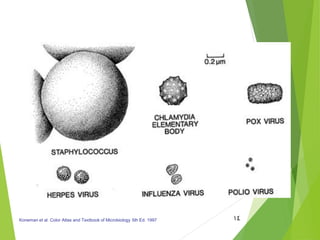
 SMALL
 (20-400nm)
 OBLIGATE INTRACELLULAR PARASITES
12
13
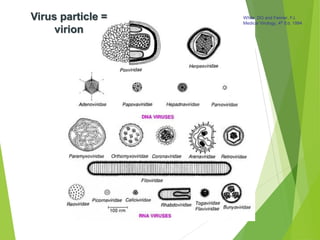
Virus particle =
virion
White, DO and Fenner, FJ.
Medical Virology, 4th Ed. 1994
14Koneman et al. Color Atlas and Textbook of Microbiology 5th Ed. 1997
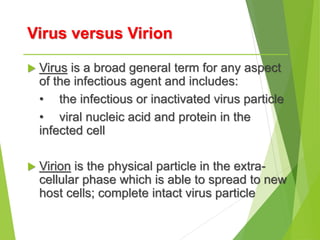
Virus versus Virion
 Virus is a broad general term for any aspect
of the infectious agent and includes:
• the infectious or inactivated virus particle
• viral nucleic acid and protein in the
infected cell
 Virion is the physical particle in the extra-
cellular phase which is able to spread to new
host cells; complete intact virus particle
16
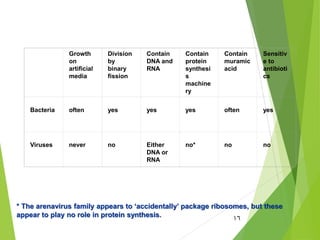
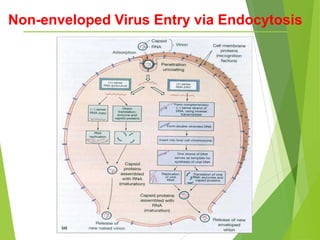
Growth
on
artificial
media
Division
by
binary
fission
Contain
DNA and
RNA
Contain
protein
synthesi
s
machine
ry
Contain
muramic
acid
Sensitiv
e to
antibioti
cs
Bacteria often yes yes yes often yes
Viruses never no Either
DNA or
RNA
no* no no
* The arenavirus family appears to ‘accidentally’ package ribosomes, but these
appear to play no role in protein synthesis.
CONSEQUENCES
 NO BROAD RANGE ANTIBIOTICS
 HEAVILY PARASITIC ON HOST CELL
 NEED TO LOOK FOR WEAK LINK
17
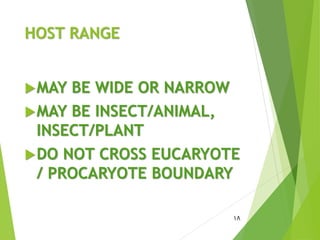
HOST RANGE
MAY BE WIDE OR NARROW
MAY BE INSECT/ANIMAL,
INSECT/PLANT
DO NOT CROSS EUCARYOTE
/ PROCARYOTE BOUNDARY
18
19
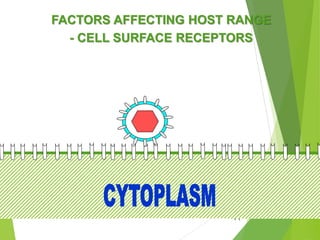
FACTORS AFFECTING HOST RANGE
- CELL SURFACE RECEPTORS
FACTORS AFFECTING HOST RANGE
 CELL SURFACE RECEPTORS
20
• AVAILABILITY OF REPLICATION
MACHINERY
• ABILITY TO GET OUT OF CELL AND
SPREAD
• HOST ANTI-VIRAL RESPONSE
VIRAL STRUCTURE : SOME
TERMINOLOGY
 virus particle = virion
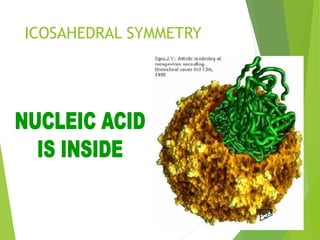
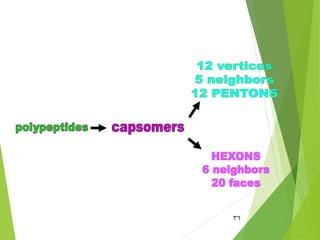
 protein which coats the genome = capsid
 capsid usually symmetrical
 capsid + genome = nucleocapsid
 may have an envelope
21
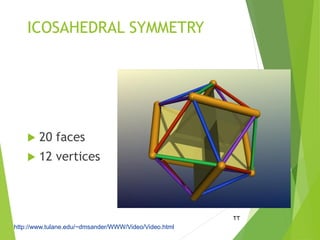
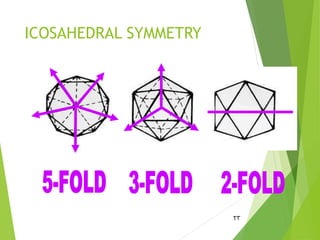
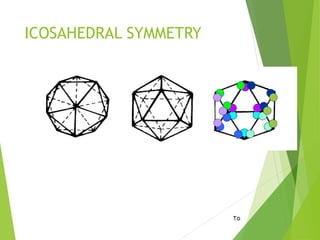
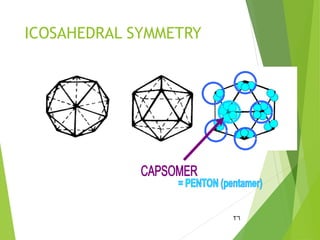
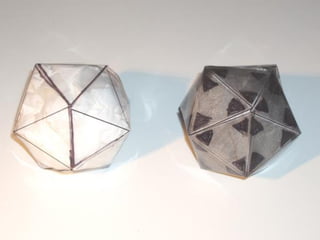
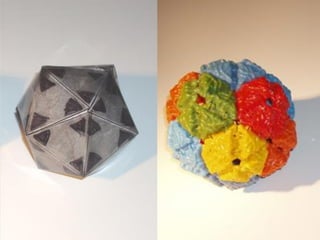
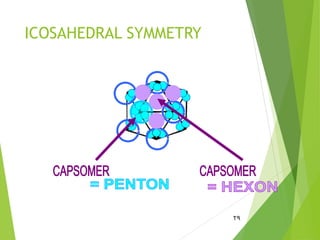
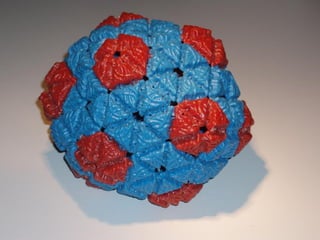
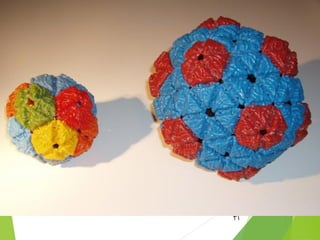
ICOSAHEDRAL SYMMETRY
 20 faces
 12 vertices
22
http://www.tulane.edu/~dmsander/WWW/Video/Video.html
ICOSAHEDRAL SYMMETRY
23
ICOSAHEDRAL SYMMETRY
24
ICOSAHEDRAL SYMMETRY
25
ICOSAHEDRAL SYMMETRY
26
27
28
ICOSAHEDRAL SYMMETRY
29
30
31
32
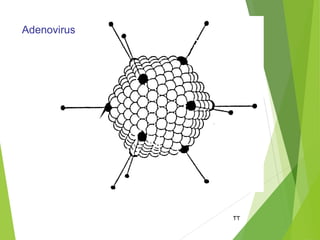
Adenovirus
33
34
35
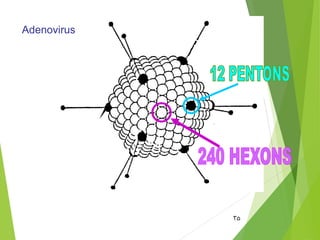
Adenovirus
36
ICOSAHEDRAL SYMMETRY
37
SYMMETRY OF
NUCLEOCAPSID
 ICOSAHEDRAL
 HELICAL
38
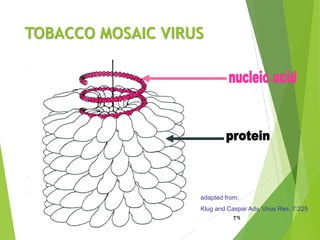
TOBACCO MOSAIC VIRUS
39
adapted from:
Klug and Caspar Adv. Virus Res. 7:225
40
Helical symmetry
 Length controlled by nucleic acid
 Helix may be stiff or flexible
41
42
43
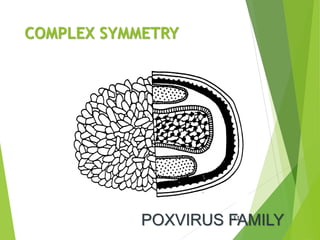
COMPLEX SYMMETRY
44
POXVIRUS FAMILY
ENVELOPE
 OBTAINED BY BUDDING THROUGH A CELLULAR
MEMBRANE (except poxviruses)
 POSSIBILITY OF EXITING CELL WITHOUT KILLING IT
 CONTAINS AT LEAST ONE VIRALLY CODED PROTEIN
45
46
ENVELOPE
 OBTAINED BY BUDDING THROUGH A
CELLULAR MEMBRANE (except
poxviruses)
 POSSIBILITY OF EXITING CELL
WITHOUT KILLING IT
 CONTAINS AT LEAST ONE VIRALLY
CODED PROTEIN
 ATTACHMENT PROTEIN
 LOSS OF ENVELOPE RESULTS IN LOSS
OF INFECTIVITY
47
ENVELOPE
48
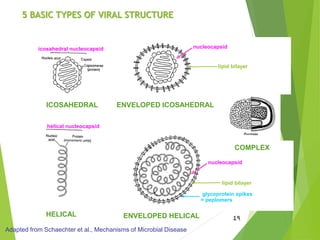
5 BASIC TYPES OF VIRAL STRUCTURE
49
HELICAL ENVELOPED HELICAL
ENVELOPED ICOSAHEDRAL
COMPLEX
ICOSAHEDRAL
Adapted from Schaechter et al., Mechanisms of Microbial Disease
nucleocapsidicosahedral nucleocapsid
nucleocapsid
helical nucleocapsid
lipid bilayer
lipid bilayer
glycoprotein spikes
= peplomers
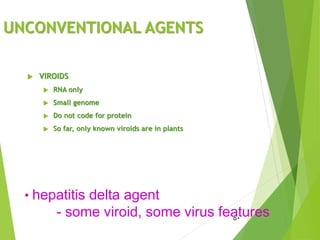
UNCONVENTIONAL AGENTS
 VIROIDS
 RNA only
 Small genome
 Do not code for protein
 So far, only known viroids are in plants
50
• hepatitis delta agent
- some viroid, some virus features
UNCONVENTIONAL AGENTS
 PRIONS
 protein only?
 do not contain any nucleic acid?
51
LIVING OR DEAD?
52
CLASSIFICATION
 BASIC STRUCTURE AND MOLECULAR
BIOLOGY
 particularly important as diagnostic and
therapeutic abilities expand
 past schemes
 host range
 tissue infected
 type of cell infected
 mode of transmission
 disease caused
53
Arboviruses
(arthropod borne)
CLASSIFICATION
 NUCLEIC ACID
 CAPSID
 PRESENCE OF ENVELOPE
 REPLICATION STRATEGY
54
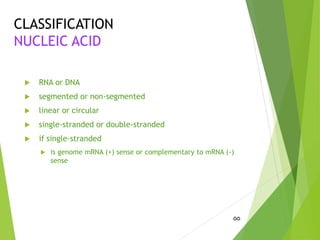
CLASSIFICATION
NUCLEIC ACID
 RNA or DNA
 segmented or non-segmented
 linear or circular
 single-stranded or double-stranded
 if single-stranded
 is genome mRNA (+) sense or complementary to mRNA (-)
sense
55
 symmetry
 icosahedral, helical, complex
 enveloped or non-enveloped
 number of capsomers
56
CLASSIFICATION
CAPSID
CLASSIFICATION
 ENVELOPE
 REPLICATION STRATEGY
57
58
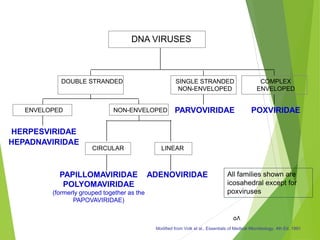
HERPESVIRIDAE
HEPADNAVIRIDAE
ENVELOPED
PAPILLOMAVIRIDAE
POLYOMAVIRIDAE
(formerly grouped together as the
PAPOVAVIRIDAE)
CIRCULAR
ADENOVIRIDAE
LINEAR
NON-ENVELOPED
DOUBLE STRANDED
PARVOVIRIDAE
SINGLE STRANDED
NON-ENVELOPED
POXVIRIDAE
COMPLEX
ENVELOPED
DNA VIRUSES
Modified from Volk et al., Essentials of Medical Microbiology, 4th Ed. 1991
All families shown are
icosahedral except for
poxviruses
59
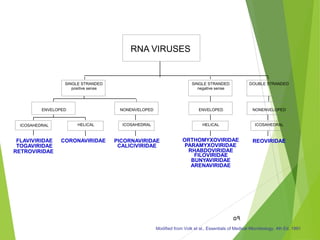
FLAVIVIRIDAE
TOGAVIRIDAE
RETROVIRIDAE
ICOSAHEDRAL
CORONAVIRIDAE
HELICAL
ENVELOPED
ICOSAHEDRAL
PICORNAVIRIDAE
CALICIVIRIDAE
NONENVELOPED
SINGLE STRANDED
positive sense
BUNYAVIRIDAE
ARENAVIRIDAE
ORTHOMYXOVIRIDAE
PARAMYXOVIRIDAE
RHABDOVIRIDAE
FILOVIRIDAE
SINGLE STRANDED
negative sense
REOVIRIDAE
DOUBLE STRANDED
RNA VIRUSES
ENVELOPED
HELICAL ICOSAHEDRAL
NONENVELOPED
Modified from Volk et al., Essentials of Medical Microbiology, 4th Ed. 1991
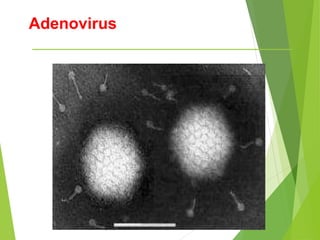
Adenovirus
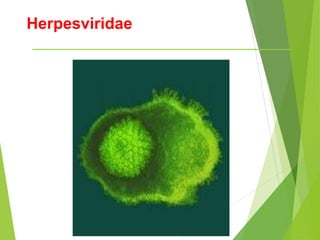
Herpesviridae
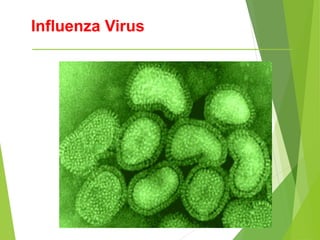
Influenza Virus
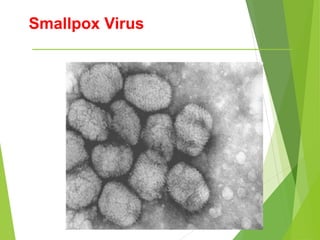
Smallpox Virus
Virus Classification
 Historically based on:
 Host preference: Plant, insect, animal, human
 Target organ: respiratory, hepatic, enteric, etc.
 Vector: arboviruses
 Overlapping, inconsistent
 Currently based on molecular biology of genome and biophysical
structure
Virus Classification
 Viruses with similar structural, genomic &
replication properties are grouped into
families (suffix: viridae) e.g. Herpesviridae
 Families subdivided into genera (suffix:
virus) e.g. Herpes simplex virus,
Cytomegalovirus, Varicella zoster virus
 Subtypes based on nucleotide sequence
and antigenic reactivities e.g. Herpes
simplex virus type 1, Herpes simplex virus
type 2
Virus Classification
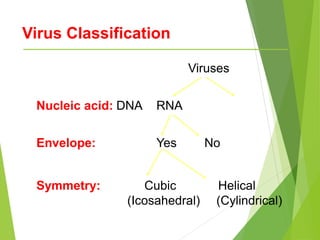
Viruses
Nucleic acid: DNA RNA
Envelope: Yes No
Symmetry: Cubic Helical
(Icosahedral) (Cylindrical)
Classification of Some Common Viruses
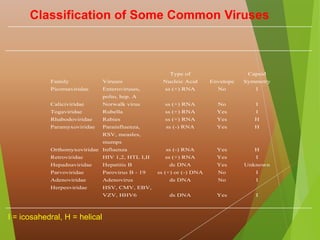
Family Viruses
Type of
Nucleic Acid Envelope
Capsid
Symmetry
Picornaviridae Enteroviruses,
polio, hep. A
ss (+) RNA No I
Caliciviridae Norwalk virus ss (+) RNA No I
Togaviridae Rubella ss (+) RNA Yes I
Rhabodoviridae Rabies ss (+) RNA Yes H
Paramyxoviridae Parainfluenza,
RSV, measles,
mumps
ss (-) RNA Yes H
Orthomyxoviridae Influenza ss (-) RNA Yes H
Retroviridae HIV 1,2, HTL I,II ss (+) RNA Yes I
Hepadnaviridae Hepatitis B ds DNA Yes Unknown
Parvoviridae Parovirus B - 19 ss (+) or (-) DNA No I
Adenoviridae Adenovirus ds DNA No I
Herpesviridae HSV, CMV, EBV,
VZV, HHV6 ds DNA Yes I
I = icosahedral, H = helical
Virus Classification
(Common)
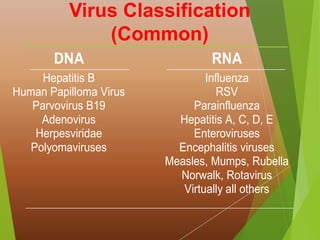
DNA RNA
Hepatitis B
Human Papilloma Virus
Parvovirus B19
Adenovirus
Herpesviridae
Polyomaviruses
Influenza
RSV
Parainfluenza
Hepatitis A, C, D, E
Enteroviruses
Encephalitis viruses
Measles, Mumps, Rubella
Norwalk, Rotavirus
Virtually all others
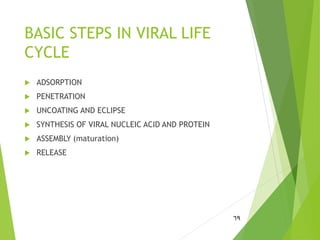
BASIC STEPS IN VIRAL LIFE
CYCLE
 ADSORPTION
 PENETRATION
 UNCOATING AND ECLIPSE
 SYNTHESIS OF VIRAL NUCLEIC ACID AND PROTEIN
 ASSEMBLY (maturation)
 RELEASE
69
ADSORPTION
70
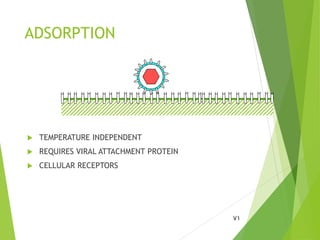
ADSORPTION
 TEMPERATURE INDEPENDENT
 REQUIRES VIRAL ATTACHMENT PROTEIN
 CELLULAR RECEPTORS
71
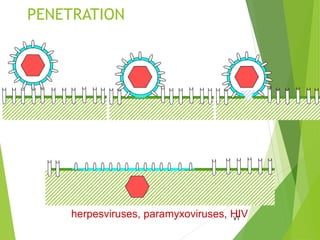
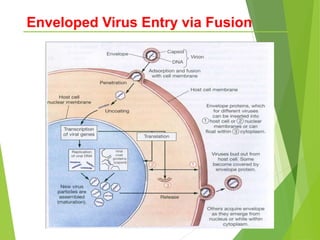
- ENVELOPED VIRUSES
•FUSION WITH PLASMA MEMBRANE
•ENTRY VIA ENDOSOMES
72
PENETRATION
73herpesviruses, paramyxoviruses, HIV
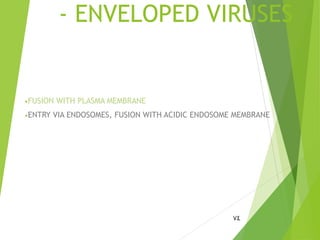
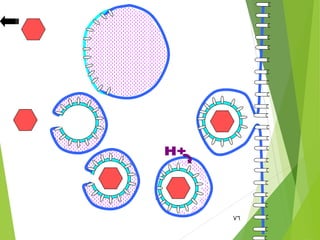
- ENVELOPED VIRUSES
•FUSION WITH PLASMA MEMBRANE
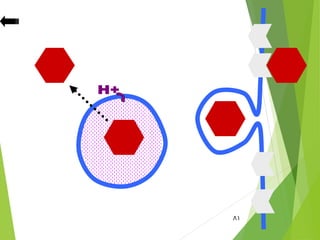
•ENTRY VIA ENDOSOMES, FUSION WITH ACIDIC ENDOSOME MEMBRANE
74
75
76
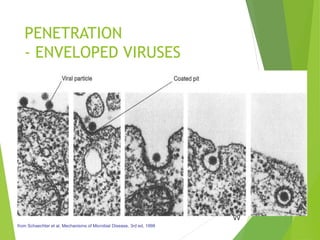
PENETRATION
- ENVELOPED VIRUSES
77
from Schaechter et al, Mechanisms of Microbial Disease, 3rd ed, 1998
VIRUS UPTAKE VIA
ENDOSOMES
 CALLED
 VIROPEXIS / ENDOCYTOSIS / PINOCYTOSIS
78
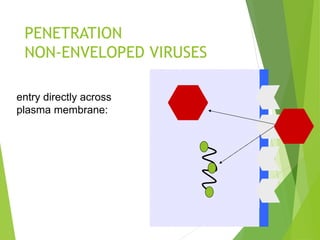
PENETRATION
NON-ENVELOPED VIRUSES
79
PENETRATION
NON-ENVELOPED VIRUSES
80
entry directly across
plasma membrane:
81
UNCOATING
 NEED TO MAKE GENOME AVAILABLE
 ONCE UNCOATING OCCURS, ENTER ECLIPSE PHASE
 ECLIPSE PHASE LASTS UNTIL FIRST NEW VIRUS PARTICLE FORMED
82
SYNTHESIS OF VIRAL NUCLEIC
ACID AND PROTEIN
 MANY STRATEGIES
 NUCLEIC ACID MAY BE MADE IN NUCLEUS OR CYTOPLASM
 PROTEIN SYNTHESIS IS ALWAYS IN THE CYTOPLASM
83
ASSEMBLY AND MATURATION
 NUCLEUS
 CYTOPLASM
 AT MEMBRANE
84
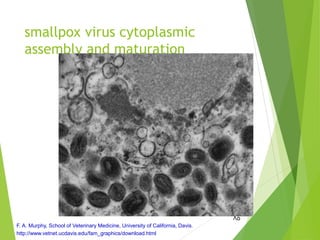
smallpox virus cytoplasmic
assembly and maturation
85
F. A. Murphy, School of Veterinary Medicine, University of California, Davis.
http://www.vetnet.ucdavis.edu/fam_graphics/download.html
RELEASE
 LYSIS
 BUDDING THROUGH PLASMA MEMBRANE
 NOT EVERY RELEASED VIRION IS INFECTIOUS
86
HIV budding and maturation
87Hsiung, GD et al., Diagnostic Virology 1994 p204 (D. Medina)
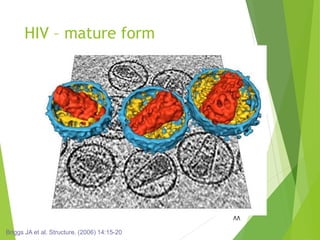
HIV – mature form
88
Briggs JA et al. Structure. (2006) 14:15-20
Viral Replication
i) adsorption (attachment)
ii) entry
iii) uncoating
iv) transcription
v) synthesis of virus components
vi) assembly
vii) release
Viral Replication
i) Adsorption (attachment):
 random collision
 interaction between specific proteins on viral
surface and specific receptors on target cell
membrane (tropism)
 not all cells carrying a receptor for a particular
virus can be productively infected by that
virus
Viral Replication
i) Adsorption (attachment):
some viruses may use more
than one host cell receptor (e.g.
HIV)
able to infect a limited spectrum
of cell types (host range)
most neutralizing antibodies are
specific for virion attachment
proteins
Viral Replication
ii) Entry (penetration):
2 mechanisms - endocytosis -
fusion of virus envelope with cell
membrane
iii) Uncoating:
release of viral genome
cell enzymes (lysosomes) strip off the
virus protein coat
virion can no longer be detected; known
as the “eclipse period”
Viral Replication
iv) Transcription/Translation/Synthesis:
a) DNA viruses:
• replicate their DNA in host cell nucleus mediated
by viral enzymes
• synthesize capsid and other proteins in cytoplasm
using host cell enzymes
• new viral proteins move to nucleus where they
combine with new DNA to form new viruses
• Exception - Poxviruses synthesize their parts in
host cell’s cytoplasm
Viral Replication
iv)
Transcription/Translation/Synthesi
s:
b) RNA viruses:
–“+” sense RNA acts as mRNA - viral
proteins are made immediately in
cytoplasm mediated by viral
enzymes
–“-” sense RNA (e.g. influenza) - lst
makes a “+” sense RNA copy via
viral enzyme
Viral Replication
iv) Transcription/Translation/Synthesis:
• Retroviridae (e.g. HIV)
• Contain enzyme “Reverse
transcriptase”
• “+” sense Viral RNA  cDNA  integrated into host cell
chromosome
• mRNA (for viral proteins) and progeny
virion RNA are synthesized from
integrated viral DNA by host cell
enzymes (RNA polymerases)
Viral Replication
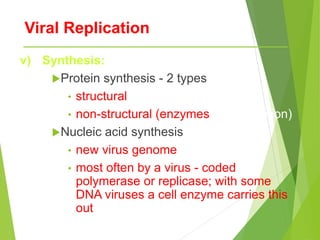
v) Synthesis:
Protein synthesis - 2 types
• structural
• non-structural (enzymes for replication)
Nucleic acid synthesis
• new virus genome
• most often by a virus - coded
polymerase or replicase; with some
DNA viruses a cell enzyme carries this
out
Viral Replication
vi) Assembly:
may take place in cell nucleus,
cytoplasm or (with most enveloped
viruses) at the plasma membrane
vii) Release:
sudden rupture of cell
gradual extrusion (budding) of
enveloped viruses through the cell
membrane
may occur together with assembly
Enveloped Virus Entry via Fusion
Non-enveloped Virus Entry via Endocytosis
Outcome of Viral Infections
Virus-host cell interaction may result in:
1. Cell death (lytic) - due to cytopathic
effect of virus
2. Cell transformation - cell converted to
malignant or cancerous cell
3. Latent infection (occult) - persistent
infection in quiescent state which may
reactive anytime to produce disease;
continuous or intermittent shedding
4. Cell fusion to form multinucleated cells
Persistent Viral Infections
3 types of persistent viral infection (some
overlap):
1. Chronic carrier - eg. Hepatitis B; results
in chronic illness
2. Latent infection - eg. Herpesviridae;
result in symptomatic or asymptomatic
shedding
3. Slow virus infections - due to prolonged
incubation period (eg. Measles virus and
SSPE)
Host - Organism Relationship
• Interaction between host and organism
affecting the development and outcome of
an infection includes:
– Host’s primary physical barriers
– Host’s immunologic ability to control and eliminate the
invading organisms
– Organism’s ability to evade, destruction/virulence
– Ability of organism to spread in the body
Virulence of Viruses & Evasion of the
Immune Response
 Poorly understood processes:
 Antigenic variation
 Some viruses encode receptors for various
mediators of immunity (eg. IL1 & TNF) thus
blocking their ability to interact with receptors on
their intended targets
 Some viruses (eg. HIV) reduce expression of class
I MHC proteins, thus reducing ability of cytotoxic T
cells to kill the virus-infected cells
 Direct cell-to-cell propagation
 Attenuated viruses (eg. Vaccine strains)
Definitions
 Exposure: contact with a potentially
infectious agent
 Infection: persistence on or within another
living organism
 Disease: end product (damage) resulting
from an infectious process
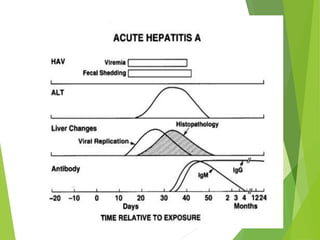
 Incubation: time from infection to
development of symptoms /
disease
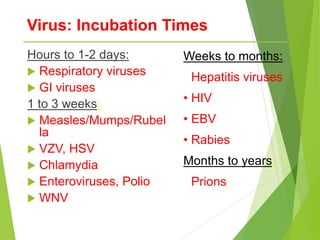
Virus: Incubation Times
Hours to 1-2 days:
 Respiratory viruses
 GI viruses
1 to 3 weeks:
 Measles/Mumps/Rubel
la
 VZV, HSV
 Chlamydia
 Enteroviruses, Polio
 WNV
Weeks to months:
• Hepatitis viruses
• HIV
• EBV
• Rabies
Months to years:
• Prions
Routes of Transmission
 Horizontal transmission:
 Direct contact (secretions, blood etc.)
 Respiratory (aerosol)
 Contaminated inanimate objects
 Insect vector (mosquitoes, ticks, etc.)
 Zoonoses
 Vertical transmission:
 Mother to fetus [Transplacental (Congenital), Perinatally]
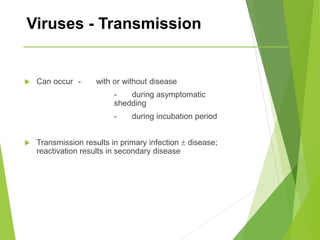
Viruses - Transmission
 Can occur - with or without disease
- during asymptomatic
shedding
- during incubation period
 Transmission results in primary infection  disease;
reactivation results in secondary disease
Viruses - Epidemiology
 mode of transmission
 age
 gender
 ethnic background / country of origin
 travel history
 occupation
 season
 underlying medical condition(s)
DEFINITIONS - VIRAL
PROTEINS
 STRUCTURAL PROTEINS
 ALL PROTEINS IN A MATURE VIRION
 NON-STRUCTURAL PROTEINS
 VIRALLY CODED PROTEINS WHICH ARE NOT PACKAGED IN
THE VIRION
111
EFFECTS ON HOST
 MAY INHIBIT HOST DNA, RNA OR PROTEIN SYNTHESIS
 DETAILS AND MECHANISM VARY
112
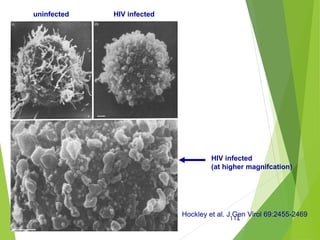
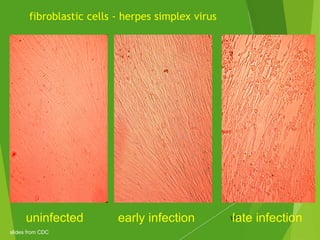
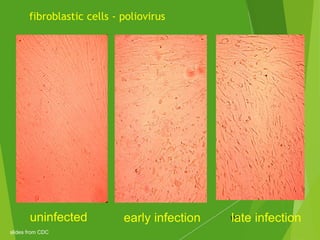
CYTOPATHIC EFFECT
 ANY DETECTABLE CHANGES IN THE HOST CELL
 MORPHOLOGICAL CHANGES
113
114
Hockley et al. J Gen Virol 69:2455-2469
uninfected HIV infected
HIV infected
(at higher magnifcation)
CYTOPATHIC EFFECT
 ANY DETECTABLE CHANGES IN THE HOST CELL
 MORPHOLOGICAL CHANGES
 DEATH
 APOPTOSIS
 INDEFINITE GROWTH
115
116
117
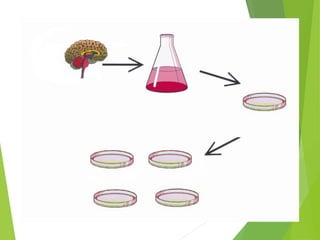
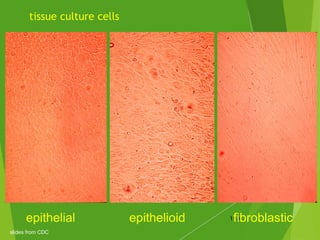
tissue culture cells
118epithelial epithelioid fibroblastic
slides from CDC
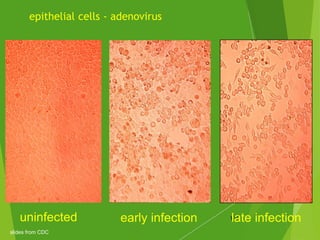
epithelial cells - adenovirus
119uninfected early infection late infection
slides from CDC
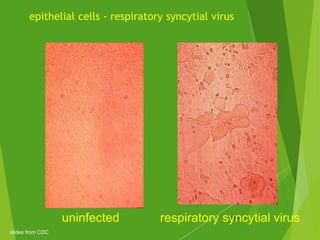
epithelial cells - respiratory syncytial virus
120uninfected respiratory syncytial virus
slides from CDC
fibroblastic cells - herpes simplex virus
121uninfected early infection late infection
slides from CDC
fibroblastic cells - poliovirus
122uninfected early infection late infection
slides from CDC
123
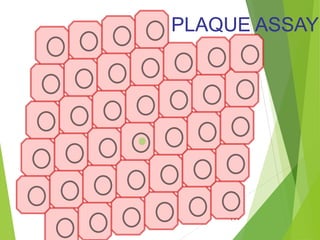
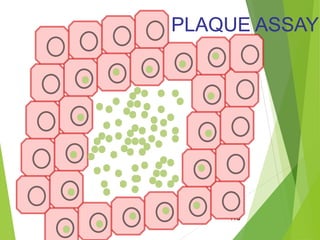
PLAQUE ASSAYPLAQUE ASSAY
124
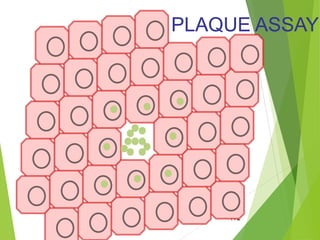
PLAQUE ASSAYPLAQUE ASSAY
125
PLAQUE ASSAYPLAQUE ASSAY
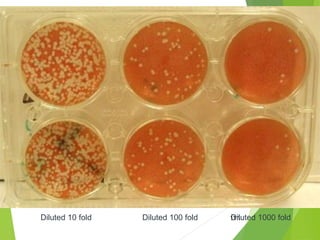
126Diluted 10 fold Diluted 100 fold Diluted 1000 fold
PLAQUE FORMING UNIT
P.F.U.
pfu
127
SOME POINTS TO REMEMBER
 INFECTIVITY
 NOT EVERY RELEASED PARTICLE IS INFECTIOUS
128
• ASSAYS
– detect every particle (e.g. electron
microscope)
– detect infectious particles only (e.g. plaque
assay)
GLOSSARY
129

An introduction to virology

  • 1.
  • 2.
    VIROLOGY (The study ofViruses) 2 Dr. Kaveh Haratian Department of Microbiology and Immunology Alborz University of Medical Sciences Fall 1394
  • 3.
    3 OUTLINE • introduction toviruses structure and classification • basic virology • clinical virology
  • 4.
    In VIROLOGY wenotice:  different structure  different method of replication  implications for  diagnosis  treatment  prevention 4
  • 5.
    CONTROL METHODS  INVOLVEKNOWLEDGE OF:  RESERVOIRS  MODE OF TRANSMISSION  METHODS TO INACTIVATE VIRUS OF INTEREST  VACCINES  ANTI-VIRAL DRUGS  DEVELOPMENT OF DRUG RESISTANCE 5
  • 6.
    EMERGING VIRAL DISEASES Some new global examples:  HIV/AIDS  Hantavirus pulmonary syndrome (HPS)  West Nile encephalitis (WNV)  Severe acute respiratory syndrome (SARS)  Monkey pox  Human metapneumovirus  Ebola hemorrhagic disease 6
  • 7.
    Consequences of viralinfections  50% of all absenteeism  Children:  7 or more viral infections per year that involve a visit to a physician 7
  • 8.
    Consequences of viralinfections  Suffering, followed by recovery  Persistent disease  Fatal disease  Congenital disease  Contributory factor in cancer  Contributory factor in other diseases 8
  • 9.
  • 10.
    VIRUSES CAN BEUSEFUL  VACCINE DEVELOPMENT  GENE THERAPY  TOOLS TO INVESTIGATE HOST CELLS 10
  • 11.
    WHAT ARE VIRUSES? 11 “APIECE OF BAD NEWS WRAPPED UP IN A PROTEIN”
  • 12.
    WHAT ARE VIRUSES? NUCLEIC ACID GENOME:  DNA OR RNA  PROTEIN COAT  PROTECTION, ENTRY  LIPID ENVELOPE IN SOME VIRUSES  SMALL  (20-400nm)  OBLIGATE INTRACELLULAR PARASITES 12
  • 13.
    13 Virus particle = virion White,DO and Fenner, FJ. Medical Virology, 4th Ed. 1994
  • 14.
    14Koneman et al.Color Atlas and Textbook of Microbiology 5th Ed. 1997
  • 15.
    Virus versus Virion Virus is a broad general term for any aspect of the infectious agent and includes: • the infectious or inactivated virus particle • viral nucleic acid and protein in the infected cell  Virion is the physical particle in the extra- cellular phase which is able to spread to new host cells; complete intact virus particle
  • 16.
    16 Growth on artificial media Division by binary fission Contain DNA and RNA Contain protein synthesi s machine ry Contain muramic acid Sensitiv e to antibioti cs Bacteriaoften yes yes yes often yes Viruses never no Either DNA or RNA no* no no * The arenavirus family appears to ‘accidentally’ package ribosomes, but these appear to play no role in protein synthesis.
  • 17.
    CONSEQUENCES  NO BROADRANGE ANTIBIOTICS  HEAVILY PARASITIC ON HOST CELL  NEED TO LOOK FOR WEAK LINK 17
  • 18.
    HOST RANGE MAY BEWIDE OR NARROW MAY BE INSECT/ANIMAL, INSECT/PLANT DO NOT CROSS EUCARYOTE / PROCARYOTE BOUNDARY 18
  • 19.
    19 FACTORS AFFECTING HOSTRANGE - CELL SURFACE RECEPTORS
  • 20.
    FACTORS AFFECTING HOSTRANGE  CELL SURFACE RECEPTORS 20 • AVAILABILITY OF REPLICATION MACHINERY • ABILITY TO GET OUT OF CELL AND SPREAD • HOST ANTI-VIRAL RESPONSE
  • 21.
    VIRAL STRUCTURE :SOME TERMINOLOGY  virus particle = virion  protein which coats the genome = capsid  capsid usually symmetrical  capsid + genome = nucleocapsid  may have an envelope 21
  • 22.
    ICOSAHEDRAL SYMMETRY  20faces  12 vertices 22 http://www.tulane.edu/~dmsander/WWW/Video/Video.html
  • 23.
  • 24.
  • 25.
  • 26.
  • 27.
  • 28.
  • 29.
  • 30.
  • 31.
  • 32.
  • 33.
  • 34.
  • 35.
  • 36.
  • 37.
  • 38.
  • 39.
    TOBACCO MOSAIC VIRUS 39 adaptedfrom: Klug and Caspar Adv. Virus Res. 7:225
  • 40.
  • 41.
    Helical symmetry  Lengthcontrolled by nucleic acid  Helix may be stiff or flexible 41
  • 42.
  • 43.
  • 44.
  • 45.
    ENVELOPE  OBTAINED BYBUDDING THROUGH A CELLULAR MEMBRANE (except poxviruses)  POSSIBILITY OF EXITING CELL WITHOUT KILLING IT  CONTAINS AT LEAST ONE VIRALLY CODED PROTEIN 45
  • 46.
  • 47.
    ENVELOPE  OBTAINED BYBUDDING THROUGH A CELLULAR MEMBRANE (except poxviruses)  POSSIBILITY OF EXITING CELL WITHOUT KILLING IT  CONTAINS AT LEAST ONE VIRALLY CODED PROTEIN  ATTACHMENT PROTEIN  LOSS OF ENVELOPE RESULTS IN LOSS OF INFECTIVITY 47
  • 48.
  • 49.
    5 BASIC TYPESOF VIRAL STRUCTURE 49 HELICAL ENVELOPED HELICAL ENVELOPED ICOSAHEDRAL COMPLEX ICOSAHEDRAL Adapted from Schaechter et al., Mechanisms of Microbial Disease nucleocapsidicosahedral nucleocapsid nucleocapsid helical nucleocapsid lipid bilayer lipid bilayer glycoprotein spikes = peplomers
  • 50.
    UNCONVENTIONAL AGENTS  VIROIDS RNA only  Small genome  Do not code for protein  So far, only known viroids are in plants 50 • hepatitis delta agent - some viroid, some virus features
  • 51.
    UNCONVENTIONAL AGENTS  PRIONS protein only?  do not contain any nucleic acid? 51
  • 52.
  • 53.
    CLASSIFICATION  BASIC STRUCTUREAND MOLECULAR BIOLOGY  particularly important as diagnostic and therapeutic abilities expand  past schemes  host range  tissue infected  type of cell infected  mode of transmission  disease caused 53 Arboviruses (arthropod borne)


  • 54.
    CLASSIFICATION  NUCLEIC ACID CAPSID  PRESENCE OF ENVELOPE  REPLICATION STRATEGY 54
  • 55.
    CLASSIFICATION NUCLEIC ACID  RNAor DNA  segmented or non-segmented  linear or circular  single-stranded or double-stranded  if single-stranded  is genome mRNA (+) sense or complementary to mRNA (-) sense 55
  • 56.
     symmetry  icosahedral,helical, complex  enveloped or non-enveloped  number of capsomers 56 CLASSIFICATION CAPSID
  • 57.
  • 58.
    58 HERPESVIRIDAE HEPADNAVIRIDAE ENVELOPED PAPILLOMAVIRIDAE POLYOMAVIRIDAE (formerly grouped togetheras the PAPOVAVIRIDAE) CIRCULAR ADENOVIRIDAE LINEAR NON-ENVELOPED DOUBLE STRANDED PARVOVIRIDAE SINGLE STRANDED NON-ENVELOPED POXVIRIDAE COMPLEX ENVELOPED DNA VIRUSES Modified from Volk et al., Essentials of Medical Microbiology, 4th Ed. 1991 All families shown are icosahedral except for poxviruses
  • 59.
    59 FLAVIVIRIDAE TOGAVIRIDAE RETROVIRIDAE ICOSAHEDRAL CORONAVIRIDAE HELICAL ENVELOPED ICOSAHEDRAL PICORNAVIRIDAE CALICIVIRIDAE NONENVELOPED SINGLE STRANDED positive sense BUNYAVIRIDAE ARENAVIRIDAE ORTHOMYXOVIRIDAE PARAMYXOVIRIDAE RHABDOVIRIDAE FILOVIRIDAE SINGLESTRANDED negative sense REOVIRIDAE DOUBLE STRANDED RNA VIRUSES ENVELOPED HELICAL ICOSAHEDRAL NONENVELOPED Modified from Volk et al., Essentials of Medical Microbiology, 4th Ed. 1991
  • 60.
  • 61.
  • 62.
  • 63.
  • 64.
    Virus Classification  Historicallybased on:  Host preference: Plant, insect, animal, human  Target organ: respiratory, hepatic, enteric, etc.  Vector: arboviruses  Overlapping, inconsistent  Currently based on molecular biology of genome and biophysical structure
  • 65.
    Virus Classification  Viruseswith similar structural, genomic & replication properties are grouped into families (suffix: viridae) e.g. Herpesviridae  Families subdivided into genera (suffix: virus) e.g. Herpes simplex virus, Cytomegalovirus, Varicella zoster virus  Subtypes based on nucleotide sequence and antigenic reactivities e.g. Herpes simplex virus type 1, Herpes simplex virus type 2
  • 66.
    Virus Classification Viruses Nucleic acid:DNA RNA Envelope: Yes No Symmetry: Cubic Helical (Icosahedral) (Cylindrical)
  • 67.
    Classification of SomeCommon Viruses Family Viruses Type of Nucleic Acid Envelope Capsid Symmetry Picornaviridae Enteroviruses, polio, hep. A ss (+) RNA No I Caliciviridae Norwalk virus ss (+) RNA No I Togaviridae Rubella ss (+) RNA Yes I Rhabodoviridae Rabies ss (+) RNA Yes H Paramyxoviridae Parainfluenza, RSV, measles, mumps ss (-) RNA Yes H Orthomyxoviridae Influenza ss (-) RNA Yes H Retroviridae HIV 1,2, HTL I,II ss (+) RNA Yes I Hepadnaviridae Hepatitis B ds DNA Yes Unknown Parvoviridae Parovirus B - 19 ss (+) or (-) DNA No I Adenoviridae Adenovirus ds DNA No I Herpesviridae HSV, CMV, EBV, VZV, HHV6 ds DNA Yes I I = icosahedral, H = helical
  • 68.
    Virus Classification (Common) DNA RNA HepatitisB Human Papilloma Virus Parvovirus B19 Adenovirus Herpesviridae Polyomaviruses Influenza RSV Parainfluenza Hepatitis A, C, D, E Enteroviruses Encephalitis viruses Measles, Mumps, Rubella Norwalk, Rotavirus Virtually all others
  • 69.
    BASIC STEPS INVIRAL LIFE CYCLE  ADSORPTION  PENETRATION  UNCOATING AND ECLIPSE  SYNTHESIS OF VIRAL NUCLEIC ACID AND PROTEIN  ASSEMBLY (maturation)  RELEASE 69
  • 70.
  • 71.
    ADSORPTION  TEMPERATURE INDEPENDENT REQUIRES VIRAL ATTACHMENT PROTEIN  CELLULAR RECEPTORS 71
  • 72.
    - ENVELOPED VIRUSES •FUSIONWITH PLASMA MEMBRANE •ENTRY VIA ENDOSOMES 72
  • 73.
  • 74.
    - ENVELOPED VIRUSES •FUSIONWITH PLASMA MEMBRANE •ENTRY VIA ENDOSOMES, FUSION WITH ACIDIC ENDOSOME MEMBRANE 74
  • 75.
  • 76.
  • 77.
    PENETRATION - ENVELOPED VIRUSES 77 fromSchaechter et al, Mechanisms of Microbial Disease, 3rd ed, 1998
  • 78.
    VIRUS UPTAKE VIA ENDOSOMES CALLED  VIROPEXIS / ENDOCYTOSIS / PINOCYTOSIS 78
  • 79.
  • 80.
  • 81.
  • 82.
    UNCOATING  NEED TOMAKE GENOME AVAILABLE  ONCE UNCOATING OCCURS, ENTER ECLIPSE PHASE  ECLIPSE PHASE LASTS UNTIL FIRST NEW VIRUS PARTICLE FORMED 82
  • 83.
    SYNTHESIS OF VIRALNUCLEIC ACID AND PROTEIN  MANY STRATEGIES  NUCLEIC ACID MAY BE MADE IN NUCLEUS OR CYTOPLASM  PROTEIN SYNTHESIS IS ALWAYS IN THE CYTOPLASM 83
  • 84.
    ASSEMBLY AND MATURATION NUCLEUS  CYTOPLASM  AT MEMBRANE 84
  • 85.
    smallpox virus cytoplasmic assemblyand maturation 85 F. A. Murphy, School of Veterinary Medicine, University of California, Davis. http://www.vetnet.ucdavis.edu/fam_graphics/download.html
  • 86.
    RELEASE  LYSIS  BUDDINGTHROUGH PLASMA MEMBRANE  NOT EVERY RELEASED VIRION IS INFECTIOUS 86
  • 87.
    HIV budding andmaturation 87Hsiung, GD et al., Diagnostic Virology 1994 p204 (D. Medina)
  • 88.
    HIV – matureform 88 Briggs JA et al. Structure. (2006) 14:15-20
  • 89.
    Viral Replication i) adsorption(attachment) ii) entry iii) uncoating iv) transcription v) synthesis of virus components vi) assembly vii) release
  • 90.
    Viral Replication i) Adsorption(attachment):  random collision  interaction between specific proteins on viral surface and specific receptors on target cell membrane (tropism)  not all cells carrying a receptor for a particular virus can be productively infected by that virus
  • 91.
    Viral Replication i) Adsorption(attachment): some viruses may use more than one host cell receptor (e.g. HIV) able to infect a limited spectrum of cell types (host range) most neutralizing antibodies are specific for virion attachment proteins
  • 92.
    Viral Replication ii) Entry(penetration): 2 mechanisms - endocytosis - fusion of virus envelope with cell membrane iii) Uncoating: release of viral genome cell enzymes (lysosomes) strip off the virus protein coat virion can no longer be detected; known as the “eclipse period”
  • 93.
    Viral Replication iv) Transcription/Translation/Synthesis: a)DNA viruses: • replicate their DNA in host cell nucleus mediated by viral enzymes • synthesize capsid and other proteins in cytoplasm using host cell enzymes • new viral proteins move to nucleus where they combine with new DNA to form new viruses • Exception - Poxviruses synthesize their parts in host cell’s cytoplasm
  • 94.
    Viral Replication iv) Transcription/Translation/Synthesi s: b) RNAviruses: –“+” sense RNA acts as mRNA - viral proteins are made immediately in cytoplasm mediated by viral enzymes –“-” sense RNA (e.g. influenza) - lst makes a “+” sense RNA copy via viral enzyme
  • 95.
    Viral Replication iv) Transcription/Translation/Synthesis: •Retroviridae (e.g. HIV) • Contain enzyme “Reverse transcriptase” • “+” sense Viral RNA  cDNA  integrated into host cell chromosome • mRNA (for viral proteins) and progeny virion RNA are synthesized from integrated viral DNA by host cell enzymes (RNA polymerases)
  • 96.
    Viral Replication v) Synthesis: Proteinsynthesis - 2 types • structural • non-structural (enzymes for replication) Nucleic acid synthesis • new virus genome • most often by a virus - coded polymerase or replicase; with some DNA viruses a cell enzyme carries this out
  • 97.
    Viral Replication vi) Assembly: maytake place in cell nucleus, cytoplasm or (with most enveloped viruses) at the plasma membrane vii) Release: sudden rupture of cell gradual extrusion (budding) of enveloped viruses through the cell membrane may occur together with assembly
  • 98.
  • 99.
  • 100.
    Outcome of ViralInfections Virus-host cell interaction may result in: 1. Cell death (lytic) - due to cytopathic effect of virus 2. Cell transformation - cell converted to malignant or cancerous cell 3. Latent infection (occult) - persistent infection in quiescent state which may reactive anytime to produce disease; continuous or intermittent shedding 4. Cell fusion to form multinucleated cells
  • 101.
    Persistent Viral Infections 3types of persistent viral infection (some overlap): 1. Chronic carrier - eg. Hepatitis B; results in chronic illness 2. Latent infection - eg. Herpesviridae; result in symptomatic or asymptomatic shedding 3. Slow virus infections - due to prolonged incubation period (eg. Measles virus and SSPE)
  • 102.
    Host - OrganismRelationship • Interaction between host and organism affecting the development and outcome of an infection includes: – Host’s primary physical barriers – Host’s immunologic ability to control and eliminate the invading organisms – Organism’s ability to evade, destruction/virulence – Ability of organism to spread in the body
  • 103.
    Virulence of Viruses& Evasion of the Immune Response  Poorly understood processes:  Antigenic variation  Some viruses encode receptors for various mediators of immunity (eg. IL1 & TNF) thus blocking their ability to interact with receptors on their intended targets  Some viruses (eg. HIV) reduce expression of class I MHC proteins, thus reducing ability of cytotoxic T cells to kill the virus-infected cells  Direct cell-to-cell propagation  Attenuated viruses (eg. Vaccine strains)
  • 104.
    Definitions  Exposure: contactwith a potentially infectious agent  Infection: persistence on or within another living organism  Disease: end product (damage) resulting from an infectious process  Incubation: time from infection to development of symptoms / disease
  • 105.
    Virus: Incubation Times Hoursto 1-2 days:  Respiratory viruses  GI viruses 1 to 3 weeks:  Measles/Mumps/Rubel la  VZV, HSV  Chlamydia  Enteroviruses, Polio  WNV Weeks to months: • Hepatitis viruses • HIV • EBV • Rabies Months to years: • Prions
  • 108.
    Routes of Transmission Horizontal transmission:  Direct contact (secretions, blood etc.)  Respiratory (aerosol)  Contaminated inanimate objects  Insect vector (mosquitoes, ticks, etc.)  Zoonoses  Vertical transmission:  Mother to fetus [Transplacental (Congenital), Perinatally]
  • 109.
    Viruses - Transmission Can occur - with or without disease - during asymptomatic shedding - during incubation period  Transmission results in primary infection  disease; reactivation results in secondary disease
  • 110.
    Viruses - Epidemiology mode of transmission  age  gender  ethnic background / country of origin  travel history  occupation  season  underlying medical condition(s)
  • 111.
    DEFINITIONS - VIRAL PROTEINS STRUCTURAL PROTEINS  ALL PROTEINS IN A MATURE VIRION  NON-STRUCTURAL PROTEINS  VIRALLY CODED PROTEINS WHICH ARE NOT PACKAGED IN THE VIRION 111
  • 112.
    EFFECTS ON HOST MAY INHIBIT HOST DNA, RNA OR PROTEIN SYNTHESIS  DETAILS AND MECHANISM VARY 112
  • 113.
    CYTOPATHIC EFFECT  ANYDETECTABLE CHANGES IN THE HOST CELL  MORPHOLOGICAL CHANGES 113
  • 114.
    114 Hockley et al.J Gen Virol 69:2455-2469 uninfected HIV infected HIV infected (at higher magnifcation)
  • 115.
    CYTOPATHIC EFFECT  ANYDETECTABLE CHANGES IN THE HOST CELL  MORPHOLOGICAL CHANGES  DEATH  APOPTOSIS  INDEFINITE GROWTH 115
  • 116.
  • 117.
  • 118.
    tissue culture cells 118epithelialepithelioid fibroblastic slides from CDC
  • 119.
    epithelial cells -adenovirus 119uninfected early infection late infection slides from CDC
  • 120.
    epithelial cells -respiratory syncytial virus 120uninfected respiratory syncytial virus slides from CDC
  • 121.
    fibroblastic cells -herpes simplex virus 121uninfected early infection late infection slides from CDC
  • 122.
    fibroblastic cells -poliovirus 122uninfected early infection late infection slides from CDC
  • 123.
  • 124.
  • 125.
  • 126.
    126Diluted 10 foldDiluted 100 fold Diluted 1000 fold
  • 127.
  • 128.
    SOME POINTS TOREMEMBER  INFECTIVITY  NOT EVERY RELEASED PARTICLE IS INFECTIOUS 128 • ASSAYS – detect every particle (e.g. electron microscope) – detect infectious particles only (e.g. plaque assay)
  • 129.