Laboratory Learning
Series(LLS)
DR.KAVEH HARATIAN, MEDICAL VIROLOGY,PHD
DEPT. OF MICROBIOLOGY AND IMMUNOLOGY
ALBORZ UNIVERSITY OF MEDICAL SCIENCES
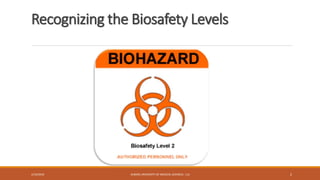
Recognizing the Biosafety Levels
2/19/2016 ALBORZ UNIVERSITY OF MEDICAL SCIENCES - LLS 2
Introduction
Suppose you are a laboratory microbiologist working with a potentially harmful microbe.
Precautions must be taken in the laboratory to make sure you and others are not infected.
Where in the lab would you complete your work?
What protective equipment and practices would you use?
How would you contain the microbe to limit contamination or accidental infection?
These are just a few of the questions that can be answered through an understanding of
biosafety and the four biosafety levels (BSLs).
2/19/2016 ALBORZ UNIVERSITY OF MEDICAL SCIENCES - LLS 3
Biosafety and biosafety levels
What is Biosafety?
Biosafety is the application of safety precautions that reduce a laboratorian’s risk of exposure to a
potentially infectious microbe and limit contamination of the work environment and, ultimately,
the community.
What are Biosafety Levels (BSLs)?
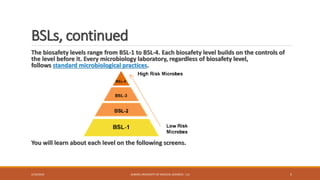
There are four biosafety levels. Each level has specific controls for containment of microbes and
biological agents. The primary risks that determine levels of containment are infectivity, severity of
disease, transmissibility, and the nature of the work conducted. Origin of the microbe, or the agent
in question, and the route of exposure are also important.
Each biosafety level has its own specific containment controls that are required for the following:
Laboratory practices
Safety equipment
Facility construction
2/19/2016 ALBORZ UNIVERSITY OF MEDICAL SCIENCES - LLS 4
BSLs, continued
The biosafety levels range from BSL-1 to BSL-4. Each biosafety level builds on the controls of
the level before it. Every microbiology laboratory, regardless of biosafety level,
follows standard microbiological practices.
You will learn about each level on the following screens.
2/19/2016 ALBORZ UNIVERSITY OF MEDICAL SCIENCES - LLS 5
BSL 1
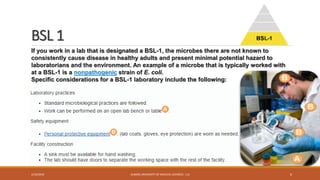
If you work in a lab that is designated a BSL-1, the microbes there are not known to
consistently cause disease in healthy adults and present minimal potential hazard to
laboratorians and the environment. An example of a microbe that is typically worked with
at a BSL-1 is a nonpathogenic strain of E. coli.
Specific considerations for a BSL-1 laboratory include the following:
2/19/2016 ALBORZ UNIVERSITY OF MEDICAL SCIENCES - LLS 6
BSL 2
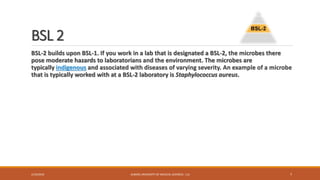
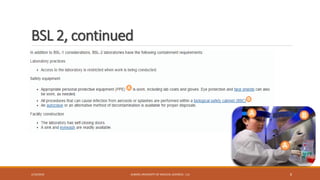
BSL-2 builds upon BSL-1. If you work in a lab that is designated a BSL-2, the microbes there
pose moderate hazards to laboratorians and the environment. The microbes are
typically indigenous and associated with diseases of varying severity. An example of a microbe
that is typically worked with at a BSL-2 laboratory is Staphylococcus aureus.
2/19/2016 ALBORZ UNIVERSITY OF MEDICAL SCIENCES - LLS 7
BSL 2, continued
2/19/2016 ALBORZ UNIVERSITY OF MEDICAL SCIENCES - LLS 8
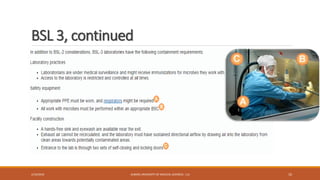
BSL 3
BSL-3 builds upon the containment requirements of BSL-2. If you work in a lab that is
designated BSL-3, the microbes there can be either indigenous or exotic, and they can cause
serious or potentially lethal disease through respiratory transmission. Respiratory
transmission is the inhalation route of exposure. One example of a microbe that is typically
worked with in a BSL-3 laboratory is Mycobacterium tuberculosis, the bacteria that causes
tuberculosis.
2/19/2016 ALBORZ UNIVERSITY OF MEDICAL SCIENCES - LLS 9
BSL 3, continued
2/19/2016 ALBORZ UNIVERSITY OF MEDICAL SCIENCES - LLS 10
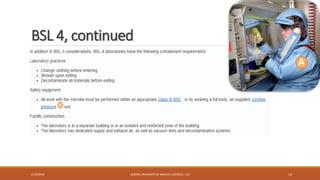
BSL 4
BSL-4 builds upon the containment requirements of BSL-3 and is the highest level of biological
safety. There are a small number of BSL-4 labs in the United States and around the world. The
microbes in a BSL-4 lab are dangerous and exotic, posing a high risk of aerosol-transmitted
infections. Infections caused by these microbes are frequently fatal and without treatment or
vaccines. Two examples of microbes worked with in a BSL-4 laboratory include Ebola and
Marburg viruses.
2/19/2016 ALBORZ UNIVERSITY OF MEDICAL SCIENCES - LLS 11
BSL 4, continued
2/19/2016 ALBORZ UNIVERSITY OF MEDICAL SCIENCES - LLS 12
Your turn : Exercises
Now that you have learned about the four biosafety levels, it's your turn to identify the
correct BSL in the examples on the following screens.
Select the Next slide to begin.
2/19/2016 ALBORZ UNIVERSITY OF MEDICAL SCIENCES - LLS 13
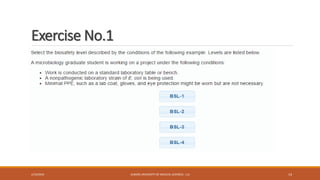
Exercise No.1
2/19/2016 ALBORZ UNIVERSITY OF MEDICAL SCIENCES - LLS 14
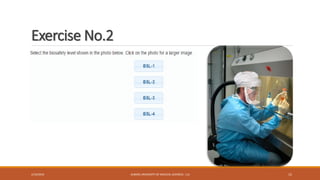
Exercise No.2
2/19/2016 ALBORZ UNIVERSITY OF MEDICAL SCIENCES - LLS 15
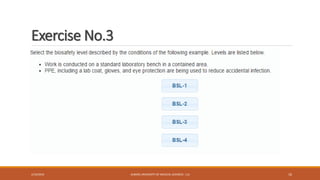
Exercise No.3
2/19/2016 ALBORZ UNIVERSITY OF MEDICAL SCIENCES - LLS 16
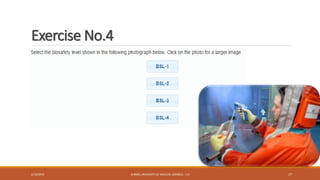
Exercise No.4
2/19/2016 ALBORZ UNIVERSITY OF MEDICAL SCIENCES - LLS 17
Summary
Congratulations!
You should now be able to recognize characteristics of the four biological safety levels. If you
would like additional information or resources on the topic of biosafety, select the Next icon. To
view other Quick Learn Lessons, visit CDC Learning Connection.
2/19/2016 ALBORZ UNIVERSITY OF MEDICAL SCIENCES - LLS 18
Resources
For more information on biosafety and laboratory practice, review the following web
resources:
Biosafety in Microbiological and Biomedical Laboratories (5th Edition)
Biosafety — Centers for Disease Control and Prevention
Respirator Fact Sheet
2/19/2016 ALBORZ UNIVERSITY OF MEDICAL SCIENCES - LLS 19

Biosafety recognition course

  • 1.
    Laboratory Learning Series(LLS) DR.KAVEH HARATIAN,MEDICAL VIROLOGY,PHD DEPT. OF MICROBIOLOGY AND IMMUNOLOGY ALBORZ UNIVERSITY OF MEDICAL SCIENCES
  • 2.
    Recognizing the BiosafetyLevels 2/19/2016 ALBORZ UNIVERSITY OF MEDICAL SCIENCES - LLS 2
  • 3.
    Introduction Suppose you area laboratory microbiologist working with a potentially harmful microbe. Precautions must be taken in the laboratory to make sure you and others are not infected. Where in the lab would you complete your work? What protective equipment and practices would you use? How would you contain the microbe to limit contamination or accidental infection? These are just a few of the questions that can be answered through an understanding of biosafety and the four biosafety levels (BSLs). 2/19/2016 ALBORZ UNIVERSITY OF MEDICAL SCIENCES - LLS 3
  • 4.
    Biosafety and biosafetylevels What is Biosafety? Biosafety is the application of safety precautions that reduce a laboratorian’s risk of exposure to a potentially infectious microbe and limit contamination of the work environment and, ultimately, the community. What are Biosafety Levels (BSLs)? There are four biosafety levels. Each level has specific controls for containment of microbes and biological agents. The primary risks that determine levels of containment are infectivity, severity of disease, transmissibility, and the nature of the work conducted. Origin of the microbe, or the agent in question, and the route of exposure are also important. Each biosafety level has its own specific containment controls that are required for the following: Laboratory practices Safety equipment Facility construction 2/19/2016 ALBORZ UNIVERSITY OF MEDICAL SCIENCES - LLS 4
  • 5.
    BSLs, continued The biosafetylevels range from BSL-1 to BSL-4. Each biosafety level builds on the controls of the level before it. Every microbiology laboratory, regardless of biosafety level, follows standard microbiological practices. You will learn about each level on the following screens. 2/19/2016 ALBORZ UNIVERSITY OF MEDICAL SCIENCES - LLS 5
  • 6.
    BSL 1 If youwork in a lab that is designated a BSL-1, the microbes there are not known to consistently cause disease in healthy adults and present minimal potential hazard to laboratorians and the environment. An example of a microbe that is typically worked with at a BSL-1 is a nonpathogenic strain of E. coli. Specific considerations for a BSL-1 laboratory include the following: 2/19/2016 ALBORZ UNIVERSITY OF MEDICAL SCIENCES - LLS 6
  • 7.
    BSL 2 BSL-2 buildsupon BSL-1. If you work in a lab that is designated a BSL-2, the microbes there pose moderate hazards to laboratorians and the environment. The microbes are typically indigenous and associated with diseases of varying severity. An example of a microbe that is typically worked with at a BSL-2 laboratory is Staphylococcus aureus. 2/19/2016 ALBORZ UNIVERSITY OF MEDICAL SCIENCES - LLS 7
  • 8.
    BSL 2, continued 2/19/2016ALBORZ UNIVERSITY OF MEDICAL SCIENCES - LLS 8
  • 9.
    BSL 3 BSL-3 buildsupon the containment requirements of BSL-2. If you work in a lab that is designated BSL-3, the microbes there can be either indigenous or exotic, and they can cause serious or potentially lethal disease through respiratory transmission. Respiratory transmission is the inhalation route of exposure. One example of a microbe that is typically worked with in a BSL-3 laboratory is Mycobacterium tuberculosis, the bacteria that causes tuberculosis. 2/19/2016 ALBORZ UNIVERSITY OF MEDICAL SCIENCES - LLS 9
  • 10.
    BSL 3, continued 2/19/2016ALBORZ UNIVERSITY OF MEDICAL SCIENCES - LLS 10
  • 11.
    BSL 4 BSL-4 buildsupon the containment requirements of BSL-3 and is the highest level of biological safety. There are a small number of BSL-4 labs in the United States and around the world. The microbes in a BSL-4 lab are dangerous and exotic, posing a high risk of aerosol-transmitted infections. Infections caused by these microbes are frequently fatal and without treatment or vaccines. Two examples of microbes worked with in a BSL-4 laboratory include Ebola and Marburg viruses. 2/19/2016 ALBORZ UNIVERSITY OF MEDICAL SCIENCES - LLS 11
  • 12.
    BSL 4, continued 2/19/2016ALBORZ UNIVERSITY OF MEDICAL SCIENCES - LLS 12
  • 13.
    Your turn :Exercises Now that you have learned about the four biosafety levels, it's your turn to identify the correct BSL in the examples on the following screens. Select the Next slide to begin. 2/19/2016 ALBORZ UNIVERSITY OF MEDICAL SCIENCES - LLS 13
  • 14.
    Exercise No.1 2/19/2016 ALBORZUNIVERSITY OF MEDICAL SCIENCES - LLS 14
  • 15.
    Exercise No.2 2/19/2016 ALBORZUNIVERSITY OF MEDICAL SCIENCES - LLS 15
  • 16.
    Exercise No.3 2/19/2016 ALBORZUNIVERSITY OF MEDICAL SCIENCES - LLS 16
  • 17.
    Exercise No.4 2/19/2016 ALBORZUNIVERSITY OF MEDICAL SCIENCES - LLS 17
  • 18.
    Summary Congratulations! You should nowbe able to recognize characteristics of the four biological safety levels. If you would like additional information or resources on the topic of biosafety, select the Next icon. To view other Quick Learn Lessons, visit CDC Learning Connection. 2/19/2016 ALBORZ UNIVERSITY OF MEDICAL SCIENCES - LLS 18
  • 19.
    Resources For more informationon biosafety and laboratory practice, review the following web resources: Biosafety in Microbiological and Biomedical Laboratories (5th Edition) Biosafety — Centers for Disease Control and Prevention Respirator Fact Sheet 2/19/2016 ALBORZ UNIVERSITY OF MEDICAL SCIENCES - LLS 19