Mrs. Rani Chandran
POST GRADUATE TEACHER(BIOLOGY)
  Kendriya Vidyalaya-AFS, Trivandrum
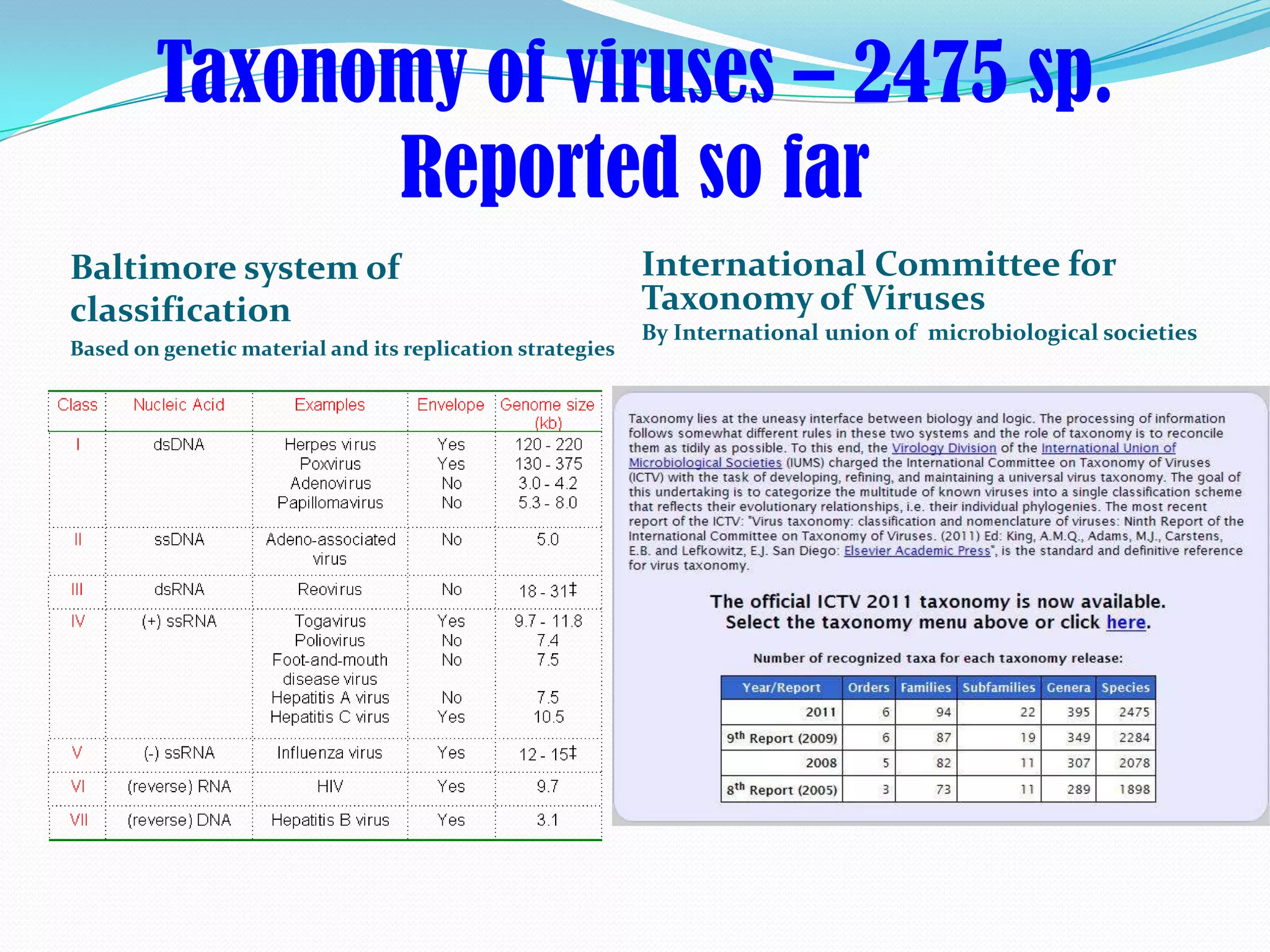
Taxonomy of viruses – 2475 sp.
              Reported so far
Baltimore system of                                        International Committee for
classification                                             Taxonomy of Viruses
                                                           By International union of microbiological societies
Based on genetic material and its replication strategies
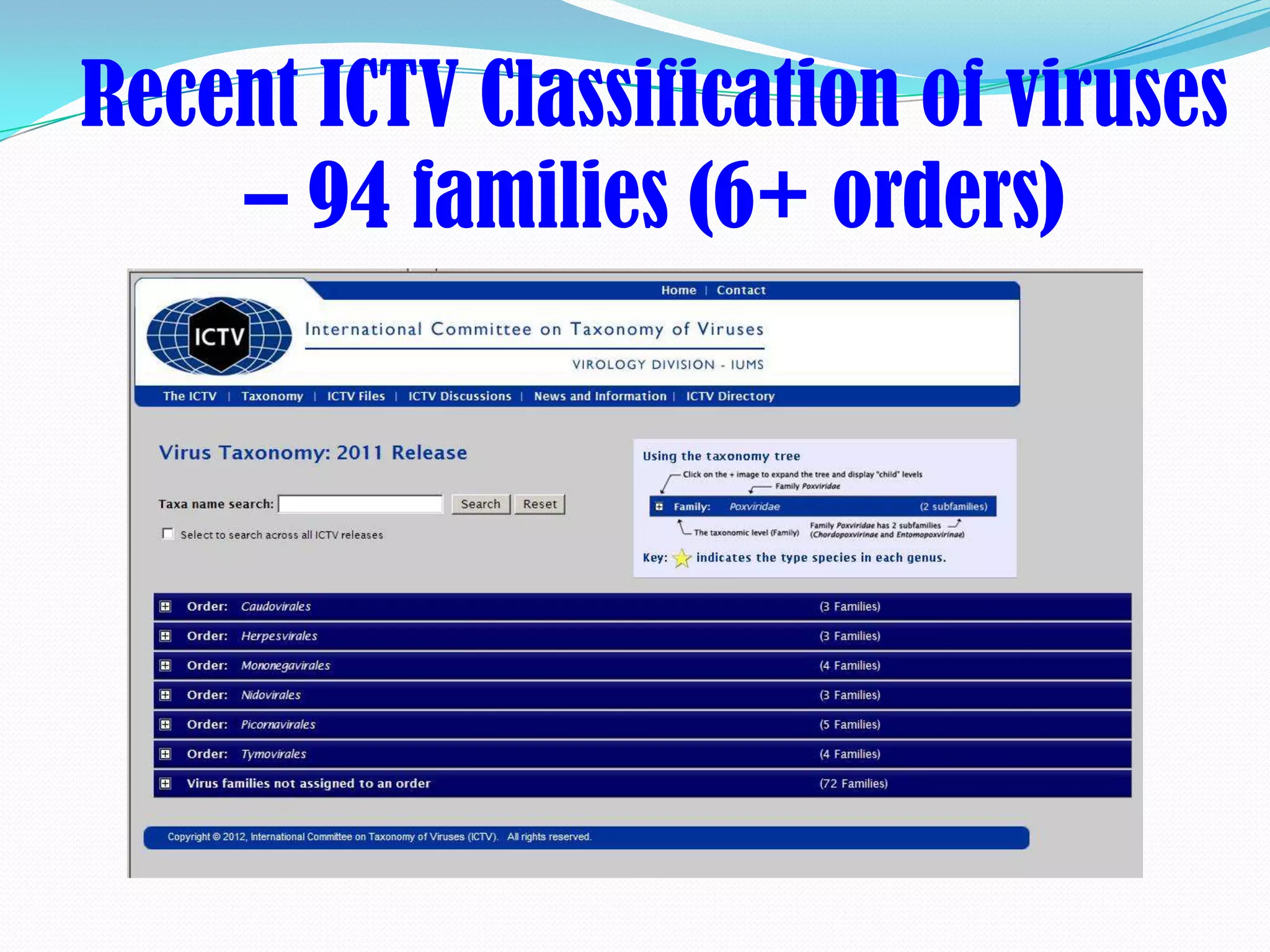
Recent ICTV Classification of viruses
    – 94 families (6+ orders)
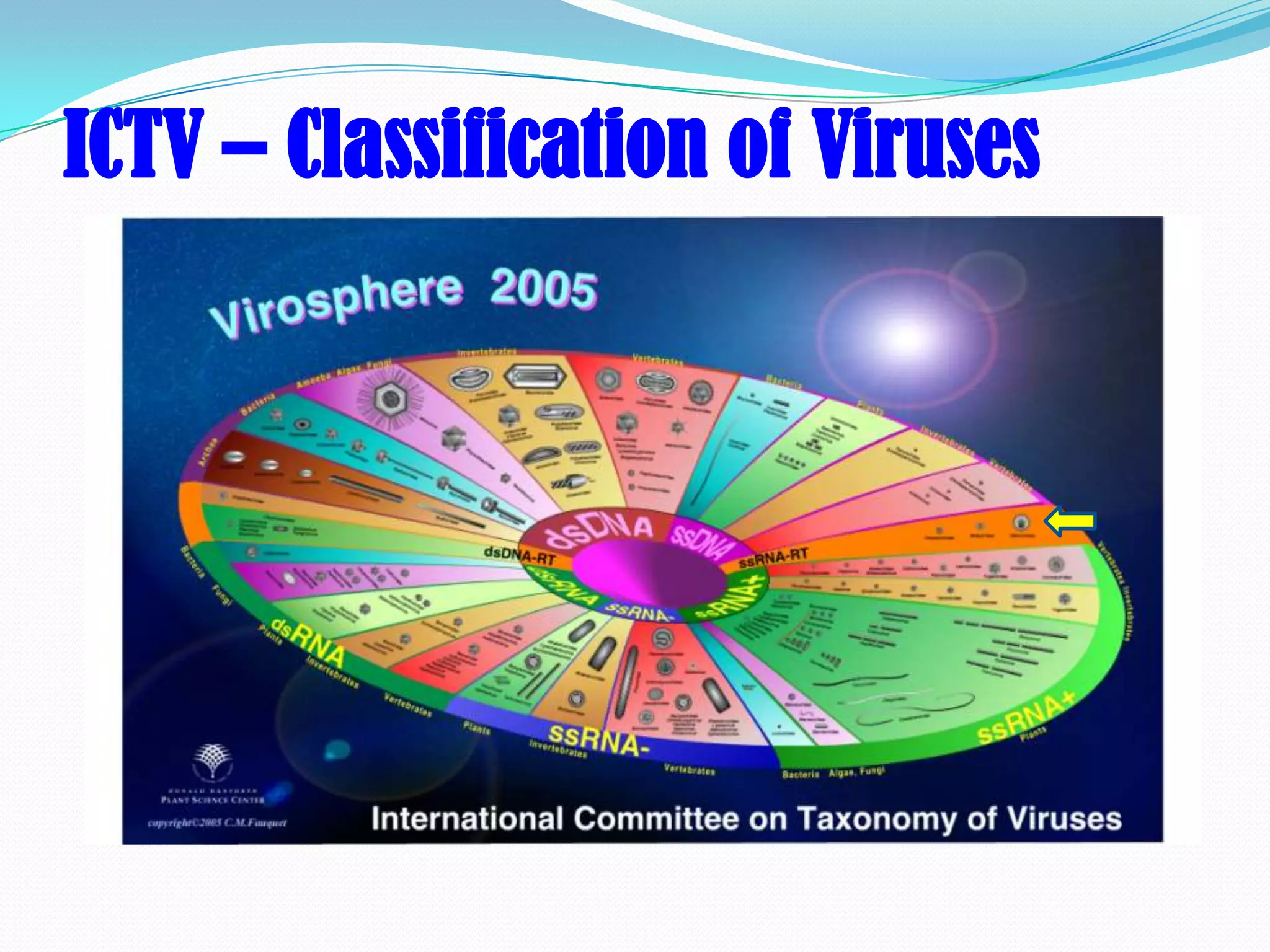
ICTV – Classification of Viruses
Retroviruses (Family Retroviridae)
family of single-stranded RNA
viruses having a helical envelope
and containing an enzyme (RT)
that allows for a reversal of
genetic transcription, from RNA
to DNA rather than the usual DNA
to RNA.
the newly transcribed viral DNA is
incorporated into the host cell's
DNA strand for the production of     Schematic cross section through a
new RNA retroviruses (Integrase)     retroviral particle. Transmembrane (TM)
                                     and the surface (SU) components linked
                                     together by disulfide bonds, matrix (MA)
                                     protein, capsid (CA) protein, and
                                     nucleocapsid (NC) protein. Major products
                                     of the pol-coding region are reverse
                                     transcriptase (RT) and integrase (IN). The
                                     protease (PR) is derived from the pro gene
                                     between gag and pol.
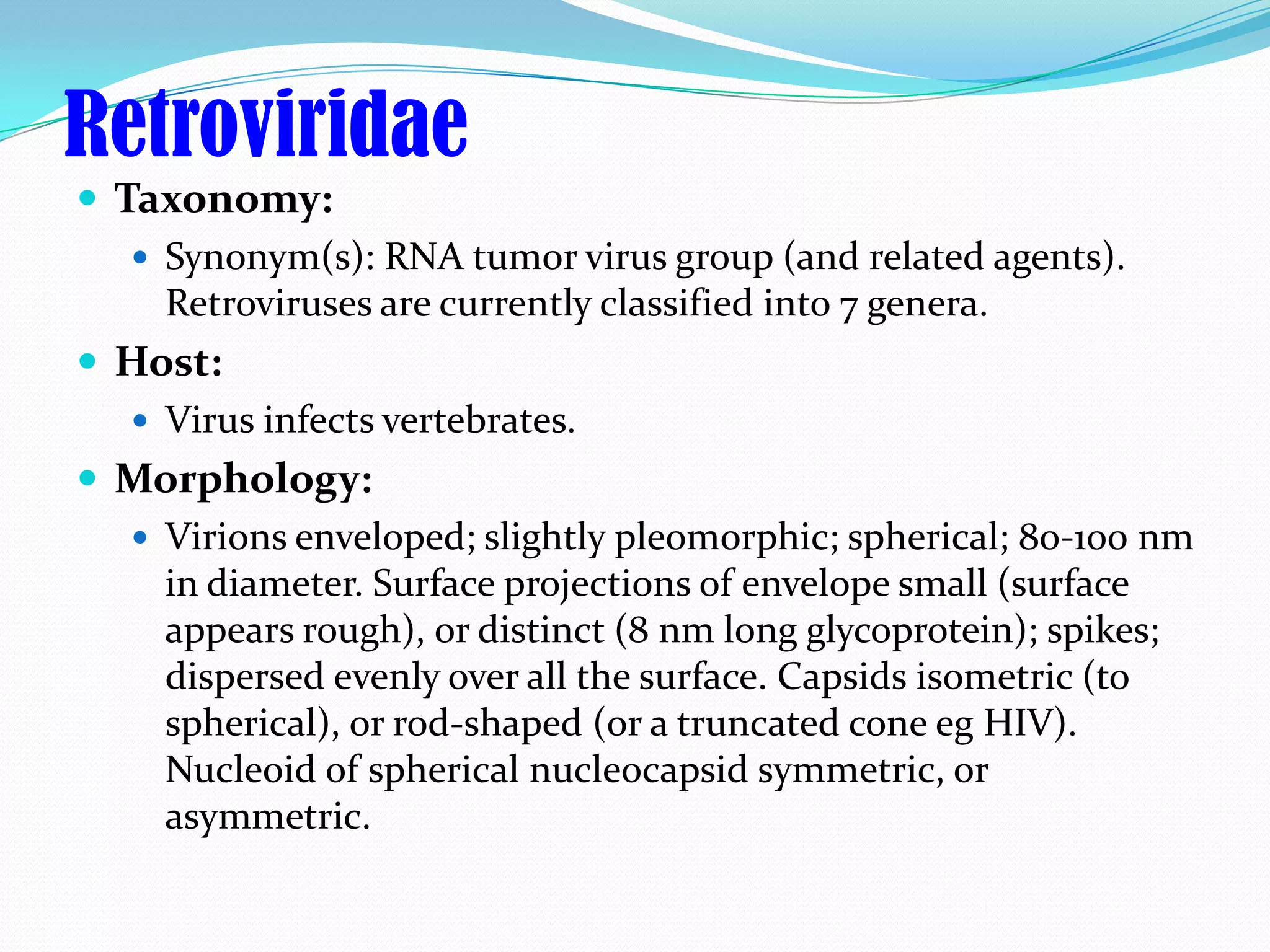
Retroviridae
 Taxonomy:
    Synonym(s): RNA tumor virus group (and related agents).
     Retroviruses are currently classified into 7 genera.
 Host:
    Virus infects vertebrates.
 Morphology:
    Virions enveloped; slightly pleomorphic; spherical; 80-100 nm
     in diameter. Surface projections of envelope small (surface
     appears rough), or distinct (8 nm long glycoprotein); spikes;
     dispersed evenly over all the surface. Capsids isometric (to
     spherical), or rod-shaped (or a truncated cone eg HIV).
     Nucleoid of spherical nucleocapsid symmetric, or
     asymmetric.
Retrovirus genome
  RNA. Single stranded. Linear; genomic nucleic acid
  positive sense. Genome dimeric. Total genome of one
  monomer 7000-11000 nucleotides long.


              Genome of retroviruses is flanked at
              each end by repeated sequences ("R")

      the gag gene is translated into molecules of the capsid protein
      the pol gene is transcribed into molecules of reverse
      transcriptase
      the env gene is translated into molecules of the envelope
      protein
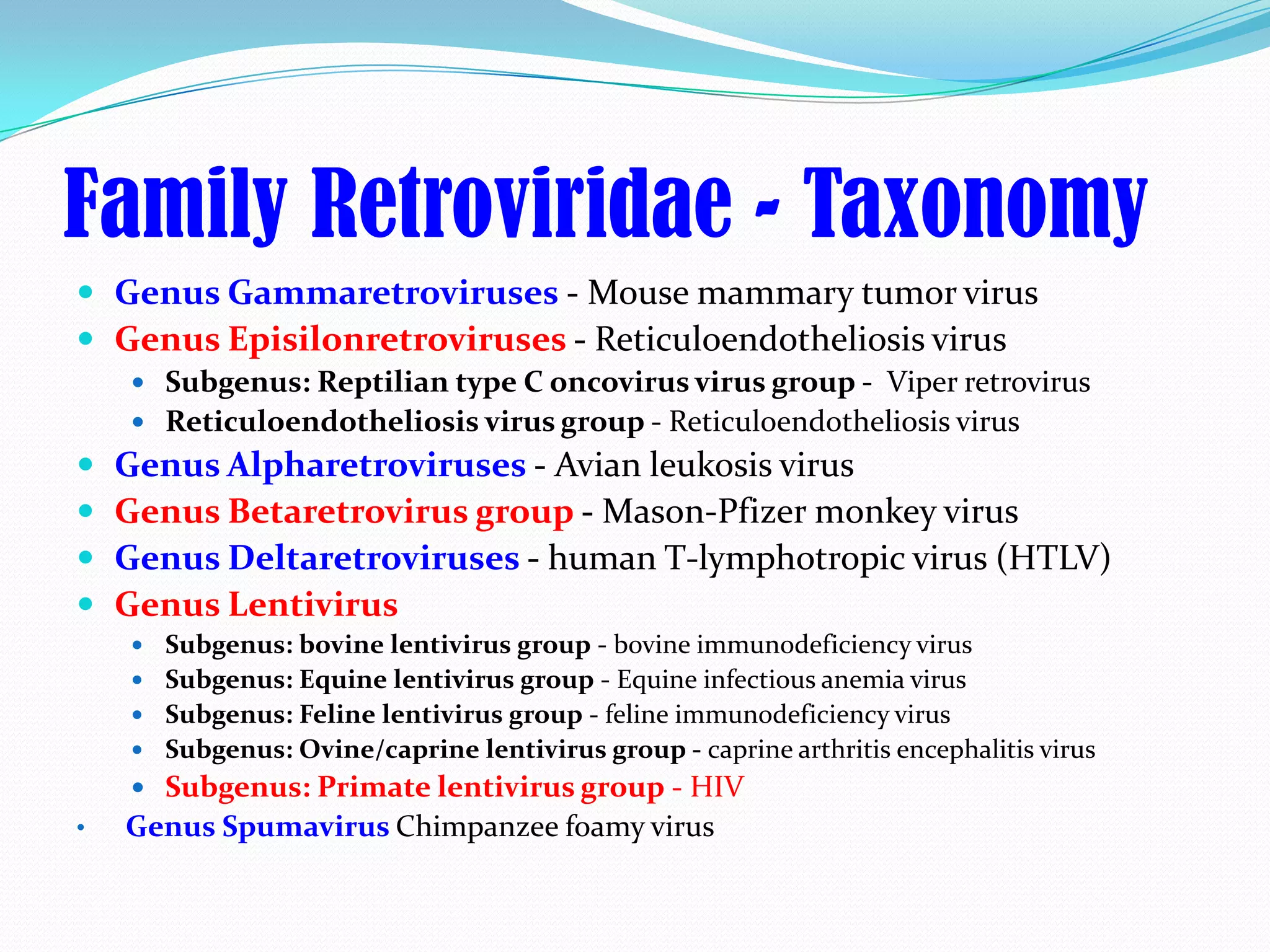
Family Retroviridae - Taxonomy
 Genus Gammaretroviruses - Mouse mammary tumor virus
 Genus Episilonretroviruses - Reticuloendotheliosis virus
     Subgenus: Reptilian type C oncovirus virus group - Viper retrovirus
     Reticuloendotheliosis virus group - Reticuloendotheliosis virus
   Genus Alpharetroviruses - Avian leukosis virus
   Genus Betaretrovirus group - Mason-Pfizer monkey virus
   Genus Deltaretroviruses - human T-lymphotropic virus (HTLV)
   Genus Lentivirus
     Subgenus: bovine lentivirus group - bovine immunodeficiency virus
     Subgenus: Equine lentivirus group - Equine infectious anemia virus
     Subgenus: Feline lentivirus group - feline immunodeficiency virus
     Subgenus: Ovine/caprine lentivirus group - caprine arthritis encephalitis virus
     Subgenus: Primate lentivirus group - HIV
•   Genus Spumavirus Chimpanzee foamy virus
Life cycle - Retroviruses
                        When a retrovirus
                          infects a cell
                   its molecules of reverse
                      transcriptase are carried into
                      the cell attached to the viral
                      RNA molecules.
                     The reverse transcriptase
                      synthesizes DNA copies of the
                      RNA.
                     These enter the nucleus and
                      are
                     inserted into the DNA of the
                      host.
                     These inserts are transcribed
                      by the host's enzymes into
                      fresh RNA molecules which
                      re-enter the cytosol where
                       some are translated by host
                        ribosomes
Human Immunodeficiency Virus (HIV)
 ICTV Group: +ssRNA RT
 Baltimore Group( Earlier Classification): Group VI
 (ssRNA-RT viruses (+)sense RNA with DNA
 intermediate in life-cycle)
 Family: Retroviridae
 Genus: Lentivirus
 Species: Human Immunodeficiency Virus (HIV)
Human Immunodeficiency Virus (HIV)
HIV
 An HIV particle is around 100-150 billionths of a metre in diameter. That's
  about the same as: 0.1 microns

 one seventieth of the diameter of Host Cell- human CD4+ white blood cell.

 Unlike most bacteria, HIV particles are much too small to be seen through an
  ordinary microscope. However they can be seen clearly with an electron
  microscope.

 HIV particles surround themselves with a coat of fatty material known as
  the viral envelope (or membrane). Projecting from this are around 72 little
  spikes, which are formed from the proteins gp120 and gp41 that act as
  receptors.. Just below the viral envelope is a layer called the matrix, which is
  made from the protein p17.

 The viral core (or capsid) is usually bullet-shaped and is made from the protein
  p24. Inside the core are three enzymes required for HIV replication called
  reverse transcriptase, integrase and protease. Also held within the core is HIV's
  genetic material, which consists of two identical single strands of RNA.
Different types of HIV
 There are two types of HIV: HIV-1 and HIV-2. Both types
  are transmitted by sexual contact, through blood, and from
  mother to child, and they appear to cause clinically
  indistinguishable AIDS. However, it seems that HIV-2 is
  less easily transmitted, and the period between initial
  infection and illness is longer in the case of HIV-2.
 Worldwide, the predominant virus is HIV-1, and generally
  when people refer to HIV without specifying the type of
  virus they will be referring to HIV-1. The relatively
  uncommon HIV-2 type is concentrated in West Africa and
  is rarely found elsewhere.
Life Cycle - HIV
 Virus entry into lymphocytes is receptor mediated
 After entry it releases the 2 RNA genome and 3 proteins viz.,
    protease, reverse transcriptase and integrase into cytosol.
   Viral RNA undergoes transcription to cDNA with help of RT
   Viral RNA removed with viral enzymes and sscDNA undergoes
    duplication to form dsDNA
   dsDNA moves to the nucleus and integrates (with the help of
    integrase ) with the host cell DNA which undergoes
    transcription to viral RNA and translation to viral proteins – core
    proteins (further processed by protease)
   2 viral RNA mol, integrase, RT and protease come together forms
    the core of the virus and acquires the envelope / lipid coat and
    penetrates out of the cell as infective virions.
THANK YOU

Retro virus

  • 1.
    Mrs. Rani Chandran POSTGRADUATE TEACHER(BIOLOGY) Kendriya Vidyalaya-AFS, Trivandrum
  • 2.
    Taxonomy of viruses– 2475 sp. Reported so far Baltimore system of International Committee for classification Taxonomy of Viruses By International union of microbiological societies Based on genetic material and its replication strategies
  • 3.
    Recent ICTV Classificationof viruses – 94 families (6+ orders)
  • 4.
  • 5.
    Retroviruses (Family Retroviridae) familyof single-stranded RNA viruses having a helical envelope and containing an enzyme (RT) that allows for a reversal of genetic transcription, from RNA to DNA rather than the usual DNA to RNA. the newly transcribed viral DNA is incorporated into the host cell's DNA strand for the production of Schematic cross section through a new RNA retroviruses (Integrase) retroviral particle. Transmembrane (TM) and the surface (SU) components linked together by disulfide bonds, matrix (MA) protein, capsid (CA) protein, and nucleocapsid (NC) protein. Major products of the pol-coding region are reverse transcriptase (RT) and integrase (IN). The protease (PR) is derived from the pro gene between gag and pol.
  • 6.
    Retroviridae  Taxonomy:  Synonym(s): RNA tumor virus group (and related agents). Retroviruses are currently classified into 7 genera.  Host:  Virus infects vertebrates.  Morphology:  Virions enveloped; slightly pleomorphic; spherical; 80-100 nm in diameter. Surface projections of envelope small (surface appears rough), or distinct (8 nm long glycoprotein); spikes; dispersed evenly over all the surface. Capsids isometric (to spherical), or rod-shaped (or a truncated cone eg HIV). Nucleoid of spherical nucleocapsid symmetric, or asymmetric.
  • 7.
    Retrovirus genome RNA. Single stranded. Linear; genomic nucleic acid positive sense. Genome dimeric. Total genome of one monomer 7000-11000 nucleotides long. Genome of retroviruses is flanked at each end by repeated sequences ("R") the gag gene is translated into molecules of the capsid protein the pol gene is transcribed into molecules of reverse transcriptase the env gene is translated into molecules of the envelope protein
  • 8.
    Family Retroviridae -Taxonomy  Genus Gammaretroviruses - Mouse mammary tumor virus  Genus Episilonretroviruses - Reticuloendotheliosis virus  Subgenus: Reptilian type C oncovirus virus group - Viper retrovirus  Reticuloendotheliosis virus group - Reticuloendotheliosis virus  Genus Alpharetroviruses - Avian leukosis virus  Genus Betaretrovirus group - Mason-Pfizer monkey virus  Genus Deltaretroviruses - human T-lymphotropic virus (HTLV)  Genus Lentivirus  Subgenus: bovine lentivirus group - bovine immunodeficiency virus  Subgenus: Equine lentivirus group - Equine infectious anemia virus  Subgenus: Feline lentivirus group - feline immunodeficiency virus  Subgenus: Ovine/caprine lentivirus group - caprine arthritis encephalitis virus  Subgenus: Primate lentivirus group - HIV • Genus Spumavirus Chimpanzee foamy virus
  • 9.
    Life cycle -Retroviruses When a retrovirus infects a cell  its molecules of reverse transcriptase are carried into the cell attached to the viral RNA molecules.  The reverse transcriptase synthesizes DNA copies of the RNA.  These enter the nucleus and are  inserted into the DNA of the host.  These inserts are transcribed by the host's enzymes into fresh RNA molecules which re-enter the cytosol where  some are translated by host ribosomes
  • 10.
    Human Immunodeficiency Virus(HIV)  ICTV Group: +ssRNA RT Baltimore Group( Earlier Classification): Group VI (ssRNA-RT viruses (+)sense RNA with DNA intermediate in life-cycle) Family: Retroviridae Genus: Lentivirus Species: Human Immunodeficiency Virus (HIV)
  • 11.
  • 12.
    HIV  An HIVparticle is around 100-150 billionths of a metre in diameter. That's about the same as: 0.1 microns  one seventieth of the diameter of Host Cell- human CD4+ white blood cell.  Unlike most bacteria, HIV particles are much too small to be seen through an ordinary microscope. However they can be seen clearly with an electron microscope.  HIV particles surround themselves with a coat of fatty material known as the viral envelope (or membrane). Projecting from this are around 72 little spikes, which are formed from the proteins gp120 and gp41 that act as receptors.. Just below the viral envelope is a layer called the matrix, which is made from the protein p17.  The viral core (or capsid) is usually bullet-shaped and is made from the protein p24. Inside the core are three enzymes required for HIV replication called reverse transcriptase, integrase and protease. Also held within the core is HIV's genetic material, which consists of two identical single strands of RNA.
  • 13.
    Different types ofHIV  There are two types of HIV: HIV-1 and HIV-2. Both types are transmitted by sexual contact, through blood, and from mother to child, and they appear to cause clinically indistinguishable AIDS. However, it seems that HIV-2 is less easily transmitted, and the period between initial infection and illness is longer in the case of HIV-2.  Worldwide, the predominant virus is HIV-1, and generally when people refer to HIV without specifying the type of virus they will be referring to HIV-1. The relatively uncommon HIV-2 type is concentrated in West Africa and is rarely found elsewhere.
  • 14.
    Life Cycle -HIV  Virus entry into lymphocytes is receptor mediated  After entry it releases the 2 RNA genome and 3 proteins viz., protease, reverse transcriptase and integrase into cytosol.  Viral RNA undergoes transcription to cDNA with help of RT  Viral RNA removed with viral enzymes and sscDNA undergoes duplication to form dsDNA  dsDNA moves to the nucleus and integrates (with the help of integrase ) with the host cell DNA which undergoes transcription to viral RNA and translation to viral proteins – core proteins (further processed by protease)  2 viral RNA mol, integrase, RT and protease come together forms the core of the virus and acquires the envelope / lipid coat and penetrates out of the cell as infective virions.
  • 15.