viruses
By the end of this session, students are expected to be
able to:
Define different terms used in virology
Describe characteristic of viruses
Describe structure of the virus
Compare virus and bacteria cell structures
Learning Objectives
Viruses: Are smallest infectious agents (ranging from about 20 nm
to about 300 nm in diameter) and contain only one kind of nucleic
acid (RNA or DNA) as their genome
Virology-Is study of viruses
Capsid: The protein shell, or coat that encloses the nucleic acid
genome
Nucleocapsid: The protein-nucleic acid complex plus a capsid.
Sometimes it is a complete virion
Capsomeres: Morphologic units of a capsid
Virion: The complete virus particle. In some instances the virion is
identical with the nucleocapsid. In more complex virion, it
includes the nucleocapsid plus a surrounding envelope
Terms in used in Virology
Envelope: A lipid-containing membrane that surrounds
some virus particles
Structural units: The basic protein building blocks of the
coat. They are usually a collection of more than one
identical protein subunit. The structural unit is often
referred to as a protomer
Subunit: A single folded viral polypeptide chain
Defective virus: A virus particle that is functionally
deficient in some aspect of replication
Terms in used in Virology
Are small in size ranging from about 20 nm to about 300 nm in
diameter.
Akaryotic particles (neither eukaryotes nor prokaryotes)
 Contain either DNA or RNA and not both as their genome
Exhibit living properties when inside the living cells (i.e. they are
incapable of independent reproduction unless they are in the
living cell)
Are non motile
 Can be grown in cell cultures
Viruses are known to infect unicellular organisms such as
mycoplasmas, bacteria, and algae and all higher plants and
animals
Characteristics of Viruses
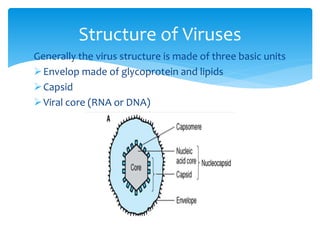
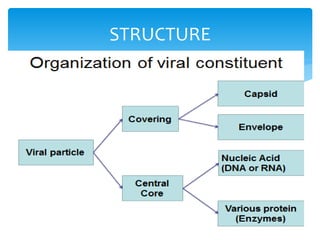
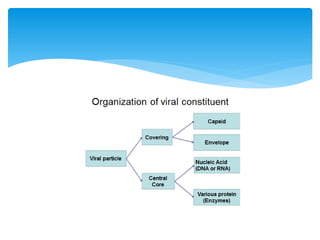
Generally the virus structure is made of three basic units
Envelop made of glycoprotein and lipids
Capsid
Viral core (RNA or DNA)
Structure of Viruses
STRUCTURE
Envelop is the outermost coat of the virus made of lipid and
proteins
 Its function is to support glycoproteins or spikes used for
attachment to the host cell
Gives stability to the virus
Protects the inner parts of the virus
It is usually derived from the host cell during release (budding)
Virus with an envelop are less stable than non enveloped virus
(they can be destroyed by disinfectants or adverse condition of
the environment)
Parts of the Viral Structure and its
Function
Capsid is a protein coat which covers the viral genome,
it is made up of repeating subunits called capsomers
The repeating subunits of the capsid give the virus a
symmetric appearance that is useful for classification
purposes
Some viral nucleocapsids have spherical (icosahedral)
symmetry where as others have helical symmetry
 All human viruses that have a helical nucleocapsid are
enveloped (there are not naked helical viruses that
infect humans)
Parts of the Viral Structure and its
Function
Viral Core contains genetic materials necessary for replication.
They include either DNA or RNA, never both
Deoxyribonucleic acid (DNA) containing viruses are double
stranded except parvoviruses which have single strand DNA
 Ribonucleic Acid (RNA) containing viruses are single stranded.
Example human immunodeficiency virus (HIV)
 Nucleic acid can either be linear or circular, continuous or
segmented
Parts of the Viral Structure and its
Function
Classification of Viruses
By the end of this session, students are expected to be
able to:
Explain the criteria used to classify viruses
Classify viruses based on the size, morphology and
capsid symmetry of the virus particle
Classify viruses based on type of nucleic acid and
mode of replication
Outline reproductive cycle of a virus
Learning Objectives
Viruses are classified based on the number of criteria
which include Size, morphology and capsid symmetry
of the virus particle
Type of nucleic acid and mode of replication
Mode of transmission
CLASSIFICATION OF VIRUSES
Classification of Viruses According to Morphology and
Capsid Symmetry of the Virus.
Symmetry of the capsid
-Helical symmetry
-Icosahedra symmetry
-Complex symmetry
Envelope as the outer coat
-Enveloped viruses
- None enveloped viruses (naked viruses)
CLASSIFICATION
Helical Symmetry Viruses
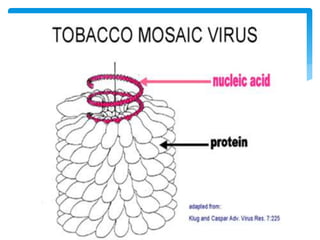
Replication of viruses with helical symmetry, identical protein
subunits (protomers) self-assemble into a helical array
surrounding the nucleic acid, which follows a similar spiral path.
Nucleocapsids form rigid, highly elongated rods or flexible
filaments shaped like a spiral stare case.
Examples of the helical symmetry viruses are measles virus,
mumps viruses, rabies viruses, respiratory syncytial virus.
CLASSIFICATION
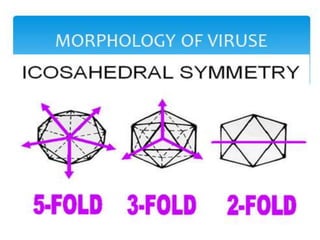
Icosahedral Symmetry
An icosahedron is a polyhedron having 20 equilateral triangular
faces and 12 vertices
Appearance of such viruses is spherical
There are exactly 60 identical subunits on the surface of an
icosahedron
Examples of viruses with icosahedral symmetry are Adenoviruses,
herpes simplex virus, cytomegalovirus, varicela zoster virus,
hepatitis B virus and papiloma virus
CLASSIFICATION
An envelope is an outer (bounding) lipoprotein bilayer
membrane possessed by many viruses
Most of the enveloped viruses are helical in shape
Most of the enveloped helical viruses are RNA viruses
Example influenza viruses, measles virus, mumps virus, rabies
virus, respiratory syncytial virus
Enveloped viruses which are icosahedral in shape are also DNA
viruses. These include Herpes simplex virus, Varisella zoster
virus, and cytomegalovirus
CLASSIFICATION
Non Enveloped Viruses
Viruses which are not enveloped are all icosahedra in
shape
RNA viruses which are not enveloped include
Poliovirus, Hepatitis A virus, and Enteroviruses
DNA viruses which are not enveloped include
Adenoviruses, Papilloma viruses and Polyoma viruses
CLASSIFICATION
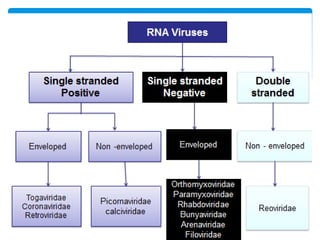
Based on the nucleic acid viruses are classified into
RNA viruses
DNA viruses
Classification of Viruses According to the
Nucleic Acid
RNA viruses, comprising 70% of all viruses.
Because of the error rate of the enzymes involved in RNA
replication, these viruses usually show much higher mutation
rates than do the DNA viruses
The viral RNA may be single-stranded (ss) or double-stranded
(ds), and the genome may occupy a single RNA segment or be
distributed on two or more separate segments (segmented
genomes)
The proteins necessary for the construction of complete virions
are always made via the information coded in the host
messenger RNA (mRNA)
RNA Viruses
 RNA viruses can either have positive sense or negative sense
genome
Virus with positive sense strand can function as messenger RNA
(mRNA), while a negative sense strand cannot function as
mRNA protein translation.
Positive sense viral RNA alone can replicate if injected into cells,
since it can function as mRNA and initiate translation of virus-
encoded proteins.
Negative sense RNA, on the other hand, has no translational
function and cannot per seproduce viral components without
the help of the host cell messenger RNA.
RNA Viruses
Examples of double stranded RNA viruses include , reoviridae
family (Reoviruses spp)
Examples of single stranded RNA viruses include, Retroviridae
(example HIV),
Rhabdoviridae (example Rabies virus)
Orthomyxoviridae (example Influenza virus)
Filoviridae (example Murbug and Ebola Viruses)
Paramyxoviridae (examples Measles viruses, Mumps viruses,
Respiratory syncytial viruses and Parainfuenza viruses),
Pircornaviridae (examples Polioviruses, Hepatitis A, Enteroviruses)
RNA Viruses
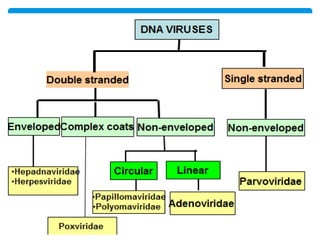
Most DNA viruses contain a single genome of linear double
stranded DNA (dsDNA).
However the papovaviruses (papillomaviruses, polyoma and
vacuolating agents), have circular DNA genomes.
dsDNA serves as a template both for mRNA and for self-
transcription.
Examples of double stranded DNA (dsDNA) viruses include
Herpadnaviridae (Hepatitis B virus), Poxviridae (Small pox
virus), Herpesviridae (Herpex simples viruses, Varisela zoster
viruses, cytomegaloviruses)
Examples of Single stranded DNA(ssDNA) viruses include
Parvoviridae (B19 virus)
DNA Viruses
Contact
 Herpes viruses, HIV, Hepatitis viruses, Ebola virus, Rabies virus,
Marburg virus
Viruses under this group are transmitted through contact with
virus from the vesicle,blisters. This may be via sexual contact,
during birth, kissing
Inhalation
Examples measles viruses, varicella zoster virus, mumps virus,
variolla virus, rubella virus, respiratory syncytial virus, Influenza
virus,
Fecal Oral Route- Examples enteroviruses
Vector -Examples yellow fever viruses
Transfusion- Examples HIV, Hepatitis B
Classification of Viruses According
to the Mode of Transmission
Viruses are inert in the extracellular environment
They replicate only in living cells, being parasites at
the genetic level
The viral nucleic acid contains information necessary
for programming the infected host cell to synthesize
virus-specific macromolecules required for the
production of viral progeny (new virus particle)
Replicative Cycle of Viruses
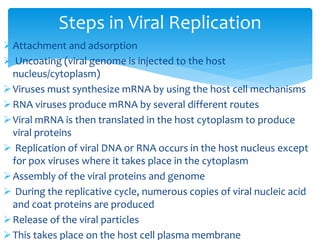
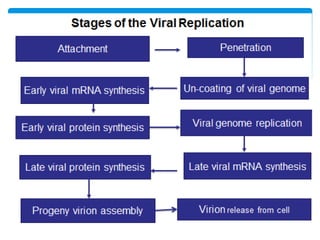
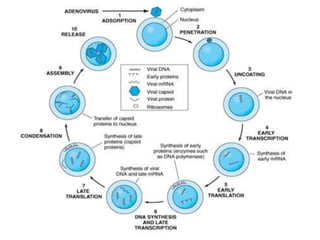
Attachment and adsorption
 Uncoating (viral genome is injected to the host
nucleus/cytoplasm)
Viruses must synthesize mRNA by using the host cell mechanisms
RNA viruses produce mRNA by several different routes
Viral mRNA is then translated in the host cytoplasm to produce
viral proteins
 Replication of viral DNA or RNA occurs in the host nucleus except
for pox viruses where it takes place in the cytoplasm
Assembly of the viral proteins and genome
 During the replicative cycle, numerous copies of viral nucleic acid
and coat proteins are produced
Release of the viral particles
This takes place on the host cell plasma membrane
Steps in Viral Replication
SESSION 7.ppt
SESSION 7.ppt

SESSION 7.ppt

  • 1.
  • 2.
    By the endof this session, students are expected to be able to: Define different terms used in virology Describe characteristic of viruses Describe structure of the virus Compare virus and bacteria cell structures Learning Objectives
  • 3.
    Viruses: Are smallestinfectious agents (ranging from about 20 nm to about 300 nm in diameter) and contain only one kind of nucleic acid (RNA or DNA) as their genome Virology-Is study of viruses Capsid: The protein shell, or coat that encloses the nucleic acid genome Nucleocapsid: The protein-nucleic acid complex plus a capsid. Sometimes it is a complete virion Capsomeres: Morphologic units of a capsid Virion: The complete virus particle. In some instances the virion is identical with the nucleocapsid. In more complex virion, it includes the nucleocapsid plus a surrounding envelope Terms in used in Virology
  • 4.
    Envelope: A lipid-containingmembrane that surrounds some virus particles Structural units: The basic protein building blocks of the coat. They are usually a collection of more than one identical protein subunit. The structural unit is often referred to as a protomer Subunit: A single folded viral polypeptide chain Defective virus: A virus particle that is functionally deficient in some aspect of replication Terms in used in Virology
  • 5.
    Are small insize ranging from about 20 nm to about 300 nm in diameter. Akaryotic particles (neither eukaryotes nor prokaryotes)  Contain either DNA or RNA and not both as their genome Exhibit living properties when inside the living cells (i.e. they are incapable of independent reproduction unless they are in the living cell) Are non motile  Can be grown in cell cultures Viruses are known to infect unicellular organisms such as mycoplasmas, bacteria, and algae and all higher plants and animals Characteristics of Viruses
  • 6.
    Generally the virusstructure is made of three basic units Envelop made of glycoprotein and lipids Capsid Viral core (RNA or DNA) Structure of Viruses
  • 7.
  • 8.
    Envelop is theoutermost coat of the virus made of lipid and proteins  Its function is to support glycoproteins or spikes used for attachment to the host cell Gives stability to the virus Protects the inner parts of the virus It is usually derived from the host cell during release (budding) Virus with an envelop are less stable than non enveloped virus (they can be destroyed by disinfectants or adverse condition of the environment) Parts of the Viral Structure and its Function
  • 9.
    Capsid is aprotein coat which covers the viral genome, it is made up of repeating subunits called capsomers The repeating subunits of the capsid give the virus a symmetric appearance that is useful for classification purposes Some viral nucleocapsids have spherical (icosahedral) symmetry where as others have helical symmetry  All human viruses that have a helical nucleocapsid are enveloped (there are not naked helical viruses that infect humans) Parts of the Viral Structure and its Function
  • 10.
    Viral Core containsgenetic materials necessary for replication. They include either DNA or RNA, never both Deoxyribonucleic acid (DNA) containing viruses are double stranded except parvoviruses which have single strand DNA  Ribonucleic Acid (RNA) containing viruses are single stranded. Example human immunodeficiency virus (HIV)  Nucleic acid can either be linear or circular, continuous or segmented Parts of the Viral Structure and its Function
  • 12.
  • 13.
    By the endof this session, students are expected to be able to: Explain the criteria used to classify viruses Classify viruses based on the size, morphology and capsid symmetry of the virus particle Classify viruses based on type of nucleic acid and mode of replication Outline reproductive cycle of a virus Learning Objectives
  • 14.
    Viruses are classifiedbased on the number of criteria which include Size, morphology and capsid symmetry of the virus particle Type of nucleic acid and mode of replication Mode of transmission CLASSIFICATION OF VIRUSES
  • 15.
    Classification of VirusesAccording to Morphology and Capsid Symmetry of the Virus. Symmetry of the capsid -Helical symmetry -Icosahedra symmetry -Complex symmetry Envelope as the outer coat -Enveloped viruses - None enveloped viruses (naked viruses) CLASSIFICATION
  • 17.
    Helical Symmetry Viruses Replicationof viruses with helical symmetry, identical protein subunits (protomers) self-assemble into a helical array surrounding the nucleic acid, which follows a similar spiral path. Nucleocapsids form rigid, highly elongated rods or flexible filaments shaped like a spiral stare case. Examples of the helical symmetry viruses are measles virus, mumps viruses, rabies viruses, respiratory syncytial virus. CLASSIFICATION
  • 19.
    Icosahedral Symmetry An icosahedronis a polyhedron having 20 equilateral triangular faces and 12 vertices Appearance of such viruses is spherical There are exactly 60 identical subunits on the surface of an icosahedron Examples of viruses with icosahedral symmetry are Adenoviruses, herpes simplex virus, cytomegalovirus, varicela zoster virus, hepatitis B virus and papiloma virus CLASSIFICATION
  • 21.
    An envelope isan outer (bounding) lipoprotein bilayer membrane possessed by many viruses Most of the enveloped viruses are helical in shape Most of the enveloped helical viruses are RNA viruses Example influenza viruses, measles virus, mumps virus, rabies virus, respiratory syncytial virus Enveloped viruses which are icosahedral in shape are also DNA viruses. These include Herpes simplex virus, Varisella zoster virus, and cytomegalovirus CLASSIFICATION
  • 22.
    Non Enveloped Viruses Viruseswhich are not enveloped are all icosahedra in shape RNA viruses which are not enveloped include Poliovirus, Hepatitis A virus, and Enteroviruses DNA viruses which are not enveloped include Adenoviruses, Papilloma viruses and Polyoma viruses CLASSIFICATION
  • 23.
    Based on thenucleic acid viruses are classified into RNA viruses DNA viruses Classification of Viruses According to the Nucleic Acid
  • 24.
    RNA viruses, comprising70% of all viruses. Because of the error rate of the enzymes involved in RNA replication, these viruses usually show much higher mutation rates than do the DNA viruses The viral RNA may be single-stranded (ss) or double-stranded (ds), and the genome may occupy a single RNA segment or be distributed on two or more separate segments (segmented genomes) The proteins necessary for the construction of complete virions are always made via the information coded in the host messenger RNA (mRNA) RNA Viruses
  • 25.
     RNA virusescan either have positive sense or negative sense genome Virus with positive sense strand can function as messenger RNA (mRNA), while a negative sense strand cannot function as mRNA protein translation. Positive sense viral RNA alone can replicate if injected into cells, since it can function as mRNA and initiate translation of virus- encoded proteins. Negative sense RNA, on the other hand, has no translational function and cannot per seproduce viral components without the help of the host cell messenger RNA. RNA Viruses
  • 26.
    Examples of doublestranded RNA viruses include , reoviridae family (Reoviruses spp) Examples of single stranded RNA viruses include, Retroviridae (example HIV), Rhabdoviridae (example Rabies virus) Orthomyxoviridae (example Influenza virus) Filoviridae (example Murbug and Ebola Viruses) Paramyxoviridae (examples Measles viruses, Mumps viruses, Respiratory syncytial viruses and Parainfuenza viruses), Pircornaviridae (examples Polioviruses, Hepatitis A, Enteroviruses) RNA Viruses
  • 28.
    Most DNA virusescontain a single genome of linear double stranded DNA (dsDNA). However the papovaviruses (papillomaviruses, polyoma and vacuolating agents), have circular DNA genomes. dsDNA serves as a template both for mRNA and for self- transcription. Examples of double stranded DNA (dsDNA) viruses include Herpadnaviridae (Hepatitis B virus), Poxviridae (Small pox virus), Herpesviridae (Herpex simples viruses, Varisela zoster viruses, cytomegaloviruses) Examples of Single stranded DNA(ssDNA) viruses include Parvoviridae (B19 virus) DNA Viruses
  • 30.
    Contact  Herpes viruses,HIV, Hepatitis viruses, Ebola virus, Rabies virus, Marburg virus Viruses under this group are transmitted through contact with virus from the vesicle,blisters. This may be via sexual contact, during birth, kissing Inhalation Examples measles viruses, varicella zoster virus, mumps virus, variolla virus, rubella virus, respiratory syncytial virus, Influenza virus, Fecal Oral Route- Examples enteroviruses Vector -Examples yellow fever viruses Transfusion- Examples HIV, Hepatitis B Classification of Viruses According to the Mode of Transmission
  • 31.
    Viruses are inertin the extracellular environment They replicate only in living cells, being parasites at the genetic level The viral nucleic acid contains information necessary for programming the infected host cell to synthesize virus-specific macromolecules required for the production of viral progeny (new virus particle) Replicative Cycle of Viruses
  • 32.
    Attachment and adsorption Uncoating (viral genome is injected to the host nucleus/cytoplasm) Viruses must synthesize mRNA by using the host cell mechanisms RNA viruses produce mRNA by several different routes Viral mRNA is then translated in the host cytoplasm to produce viral proteins  Replication of viral DNA or RNA occurs in the host nucleus except for pox viruses where it takes place in the cytoplasm Assembly of the viral proteins and genome  During the replicative cycle, numerous copies of viral nucleic acid and coat proteins are produced Release of the viral particles This takes place on the host cell plasma membrane Steps in Viral Replication