POXVIRUSES
(VIROLOGY)
Pox virus
 Family- poxviridae
 Subfamily-.
 Chordopoxvirinae (pox virus of vertebrae)
 Entomopoxvirinae (pox virus of insects)
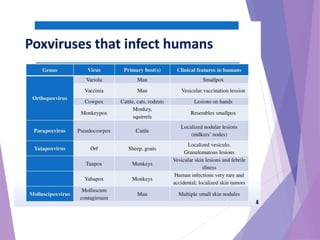
 Chordopoxvirinae have 8 genera but only 4 infects human
 They are largest and most complex of all viruses.
 DNA virus
 Replicate in the cytoplasm
 Can be seen under light microscope
MORPHOLOGY
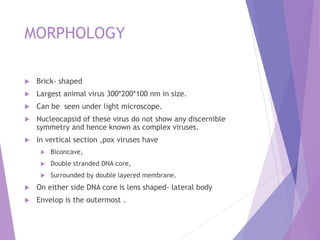
 Brick- shaped
 Largest animal virus 300*200*100 nm in size.
 Can be seen under light microscope.
 Nucleocapsid of these virus do not show any discernible
symmetry and hence known as complex viruses.
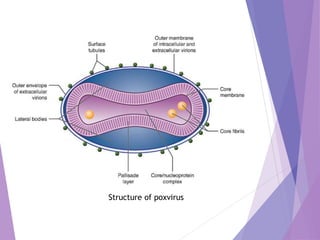
 In vertical section ,pox viruses have
 Biconcave,
 Double stranded DNA core,
 Surrounded by double layered membrane.
 On either side DNA core is lens shaped- lateral body
 Envelop is the outermost .
Structure of poxvirus
RESISTANCE
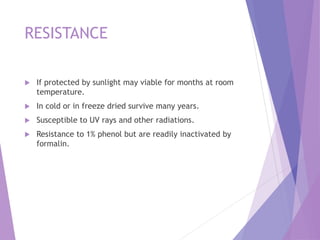
 If protected by sunlight may viable for months at room
temperature.
 In cold or in freeze dried survive many years.
 Susceptible to UV rays and other radiations.
 Resistance to 1% phenol but are readily inactivated by
formalin.
ANTIGEN STRUCTURE
 All have common nucleoprotein (NP) antigen.
 LS antigen
 Agglutinogen
 Haemagglutinin
CULTIVATION
 Grow in Chorio-allantonic membrane(CAM) of chick
embryo
 Tissue culture.
 Both variola and vaccinia produces pocks on the CAM in
48-72 hours.
 Variola pox are small, shiny, white, convex, non-
necrotic and non-hemorrhagic.
 Vaccinia pocks are larger, irregular, greyish, flat,
necrotic and some of these are hemorrhagic.
 Tissue culture of Monkey kidney, HeLa and Chick embryo
cells can be used.
 Cytopathic effects are produced by vaccinia in 24-48
hours but variola takes larger to produce these changes.
 Eosinophilic inclusion bodies (Guarnieri bodies) can be
demonstrated in stained preparations.
 Plaques in chick embryo can be produced by vaccinia.
VIRUSES CAUSING HUMAN INFECTIONS
1) VARIOLA
2) VACCINIA
3) COWPOX
4) HUMAN MONKEYPOX
5) MILKER’S NODE
6) ORF
7) MOLLUSCUM CONTAGIOSUM
8) TANAPOX
9) YABAPOX
VARIOLA
 Causes smallpox
 Human and monkey only
 Variola major- classic smallpox (Fatal disease)
 Variola minor- non fatal disease
 Smallpox eradicated and routine vaccination in
now stopped.
 Last case recorded was in Somalia, in October
1977.
 On 8th may 1980, the WHO announced the
global eradication of smallpox.
 Eradication achieved because of-
 No subclinical infection or carrier state.
 An effective vaccine
 No animal reservoir
 Aggressive surveillance- containment measure
 Although two laboratory still holds stocks of variola virus.
VACCINIA
 In past used for smallpox vaccination.
 May have evolved from cowpox or smallpox virus
 An artificial virus.
 Cause localised skin infections with broad host range
including rabbit and mice.
 Virus is being used as vector for incorporating genes for
protective antigen for several pathogens and
development of recombinant vaccines.
COWPOX
 In cows it produces ulcers on the teats and udders and
human infection is aquired from cows by process of
milking.
 The lesion appear on hands of man.
 These are localised lesions and undergo changes from
macules to pustules as in smallpox.
 Rodents are reservior hosts in cowpox virus.
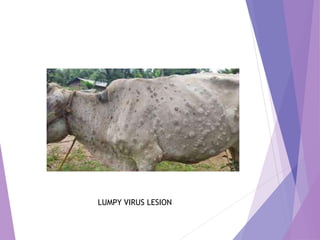
LUMPY VIRUS LESION
HUMAN MONKEYPOX
 Infection is probably acquired by handling infected
animals.
 Human monkeypox resembles mild smallpox.
MILKER’S NODE
 Transmitted to humans from teats and udder of cattle.
 Similar to cowpox, but rarely becomes pustular.
Orf
 Contagious pustular dermatitis of sheep and goats.
 Acquired by man after contact with an infected animal.
 In man, disease occurs as a single lesion on finger or
hand or occasionally on the face.
MOLLUSCUM CONTAGIOSUM
 It is benign epidermal tumour like lesion.
 Occurs only in humans,
 Mainly involves arms, legs, buttocks and genital area.
 Contagious disease.
 Virus is also transmitted sexually in adults.
 Nodules show hyaline acidophilic inclusion bodies
(molluscum bodies) within proliferated epidermal cells.
 Molluscum contagiosum virus has not yet been cultured.
TANAPOX
 Probably acquired by insect bite.
 Reserviors are some wild animals.
 Produces scanty vesicular lesions of the skin.
 Epidemics have been reported in East- Africa.
YABAPOX
 Produces large benign tumors in monkeys.
 Similar lesions have been reported in a laboratory
person handling affected monkeys.
PROPHYLAXIS
 Both vaccinia and variola viruses can be grown on the
CAM of chick embryo.
 The two viruses differs from each other by only a single
antigen.
 A natural infection of smallpox gives complete
protection against reinfection.
 Vaccination with vaccinia induces protection against
smallpox for about five years.
THANK YOU
DR JAGRUTI SINGH
MD (Hom.) Practice of medicine, BHMS

POXVIRUSES.pptx

  • 1.
  • 2.
    Pox virus  Family-poxviridae  Subfamily-.  Chordopoxvirinae (pox virus of vertebrae)  Entomopoxvirinae (pox virus of insects)  Chordopoxvirinae have 8 genera but only 4 infects human
  • 3.
     They arelargest and most complex of all viruses.  DNA virus  Replicate in the cytoplasm  Can be seen under light microscope
  • 4.
    MORPHOLOGY  Brick- shaped Largest animal virus 300*200*100 nm in size.  Can be seen under light microscope.  Nucleocapsid of these virus do not show any discernible symmetry and hence known as complex viruses.  In vertical section ,pox viruses have  Biconcave,  Double stranded DNA core,  Surrounded by double layered membrane.  On either side DNA core is lens shaped- lateral body  Envelop is the outermost .
  • 5.
  • 6.
    RESISTANCE  If protectedby sunlight may viable for months at room temperature.  In cold or in freeze dried survive many years.  Susceptible to UV rays and other radiations.  Resistance to 1% phenol but are readily inactivated by formalin.
  • 8.
    ANTIGEN STRUCTURE  Allhave common nucleoprotein (NP) antigen.  LS antigen  Agglutinogen  Haemagglutinin
  • 9.
    CULTIVATION  Grow inChorio-allantonic membrane(CAM) of chick embryo  Tissue culture.  Both variola and vaccinia produces pocks on the CAM in 48-72 hours.  Variola pox are small, shiny, white, convex, non- necrotic and non-hemorrhagic.  Vaccinia pocks are larger, irregular, greyish, flat, necrotic and some of these are hemorrhagic.
  • 10.
     Tissue cultureof Monkey kidney, HeLa and Chick embryo cells can be used.  Cytopathic effects are produced by vaccinia in 24-48 hours but variola takes larger to produce these changes.  Eosinophilic inclusion bodies (Guarnieri bodies) can be demonstrated in stained preparations.  Plaques in chick embryo can be produced by vaccinia.
  • 11.
    VIRUSES CAUSING HUMANINFECTIONS 1) VARIOLA 2) VACCINIA 3) COWPOX 4) HUMAN MONKEYPOX 5) MILKER’S NODE 6) ORF 7) MOLLUSCUM CONTAGIOSUM 8) TANAPOX 9) YABAPOX
  • 12.
    VARIOLA  Causes smallpox Human and monkey only  Variola major- classic smallpox (Fatal disease)  Variola minor- non fatal disease  Smallpox eradicated and routine vaccination in now stopped.  Last case recorded was in Somalia, in October 1977.  On 8th may 1980, the WHO announced the global eradication of smallpox.
  • 13.
     Eradication achievedbecause of-  No subclinical infection or carrier state.  An effective vaccine  No animal reservoir  Aggressive surveillance- containment measure  Although two laboratory still holds stocks of variola virus.
  • 14.
    VACCINIA  In pastused for smallpox vaccination.  May have evolved from cowpox or smallpox virus  An artificial virus.  Cause localised skin infections with broad host range including rabbit and mice.  Virus is being used as vector for incorporating genes for protective antigen for several pathogens and development of recombinant vaccines.
  • 15.
    COWPOX  In cowsit produces ulcers on the teats and udders and human infection is aquired from cows by process of milking.  The lesion appear on hands of man.  These are localised lesions and undergo changes from macules to pustules as in smallpox.  Rodents are reservior hosts in cowpox virus.
  • 16.
  • 17.
    HUMAN MONKEYPOX  Infectionis probably acquired by handling infected animals.  Human monkeypox resembles mild smallpox.
  • 18.
    MILKER’S NODE  Transmittedto humans from teats and udder of cattle.  Similar to cowpox, but rarely becomes pustular.
  • 19.
    Orf  Contagious pustulardermatitis of sheep and goats.  Acquired by man after contact with an infected animal.  In man, disease occurs as a single lesion on finger or hand or occasionally on the face.
  • 20.
    MOLLUSCUM CONTAGIOSUM  Itis benign epidermal tumour like lesion.  Occurs only in humans,  Mainly involves arms, legs, buttocks and genital area.  Contagious disease.  Virus is also transmitted sexually in adults.  Nodules show hyaline acidophilic inclusion bodies (molluscum bodies) within proliferated epidermal cells.  Molluscum contagiosum virus has not yet been cultured.
  • 21.
    TANAPOX  Probably acquiredby insect bite.  Reserviors are some wild animals.  Produces scanty vesicular lesions of the skin.  Epidemics have been reported in East- Africa.
  • 22.
    YABAPOX  Produces largebenign tumors in monkeys.  Similar lesions have been reported in a laboratory person handling affected monkeys.
  • 23.
    PROPHYLAXIS  Both vacciniaand variola viruses can be grown on the CAM of chick embryo.  The two viruses differs from each other by only a single antigen.  A natural infection of smallpox gives complete protection against reinfection.  Vaccination with vaccinia induces protection against smallpox for about five years.
  • 24.
    THANK YOU DR JAGRUTISINGH MD (Hom.) Practice of medicine, BHMS