In the Name of GOD
Dr. Kaveh Haratian
Department of Microbiology and Immunology
Alborz University of Medical Sciences
Rubella
Postnatal infections
Introduction
• Derived from “rubellus” meaning “reddish” refers to pink rash.
• Also called “German measles”, first described in Germany during
18th. Century.
• Predominantly an infection of children, mild febril illness.
• Potent cause of fetal abnormality.
3
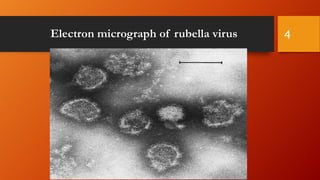
Electron micrograph of rubella virus 4
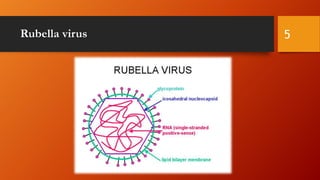
Rubella virus 5
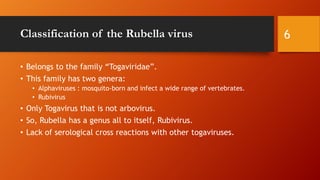
Classification of the Rubella virus
• Belongs to the family “Togaviridae”.
• This family has two genera:
• Alphaviruses : mosquito-born and infect a wide range of vertebrates.
• Rubivirus
• Only Togavirus that is not arbovirus.
• So, Rubella has a genus all to itself, Rubivirus.
• Lack of serological cross reactions with other togaviruses.
6
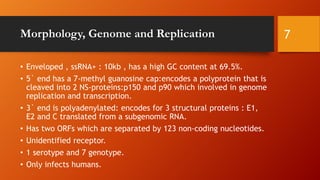
Morphology, Genome and Replication
• Enveloped , ssRNA+ : 10kb , has a high GC content at 69.5%.
• 5` end has a 7-methyl guanosine cap:encodes a polyprotein that is
cleaved into 2 NS-proteins:p150 and p90 which involved in genome
replication and transcription.
• 3` end is polyadenylated: encodes for 3 structural proteins : E1,
E2 and C translated from a subgenomic RNA.
• Has two ORFs which are separated by 123 non-coding nucleotides.
• Unidentified receptor.
• 1 serotype and 7 genotype.
• Only infects humans.
7
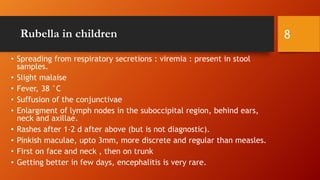
Rubella in children
• Spreading from respiratory secretions : viremia : present in stool
samples.
• Slight malaise
• Fever, 38 °C
• Suffusion of the conjunctivae
• Enlargment of lymph nodes in the suboccipital region, behind ears,
neck and axillae.
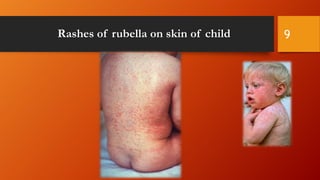
• Rashes after 1-2 d after above (but is not diagnostic).
• Pinkish maculae, upto 3mm, more discrete and regular than measles.
• First on face and neck , then on trunk
• Getting better in few days, encephalitis is very rare.
8
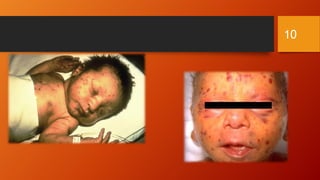
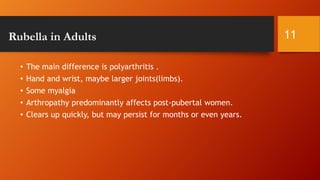
Rashes of rubella on skin of child 9
10
Rubella in Adults
• The main difference is polyarthritis .
• Hand and wrist, maybe larger joints(limbs).
• Some myalgia
• Arthropathy predominantly affects post-pubertal women.
• Clears up quickly, but may persist for months or even years.
11
Epidemiology
• Of significant in women of childbearing age.
• Presents in all countries but its distribution varies in each one.
• About 70% of women has been infected in most populations.
• Effective immunization programmes radically alter the
prevalence.
• So, rubella is now a rare infection.
12
Pathogenesis and pathology
• The portal of entry : respiratory tract
• IP: 14-16 d (10-21d).
• Postnatal rubella is not fatal.
• Animals van not be infected.
• Fetal infection : slowed growth rate of fetal cells infected by the
virus and apoptosis induced by viral proteins.
13
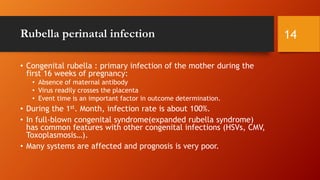
Rubella perinatal infection
• Congenital rubella : primary infection of the mother during the
first 16 weeks of pregnancy:
• Absence of maternal antibody
• Virus readily crosses the placenta
• Event time is an important factor in outcome determination.
• During the 1st. Month, infection rate is about 100%.
• In full-blown congenital syndrome(expanded rubella syndrome)
has common features with other congenital infections (HSVs, CMV,
Toxoplasmosis…).
• Many systems are affected and prognosis is very poor.
14
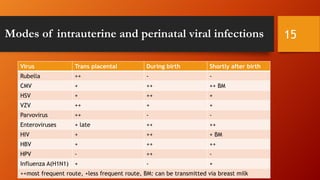
Modes of intrauterine and perinatal viral infections
Virus Trans placental During birth Shortly after birth
Rubella ++ - -
CMV + ++ ++ BM
HSV + ++ +
VZV ++ + +
Parvovirus ++ - -
Enteroviruses + late ++ ++
HIV + ++ + BM
HBV + ++ ++
HPV - ++ -
Influenza A(H1N1) + - +
++most frequent route, +less frequent route, BM: can be transmitted via breast milk
15
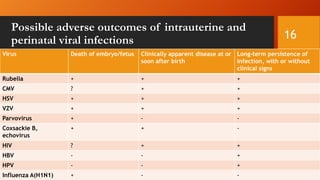
Possible adverse outcomes of intrauterine and
perinatal viral infections
Virus Death of embryo/fetus Clinically apparent disease at or
soon after birth
Long-term persistence of
infection, with or without
clinical signs
Rubella + + +
CMV ? + +
HSV + + +
VZV + + +
Parvovirus + - -
Coxsackie B,
echovirus
+ + -
HIV ? + +
HBV - - +
HPV - - +
Influenza A(H1N1) + - -
16
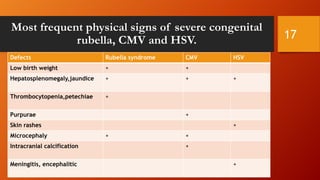
Most frequent physical signs of severe congenital
rubella, CMV and HSV.
Defects Rubella syndrome CMV HSV
Low birth weight + +
Hepatosplenomegaly,jaundice + + +
Thrombocytopenia,petechiae +
Purpurae +
Skin rashes +
Microcephaly + +
Intracranial calcification +
Meningitis, encephalitic +
17
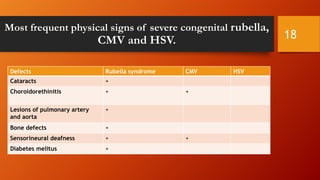
Most frequent physical signs of severe congenital rubella,
CMV and HSV.
Defects Rubella syndrome CMV HSV
Cataracts +
Choroidorethinitis + +
Lesions of pulmonary artery
and aorta
+
Bone defects +
Sensorineural deafness + +
Diabetes melitus +
18
Immune response
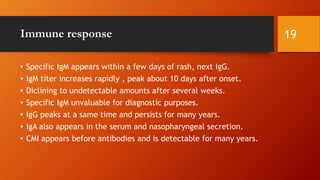
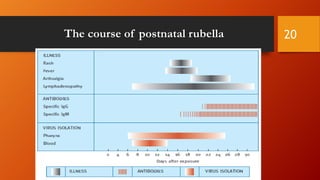
• Specific IgM appears within a few days of rash, next IgG.
• IgM titer increases rapidly , peak about 10 days after onset.
• Diclining to undetectable amounts after several weeks.
• Specific IgM unvaluable for diagnostic purposes.
• IgG peaks at a same time and persists for many years.
• IgA also appears in the serum and nasopharyngeal secretion.
• CMI appears before antibodies and is detectable for many years.
19
The course of postnatal rubella 20
Laboratory Diagnosis
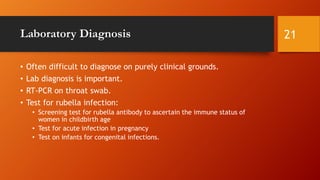
• Often difficult to diagnose on purely clinical grounds.
• Lab diagnosis is important.
• RT-PCR on throat swab.
• Test for rubella infection:
• Screening test for rubella antibody to ascertain the immune status of
women in childbirth age
• Test for acute infection in pregnancy
• Test on infants for congenital infections.
21
Screening teats on women
• Antenatal clinics for routin screening of rubella antibody.
• Negative result : immunization soon after the birth : preotect
subsequent pregnancies.
• Screening is also advised for women of childbearing age of
particular risk of infection : teachers, clinical and hospital staff
(irrespective of a history of past infection/immunization which
may be unreliable).
• ELISA test for IgG antibody is commonly available .
22
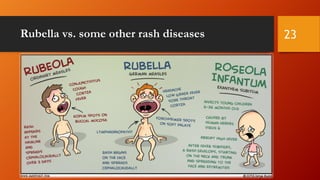
Rubella vs. some other rash diseases 23
Immunization
• The only vaccine not given primarily for the benefit of the
recipient, but to protect another (=fetus).
• First dose : 12-15 months.
• Second dose : before school entry (3-5 years).
• Non-immune women : before pregnancy or after delivery (single
dose).
24
Contraindications to vaccine
• Main subjects (like other live vaccines) are :
• Febrile illness
• Allergy to one of the constituents (rare)
• Defective immunity
• The importance is : early pregnancy : not before 1 month after
receiving rubella vaccine.
25
26
27

Rubella

  • 1.
    In the Nameof GOD Dr. Kaveh Haratian Department of Microbiology and Immunology Alborz University of Medical Sciences
  • 2.
  • 3.
    Introduction • Derived from“rubellus” meaning “reddish” refers to pink rash. • Also called “German measles”, first described in Germany during 18th. Century. • Predominantly an infection of children, mild febril illness. • Potent cause of fetal abnormality. 3
  • 4.
    Electron micrograph ofrubella virus 4
  • 5.
  • 6.
    Classification of theRubella virus • Belongs to the family “Togaviridae”. • This family has two genera: • Alphaviruses : mosquito-born and infect a wide range of vertebrates. • Rubivirus • Only Togavirus that is not arbovirus. • So, Rubella has a genus all to itself, Rubivirus. • Lack of serological cross reactions with other togaviruses. 6
  • 7.
    Morphology, Genome andReplication • Enveloped , ssRNA+ : 10kb , has a high GC content at 69.5%. • 5` end has a 7-methyl guanosine cap:encodes a polyprotein that is cleaved into 2 NS-proteins:p150 and p90 which involved in genome replication and transcription. • 3` end is polyadenylated: encodes for 3 structural proteins : E1, E2 and C translated from a subgenomic RNA. • Has two ORFs which are separated by 123 non-coding nucleotides. • Unidentified receptor. • 1 serotype and 7 genotype. • Only infects humans. 7
  • 8.
    Rubella in children •Spreading from respiratory secretions : viremia : present in stool samples. • Slight malaise • Fever, 38 °C • Suffusion of the conjunctivae • Enlargment of lymph nodes in the suboccipital region, behind ears, neck and axillae. • Rashes after 1-2 d after above (but is not diagnostic). • Pinkish maculae, upto 3mm, more discrete and regular than measles. • First on face and neck , then on trunk • Getting better in few days, encephalitis is very rare. 8
  • 9.
    Rashes of rubellaon skin of child 9
  • 10.
  • 11.
    Rubella in Adults •The main difference is polyarthritis . • Hand and wrist, maybe larger joints(limbs). • Some myalgia • Arthropathy predominantly affects post-pubertal women. • Clears up quickly, but may persist for months or even years. 11
  • 12.
    Epidemiology • Of significantin women of childbearing age. • Presents in all countries but its distribution varies in each one. • About 70% of women has been infected in most populations. • Effective immunization programmes radically alter the prevalence. • So, rubella is now a rare infection. 12
  • 13.
    Pathogenesis and pathology •The portal of entry : respiratory tract • IP: 14-16 d (10-21d). • Postnatal rubella is not fatal. • Animals van not be infected. • Fetal infection : slowed growth rate of fetal cells infected by the virus and apoptosis induced by viral proteins. 13
  • 14.
    Rubella perinatal infection •Congenital rubella : primary infection of the mother during the first 16 weeks of pregnancy: • Absence of maternal antibody • Virus readily crosses the placenta • Event time is an important factor in outcome determination. • During the 1st. Month, infection rate is about 100%. • In full-blown congenital syndrome(expanded rubella syndrome) has common features with other congenital infections (HSVs, CMV, Toxoplasmosis…). • Many systems are affected and prognosis is very poor. 14
  • 15.
    Modes of intrauterineand perinatal viral infections Virus Trans placental During birth Shortly after birth Rubella ++ - - CMV + ++ ++ BM HSV + ++ + VZV ++ + + Parvovirus ++ - - Enteroviruses + late ++ ++ HIV + ++ + BM HBV + ++ ++ HPV - ++ - Influenza A(H1N1) + - + ++most frequent route, +less frequent route, BM: can be transmitted via breast milk 15
  • 16.
    Possible adverse outcomesof intrauterine and perinatal viral infections Virus Death of embryo/fetus Clinically apparent disease at or soon after birth Long-term persistence of infection, with or without clinical signs Rubella + + + CMV ? + + HSV + + + VZV + + + Parvovirus + - - Coxsackie B, echovirus + + - HIV ? + + HBV - - + HPV - - + Influenza A(H1N1) + - - 16
  • 17.
    Most frequent physicalsigns of severe congenital rubella, CMV and HSV. Defects Rubella syndrome CMV HSV Low birth weight + + Hepatosplenomegaly,jaundice + + + Thrombocytopenia,petechiae + Purpurae + Skin rashes + Microcephaly + + Intracranial calcification + Meningitis, encephalitic + 17
  • 18.
    Most frequent physicalsigns of severe congenital rubella, CMV and HSV. Defects Rubella syndrome CMV HSV Cataracts + Choroidorethinitis + + Lesions of pulmonary artery and aorta + Bone defects + Sensorineural deafness + + Diabetes melitus + 18
  • 19.
    Immune response • SpecificIgM appears within a few days of rash, next IgG. • IgM titer increases rapidly , peak about 10 days after onset. • Diclining to undetectable amounts after several weeks. • Specific IgM unvaluable for diagnostic purposes. • IgG peaks at a same time and persists for many years. • IgA also appears in the serum and nasopharyngeal secretion. • CMI appears before antibodies and is detectable for many years. 19
  • 20.
    The course ofpostnatal rubella 20
  • 21.
    Laboratory Diagnosis • Oftendifficult to diagnose on purely clinical grounds. • Lab diagnosis is important. • RT-PCR on throat swab. • Test for rubella infection: • Screening test for rubella antibody to ascertain the immune status of women in childbirth age • Test for acute infection in pregnancy • Test on infants for congenital infections. 21
  • 22.
    Screening teats onwomen • Antenatal clinics for routin screening of rubella antibody. • Negative result : immunization soon after the birth : preotect subsequent pregnancies. • Screening is also advised for women of childbearing age of particular risk of infection : teachers, clinical and hospital staff (irrespective of a history of past infection/immunization which may be unreliable). • ELISA test for IgG antibody is commonly available . 22
  • 23.
    Rubella vs. someother rash diseases 23
  • 24.
    Immunization • The onlyvaccine not given primarily for the benefit of the recipient, but to protect another (=fetus). • First dose : 12-15 months. • Second dose : before school entry (3-5 years). • Non-immune women : before pregnancy or after delivery (single dose). 24
  • 25.
    Contraindications to vaccine •Main subjects (like other live vaccines) are : • Febrile illness • Allergy to one of the constituents (rare) • Defective immunity • The importance is : early pregnancy : not before 1 month after receiving rubella vaccine. 25
  • 26.
  • 27.