BY:
Amr Shalaby
Definition:
Viruses are the smallest known infectious
agents, they can infect man, animals, plants,
insects & even bacteria ( Bacteriophage ) .
NB: The word ( Virus ) is a latin word
meaning ( Poison )
Properties:
1- Their size is very small (20-300nm) so they
only can be seen by EM except ( poxvirus ).
2- They are obligate intracellular parasites
,which can replicate only inside the host cells
as they lack the required machinery for
replication.
3- They can’t be grown on artificial culture
media , but only on living cells.
4- Their genome is either DNA or RNA ( but
never both )
Structure:
The virion ( the complete infectious virus
particle ) is constructed of two components ..
1- The nucleic acid core .
2- The capsid ( a protein coat protect the
genome ).
3- Other components : enzymes &
matrix protein ( may be present )
NB: They are together called the nucleocapsid
NB: Some viruses are enclosed in an
envelope.
1-viral nucleic acid genome:
- Either DNA or RNA.
- Single or Double stranded.
- Linear or Non-linear.
- Segmented or Non segmented.
- All virus genomes are haploid ( 1 copy )
except : Retrovirus which are 2 copies of
linear RNA ( diploid )
2- Viral Capsid :
- protein coat of the virus
- makes most of the virion mass
- composition small protein subunits called
capsomers ,this arrangement determines the
virus symmetry
functions of capsid :
1) Protection of genome from destruction
2) Attachment to specific receptors on cells
3) Antigenic : induce Ab & activate Tc
4) Arrangement of the capsomers
Viral Envelope:
Structure :
surrounded by lipid or lipoprotein envelope
& covered by glycoprotein spike like
projections
Source :
partially or totally derived from host cell
membrane during release of virus by Budding
Importance :
1- Sensitive to heat , detergent & ether
2- Loss of envelope causing loss of infectivity
Envelope proteins :
A- matrix protein : link nucleocapsid to
envelope
B- spike glycoprotein attached to cell receptors
C- antigenic structure
D- determine type specificity of the virus
Viral enzymes:
Carry enzyms important for their replication.
Atypical virus like agents :
A- Defective viruses : viruses can't replicate
without a helper providing the missing
function
B- Pseudovirions : contain host cell DNA
instead of viral during viral replication parts of
host DNA incorporated in the viral capsid
infectious but not replicative
C- Viroids : infectious agents composed only of
Single Stranded circular RNA with some
double stranded regions causing plant
diseases
D- Prions : infectious particles composed of
solely of proteins i.e. no nucleic acid & cause
slow diseases e.g mad cow disease
Definition : It is the intracellular phase of
virus life cycle that starts by the contact of a
virion depending completely on the cell's
metabolic function .
Stages :
1-Adsorption 2-Penetration
3-Uncoating 4-Transcription
5-Translation 6-Synthesis of nucleic acid
7-Assembley of new virions
8-Release of new virions
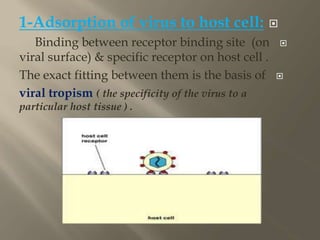
1-Adsorption of virus to host cell:
Binding between receptor binding site (on
viral surface) & specific receptor on host cell .
The exact fitting between them is the basis of
viral tropism ( the specificity of the virus to a
particular host tissue ) .
2-Penetration:
-Enveloped viruses: by fusing to plasma
membrane
-Non enveloped: by endocytosis: by
endocytosis (then liberation inside cell)
3-Uncoating:
- proteolytic enzymes of the host attack virus
destructing its capsid (liberation of genome)
NB: Uncoating mark the beginning of eclipse
phase ( virus cannot be detected but genome is detected by
molecular test )
5-Transcription:
-1- In double strand DNA viruses :
-mRNA is transcribed from the negative strand of
DNA by host cell DNA dependent RNA polymerase .
2- In ssRNA viruses of +ve sense:
ssRNA itself act as mRNA for translation into protein .
3- In ssRNA viruses of –ve sense:
transcribed by RNA dependent RNA polymerase into
complementary mRNA
6-Translation :
Viruses use the cellular ribosomes to translate
their viral mRNA into:
-non structural ptns (early ptns): replication
enzymes
-structural ptns (late ptns): coat ,core, cote
ptns
7-Genome synthesis:
By using single strand as template .
8-Assembly:
Assembly of genome & coats to form mature
viruses e.g herpes virus
9-Release:
- Non enveloped: lysis of cells
-Enveloped: budding (taking part from cell
membrane) with no cell lysis
Defenetion:
It's the process by which a viral infection
leads to disease .
NB: Infection Vs disease
ŸInfection : entry of the virus into the body produces
no symptoms or transient symptoms due to local infection
.
ŸDisease : virus at target organ produces signs and
symptoms associated with disease .
NB: The majority of viral infections are
subclinical
Outcome of viral infection :
Acute infection:
Recovery , death , progression to chronic
Chronic infection:
- Silent subclinical infection for life .
- Long silent period before disease .
- Reactivation to cause acute disease .
- Chronic disease with relapses and exacerbations .
- Cancers .
Factors in viral pathogenesis :
1- Cellular pathogenesis :
cells can respond to viral infections in 3 ways :
ŸNo apparent change ,Death ,Transformation .
2- Viral entry :
Skin, Conjunctiva and other mucous membranes,
Respiratory tract, GIT and Genitourinary tract .
3- Cell tropism :
viral affinity to specific tissue determined by :
Ÿcell receptors for virus
Ÿcell transcription factors that recognize viral
promoters and enhancer sequences .
Ÿability of the cell to support virus replication .
4- Course of viral infection :
Primary replication :
The virus replicates after gaining initial entry into the host .
This determines whether the infection will be localized at the
site of entry r spread to become a systemic infection .
Systemic spread :
Apart from direct cell-to cell contact, the virus may spread
via the blood or lymphatic causing viraemia or through the
nerves to reach the target organ .
Secondary replication :
Takes place at susceptible organs/tissues following systemic
spread .
5- Cell damage :
- Viruses may replicate throughout the body
without any symptoms if they don't cause
significant cell damage or death .
- Retroviruses don't generally cause cell
death, being released from the cell by budding
rather than cell lysis, and cause persistent
infections .
- Picornaviruses cause lysis and death of the
cell in which they replicate .
6-Immune response :
It has the greatest impact in the outcome of
infection . Cellular immunity plays the major
role in clearing the viral infection whereas
humoral immunity protects againre reinfection
.
7- Viral clearance or persistence :
The majority are cleared but some viruses may
cause persistent infections .
Mechanism of viral persistence
1- Antigenic variation
2- Immune tolerance, causing a reduced
response to an antigen, may be due to genetic
factors or prenatal infection .
3-Infection of immuneprivileged sites within
the body e.g HSV in sensory ganglia in the
CNS .
4-Direct infection of the cells of the immune
system itself e.g Retrovirus (HIV) often
resulting in immunosuppression .
1-Direct detection in clinical
specimens:
1- light microscopy : can be used for large viruses e.g.
Poxviruses in skin lesions and for inclusions bodies e.g. Negri
bodies of Rabies viruse in nerve cells .
2- Electron microscopy : used to demonstrate large
number of virus particles in vesicular fluid or tissue extract
treated with special stains.
3- Immuoelectron microscopy (IEM) : by adddition
of specific antisera to clinical samples leading to aggregation of
virus particles which can be see easier than separate virus . e.g.
Hepatites A virus ad rotavirus detectio in stools.
4- Immunofluorescence microscopy : fluorescein
labeled specific antisera are added to smears from lesions and
visualized by fluorescense microscope.e.g. diagnosis of rabies in
brain smears.
5- Solid-phase immunoassays : Radioimmunoassay
(RIA) and Enzyme linked immunosorbent assay (ELISA) are
used to detect virl antigens in clinical specimens.e.g. detection of
p24 antigen of HIV in blood .
6- Nucleic acid hybridization : labeled DNA probes
are used to detect virus nucleic acid by hybridization with
its
complementary part in the sample.
7- Polymerase chain reaction : by amplification of a
short sequence of the target nucleic acid which maybe of a small
amount in the sample to facilitate its detection .
2- Isolation of viruses :
A- cell cultures :
These are pieces of animal or human tissue to which
trypsin is added to separate the cells .Cells are grown with
a growth medium containing serum , on glass or plastic
tubes , bottles or plates with a flat side . A monolayerof
cells is formed on the flat side into which the viruses is
inoculated there are 3 types of cell cultures :
1. primary cell lines : prepared from organ fragments
2. Human diplod cell lines : which are fibroblasts from
human embryo tissue , the grow rapidly.
3. Continuous (heteroploid) cell lines : from tumor
cell , they can divide identically.
Detection of viruses in cell cultures:
1.Cytopathic effects (CPE) : change :
a.Cell death & detachment from the glass surface (poliovirus)
b.Rounding & cluster formation (adenovirus)
c.Syncytium or multinucleated giant cell formation
(measles)
d.Transformation (tumor viruses)
2. Plaque formation : virally infected areas in cell
cultures that can be seen by naked eye as unstained areas
when stained with crystal violet .
3.Inclusion bodies : structures seen by LM :
-Intranuclear (Herpesvirus)
-Inracytoplasmic (pox & rabies virus *Negri bodies*)
4.Haemagglutination : cell culturebfluid + RBCs >>
clumping of RBCs on areas infected with virus.
5.Interference : growth of some viruses can be detected
by their interference with growth of CPE producing viruses .
6. Flouresence ab staining : florescein labeled ab +
infected cells >> fluorescence by fluorescent microscope.
7.Neutralization tests : viruses with CPE + ab + cells >>
NO more CPE .
8.Serology for ag : ELISA & complement fixation .
9. Decrease acid production : in dying cells & detected
by color change using a PH indicator .
B- Embryonated eggs :
Viruses can be grown in the amniotic or allantoic cavity on
the choriallantoic membrane or in the embryo itself .
The virus is detected by lesions (pocks) on the chorioallantoic
membrane or by the hemagglutination in the fluid from
cavities
C- Laboratory animals :
Inoculation of the virus into laboratory animals was
mainly used in the past before using tissue culture .
However it still used to study viral pathogensis
.oncogensis and immune response against viruses .white
suckling mice are the most widely used for virus
inoculation
4- Serelogical methods to detect
anti viral antibodies :
By detecting arising antibody titer throught
obtaining two samples
The first one in the acute phase and the second after
10-14 days .
A four-fold rise in antibody titer indicates infection
Detection of IgM antibodies in a single serum
sample indicates infection . Also the presence of IgM
to any virus in a serum of newborn indicates
infection in utero , the used test include
neutralization ,ElIsa, RIA,IF,complement fixation
or haemagglutination inhibition
4- Skin test:
Are used to detect cell mediated immunity against
some viral infections e.g. mumps
1- chemotheraputic antiviral .
2- Cytokines therapy .
3- Antiviral immunoglobulins .
1- chemotheraputic antiviral :
Chemotherapy aims at the use of a chemical
that inhibit virus replication steps .
1 . Nucleoside analogues :
a-azidothymidine :
-Synthetic thymidine analogue.
- Inhibit replication of HIV by inhibiting viral reverse
transcriptase and block proviral DNA synthesis .
- Dideoxyinosine (DDI) : same action , less toxic
b-Deoxythiacytidine and stavudine :
-used if resistance to treatment with AZT or DDI develop .
c-Acyclovir :
-Guanisine analogue inhibting Herpes simplex virus .
-Inhibits virus specific DNA polymerase .
2 . Nucleotide analogues :
They differ from the nucleoside analogs in having
an attached phosphate group . their ability to persist in
cells for long periods of time increases their potency e.g.
cidofovir
3 . Non nucleoside reverse transcriptase
inhibitors :
They act by binding directly to reverse
transcriptase and disrupt the enzyme catalytic site e.g.
nevirapine.
4 . Protrease inhibitors :
Such drugs inhibit the viral protease that is
required at the late stage of replication cycle . e.g.
saquinavir used for treatment of HIV infection
5 . Fusion inhibitors :
Fuzeon is a large peptide that blocks the
virus and cellular membrane fusion step involved in
entry of HIV-1 into cells.
6. Other types of antiviral agents :
- Ribavirin : Synthetic nucleotide effective against
many DNA & RNA viruses .
-Amantadine & rimantadine : Synthetic amines
inhibiting uncoating of influenza A but not B virus .
-Zanamivir : Inhibits the release of influenza virus
from infected cells .
-Foscarnet : A viral polymerase inhibitor of herpes
viruses . It also inhibits the reverse transcriptase of
HIV
-Methisazone : Is of historical interest as an
inhibitor of poxviruses .
Combination chemotherapy:
These are strategies to use more than one drug
for therapy of viruses especially those that
undergo mutation inside the body , Examples:
1-HAART(highly active antiretroviral therapy)
used to treat HIV with nucleoside analogue AZT ,a
nonnucleoside nalogue Lamivudine ,and protease
ihibitor eg, Saqwinavir,Ritonavir.
2-Pegylated interferon alpha , ribavirinand
protease inhibitor to treat HCV
3- Pegylated inter feron alpha with
Lamivudin to treat HBV
2-Cytokines Therapy:
Examples:
1-Antiviral cytokines
Type 1 interferon :inhibits viral replication
.therapeutic targets are HBV,HCV,herpes
zoster,papilloma,HIV.
side effects of therapy are fever,malaise,fatigue,muscle
pain and depression
Type 2 interferon :up regulates expression of class2
MHC,enhance activity of CTL and macrophageand
inhibit viral replication . Therapeutic targets are viral
encephalitis ,slow viruses,prions. side effects are
rare.include kidney,liver, heart,and bone marrow toxicit
2-Regulators of lymphocyte functions
Interleukin-2 (IL-2) induces proliferation of B ,T cells
and CTL and stimulates NK cells.
Therapeutic targets is local treatment of viral skin
and mucous membranes lesions .
Side effects of therapy are : depression,
ascites,renal failure, hepatic failure and mental
changes
3- Antiviral immunoglobulins :
These are used for passive immunization and immunotherapy .The
injection of human hyperimmune globulin provides an immediate
partial or complete
protection last for 2-4 weeks Examples :
1- Vaccine induced anti HBs human immuneoglobulin (HBIG)
- Co-administered with r-HBs vaccine to newborns of mothers with
active HBV- infection .
- Persons with needle stick injuries with first dose of accelerated
vaccination with r-HBs
2- Vaccine induced human anti rabies immunoglobulin (HRIG) :to
provide rapid protection after exposure to rabies virus until vaccine
immunity develops by active vaccination .injected IM around the bite
site .
Source
Basics in medical microbiology and
immunology
part IV VIROLOGY
By
Staff members of medical microbiology and
immunology department
Faculty of medicine ,Zagazig university
Thank you
ASh

General virology

  • 1.
  • 2.
    Definition: Viruses are thesmallest known infectious agents, they can infect man, animals, plants, insects & even bacteria ( Bacteriophage ) . NB: The word ( Virus ) is a latin word meaning ( Poison )
  • 3.
    Properties: 1- Their sizeis very small (20-300nm) so they only can be seen by EM except ( poxvirus ). 2- They are obligate intracellular parasites ,which can replicate only inside the host cells as they lack the required machinery for replication. 3- They can’t be grown on artificial culture media , but only on living cells. 4- Their genome is either DNA or RNA ( but never both )
  • 4.
    Structure: The virion (the complete infectious virus particle ) is constructed of two components .. 1- The nucleic acid core . 2- The capsid ( a protein coat protect the genome ). 3- Other components : enzymes & matrix protein ( may be present ) NB: They are together called the nucleocapsid NB: Some viruses are enclosed in an envelope.
  • 5.
    1-viral nucleic acidgenome: - Either DNA or RNA. - Single or Double stranded. - Linear or Non-linear. - Segmented or Non segmented. - All virus genomes are haploid ( 1 copy ) except : Retrovirus which are 2 copies of linear RNA ( diploid )
  • 6.
    2- Viral Capsid: - protein coat of the virus - makes most of the virion mass - composition small protein subunits called capsomers ,this arrangement determines the virus symmetry functions of capsid : 1) Protection of genome from destruction 2) Attachment to specific receptors on cells 3) Antigenic : induce Ab & activate Tc 4) Arrangement of the capsomers
  • 7.
    Viral Envelope: Structure : surroundedby lipid or lipoprotein envelope & covered by glycoprotein spike like projections Source : partially or totally derived from host cell membrane during release of virus by Budding Importance : 1- Sensitive to heat , detergent & ether 2- Loss of envelope causing loss of infectivity
  • 8.
    Envelope proteins : A-matrix protein : link nucleocapsid to envelope B- spike glycoprotein attached to cell receptors C- antigenic structure D- determine type specificity of the virus Viral enzymes: Carry enzyms important for their replication.
  • 9.
    Atypical virus likeagents : A- Defective viruses : viruses can't replicate without a helper providing the missing function B- Pseudovirions : contain host cell DNA instead of viral during viral replication parts of host DNA incorporated in the viral capsid infectious but not replicative C- Viroids : infectious agents composed only of Single Stranded circular RNA with some double stranded regions causing plant diseases D- Prions : infectious particles composed of solely of proteins i.e. no nucleic acid & cause slow diseases e.g mad cow disease
  • 10.
    Definition : Itis the intracellular phase of virus life cycle that starts by the contact of a virion depending completely on the cell's metabolic function . Stages : 1-Adsorption 2-Penetration 3-Uncoating 4-Transcription 5-Translation 6-Synthesis of nucleic acid 7-Assembley of new virions 8-Release of new virions
  • 11.
    1-Adsorption of virusto host cell: Binding between receptor binding site (on viral surface) & specific receptor on host cell . The exact fitting between them is the basis of viral tropism ( the specificity of the virus to a particular host tissue ) .
  • 12.
    2-Penetration: -Enveloped viruses: byfusing to plasma membrane -Non enveloped: by endocytosis: by endocytosis (then liberation inside cell)
  • 13.
    3-Uncoating: - proteolytic enzymesof the host attack virus destructing its capsid (liberation of genome) NB: Uncoating mark the beginning of eclipse phase ( virus cannot be detected but genome is detected by molecular test )
  • 14.
    5-Transcription: -1- In doublestrand DNA viruses : -mRNA is transcribed from the negative strand of DNA by host cell DNA dependent RNA polymerase . 2- In ssRNA viruses of +ve sense: ssRNA itself act as mRNA for translation into protein . 3- In ssRNA viruses of –ve sense: transcribed by RNA dependent RNA polymerase into complementary mRNA
  • 15.
    6-Translation : Viruses usethe cellular ribosomes to translate their viral mRNA into: -non structural ptns (early ptns): replication enzymes -structural ptns (late ptns): coat ,core, cote ptns
  • 16.
    7-Genome synthesis: By usingsingle strand as template . 8-Assembly: Assembly of genome & coats to form mature viruses e.g herpes virus 9-Release: - Non enveloped: lysis of cells -Enveloped: budding (taking part from cell membrane) with no cell lysis
  • 17.
    Defenetion: It's the processby which a viral infection leads to disease . NB: Infection Vs disease ŸInfection : entry of the virus into the body produces no symptoms or transient symptoms due to local infection . ŸDisease : virus at target organ produces signs and symptoms associated with disease . NB: The majority of viral infections are subclinical
  • 18.
    Outcome of viralinfection : Acute infection: Recovery , death , progression to chronic Chronic infection: - Silent subclinical infection for life . - Long silent period before disease . - Reactivation to cause acute disease . - Chronic disease with relapses and exacerbations . - Cancers .
  • 19.
    Factors in viralpathogenesis : 1- Cellular pathogenesis : cells can respond to viral infections in 3 ways : ŸNo apparent change ,Death ,Transformation . 2- Viral entry : Skin, Conjunctiva and other mucous membranes, Respiratory tract, GIT and Genitourinary tract . 3- Cell tropism : viral affinity to specific tissue determined by : Ÿcell receptors for virus Ÿcell transcription factors that recognize viral promoters and enhancer sequences . Ÿability of the cell to support virus replication .
  • 20.
    4- Course ofviral infection : Primary replication : The virus replicates after gaining initial entry into the host . This determines whether the infection will be localized at the site of entry r spread to become a systemic infection . Systemic spread : Apart from direct cell-to cell contact, the virus may spread via the blood or lymphatic causing viraemia or through the nerves to reach the target organ . Secondary replication : Takes place at susceptible organs/tissues following systemic spread .
  • 21.
    5- Cell damage: - Viruses may replicate throughout the body without any symptoms if they don't cause significant cell damage or death . - Retroviruses don't generally cause cell death, being released from the cell by budding rather than cell lysis, and cause persistent infections . - Picornaviruses cause lysis and death of the cell in which they replicate .
  • 22.
    6-Immune response : Ithas the greatest impact in the outcome of infection . Cellular immunity plays the major role in clearing the viral infection whereas humoral immunity protects againre reinfection . 7- Viral clearance or persistence : The majority are cleared but some viruses may cause persistent infections .
  • 23.
    Mechanism of viralpersistence 1- Antigenic variation 2- Immune tolerance, causing a reduced response to an antigen, may be due to genetic factors or prenatal infection . 3-Infection of immuneprivileged sites within the body e.g HSV in sensory ganglia in the CNS . 4-Direct infection of the cells of the immune system itself e.g Retrovirus (HIV) often resulting in immunosuppression .
  • 24.
    1-Direct detection inclinical specimens: 1- light microscopy : can be used for large viruses e.g. Poxviruses in skin lesions and for inclusions bodies e.g. Negri bodies of Rabies viruse in nerve cells . 2- Electron microscopy : used to demonstrate large number of virus particles in vesicular fluid or tissue extract treated with special stains.
  • 25.
    3- Immuoelectron microscopy(IEM) : by adddition of specific antisera to clinical samples leading to aggregation of virus particles which can be see easier than separate virus . e.g. Hepatites A virus ad rotavirus detectio in stools. 4- Immunofluorescence microscopy : fluorescein labeled specific antisera are added to smears from lesions and visualized by fluorescense microscope.e.g. diagnosis of rabies in brain smears. 5- Solid-phase immunoassays : Radioimmunoassay (RIA) and Enzyme linked immunosorbent assay (ELISA) are used to detect virl antigens in clinical specimens.e.g. detection of p24 antigen of HIV in blood .
  • 26.
    6- Nucleic acidhybridization : labeled DNA probes are used to detect virus nucleic acid by hybridization with its complementary part in the sample. 7- Polymerase chain reaction : by amplification of a short sequence of the target nucleic acid which maybe of a small amount in the sample to facilitate its detection .
  • 27.
    2- Isolation ofviruses : A- cell cultures : These are pieces of animal or human tissue to which trypsin is added to separate the cells .Cells are grown with a growth medium containing serum , on glass or plastic tubes , bottles or plates with a flat side . A monolayerof cells is formed on the flat side into which the viruses is inoculated there are 3 types of cell cultures : 1. primary cell lines : prepared from organ fragments 2. Human diplod cell lines : which are fibroblasts from human embryo tissue , the grow rapidly. 3. Continuous (heteroploid) cell lines : from tumor cell , they can divide identically.
  • 28.
    Detection of virusesin cell cultures: 1.Cytopathic effects (CPE) : change : a.Cell death & detachment from the glass surface (poliovirus) b.Rounding & cluster formation (adenovirus) c.Syncytium or multinucleated giant cell formation (measles) d.Transformation (tumor viruses)
  • 29.
    2. Plaque formation: virally infected areas in cell cultures that can be seen by naked eye as unstained areas when stained with crystal violet . 3.Inclusion bodies : structures seen by LM : -Intranuclear (Herpesvirus) -Inracytoplasmic (pox & rabies virus *Negri bodies*) 4.Haemagglutination : cell culturebfluid + RBCs >> clumping of RBCs on areas infected with virus.
  • 30.
    5.Interference : growthof some viruses can be detected by their interference with growth of CPE producing viruses . 6. Flouresence ab staining : florescein labeled ab + infected cells >> fluorescence by fluorescent microscope. 7.Neutralization tests : viruses with CPE + ab + cells >> NO more CPE . 8.Serology for ag : ELISA & complement fixation . 9. Decrease acid production : in dying cells & detected by color change using a PH indicator .
  • 31.
    B- Embryonated eggs: Viruses can be grown in the amniotic or allantoic cavity on the choriallantoic membrane or in the embryo itself . The virus is detected by lesions (pocks) on the chorioallantoic membrane or by the hemagglutination in the fluid from cavities C- Laboratory animals : Inoculation of the virus into laboratory animals was mainly used in the past before using tissue culture . However it still used to study viral pathogensis .oncogensis and immune response against viruses .white suckling mice are the most widely used for virus inoculation
  • 32.
    4- Serelogical methodsto detect anti viral antibodies : By detecting arising antibody titer throught obtaining two samples The first one in the acute phase and the second after 10-14 days . A four-fold rise in antibody titer indicates infection Detection of IgM antibodies in a single serum sample indicates infection . Also the presence of IgM to any virus in a serum of newborn indicates infection in utero , the used test include neutralization ,ElIsa, RIA,IF,complement fixation or haemagglutination inhibition
  • 33.
    4- Skin test: Areused to detect cell mediated immunity against some viral infections e.g. mumps
  • 34.
    1- chemotheraputic antiviral. 2- Cytokines therapy . 3- Antiviral immunoglobulins .
  • 35.
    1- chemotheraputic antiviral: Chemotherapy aims at the use of a chemical that inhibit virus replication steps . 1 . Nucleoside analogues : a-azidothymidine : -Synthetic thymidine analogue. - Inhibit replication of HIV by inhibiting viral reverse transcriptase and block proviral DNA synthesis . - Dideoxyinosine (DDI) : same action , less toxic b-Deoxythiacytidine and stavudine : -used if resistance to treatment with AZT or DDI develop . c-Acyclovir : -Guanisine analogue inhibting Herpes simplex virus . -Inhibits virus specific DNA polymerase .
  • 36.
    2 . Nucleotideanalogues : They differ from the nucleoside analogs in having an attached phosphate group . their ability to persist in cells for long periods of time increases their potency e.g. cidofovir 3 . Non nucleoside reverse transcriptase inhibitors : They act by binding directly to reverse transcriptase and disrupt the enzyme catalytic site e.g. nevirapine. 4 . Protrease inhibitors : Such drugs inhibit the viral protease that is required at the late stage of replication cycle . e.g. saquinavir used for treatment of HIV infection
  • 37.
    5 . Fusioninhibitors : Fuzeon is a large peptide that blocks the virus and cellular membrane fusion step involved in entry of HIV-1 into cells. 6. Other types of antiviral agents : - Ribavirin : Synthetic nucleotide effective against many DNA & RNA viruses . -Amantadine & rimantadine : Synthetic amines inhibiting uncoating of influenza A but not B virus . -Zanamivir : Inhibits the release of influenza virus from infected cells . -Foscarnet : A viral polymerase inhibitor of herpes viruses . It also inhibits the reverse transcriptase of HIV -Methisazone : Is of historical interest as an inhibitor of poxviruses .
  • 38.
    Combination chemotherapy: These arestrategies to use more than one drug for therapy of viruses especially those that undergo mutation inside the body , Examples: 1-HAART(highly active antiretroviral therapy) used to treat HIV with nucleoside analogue AZT ,a nonnucleoside nalogue Lamivudine ,and protease ihibitor eg, Saqwinavir,Ritonavir. 2-Pegylated interferon alpha , ribavirinand protease inhibitor to treat HCV 3- Pegylated inter feron alpha with Lamivudin to treat HBV
  • 39.
    2-Cytokines Therapy: Examples: 1-Antiviral cytokines Type1 interferon :inhibits viral replication .therapeutic targets are HBV,HCV,herpes zoster,papilloma,HIV. side effects of therapy are fever,malaise,fatigue,muscle pain and depression Type 2 interferon :up regulates expression of class2 MHC,enhance activity of CTL and macrophageand inhibit viral replication . Therapeutic targets are viral encephalitis ,slow viruses,prions. side effects are rare.include kidney,liver, heart,and bone marrow toxicit
  • 40.
    2-Regulators of lymphocytefunctions Interleukin-2 (IL-2) induces proliferation of B ,T cells and CTL and stimulates NK cells. Therapeutic targets is local treatment of viral skin and mucous membranes lesions . Side effects of therapy are : depression, ascites,renal failure, hepatic failure and mental changes
  • 41.
    3- Antiviral immunoglobulins: These are used for passive immunization and immunotherapy .The injection of human hyperimmune globulin provides an immediate partial or complete protection last for 2-4 weeks Examples : 1- Vaccine induced anti HBs human immuneoglobulin (HBIG) - Co-administered with r-HBs vaccine to newborns of mothers with active HBV- infection . - Persons with needle stick injuries with first dose of accelerated vaccination with r-HBs 2- Vaccine induced human anti rabies immunoglobulin (HRIG) :to provide rapid protection after exposure to rabies virus until vaccine immunity develops by active vaccination .injected IM around the bite site .
  • 42.
    Source Basics in medicalmicrobiology and immunology part IV VIROLOGY By Staff members of medical microbiology and immunology department Faculty of medicine ,Zagazig university Thank you ASh