2/19/2016 Dr. Kaveh Haratian, Dept. of Microbiology and Immunology, ABZUMS 1
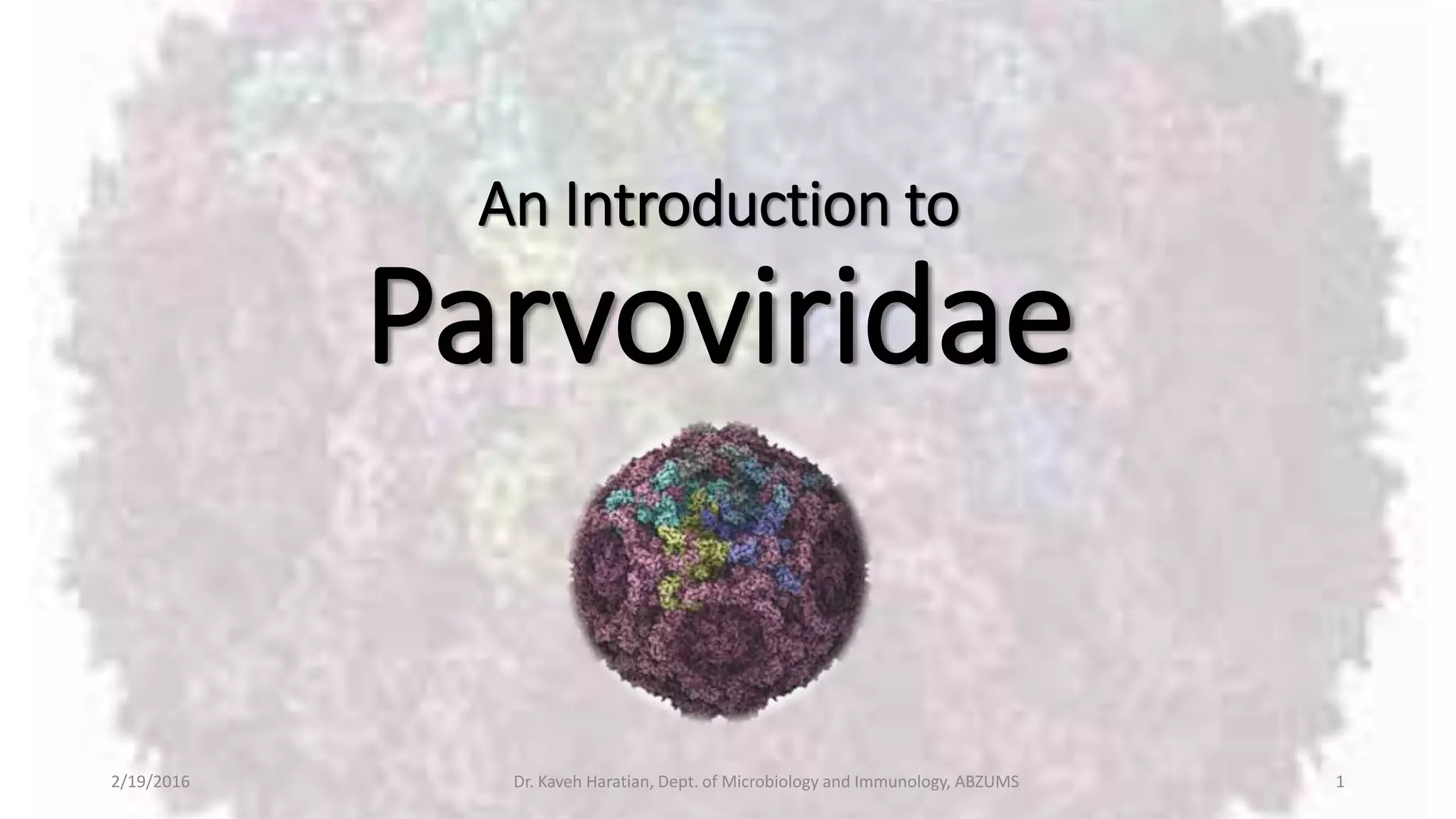
An Introduction to
Parvoviridae
The most dependent viruses
• Latin Parvus = small
• The smallest of all human viruses(only 20-25 nm in diameter).
• It might be thought that viruses as a class represent the ultimate in
parasitism.
• Reliant as they are on their host cells to provide most of the machinery or
replication.
• The Parvoviruses, show a still further degree of dependence .
• As they can replicate only in the presence of active DNA synthesis in
rapidly dividing host cells, or under the influence of another virus
infection(helper virus).
• The reason lies in their minute size(smallest of all human viruses).
2/19/2016
Dr. Kaveh Haratian, Dept. of Microbiology and Immunology,
ABZUMS
2
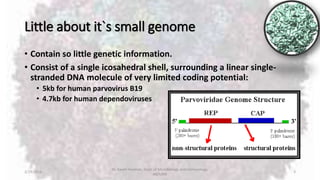
Little about it`s small genome
• Contain so little genetic information.
• Consist of a single icosahedral shell, surrounding a linear single-
stranded DNA molecule of very limited coding potential:
• 5kb for human parvovirus B19
• 4.7kb for human dependoviruses
2/19/2016
Dr. Kaveh Haratian, Dept. of Microbiology and Immunology,
ABZUMS
3
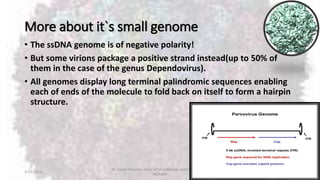
More about it`s small genome
• The ssDNA genome is of negative polarity!
• But some virions package a positive strand instead(up to 50% of
them in the case of the genus Dependovirus).
• All genomes display long terminal palindromic sequences enabling
each of ends of the molecule to fold back on itself to form a hairpin
structure.
2/19/2016
Dr. Kaveh Haratian, Dept. of Microbiology and Immunology,
ABZUMS
4
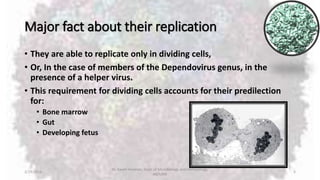
Major fact about their replication
• They are able to replicate only in dividing cells,
• Or, In the case of members of the Dependovirus genus, in the
presence of a helper virus.
• This requirement for dividing cells accounts for their predilection
for:
• Bone marrow
• Gut
• Developing fetus
2/19/2016
Dr. Kaveh Haratian, Dept. of Microbiology and Immunology,
ABZUMS
5
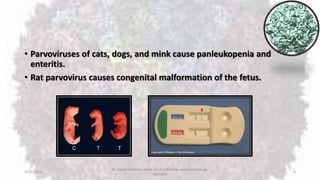
• Parvoviruses of cats, dogs, and mink cause panleukopenia and
enteritis.
• Rat parvovirus causes congenital malformation of the fetus.
2/19/2016
Dr. Kaveh Haratian, Dept. of Microbiology and Immunology,
ABZUMS
6
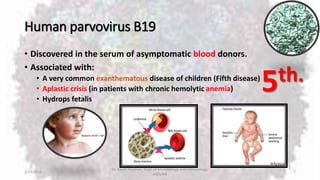
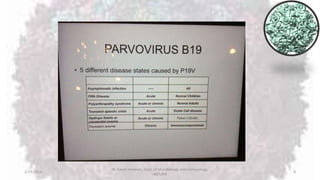
Human parvovirus B19
• Discovered in the serum of asymptomatic blood donors.
• Associated with:
• A very common exanthematous disease of children (Fifth disease)
• Aplastic crisis (in patients with chronic hemolytic anemia)
• Hydrops fetalis
2/19/2016
Dr. Kaveh Haratian, Dept. of Microbiology and Immunology,
ABZUMS
7
5th.
2/19/2016
Dr. Kaveh Haratian, Dept. of Microbiology and Immunology,
ABZUMS
8
More infections
Another human
parvovirus cause
gastroenteritis
2/19/2016
Dr. Kaveh Haratian, Dept. of Microbiology and Immunology,
ABZUMS
9
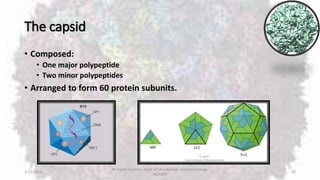
The capsid
• Composed:
• One major polypeptide
• Two minor polypeptides
• Arranged to form 60 protein subunits.
2/19/2016
Dr. Kaveh Haratian, Dept. of Microbiology and Immunology,
ABZUMS
10
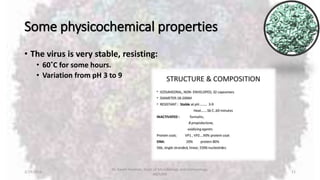
Some physicochemical properties
• The virus is very stable, resisting:
• 60˚C for some hours.
• Variation from pH 3 to 9
2/19/2016
Dr. Kaveh Haratian, Dept. of Microbiology and Immunology,
ABZUMS
11
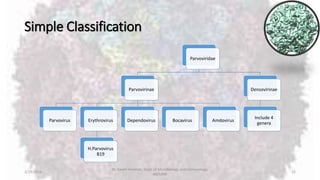
Simple Classification
Parvoviridae
Parvovirinae
Parvovirus Erythrovirus
H.Parvovirus
B19
Dependovirus Bocavirus Amdovirus
Densovirinae
Include 4
genera
2/19/2016
Dr. Kaveh Haratian, Dept. of Microbiology and Immunology,
ABZUMS
12
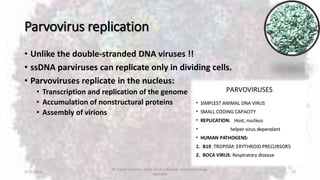
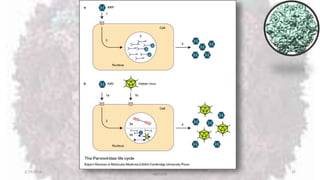
Parvovirus replication
• Unlike the double-stranded DNA viruses !!
• ssDNA parviruses can replicate only in dividing cells.
• Parvoviruses replicate in the nucleus:
• Transcription and replication of the genome
• Accumulation of nonstructural proteins
• Assembly of virions
2/19/2016
Dr. Kaveh Haratian, Dept. of Microbiology and Immunology,
ABZUMS
13
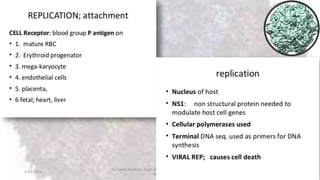
2/19/2016
Dr. Kaveh Haratian, Dept. of Microbiology and Immunology,
ABZUMS
14
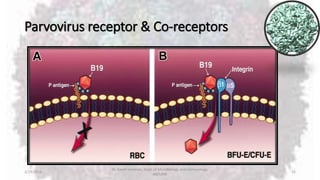
Parvovirus receptor & Co-receptors
2/19/2016
Dr. Kaveh Haratian, Dept. of Microbiology and Immunology,
ABZUMS
15
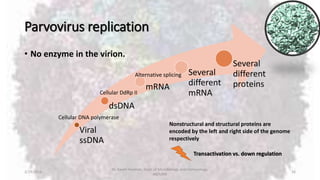
Parvovirus replication
• No enzyme in the virion.
2/19/2016
Dr. Kaveh Haratian, Dept. of Microbiology and Immunology,
ABZUMS
16
Viral
ssDNA
dsDNA
mRNA
Several
different
mRNA
Several
different
proteins
Cellular DNA polymerase
Cellular DdRp II
Alternative splicing
Nonstructural and structural proteins are
encoded by the left and right side of the genome
respectively
Transactivation vs. down regulation
2/19/2016
Dr. Kaveh Haratian, Dept. of Microbiology and Immunology,
ABZUMS
17
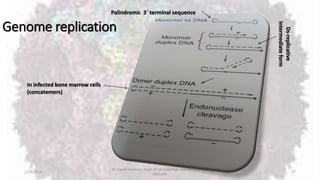
Genome replication
Palindromic 3` terminal sequence
Ds-replicative
intermediateform
In infected bone marrow cells
(concatemers)
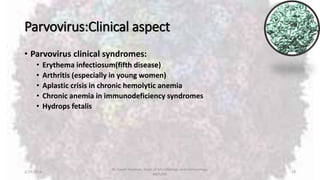
Parvovirus:Clinical aspect
• Parvovirus clinical syndromes:
• Erythema infectiosum(fifth disease)
• Arthritis (especially in young women)
• Aplastic crisis in chronic hemolytic anemia
• Chronic anemia in immunodeficiency syndromes
• Hydrops fetalis
2/19/2016
Dr. Kaveh Haratian, Dept. of Microbiology and Immunology,
ABZUMS
18
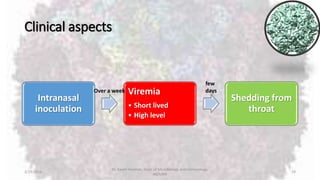
Clinical aspects
Intranasal
inoculation
Viremia
• Short lived
• High level
Shedding from
throat
2/19/2016
Dr. Kaveh Haratian, Dept. of Microbiology and Immunology,
ABZUMS
19
Over a week
few
days
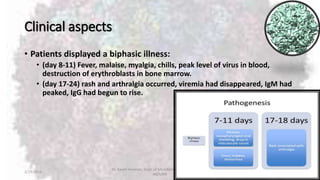
Clinical aspects
• Patients displayed a biphasic illness:
• (day 8-11) Fever, malaise, myalgia, chills, peak level of virus in blood,
destruction of erythroblasts in bone marrow.
• (day 17-24) rash and arthralgia occurred, viremia had disappeared, IgM had
peaked, IgG had begun to rise.
2/19/2016
Dr. Kaveh Haratian, Dept. of Microbiology and Immunology,
ABZUMS
20
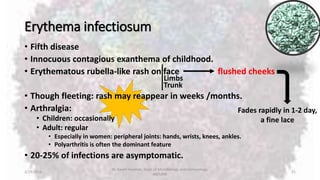
Erythema infectiosum
• Fifth disease
• Innocuous contagious exanthema of childhood.
• Erythematous rubella-like rash on face flushed cheeks
• Though fleeting: rash may reappear in weeks /months.
• Arthralgia:
• Children: occasionally
• Adult: regular
• Especially in women: peripheral joints: hands, wrists, knees, ankles.
• Polyarthritis is often the dominant feature
• 20-25% of infections are asymptomatic.
2/19/2016
Dr. Kaveh Haratian, Dept. of Microbiology and Immunology,
ABZUMS
21
Limbs
Trunk
Fades rapidly in 1-2 day,
a fine lace
2/19/2016
Dr. Kaveh Haratian, Dept. of Microbiology and Immunology,
ABZUMS
22
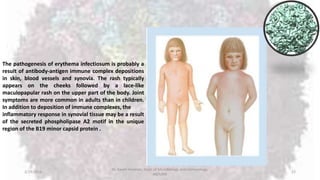
The pathogenesis of erythema infectiosum is probably a
result of antibody-antigen immune complex depositions
in skin, blood vessels and synovia. The rash typically
appears on the cheeks followed by a lace-like
maculopapular rash on the upper part of the body. Joint
symptoms are more common in adults than in children.
In addition to deposition of immune complexes, the
inflammatory response in synovial tissue may be a result
of the secreted phospholipase A2 motif in the unique
region of the B19 minor capsid protein .
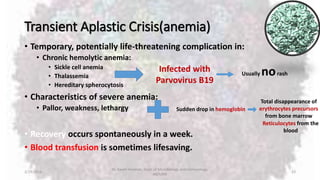
Transient Aplastic Crisis(anemia)
• Temporary, potentially life-threatening complication in:
• Chronic hemolytic anemia:
• Sickle cell anemia
• Thalassemia
• Hereditary spherocytosis
• Characteristics of severe anemia:
• Pallor, weakness, lethargy
• Recovery occurs spontaneously in a week.
• Blood transfusion is sometimes lifesaving.

2/19/2016
Dr. Kaveh Haratian, Dept. of Microbiology and Immunology,
ABZUMS
23
Infected with
Parvovirus B19
Usually norash
Sudden drop in hemoglobin
Total disappearance of
erythrocytes precursors
from bone marrow
Reticulocytes from the
blood
2/19/2016
Dr. Kaveh Haratian, Dept. of Microbiology and Immunology,
ABZUMS
24
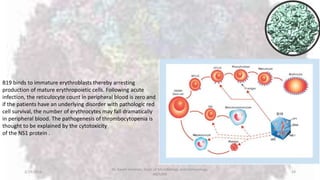
B19 binds to immature erythroblasts thereby arresting
production of mature erythropoietic cells. Following acute
infection, the reticulocyte count in peripheral blood is zero and
if the patients have an underlying disorder with pathologic red
cell survival, the number of erythrocytes may fall dramatically
in peripheral blood. The pathogenesis of thrombocytopenia is
thought to be explained by the cytotoxicity
of the NS1 protein .
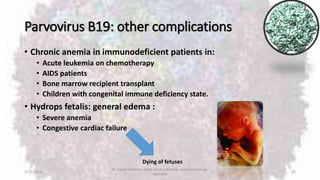
Parvovirus B19: other complications
• Chronic anemia in immunodeficient patients in:
• Acute leukemia on chemotherapy
• AIDS patients
• Bone marrow recipient transplant
• Children with congenital immune deficiency state.
• Hydrops fetalis: general edema :
• Severe anemia
• Congestive cardiac failure
2/19/2016
Dr. Kaveh Haratian, Dept. of Microbiology and Immunology,
ABZUMS
25
Dying of fetuses
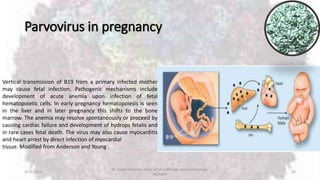
Parvovirus in pregnancy
2/19/2016
Dr. Kaveh Haratian, Dept. of Microbiology and Immunology,
ABZUMS
26
Vertical transmission of B19 from a primary infected mother
may cause fetal infection. Pathogenic mechanisms include
development of acute anemia upon infection of fetal
hematopoietic cells. In early pregnancy hematopoiesis is seen
in the liver and in later pregnancy this shifts to the bone
marrow. The anemia may resolve spontaneously or proceed by
causing cardiac failure and development of hydrops fetalis and
in rare cases fetal death. The virus may also cause myocarditis
and heart arrest by direct infection of myocardial
tissue. Modified from Anderson and Young .
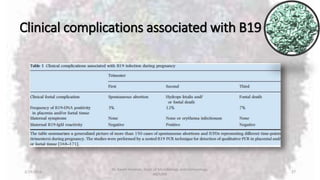
Clinical complications associated with B19
2/19/2016
Dr. Kaveh Haratian, Dept. of Microbiology and Immunology,
ABZUMS
27
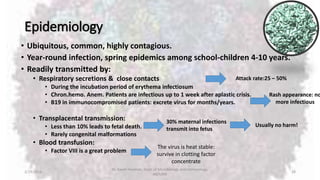
Epidemiology
• Ubiquitous, common, highly contagious.
• Year-round infection, spring epidemics among school-children 4-10 years.
• Readily transmitted by:
• Respiratory secretions & close contacts
• During the incubation period of erythema infectiosum
• Chron.hemo. Anem. Patients are infectious up to 1 week after aplastic crisis.
• B19 in immunocompromised patients: excrete virus for months/years.
• Transplacental transmission:
• Less than 10% leads to fetal death.
• Rarely congenital malformations
• Blood transfusion:
• Factor VIII is a great problem
2/19/2016
Dr. Kaveh Haratian, Dept. of Microbiology and Immunology,
ABZUMS
28
Attack rate:25 – 50%
Rash appearance: no
more infectious
30% maternal infections
transmit into fetus
Usually no harm!
The virus is heat stable:
survive in clotting factor
concentrate
Treatment and control
• Erythema infectiosum requires no treatment.
• Aplastic crisis requires supportive care and blood transfusion.
• Severe persistent anemia(Immunocomp. Patients) requires IVIG.
• Persons of potential risk:
• Pregnant non-immune women
• Immunocompromised individuals
• Chronic hemolytic anemia
2/19/2016
Dr. Kaveh Haratian, Dept. of Microbiology and Immunology,
ABZUMS
29
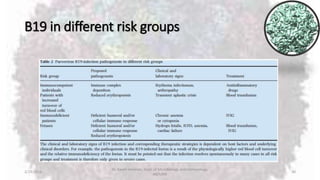
B19 in different risk groups
2/19/2016
Dr. Kaveh Haratian, Dept. of Microbiology and Immunology,
ABZUMS
30
Dependoviruses
Adeno-associated viruses
2/19/2016
Dr. Kaveh Haratian, Dept. of Microbiology and Immunology,
ABZUMS
31
2/19/2016
Dr. Kaveh Haratian, Dept. of Microbiology and Immunology,
ABZUMS
32
Laboratory diagnosis
• Cell culture :
• bone marrow, fetal lever (with erythropoietin & IL-3).
• MB-02(H.megakaryocytic leukemia cell line)(with GM-CSF).
• Serology :
• EIA/RIA: IgM or significant rise of IgG.
• Molecular detection:
• Detection of virus DNA by:
• Nucleic acid hybridization
• PCR
• EIA: for viral antigens
• EIA
• Electron microscopy:
• Nuclear inclusion bodies: crystalline array of virions in nucleus.
2/19/2016
Dr. Kaveh Haratian, Dept. of Microbiology and Immunology,
ABZUMS
33
Antigen produced by molecular
cloning
In hydrops fetalis:
in situ hybridization
2/19/2016
Dr. Kaveh Haratian, Dept. of Microbiology and Immunology,
ABZUMS
34

An introduction to Parvoviridae

  • 1.
    2/19/2016 Dr. KavehHaratian, Dept. of Microbiology and Immunology, ABZUMS 1 An Introduction to Parvoviridae
  • 2.
    The most dependentviruses • Latin Parvus = small • The smallest of all human viruses(only 20-25 nm in diameter). • It might be thought that viruses as a class represent the ultimate in parasitism. • Reliant as they are on their host cells to provide most of the machinery or replication. • The Parvoviruses, show a still further degree of dependence . • As they can replicate only in the presence of active DNA synthesis in rapidly dividing host cells, or under the influence of another virus infection(helper virus). • The reason lies in their minute size(smallest of all human viruses). 2/19/2016 Dr. Kaveh Haratian, Dept. of Microbiology and Immunology, ABZUMS 2
  • 3.
    Little about it`ssmall genome • Contain so little genetic information. • Consist of a single icosahedral shell, surrounding a linear single- stranded DNA molecule of very limited coding potential: • 5kb for human parvovirus B19 • 4.7kb for human dependoviruses 2/19/2016 Dr. Kaveh Haratian, Dept. of Microbiology and Immunology, ABZUMS 3
  • 4.
    More about it`ssmall genome • The ssDNA genome is of negative polarity! • But some virions package a positive strand instead(up to 50% of them in the case of the genus Dependovirus). • All genomes display long terminal palindromic sequences enabling each of ends of the molecule to fold back on itself to form a hairpin structure. 2/19/2016 Dr. Kaveh Haratian, Dept. of Microbiology and Immunology, ABZUMS 4
  • 5.
    Major fact abouttheir replication • They are able to replicate only in dividing cells, • Or, In the case of members of the Dependovirus genus, in the presence of a helper virus. • This requirement for dividing cells accounts for their predilection for: • Bone marrow • Gut • Developing fetus 2/19/2016 Dr. Kaveh Haratian, Dept. of Microbiology and Immunology, ABZUMS 5
  • 6.
    • Parvoviruses ofcats, dogs, and mink cause panleukopenia and enteritis. • Rat parvovirus causes congenital malformation of the fetus. 2/19/2016 Dr. Kaveh Haratian, Dept. of Microbiology and Immunology, ABZUMS 6
  • 7.
    Human parvovirus B19 •Discovered in the serum of asymptomatic blood donors. • Associated with: • A very common exanthematous disease of children (Fifth disease) • Aplastic crisis (in patients with chronic hemolytic anemia) • Hydrops fetalis 2/19/2016 Dr. Kaveh Haratian, Dept. of Microbiology and Immunology, ABZUMS 7 5th.
  • 8.
    2/19/2016 Dr. Kaveh Haratian,Dept. of Microbiology and Immunology, ABZUMS 8
  • 9.
    More infections Another human parvoviruscause gastroenteritis 2/19/2016 Dr. Kaveh Haratian, Dept. of Microbiology and Immunology, ABZUMS 9
  • 10.
    The capsid • Composed: •One major polypeptide • Two minor polypeptides • Arranged to form 60 protein subunits. 2/19/2016 Dr. Kaveh Haratian, Dept. of Microbiology and Immunology, ABZUMS 10
  • 11.
    Some physicochemical properties •The virus is very stable, resisting: • 60˚C for some hours. • Variation from pH 3 to 9 2/19/2016 Dr. Kaveh Haratian, Dept. of Microbiology and Immunology, ABZUMS 11
  • 12.
    Simple Classification Parvoviridae Parvovirinae Parvovirus Erythrovirus H.Parvovirus B19 DependovirusBocavirus Amdovirus Densovirinae Include 4 genera 2/19/2016 Dr. Kaveh Haratian, Dept. of Microbiology and Immunology, ABZUMS 12
  • 13.
    Parvovirus replication • Unlikethe double-stranded DNA viruses !! • ssDNA parviruses can replicate only in dividing cells. • Parvoviruses replicate in the nucleus: • Transcription and replication of the genome • Accumulation of nonstructural proteins • Assembly of virions 2/19/2016 Dr. Kaveh Haratian, Dept. of Microbiology and Immunology, ABZUMS 13
  • 14.
    2/19/2016 Dr. Kaveh Haratian,Dept. of Microbiology and Immunology, ABZUMS 14
  • 15.
    Parvovirus receptor &Co-receptors 2/19/2016 Dr. Kaveh Haratian, Dept. of Microbiology and Immunology, ABZUMS 15
  • 16.
    Parvovirus replication • Noenzyme in the virion. 2/19/2016 Dr. Kaveh Haratian, Dept. of Microbiology and Immunology, ABZUMS 16 Viral ssDNA dsDNA mRNA Several different mRNA Several different proteins Cellular DNA polymerase Cellular DdRp II Alternative splicing Nonstructural and structural proteins are encoded by the left and right side of the genome respectively Transactivation vs. down regulation
  • 17.
    2/19/2016 Dr. Kaveh Haratian,Dept. of Microbiology and Immunology, ABZUMS 17 Genome replication Palindromic 3` terminal sequence Ds-replicative intermediateform In infected bone marrow cells (concatemers)
  • 18.
    Parvovirus:Clinical aspect • Parvovirusclinical syndromes: • Erythema infectiosum(fifth disease) • Arthritis (especially in young women) • Aplastic crisis in chronic hemolytic anemia • Chronic anemia in immunodeficiency syndromes • Hydrops fetalis 2/19/2016 Dr. Kaveh Haratian, Dept. of Microbiology and Immunology, ABZUMS 18
  • 19.
    Clinical aspects Intranasal inoculation Viremia • Shortlived • High level Shedding from throat 2/19/2016 Dr. Kaveh Haratian, Dept. of Microbiology and Immunology, ABZUMS 19 Over a week few days
  • 20.
    Clinical aspects • Patientsdisplayed a biphasic illness: • (day 8-11) Fever, malaise, myalgia, chills, peak level of virus in blood, destruction of erythroblasts in bone marrow. • (day 17-24) rash and arthralgia occurred, viremia had disappeared, IgM had peaked, IgG had begun to rise. 2/19/2016 Dr. Kaveh Haratian, Dept. of Microbiology and Immunology, ABZUMS 20
  • 21.
    Erythema infectiosum • Fifthdisease • Innocuous contagious exanthema of childhood. • Erythematous rubella-like rash on face flushed cheeks • Though fleeting: rash may reappear in weeks /months. • Arthralgia: • Children: occasionally • Adult: regular • Especially in women: peripheral joints: hands, wrists, knees, ankles. • Polyarthritis is often the dominant feature • 20-25% of infections are asymptomatic. 2/19/2016 Dr. Kaveh Haratian, Dept. of Microbiology and Immunology, ABZUMS 21 Limbs Trunk Fades rapidly in 1-2 day, a fine lace
  • 22.
    2/19/2016 Dr. Kaveh Haratian,Dept. of Microbiology and Immunology, ABZUMS 22 The pathogenesis of erythema infectiosum is probably a result of antibody-antigen immune complex depositions in skin, blood vessels and synovia. The rash typically appears on the cheeks followed by a lace-like maculopapular rash on the upper part of the body. Joint symptoms are more common in adults than in children. In addition to deposition of immune complexes, the inflammatory response in synovial tissue may be a result of the secreted phospholipase A2 motif in the unique region of the B19 minor capsid protein .
  • 23.
    Transient Aplastic Crisis(anemia) •Temporary, potentially life-threatening complication in: • Chronic hemolytic anemia: • Sickle cell anemia • Thalassemia • Hereditary spherocytosis • Characteristics of severe anemia: • Pallor, weakness, lethargy • Recovery occurs spontaneously in a week. • Blood transfusion is sometimes lifesaving. 2/19/2016 Dr. Kaveh Haratian, Dept. of Microbiology and Immunology, ABZUMS 23 Infected with Parvovirus B19 Usually norash Sudden drop in hemoglobin Total disappearance of erythrocytes precursors from bone marrow Reticulocytes from the blood
  • 24.
    2/19/2016 Dr. Kaveh Haratian,Dept. of Microbiology and Immunology, ABZUMS 24 B19 binds to immature erythroblasts thereby arresting production of mature erythropoietic cells. Following acute infection, the reticulocyte count in peripheral blood is zero and if the patients have an underlying disorder with pathologic red cell survival, the number of erythrocytes may fall dramatically in peripheral blood. The pathogenesis of thrombocytopenia is thought to be explained by the cytotoxicity of the NS1 protein .
  • 25.
    Parvovirus B19: othercomplications • Chronic anemia in immunodeficient patients in: • Acute leukemia on chemotherapy • AIDS patients • Bone marrow recipient transplant • Children with congenital immune deficiency state. • Hydrops fetalis: general edema : • Severe anemia • Congestive cardiac failure 2/19/2016 Dr. Kaveh Haratian, Dept. of Microbiology and Immunology, ABZUMS 25 Dying of fetuses
  • 26.
    Parvovirus in pregnancy 2/19/2016 Dr.Kaveh Haratian, Dept. of Microbiology and Immunology, ABZUMS 26 Vertical transmission of B19 from a primary infected mother may cause fetal infection. Pathogenic mechanisms include development of acute anemia upon infection of fetal hematopoietic cells. In early pregnancy hematopoiesis is seen in the liver and in later pregnancy this shifts to the bone marrow. The anemia may resolve spontaneously or proceed by causing cardiac failure and development of hydrops fetalis and in rare cases fetal death. The virus may also cause myocarditis and heart arrest by direct infection of myocardial tissue. Modified from Anderson and Young .
  • 27.
    Clinical complications associatedwith B19 2/19/2016 Dr. Kaveh Haratian, Dept. of Microbiology and Immunology, ABZUMS 27
  • 28.
    Epidemiology • Ubiquitous, common,highly contagious. • Year-round infection, spring epidemics among school-children 4-10 years. • Readily transmitted by: • Respiratory secretions & close contacts • During the incubation period of erythema infectiosum • Chron.hemo. Anem. Patients are infectious up to 1 week after aplastic crisis. • B19 in immunocompromised patients: excrete virus for months/years. • Transplacental transmission: • Less than 10% leads to fetal death. • Rarely congenital malformations • Blood transfusion: • Factor VIII is a great problem 2/19/2016 Dr. Kaveh Haratian, Dept. of Microbiology and Immunology, ABZUMS 28 Attack rate:25 – 50% Rash appearance: no more infectious 30% maternal infections transmit into fetus Usually no harm! The virus is heat stable: survive in clotting factor concentrate
  • 29.
    Treatment and control •Erythema infectiosum requires no treatment. • Aplastic crisis requires supportive care and blood transfusion. • Severe persistent anemia(Immunocomp. Patients) requires IVIG. • Persons of potential risk: • Pregnant non-immune women • Immunocompromised individuals • Chronic hemolytic anemia 2/19/2016 Dr. Kaveh Haratian, Dept. of Microbiology and Immunology, ABZUMS 29
  • 30.
    B19 in differentrisk groups 2/19/2016 Dr. Kaveh Haratian, Dept. of Microbiology and Immunology, ABZUMS 30
  • 31.
    Dependoviruses Adeno-associated viruses 2/19/2016 Dr. KavehHaratian, Dept. of Microbiology and Immunology, ABZUMS 31
  • 32.
    2/19/2016 Dr. Kaveh Haratian,Dept. of Microbiology and Immunology, ABZUMS 32
  • 33.
    Laboratory diagnosis • Cellculture : • bone marrow, fetal lever (with erythropoietin & IL-3). • MB-02(H.megakaryocytic leukemia cell line)(with GM-CSF). • Serology : • EIA/RIA: IgM or significant rise of IgG. • Molecular detection: • Detection of virus DNA by: • Nucleic acid hybridization • PCR • EIA: for viral antigens • EIA • Electron microscopy: • Nuclear inclusion bodies: crystalline array of virions in nucleus. 2/19/2016 Dr. Kaveh Haratian, Dept. of Microbiology and Immunology, ABZUMS 33 Antigen produced by molecular cloning In hydrops fetalis: in situ hybridization
  • 34.
    2/19/2016 Dr. Kaveh Haratian,Dept. of Microbiology and Immunology, ABZUMS 34