 ARP (Address Resolution Protocol) is a network protocol used to
find out the hardware (MAC) address of a device from an IP
address.
 It is used when a device wants to communicate with some other
device on a local network (for example on an Ethernet network
that requires physical addresses to be known before sending
packets).
 The sending device uses ARP to translate IP addresses to MAC
addresses.
 The device sends an ARP request message containing the IP
address of the receiving device.
 All devices on a local network segment see the message, but
only the device that has that IP address responds with the ARP
reply message containing its MAC address.
 The sending device now has enough information to send the
packet to the receiving device.
 ARP request packets are sent to the broadcast addresses
(FF:FF:FF:FF:FF:FF for the Ethernet broadcasts and
255.255.255.255 for the IP broadcast).
ARP broadcast explained:
 Let's say that Host A wants to communicate with host B.
 Host A knows the IP address of host B, but it doesn't know the
host B's MAC address.
 In order to find out the MAC address of host B, host A sends an
ARP request, listing the host B's IP address as the destination IP
address and the MAC address of FF:FF:FF:FF:FF:FF (Ethernet
broadcast).
 Switch will forward the frame out all interfaces (except the
incoming interface).
 Each device on the segment will receive the packet, but because
the destination IP address is host B's IP address, only host B will
reply with the ARP reply packet, listing its MAC address.
 Host A now has enough information to send the traffic to host B.
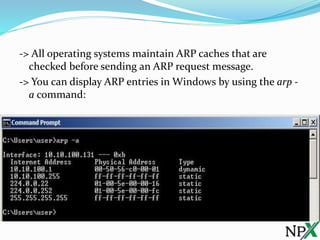
-> All operating systems maintain ARP caches that are
checked before sending an ARP request message.
-> You can display ARP entries in Windows by using the arp -
a command:

Address resolution protocol (ARP)

  • 2.
     ARP (AddressResolution Protocol) is a network protocol used to find out the hardware (MAC) address of a device from an IP address.  It is used when a device wants to communicate with some other device on a local network (for example on an Ethernet network that requires physical addresses to be known before sending packets).  The sending device uses ARP to translate IP addresses to MAC addresses.  The device sends an ARP request message containing the IP address of the receiving device.  All devices on a local network segment see the message, but only the device that has that IP address responds with the ARP reply message containing its MAC address.  The sending device now has enough information to send the packet to the receiving device.  ARP request packets are sent to the broadcast addresses (FF:FF:FF:FF:FF:FF for the Ethernet broadcasts and 255.255.255.255 for the IP broadcast).
  • 3.
  • 4.
     Let's saythat Host A wants to communicate with host B.  Host A knows the IP address of host B, but it doesn't know the host B's MAC address.  In order to find out the MAC address of host B, host A sends an ARP request, listing the host B's IP address as the destination IP address and the MAC address of FF:FF:FF:FF:FF:FF (Ethernet broadcast).  Switch will forward the frame out all interfaces (except the incoming interface).  Each device on the segment will receive the packet, but because the destination IP address is host B's IP address, only host B will reply with the ARP reply packet, listing its MAC address.  Host A now has enough information to send the traffic to host B.
  • 5.
    -> All operatingsystems maintain ARP caches that are checked before sending an ARP request message. -> You can display ARP entries in Windows by using the arp - a command: