NETWORK LAYER
Shashikant V. Athawale
Assistant Professor
Department of Computer Engineering,
AISSMS COE ,Pune
OUTLINES
 Basics of IPV4
 ICMPV4
 IPV6
 ARP
 RARP
 Mobile IP
 Routing algorithms
 Routing protocols
2
INTERNET PROTOCOL VERSION 4(IPV4)
3
BASICS OF IPV4
 IPv4 is the first network protocol to interconnect different
networks regardless of the medium used.
 Globally unique addressing scheme
 Any two nodes can communicate directly
4
IPV4 ADDRESSING
 Every node is identified by a four byte address
 Networks are divided by subnet classes each class has
a fixed number of network bits
 Communication between nodes on different networks is
established by routers
5
INTERNET PROTOCOL VERSION 6(IPV6)
6
IPV6 HISTORY
 Late 1980s:
 Exponential growth of the Internet
 Late 1990:
 CLNS proposed as IP replacement
 1991-1992:
 Running out of “class-B” network numbers
 Explosive growth of the “default-free” routing table
 Eventual exhaustion of 32-bit address space
 Two efforts – short-term vs. long-term
 More at “The Long and Windy ROAD”
7
BASICS
 General perception is that “IPv6 has not yet taken hold”
IPv4 Address run-out is not “headline news” yet
 More discussions and run-out plans proposed Private
sector requires a business case to “migrate”
 No easy Return on Investment (RoI) computation. But
reality is very different from perception! Something
needs to be done to sustain the Internet growth
 IPv6 or NAT or both or something else?
8
LARGE ADDRESS SPACE
 Internet population:
~630 million users end of 2002 – 10% of world pop.
~1320 million users end of 2007 – 20% of world
pop. Future? (World pop. ~9B in 2050)
US uses 81 /8s – this is 3.9 IPv4 addresses per
person
 Repeat this the world over:
6 billion population could require 23.4 billion IPv4
addresses (6 times larger than the IPv4 address pool)
 Emerging Internet economies need address space:
China uses more than 94 million IPv4 addresses
today (5.5 /8s)
9
NETWORK ADDRESS TRANSLATION
 Private address space and Network address
translation (NAT) could be used instead of IPv6
 But NAT has many serious issues:
 Breaks the end-to-end model of IP
 Layered NAT devices
 Mandates that the network keeps the state of the
connections
 How to scale NAT performance for large networks?
 Makes fast rerouting difficult
 Service provision inhibited
10
PROTOCOLS AND STANDARDS
 Expanded address space:
 Address length quadrupled to 16 bytes
 Header Format Simplification:
 Fixed length, optional headers are daisy-chained
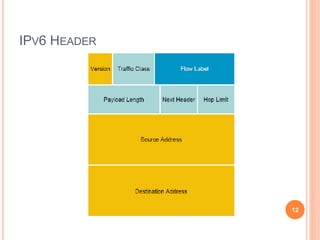
 IPv6 header is twice as long (40 bytes) as IPv4 header
without options (20 bytes)
 No checksum at the IP network layer
 No hop-by-hop segmentation
 Path MTU discovery
 64 bits aligned
 Authentication and Privacy Capabilities
 IPsec is mandated
 No more broadcast 11
IPV6 HEADER
12
LARGE ADDRESS SPACE
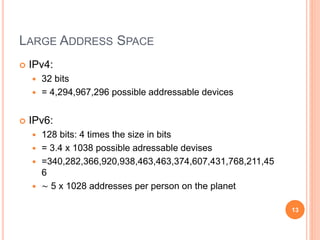
 IPv4:
 32 bits
 = 4,294,967,296 possible addressable devices
 IPv6:
 128 bits: 4 times the size in bits
 = 3.4 x 1038 possible adressable devises
 =340,282,366,920,938,463,463,374,607,431,768,211,45
6
 ∼ 5 x 1028 addresses per person on the planet
13
IP ADDRESS REPRESENTATION
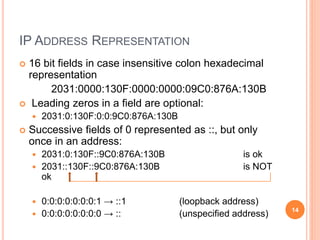
 16 bit fields in case insensitive colon hexadecimal
representation
2031:0000:130F:0000:0000:09C0:876A:130B
 Leading zeros in a field are optional:
 2031:0:130F:0:0:9C0:876A:130B
 Successive fields of 0 represented as ::, but only
once in an address:
 2031:0:130F::9C0:876A:130B is ok
 2031::130F::9C0:876A:130B is NOT
ok
 0:0:0:0:0:0:0:1 → ::1 (loopback address)
 0:0:0:0:0:0:0:0 → :: (unspecified address) 14
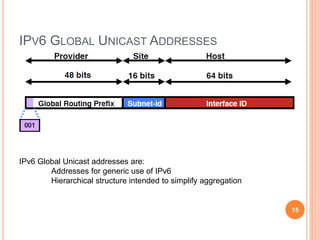
IPV6 GLOBAL UNICAST ADDRESSES
15
IPv6 Global Unicast addresses are:
Addresses for generic use of IPv6
Hierarchical structure intended to simplify aggregation
MULTICAST ADDRESSES
 Broadcasts in IPv4:
 Interrupts all devices on the LAN even if the intent of the
request was for a subset
 Can completely swamp the network (“broadcast storm”)
 Broadcasts in IPv6:
 Are not used and replaced by multicast
 Multicast:
 Enables the efficient use of the network
 Multicast address range is much larger
16
RIP AND RARP
17
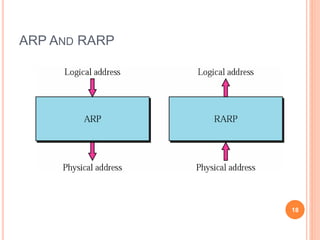
ARP AND RARP
18
CONTINUE
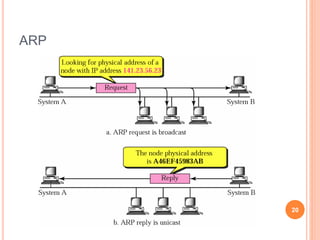
 A host with IP address 130.23.43.20 and physical
address 0xB23455102210 has a packet to send to
another host with IP address 130.23.43.25 and
physical address 0xA46EF45983AB. The two hosts
are on the same Ethernet network. Show the ARP
request and reply packets encapsulated in Ethernet
frames.
19
ARP
20
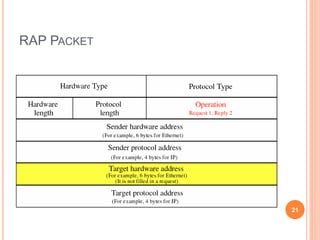
RAP PACKET
21
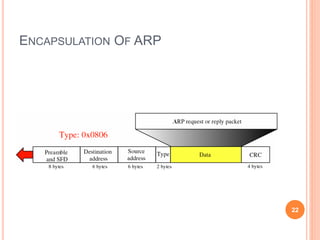
ENCAPSULATION OF ARP
22
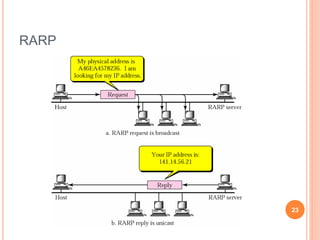
RARP
23
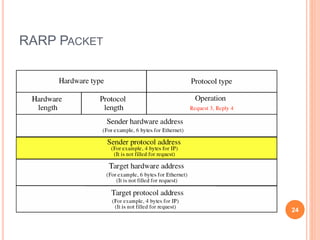
RARP PACKET
24
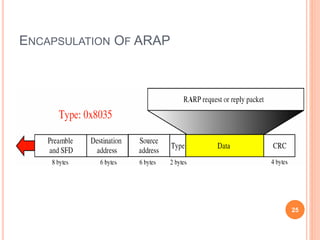
ENCAPSULATION OF ARAP
25
MOBILE IP
26
MOBILE IP
 Mobile IP is a standard that allows users to move
from one network to another without loosing
connectivity.
 Mobile devices have IP addresses that are
associated with one network and moving to another
network means changing IP address.
 Using the mobile IP system will allow users to
achieve this and at the same time make the
underlying process transparent for a user.
27
BASIC IP ADDRESS
 All computers that are connected to the Internet
need to have a valid IP address.
 This address is usually assigned by an Internet
Service Provider (ISP) which in turn has bought a
block of addresses from the Internet Cooperation
for Assigned Names and Numbers (ICANN).
 Most companies never interact with the ICANN
directly. In order for a company to receive valid IP
addresses they contact a local ISP.
 Even local ISP:s do not interact with ICANN but in
turn they contact larger ISP:s and only they contact
ICANN.
28
NEED FOR IP MOBILE
 Imagine what would happen with your message if
you were to move your computer (and IP address)
to another network then your own.
 The routers would examine the address and
forward it according to the previously described
manner.
 When the message reaches the router, that you
were directly connected to before you moved, it
would not be able to forward the message to you
since you have moved.
 There is no way for a router to know how to reach
you and therefore the message will never arrive to
you. 29
OBTAINING AN IP ADDRESS USING DHCP
 One of the methods involves using the Dynamic Host
Configuration Protocol (DHCP) server at the foreign
network. DHCP is the protocol that dynamically assigns
IP-addresses to connected computers on the network.
 The DHCP server chooses one of the available
addresses and either permanently or temporary assigns
it to the computer on the network.
 When the mobile host arrives at the foreign network he
first needs to discover a DHCP server to obtain an IP
address.
 Discovering the server is easy since it advertises its
presence every 20 seconds, but it is also possible for
the host to broadcast a question if there are any DHCP
servers. 30
ROUTING ALGORITHM
31
LINK STATE ROUTING ALGORITHM
 Use a routing protocol to collect the whole network
topology
 Obtain destination reachability information as well
as link weights/states
 Compute shortest paths using Dijkstra’s algorithm
from a node to all other nodes
 Construct routing tables that show the destination
addresses and the next hop addresses
 Note that while Dijkstra’s algorithm gives you end-
to-end routes, the routing tables may only store the
next hop address.
32
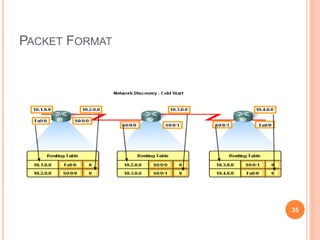
DISTANCE VECTOR TECHNOLOGY
 Routes are advertised as vectors of distance and
direction
 Distance is defined in terms of a metric (hop
count...)
 Direction is the next-hop router or exit interface
33
CONTINUE
 The router does not have the knowledge of the
entire path to the destination network, but it knows:
 The direction or interface in which packets should be
forwarded
 The distance or how far it is to the destination network
34
PACKET FORMAT
35
ROUTING PROTOCOL
36
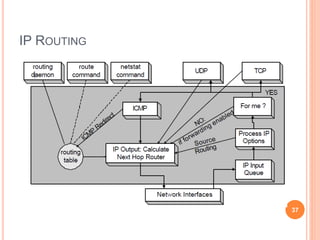
IP ROUTING
37
RIP - ROUTING INFORMATION PROTOCOL
 A simple intra domain protocol
 Straightforward implementation of Distance Vector
Routing
 Each router advertises its minimum distances to
destinations every 30 seconds (or whenever its
routing table changes)
 RIP always uses the hop-count as link metric.
Maximum hop count is 15, with “16” equal to “¥”.
 Routes timeout after 3 minutes if they are not
updated. Route metric is set to ¥ (16) and marked
for deletion
38
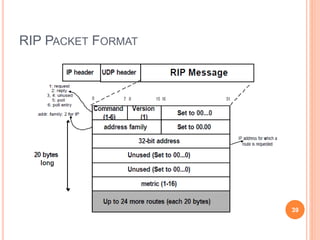
RIP PACKET FORMAT
39
ROUTING WITH RIP
 This is the operation of RIP in routed. Dedicated port for RIP
is UDP port 520.
 Initialization:
 Broadcast a request packet (command = 1, metric=16;
address family=0, metric=16) on the interfaces requesting
current routing tables from routers.
 Request received:
 Routers that receive above request send their entire
routing table.
 Response received:
 Update the routing table (see distance vector algorithm).
 Regular routing updates:
 Every 30 seconds, send all or part of the routing tables to
every neighbor.
 Triggered Updates:
40
OSPF
 OSPF = Open Shortest Path First
 RFC 1247 from 1991
 Alternative solution to RIP as interior gateway
protocol
 OSPF is a link state protocol, i.e., each node has
complete topology information
 OSPF messages are sent directly in IP (and not as
payload of UDP packets)
 Hellos and Link State Advertisements (LSAs)
 To get the topology of the network
 Shortest-path algorithm,
 e.g., Dijkstra’s to precompute routing tables. 41
FEATURES OF OSPF
 Provides authentication of routing messages
 Enables load balancing by allowing traffic to be split
evenly across routes with equal cost
 Supports sub netting
 Supports multicasting
42
BGP
 BGP = Border Gateway Protocol
 Currently in version 4
 Note: In the context of BGP, a gateway is nothing
else but an IP router that connects autonomous
systems.
 Inter domain routing protocol for routing between
autonomous systems
 Uses TCP to send routing messages
 BGP is a distance vector protocol, but unlike in RIP,
routing messages in BGP contain complete routes.
 Network administrators can specify routing policies
43
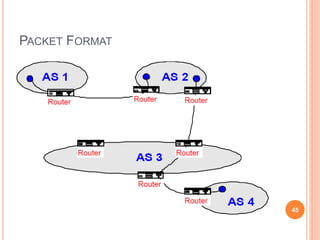
CONTINUE
 BGP’s goal is to find any path (not an optimal one).
Since the
 internals of the AS are never revealed, finding an
optimal path
 is not feasible.
 For each autonomous system (AS), BGP distinguishes:
 local traffic = traffic with source or destination in AS
 transit traffic = traffic that passes through the AS
 Stub AS = has connection to only one AS, only
 carry local traffic
 Multi homed AS = has connection to >1 AS, but does
 not carry transit traffic
 Transit AS = has connection to >1 AS and carries
 transit traffic
44
PACKET FORMAT
45
CONCLUSION
 We explain the network layer concept and different
sub topic of network layer. IPv6 provides sample of
address space and is designed to expand today’s
Internet services.
 Feature-rich IPv6 enabled Internet version 2 may
deliver more than expected.
 Link state routing algorithm are described.
 Different types of routing protocol also we seen.
46
REFERENCES
 ftp://ftp-eng.cisco.com/pfs/seminars/NANOG42-
IPv6-Introduction.pdf
 D.E. Comer, Internetworking with TCP/IP:
Principles, Protocols, and Architectures, 4th edition,
Prentice Hall, NJ, 2000.
 Introducing Mobile IPv6 in 2G and 3G mobile
networks - paper, NOKIA.
http://www.bitpipe.com/data/detail?id=1007501662_
307&type=RES&x=294970019
 http://www.routeralley.com.
47
THANK YOU!!!
48

Network Layer

  • 1.
    NETWORK LAYER Shashikant V.Athawale Assistant Professor Department of Computer Engineering, AISSMS COE ,Pune
  • 2.
    OUTLINES  Basics ofIPV4  ICMPV4  IPV6  ARP  RARP  Mobile IP  Routing algorithms  Routing protocols 2
  • 3.
  • 4.
    BASICS OF IPV4 IPv4 is the first network protocol to interconnect different networks regardless of the medium used.  Globally unique addressing scheme  Any two nodes can communicate directly 4
  • 5.
    IPV4 ADDRESSING  Everynode is identified by a four byte address  Networks are divided by subnet classes each class has a fixed number of network bits  Communication between nodes on different networks is established by routers 5
  • 6.
  • 7.
    IPV6 HISTORY  Late1980s:  Exponential growth of the Internet  Late 1990:  CLNS proposed as IP replacement  1991-1992:  Running out of “class-B” network numbers  Explosive growth of the “default-free” routing table  Eventual exhaustion of 32-bit address space  Two efforts – short-term vs. long-term  More at “The Long and Windy ROAD” 7
  • 8.
    BASICS  General perceptionis that “IPv6 has not yet taken hold” IPv4 Address run-out is not “headline news” yet  More discussions and run-out plans proposed Private sector requires a business case to “migrate”  No easy Return on Investment (RoI) computation. But reality is very different from perception! Something needs to be done to sustain the Internet growth  IPv6 or NAT or both or something else? 8
  • 9.
    LARGE ADDRESS SPACE Internet population: ~630 million users end of 2002 – 10% of world pop. ~1320 million users end of 2007 – 20% of world pop. Future? (World pop. ~9B in 2050) US uses 81 /8s – this is 3.9 IPv4 addresses per person  Repeat this the world over: 6 billion population could require 23.4 billion IPv4 addresses (6 times larger than the IPv4 address pool)  Emerging Internet economies need address space: China uses more than 94 million IPv4 addresses today (5.5 /8s) 9
  • 10.
    NETWORK ADDRESS TRANSLATION Private address space and Network address translation (NAT) could be used instead of IPv6  But NAT has many serious issues:  Breaks the end-to-end model of IP  Layered NAT devices  Mandates that the network keeps the state of the connections  How to scale NAT performance for large networks?  Makes fast rerouting difficult  Service provision inhibited 10
  • 11.
    PROTOCOLS AND STANDARDS Expanded address space:  Address length quadrupled to 16 bytes  Header Format Simplification:  Fixed length, optional headers are daisy-chained  IPv6 header is twice as long (40 bytes) as IPv4 header without options (20 bytes)  No checksum at the IP network layer  No hop-by-hop segmentation  Path MTU discovery  64 bits aligned  Authentication and Privacy Capabilities  IPsec is mandated  No more broadcast 11
  • 12.
  • 13.
    LARGE ADDRESS SPACE IPv4:  32 bits  = 4,294,967,296 possible addressable devices  IPv6:  128 bits: 4 times the size in bits  = 3.4 x 1038 possible adressable devises  =340,282,366,920,938,463,463,374,607,431,768,211,45 6  ∼ 5 x 1028 addresses per person on the planet 13
  • 14.
    IP ADDRESS REPRESENTATION 16 bit fields in case insensitive colon hexadecimal representation 2031:0000:130F:0000:0000:09C0:876A:130B  Leading zeros in a field are optional:  2031:0:130F:0:0:9C0:876A:130B  Successive fields of 0 represented as ::, but only once in an address:  2031:0:130F::9C0:876A:130B is ok  2031::130F::9C0:876A:130B is NOT ok  0:0:0:0:0:0:0:1 → ::1 (loopback address)  0:0:0:0:0:0:0:0 → :: (unspecified address) 14
  • 15.
    IPV6 GLOBAL UNICASTADDRESSES 15 IPv6 Global Unicast addresses are: Addresses for generic use of IPv6 Hierarchical structure intended to simplify aggregation
  • 16.
    MULTICAST ADDRESSES  Broadcastsin IPv4:  Interrupts all devices on the LAN even if the intent of the request was for a subset  Can completely swamp the network (“broadcast storm”)  Broadcasts in IPv6:  Are not used and replaced by multicast  Multicast:  Enables the efficient use of the network  Multicast address range is much larger 16
  • 17.
  • 18.
  • 19.
    CONTINUE  A hostwith IP address 130.23.43.20 and physical address 0xB23455102210 has a packet to send to another host with IP address 130.23.43.25 and physical address 0xA46EF45983AB. The two hosts are on the same Ethernet network. Show the ARP request and reply packets encapsulated in Ethernet frames. 19
  • 20.
  • 21.
  • 22.
  • 23.
  • 24.
  • 25.
  • 26.
  • 27.
    MOBILE IP  MobileIP is a standard that allows users to move from one network to another without loosing connectivity.  Mobile devices have IP addresses that are associated with one network and moving to another network means changing IP address.  Using the mobile IP system will allow users to achieve this and at the same time make the underlying process transparent for a user. 27
  • 28.
    BASIC IP ADDRESS All computers that are connected to the Internet need to have a valid IP address.  This address is usually assigned by an Internet Service Provider (ISP) which in turn has bought a block of addresses from the Internet Cooperation for Assigned Names and Numbers (ICANN).  Most companies never interact with the ICANN directly. In order for a company to receive valid IP addresses they contact a local ISP.  Even local ISP:s do not interact with ICANN but in turn they contact larger ISP:s and only they contact ICANN. 28
  • 29.
    NEED FOR IPMOBILE  Imagine what would happen with your message if you were to move your computer (and IP address) to another network then your own.  The routers would examine the address and forward it according to the previously described manner.  When the message reaches the router, that you were directly connected to before you moved, it would not be able to forward the message to you since you have moved.  There is no way for a router to know how to reach you and therefore the message will never arrive to you. 29
  • 30.
    OBTAINING AN IPADDRESS USING DHCP  One of the methods involves using the Dynamic Host Configuration Protocol (DHCP) server at the foreign network. DHCP is the protocol that dynamically assigns IP-addresses to connected computers on the network.  The DHCP server chooses one of the available addresses and either permanently or temporary assigns it to the computer on the network.  When the mobile host arrives at the foreign network he first needs to discover a DHCP server to obtain an IP address.  Discovering the server is easy since it advertises its presence every 20 seconds, but it is also possible for the host to broadcast a question if there are any DHCP servers. 30
  • 31.
  • 32.
    LINK STATE ROUTINGALGORITHM  Use a routing protocol to collect the whole network topology  Obtain destination reachability information as well as link weights/states  Compute shortest paths using Dijkstra’s algorithm from a node to all other nodes  Construct routing tables that show the destination addresses and the next hop addresses  Note that while Dijkstra’s algorithm gives you end- to-end routes, the routing tables may only store the next hop address. 32
  • 33.
    DISTANCE VECTOR TECHNOLOGY Routes are advertised as vectors of distance and direction  Distance is defined in terms of a metric (hop count...)  Direction is the next-hop router or exit interface 33
  • 34.
    CONTINUE  The routerdoes not have the knowledge of the entire path to the destination network, but it knows:  The direction or interface in which packets should be forwarded  The distance or how far it is to the destination network 34
  • 35.
  • 36.
  • 37.
  • 38.
    RIP - ROUTINGINFORMATION PROTOCOL  A simple intra domain protocol  Straightforward implementation of Distance Vector Routing  Each router advertises its minimum distances to destinations every 30 seconds (or whenever its routing table changes)  RIP always uses the hop-count as link metric. Maximum hop count is 15, with “16” equal to “¥”.  Routes timeout after 3 minutes if they are not updated. Route metric is set to ¥ (16) and marked for deletion 38
  • 39.
  • 40.
    ROUTING WITH RIP This is the operation of RIP in routed. Dedicated port for RIP is UDP port 520.  Initialization:  Broadcast a request packet (command = 1, metric=16; address family=0, metric=16) on the interfaces requesting current routing tables from routers.  Request received:  Routers that receive above request send their entire routing table.  Response received:  Update the routing table (see distance vector algorithm).  Regular routing updates:  Every 30 seconds, send all or part of the routing tables to every neighbor.  Triggered Updates: 40
  • 41.
    OSPF  OSPF =Open Shortest Path First  RFC 1247 from 1991  Alternative solution to RIP as interior gateway protocol  OSPF is a link state protocol, i.e., each node has complete topology information  OSPF messages are sent directly in IP (and not as payload of UDP packets)  Hellos and Link State Advertisements (LSAs)  To get the topology of the network  Shortest-path algorithm,  e.g., Dijkstra’s to precompute routing tables. 41
  • 42.
    FEATURES OF OSPF Provides authentication of routing messages  Enables load balancing by allowing traffic to be split evenly across routes with equal cost  Supports sub netting  Supports multicasting 42
  • 43.
    BGP  BGP =Border Gateway Protocol  Currently in version 4  Note: In the context of BGP, a gateway is nothing else but an IP router that connects autonomous systems.  Inter domain routing protocol for routing between autonomous systems  Uses TCP to send routing messages  BGP is a distance vector protocol, but unlike in RIP, routing messages in BGP contain complete routes.  Network administrators can specify routing policies 43
  • 44.
    CONTINUE  BGP’s goalis to find any path (not an optimal one). Since the  internals of the AS are never revealed, finding an optimal path  is not feasible.  For each autonomous system (AS), BGP distinguishes:  local traffic = traffic with source or destination in AS  transit traffic = traffic that passes through the AS  Stub AS = has connection to only one AS, only  carry local traffic  Multi homed AS = has connection to >1 AS, but does  not carry transit traffic  Transit AS = has connection to >1 AS and carries  transit traffic 44
  • 45.
  • 46.
    CONCLUSION  We explainthe network layer concept and different sub topic of network layer. IPv6 provides sample of address space and is designed to expand today’s Internet services.  Feature-rich IPv6 enabled Internet version 2 may deliver more than expected.  Link state routing algorithm are described.  Different types of routing protocol also we seen. 46
  • 47.
    REFERENCES  ftp://ftp-eng.cisco.com/pfs/seminars/NANOG42- IPv6-Introduction.pdf  D.E.Comer, Internetworking with TCP/IP: Principles, Protocols, and Architectures, 4th edition, Prentice Hall, NJ, 2000.  Introducing Mobile IPv6 in 2G and 3G mobile networks - paper, NOKIA. http://www.bitpipe.com/data/detail?id=1007501662_ 307&type=RES&x=294970019  http://www.routeralley.com. 47
  • 48.