IP ADDRESS
presentation
IP ADDRESSING
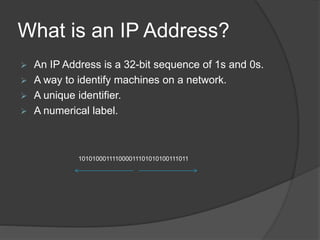
What is an IP Address?
 An IP Address is a 32-bit sequence of 1s and 0s.
 A way to identify machines on a network.
 A unique identifier.
 A numerical label.
101010001111000011101010100111011
IP Usage
Used to connect to
another computer.
Allows transfers of files
and e-mail.
What is an internet protocol?
 Protocol used for communicating data.
Services provided by IP
 Addressing
 Fragmentation
Part of IP Address
 Network Part
 Local or Host Part
IP Structure
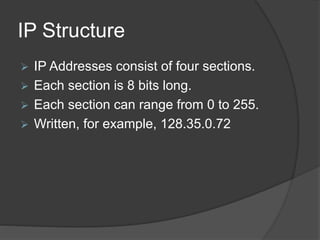
 IP Addresses consist of four sections.
 Each section is 8 bits long.
 Each section can range from 0 to 255.
 Written, for example, 128.35.0.72
IP Structure
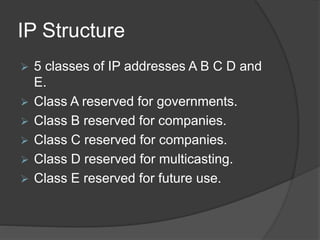
 5 classes of IP addresses A B C D and
E.
 Class A reserved for governments.
 Class B reserved for companies.
 Class C reserved for companies.
 Class D reserved for multicasting.
 Class E reserved for future use.
IP ranges
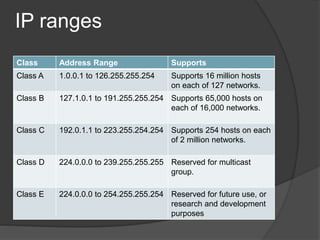
Class Address Range Supports
Class A 1.0.0.1 to 126.255.255.254 Supports 16 million hosts
on each of 127 networks.
Class B 127.1.0.1 to 191.255.255.254 Supports 65,000 hosts on
each of 16,000 networks.
Class C 192.0.1.1 to 223.255.254.254 Supports 254 hosts on each
of 2 million networks.
Class D 224.0.0.0 to 239.255.255.255 Reserved for multicast
group.
Class E 224.0.0.0 to 254.255.255.254 Reserved for future use, or
research and development
purposes
network Host Host HostClass A
24 Bits
Network Network Host HostClass B
16 Bits
Network Network Network HostClass C
8 Bits
Address Class High-Order
Bits
First Octal
Address
Range
Number of
Bits in the
Network
Address
Number of
Networks
Number of
Hosts per
Network
Class A 0 0-127 8 126 16,777,216
Class B 10 128-191 16 16,384 65,536
Class C 110 192-223 24 2,097,152 254
Class D 1110 224-255 28 N/A N/A
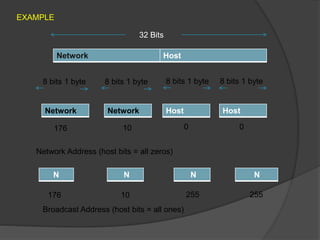
EXAMPLE
Network Host
32 Bits
Network Network Host Host
8 bits 1 byte 8 bits 1 byte8 bits 1 byte8 bits 1 byte
176 10 0 0
Network Address (host bits = all zeros)
N N N N
176 10 255 255
Broadcast Address (host bits = all ones)
How to Calculate
Historical classful network architecture
Class First
Octal
Binary
Range
of first
Octal
Networ
k ID
Host ID Number
of
Networ
ks
Number
Of
Addres
ses
A 0XXXX
XXX
0-127 a b.c.d 27=128 224=16,7
77,214
B 10XXXX
XX
128-191 a.b c.d 214=16,3
84
216=65,5
34
C 110XXX
XX
192-223 a.b.c d 221=2,09
7,152
28=254
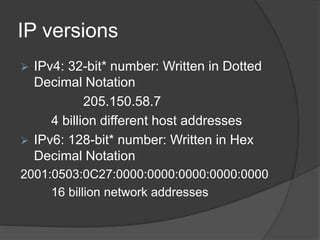
IP versions
 IPv4: 32-bit* number: Written in Dotted
Decimal Notation
205.150.58.7
4 billion different host addresses
 IPv6: 128-bit* number: Written in Hex
Decimal Notation
2001:0503:0C27:0000:0000:0000:0000:0000
16 billion network addresses
Types of IP Address
 Static address
 Dynamic address
Types of IP Address
 Static IP Address
 Manually input by network administrator
 Manageable for small networks
 Requires careful checks to avoid
duplication
Types of IP Address
 Dynamic IP Address.
 Examples – BOOTP, DHCP.
 Assigned by server when host boots.
 Derived automatically from a range of
addresses.
 Duration of `lease` negotiated, then
address released back to server.
Public and Private IP
Address
 A public IP Address will be issued by an
ISP and will have number ranges from 1
to 191 in first octal with the exception of
the private address ranges that starts at
10.0.0 for class A private networks and
172.16.0 for the class B private
addresses.
THANKS FOR YOUR TIME

Ip address presentation

  • 1.
  • 2.
  • 3.
    What is anIP Address?  An IP Address is a 32-bit sequence of 1s and 0s.  A way to identify machines on a network.  A unique identifier.  A numerical label. 101010001111000011101010100111011
  • 4.
    IP Usage Used toconnect to another computer. Allows transfers of files and e-mail.
  • 5.
    What is aninternet protocol?  Protocol used for communicating data.
  • 6.
    Services provided byIP  Addressing  Fragmentation
  • 7.
    Part of IPAddress  Network Part  Local or Host Part
  • 8.
    IP Structure  IPAddresses consist of four sections.  Each section is 8 bits long.  Each section can range from 0 to 255.  Written, for example, 128.35.0.72
  • 9.
    IP Structure  5classes of IP addresses A B C D and E.  Class A reserved for governments.  Class B reserved for companies.  Class C reserved for companies.  Class D reserved for multicasting.  Class E reserved for future use.
  • 10.
    IP ranges Class AddressRange Supports Class A 1.0.0.1 to 126.255.255.254 Supports 16 million hosts on each of 127 networks. Class B 127.1.0.1 to 191.255.255.254 Supports 65,000 hosts on each of 16,000 networks. Class C 192.0.1.1 to 223.255.254.254 Supports 254 hosts on each of 2 million networks. Class D 224.0.0.0 to 239.255.255.255 Reserved for multicast group. Class E 224.0.0.0 to 254.255.255.254 Reserved for future use, or research and development purposes
  • 11.
    network Host HostHostClass A 24 Bits Network Network Host HostClass B 16 Bits Network Network Network HostClass C 8 Bits
  • 12.
    Address Class High-Order Bits FirstOctal Address Range Number of Bits in the Network Address Number of Networks Number of Hosts per Network Class A 0 0-127 8 126 16,777,216 Class B 10 128-191 16 16,384 65,536 Class C 110 192-223 24 2,097,152 254 Class D 1110 224-255 28 N/A N/A
  • 13.
    EXAMPLE Network Host 32 Bits NetworkNetwork Host Host 8 bits 1 byte 8 bits 1 byte8 bits 1 byte8 bits 1 byte 176 10 0 0 Network Address (host bits = all zeros) N N N N 176 10 255 255 Broadcast Address (host bits = all ones)
  • 14.
    How to Calculate Historicalclassful network architecture Class First Octal Binary Range of first Octal Networ k ID Host ID Number of Networ ks Number Of Addres ses A 0XXXX XXX 0-127 a b.c.d 27=128 224=16,7 77,214 B 10XXXX XX 128-191 a.b c.d 214=16,3 84 216=65,5 34 C 110XXX XX 192-223 a.b.c d 221=2,09 7,152 28=254
  • 15.
    IP versions  IPv4:32-bit* number: Written in Dotted Decimal Notation 205.150.58.7 4 billion different host addresses  IPv6: 128-bit* number: Written in Hex Decimal Notation 2001:0503:0C27:0000:0000:0000:0000:0000 16 billion network addresses
  • 16.
    Types of IPAddress  Static address  Dynamic address
  • 17.
    Types of IPAddress  Static IP Address  Manually input by network administrator  Manageable for small networks  Requires careful checks to avoid duplication
  • 18.
    Types of IPAddress  Dynamic IP Address.  Examples – BOOTP, DHCP.  Assigned by server when host boots.  Derived automatically from a range of addresses.  Duration of `lease` negotiated, then address released back to server.
  • 19.
    Public and PrivateIP Address  A public IP Address will be issued by an ISP and will have number ranges from 1 to 191 in first octal with the exception of the private address ranges that starts at 10.0.0 for class A private networks and 172.16.0 for the class B private addresses.
  • 20.