1
Address Resolution Protocol
(ARP)
2
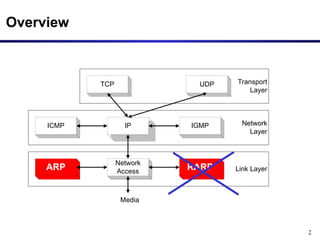
Network
Layer
Link Layer
IP
ARP
Network
Access
RARP
Media
ICMP IGMP
Transport
Layer
TCP UDP
Overview
3
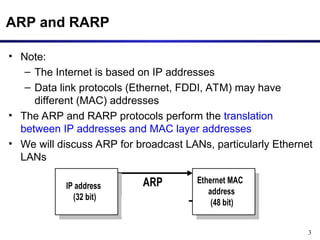
ARP and RARP
• Note:
– The Internet is based on IP addresses
– Data link protocols (Ethernet, FDDI, ATM) may have
different (MAC) addresses
• The ARP and RARP protocols perform the translation
between IP addresses and MAC layer addresses
• We will discuss ARP for broadcast LANs, particularly Ethernet
LANs
RARP
Ethernet MAC
address
(48 bit)
ARP
IP address
(32 bit)
4
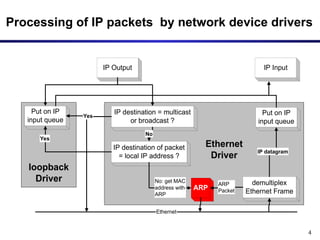
Processing of IP packets by network device drivers
loopback
Driver
IP Input
Put on IP
input queue
ARP
demultiplex
Ethernet Frame
Ethernet
IP destination of packet
= local IP address ?
IP destination = multicast
or broadcast ?
IP Output
Put on IP
input queue
No: get MAC
address with
ARP
ARP
Packet
IP datagram
No
Yes
Yes
Ethernet
Driver
5
Address Translation with ARP
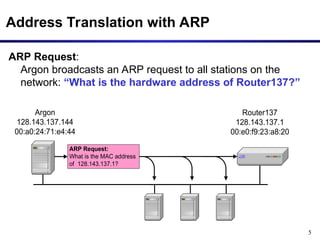
ARP Request:
Argon broadcasts an ARP request to all stations on the
network: “What is the hardware address of Router137?”
Argon
128.143.137.144
00:a0:24:71:e4:44
Router137
128.143.137.1
00:e0:f9:23:a8:20
ARP Request:
What is the MAC address
of 128.143.137.1?
6
Address Translation with ARP
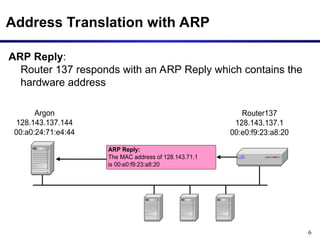
ARP Reply:
Router 137 responds with an ARP Reply which contains the
hardware address
Argon
128.143.137.144
00:a0:24:71:e4:44
Router137
128.143.137.1
00:e0:f9:23:a8:20
ARP Reply:
The MAC address of 128.143.71.1
is 00:e0:f9:23:a8:20
7
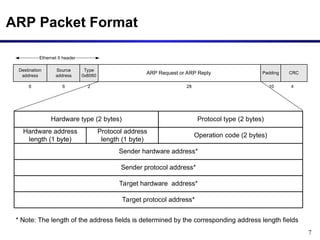
ARP Packet Format
Destination
address
6
ARP Request or ARP Reply
28
Source
address
6 2
CRC
4
Type
0x8060
Padding
10
Ethernet II header
Hardware type (2 bytes)
Hardware address
length (1 byte)
Protocol address
length (1 byte)
Operation code (2 bytes)
Target hardware address*
Protocol type (2 bytes)
Sender hardware address*
Sender protocol address*
Target protocol address*
* Note: The length of the address fields is determined by the corresponding address length fields
8
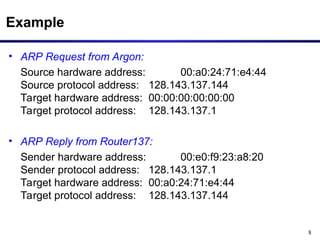
Example
• ARP Request from Argon:
Source hardware address: 00:a0:24:71:e4:44
Source protocol address: 128.143.137.144
Target hardware address: 00:00:00:00:00:00
Target protocol address: 128.143.137.1
• ARP Reply from Router137:
Sender hardware address: 00:e0:f9:23:a8:20
Sender protocol address: 128.143.137.1
Target hardware address: 00:a0:24:71:e4:44
Target protocol address: 128.143.137.144
9
ARP Cache
• Since sending an ARP request/reply for each IP datagram is
inefficient, hosts maintain a cache (ARP Cache) of current
entries. The entries expire after 20 minutes.
• Contents of the ARP Cache:
(128.143.71.37) at 00:10:4B:C5:D1:15 [ether] on eth0
(128.143.71.36) at 00:B0:D0:E1:17:D5 [ether] on eth0
(128.143.71.35) at 00:B0:D0:DE:70:E6 [ether] on eth0
(128.143.136.90) at 00:05:3C:06:27:35 [ether] on eth1
(128.143.71.34) at 00:B0:D0:E1:17:DB [ether] on eth0
(128.143.71.33) at 00:B0:D0:E1:17:DF [ether] on eth0
10
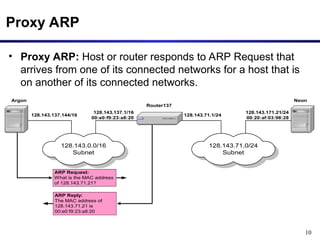
Proxy ARP
• Proxy ARP: Host or router responds to ARP Request that
arrives from one of its connected networks for a host that is
on another of its connected networks.
128.143.137.1/16
00:e0:f9:23:a8:20
128.143.71.1/24
128.143.0.0/16
Subnet
128.143.71.0/24
Subnet
Router137
ARP Request:
What is the MAC address
of 128.143.71.21?
128.143.137.144/16
128.143.171.21/24
00:20:af:03:98:28
Argon Neon
ARP Reply:
The MAC address of
128.143.71.21 is
00:e0:f9:23:a8:20
11
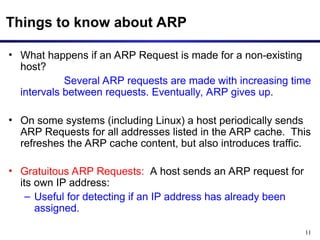
Things to know about ARP
• What happens if an ARP Request is made for a non-existing
host?
Several ARP requests are made with increasing time
intervals between requests. Eventually, ARP gives up.
• On some systems (including Linux) a host periodically sends
ARP Requests for all addresses listed in the ARP cache. This
refreshes the ARP cache content, but also introduces traffic.
• Gratuitous ARP Requests: A host sends an ARP request for
its own IP address:
– Useful for detecting if an IP address has already been
assigned.
12
Vulnerabilities of ARP
1. Since ARP does not authenticate requests or replies, ARP Requests and
Replies can be forged
2. ARP is stateless: ARP Replies can be sent without a corresponding ARP
Request
3. According to the ARP protocol specification, a node receiving an ARP
packet (Request or Reply) must update its local ARP cache with the
information in the source fields, if the receiving node already has an entry
for the IP address of the source in its ARP cache. (This applies to ARP
Request packets and to ARP Reply packets)
Typical exploitation of these vulnerabilities:
• A forged ARP Request or Reply can be used to update the ARP cache of
a remote system with a forged entry (ARP Poisoning)
• This can be used to redirect IP traffic to other hosts

module06-arpV4(1) fr computer network protocol

  • 1.
  • 2.
  • 3.
    3 ARP and RARP •Note: – The Internet is based on IP addresses – Data link protocols (Ethernet, FDDI, ATM) may have different (MAC) addresses • The ARP and RARP protocols perform the translation between IP addresses and MAC layer addresses • We will discuss ARP for broadcast LANs, particularly Ethernet LANs RARP Ethernet MAC address (48 bit) ARP IP address (32 bit)
  • 4.
    4 Processing of IPpackets by network device drivers loopback Driver IP Input Put on IP input queue ARP demultiplex Ethernet Frame Ethernet IP destination of packet = local IP address ? IP destination = multicast or broadcast ? IP Output Put on IP input queue No: get MAC address with ARP ARP Packet IP datagram No Yes Yes Ethernet Driver
  • 5.
    5 Address Translation withARP ARP Request: Argon broadcasts an ARP request to all stations on the network: “What is the hardware address of Router137?” Argon 128.143.137.144 00:a0:24:71:e4:44 Router137 128.143.137.1 00:e0:f9:23:a8:20 ARP Request: What is the MAC address of 128.143.137.1?
  • 6.
    6 Address Translation withARP ARP Reply: Router 137 responds with an ARP Reply which contains the hardware address Argon 128.143.137.144 00:a0:24:71:e4:44 Router137 128.143.137.1 00:e0:f9:23:a8:20 ARP Reply: The MAC address of 128.143.71.1 is 00:e0:f9:23:a8:20
  • 7.
    7 ARP Packet Format Destination address 6 ARPRequest or ARP Reply 28 Source address 6 2 CRC 4 Type 0x8060 Padding 10 Ethernet II header Hardware type (2 bytes) Hardware address length (1 byte) Protocol address length (1 byte) Operation code (2 bytes) Target hardware address* Protocol type (2 bytes) Sender hardware address* Sender protocol address* Target protocol address* * Note: The length of the address fields is determined by the corresponding address length fields
  • 8.
    8 Example • ARP Requestfrom Argon: Source hardware address: 00:a0:24:71:e4:44 Source protocol address: 128.143.137.144 Target hardware address: 00:00:00:00:00:00 Target protocol address: 128.143.137.1 • ARP Reply from Router137: Sender hardware address: 00:e0:f9:23:a8:20 Sender protocol address: 128.143.137.1 Target hardware address: 00:a0:24:71:e4:44 Target protocol address: 128.143.137.144
  • 9.
    9 ARP Cache • Sincesending an ARP request/reply for each IP datagram is inefficient, hosts maintain a cache (ARP Cache) of current entries. The entries expire after 20 minutes. • Contents of the ARP Cache: (128.143.71.37) at 00:10:4B:C5:D1:15 [ether] on eth0 (128.143.71.36) at 00:B0:D0:E1:17:D5 [ether] on eth0 (128.143.71.35) at 00:B0:D0:DE:70:E6 [ether] on eth0 (128.143.136.90) at 00:05:3C:06:27:35 [ether] on eth1 (128.143.71.34) at 00:B0:D0:E1:17:DB [ether] on eth0 (128.143.71.33) at 00:B0:D0:E1:17:DF [ether] on eth0
  • 10.
    10 Proxy ARP • ProxyARP: Host or router responds to ARP Request that arrives from one of its connected networks for a host that is on another of its connected networks. 128.143.137.1/16 00:e0:f9:23:a8:20 128.143.71.1/24 128.143.0.0/16 Subnet 128.143.71.0/24 Subnet Router137 ARP Request: What is the MAC address of 128.143.71.21? 128.143.137.144/16 128.143.171.21/24 00:20:af:03:98:28 Argon Neon ARP Reply: The MAC address of 128.143.71.21 is 00:e0:f9:23:a8:20
  • 11.
    11 Things to knowabout ARP • What happens if an ARP Request is made for a non-existing host? Several ARP requests are made with increasing time intervals between requests. Eventually, ARP gives up. • On some systems (including Linux) a host periodically sends ARP Requests for all addresses listed in the ARP cache. This refreshes the ARP cache content, but also introduces traffic. • Gratuitous ARP Requests: A host sends an ARP request for its own IP address: – Useful for detecting if an IP address has already been assigned.
  • 12.
    12 Vulnerabilities of ARP 1.Since ARP does not authenticate requests or replies, ARP Requests and Replies can be forged 2. ARP is stateless: ARP Replies can be sent without a corresponding ARP Request 3. According to the ARP protocol specification, a node receiving an ARP packet (Request or Reply) must update its local ARP cache with the information in the source fields, if the receiving node already has an entry for the IP address of the source in its ARP cache. (This applies to ARP Request packets and to ARP Reply packets) Typical exploitation of these vulnerabilities: • A forged ARP Request or Reply can be used to update the ARP cache of a remote system with a forged entry (ARP Poisoning) • This can be used to redirect IP traffic to other hosts