
This document discusses common layer 2 security threats and attacks, including MAC layer attacks, VLAN attacks, spoofing attacks, and attacks against switch devices. It describes several specific attacks such as MAC flooding, VLAN hopping, DHCP starvation, and CDP manipulation. The document also provides mitigation strategies for each threat, such as using port security, private VLANs, DHCP snooping, and disabling unused protocols.
COMMON LAYER 2THREATS,
ATTACKS AND MITIGATION
SECURITY | WWW.NETPROTOCOLXPERT.IN
2.
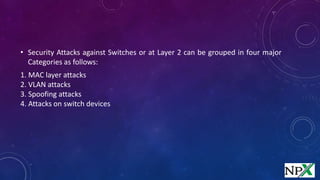
• Security Attacksagainst Switches or at Layer 2 can be grouped in four major
Categories as follows:
1. MAC layer attacks
2. VLAN attacks
3. Spoofing attacks
4. Attacks on switch devices
3.
1. MAC LayerAttacks Types
MAC address flooding
• Description :- Frames with unique, invalid source MAC addresses flood the switch,
exhausting content addressable memory (CAM) table space, disallowing new entries
from valid hosts. Traffic to valid hosts is subsequently flooded out all ports.
• Mitigation Port security. MAC address VLAN access maps.
4.
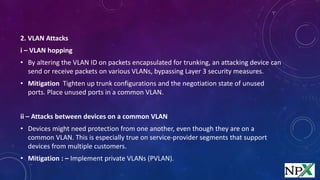
2. VLAN Attacks
i– VLAN hopping
• By altering the VLAN ID on packets encapsulated for trunking, an attacking device can
send or receive packets on various VLANs, bypassing Layer 3 security measures.
• Mitigation Tighten up trunk configurations and the negotiation state of unused
ports. Place unused ports in a common VLAN.
ii – Attacks between devices on a common VLAN
• Devices might need protection from one another, even though they are on a
common VLAN. This is especially true on service-provider segments that support
devices from multiple customers.
• Mitigation : – Implement private VLANs (PVLAN).
5.
3. Spoofing Attacks
i– DHCP starvation and DHCP spoofing
• An attacking device can exhaust the address space available to the DHCP servers for a
period of time or establish itself as a DHCP server in man-in-the middle attacks.
• Mitigation :- Use DHCP snooping.
ii – Spanning-tree compromises
• Attacking device spoofs the root bridge in the STP topology. If successful, the
network attacker can see a variety of frames.
• Mitigation :- Proactively configure the primary and backup root devices. Enable root
guard.
6.
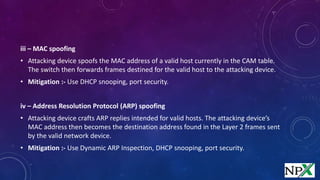
iii – MACspoofing
• Attacking device spoofs the MAC address of a valid host currently in the CAM table.
The switch then forwards frames destined for the valid host to the attacking device.
• Mitigation :- Use DHCP snooping, port security.
iv – Address Resolution Protocol (ARP) spoofing
• Attacking device crafts ARP replies intended for valid hosts. The attacking device’s
MAC address then becomes the destination address found in the Layer 2 frames sent
by the valid network device.
• Mitigation :- Use Dynamic ARP Inspection, DHCP snooping, port security.
7.
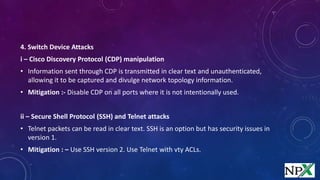
4. Switch DeviceAttacks
i – Cisco Discovery Protocol (CDP) manipulation
• Information sent through CDP is transmitted in clear text and unauthenticated,
allowing it to be captured and divulge network topology information.
• Mitigation :- Disable CDP on all ports where it is not intentionally used.
ii – Secure Shell Protocol (SSH) and Telnet attacks
• Telnet packets can be read in clear text. SSH is an option but has security issues in
version 1.
• Mitigation : – Use SSH version 2. Use Telnet with vty ACLs.