Parul Institute of Engineering And Technology
Topic: Transport Layer Protocols(TCP & UDP)
Prepared by:
1) 140370107072- Kruti Niranjan
2) 140370107089- Nayana Modhawadiya
Introduction
TCP- Transmission Control Protocol
• TCP is a connection oriented services ,widely used
transport layer protocol
• TCP provides process to process, full duplex .
UDP-User Datagram Protocol
• It is connectionless, unreliable transport protocol.
• process-to-process communication instead of host-to-
host communication.
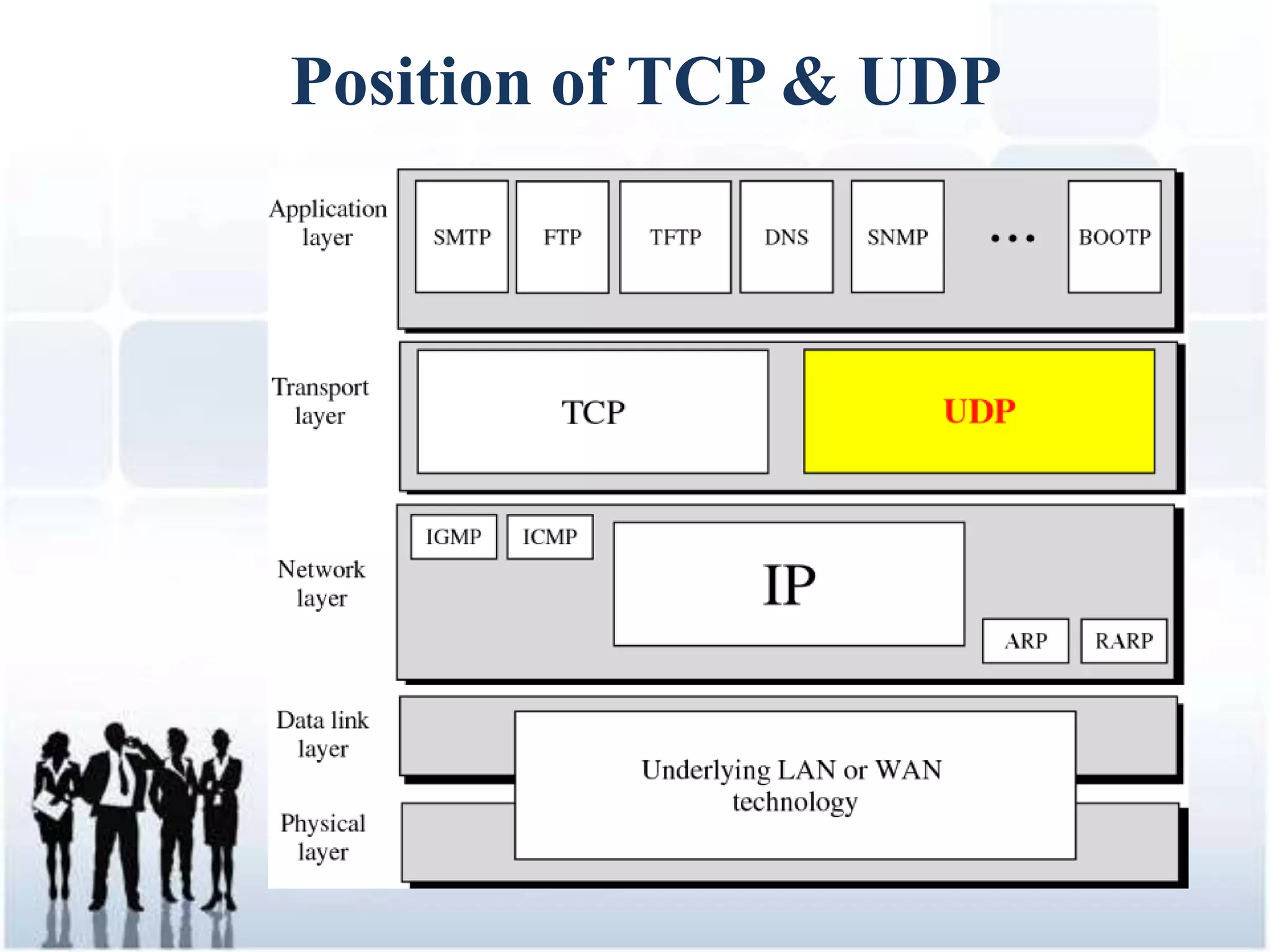
Position of TCP & UDP
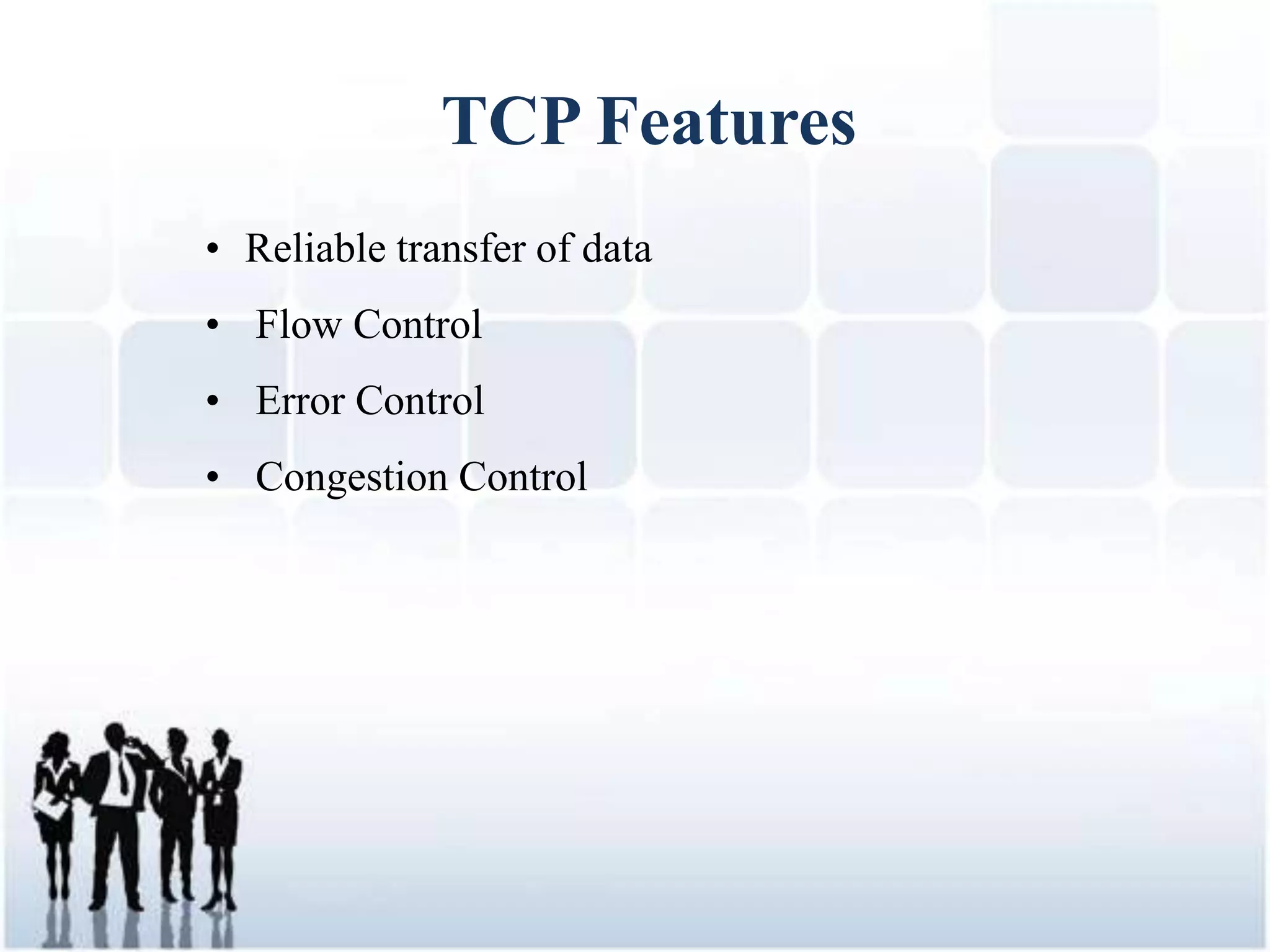
TCP Features
• Reliable transfer of data
• Flow Control
• Error Control
• Congestion Control
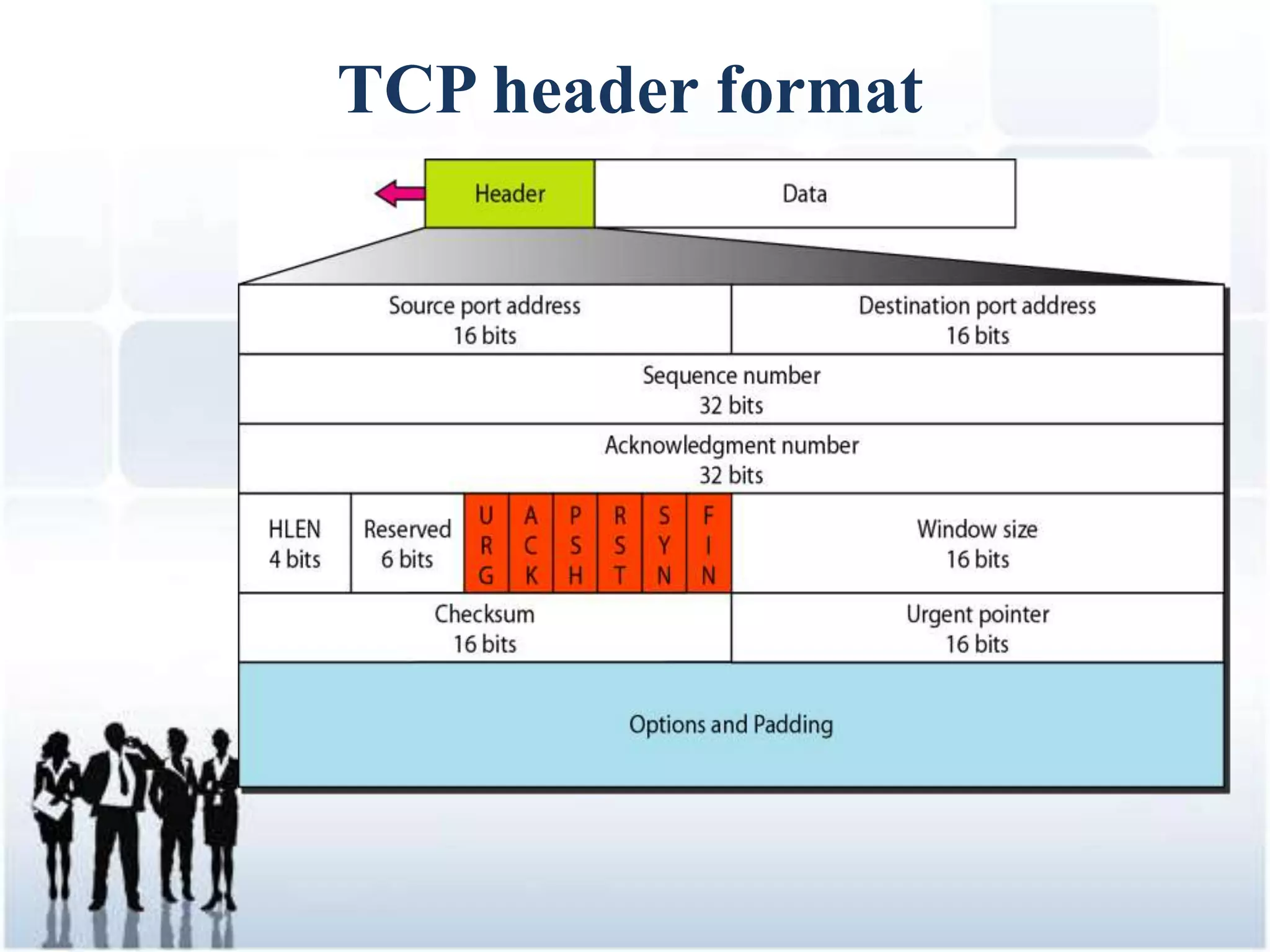
TCP header format
Description of field
1. Source Port (16-bits) - It identifies source port of the application process on
the sending device.
2. Destination Port (16-bits) - It identifies destination port of the application
process on the receiving device.
3. Sequence Number (32-bits) - Sequence number of data bytes of a segment
in a session.
4. Acknowledgement Number (32-bits) - When ACK flag is set, this number
contains the next sequence number of the data byte expected and works as
acknowledgement of the previous data received.
5. Data Offset (4-bits) - This field implies both, the size of TCP header (32-bit
words) and the offset of data in current packet in the whole TCP segment.
6. Reserved (3-bits) - Reserved for future use and all are set zero by default.
7. Flags(1-bit each)
 URG - It indicates that Urgent Pointer field has significant data and
should be processed.
 ACK - It indicates that Acknowledgement field has significance. If ACK
is cleared to 0, it indicates that packet does not contain acknowledgement.
 PSH - When set, it is a request to the receiving station to PUSH data (as
soon as it comes) to the receiving application without buffering it.
 RST - It is used to restart a connection.
 SYN - This flag is used to set up a connection between hosts.
 FIN - This flag is used to release a connection and no more data is
exchanged thereafter. Because packets with SYN and FIN flags have
sequence numbers, they are processed in correct order.
8. Windows Size - This field is used for flow control between two stations
and indicates the amount of buffer (in bytes) the receiver has allocated for
a segment, i.e. how much data is the receiver expecting.
9. Checksum - This field contains the checksum of Header, Data and Pseudo
Headers.
10. Urgent Pointer - It points to the urgent data byte if URG flag
is set to 1.
11. Options - It facilitates additional options which are not covered by the
regular header. Option field is always described in 32-bit words. If this
field contains data less than 32-bit, padding is used to cover the remaining
bits to reach 32-bit boundary.
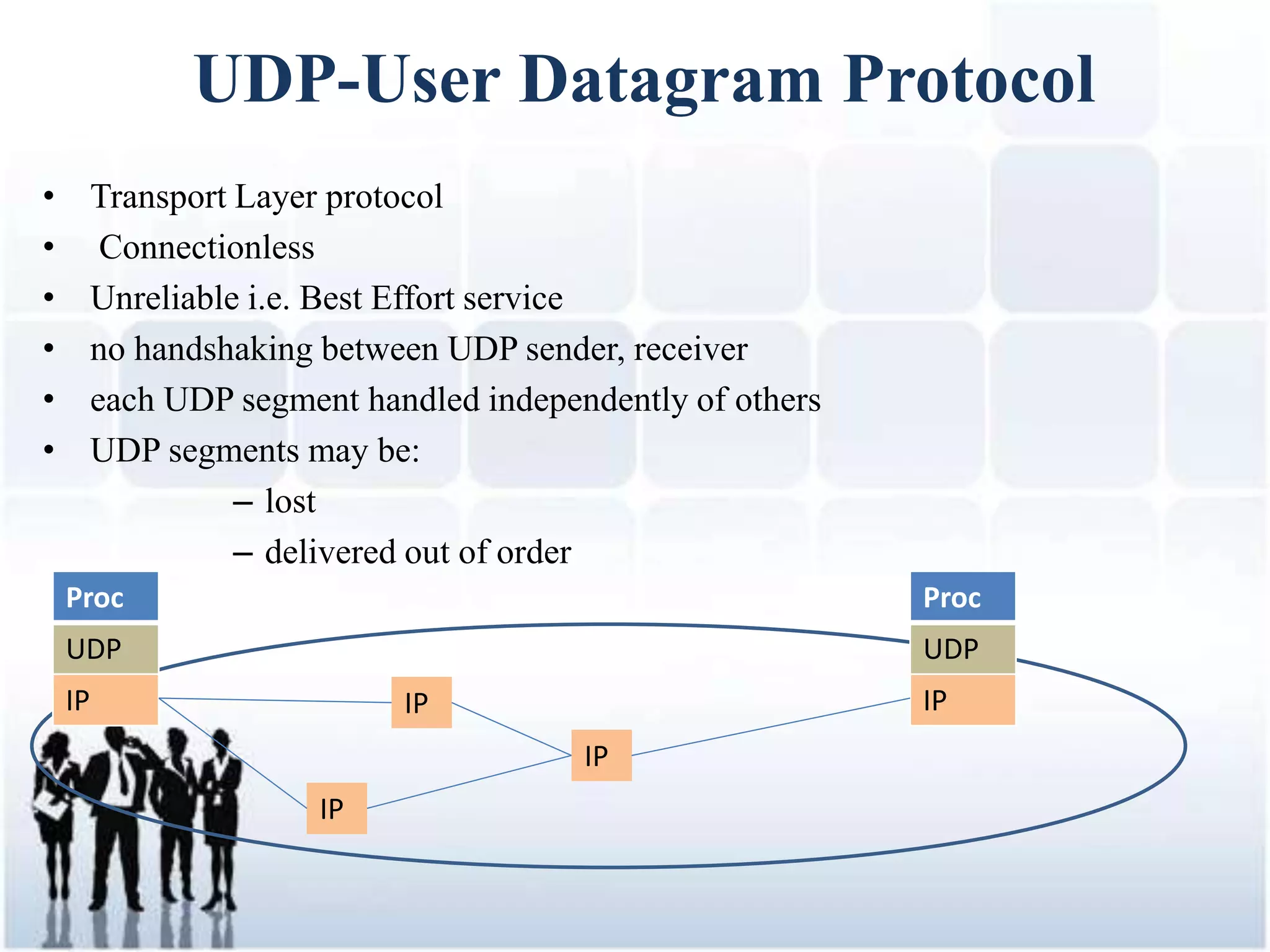
UDP-User Datagram Protocol
• Transport Layer protocol
• Connectionless
• Unreliable i.e. Best Effort service
• no handshaking between UDP sender, receiver
• each UDP segment handled independently of others
• UDP segments may be:
– lost
– delivered out of order
IP
IP
IP
Proc
UDP
IP
Proc
UDP
IP
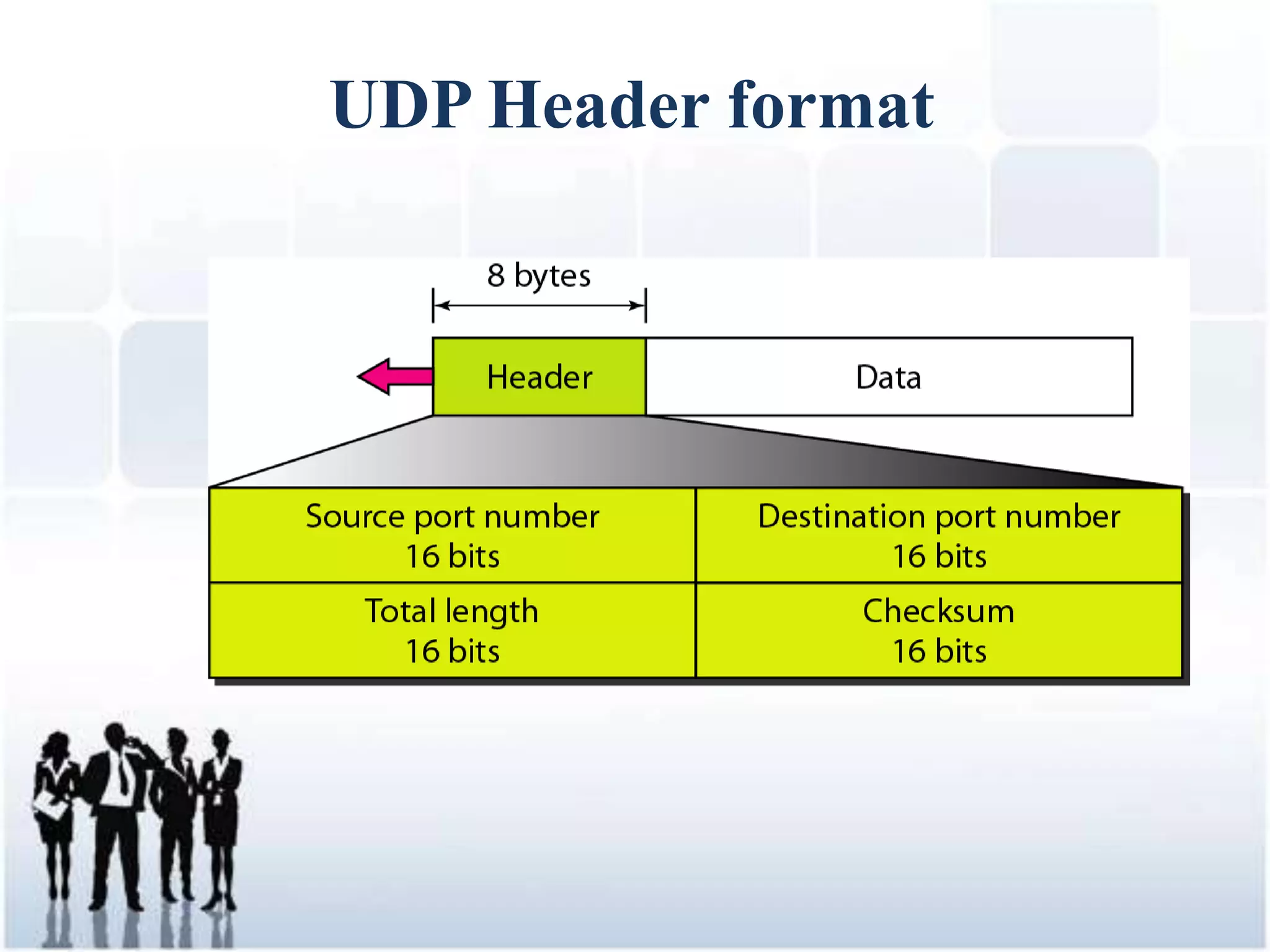
UDP Header format
Description of field
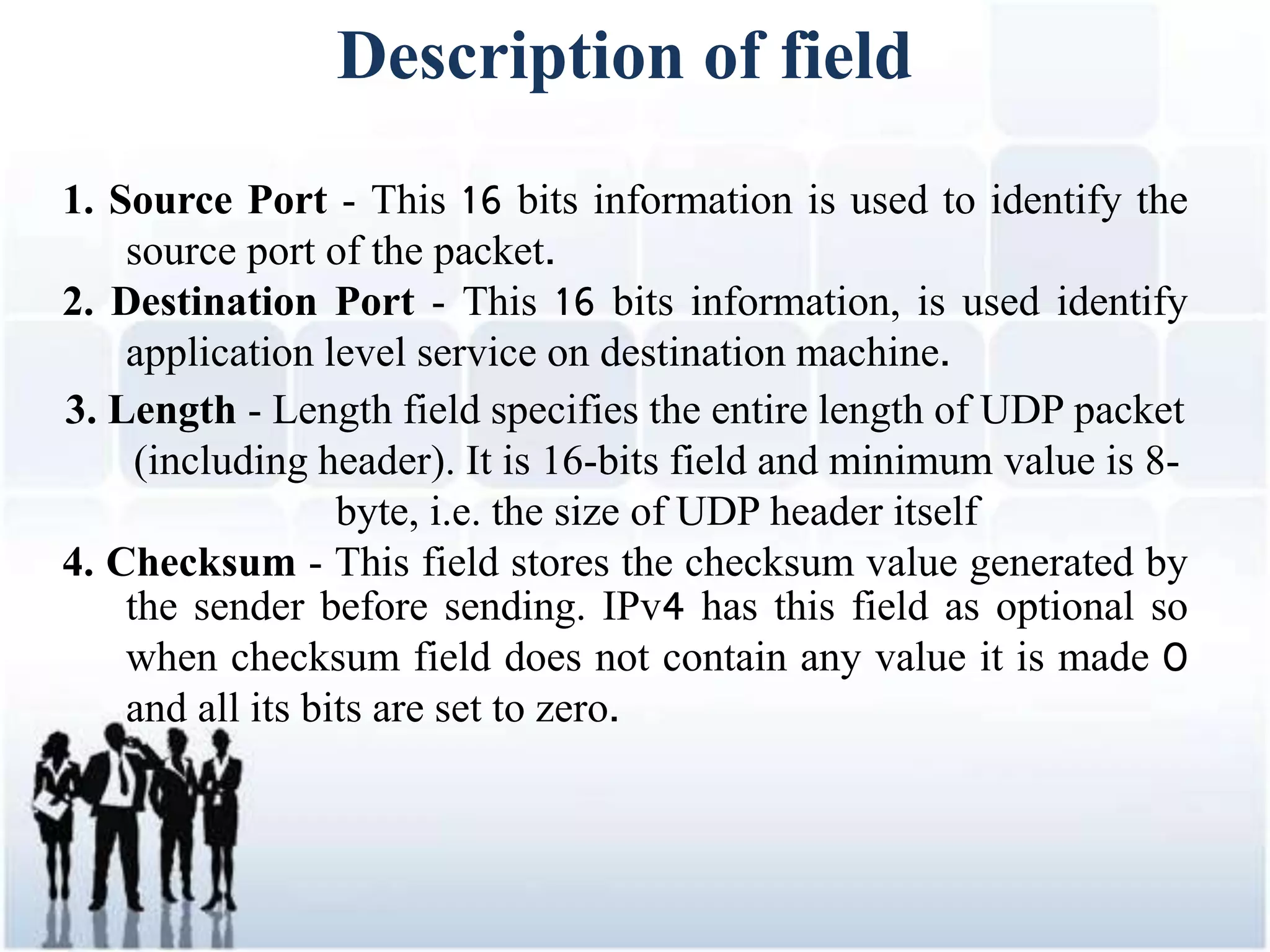
1. Source Port - This 16 bits information is used to identify the
source port of the packet.
2. Destination Port - This 16 bits information, is used identify
application level service on destination machine.
3. Length - Length field specifies the entire length of UDP packet
(including header). It is 16-bits field and minimum value is 8-
byte, i.e. the size of UDP header itself
4. Checksum - This field stores the checksum value generated by
the sender before sending. IPv4 has this field as optional so
when checksum field does not contain any value it is made 0
and all its bits are set to zero.
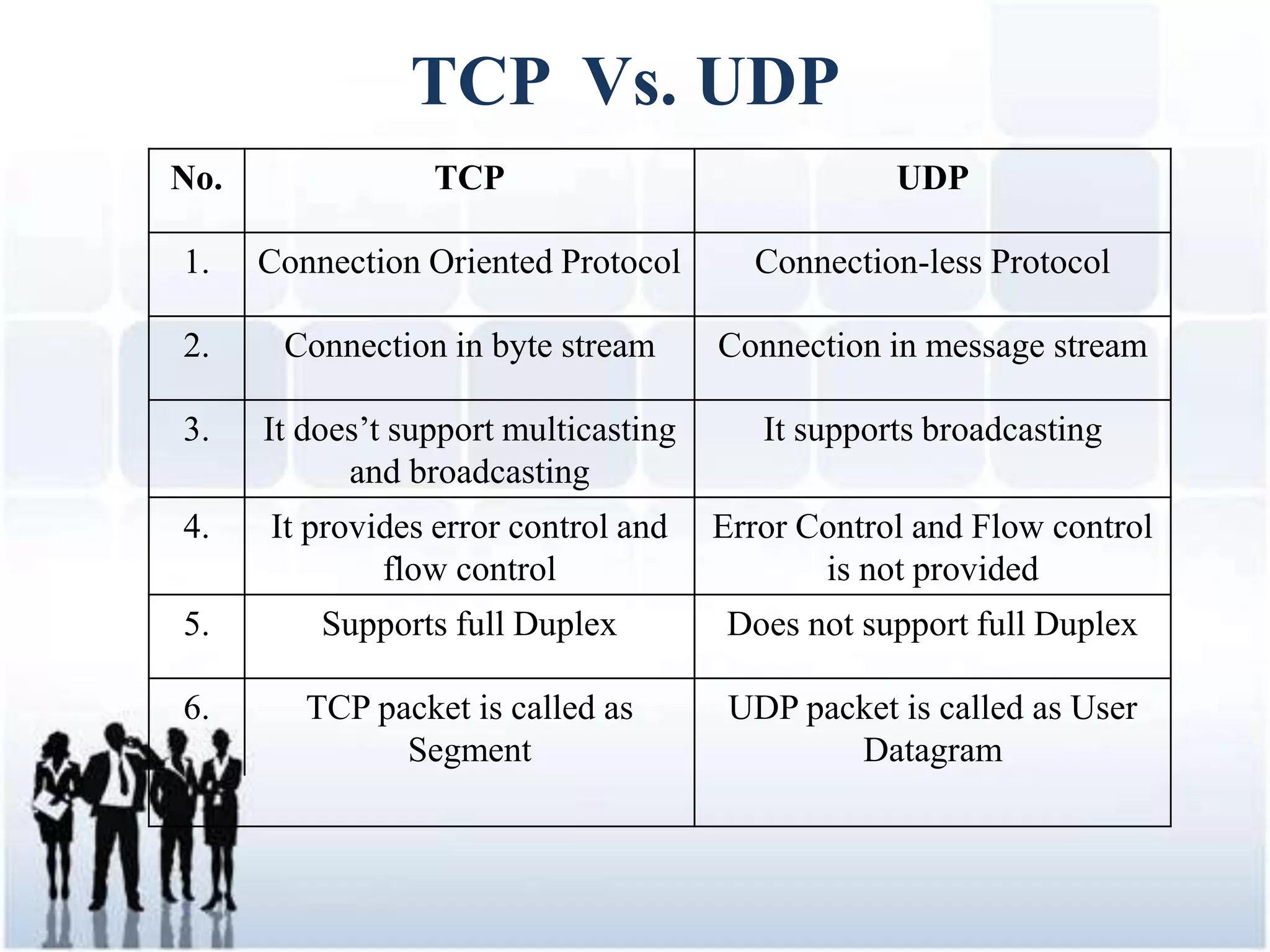
No. TCP UDP
1. Connection Oriented Protocol Connection-less Protocol
2. Connection in byte stream Connection in message stream
3. It does’t support multicasting
and broadcasting
It supports broadcasting
4. It provides error control and
flow control
Error Control and Flow control
is not provided
5. Supports full Duplex Does not support full Duplex
6. TCP packet is called as
Segment
UDP packet is called as User
Datagram
TCP Vs. UDP
TCP & UDP ( Transmission Control Protocol and User Datagram Protocol)

TCP & UDP ( Transmission Control Protocol and User Datagram Protocol)

  • 1.
    Parul Institute ofEngineering And Technology Topic: Transport Layer Protocols(TCP & UDP) Prepared by: 1) 140370107072- Kruti Niranjan 2) 140370107089- Nayana Modhawadiya
  • 2.
    Introduction TCP- Transmission ControlProtocol • TCP is a connection oriented services ,widely used transport layer protocol • TCP provides process to process, full duplex . UDP-User Datagram Protocol • It is connectionless, unreliable transport protocol. • process-to-process communication instead of host-to- host communication.
  • 3.
  • 4.
    TCP Features • Reliabletransfer of data • Flow Control • Error Control • Congestion Control
  • 5.
  • 6.
    Description of field 1.Source Port (16-bits) - It identifies source port of the application process on the sending device. 2. Destination Port (16-bits) - It identifies destination port of the application process on the receiving device. 3. Sequence Number (32-bits) - Sequence number of data bytes of a segment in a session. 4. Acknowledgement Number (32-bits) - When ACK flag is set, this number contains the next sequence number of the data byte expected and works as acknowledgement of the previous data received. 5. Data Offset (4-bits) - This field implies both, the size of TCP header (32-bit words) and the offset of data in current packet in the whole TCP segment. 6. Reserved (3-bits) - Reserved for future use and all are set zero by default.
  • 7.
    7. Flags(1-bit each) URG - It indicates that Urgent Pointer field has significant data and should be processed.  ACK - It indicates that Acknowledgement field has significance. If ACK is cleared to 0, it indicates that packet does not contain acknowledgement.  PSH - When set, it is a request to the receiving station to PUSH data (as soon as it comes) to the receiving application without buffering it.  RST - It is used to restart a connection.  SYN - This flag is used to set up a connection between hosts.  FIN - This flag is used to release a connection and no more data is exchanged thereafter. Because packets with SYN and FIN flags have sequence numbers, they are processed in correct order.
  • 8.
    8. Windows Size- This field is used for flow control between two stations and indicates the amount of buffer (in bytes) the receiver has allocated for a segment, i.e. how much data is the receiver expecting. 9. Checksum - This field contains the checksum of Header, Data and Pseudo Headers. 10. Urgent Pointer - It points to the urgent data byte if URG flag is set to 1. 11. Options - It facilitates additional options which are not covered by the regular header. Option field is always described in 32-bit words. If this field contains data less than 32-bit, padding is used to cover the remaining bits to reach 32-bit boundary.
  • 9.
    UDP-User Datagram Protocol •Transport Layer protocol • Connectionless • Unreliable i.e. Best Effort service • no handshaking between UDP sender, receiver • each UDP segment handled independently of others • UDP segments may be: – lost – delivered out of order IP IP IP Proc UDP IP Proc UDP IP
  • 10.
  • 11.
    Description of field 1.Source Port - This 16 bits information is used to identify the source port of the packet. 2. Destination Port - This 16 bits information, is used identify application level service on destination machine. 3. Length - Length field specifies the entire length of UDP packet (including header). It is 16-bits field and minimum value is 8- byte, i.e. the size of UDP header itself 4. Checksum - This field stores the checksum value generated by the sender before sending. IPv4 has this field as optional so when checksum field does not contain any value it is made 0 and all its bits are set to zero.
  • 12.
    No. TCP UDP 1.Connection Oriented Protocol Connection-less Protocol 2. Connection in byte stream Connection in message stream 3. It does’t support multicasting and broadcasting It supports broadcasting 4. It provides error control and flow control Error Control and Flow control is not provided 5. Supports full Duplex Does not support full Duplex 6. TCP packet is called as Segment UDP packet is called as User Datagram TCP Vs. UDP