IPv4
GROUP MEMBER : SHAKEEL KHAN
TAJAMMUL
SHAH
Internet Protocol
The Internet Protocol (IP) is the principal communications
protocol in the Internet protocol suite for relaying datagrams
across network boundaries.
OR
An IP address is an identifier for a particular machine on a
particular network. It is part of a scheme to identify computers
on the internet.
IP address consists of 2 components the network id and the
host id.
IPv4
Internet Protocol version 4 (IPv4) is the fourth version in the
development of the Internet Protocol (IP) Internet, and routes
most traffic on the Internet .
IPv4 is a connectionless protocol for use on packet-switched
networks.
Most widely used protocol at present
IPv4 Addresses
An IPv4 address is a 32-bit address that uniquely and
universally defines the connection of a device (for example, a
computer or a router) to the Internet.
The IPv4 addresses are unique and universal.
They are unique in the sense that each address defines one,
and only one, connection to the Internet.
The IPv4 addresses are universal in the sense that the
addressing system must be accepted by any host that wants to
be connected to the Internet.
Address Space
An address space is the total number of addresses used by the
protocol.
IPv4 allows 232 unique address which section of IP address
show the network id & which section show the machine or host
id depend on the class network.
IPv4 uses 32-bit addresses, which means that the address
space is 232 or 4,294,967,296 .
This means that, if there were no restrictions, more than 4 billion
devices could be connected to the Internet.
Notation
There are two prevalent notations to show an IPv4 address:
1)binary notation
2)dotted-decimal notation.
binary notation vs Dot-decimal notation
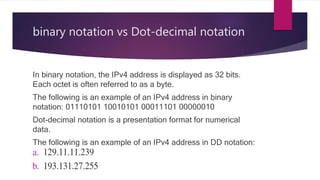
In binary notation, the IPv4 address is displayed as 32 bits.
Each octet is often referred to as a byte.
The following is an example of an IPv4 address in binary
notation: 01110101 10010101 00011101 00000010
Dot-decimal notation is a presentation format for numerical
data.
The following is an example of an IPv4 address in DD notation:
Rules for Ipv4 notations
 There must be no leading zero (045).
 There can be no more than four numbers in an IPv4 address.
 Each number needs to be less than or equal to 255 .
 A mixture of binary notation and dotted-decimal notation is
not allowed.
IPv4 classes
There are five classes of IP addresses:-
 Class A
 Class B
 Class C
 Class D
 Class E
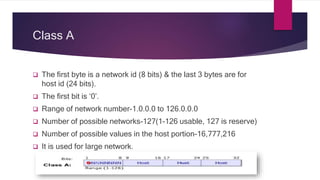
Class A
 The first byte is a network id (8 bits) & the last 3 bytes are for
host id (24 bits).
 The first bit is ‘0’.
 Range of network number-1.0.0.0 to 126.0.0.0
 Number of possible networks-127(1-126 usable, 127 is reserve)
 Number of possible values in the host portion-16,777,216
 It is used for large network.
Class B
 The first 2 bytes are a network id (16 bits) & the last 2 bytes are
for host id (16 bits).
 The first 2 bits are ‘10’.
 Range of network number- 128.0.0.0 to 191.255.0.0
 Number of possible networks- 16,384
 Number of possible values in the host portion- 65536
 Used for medium size network.
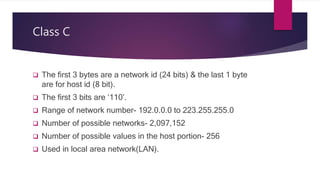
Class C
 The first 3 bytes are a network id (24 bits) & the last 1 byte
are for host id (8 bit).
 The first 3 bits are ‘110’.
 Range of network number- 192.0.0.0 to 223.255.255.0
 Number of possible networks- 2,097,152
 Number of possible values in the host portion- 256
 Used in local area network(LAN).
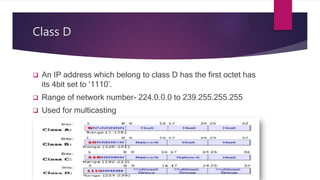
Class D
 An IP address which belong to class D has the first octet has
its 4bit set to ‘1110’.
 Range of network number- 224.0.0.0 to 239.255.255.255
 Used for multicasting
Class E
 It reserved for experimental & for future testing purpose.
 Range of network number-
240.0.0.0 to 255.255.255.254
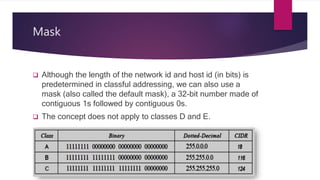
Mask
 Although the length of the network id and host id (in bits) is
predetermined in classful addressing, we can also use a
mask (also called the default mask), a 32-bit number made of
contiguous 1s followed by contiguous 0s.
 The concept does not apply to classes D and E.
Mask Cont…
 The mask can help us to find the network id and the host id
 For example, the mask for a class A address has eight 1s,
which means the first 8 bits of any address in class A define
the network id; the next 24 bits define the host id.
 The last column of Table shows the mask in the form /n
where n can be 8, 16, or 24 in classful addressing. This
notation is also called slash notation or Classless
Interdomain Routing (CIDR) notation.
Problems of IPv4
 Insufficiency
 Only four bytes
Maximum nodes ~ 4.3 billion
Much less than the human population (6.799 billion)
 Not enough for growing number of users
 Will be exhausted in near future
 Increasing routing information
 Rapid growth of routing tables in backbones
 Increasing the number of Network Address Translation
 Breaking the Internet architecture
Cont…
 Security issues
 Number of ways to encrypt IPv4 traffic Example: IPSec
 No real standard encryption method
 Real-time delivery of multimedia content and necessary
bandwidth allocation
 Quality of Service (QoS)
 Different interpretations
 QoS compliant devices are not compatible one another
Any Question…
THANK YOU

Ipv4 presentation

  • 1.
    IPv4 GROUP MEMBER :SHAKEEL KHAN TAJAMMUL SHAH
  • 2.
    Internet Protocol The InternetProtocol (IP) is the principal communications protocol in the Internet protocol suite for relaying datagrams across network boundaries. OR An IP address is an identifier for a particular machine on a particular network. It is part of a scheme to identify computers on the internet. IP address consists of 2 components the network id and the host id.
  • 3.
    IPv4 Internet Protocol version4 (IPv4) is the fourth version in the development of the Internet Protocol (IP) Internet, and routes most traffic on the Internet . IPv4 is a connectionless protocol for use on packet-switched networks. Most widely used protocol at present
  • 4.
    IPv4 Addresses An IPv4address is a 32-bit address that uniquely and universally defines the connection of a device (for example, a computer or a router) to the Internet. The IPv4 addresses are unique and universal. They are unique in the sense that each address defines one, and only one, connection to the Internet. The IPv4 addresses are universal in the sense that the addressing system must be accepted by any host that wants to be connected to the Internet.
  • 5.
    Address Space An addressspace is the total number of addresses used by the protocol. IPv4 allows 232 unique address which section of IP address show the network id & which section show the machine or host id depend on the class network. IPv4 uses 32-bit addresses, which means that the address space is 232 or 4,294,967,296 . This means that, if there were no restrictions, more than 4 billion devices could be connected to the Internet.
  • 6.
    Notation There are twoprevalent notations to show an IPv4 address: 1)binary notation 2)dotted-decimal notation.
  • 7.
    binary notation vsDot-decimal notation In binary notation, the IPv4 address is displayed as 32 bits. Each octet is often referred to as a byte. The following is an example of an IPv4 address in binary notation: 01110101 10010101 00011101 00000010 Dot-decimal notation is a presentation format for numerical data. The following is an example of an IPv4 address in DD notation:
  • 8.
    Rules for Ipv4notations  There must be no leading zero (045).  There can be no more than four numbers in an IPv4 address.  Each number needs to be less than or equal to 255 .  A mixture of binary notation and dotted-decimal notation is not allowed.
  • 9.
    IPv4 classes There arefive classes of IP addresses:-  Class A  Class B  Class C  Class D  Class E
  • 10.
    Class A  Thefirst byte is a network id (8 bits) & the last 3 bytes are for host id (24 bits).  The first bit is ‘0’.  Range of network number-1.0.0.0 to 126.0.0.0  Number of possible networks-127(1-126 usable, 127 is reserve)  Number of possible values in the host portion-16,777,216  It is used for large network.
  • 11.
    Class B  Thefirst 2 bytes are a network id (16 bits) & the last 2 bytes are for host id (16 bits).  The first 2 bits are ‘10’.  Range of network number- 128.0.0.0 to 191.255.0.0  Number of possible networks- 16,384  Number of possible values in the host portion- 65536  Used for medium size network.
  • 12.
    Class C  Thefirst 3 bytes are a network id (24 bits) & the last 1 byte are for host id (8 bit).  The first 3 bits are ‘110’.  Range of network number- 192.0.0.0 to 223.255.255.0  Number of possible networks- 2,097,152  Number of possible values in the host portion- 256  Used in local area network(LAN).
  • 13.
    Class D  AnIP address which belong to class D has the first octet has its 4bit set to ‘1110’.  Range of network number- 224.0.0.0 to 239.255.255.255  Used for multicasting
  • 14.
    Class E  Itreserved for experimental & for future testing purpose.  Range of network number- 240.0.0.0 to 255.255.255.254
  • 15.
    Mask  Although thelength of the network id and host id (in bits) is predetermined in classful addressing, we can also use a mask (also called the default mask), a 32-bit number made of contiguous 1s followed by contiguous 0s.  The concept does not apply to classes D and E.
  • 16.
    Mask Cont…  Themask can help us to find the network id and the host id  For example, the mask for a class A address has eight 1s, which means the first 8 bits of any address in class A define the network id; the next 24 bits define the host id.  The last column of Table shows the mask in the form /n where n can be 8, 16, or 24 in classful addressing. This notation is also called slash notation or Classless Interdomain Routing (CIDR) notation.
  • 17.
    Problems of IPv4 Insufficiency  Only four bytes Maximum nodes ~ 4.3 billion Much less than the human population (6.799 billion)  Not enough for growing number of users  Will be exhausted in near future  Increasing routing information  Rapid growth of routing tables in backbones  Increasing the number of Network Address Translation  Breaking the Internet architecture
  • 18.
    Cont…  Security issues Number of ways to encrypt IPv4 traffic Example: IPSec  No real standard encryption method  Real-time delivery of multimedia content and necessary bandwidth allocation  Quality of Service (QoS)  Different interpretations  QoS compliant devices are not compatible one another
  • 19.
  • 20.