C H A P T E R 7 :
Mohd Noor Abdul Hamid, Ph.D
1. The concept of derivative
- Notation
- First Principle of Differentiation
2. Rules of Differentiation for:
- Derivative of a Constant
- Derivative of xn
- Constant Factor Rule
- Derivative of a Sum or Differences
- Product & Quotient Rules
- Chain Rule and Power Rule
- Exponent & Logarithmic Rules
3. Higher order of derivatives
• Critical points – minimum, maximum, inflection point
• Application : Business and economics
After finishing this class, you should be able to:
• Explain the concept of derivative.
• Differentiate a function using the First Principle
(The Concept of limit)
The concepts of derivative : Notation
If f defined as the function of x and can be written as f(x).
Then the derivative of f(x) = y denoted as f’(x) or is read as
“derivative value of function f at x”.
The process to get f’(x) is called DIFFERENTIATION
(FIRST DERIVATIVE)
dx
dy
f(x)
g(u)
y = f(x)
U = f(v)
f’(x)differentiate
g’(u)differentiate
dy
dx
differentiate
dU
dv
differentiate
y/f(x)
x
3 6
15
30
0
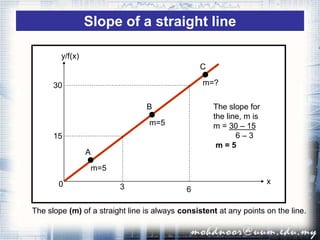
Slope of a straight line
The slope for
the line, m is
m = 30 – 15
6 – 3
m = 5
m=5
A
m=5
B
m=?
C
The slope (m) of a straight line is always consistent at any points on the line.
Slope of a curve
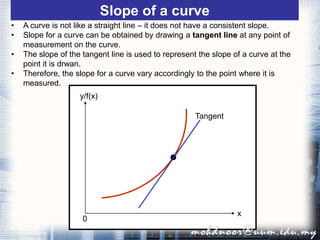
• A curve is not like a straight line – it does not have a consistent slope.
• Slope for a curve can be obtained by drawing a tangent line at any point of
measurement on the curve.
• The slope of the tangent line is used to represent the slope of a curve at the
point it is drwan.
• Therefore, the slope for a curve vary accordingly to the point where it is
measured.
0
y/f(x)
x
Tangent
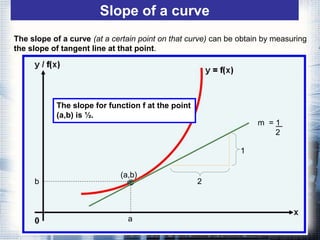
The slope of a curve (at a certain point on that curve) can be obtain by measuring
the slope of tangent line at that point.
m = 1
2
1
2
a
b
(a,b)
The slope for function f at the point
(a,b) is ½.
Slope of a curve
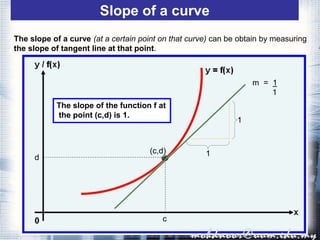
The slope of the function f at
the point (c,d) is 1.
1
1
m = 1
1
c
d
(c,d)
The slope of a curve (at a certain point on that curve) can be obtain by measuring
the slope of tangent line at that point.
Slope of a curve
The slope for function f at the point
(e,f) is ? 6
2
m = ?
e
f
(e,f)
The slope of a curve (at a certain point on that curve) can be obtain by measuring
the slope of tangent line at that point.
Slope of a curve
x
h
x+h
f(x)
f(x+h)
Consider a function, f and suppose that there are 2 points (A and B) on the
function (curve).
A
B
= (x, f(x))
= (x+h, f(x+h))
x
h
x+h
f(x)
f(x+h)
A= (x, f(x))
B= (x+h, f(x+h))
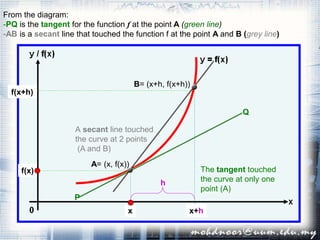
The tangent touched
the curve at only one
point (A)
A secant line touched
the curve at 2 points
(A and B)
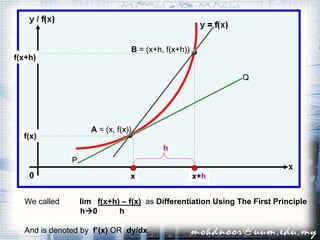
From the diagram:
-PQ is the tangent for the function f at the point A (green line)
-AB is a secant line that touched the function f at the point A and B (grey line)
P
Q
P
Q
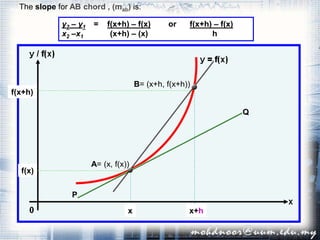
The slope for AB chord , (mab) is:
f(x)
f(x+h)
A= (x, f(x))
B= (x+h, f(x+h))
y2 – y1 = f(x+h) – f(x) or f(x+h) – f(x)
x2 –x1 (x+h) – (x) h
x x+h
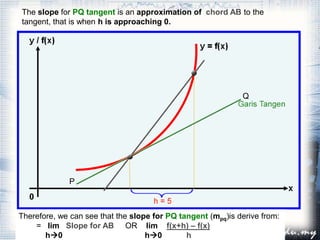
The slope for PQ tangent is an approximation of chord AB to the
tangent, that is when h is approaching 0.
P
Q
Therefore, we can see that the slope for PQ tangent (mpq)is derive from:
= lim Slope for AB OR lim f(x+h) – f(x)
h0 h0 h
x
h
x+h
f(x)
f(x+h)
A
B
= (x, f(x))
= (x+h, f(x+h))
P
Q
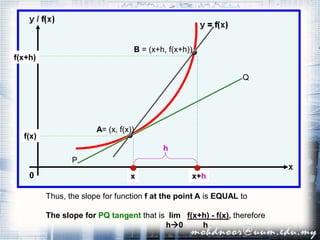
Thus, the slope for function f at the point A is EQUAL to
The slope for PQ tangent that is lim f(x+h) - f(x), therefore
h0 h
x
h
x+h
f(x)
f(x+h)
A
B
= (x, f(x))
= (x+h, f(x+h))
P
Q
We called lim f(x+h) – f(x) as Differentiation Using The First Principle
h0 h
And is denoted by f’(x) OR dy/dx
DIFFERENTIATION : USING THE FIRST PRINCIPLE
dy = f’(x) = lim f(x+h) – f(x)
dx h0 h

Differentiation using First Principle - By Mohd Noor Abdul Hamid

  • 1.
    C H AP T E R 7 : Mohd Noor Abdul Hamid, Ph.D
  • 2.
    1. The conceptof derivative - Notation - First Principle of Differentiation 2. Rules of Differentiation for: - Derivative of a Constant - Derivative of xn - Constant Factor Rule - Derivative of a Sum or Differences - Product & Quotient Rules - Chain Rule and Power Rule - Exponent & Logarithmic Rules 3. Higher order of derivatives • Critical points – minimum, maximum, inflection point • Application : Business and economics
  • 3.
    After finishing thisclass, you should be able to: • Explain the concept of derivative. • Differentiate a function using the First Principle (The Concept of limit)
  • 4.
    The concepts ofderivative : Notation If f defined as the function of x and can be written as f(x). Then the derivative of f(x) = y denoted as f’(x) or is read as “derivative value of function f at x”. The process to get f’(x) is called DIFFERENTIATION (FIRST DERIVATIVE) dx dy f(x) g(u) y = f(x) U = f(v) f’(x)differentiate g’(u)differentiate dy dx differentiate dU dv differentiate
  • 6.
    y/f(x) x 3 6 15 30 0 Slope ofa straight line The slope for the line, m is m = 30 – 15 6 – 3 m = 5 m=5 A m=5 B m=? C The slope (m) of a straight line is always consistent at any points on the line.
  • 7.
    Slope of acurve • A curve is not like a straight line – it does not have a consistent slope. • Slope for a curve can be obtained by drawing a tangent line at any point of measurement on the curve. • The slope of the tangent line is used to represent the slope of a curve at the point it is drwan. • Therefore, the slope for a curve vary accordingly to the point where it is measured. 0 y/f(x) x Tangent
  • 8.
    The slope ofa curve (at a certain point on that curve) can be obtain by measuring the slope of tangent line at that point. m = 1 2 1 2 a b (a,b) The slope for function f at the point (a,b) is ½. Slope of a curve
  • 9.
    The slope ofthe function f at the point (c,d) is 1. 1 1 m = 1 1 c d (c,d) The slope of a curve (at a certain point on that curve) can be obtain by measuring the slope of tangent line at that point. Slope of a curve
  • 10.
    The slope forfunction f at the point (e,f) is ? 6 2 m = ? e f (e,f) The slope of a curve (at a certain point on that curve) can be obtain by measuring the slope of tangent line at that point. Slope of a curve
  • 11.
    x h x+h f(x) f(x+h) Consider a function,f and suppose that there are 2 points (A and B) on the function (curve). A B = (x, f(x)) = (x+h, f(x+h))
  • 12.
    x h x+h f(x) f(x+h) A= (x, f(x)) B=(x+h, f(x+h)) The tangent touched the curve at only one point (A) A secant line touched the curve at 2 points (A and B) From the diagram: -PQ is the tangent for the function f at the point A (green line) -AB is a secant line that touched the function f at the point A and B (grey line) P Q
  • 13.
    P Q The slope forAB chord , (mab) is: f(x) f(x+h) A= (x, f(x)) B= (x+h, f(x+h)) y2 – y1 = f(x+h) – f(x) or f(x+h) – f(x) x2 –x1 (x+h) – (x) h x x+h
  • 14.
    The slope forPQ tangent is an approximation of chord AB to the tangent, that is when h is approaching 0. P Q Therefore, we can see that the slope for PQ tangent (mpq)is derive from: = lim Slope for AB OR lim f(x+h) – f(x) h0 h0 h
  • 15.
    x h x+h f(x) f(x+h) A B = (x, f(x)) =(x+h, f(x+h)) P Q Thus, the slope for function f at the point A is EQUAL to The slope for PQ tangent that is lim f(x+h) - f(x), therefore h0 h
  • 16.
    x h x+h f(x) f(x+h) A B = (x, f(x)) =(x+h, f(x+h)) P Q We called lim f(x+h) – f(x) as Differentiation Using The First Principle h0 h And is denoted by f’(x) OR dy/dx
  • 17.
    DIFFERENTIATION : USINGTHE FIRST PRINCIPLE dy = f’(x) = lim f(x+h) – f(x) dx h0 h