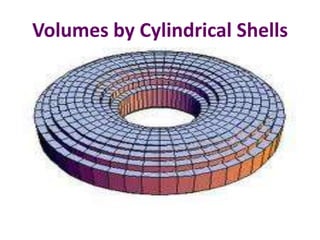
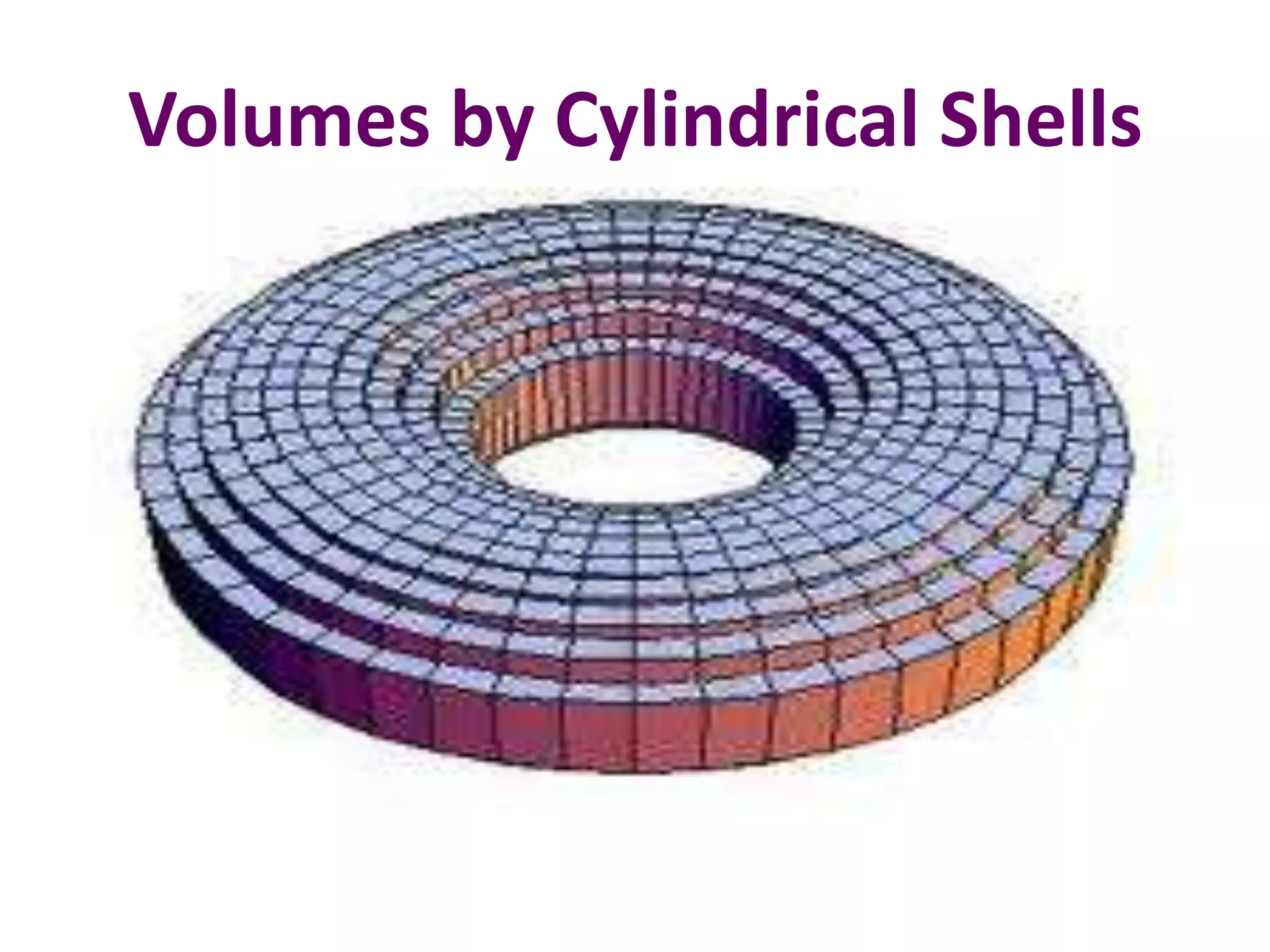
Volumes by Cylindrical Shells
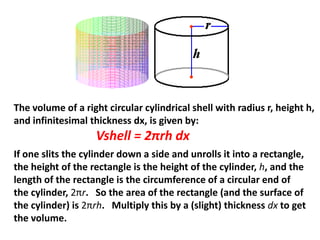
The volume of a right circular cylindrical shell with radius r, height h,
and infinitesimal thickness dx, is given by:

Vshell = 2πrh dx
If one slits the cylinder down a side and unrolls it into a rectangle,
the height of the rectangle is the height of the cylinder, h, and the
length of the rectangle is the circumference of a circular end of
the cylinder, 2πr. So the area of the rectangle (and the surface of
the cylinder) is 2πrh. Multiply this by a (slight) thickness dx to get
the volume.
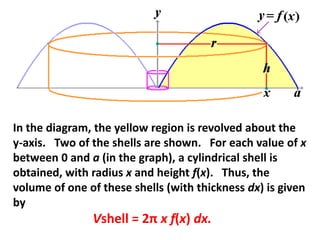
In the diagram, the yellow region is revolved about the
y-axis. Two of the shells are shown. For each value of x
between 0 and a (in the graph), a cylindrical shell is
obtained, with radius x and height f(x). Thus, the
volume of one of these shells (with thickness dx) is given
by

Vshell = 2π x f(x) dx.
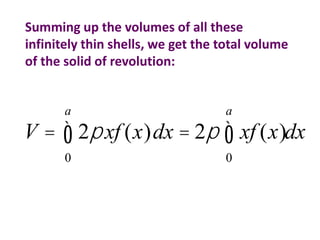
Summing up the volumes of all these
infinitely thin shells, we get the total volume
of the solid of revolution:

V=

a

a

0

0

ò 2p xf (x)dx = 2p ò xf (x)dx
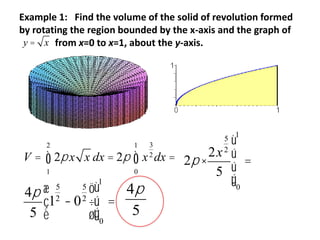
Example 1: Find the volume of the solid of revolution formed
by rotating the region bounded by the x-axis and the graph of
y = x from x=0 to x=1, about the y-axis.

ù
V = ò 2p x x dx = 2p ò x dx = 2p × 2x ú =
1
0
5 ú
ú0
1
û
5
5 öù
4p
4p æ 2
ç1 - 0 2 ÷ú =
5
5 è
øú0
û
2

1

3
2

5 1
2
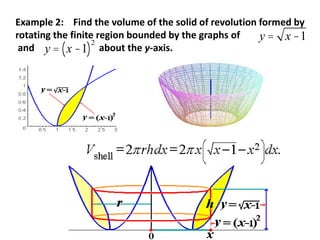
Example 2: Find the volume of the solid of revolution formed by
rotating the finite region bounded by the graphs of
y = x -1
2
and y = ( x -1) about the y-axis.
2

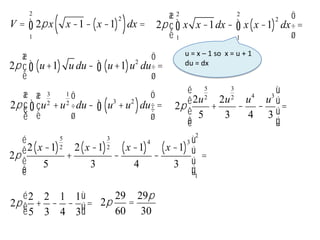
V = ò 2p x
1

(

x -1 - ( x -1)

2

)

2
æ2
ö
2
dx = 2p ç ò x x -1 dx - ò x ( x -1) dx ÷ =
è1
ø
1

æ
ö
2
2p ç ò ( u +1) u du - ò ( u +1) u du÷ =
è
ø
æ æ 3 1ö
ö
3
2
2p ç ò ç u 2 + u 2 ÷ du - ò ( u + u ) du÷ =
ç
÷
è
ø
è
ø

u = x – 1 so x = u + 1
du = dx
3
é 5
ù
4
3
2
2
ê 2u 2u u u ú
2p ê
+
- - ú=
5
3
4 3
ê
ú
ë
û

5
3
é
4
3ù
2
2
ê 2 ( x -1) + 2 ( x -1) - ( x -1) - ( x -1) ú =
2p
ê
5
3
4
3 ú
ê
ú1
ë
û
2

é 2 2 1 1ù
29 29p
=
2p ê + - - ú = 2p
60 30
ë 5 3 4 3û
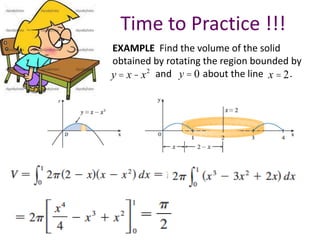
Time to Practice !!!
EXAMPLE Find the volume of the solid
obtained by rotating the region bounded by
y = x - x 2 and y = 0 about the line x = 2 .
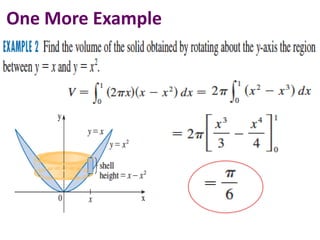
One More Example

7.3 volumes by cylindrical shells

  • 1.
  • 2.
    The volume ofa right circular cylindrical shell with radius r, height h, and infinitesimal thickness dx, is given by: Vshell = 2πrh dx If one slits the cylinder down a side and unrolls it into a rectangle, the height of the rectangle is the height of the cylinder, h, and the length of the rectangle is the circumference of a circular end of the cylinder, 2πr. So the area of the rectangle (and the surface of the cylinder) is 2πrh. Multiply this by a (slight) thickness dx to get the volume.
  • 3.
    In the diagram,the yellow region is revolved about the y-axis. Two of the shells are shown. For each value of x between 0 and a (in the graph), a cylindrical shell is obtained, with radius x and height f(x). Thus, the volume of one of these shells (with thickness dx) is given by Vshell = 2π x f(x) dx.
  • 4.
    Summing up thevolumes of all these infinitely thin shells, we get the total volume of the solid of revolution: V= a a 0 0 ò 2p xf (x)dx = 2p ò xf (x)dx
  • 5.
    Example 1: Findthe volume of the solid of revolution formed by rotating the region bounded by the x-axis and the graph of y = x from x=0 to x=1, about the y-axis. ù V = ò 2p x x dx = 2p ò x dx = 2p × 2x ú = 1 0 5 ú ú0 1 û 5 5 öù 4p 4p æ 2 ç1 - 0 2 ÷ú = 5 5 è øú0 û 2 1 3 2 5 1 2
  • 6.
    Example 2: Findthe volume of the solid of revolution formed by rotating the finite region bounded by the graphs of y = x -1 2 and y = ( x -1) about the y-axis.
  • 7.
    2 V = ò2p x 1 ( x -1 - ( x -1) 2 ) 2 æ2 ö 2 dx = 2p ç ò x x -1 dx - ò x ( x -1) dx ÷ = è1 ø 1 æ ö 2 2p ç ò ( u +1) u du - ò ( u +1) u du÷ = è ø æ æ 3 1ö ö 3 2 2p ç ò ç u 2 + u 2 ÷ du - ò ( u + u ) du÷ = ç ÷ è ø è ø u = x – 1 so x = u + 1 du = dx 3 é 5 ù 4 3 2 2 ê 2u 2u u u ú 2p ê + - - ú= 5 3 4 3 ê ú ë û 5 3 é 4 3ù 2 2 ê 2 ( x -1) + 2 ( x -1) - ( x -1) - ( x -1) ú = 2p ê 5 3 4 3 ú ê ú1 ë û 2 é 2 2 1 1ù 29 29p = 2p ê + - - ú = 2p 60 30 ë 5 3 4 3û
  • 8.
    Time to Practice!!! EXAMPLE Find the volume of the solid obtained by rotating the region bounded by y = x - x 2 and y = 0 about the line x = 2 .
  • 9.