Solids of Revolution: Volume


Review: The Disk Method


                               1
The Disk Method
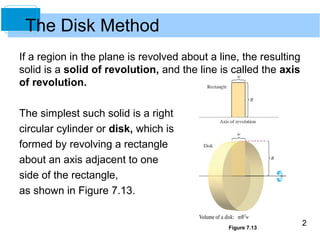
If a region in the plane is revolved about a line, the resulting
solid is a solid of revolution, and the line is called the axis
of revolution.

The simplest such solid is a right
circular cylinder or disk, which is
formed by revolving a rectangle
about an axis adjacent to one
side of the rectangle,
as shown in Figure 7.13.


                                               Figure 7.13
                                                                   2
The Disk Method
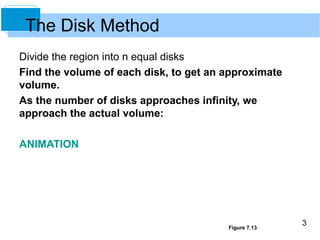
Divide the region into n equal disks
Find the volume of each disk, to get an approximate
volume.
As the number of disks approaches infinity, we
approach the actual volume:

ANIMATION


                                        Figure 7.13
                                                      3
The Washer Method


                    4
The Washer Method
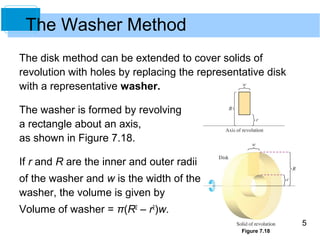
The disk method can be extended to cover solids of
revolution with holes by replacing the representative disk
with a representative washer.

The washer is formed by revolving
a rectangle about an axis,
as shown in Figure 7.18.

If r and R are the inner and outer radii
of the washer and w is the width of the
washer, the volume is given by
Volume of washer = π(R2 – r2)w.
                                                              5
                                                Figure 7.18
The Washer Method
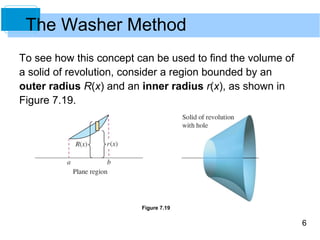
To see how this concept can be used to find the volume of
a solid of revolution, consider a region bounded by an
outer radius R(x) and an inner radius r(x), as shown in
Figure 7.19.


                         Figure 7.19


                                                            6
The Washer Method
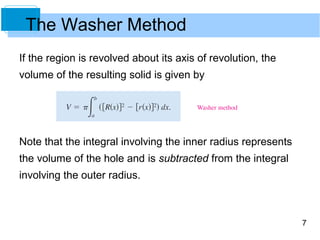
If the region is revolved about its axis of revolution, the
volume of the resulting solid is given by


Note that the integral involving the inner radius represents
the volume of the hole and is subtracted from the integral
involving the outer radius.


                                                               7
Example 3 – Using the Washer Method
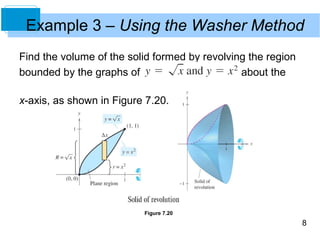
Find the volume of the solid formed by revolving the region
bounded by the graphs of                       about the

x-axis, as shown in Figure 7.20.


                          Figure 7.20

                                                              8
Example 3 – Solution
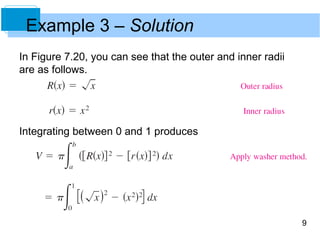
In Figure 7.20, you can see that the outer and inner radii
are as follows.


Integrating between 0 and 1 produces


                                                             9
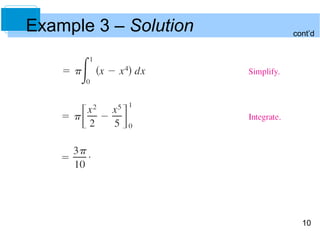
Example 3 – Solution   cont’d


                         10
Practice
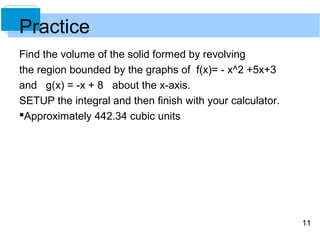
Find the volume of the solid formed by revolving
the region bounded by the graphs of f(x)= - x^2 +5x+3
and g(x) = -x + 8 about the x-axis.
SETUP the integral and then finish with your calculator.
Approximately 442.34 cubic units


                                                           11
The Washer Method
So far, the axis of revolution has been horizontal and you
have integrated with respect to x. In the Example 4, the
axis of revolution is vertical and you integrate with respect
to y. In this example, you need two separate integrals to
compute the volume.


                                                                12
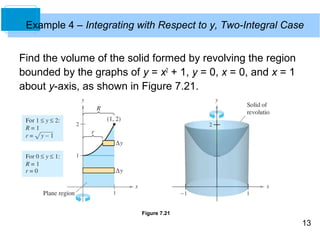
Example 4 – Integrating with Respect to y, Two-Integral Case


Find the volume of the solid formed by revolving the region
bounded by the graphs of y = x2 + 1, y = 0, x = 0, and x = 1
about y-axis, as shown in Figure 7.21.


                          Figure 7.21

                                                               13
Example 4 – Solution
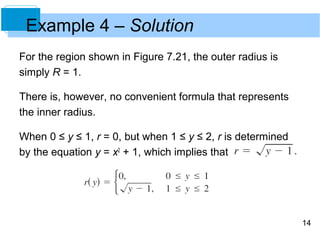
For the region shown in Figure 7.21, the outer radius is
simply R = 1.

There is, however, no convenient formula that represents
the inner radius.

When 0 ≤ y ≤ 1, r = 0, but when 1 ≤ y ≤ 2, r is determined
by the equation y = x2 + 1, which implies that


                                                             14
Example 4 – Solution                                        cont’d


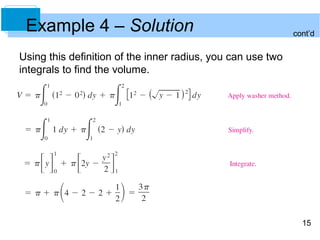
Using this definition of the inner radius, you can use two
integrals to find the volume.


                                                               15
Example 4 – Solution                                         cont’d


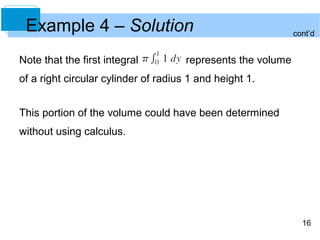
Note that the first integral          represents the volume
of a right circular cylinder of radius 1 and height 1.


This portion of the volume could have been determined
without using calculus.


                                                                16
Solids with Known Cross Sections


                                   17
Solids with Known Cross Sections
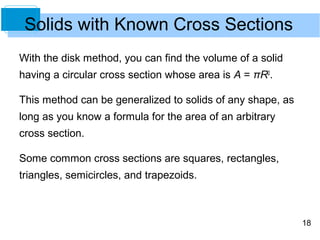
With the disk method, you can find the volume of a solid
having a circular cross section whose area is A = πR2.

This method can be generalized to solids of any shape, as
long as you know a formula for the area of an arbitrary
cross section.

Some common cross sections are squares, rectangles,
triangles, semicircles, and trapezoids.


                                                            18
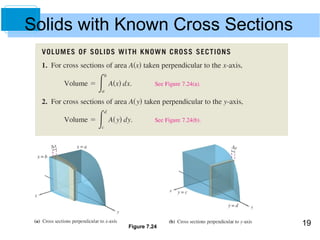
Solids with Known Cross Sections


            Figure 7.24
                                   19
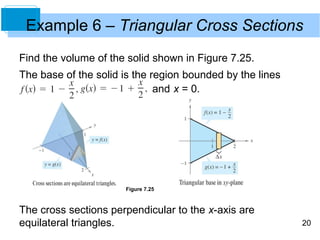
Example 6 – Triangular Cross Sections
Find the volume of the solid shown in Figure 7.25.
The base of the solid is the region bounded by the lines
                              and x = 0.


                      Figure 7.25


The cross sections perpendicular to the x-axis are
equilateral triangles.                                     20
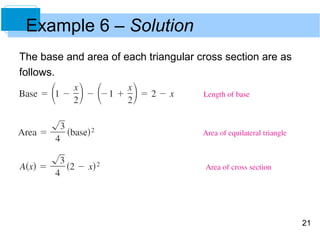
Example 6 – Solution
The base and area of each triangular cross section are as
follows.


                                                            21
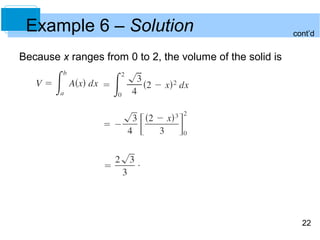
Example 6 – Solution                                      cont’d


Because x ranges from 0 to 2, the volume of the solid is


                                                             22

Other disk method

  • 1.
    Solids of Revolution:Volume Review: The Disk Method 1
  • 2.
    The Disk Method Ifa region in the plane is revolved about a line, the resulting solid is a solid of revolution, and the line is called the axis of revolution. The simplest such solid is a right circular cylinder or disk, which is formed by revolving a rectangle about an axis adjacent to one side of the rectangle, as shown in Figure 7.13. Figure 7.13 2
  • 3.
    The Disk Method Dividethe region into n equal disks Find the volume of each disk, to get an approximate volume. As the number of disks approaches infinity, we approach the actual volume: ANIMATION Figure 7.13 3
  • 4.
  • 5.
    The Washer Method Thedisk method can be extended to cover solids of revolution with holes by replacing the representative disk with a representative washer. The washer is formed by revolving a rectangle about an axis, as shown in Figure 7.18. If r and R are the inner and outer radii of the washer and w is the width of the washer, the volume is given by Volume of washer = π(R2 – r2)w. 5 Figure 7.18
  • 6.
    The Washer Method Tosee how this concept can be used to find the volume of a solid of revolution, consider a region bounded by an outer radius R(x) and an inner radius r(x), as shown in Figure 7.19. Figure 7.19 6
  • 7.
    The Washer Method Ifthe region is revolved about its axis of revolution, the volume of the resulting solid is given by Note that the integral involving the inner radius represents the volume of the hole and is subtracted from the integral involving the outer radius. 7
  • 8.
    Example 3 –Using the Washer Method Find the volume of the solid formed by revolving the region bounded by the graphs of about the x-axis, as shown in Figure 7.20. Figure 7.20 8
  • 9.
    Example 3 –Solution In Figure 7.20, you can see that the outer and inner radii are as follows. Integrating between 0 and 1 produces 9
  • 10.
    Example 3 –Solution cont’d 10
  • 11.
    Practice Find the volumeof the solid formed by revolving the region bounded by the graphs of f(x)= - x^2 +5x+3 and g(x) = -x + 8 about the x-axis. SETUP the integral and then finish with your calculator. Approximately 442.34 cubic units 11
  • 12.
    The Washer Method Sofar, the axis of revolution has been horizontal and you have integrated with respect to x. In the Example 4, the axis of revolution is vertical and you integrate with respect to y. In this example, you need two separate integrals to compute the volume. 12
  • 13.
    Example 4 –Integrating with Respect to y, Two-Integral Case Find the volume of the solid formed by revolving the region bounded by the graphs of y = x2 + 1, y = 0, x = 0, and x = 1 about y-axis, as shown in Figure 7.21. Figure 7.21 13
  • 14.
    Example 4 –Solution For the region shown in Figure 7.21, the outer radius is simply R = 1. There is, however, no convenient formula that represents the inner radius. When 0 ≤ y ≤ 1, r = 0, but when 1 ≤ y ≤ 2, r is determined by the equation y = x2 + 1, which implies that 14
  • 15.
    Example 4 –Solution cont’d Using this definition of the inner radius, you can use two integrals to find the volume. 15
  • 16.
    Example 4 –Solution cont’d Note that the first integral represents the volume of a right circular cylinder of radius 1 and height 1. This portion of the volume could have been determined without using calculus. 16
  • 17.
    Solids with KnownCross Sections 17
  • 18.
    Solids with KnownCross Sections With the disk method, you can find the volume of a solid having a circular cross section whose area is A = πR2. This method can be generalized to solids of any shape, as long as you know a formula for the area of an arbitrary cross section. Some common cross sections are squares, rectangles, triangles, semicircles, and trapezoids. 18
  • 19.
    Solids with KnownCross Sections Figure 7.24 19
  • 20.
    Example 6 –Triangular Cross Sections Find the volume of the solid shown in Figure 7.25. The base of the solid is the region bounded by the lines and x = 0. Figure 7.25 The cross sections perpendicular to the x-axis are equilateral triangles. 20
  • 21.
    Example 6 –Solution The base and area of each triangular cross section are as follows. 21
  • 22.
    Example 6 –Solution cont’d Because x ranges from 0 to 2, the volume of the solid is 22