
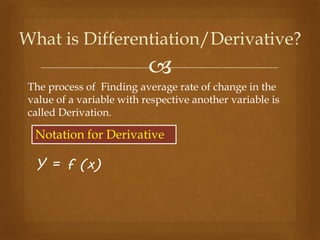
The process of Finding average rate of change in the
value of a variable with respective another variable is
called Derivation.
What is Differentiation/Derivative?
Notation for Derivative
Y = f (x)

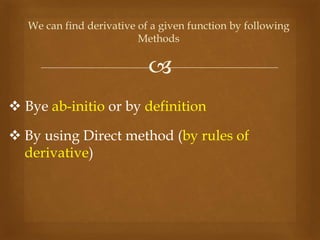
 Bye ab-initio or by definition
We can find derivative of a given function by following
Methods
 By using Direct method (by rules of
derivative)

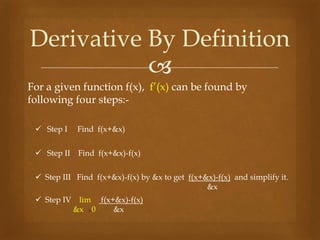
For a given function f(x), f’(x) can be found by
following four steps:-
Derivative By Definition
 Step I Find f(x+&x)
 Step II Find f(x+&x)-f(x)
 Step III Find f(x+&x)-f(x) by &x to get f(x+&x)-f(x) and simplify it.
&x
 Step IV lim f(x+&x)-f(x)
&x 0 &x

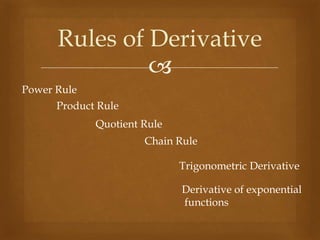
Product Rule
Rules of Derivative
Quotient Rule
Power Rule
Trigonometric Derivative
Derivative of exponential
functions
Chain Rule

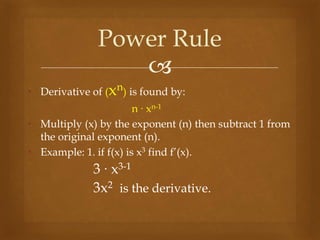
• Derivative of (xn) is found by:
n ∙ xn-1
• Multiply (x) by the exponent (n) then subtract 1 from
the original exponent (n).
• Example: 1. if f(x) is x3 find f’(x).
3 ∙ x3-1
3x2 is the derivative.
Power Rule

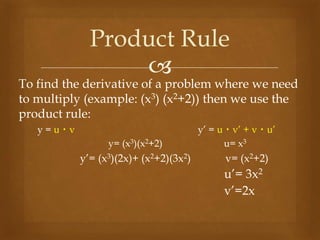
• To find the derivative of a problem where we need
to multiply (example: (x3) (x2+2)) then we use the
product rule:
y = u・v y’ = u・v’ + v・u’
y= (x3)(x2+2) u= x3
• y’= (x3)(2x)+ (x2+2)(3x2) v= (x2+2)
u’= 3x2
v’=2x
Product Rule

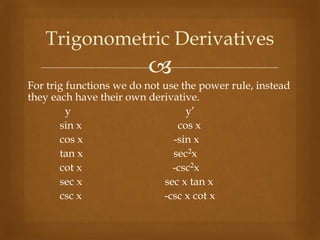
For trig functions we do not use the power rule, instead
they each have their own derivative.
y y’
sin x cos x
cos x -sin x
tan x sec2x
cot x -csc2x
sec x sec x tan x
csc x -csc x cot x
Trigonometric Derivatives

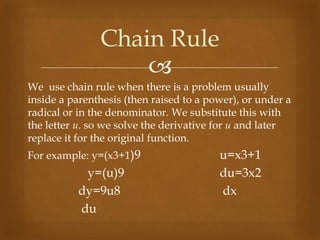
We use chain rule when there is a problem usually
inside a parenthesis (then raised to a power), or under a
radical or in the denominator. We substitute this with
the letter u. so we solve the derivative for u and later
replace it for the original function.
For example: y=(x3+1)9 u=x3+1
y=(u)9 du=3x2
dy=9u8 dx
du
Chain Rule

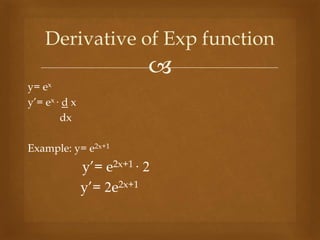
y= ex
y’= ex ∙ d x
dx
Example: y= e2x+1
y’= e2x+1 ∙ 2
y’= 2e2x+1
Derivative of Exp function


Rules of derivative

  • 2.
     The process ofFinding average rate of change in the value of a variable with respective another variable is called Derivation. What is Differentiation/Derivative? Notation for Derivative Y = f (x)
  • 3.
      Bye ab-initioor by definition We can find derivative of a given function by following Methods  By using Direct method (by rules of derivative)
  • 4.
     For a givenfunction f(x), f’(x) can be found by following four steps:- Derivative By Definition  Step I Find f(x+&x)  Step II Find f(x+&x)-f(x)  Step III Find f(x+&x)-f(x) by &x to get f(x+&x)-f(x) and simplify it. &x  Step IV lim f(x+&x)-f(x) &x 0 &x
  • 5.
     Product Rule Rules ofDerivative Quotient Rule Power Rule Trigonometric Derivative Derivative of exponential functions Chain Rule
  • 6.
     • Derivative of(xn) is found by: n ∙ xn-1 • Multiply (x) by the exponent (n) then subtract 1 from the original exponent (n). • Example: 1. if f(x) is x3 find f’(x). 3 ∙ x3-1 3x2 is the derivative. Power Rule
  • 7.
     • To findthe derivative of a problem where we need to multiply (example: (x3) (x2+2)) then we use the product rule: y = u・v y’ = u・v’ + v・u’ y= (x3)(x2+2) u= x3 • y’= (x3)(2x)+ (x2+2)(3x2) v= (x2+2) u’= 3x2 v’=2x Product Rule
  • 8.
     For trig functionswe do not use the power rule, instead they each have their own derivative. y y’ sin x cos x cos x -sin x tan x sec2x cot x -csc2x sec x sec x tan x csc x -csc x cot x Trigonometric Derivatives
  • 9.
     We use chainrule when there is a problem usually inside a parenthesis (then raised to a power), or under a radical or in the denominator. We substitute this with the letter u. so we solve the derivative for u and later replace it for the original function. For example: y=(x3+1)9 u=x3+1 y=(u)9 du=3x2 dy=9u8 dx du Chain Rule
  • 10.
     y= ex y’= ex∙ d x dx Example: y= e2x+1 y’= e2x+1 ∙ 2 y’= 2e2x+1 Derivative of Exp function
  • 11.