ALGEBRAIC CURVES


                   Prepared by:
       Prof. Teresita P. Liwanag – Zapanta
B.S.C.E., M.S.C.M., M.Ed. (Math-units), PhD-TM (on-going)
SPECIFIC OBJECTIVES

      At the end of the lesson, the student is
expected to be able to:

• define and describe the properties of algebraic
curves
• identify the intercepts of a curve
• test the equation of a curve for symmetry
• identify the vertical and horizontal asymptotes
• sketch algebraic curves
ALGEBRAIC CURVES

       An equation involving the variables x and y
is satisfied by an infinite number of values of x
and y, and each pair of values corresponds to a
point. When plotted on the Cartesian plane, these
points follow a pattern according to the given
equation and form a definite geometric figure
called the CURVE or LOCUS OF THE EQUATION.
The method of drawing curves by point-
plotting is a tedious process and usually difficult.
The general appearance of a curve may be
developed by examining some of the properties of
curves.

PROPERTIES OF CURVES
The following are some properties of an algebraic
curve:
1. Extent
2. Symmetry
7.Intercepts
8.Asymptotes
1. EXTENT
       The extent of the graph of an algebraic curve
involves its domain and range. The domain is the
set of permissible values for x and the range is the
set of permissible values for y.
       Regions on which the curve lies and which is
bounded by broken or light vertical lines through
the intersection of the curve with the x-axis.
       To determine whether the curve lies above
and/or below the x-axis, solve for the equation of y
or y2 and note the changes of the sign of the right
hand member of the equation.
2. SYMMETRY
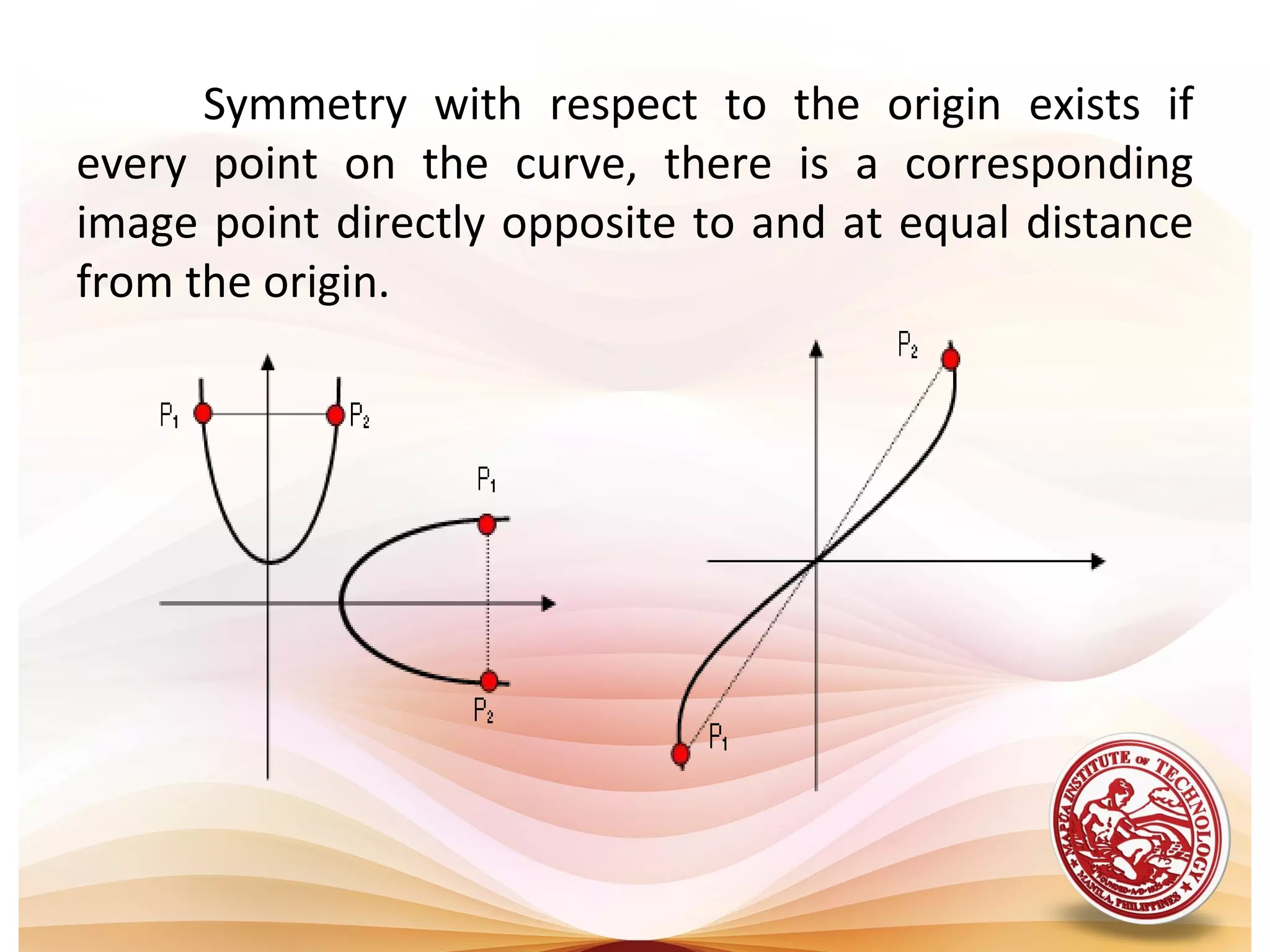
       Symmetry with respect to the coordinate axes
exists on one side of the axis if for every point of the
curve on one side of the axis, there is a
corresponding image on the opposite side of the axis.
      Symmetry with respect to the origin exists if
every point on the curve, there is a corresponding
image point directly opposite to and at equal
distance from the origin.
Symmetry with respect to the origin exists if
every point on the curve, there is a corresponding
image point directly opposite to and at equal distance
from the origin.
Test for Symmetry

1. Substitute –y for y, if the equation is unchanged
then the curve is symmetrical with respect to the
x-axis.
2. Substitute –x for x, if the equation is unchanged
the curve is symmetrical with respect to the y- axis.
3. Substitute – x for x and –y for y, if the equation is
unchanged then the curve is symmetrical with
respect to the origin.
Simplified Test for Symmetry

1. If all y terms have even exponents therefore the
curve is symmetrical with respect to the x-axis.
2. If all x terms have even exponents therefore the
curve is symmetrical with respect to the y-axis.
3. If all terms have even exponents therefore the
curve is symmetrical with respect to the origin.
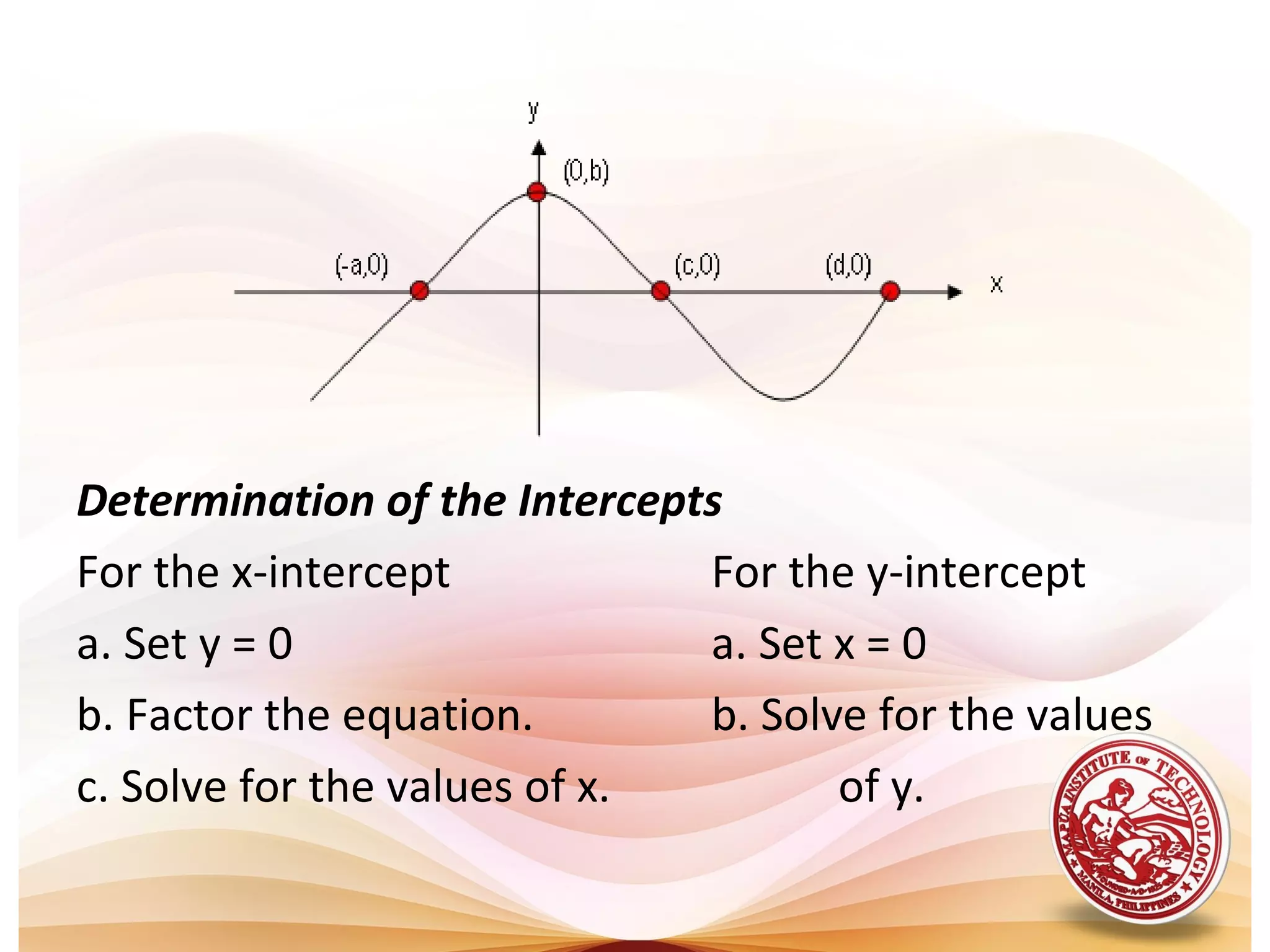
3. INTERCEPTS

       These are the points which the curve crosses
the coordinate axes.
a. x-intercepts – abscissa of the points at which the
curve crosses the x-axis.
b. y-intercepts – ordinate of the points at which the
curve crosses the y-axis.
Determination of the Intercepts
For the x-intercept           For the y-intercept
a. Set y = 0                  a. Set x = 0
b. Factor the equation.       b. Solve for the values
c. Solve for the values of x.        of y.
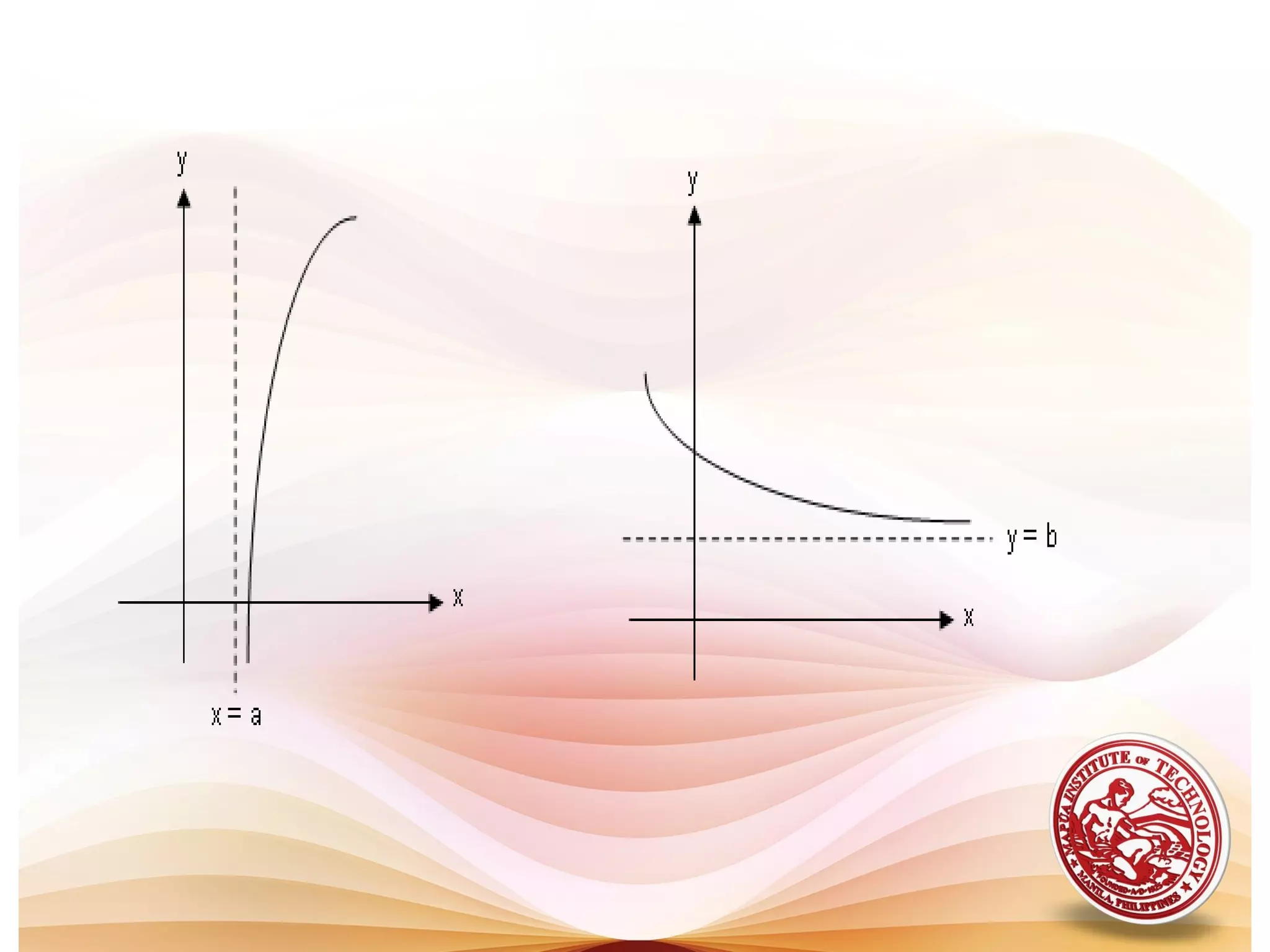
4. Asymptotes

       A straight line is said to be an asymptote of a
curve if the curve approaches such a line more and
more closely but never really touches it except as a
limiting position at infinity. Not all curves have
asymptotes.
Types of Asymptotes

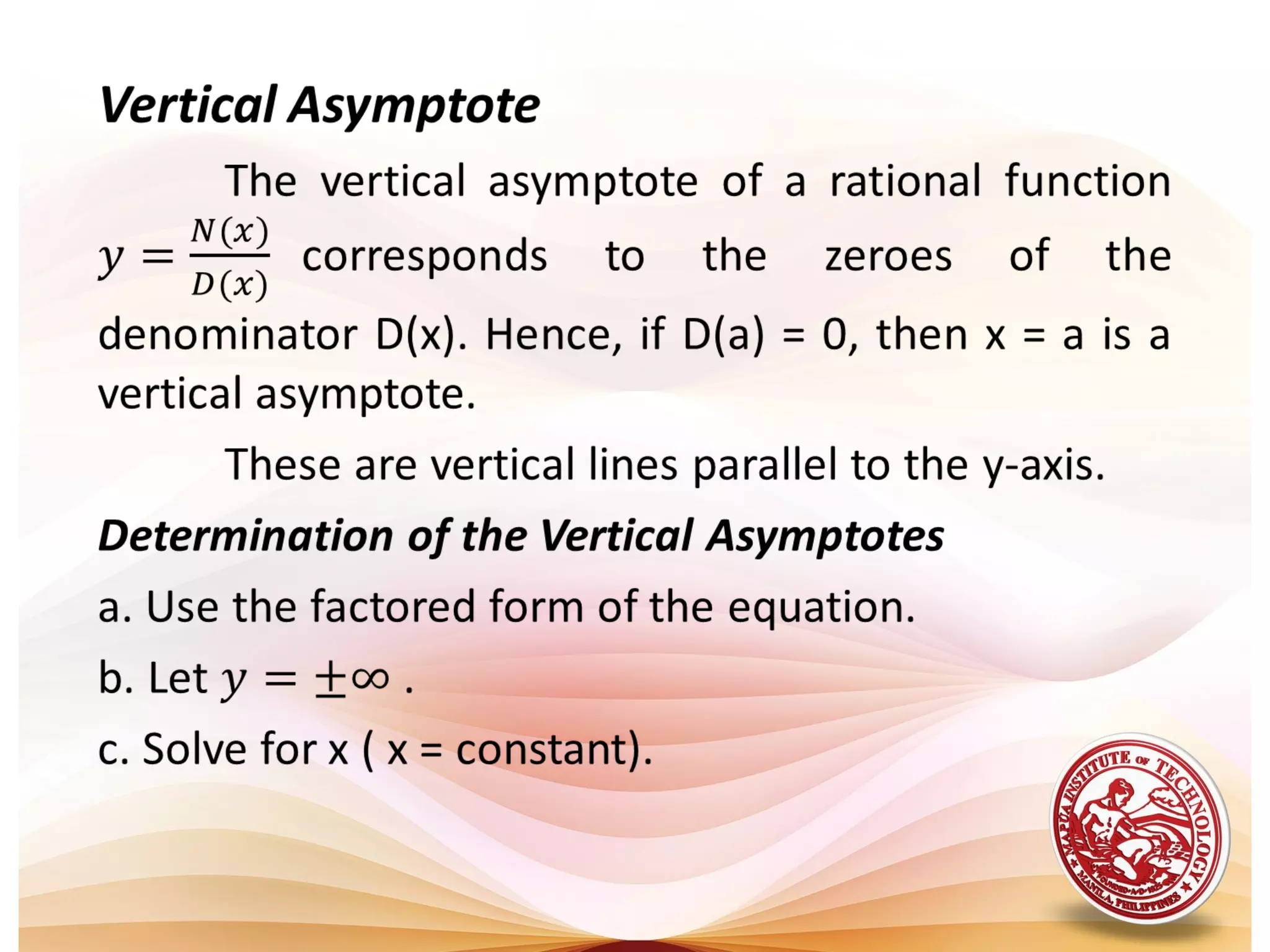
6.Vertical Asymptote
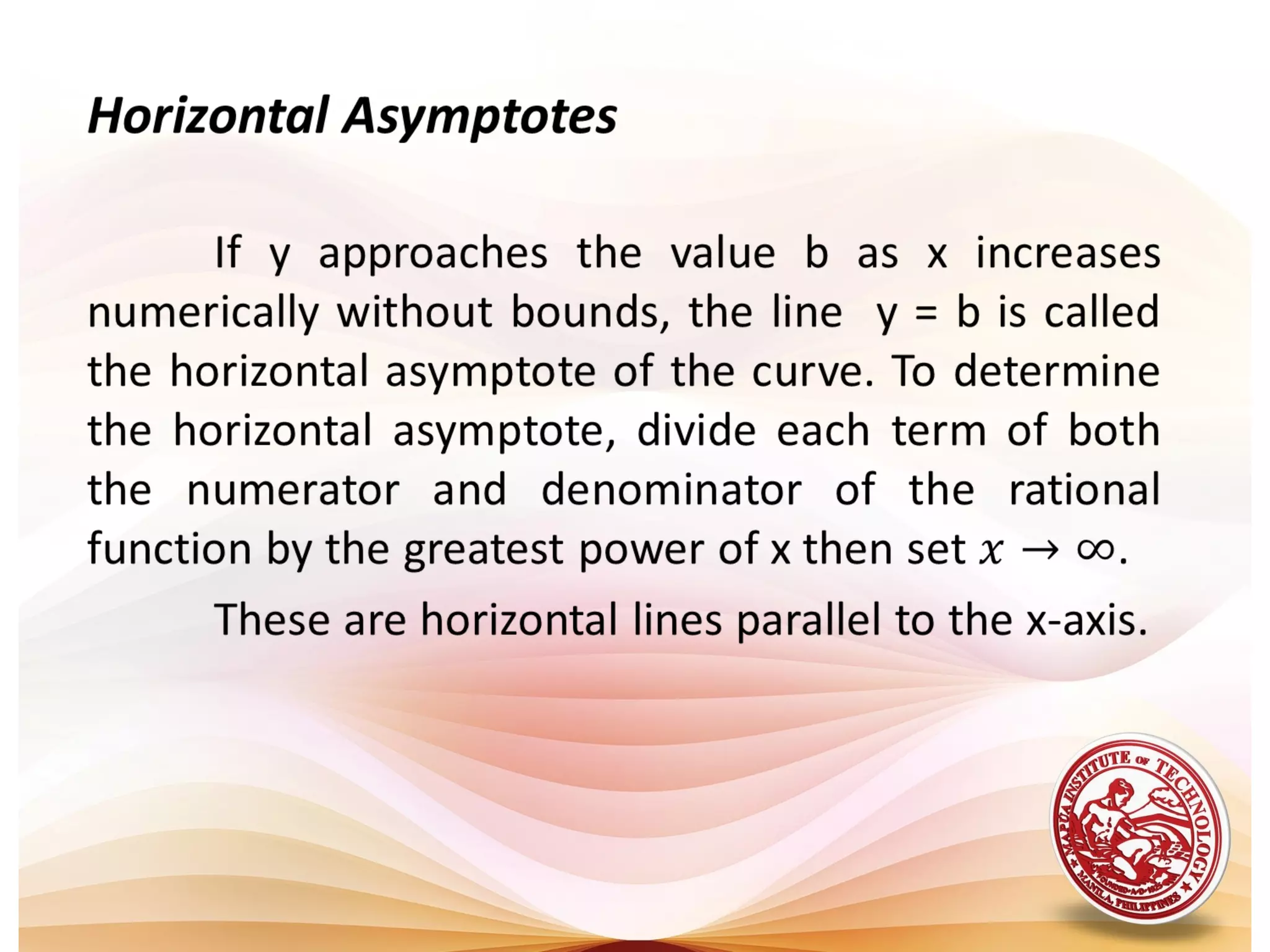
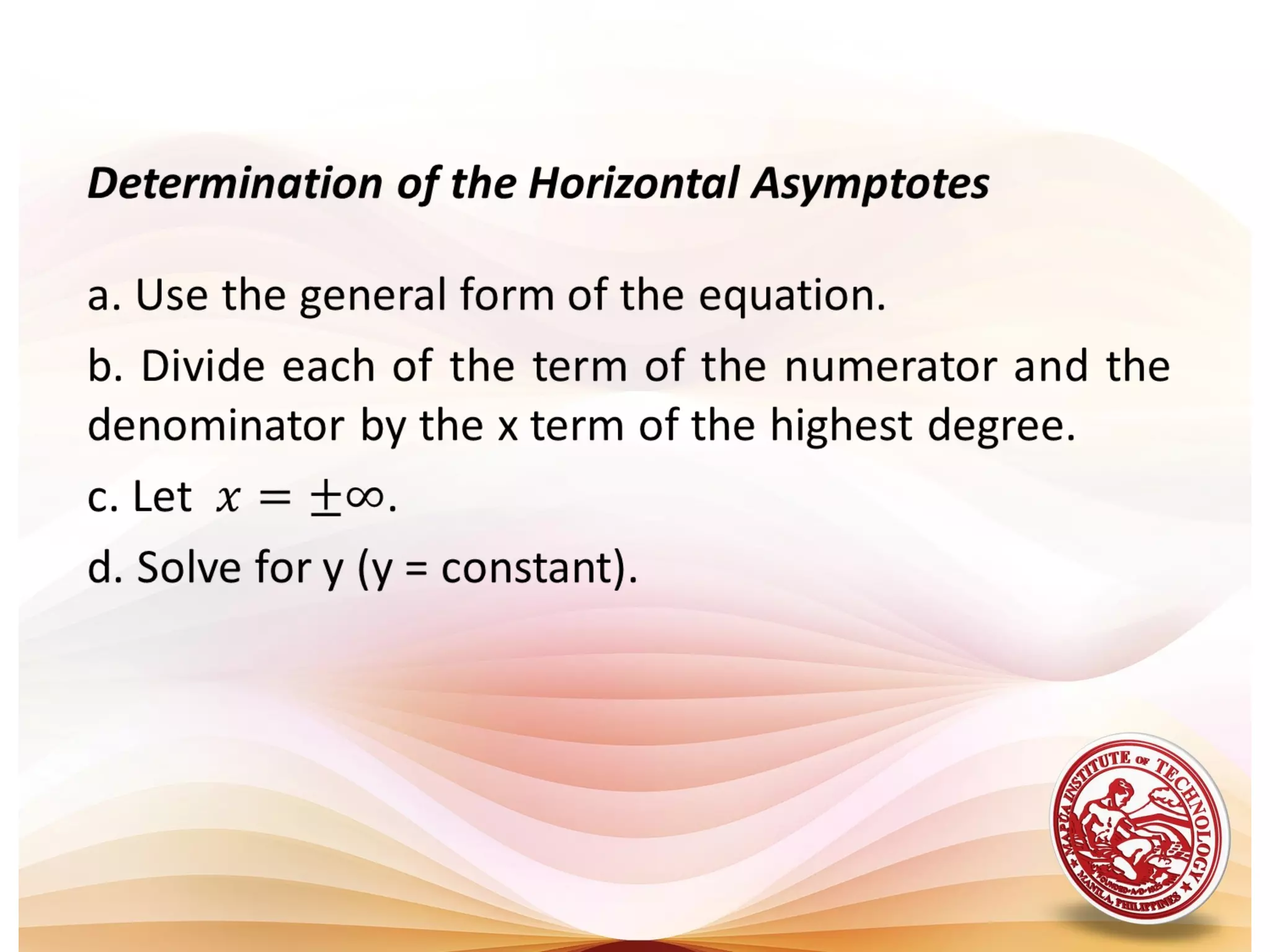
7.Horizontal Asymptote
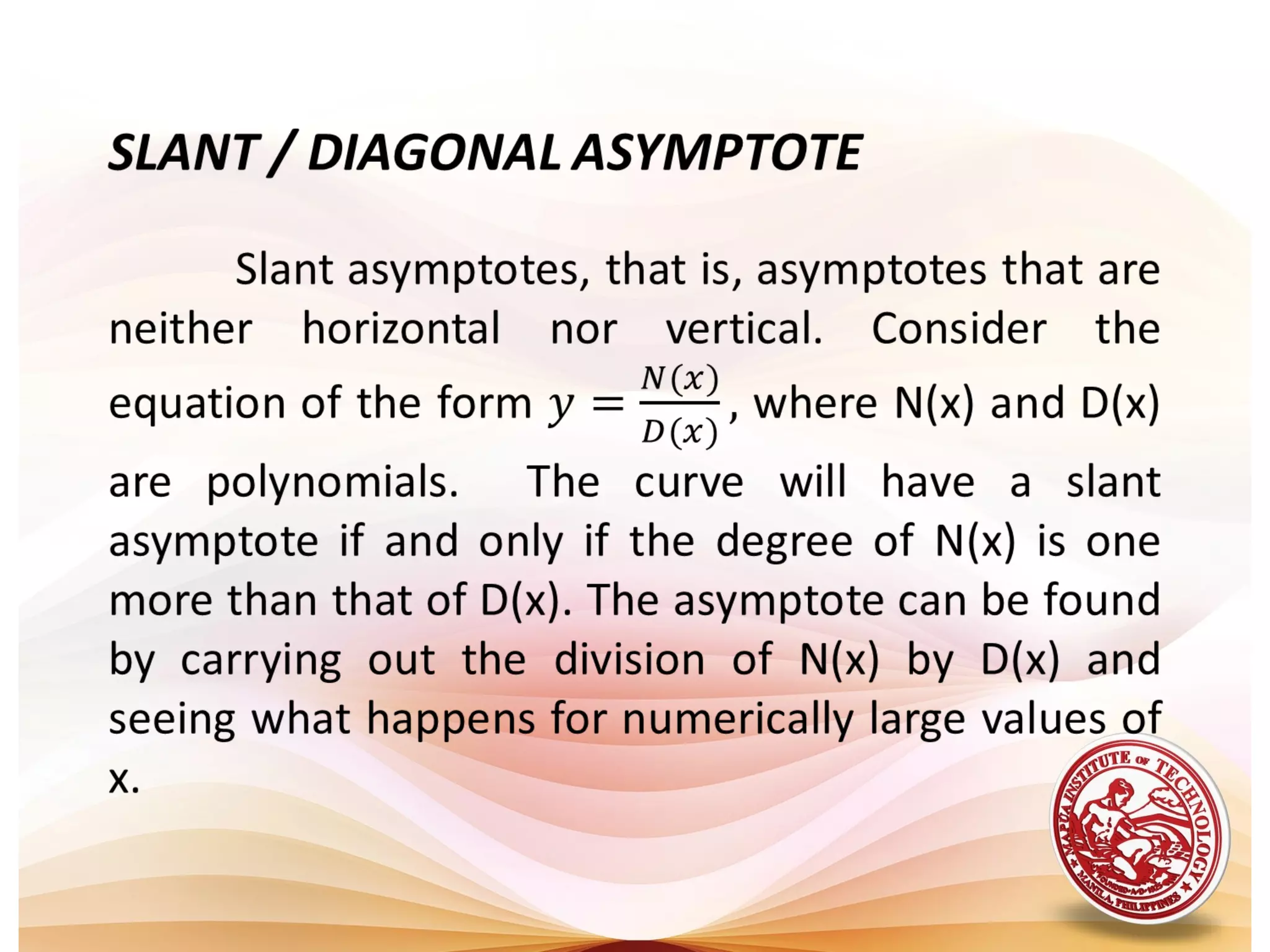
8.Slant/Diagonal Asymptote
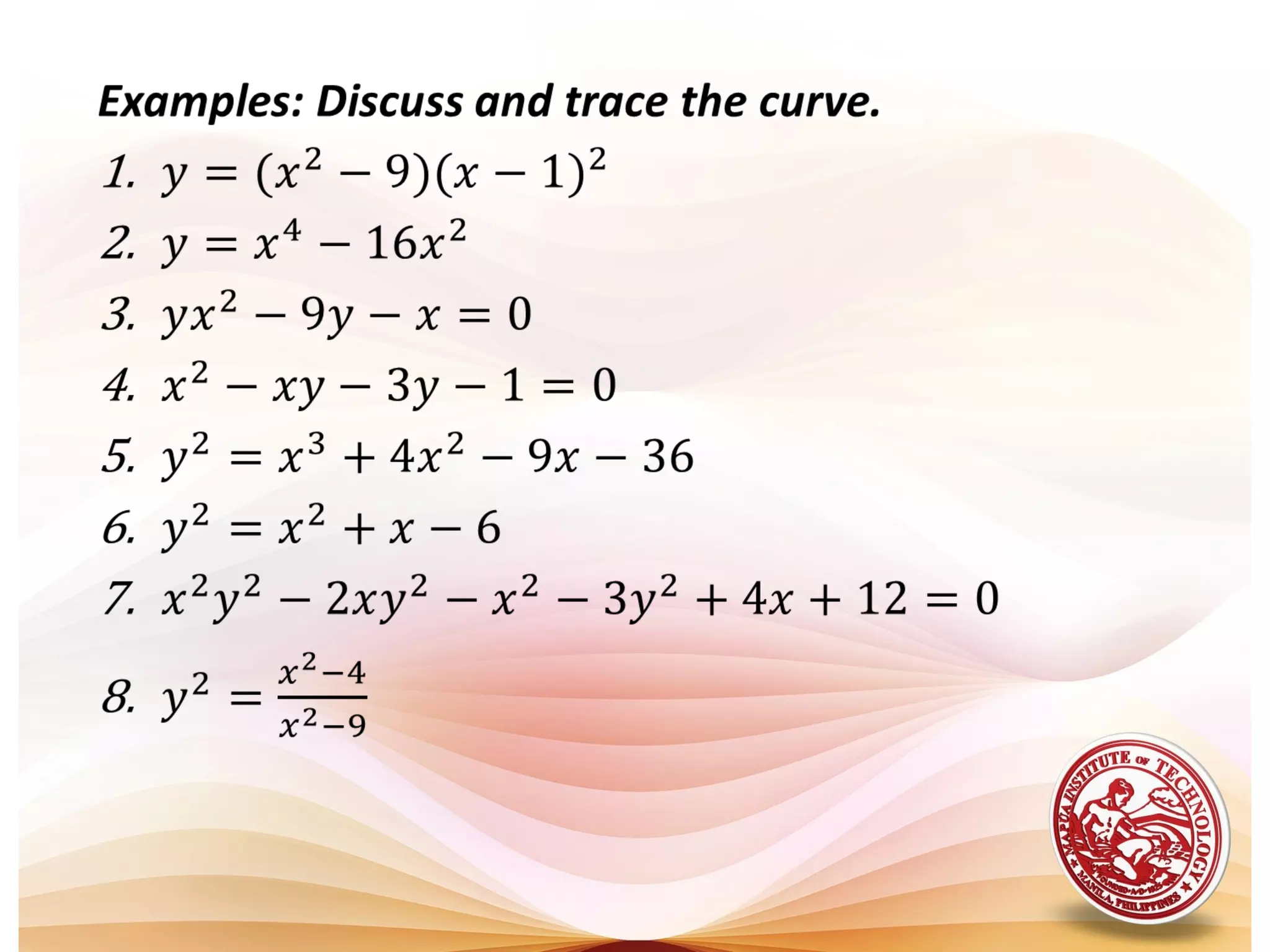
Steps in Curve Tracing
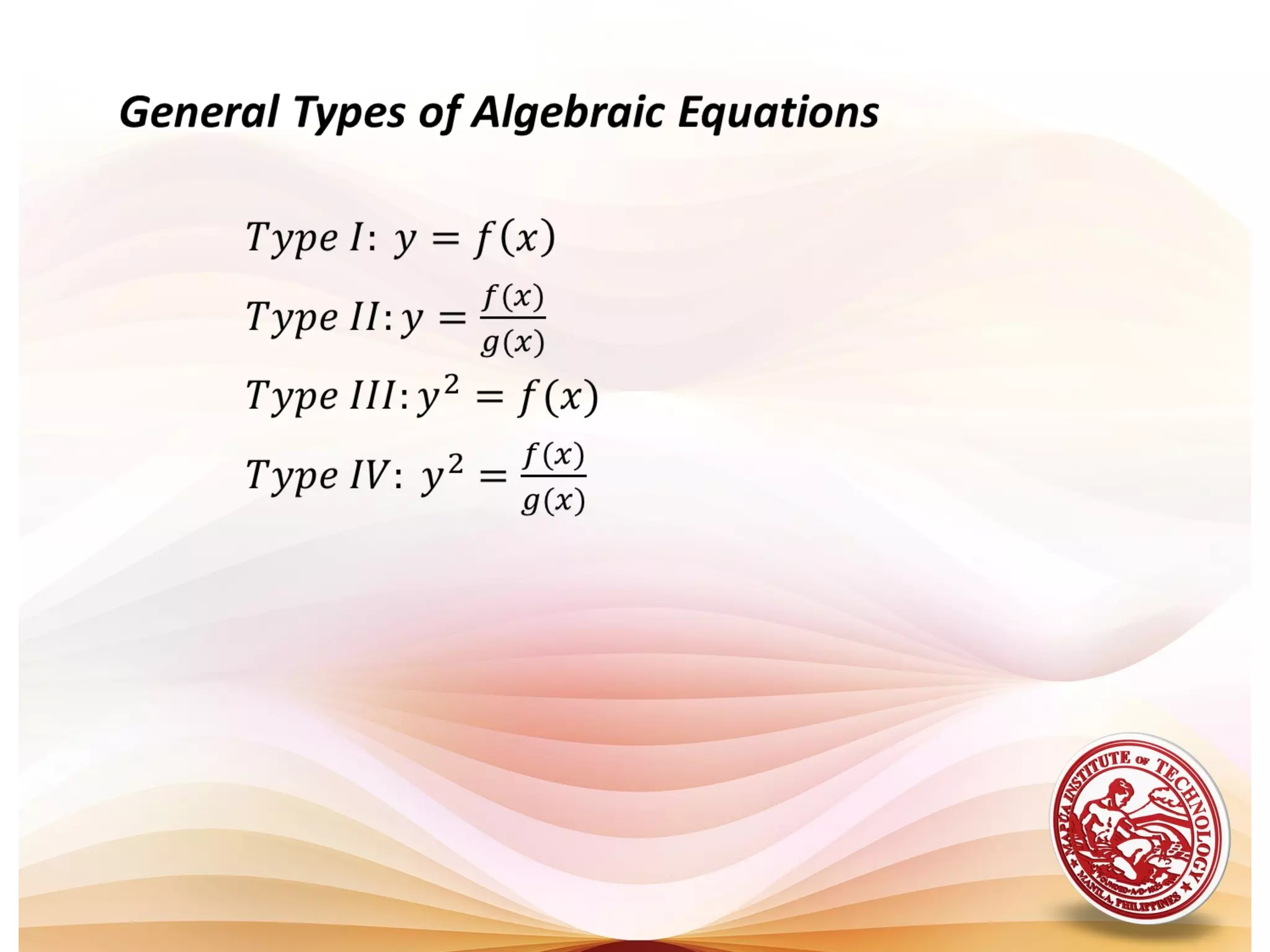
1. If the equation is given in the form of f( x, y) = 0,
solve for y (or y2) to express the equation in a form
identical with the one of the four general types of
the equation.
2. Subject the equation to the test of symmetry.
3. Determine the x and y intercepts.
4. Determine the asymptotes if any. Also determine
the intersection of the curve with the horizontal
asymptotes.
Note: The curve may intercept the horizontal
asymptotes but not the vertical asymptotes.
5. Divide the plane into regions by drawing light
vertical lines through the intersection on the x-axis.
Note: All vertical asymptotes must be considered as
dividing lines.
6. Find the sign of y on each region using the
factored form of the equation to determine whether
the curve lies above and/or below the x-axis.
7. Trace the curve. Plot a few points if necessary.
Lesson 13    algebraic curves

Lesson 13 algebraic curves

  • 1.
    ALGEBRAIC CURVES Prepared by: Prof. Teresita P. Liwanag – Zapanta B.S.C.E., M.S.C.M., M.Ed. (Math-units), PhD-TM (on-going)
  • 2.
    SPECIFIC OBJECTIVES At the end of the lesson, the student is expected to be able to: • define and describe the properties of algebraic curves • identify the intercepts of a curve • test the equation of a curve for symmetry • identify the vertical and horizontal asymptotes • sketch algebraic curves
  • 3.
    ALGEBRAIC CURVES An equation involving the variables x and y is satisfied by an infinite number of values of x and y, and each pair of values corresponds to a point. When plotted on the Cartesian plane, these points follow a pattern according to the given equation and form a definite geometric figure called the CURVE or LOCUS OF THE EQUATION.
  • 4.
    The method ofdrawing curves by point- plotting is a tedious process and usually difficult. The general appearance of a curve may be developed by examining some of the properties of curves. PROPERTIES OF CURVES The following are some properties of an algebraic curve: 1. Extent 2. Symmetry 7.Intercepts 8.Asymptotes
  • 5.
    1. EXTENT The extent of the graph of an algebraic curve involves its domain and range. The domain is the set of permissible values for x and the range is the set of permissible values for y. Regions on which the curve lies and which is bounded by broken or light vertical lines through the intersection of the curve with the x-axis. To determine whether the curve lies above and/or below the x-axis, solve for the equation of y or y2 and note the changes of the sign of the right hand member of the equation.
  • 6.
    2. SYMMETRY Symmetry with respect to the coordinate axes exists on one side of the axis if for every point of the curve on one side of the axis, there is a corresponding image on the opposite side of the axis. Symmetry with respect to the origin exists if every point on the curve, there is a corresponding image point directly opposite to and at equal distance from the origin.
  • 7.
    Symmetry with respectto the origin exists if every point on the curve, there is a corresponding image point directly opposite to and at equal distance from the origin.
  • 8.
    Test for Symmetry 1.Substitute –y for y, if the equation is unchanged then the curve is symmetrical with respect to the x-axis. 2. Substitute –x for x, if the equation is unchanged the curve is symmetrical with respect to the y- axis. 3. Substitute – x for x and –y for y, if the equation is unchanged then the curve is symmetrical with respect to the origin.
  • 9.
    Simplified Test forSymmetry 1. If all y terms have even exponents therefore the curve is symmetrical with respect to the x-axis. 2. If all x terms have even exponents therefore the curve is symmetrical with respect to the y-axis. 3. If all terms have even exponents therefore the curve is symmetrical with respect to the origin.
  • 10.
    3. INTERCEPTS These are the points which the curve crosses the coordinate axes. a. x-intercepts – abscissa of the points at which the curve crosses the x-axis. b. y-intercepts – ordinate of the points at which the curve crosses the y-axis.
  • 11.
    Determination of theIntercepts For the x-intercept For the y-intercept a. Set y = 0 a. Set x = 0 b. Factor the equation. b. Solve for the values c. Solve for the values of x. of y.
  • 12.
    4. Asymptotes A straight line is said to be an asymptote of a curve if the curve approaches such a line more and more closely but never really touches it except as a limiting position at infinity. Not all curves have asymptotes. Types of Asymptotes 6.Vertical Asymptote 7.Horizontal Asymptote 8.Slant/Diagonal Asymptote
  • 19.
    Steps in CurveTracing 1. If the equation is given in the form of f( x, y) = 0, solve for y (or y2) to express the equation in a form identical with the one of the four general types of the equation. 2. Subject the equation to the test of symmetry. 3. Determine the x and y intercepts. 4. Determine the asymptotes if any. Also determine the intersection of the curve with the horizontal asymptotes. Note: The curve may intercept the horizontal asymptotes but not the vertical asymptotes.
  • 20.
    5. Divide theplane into regions by drawing light vertical lines through the intersection on the x-axis. Note: All vertical asymptotes must be considered as dividing lines. 6. Find the sign of y on each region using the factored form of the equation to determine whether the curve lies above and/or below the x-axis. 7. Trace the curve. Plot a few points if necessary.