Module 5: Digital Techniques and
Electronic Instrument Systems
5.8 Integrated Circuits
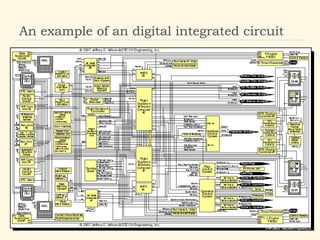
An example of an digital integrated circuit
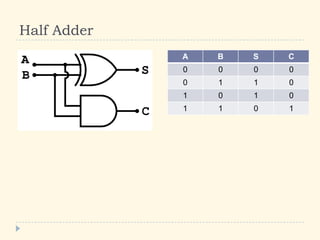
Half Adder
A B S C
0 0 0 0
0 1 1 0
1 0 1 0
1 1 0 1
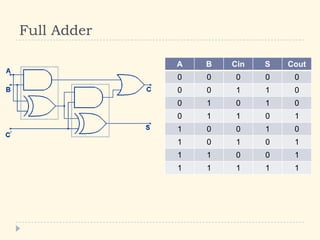
Full Adder
A B Cin S Cout
0 0 0 0 0
0 0 1 1 0
0 1 0 1 0
0 1 1 0 1
1 0 0 1 0
1 0 1 0 1
1 1 0 0 1
1 1 1 1 1
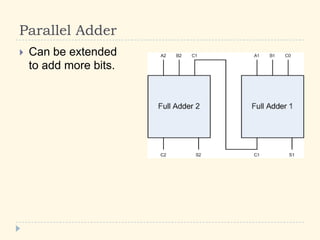
Parallel Adder
 Can be extended
to add more bits.
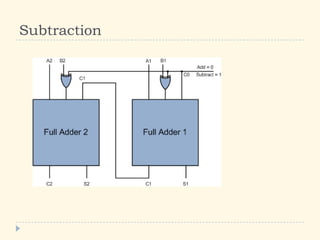
Subtraction
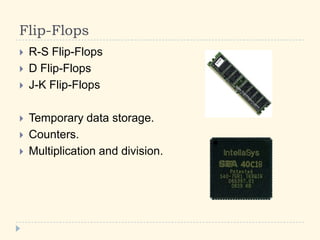
Flip-Flops
 R-S Flip-Flops
 D Flip-Flops
 J-K Flip-Flops
 Temporary data storage.
 Counters.
 Multiplication and division.
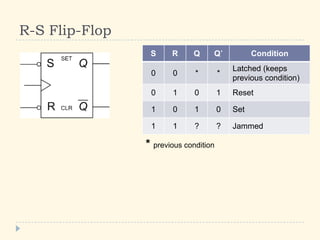
R-S Flip-Flop
S R Q Q΄ Condition
0 0 * *
Latched (keeps
previous condition)
0 1 0 1 Reset
1 0 1 0 Set
1 1 ? ? Jammed
* previous condition
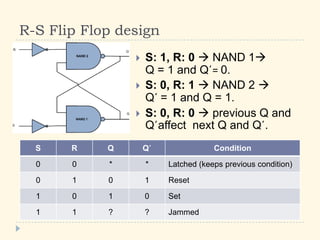
R-S Flip Flop design
 S: 1, R: 0  NAND 1
Q = 1 and Q΄= 0.
 S: 0, R: 1  NAND 2 
Q΄ = 1 and Q = 1.
 S: 0, R: 0  previous Q and
Q΄affect next Q and Q΄.
S R Q Q΄ Condition
0 0 * * Latched (keeps previous condition)
0 1 0 1 Reset
1 0 1 0 Set
1 1 ? ? Jammed
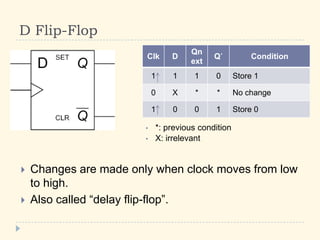
D Flip-Flop
 Changes are made only when clock moves from low
to high.
 Also called “delay flip-flop”.
Clk D
Qn
ext
Q΄ Condition
1 1 1 0 Store 1
0 X * * No change
1 0 0 1 Store 0
• *: previous condition
• X: irrelevant
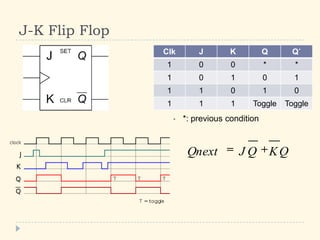
J-K Flip Flop
Clk J K Q Q΄
1 0 0 * *
1 0 1 0 1
1 1 0 1 0
1 1 1 Toggle Toggle
QKQJQnext
• *: previous condition
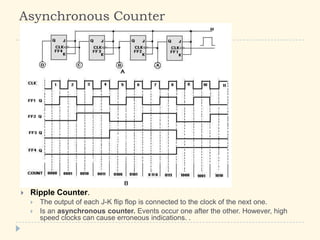
Asynchronous Counter
 Ripple Counter.
 The output of each J-K flip flop is connected to the clock of the next one.
 Is an asynchronous counter. Events occur one after the other. However, high
speed clocks can cause erroneous indications. .
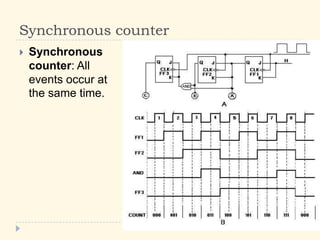
Synchronous counter
 Synchronous
counter: All
events occur at
the same time.
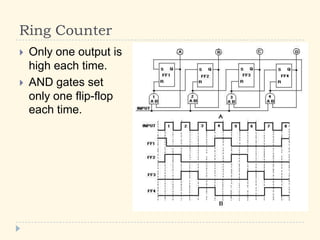
Ring Counter
 Only one output is
high each time.
 AND gates set
only one flip-flop
each time.
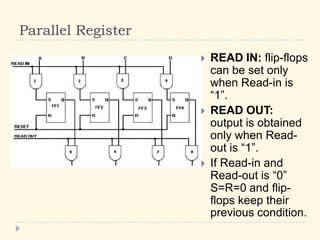
Parallel Register
 READ IN: flip-flops
can be set only
when Read-in is
“1”.
 READ OUT:
output is obtained
only when Read-
out is “1”.
 If Read-in and
Read-out is “0”
S=R=0 and flip-
flops keep their
previous condition.
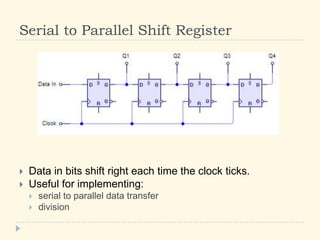
Serial to Parallel Shift Register
 Data in bits shift right each time the clock ticks.
 Useful for implementing:
 serial to parallel data transfer
 division
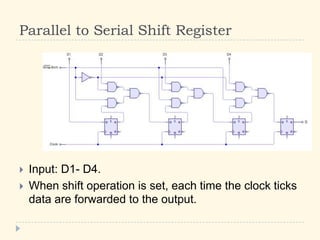
Parallel to Serial Shift Register
 Input: D1- D4.
 When shift operation is set, each time the clock ticks
data are forwarded to the output.
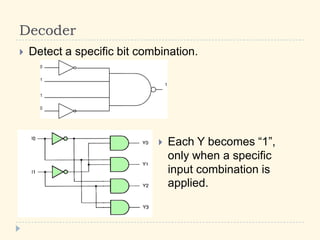
Decoder
 Detect a specific bit combination.
 Each Y becomes “1”,
only when a specific
input combination is
applied.
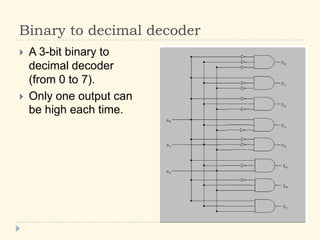
Binary to decimal decoder
 A 3-bit binary to
decimal decoder
(from 0 to 7).
 Only one output can
be high each time.
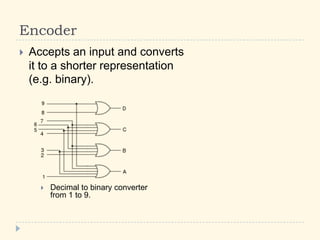
Encoder
 Accepts an input and converts
it to a shorter representation
(e.g. binary).
 Decimal to binary converter
from 1 to 9.
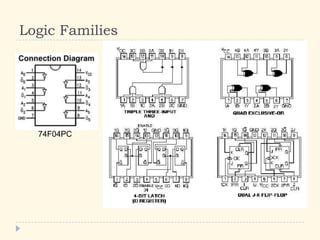
Logic Families
74F04PC

5.8 Integrated circuits

  • 1.
    Module 5: DigitalTechniques and Electronic Instrument Systems 5.8 Integrated Circuits
  • 2.
    An example ofan digital integrated circuit
  • 3.
    Half Adder A BS C 0 0 0 0 0 1 1 0 1 0 1 0 1 1 0 1
  • 4.
    Full Adder A BCin S Cout 0 0 0 0 0 0 0 1 1 0 0 1 0 1 0 0 1 1 0 1 1 0 0 1 0 1 0 1 0 1 1 1 0 0 1 1 1 1 1 1
  • 5.
    Parallel Adder  Canbe extended to add more bits.
  • 6.
  • 7.
    Flip-Flops  R-S Flip-Flops D Flip-Flops  J-K Flip-Flops  Temporary data storage.  Counters.  Multiplication and division.
  • 8.
    R-S Flip-Flop S RQ Q΄ Condition 0 0 * * Latched (keeps previous condition) 0 1 0 1 Reset 1 0 1 0 Set 1 1 ? ? Jammed * previous condition
  • 9.
    R-S Flip Flopdesign  S: 1, R: 0  NAND 1 Q = 1 and Q΄= 0.  S: 0, R: 1  NAND 2  Q΄ = 1 and Q = 1.  S: 0, R: 0  previous Q and Q΄affect next Q and Q΄. S R Q Q΄ Condition 0 0 * * Latched (keeps previous condition) 0 1 0 1 Reset 1 0 1 0 Set 1 1 ? ? Jammed
  • 10.
    D Flip-Flop  Changesare made only when clock moves from low to high.  Also called “delay flip-flop”. Clk D Qn ext Q΄ Condition 1 1 1 0 Store 1 0 X * * No change 1 0 0 1 Store 0 • *: previous condition • X: irrelevant
  • 11.
    J-K Flip Flop ClkJ K Q Q΄ 1 0 0 * * 1 0 1 0 1 1 1 0 1 0 1 1 1 Toggle Toggle QKQJQnext • *: previous condition
  • 12.
    Asynchronous Counter  RippleCounter.  The output of each J-K flip flop is connected to the clock of the next one.  Is an asynchronous counter. Events occur one after the other. However, high speed clocks can cause erroneous indications. .
  • 13.
    Synchronous counter  Synchronous counter:All events occur at the same time.
  • 14.
    Ring Counter  Onlyone output is high each time.  AND gates set only one flip-flop each time.
  • 15.
    Parallel Register  READIN: flip-flops can be set only when Read-in is “1”.  READ OUT: output is obtained only when Read- out is “1”.  If Read-in and Read-out is “0” S=R=0 and flip- flops keep their previous condition.
  • 16.
    Serial to ParallelShift Register  Data in bits shift right each time the clock ticks.  Useful for implementing:  serial to parallel data transfer  division
  • 17.
    Parallel to SerialShift Register  Input: D1- D4.  When shift operation is set, each time the clock ticks data are forwarded to the output.
  • 18.
    Decoder  Detect aspecific bit combination.  Each Y becomes “1”, only when a specific input combination is applied.
  • 19.
    Binary to decimaldecoder  A 3-bit binary to decimal decoder (from 0 to 7).  Only one output can be high each time.
  • 20.
    Encoder  Accepts aninput and converts it to a shorter representation (e.g. binary).  Decimal to binary converter from 1 to 9.
  • 21.