Module 5: Digital Techniques and
Electronic Instrument Systems
5.2 Numbering Systems
Number and Base
 Base: How many symbols (digits) are used in the
current numbering system?
 e.g. if the base of a number is 10, we use (maximum) 10
symbols to display this number.
 if the base of a number is 8, we use 8 symbols to display
this number. (0, 1, 2, 3, 4, 5, 6, 7).
 Examples: 1578, 1808210, 1001012.
MSD and LSD
 In every numbering system, the value of a digit is
determined not only by its symbol, but also by its
position.
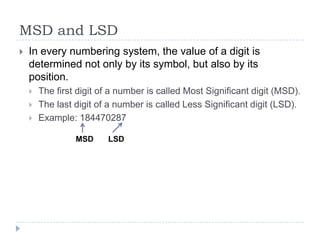
 The first digit of a number is called Most Significant digit (MSD).
 The last digit of a number is called Less Significant digit (LSD).
 Example: 184470287
MSD LSD
Binary System Rules
 0 + 0 = 0
 1 + 0 = 1
 0 + 1 = 1
 1 + 1 = 0 and 1 carry.
 0 – 0 = 0
 1 – 0 = 1
 0 – 1 = 1 with 1 carry
 1 – 1 = 0
 Complementary
subtraction:
 Get the complementary
of the subtrahend.
 Add 1
 Make addition
 Discard any carries that
exceed the size of the
minuend.
Numbering System Conversions
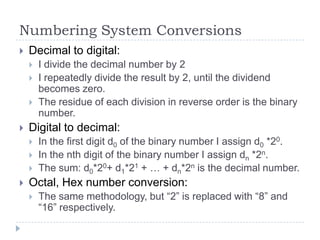
 Decimal to digital:
 I divide the decimal number by 2
 I repeatedly divide the result by 2, until the dividend
becomes zero.
 The residue of each division in reverse order is the binary
number.
 Digital to decimal:
 In the first digit d0 of the binary number I assign d0 *20.
 In the nth digit of the binary number I assign dn *2n.
 The sum: d0*20+ d1*21 + … + dn*2n is the decimal number.
 Octal, Hex number conversion:
 The same methodology, but “2” is replaced with “8” and
“16” respectively.

5.2 Numbering systems

  • 1.
    Module 5: DigitalTechniques and Electronic Instrument Systems 5.2 Numbering Systems
  • 2.
    Number and Base Base: How many symbols (digits) are used in the current numbering system?  e.g. if the base of a number is 10, we use (maximum) 10 symbols to display this number.  if the base of a number is 8, we use 8 symbols to display this number. (0, 1, 2, 3, 4, 5, 6, 7).  Examples: 1578, 1808210, 1001012.
  • 3.
    MSD and LSD In every numbering system, the value of a digit is determined not only by its symbol, but also by its position.  The first digit of a number is called Most Significant digit (MSD).  The last digit of a number is called Less Significant digit (LSD).  Example: 184470287 MSD LSD
  • 4.
    Binary System Rules 0 + 0 = 0  1 + 0 = 1  0 + 1 = 1  1 + 1 = 0 and 1 carry.  0 – 0 = 0  1 – 0 = 1  0 – 1 = 1 with 1 carry  1 – 1 = 0  Complementary subtraction:  Get the complementary of the subtrahend.  Add 1  Make addition  Discard any carries that exceed the size of the minuend.
  • 5.
    Numbering System Conversions Decimal to digital:  I divide the decimal number by 2  I repeatedly divide the result by 2, until the dividend becomes zero.  The residue of each division in reverse order is the binary number.  Digital to decimal:  In the first digit d0 of the binary number I assign d0 *20.  In the nth digit of the binary number I assign dn *2n.  The sum: d0*20+ d1*21 + … + dn*2n is the decimal number.  Octal, Hex number conversion:  The same methodology, but “2” is replaced with “8” and “16” respectively.