Application of Propositional Logic
o Propositional logic can be applied to the design of computer
hardware.
o A logic circuit (or digital circuit) receives input signals p1, p2, .
. . , pn, each a bit [either 0 (off) or 1 (on)], and produces
output signals s1, s2, . . . , sn, each a bit.
– Because of variety of digital circuits think basic circuits
black boxes.
Application: Digital Circuits
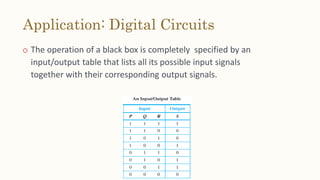
o The operation of a black box is completely specified by an
input/output table that lists all its possible input signals
together with their corresponding output signals.
Application: Digital Circuits
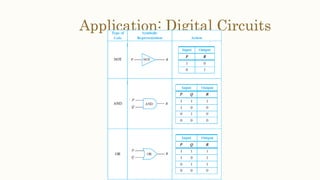
o Complicated digital circuits can be constructed from three
basic circuits, called gates,
o Three such circuits are known as NOT-, AND-, and OR-
gates.
o A NOT-gate (or inverter) is a circuit with one input signal
and one output signal. If the input signal is 1, the output
signal is 0. Conversely, if the input signal is 0, then the
output signal is 1.
Application: Digital Circuits
o An AND-gate is a circuit with two input signals and one
output signal. If both input signals are 1, then the output
signal is 1. Otherwise, the output signal is 0.
o An OR-gate also has two input signals and one output
signal. If both input signals are 0, then the output signal is
0. Otherwise, the output signal is 1.
Application: Digital Circuits
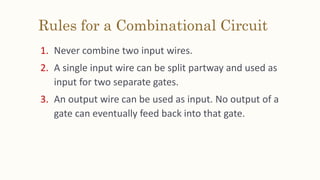
Rules for a Combinational Circuit
1. Never combine two input wires.
2. A single input wire can be split partway and used as
input for two separate gates.
3. An output wire can be used as input. No output of a
gate can eventually feed back into that gate.
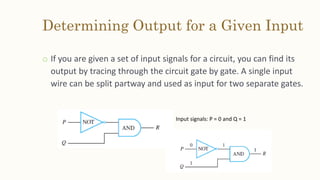
Determining Output for a Given Input
o If you are given a set of input signals for a circuit, you can find its
output by tracing through the circuit gate by gate. A single input
wire can be split partway and used as input for two separate gates.
Input signals: P = 0 and Q = 1
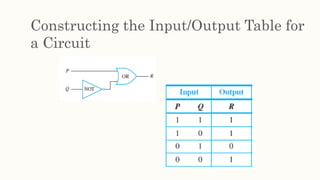
Constructing the Input/Output Table for
a Circuit
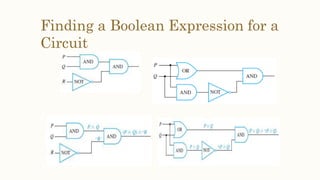
Finding a Boolean Expression for a
Circuit
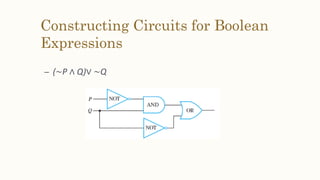
Constructing Circuits for Boolean
Expressions
– (∼P ∧ Q)∨ ∼Q
Constructing Circuits for Boolean
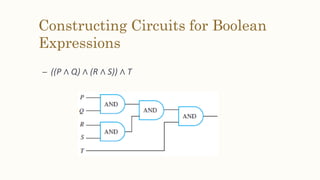
Expressions
– ((P ∧ Q) ∧ (R ∧ S)) ∧ T
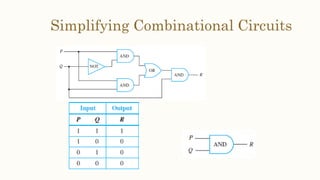
Simplifying Combinational Circuits
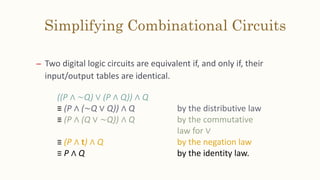
– Two digital logic circuits are equivalent if, and only if, their
input/output tables are identical.
((P ∧ ∼Q) ∨ (P ∧ Q)) ∧ Q
≡ (P ∧ (∼Q ∨ Q)) ∧ Q by the distributive law
≡ (P ∧ (Q ∨ ∼Q)) ∧ Q by the commutative
law for ∨
≡ (P ∧ t) ∧ Q by the negation law
≡ P ∧ Q by the identity law.
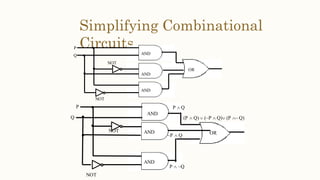
Simplifying Combinational
Circuits
AND
AND
AND
OR
P
Q
NOT
NOT
AND
AND
AND
OR
P
Q
NOT
NOT
P Ù Q
~P Ù Q
P Ù ~Q
(P Ù Q) Ú (~P Ù Q)Ú (P Ù~ Q)
Simplifying Combinational
Circuits
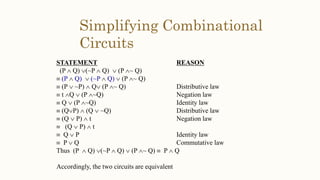
STATEMENT REASON
(P Ù Q) Ú(~P Ù Q) Ú (P Ù~ Q)
 (P Ù Q) Ú (~P Ù Q) Ú (P Ù~ Q)
 (P Ú ~P) Ù QÚ (P Ù~ Q) Distributive law
 t ÙQ Ú (P Ù~Q) Negation law
 Q Ú (P Ù~Q) Identity law
 (QÚP) Ù (Q Ú ~Q) Distributive law
 (Q Ú P) Ù t Negation law
 (Q Ú P) Ù t
 Q Ú P Identity law
 P Ú Q Commutative law
Thus (P Ù Q) Ú(~P Ù Q) Ú (P Ù~ Q)  P Ù Q
Accordingly, the two circuits are equivalent
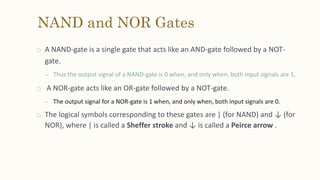
NAND and NOR Gates
o A NAND-gate is a single gate that acts like an AND-gate followed by a NOT-
gate.
– Thus the output signal of a NAND-gate is 0 when, and only when, both input signals are 1,
o A NOR-gate acts like an OR-gate followed by a NOT-gate.
– The output signal for a NOR-gate is 1 when, and only when, both input signals are 0.
o The logical symbols corresponding to these gates are | (for NAND) and ↓ (for
NOR), where | is called a Sheffer stroke and ↓ is called a Peirce arrow .
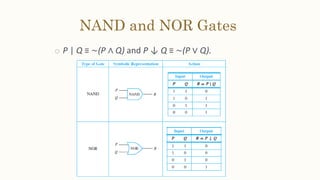
NAND and NOR Gates
o P | Q ≡ ∼(P ∧ Q) and P ↓ Q ≡ ∼(P ∨ Q).

Constructing circuits for boolean expressions(gate)

  • 2.
    Application of PropositionalLogic o Propositional logic can be applied to the design of computer hardware. o A logic circuit (or digital circuit) receives input signals p1, p2, . . . , pn, each a bit [either 0 (off) or 1 (on)], and produces output signals s1, s2, . . . , sn, each a bit. – Because of variety of digital circuits think basic circuits black boxes.
  • 3.
    Application: Digital Circuits oThe operation of a black box is completely specified by an input/output table that lists all its possible input signals together with their corresponding output signals.
  • 4.
    Application: Digital Circuits oComplicated digital circuits can be constructed from three basic circuits, called gates, o Three such circuits are known as NOT-, AND-, and OR- gates. o A NOT-gate (or inverter) is a circuit with one input signal and one output signal. If the input signal is 1, the output signal is 0. Conversely, if the input signal is 0, then the output signal is 1.
  • 5.
    Application: Digital Circuits oAn AND-gate is a circuit with two input signals and one output signal. If both input signals are 1, then the output signal is 1. Otherwise, the output signal is 0. o An OR-gate also has two input signals and one output signal. If both input signals are 0, then the output signal is 0. Otherwise, the output signal is 1.
  • 6.
  • 7.
    Rules for aCombinational Circuit 1. Never combine two input wires. 2. A single input wire can be split partway and used as input for two separate gates. 3. An output wire can be used as input. No output of a gate can eventually feed back into that gate.
  • 8.
    Determining Output fora Given Input o If you are given a set of input signals for a circuit, you can find its output by tracing through the circuit gate by gate. A single input wire can be split partway and used as input for two separate gates. Input signals: P = 0 and Q = 1
  • 9.
    Constructing the Input/OutputTable for a Circuit
  • 10.
    Finding a BooleanExpression for a Circuit
  • 11.
    Constructing Circuits forBoolean Expressions – (∼P ∧ Q)∨ ∼Q
  • 12.
    Constructing Circuits forBoolean Expressions – ((P ∧ Q) ∧ (R ∧ S)) ∧ T
  • 13.
  • 14.
    Simplifying Combinational Circuits –Two digital logic circuits are equivalent if, and only if, their input/output tables are identical. ((P ∧ ∼Q) ∨ (P ∧ Q)) ∧ Q ≡ (P ∧ (∼Q ∨ Q)) ∧ Q by the distributive law ≡ (P ∧ (Q ∨ ∼Q)) ∧ Q by the commutative law for ∨ ≡ (P ∧ t) ∧ Q by the negation law ≡ P ∧ Q by the identity law.
  • 15.
  • 16.
    Simplifying Combinational Circuits STATEMENT REASON (PÙ Q) Ú(~P Ù Q) Ú (P Ù~ Q)  (P Ù Q) Ú (~P Ù Q) Ú (P Ù~ Q)  (P Ú ~P) Ù QÚ (P Ù~ Q) Distributive law  t ÙQ Ú (P Ù~Q) Negation law  Q Ú (P Ù~Q) Identity law  (QÚP) Ù (Q Ú ~Q) Distributive law  (Q Ú P) Ù t Negation law  (Q Ú P) Ù t  Q Ú P Identity law  P Ú Q Commutative law Thus (P Ù Q) Ú(~P Ù Q) Ú (P Ù~ Q)  P Ù Q Accordingly, the two circuits are equivalent
  • 17.
    NAND and NORGates o A NAND-gate is a single gate that acts like an AND-gate followed by a NOT- gate. – Thus the output signal of a NAND-gate is 0 when, and only when, both input signals are 1, o A NOR-gate acts like an OR-gate followed by a NOT-gate. – The output signal for a NOR-gate is 1 when, and only when, both input signals are 0. o The logical symbols corresponding to these gates are | (for NAND) and ↓ (for NOR), where | is called a Sheffer stroke and ↓ is called a Peirce arrow .
  • 18.
    NAND and NORGates o P | Q ≡ ∼(P ∧ Q) and P ↓ Q ≡ ∼(P ∨ Q).