1

BJT
Voltage Divider Biasing
Objectives
2



At the end of the module the student would be
able to explain


Study Voltage Divider Bias
Voltage Divider Bias Circuit
3



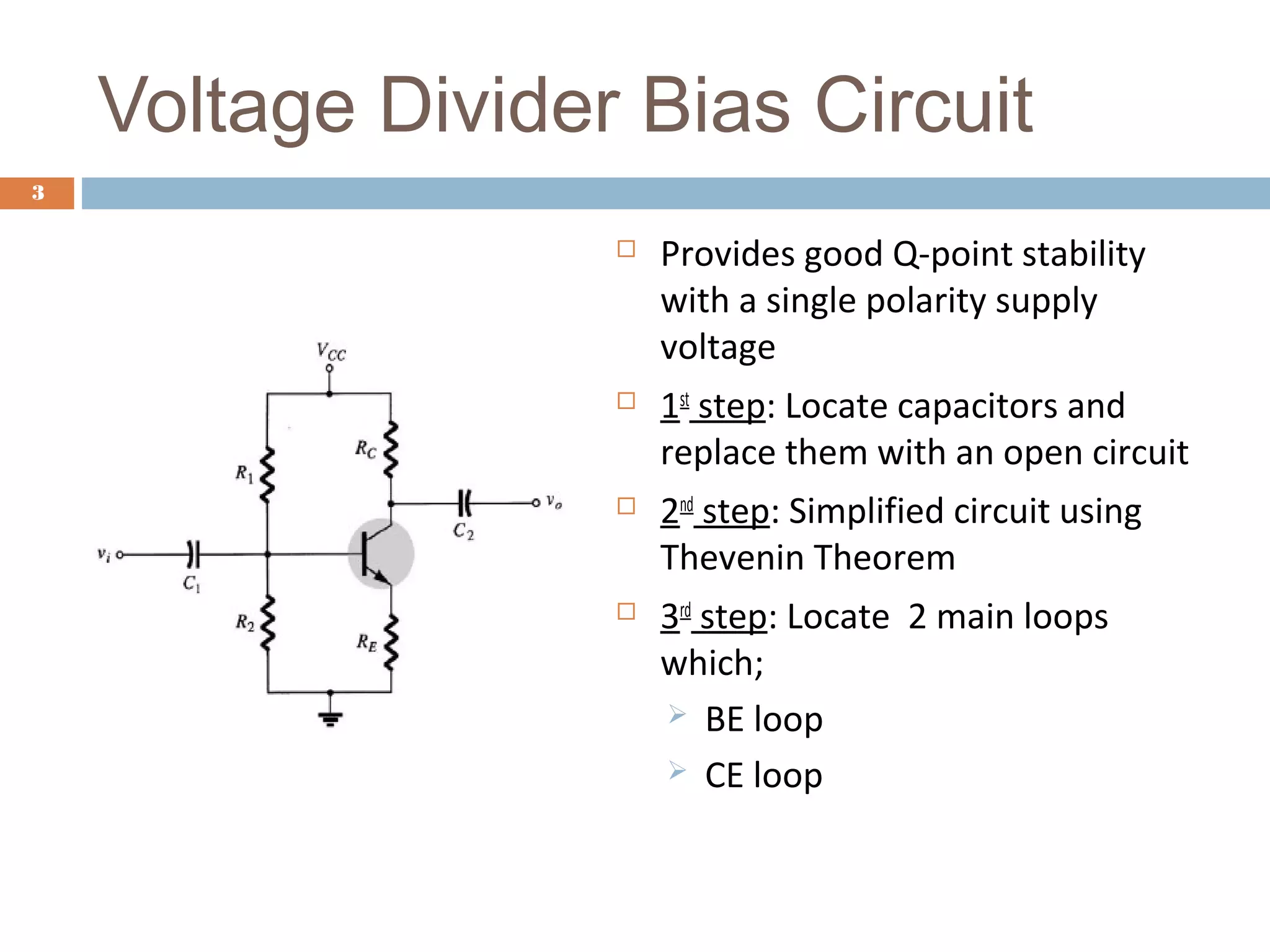
Provides good Q-point stability
with a single polarity supply
voltage



1st step: Locate capacitors and
replace them with an open circuit



2nd step: Simplified circuit using
Thevenin Theorem



3rd step: Locate 2 main loops
which;
 BE loop
 CE loop
Voltage Divider Bias Circuit
4



1st step: Locate capacitors and replace them with
an open circuit
Voltage Divider Bias Circuit
5

■ 2nd step: : Simplified circuit using Thevenin
Theorem

From Thevenin Theorem;
Thevenin Theorem;

RTH = R1 // R2 =

VTH =

R1 ×R2
R1 +R2

R2
VCC
R1 +R2
Voltage Divider Bias Circuit
6

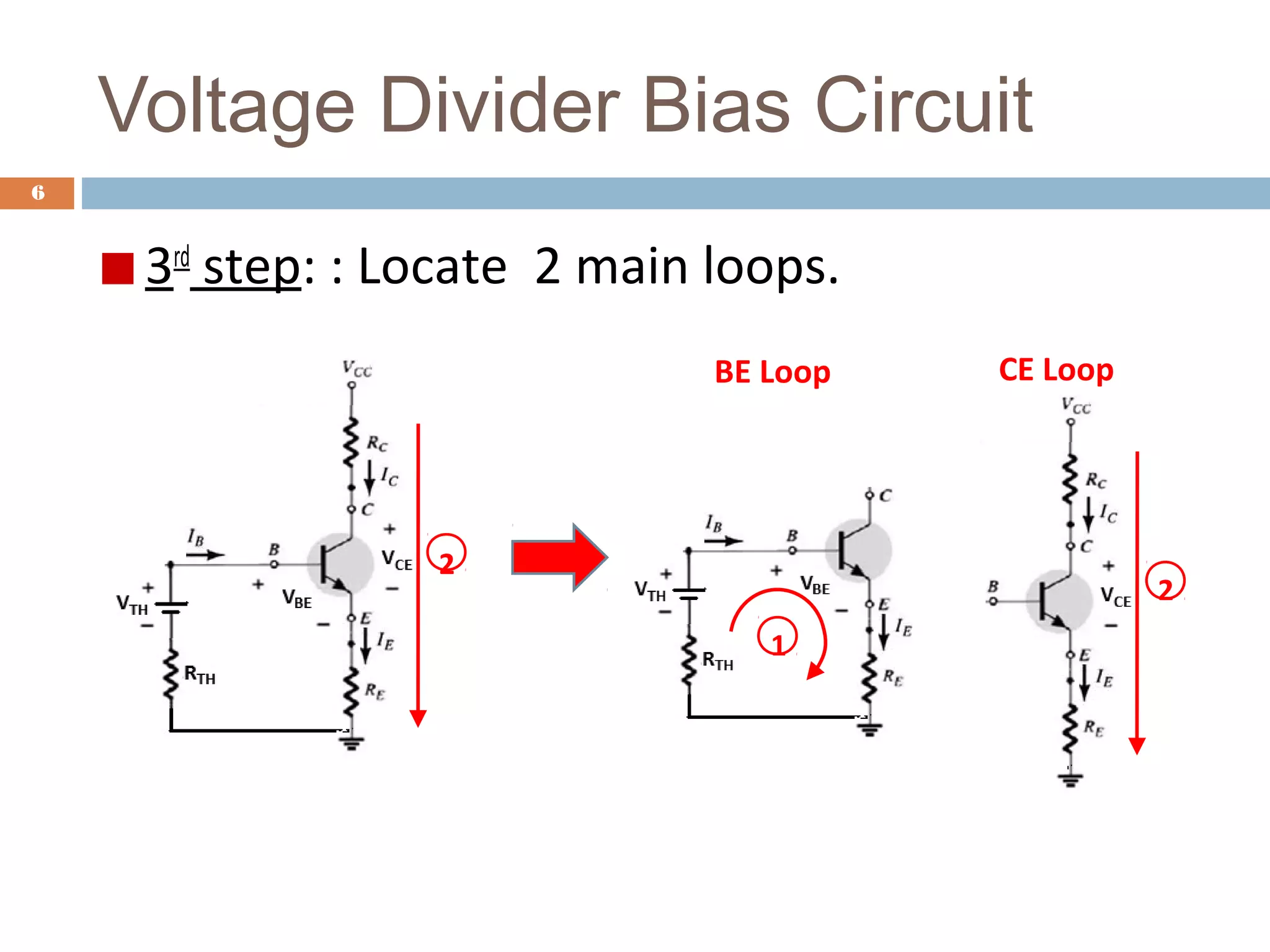
■ 3rd step: : Locate 2 main loops.
BE Loop

2

CE Loop

2
1
Voltage Divider Bias Circuit
7



BE Loop Analysis

VTH − I B RTH − VBE − I E RE = 0

Recall; I E = ( β + 1) I B
1

Substitute for IE
VTH − I B RTH − VBE − ( β + 1) I B RE = 0
∴IB =

VTH − VBE
RRTH + ( β + 1) RE
Voltage Divider Bias Circuit
8



CE Loop Analysis

VCC − I C RC − VCE − I E RE = 0
2

Assume;

I E ≈ IC

Therefore;

∴VCE = VCC − I C ( RC + RE )
Voltage Divider Bias Circuit
9



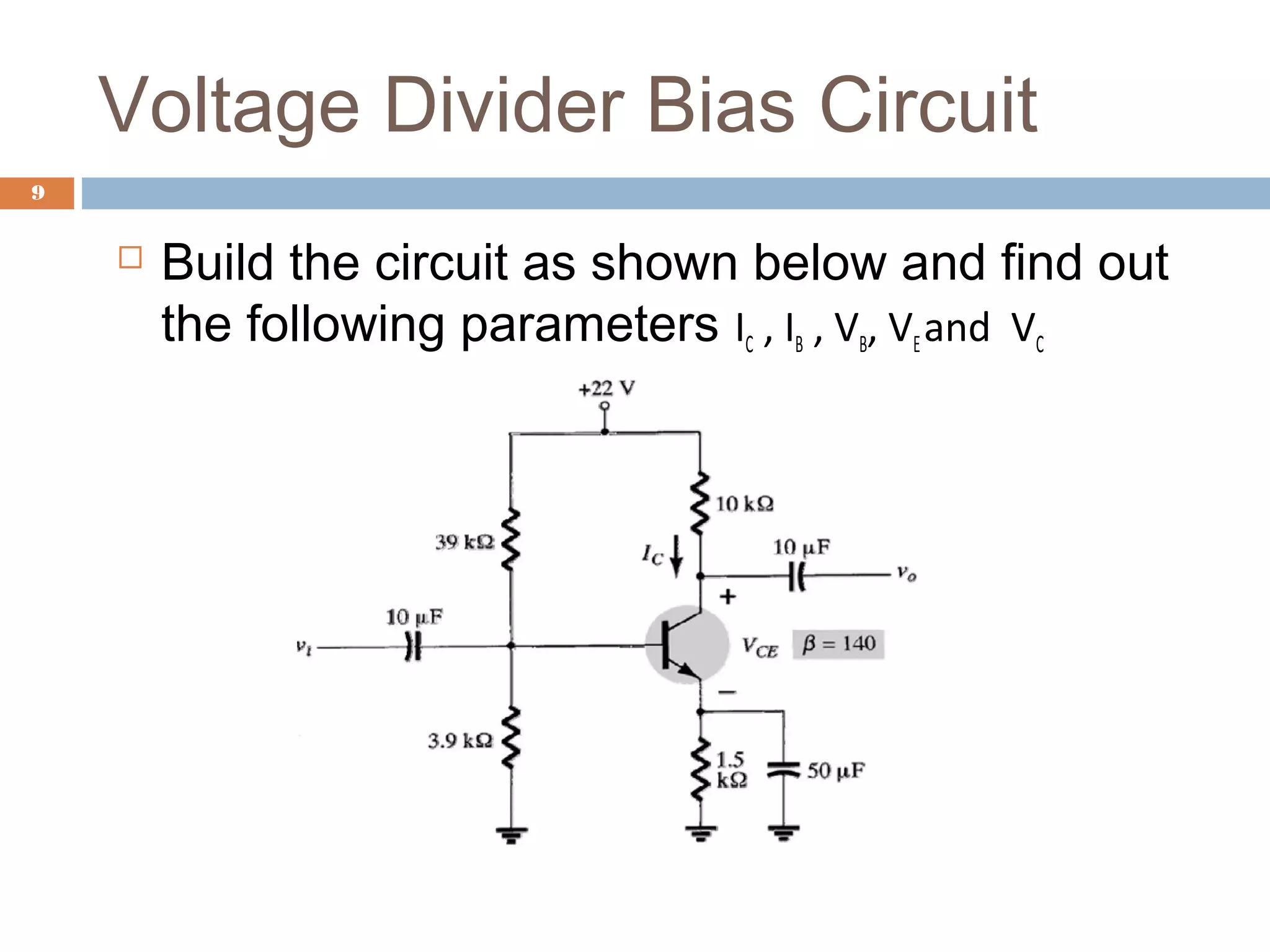
Build the circuit as shown below and find out
the following parameters IC , IB , VB, VE and VC
Voltage Divider Bias Circuit
10
Simulation and Results
11




Run DC analysis with Default Settings
Observe the output on voltmeters and
ammeters
Access it Online
12



You can access this experiment from the link below

http://www.docircuits.com/public-circuit/380/bjt-voltage-divider-bias

36.voltage divider bias

  • 1.
  • 2.
    Objectives 2  At the endof the module the student would be able to explain  Study Voltage Divider Bias
  • 3.
    Voltage Divider BiasCircuit 3  Provides good Q-point stability with a single polarity supply voltage  1st step: Locate capacitors and replace them with an open circuit  2nd step: Simplified circuit using Thevenin Theorem  3rd step: Locate 2 main loops which;  BE loop  CE loop
  • 4.
    Voltage Divider BiasCircuit 4  1st step: Locate capacitors and replace them with an open circuit
  • 5.
    Voltage Divider BiasCircuit 5 ■ 2nd step: : Simplified circuit using Thevenin Theorem From Thevenin Theorem; Thevenin Theorem; RTH = R1 // R2 = VTH = R1 ×R2 R1 +R2 R2 VCC R1 +R2
  • 6.
    Voltage Divider BiasCircuit 6 ■ 3rd step: : Locate 2 main loops. BE Loop 2 CE Loop 2 1
  • 7.
    Voltage Divider BiasCircuit 7  BE Loop Analysis VTH − I B RTH − VBE − I E RE = 0 Recall; I E = ( β + 1) I B 1 Substitute for IE VTH − I B RTH − VBE − ( β + 1) I B RE = 0 ∴IB = VTH − VBE RRTH + ( β + 1) RE
  • 8.
    Voltage Divider BiasCircuit 8  CE Loop Analysis VCC − I C RC − VCE − I E RE = 0 2 Assume; I E ≈ IC Therefore; ∴VCE = VCC − I C ( RC + RE )
  • 9.
    Voltage Divider BiasCircuit 9  Build the circuit as shown below and find out the following parameters IC , IB , VB, VE and VC
  • 10.
  • 11.
    Simulation and Results 11   RunDC analysis with Default Settings Observe the output on voltmeters and ammeters
  • 12.
    Access it Online 12  Youcan access this experiment from the link below http://www.docircuits.com/public-circuit/380/bjt-voltage-divider-bias