Silicon Controlled
Rectifier
2
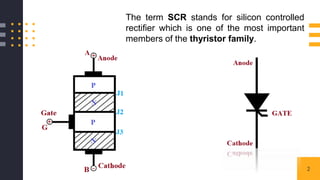
The term SCR stands for silicon controlled
rectifier which is one of the most important
members of the thyristor family.
3
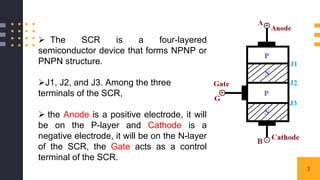
 The SCR is a four-layered
semiconductor device that forms NPNP or
PNPN structure.
J1, J2, and J3. Among the three
terminals of the SCR,
 the Anode is a positive electrode, it will
be on the P-layer and Cathode is a
negative electrode, it will be on the N-layer
of the SCR, the Gate acts as a control
terminal of the SCR.
How SCR works
▪ Forward Blocking mode
▪ Forward Conduction mode
▪ Reverse Blocking mode
4
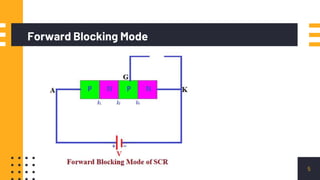
Forward Blocking Mode
5
Forward Blocking Mode
6
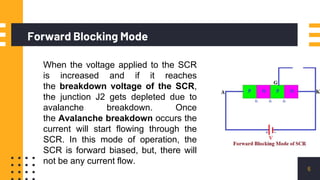
When the voltage applied to the SCR
is increased and if it reaches
the breakdown voltage of the SCR,
the junction J2 gets depleted due to
avalanche breakdown. Once
the Avalanche breakdown occurs the
current will start flowing through the
SCR. In this mode of operation, the
SCR is forward biased, but, there will
not be any current flow.
Forward Conduction Mode
7
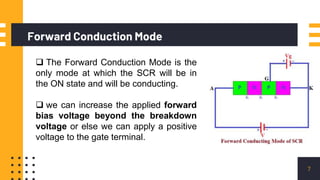
 The Forward Conduction Mode is the
only mode at which the SCR will be in
the ON state and will be conducting.
 we can increase the applied forward
bias voltage beyond the breakdown
voltage or else we can apply a positive
voltage to the gate terminal.
Reverse Blocking Mode
8
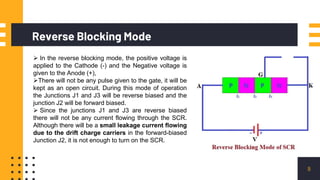
 In the reverse blocking mode, the positive voltage is
applied to the Cathode (-) and the Negative voltage is
given to the Anode (+),
There will not be any pulse given to the gate, it will be
kept as an open circuit. During this mode of operation
the Junctions J1 and J3 will be reverse biased and the
junction J2 will be forward biased.
 Since the junctions J1 and J3 are reverse biased
there will not be any current flowing through the SCR.
Although there will be a small leakage current flowing
due to the drift charge carriers in the forward-biased
Junction J2, it is not enough to turn on the SCR.
VI Characteristics of SCR
9
10
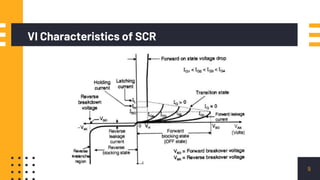
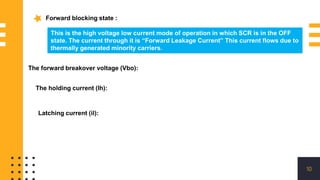
Forward blocking state :
This is the high voltage low current mode of operation in which SCR is in the OFF
state. The current through it is “Forward Leakage Current” This current flows due to
thermally generated minority carriers.
The forward breakover voltage (Vbo):
The holding current (Ih):
Latching current (il):
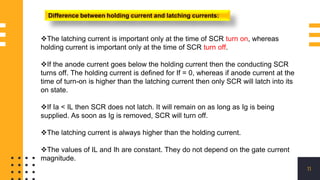
11
Difference between holding current and latching currents:
The latching current is important only at the time of SCR turn on, whereas
holding current is important only at the time of SCR turn off.
If the anode current goes below the holding current then the conducting SCR
turns off. The holding current is defined for If = 0, whereas if anode current at the
time of turn-on is higher than the latching current then only SCR will latch into its
on state.
If Ia < IL then SCR does not latch. It will remain on as long as Ig is being
supplied. As soon as Ig is removed, SCR will turn off.
The latching current is always higher than the holding current.
The values of IL and Ih are constant. They do not depend on the gate current
magnitude.
12
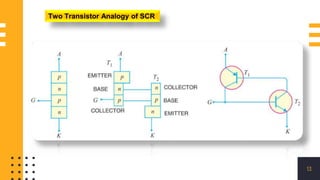
Two Transistor Analogy of SCR
13
Two Transistor Analogy of SCR
14
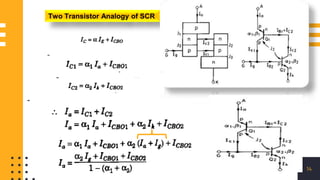
Two Transistor Analogy of SCR
15
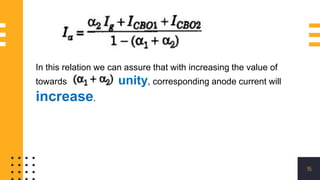
In this relation we can assure that with increasing the value of
towards unity, corresponding anode current will
increase.
16
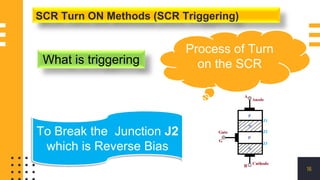
SCR Turn ON Methods (SCR Triggering)
What is triggering
Process of Turn
on the SCR
To Break the Junction J2
which is Reverse Bias
17
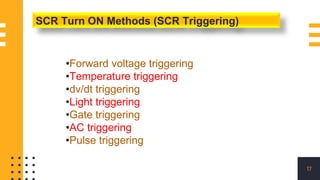
•Forward voltage triggering
•Temperature triggering
•dv/dt triggering
•Light triggering
•Gate triggering
•AC triggering
•Pulse triggering
SCR Turn ON Methods (SCR Triggering)
18
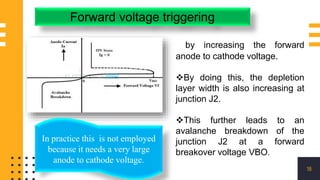
Forward voltage triggering
by increasing the forward
anode to cathode voltage.
By doing this, the depletion
layer width is also increasing at
junction J2.
This further leads to an
avalanche breakdown of the
junction J2 at a forward
breakover voltage VBO.
In practice this is not employed
because it needs a very large
anode to cathode voltage.
19
Temperature Triggering
 The reverse leakage current depends on the temperature. If the
temperature is increased to a certain value, the number of hole-pairs also
increases.
 Increase the leakage current and further it increases the current
gains of the SCR.
This starts the regenerative action inside the SCR since the (α1 + α2)
value approaches to unity
practically not employed because it causes the thermal
runaway . SCR may be damaged.
20
dv/dt Triggering
 In forward blocking state junctions J1 and J3 are forward biased and
J2 is reverse biased.
 The junction J2 behaves as a capacitor. I = C dv/ dt
Produce very high voltage spikes across the
SCR so there will be considerable damage to it.
dv/dt is the rate of change of applied voltage
C is the junction capacitance.
Rate of change of the applied voltage is large that leads to increase the
charging current which is enough to increase the value of α. Hence SCR ON
21
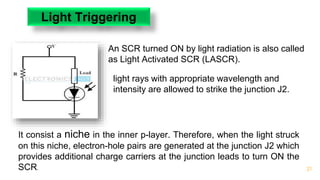
Light Triggering
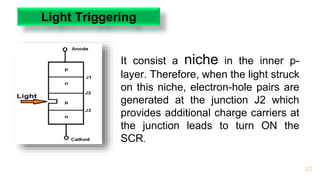
An SCR turned ON by light radiation is also called
as Light Activated SCR (LASCR).
light rays with appropriate wavelength and
intensity are allowed to strike the junction J2.
It consist a niche in the inner p-layer. Therefore, when the light struck
on this niche, electron-hole pairs are generated at the junction J2 which
provides additional charge carriers at the junction leads to turn ON the
SCR.
22
Light Triggering
It consist a niche in the inner p-
layer. Therefore, when the light struck
on this niche, electron-hole pairs are
generated at the junction J2 which
provides additional charge carriers at
the junction leads to turn ON the
SCR.
23
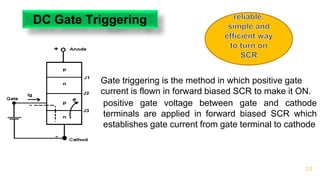
DC Gate Triggering
Gate triggering is the method in which positive gate
current is flown in forward biased SCR to make it ON.
positive gate voltage between gate and cathode
terminals are applied in forward biased SCR which
establishes gate current from gate terminal to cathode
24
DC Gate Triggering
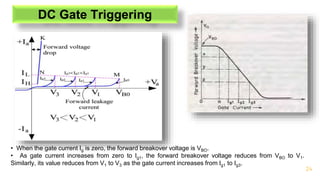
• When the gate current Ig is zero, the forward breakover voltage is VBO.
• As gate current increases from zero to Ig1, the forward breakover voltage reduces from VBO to V1.
Similarly, its value reduces from V1 to V3 as the gate current increases from Ig1 to Ig3.
25
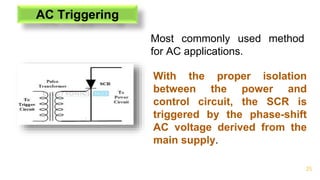
AC Triggering
Most commonly used method
for AC applications.
With the proper isolation
between the power and
control circuit, the SCR is
triggered by the phase-shift
AC voltage derived from the
main supply.
26
Pulse Triggering
Gate is supplied with single pulse or a train of pulses is
given into the SCR
ADVANTAGE
gate drive is discontinuous or doesn’t need continuous
pulses to turn the SCR.
27
SCR Turn OFF Methods
What is Commutation
Process of
Turn OFF the
SCR
The SCR can be brought back to the forward blocking
state from the forward conduction state by reducing the
anode or forward current below the holding current level.
28
SCR Turn OFF Methods
The term commutation means the transfer of
currents from one path to another.
conditions
The anode or
forward current of
SCR must be
reduced to zero or
below the level of
holding current
A sufficient reverse
voltage must be
applied across the
SCR to regain its
forward blocking
state.
29
SCR Turn OFF Methods
The reverse voltage which causes to commutate the SCR.
Commutation voltage.
The commutation methods are classified into two major types.
 Forced Commutation
 Natural commutation
30
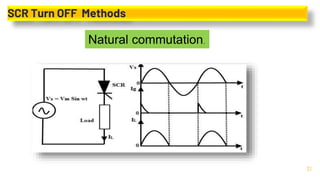
SCR Turn OFF Methods
Natural commutation.
The source of commutation voltage is the supply source itself.
If the SCR is connected to an AC supply, at every end of
the positive half cycle the anode current goes through the
natural current zero.
and also immediately a reverse voltage is applied across
the SCR. These are the conditions to turn OFF the SCR.
31
SCR Turn OFF Methods
Natural commutation.
32
Forced commutation.
In DC Circuits, there is no natural current zero to
turn OFF the SCR.
There is external circuit called commutation circuit
which will make the forward current forced to zero
to turn OFF the SCR.
Commutation circuit inductors and capacitors are
available called Commutating components.
33
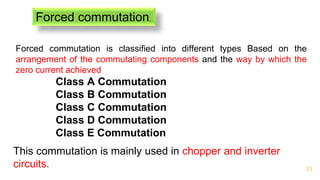
Forced commutation.
Forced commutation is classified into different types Based on the
arrangement of the commutating components and the way by which the
zero current achieved
This commutation is mainly used in chopper and inverter
circuits.
Class A Commutation
Class B Commutation
Class C Commutation
Class D Commutation
Class E Commutation
34
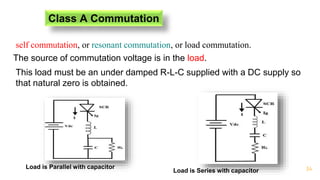
Class A Commutation
self commutation, or resonant commutation, or load commutation.
The source of commutation voltage is in the load.
This load must be an under damped R-L-C supplied with a DC supply so
that natural zero is obtained.
Load is Parallel with capacitor
Load is Series with capacitor
35
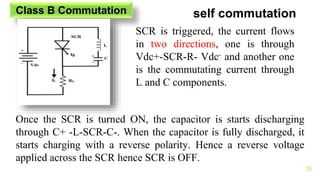
Class B Commutation self commutation
SCR is triggered, the current flows
in two directions, one is through
Vdc+-SCR-R- Vdc- and another one
is the commutating current through
L and C components.
Once the SCR is turned ON, the capacitor is starts discharging
through C+ -L-SCR-C-. When the capacitor is fully discharged, it
starts charging with a reverse polarity. Hence a reverse voltage
applied across the SCR hence SCR is OFF.
36
Class B Commutation self commutation
• Once the SCR is turned ON, the capacitor is starts discharging
through C+ – L – SCR – C-.
• When the capacitor is fully discharged, it starts charging with a
reverse polarity.
• Hence a reverse voltage applied across the SCR which causes the
commutating current IC to oppose load current IL.
•When the commutating current Ic is higher than the load current, the
SCR will automatically turn OFF and the capacitor charges with original
polarity.
Dr.A.Ravi, Francis Xavier Engineering
37
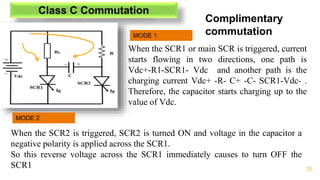
Class C Commutation
The main SCR is to be commutated is connected in series
with the load and an additional or complementary SCR is
connected in parallel with main SCR.
Complimentary commutation
38
Class C Commutation
Complimentary
commutation
MODE 1
When the SCR1 or main SCR is triggered, current
starts flowing in two directions, one path is
Vdc+-R1-SCR1- Vdc and another path is the
charging current Vdc+ -R- C+ -C- SCR1-Vdc- .
Therefore, the capacitor starts charging up to the
value of Vdc.
When the SCR2 is triggered, SCR2 is turned ON and voltage in the capacitor a
negative polarity is applied across the SCR1.
So this reverse voltage across the SCR1 immediately causes to turn OFF the
SCR1
MODE 2
39
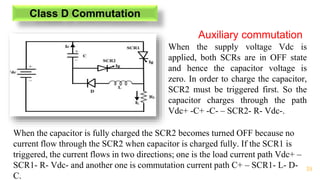
Class D Commutation
Auxiliary commutation
When the supply voltage Vdc is
applied, both SCRs are in OFF state
and hence the capacitor voltage is
zero. In order to charge the capacitor,
SCR2 must be triggered first. So the
capacitor charges through the path
Vdc+ -C+ -C- – SCR2- R- Vdc-.
When the capacitor is fully charged the SCR2 becomes turned OFF because no
current flow through the SCR2 when capacitor is charged fully. If the SCR1 is
triggered, the current flows in two directions; one is the load current path Vdc+ –
SCR1- R- Vdc- and another one is commutation current path C+ – SCR1- L- D-
C.
40
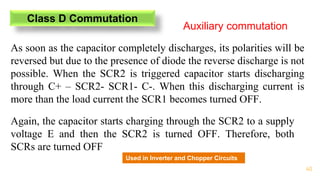
Class D Commutation
Auxiliary commutation
As soon as the capacitor completely discharges, its polarities will be
reversed but due to the presence of diode the reverse discharge is not
possible. When the SCR2 is triggered capacitor starts discharging
through C+ – SCR2- SCR1- C-. When this discharging current is
more than the load current the SCR1 becomes turned OFF.
Again, the capacitor starts charging through the SCR2 to a supply
voltage E and then the SCR2 is turned OFF. Therefore, both
SCRs are turned OFF
Used in Inverter and Chopper Circuits
41
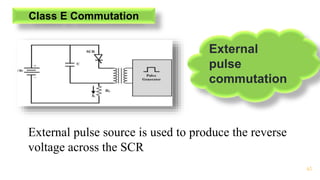
Class E Commutation
External
pulse
commutation
External pulse source is used to produce the reverse
voltage across the SCR
42
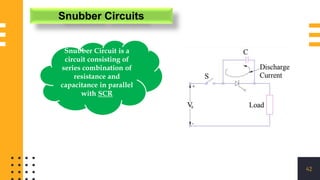
Snubber Circuits
Snubber Circuit is a
circuit consisting of
series combination of
resistance and
capacitance in parallel
with SCR
43
Purpose of Snubber Circuit
To prevent the unwanted triggering of SCR
or thyristor due to high rate of rise of
voltage i.e. dv/dt.
44
Purpose of Snubber Circuit
When a reverse voltage is applied, commutation process is initiated
and the forward current flow through SCR approaches zero.
Due to the inductance, current continuous to flow due to sweeping of
charge carries at the external junctions.
When it reaches a peak value it cannot be further supported by the
charge carriers and falls very quickly to zero. This causes a
voltage spike with the value of L(di/dt).
Also when the supply is closed to the circuit( in the above figure say
the switch S is closed), sudden voltage appears across SCR.
45
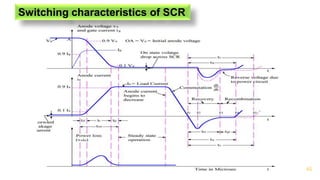
Switching characteristics of SCR
46
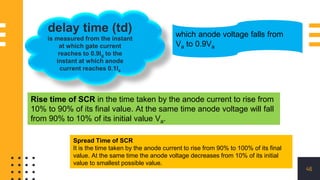
delay time (td)
is measured from the instant
at which gate current
reaches to 0.9Ig to the
instant at which anode
current reaches 0.1Ia
which anode voltage falls from
Va to 0.9Va
Rise time of SCR in the time taken by the anode current to rise from
10% to 90% of its final value. At the same time anode voltage will fall
from 90% to 10% of its initial value Va.
Spread Time of SCR
It is the time taken by the anode current to rise from 90% to 100% of its final
value. At the same time the anode voltage decreases from 10% of its initial
value to smallest possible value.
47
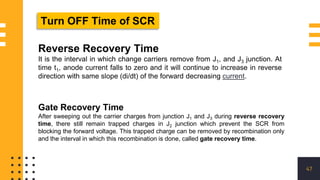
Reverse Recovery Time
It is the interval in which change carriers remove from J1, and J3 junction. At
time t1, anode current falls to zero and it will continue to increase in reverse
direction with same slope (di/dt) of the forward decreasing current.
Turn OFF Time of SCR
Gate Recovery Time
After sweeping out the carrier charges from junction J1 and J3 during reverse recovery
time, there still remain trapped charges in J2 junction which prevent the SCR from
blocking the forward voltage. This trapped charge can be removed by recombination only
and the interval in which this recombination is done, called gate recovery time.

SCR.pptx

  • 1.
  • 2.
    2 The term SCRstands for silicon controlled rectifier which is one of the most important members of the thyristor family.
  • 3.
    3  The SCRis a four-layered semiconductor device that forms NPNP or PNPN structure. J1, J2, and J3. Among the three terminals of the SCR,  the Anode is a positive electrode, it will be on the P-layer and Cathode is a negative electrode, it will be on the N-layer of the SCR, the Gate acts as a control terminal of the SCR.
  • 4.
    How SCR works ▪Forward Blocking mode ▪ Forward Conduction mode ▪ Reverse Blocking mode 4
  • 5.
  • 6.
    Forward Blocking Mode 6 Whenthe voltage applied to the SCR is increased and if it reaches the breakdown voltage of the SCR, the junction J2 gets depleted due to avalanche breakdown. Once the Avalanche breakdown occurs the current will start flowing through the SCR. In this mode of operation, the SCR is forward biased, but, there will not be any current flow.
  • 7.
    Forward Conduction Mode 7 The Forward Conduction Mode is the only mode at which the SCR will be in the ON state and will be conducting.  we can increase the applied forward bias voltage beyond the breakdown voltage or else we can apply a positive voltage to the gate terminal.
  • 8.
    Reverse Blocking Mode 8 In the reverse blocking mode, the positive voltage is applied to the Cathode (-) and the Negative voltage is given to the Anode (+), There will not be any pulse given to the gate, it will be kept as an open circuit. During this mode of operation the Junctions J1 and J3 will be reverse biased and the junction J2 will be forward biased.  Since the junctions J1 and J3 are reverse biased there will not be any current flowing through the SCR. Although there will be a small leakage current flowing due to the drift charge carriers in the forward-biased Junction J2, it is not enough to turn on the SCR.
  • 9.
  • 10.
    10 Forward blocking state: This is the high voltage low current mode of operation in which SCR is in the OFF state. The current through it is “Forward Leakage Current” This current flows due to thermally generated minority carriers. The forward breakover voltage (Vbo): The holding current (Ih): Latching current (il):
  • 11.
    11 Difference between holdingcurrent and latching currents: The latching current is important only at the time of SCR turn on, whereas holding current is important only at the time of SCR turn off. If the anode current goes below the holding current then the conducting SCR turns off. The holding current is defined for If = 0, whereas if anode current at the time of turn-on is higher than the latching current then only SCR will latch into its on state. If Ia < IL then SCR does not latch. It will remain on as long as Ig is being supplied. As soon as Ig is removed, SCR will turn off. The latching current is always higher than the holding current. The values of IL and Ih are constant. They do not depend on the gate current magnitude.
  • 12.
  • 13.
  • 14.
  • 15.
    15 In this relationwe can assure that with increasing the value of towards unity, corresponding anode current will increase.
  • 16.
    16 SCR Turn ONMethods (SCR Triggering) What is triggering Process of Turn on the SCR To Break the Junction J2 which is Reverse Bias
  • 17.
    17 •Forward voltage triggering •Temperaturetriggering •dv/dt triggering •Light triggering •Gate triggering •AC triggering •Pulse triggering SCR Turn ON Methods (SCR Triggering)
  • 18.
    18 Forward voltage triggering byincreasing the forward anode to cathode voltage. By doing this, the depletion layer width is also increasing at junction J2. This further leads to an avalanche breakdown of the junction J2 at a forward breakover voltage VBO. In practice this is not employed because it needs a very large anode to cathode voltage.
  • 19.
    19 Temperature Triggering  Thereverse leakage current depends on the temperature. If the temperature is increased to a certain value, the number of hole-pairs also increases.  Increase the leakage current and further it increases the current gains of the SCR. This starts the regenerative action inside the SCR since the (α1 + α2) value approaches to unity practically not employed because it causes the thermal runaway . SCR may be damaged.
  • 20.
    20 dv/dt Triggering  Inforward blocking state junctions J1 and J3 are forward biased and J2 is reverse biased.  The junction J2 behaves as a capacitor. I = C dv/ dt Produce very high voltage spikes across the SCR so there will be considerable damage to it. dv/dt is the rate of change of applied voltage C is the junction capacitance. Rate of change of the applied voltage is large that leads to increase the charging current which is enough to increase the value of α. Hence SCR ON
  • 21.
    21 Light Triggering An SCRturned ON by light radiation is also called as Light Activated SCR (LASCR). light rays with appropriate wavelength and intensity are allowed to strike the junction J2. It consist a niche in the inner p-layer. Therefore, when the light struck on this niche, electron-hole pairs are generated at the junction J2 which provides additional charge carriers at the junction leads to turn ON the SCR.
  • 22.
    22 Light Triggering It consista niche in the inner p- layer. Therefore, when the light struck on this niche, electron-hole pairs are generated at the junction J2 which provides additional charge carriers at the junction leads to turn ON the SCR.
  • 23.
    23 DC Gate Triggering Gatetriggering is the method in which positive gate current is flown in forward biased SCR to make it ON. positive gate voltage between gate and cathode terminals are applied in forward biased SCR which establishes gate current from gate terminal to cathode
  • 24.
    24 DC Gate Triggering •When the gate current Ig is zero, the forward breakover voltage is VBO. • As gate current increases from zero to Ig1, the forward breakover voltage reduces from VBO to V1. Similarly, its value reduces from V1 to V3 as the gate current increases from Ig1 to Ig3.
  • 25.
    25 AC Triggering Most commonlyused method for AC applications. With the proper isolation between the power and control circuit, the SCR is triggered by the phase-shift AC voltage derived from the main supply.
  • 26.
    26 Pulse Triggering Gate issupplied with single pulse or a train of pulses is given into the SCR ADVANTAGE gate drive is discontinuous or doesn’t need continuous pulses to turn the SCR.
  • 27.
    27 SCR Turn OFFMethods What is Commutation Process of Turn OFF the SCR The SCR can be brought back to the forward blocking state from the forward conduction state by reducing the anode or forward current below the holding current level.
  • 28.
    28 SCR Turn OFFMethods The term commutation means the transfer of currents from one path to another. conditions The anode or forward current of SCR must be reduced to zero or below the level of holding current A sufficient reverse voltage must be applied across the SCR to regain its forward blocking state.
  • 29.
    29 SCR Turn OFFMethods The reverse voltage which causes to commutate the SCR. Commutation voltage. The commutation methods are classified into two major types.  Forced Commutation  Natural commutation
  • 30.
    30 SCR Turn OFFMethods Natural commutation. The source of commutation voltage is the supply source itself. If the SCR is connected to an AC supply, at every end of the positive half cycle the anode current goes through the natural current zero. and also immediately a reverse voltage is applied across the SCR. These are the conditions to turn OFF the SCR.
  • 31.
    31 SCR Turn OFFMethods Natural commutation.
  • 32.
    32 Forced commutation. In DCCircuits, there is no natural current zero to turn OFF the SCR. There is external circuit called commutation circuit which will make the forward current forced to zero to turn OFF the SCR. Commutation circuit inductors and capacitors are available called Commutating components.
  • 33.
    33 Forced commutation. Forced commutationis classified into different types Based on the arrangement of the commutating components and the way by which the zero current achieved This commutation is mainly used in chopper and inverter circuits. Class A Commutation Class B Commutation Class C Commutation Class D Commutation Class E Commutation
  • 34.
    34 Class A Commutation selfcommutation, or resonant commutation, or load commutation. The source of commutation voltage is in the load. This load must be an under damped R-L-C supplied with a DC supply so that natural zero is obtained. Load is Parallel with capacitor Load is Series with capacitor
  • 35.
    35 Class B Commutationself commutation SCR is triggered, the current flows in two directions, one is through Vdc+-SCR-R- Vdc- and another one is the commutating current through L and C components. Once the SCR is turned ON, the capacitor is starts discharging through C+ -L-SCR-C-. When the capacitor is fully discharged, it starts charging with a reverse polarity. Hence a reverse voltage applied across the SCR hence SCR is OFF.
  • 36.
    36 Class B Commutationself commutation • Once the SCR is turned ON, the capacitor is starts discharging through C+ – L – SCR – C-. • When the capacitor is fully discharged, it starts charging with a reverse polarity. • Hence a reverse voltage applied across the SCR which causes the commutating current IC to oppose load current IL. •When the commutating current Ic is higher than the load current, the SCR will automatically turn OFF and the capacitor charges with original polarity.
  • 37.
    Dr.A.Ravi, Francis XavierEngineering 37 Class C Commutation The main SCR is to be commutated is connected in series with the load and an additional or complementary SCR is connected in parallel with main SCR. Complimentary commutation
  • 38.
    38 Class C Commutation Complimentary commutation MODE1 When the SCR1 or main SCR is triggered, current starts flowing in two directions, one path is Vdc+-R1-SCR1- Vdc and another path is the charging current Vdc+ -R- C+ -C- SCR1-Vdc- . Therefore, the capacitor starts charging up to the value of Vdc. When the SCR2 is triggered, SCR2 is turned ON and voltage in the capacitor a negative polarity is applied across the SCR1. So this reverse voltage across the SCR1 immediately causes to turn OFF the SCR1 MODE 2
  • 39.
    39 Class D Commutation Auxiliarycommutation When the supply voltage Vdc is applied, both SCRs are in OFF state and hence the capacitor voltage is zero. In order to charge the capacitor, SCR2 must be triggered first. So the capacitor charges through the path Vdc+ -C+ -C- – SCR2- R- Vdc-. When the capacitor is fully charged the SCR2 becomes turned OFF because no current flow through the SCR2 when capacitor is charged fully. If the SCR1 is triggered, the current flows in two directions; one is the load current path Vdc+ – SCR1- R- Vdc- and another one is commutation current path C+ – SCR1- L- D- C.
  • 40.
    40 Class D Commutation Auxiliarycommutation As soon as the capacitor completely discharges, its polarities will be reversed but due to the presence of diode the reverse discharge is not possible. When the SCR2 is triggered capacitor starts discharging through C+ – SCR2- SCR1- C-. When this discharging current is more than the load current the SCR1 becomes turned OFF. Again, the capacitor starts charging through the SCR2 to a supply voltage E and then the SCR2 is turned OFF. Therefore, both SCRs are turned OFF Used in Inverter and Chopper Circuits
  • 41.
    41 Class E Commutation External pulse commutation Externalpulse source is used to produce the reverse voltage across the SCR
  • 42.
    42 Snubber Circuits Snubber Circuitis a circuit consisting of series combination of resistance and capacitance in parallel with SCR
  • 43.
    43 Purpose of SnubberCircuit To prevent the unwanted triggering of SCR or thyristor due to high rate of rise of voltage i.e. dv/dt.
  • 44.
    44 Purpose of SnubberCircuit When a reverse voltage is applied, commutation process is initiated and the forward current flow through SCR approaches zero. Due to the inductance, current continuous to flow due to sweeping of charge carries at the external junctions. When it reaches a peak value it cannot be further supported by the charge carriers and falls very quickly to zero. This causes a voltage spike with the value of L(di/dt). Also when the supply is closed to the circuit( in the above figure say the switch S is closed), sudden voltage appears across SCR.
  • 45.
  • 46.
    46 delay time (td) ismeasured from the instant at which gate current reaches to 0.9Ig to the instant at which anode current reaches 0.1Ia which anode voltage falls from Va to 0.9Va Rise time of SCR in the time taken by the anode current to rise from 10% to 90% of its final value. At the same time anode voltage will fall from 90% to 10% of its initial value Va. Spread Time of SCR It is the time taken by the anode current to rise from 90% to 100% of its final value. At the same time the anode voltage decreases from 10% of its initial value to smallest possible value.
  • 47.
    47 Reverse Recovery Time Itis the interval in which change carriers remove from J1, and J3 junction. At time t1, anode current falls to zero and it will continue to increase in reverse direction with same slope (di/dt) of the forward decreasing current. Turn OFF Time of SCR Gate Recovery Time After sweeping out the carrier charges from junction J1 and J3 during reverse recovery time, there still remain trapped charges in J2 junction which prevent the SCR from blocking the forward voltage. This trapped charge can be removed by recombination only and the interval in which this recombination is done, called gate recovery time.