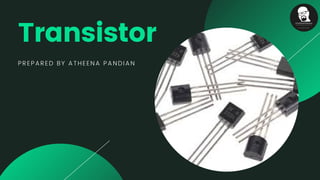
Transistor
PREPARED BY ATHEENA PANDIAN
Crucial
PointsDISCUSSION FLOW
What is Transistor?
Who invented Transistor?
Symbol
Structure
Configuration
Biasing
Operation
I-V Charecterisitic Curve
Circuits
Types
Applications
1.
2.
3.
4.
5.
6.
7.
8.
9.
10.
11.
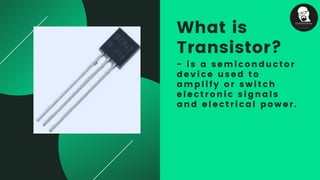
What is
Transistor?
- is a semiconductor
device used to
amplify or switch
electronic signals
and electrical power.
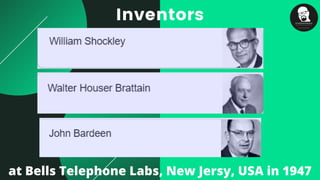
Inventors
at Bells Telephone Labs, New Jersy, USA in 1947
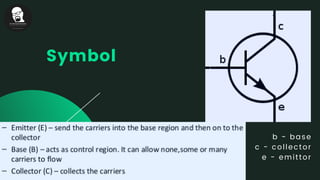
Symbol
b - base
c - collector
e - emittor
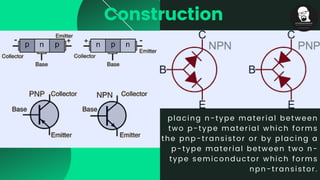
Construction
placing n-type material between
two p-type material which forms
the pnp-transistor or by placing a
p-type material between two n-
type semiconductor which forms
npn-transistor.
Doped
semiconductor regions: the
emitter region, the
base region and the
collector region.
These regions are,
respectively, p type, n type
and p type in a
PNP transistor, and n type, p
type and n type in an
NPN transistor.
Structure
The transistor is a
three terminal device
and consists of three
distinct layers.
Configuration
3 TYPES OF
CONFIGURATION
Common Collector
Common Base
Common Emitter
1.
2.
3.
Common
Collector
Configuration
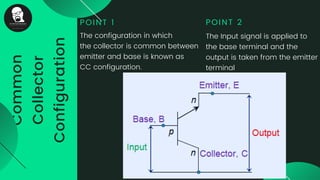
POINT 1
The configuration in which
the collector is common between
emitter and base is known as
CC configuration.
POINT 2
The Input signal is applied to
the base terminal and the
output is taken from the emitter
terminal
Common
Collector
Configuration
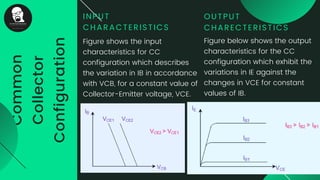
OUTPUT
CHARECTERISTICS
Figure below shows the output
characteristics for the CC
configuration which exhibit the
variations in IE against the
changes in VCE for constant
values of IB.
INPUT
CHARACTERISTICS
Figure shows the input
characteristics for CC
configuration which describes
the variation in IB in accordance
with VCB, for a constant value of
Collector-Emitter voltage, VCE.
Common
Base
Configuration
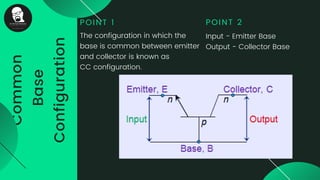
POINT 1
The configuration in which the
base is common between emitter
and collector is known as
CC configuration.
POINT 2
Input - Emitter Base
Output - Collector Base
Common
Base
Configuration
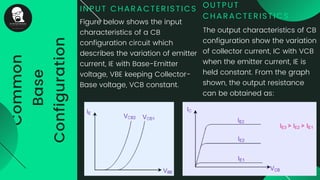
INPUT CHARACTERISTICS
Figure below shows the input
characteristics of a CB
configuration circuit which
describes the variation of emitter
current, IE with Base-Emitter
voltage, VBE keeping Collector-
Base voltage, VCB constant.
OUTPUT
CHARACTERISTICS
The output characteristics of CB
configuration show the variation
of collector current, IC with VCB
when the emitter current, IE is
held constant. From the graph
shown, the output resistance
can be obtained as:
Common
Emitter
Configuration
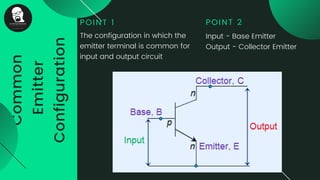
POINT 1
The configuration in which the
emitter terminal is common for
input and output circuit
POINT 2
Input - Base Emitter
Output - Collector Emitter
Common
Emitter
Configuration
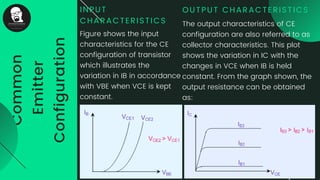
INPUT
CHARACTERISTICS
Figure shows the input
characteristics for the CE
configuration of transistor
which illustrates the
variation in IB in accordance
with VBE when VCE is kept
constant.
OUTPUT CHARACTERISTICS
The output characteristics of CE
configuration are also referred to as
collector characteristics. This plot
shows the variation in IC with the
changes in VCE when IB is held
constant. From the graph shown, the
output resistance can be obtained
as:
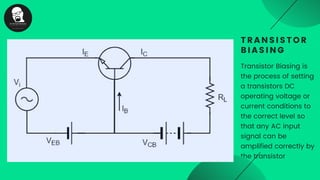
TRANSISTOR
BIASING
Transistor Biasing is
the process of setting
a transistors DC
operating voltage or
current conditions to
the correct level so
that any AC input
signal can be
amplified correctly by
the transistor
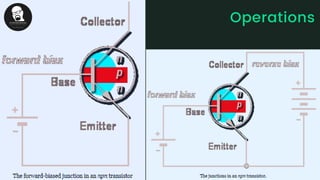
Operations
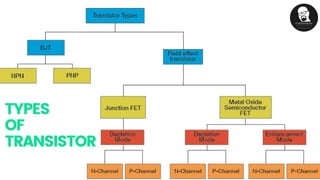
TYPES
OF
TRANSISTOR
Transistor is an active component and
that is establishing in all over electronic
circuits.
They are used as amplifiers
and switching apparatus.
As the amplifiers, they are used in high
and low level, frequency stages,
oscillators, modulators, detectors and in
any circuit need to perform a function.
1.
2.
3.
Application of
Transistor
Thank you

Transistor basics