Transients Analysis
Solution to First Order Differential Equation
)()(
)(
tfKtx
dt
tdx
s
Consider the general Equation
Let the initial condition be x(t = 0) = x( 0 ), then we solve the
differential equation:
)()(
)(
tfKtx
dt
tdx
s
The complete solution consists of two parts:
• the homogeneous solution (natural solution)
• the particular solution (forced solution)
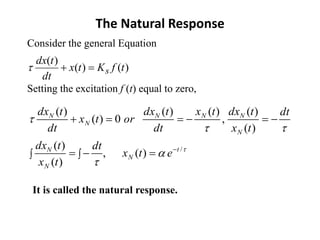
The Natural Response





/
)(,
)(
)(
)(
)(
,
)()(
0)(
)(
t
N
N
N
N
NNN
N
N
etx
dt
tx
tdx
dt
tx
tdxtx
dt
tdx
ortx
dt
tdx




Consider the general Equation
Setting the excitation f (t) equal to zero,
)()(
)(
tfKtx
dt
tdx
s
It is called the natural response.
The Forced Response
0)(
)(
)(


tforFKtx
FKtx
dt
tdx
SF
SF
F
Consider the general Equation
Setting the excitation f (t) equal to F, a constant for t 0
)()(
)(
tfKtx
dt
tdx
s
It is called the forced response.
The Complete Response
)(
)()(
/
/





xe
FKe
txtxx
t
S
t
FN




Consider the general Equation
The complete response is:
• the natural response +
• the forced response
)()(
)(
tfKtx
dt
tdx
s
Solve for ,
)()0(
)()0()0(
0



xx
xxtx
tfor


The Complete solution:
)()]()0([)( /
 
xexxtx t 
/
)]()0([ t
exx 
 called transient response
)(x called steady state response
WHAT IS TRANSIENT RESPONSE
Figure 5.1
Figu
re
5.2,
5.3
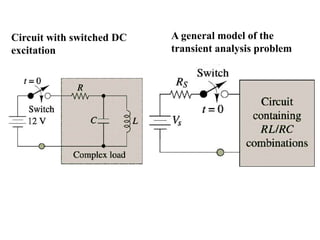
Circuit with switched DC
excitation
A general model of the
transient analysis problem
In general, any circuit containing energy storage element
Figure 5.5, 5.6
Figure 5.9,
5.10
(a) Circuit at t = 0
(b) Same circuit a long time after the switch is closed
The capacitor acts as open circuit for the steady state condition
(a long time after the switch is closed).
(a) Circuit for t = 0
(b) Same circuit a long time before the switch is opened
The inductor acts as short circuit for the steady state condition
(a long time after the switch is closed).
Why there is a transient response?
• The voltage across a capacitor cannot be changed
instantaneously.
)0()0( 
 CC VV
• The current across an inductor cannot be changed
instantaneously.
)0()0( 
 LL II
Figure 5.12,
5.13
5-6
Example
Transients Analysis
1. Solve first-order RC or RL circuits.
2. Understand the concepts of transient response
and steady-state response.
3. Relate the transient response of first-order
circuits to the time constant.
Transients
The solution of the differential equation
represents are response of the circuit. It is called
natural response.
The response must eventually die out, and
therefore referred to as transient response.
(source free response)
Discharge of a Capacitance through a Resistance
ic iR 0,0  RC iii
    0
R
tv
dt
tdv
C CC
Solving the above equation
with the initial condition
Vc(0) = Vi
Discharge of a Capacitance through a Resistance
    0
R
tv
dt
tdv
C CC
    0 tv
dt
tdv
RC C
C
  st
C Ketv 
0 stst
KeRCKse
RC
s
1

  RCt
C Ketv 

K
Ke
Vv
RC
iC



/0
)0(
  RCt
iC eVtv 

  RCt
iC eVtv 
 Exponential decay waveform
RC is called the time constant.
At time constant, the voltage is 36.8%
of the initial voltage.
  )1( RCt
iC eVtv 

Exponential rising waveform
RC is called the time constant.
At time constant, the voltage is
63.2% of the initial voltage.
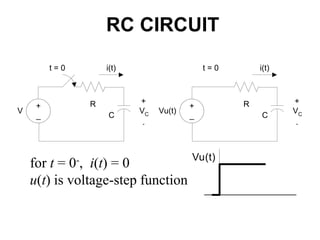
RC CIRCUIT
for t = 0-, i(t) = 0
u(t) is voltage-step function
Vu(t)
R
C
+
VC
-
i(t)t = 0
+
_
V
R
C
+
VC
-
i(t)t = 0
+
_
Vu(t)
RC CIRCUIT
Vu(t)
0)(,
,
)(





tforVtuvVv
dt
dv
RC
dt
dv
Ci
R
vtvu
i
ii
C
C
C
C
C
R
CR
Solving the differential equation
Complete Response
Complete response
= natural response + forced response
• Natural response (source free response) is due to the
initial condition
• Forced response is the due to the external excitation.
Figure
5.17,
5.18
5-8
a). Complete, transient and steady
state response
b). Complete, natural, and forced
responses of the circuit
Circuit Analysis for RC Circuit
Vs
+
Vc
-
+ VR -
R
C
iR
iC
sR
C
C
C
Rs
R
CR
v
RC
v
RCdt
dv
dt
dv
Ci
R
vv
i
ii
11
,





Apply KCL
vs is the source applied.
Solution to First Order Differential Equation
)()(
)(
tfKtx
dt
tdx
s
Consider the general Equation
Let the initial condition be x(t = 0) = x( 0 ), then we solve the
differential equation:
)()(
)(
tfKtx
dt
tdx
s
The complete solution consits of two parts:
• the homogeneous solution (natural solution)
• the particular solution (forced solution)
The Natural Response




/
)(
)()(
0)(
)(
t
N
NN
N
N
etx
tx
dt
tdx
ortx
dt
tdx



Consider the general Equation
Setting the excitation f (t) equal to zero,
)()(
)(
tfKtx
dt
tdx
s
It is called the natural response.
The Forced Response
0)(
)(
)(


tforFKtx
FKtx
dt
tdx
SF
SF
F
Consider the general Equation
Setting the excitation f (t) equal to F, a constant for t 0
)()(
)(
tfKtx
dt
tdx
s
It is called the forced response.
The Complete Response
)(
)()(
/
/





xe
FKe
txtxx
t
S
t
FN




Consider the general Equation
The complete response is:
• the natural response +
• the forced response
)()(
)(
tfKtx
dt
tdx
s
Solve for ,
)()0(
)()0()0(
0



xx
xxtx
tfor


The Complete solution:
)()]()0([)( /
 
xexxtx t 
/
)]()0([ t
exx 
 called transient response
)(x called steady state response
Example
+
Vc
-
+ VR -
100 k
ohms
0.01
microF
iR
iC
100V
Initial condition Vc(0) = 0V
sC
C
C
C
Cs
R
CR
vv
dt
dv
RC
dt
dv
Ci
R
vv
i
ii





,
10010
1001001.010
3
65




C
C
C
C
v
dt
dv
v
dt
dv
Example
+
Vc
-
+ VR -
100 k
ohms
0.01
microF
iR
iC
100V
Initial condition Vc(0) = 0V
and
3
3
10
10
100100
100
1000,0)0(
100








t
c
c
t
c
ev
A
AvAs
Aev
)()(
)(
tfKtx
dt
tdx
s
)(
)()(
/
/





xe
FKe
txtxx
t
S
t
FN




10010 3

C
C v
dt
dv
Energy stored in capacitor
    22
)()(
2
1
o
t
t
t
t
t
t
tvtvC
vdvCdt
dt
dv
Cvpdt
dt
dv
Cvvip
ooo

  

If the zero-energy reference is selected at to, implying that the
capacitor voltage is also zero at that instant, then
2
2
1
)( Cvtwc 
R C
Power dissipation in the resistor is:
pR = V2/R = (Vo
2 /R) e -2 t /RC
2
0
/22
0
/22
0
2
1
|)
2
1
(
o
RCt
o
RCt
o
RR
CV
e
RC
RV
R
dteV
dtpW





 

RC CIRCUIT
Total energy turned into heat in the resistor
RL CIRCUITS
LR
-
VR
+
+
VL
-
i(t)
Initial condition
i(t = 0) = Io
equationaldifferentitheSolving
i
dt
di
R
L
dt
di
LRivv LR
0
0


RL CIRCUITS
LR
-
VR
+
+
VL
-
i(t)
Initial condition
i(t = 0) = Io LRt
o
o
t
o
i
I
t
o
ti
I
eIti
t
L
R
Ii
t
L
R
i
dt
L
R
i
di
dt
L
R
i
di
i
L
R
dt
di
o
o
/
)(
)(
lnln
||ln
,
0







RL CIRCUIT
LR
-
VR
+
+
VL
-
i(t)
Power dissipation in the resistor is:
pR = i2R = Io
2e-2Rt/LR
Total energy turned into heat in the resistor
2
0
/22
0
/22
0
2
1
|)
2
(
o
LRt
o
LRt
oRR
LI
e
R
L
RI
dteRIdtpW








It is expected as the energy stored in the inductor is 2
2
1
oLI
RL CIRCUIT
Vu(t)
R
L
+
VL
-
i(t)
+
_
Vu(t)
ktRiV
R
L
sidesbothgIntegratin
dt
RiV
Ldi
V
dt
di
LRi




)ln(
,
0,
]ln)[ln(
ln,0)0(
/
/








tfore
R
V
R
V
i
ore
V
RiV
tVRiV
R
L
V
R
L
kthusi
LRt
LRt
where L/R is the time constant
DC STEADY STATE
The steps in determining the forced response for RL or RC
circuits with dc sources are:
1. Replace capacitances with open circuits.
2. Replace inductances with short circuits.
3. Solve the remaining circuit.

Transient analysis