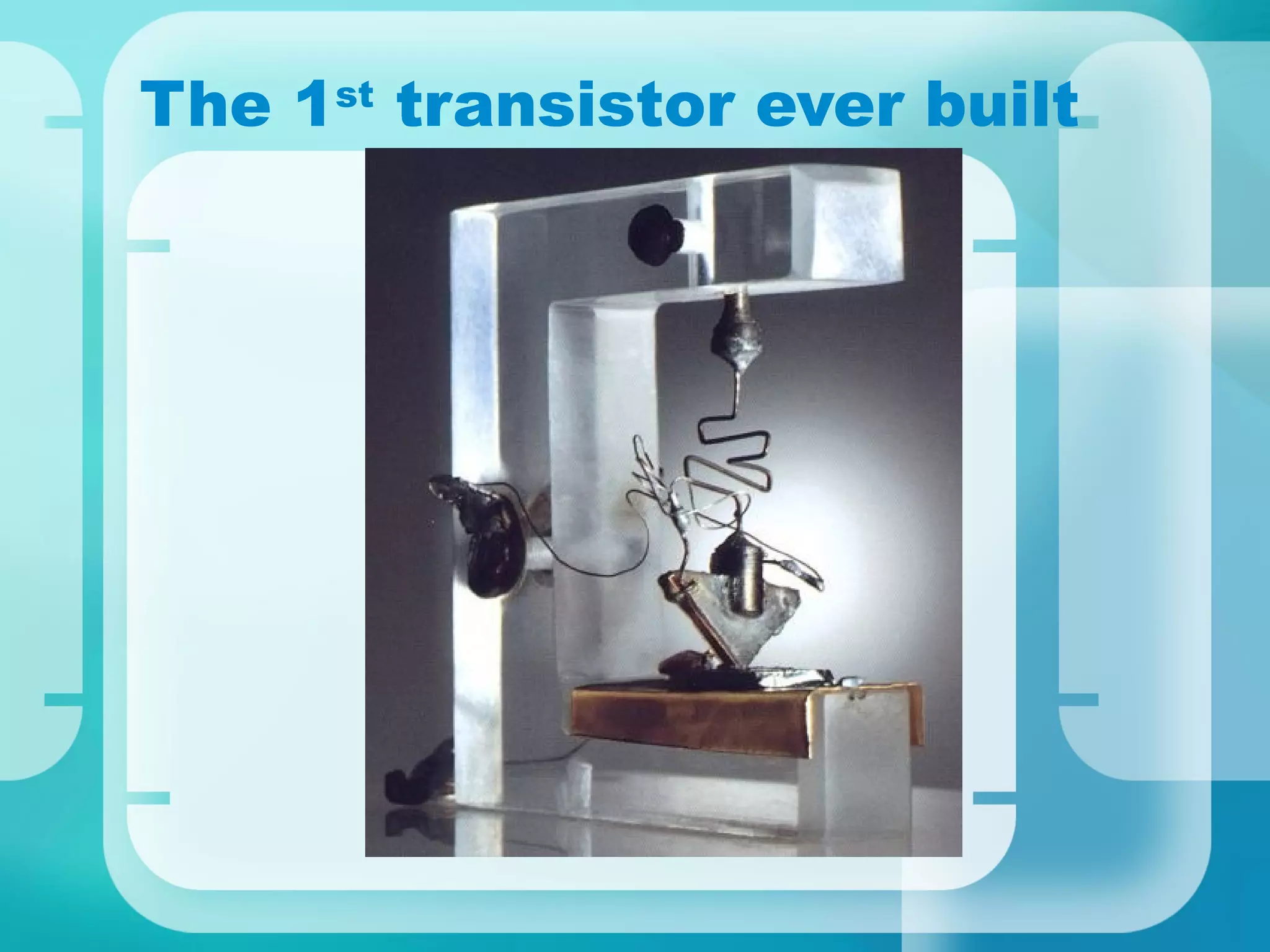
The 1st transistor ever built
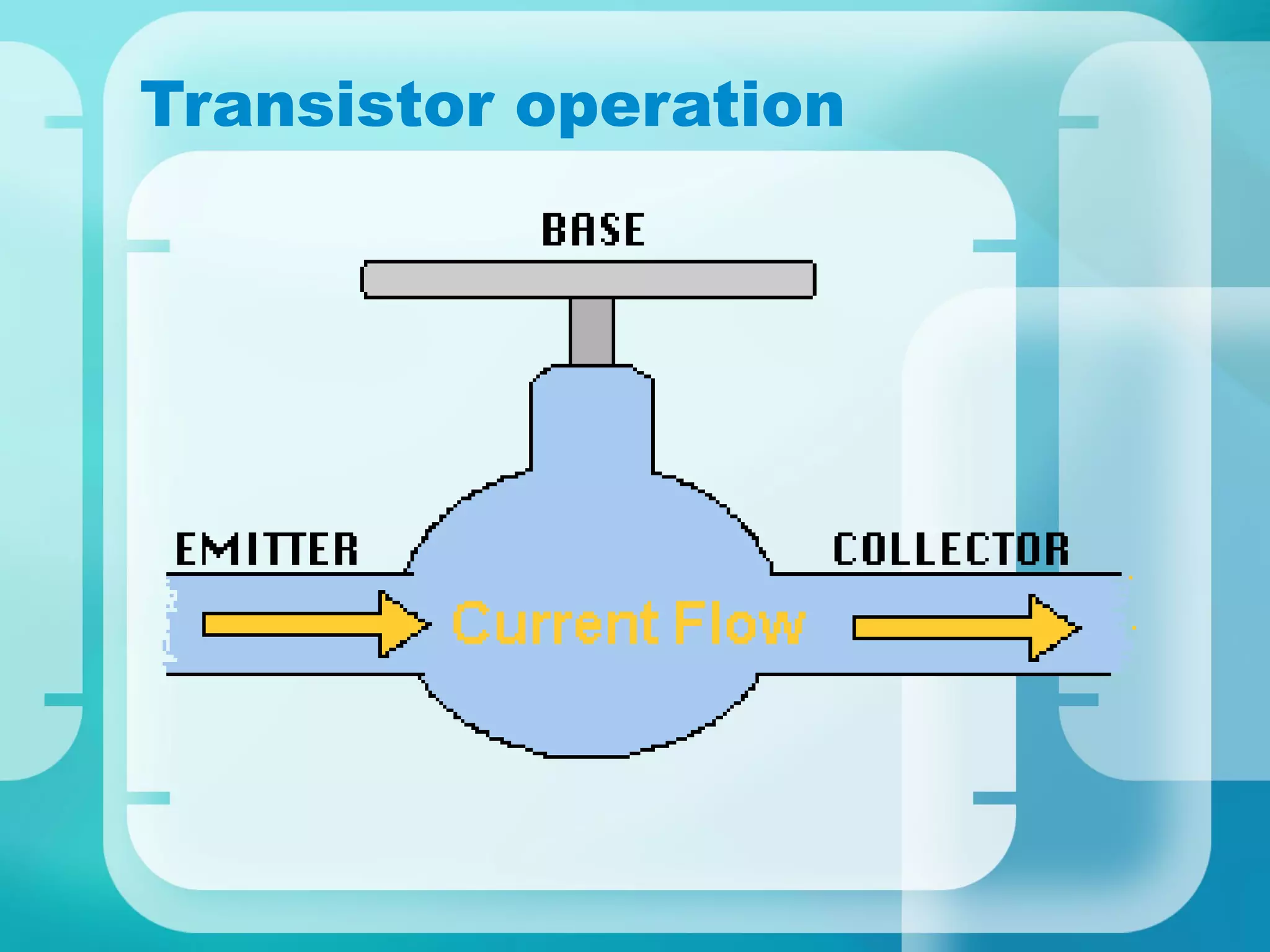
Transistor operation
Chapter 4
                       Chapter 4
                       DC biasing-
                       DC biasing-
                         BJTs
                          BJTs

Faculty of Electrical and Electronic Engineering
Topics objectives
 • You’ll learn
      • Q-point of a transistor
        operation
      • About DC analysis of a
        transistor circuit
      • About Transistor biasing
        configuration
      • Other available transistor
        biasing circuits
      • Stability factor for transistor
      • Transistor switching
INTRODUCTION
• BJTs amplifier requires a knowledge of both the DC analysis
(LARGE-signal) and AC analysis (small signal).

• For a DC analysis a transistor is controlled by a number of factors
including the range of possible operating points.

• Once the desired DC current and voltage levels have been
defined, a network must be constructed that will establish the
desired operating point.

• BJT need to be operate in active region used as amplifier.
• The cutoff and saturation region used as a switches.
• For the BJTs to be biased in its linear or active operating
region the following must be true:
        a) BE junction  forward biased, 0.6 or 0.7V
        b) BC junction  reverse biased
INTRODUCTION(CONTINUED)

• DC bias analysis  assume all capacitors are open cct.

• AC bias analysis :
        1) Neglecting all of DC sources
        2) Assume coupling capacitors are short cct. The effect of
these capacitors is to set a lower cut-off frequency for the cct.
        3) Inspect the cct (replace BJTs with its small signal model).
        4) Solve for voltage and current transfer function and i/o and
o/p impedances.

• For transistor amplifiers the resulting DC current and voltage
establish an operating point that define the region that can be
employed for amplification process.
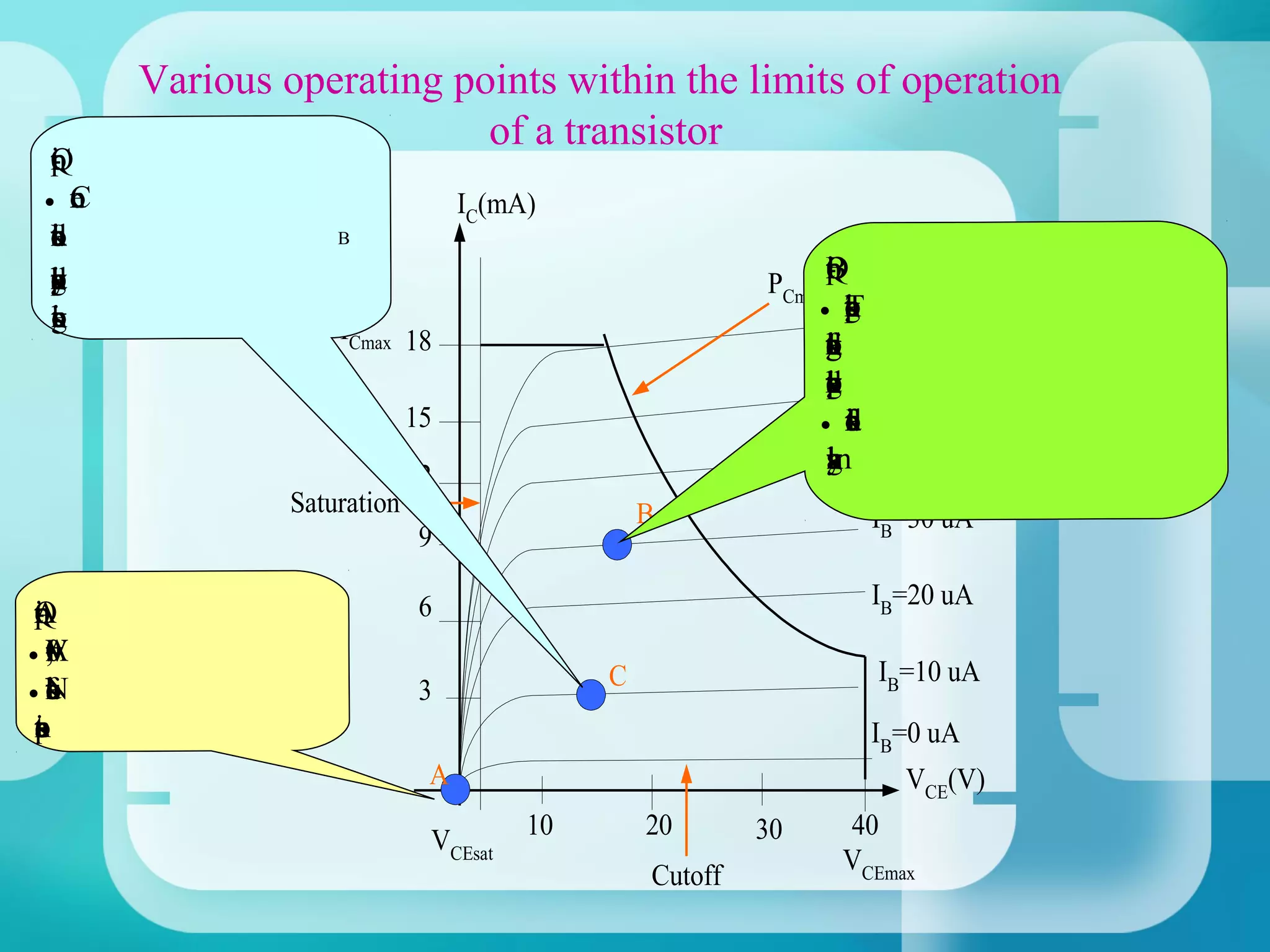
Various operating points within the limits of operation
                            of a transistor
  :
  C
  t
  n
  i
  o
  p
  -
  Q
 • on
    r
    e
    c
    C                              IC(mA)
  I
  o
  t
  e
  u
  d
  s
  i
  r
  a
  n
  l                  B

  s
  e
  g
  n
  a
  h
  c
  y
  l
  d
  i
  p
  r
  v
  u                                                       PCmaxB
                                                               :
                                                               t
                                                               n
                                                               i
                                                               o
                                                               p
                                                               -
                                                               Q
  .
  n
  o
  i
  g
  e
  r
  s
  h
  t                                                            • o IB=60 uA
                                                                  t
                                                                  n
                                                                  i
                                                                  p
                                                                  g
                                                                  a
                                                                  r
                                                                  e
                                                                  s
                                                                  b
                                                                  h
                                                                  T
                     ICmax 18
                                                                t
                                                                s
                                                                e
                                                                g
                                                                r
                                                                a
                                                                l
                                                                d
                                                                n
                                                                i
                                                                o
                                                                f
                                                                t
                                                                n
                                                                e
                                                                r IB=50 uA
                                                                u
                                                                c
                                                                d
                                                                a
                                                                g
                                                                l
                                                                o
                                                                v
                                                                b
                                                                i
                                                                s
                                                                p
                              15                               • fr
                                                                  o
                                                                  n
                                                                  i
                                                                  t
                                                                  d
                                                                  c
                                                                  e
                                                                  s
                                                                  a
                                                                  I
                                                                i IB=40 uA
                                                                s
                                                                y
                                                                l
                                                                a
                                                                n
                                                                g
                                                                m
                              12
                 Saturation                      B                 IB=30 uA
                               9

                               6                                   IB=20 uA
:
A
t
n
i
o
p
-
Q
•=V
  0
  ,
  A
  I
                                                                   IB=10 uA
                                             C
•fr
  o
  e
  l
  b
  a
  t
  i
  u
  s
  N                            3
e
t
a
r
p
o
s
i
n                                                                  IB=0 uA
                               A                                     VCE(V)
                                        10       20       30    40
                               VCEsat
                                                                VCEmax
                                                 Cutoff
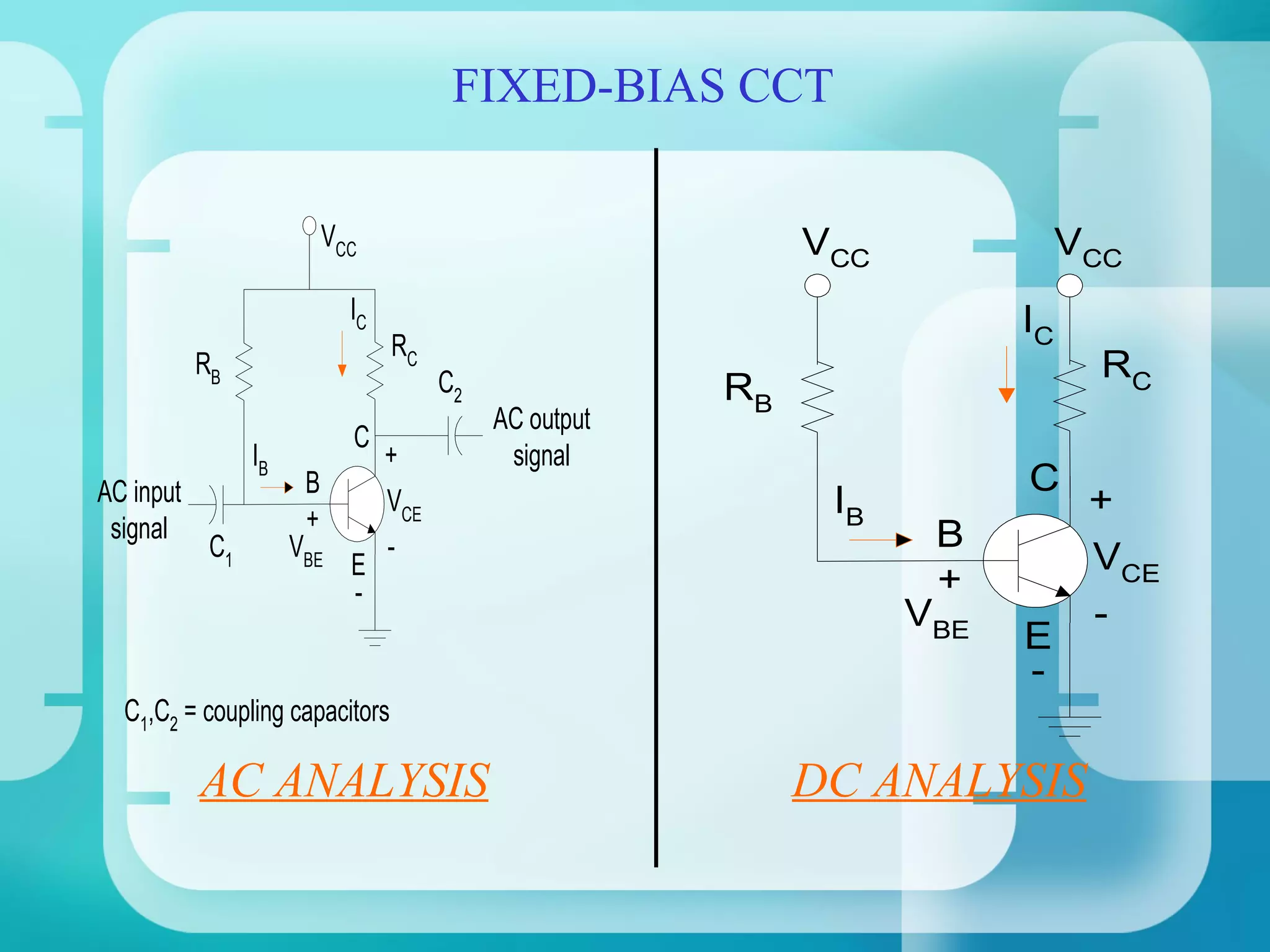
FIXED-BIAS CCT

                           VCC                                VCC              VCC
                             IC                                           IC
                                  RC
           RB
                                        C2                                       RC
                                                         RB
                                             AC output
                             C
                 IB               +           signal
AC input               B                                                  C
                       +
                                  VCE                          IB               +
 signal                                                              B
            C1        VBE         -                                             VCE
                             E
                             -                                       +
                                                                    VBE         -
                                                                          E
                                                                          -
  C1,C2 = coupling capacitors

           AC ANALYSIS                                        DC ANALYSIS
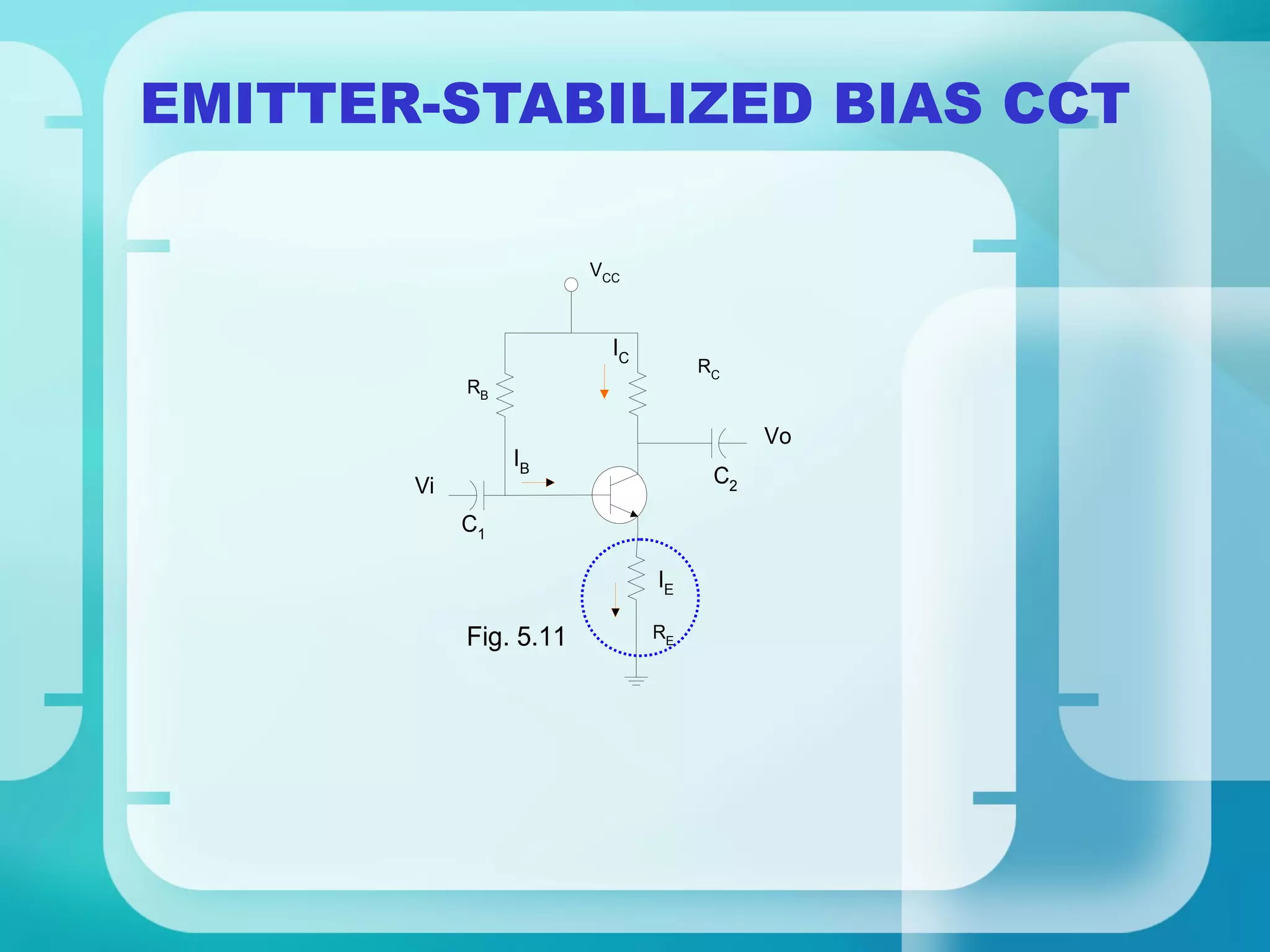
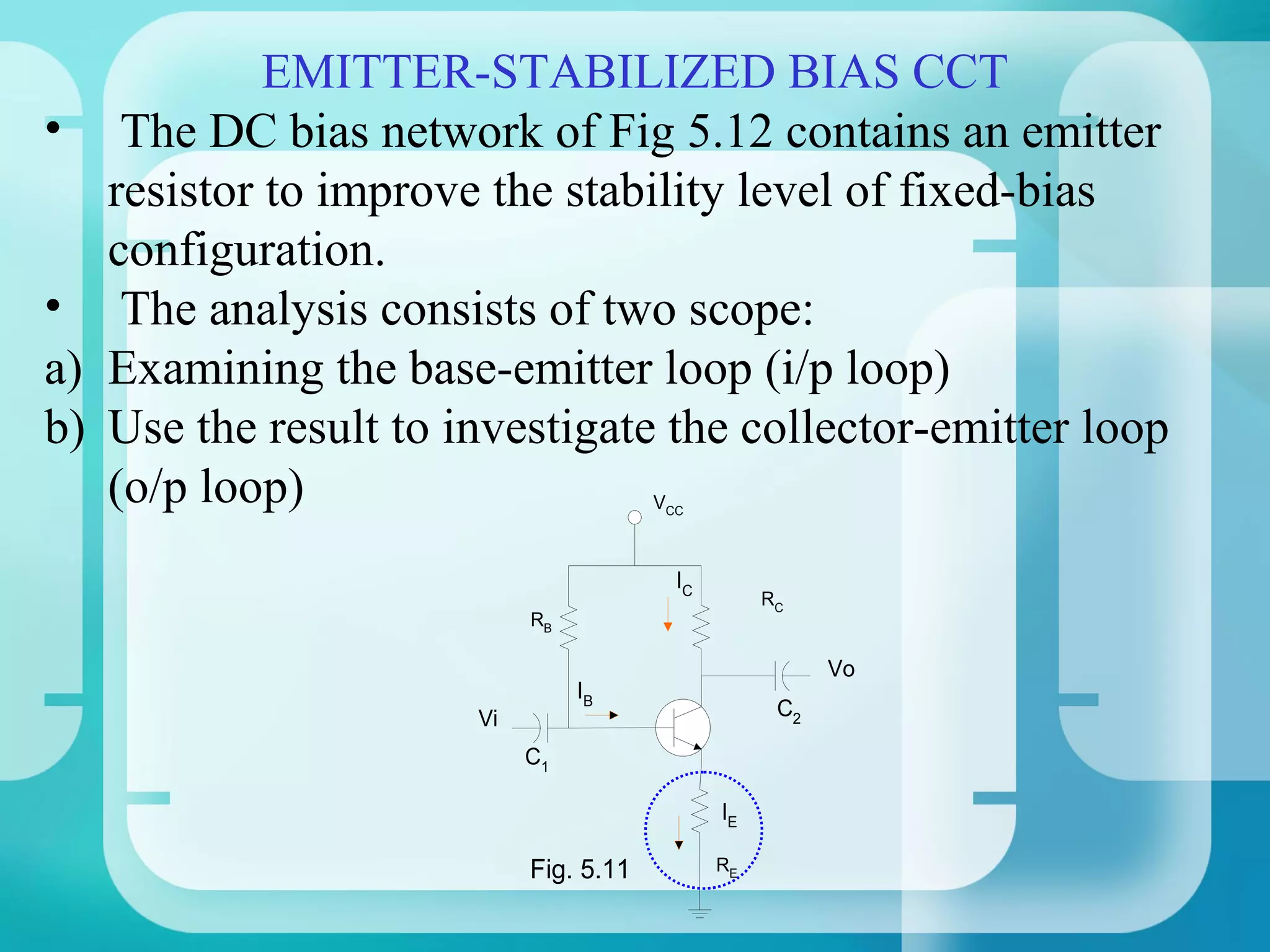
EMITTER-STABILIZED BIAS CCT

                        VCC


                          IC
                                    RC
            RB

                                          Vo
                 IB
       Vi                            C2

            C1

                               IE

            Fig. 5.11          RE
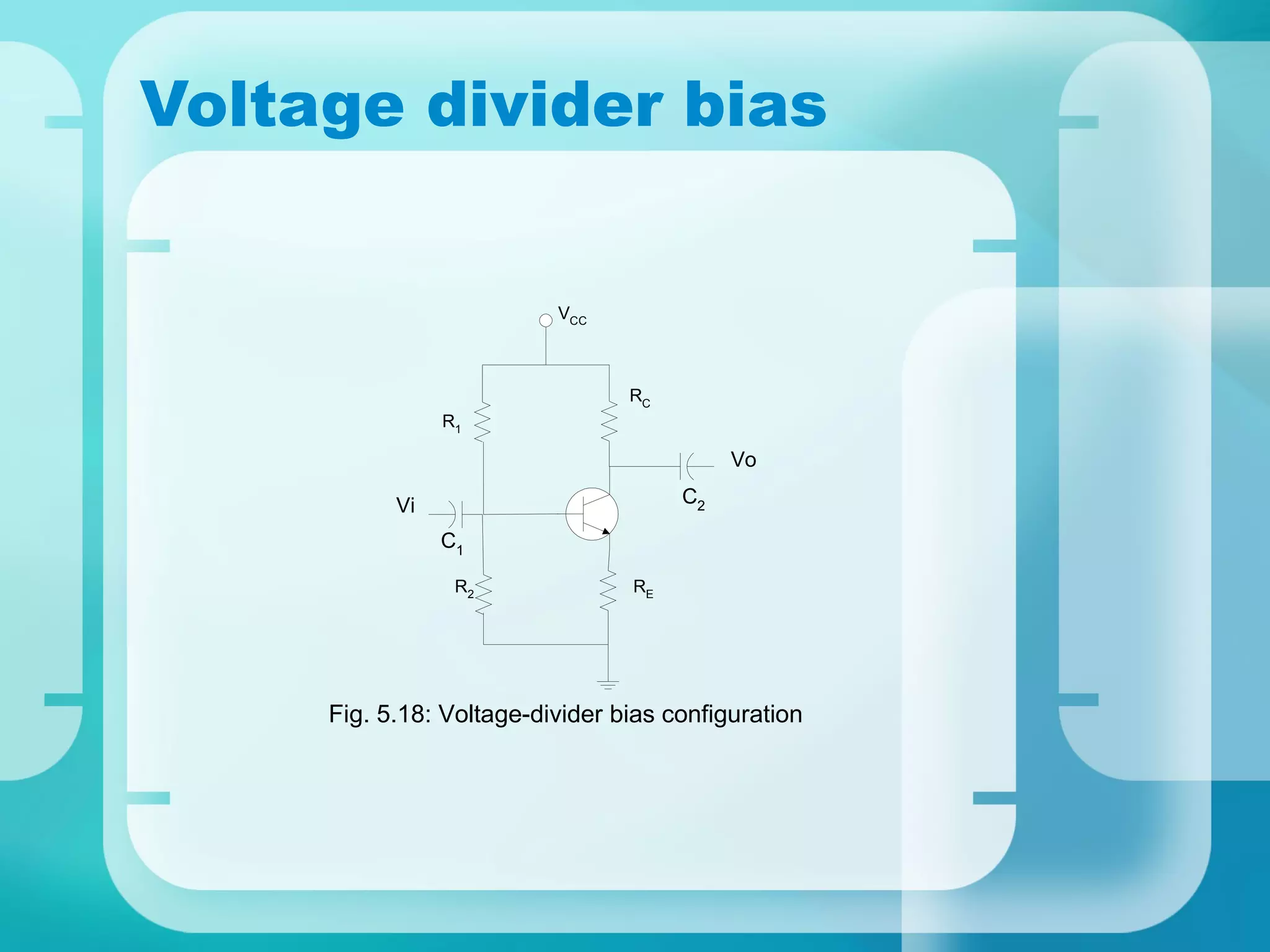
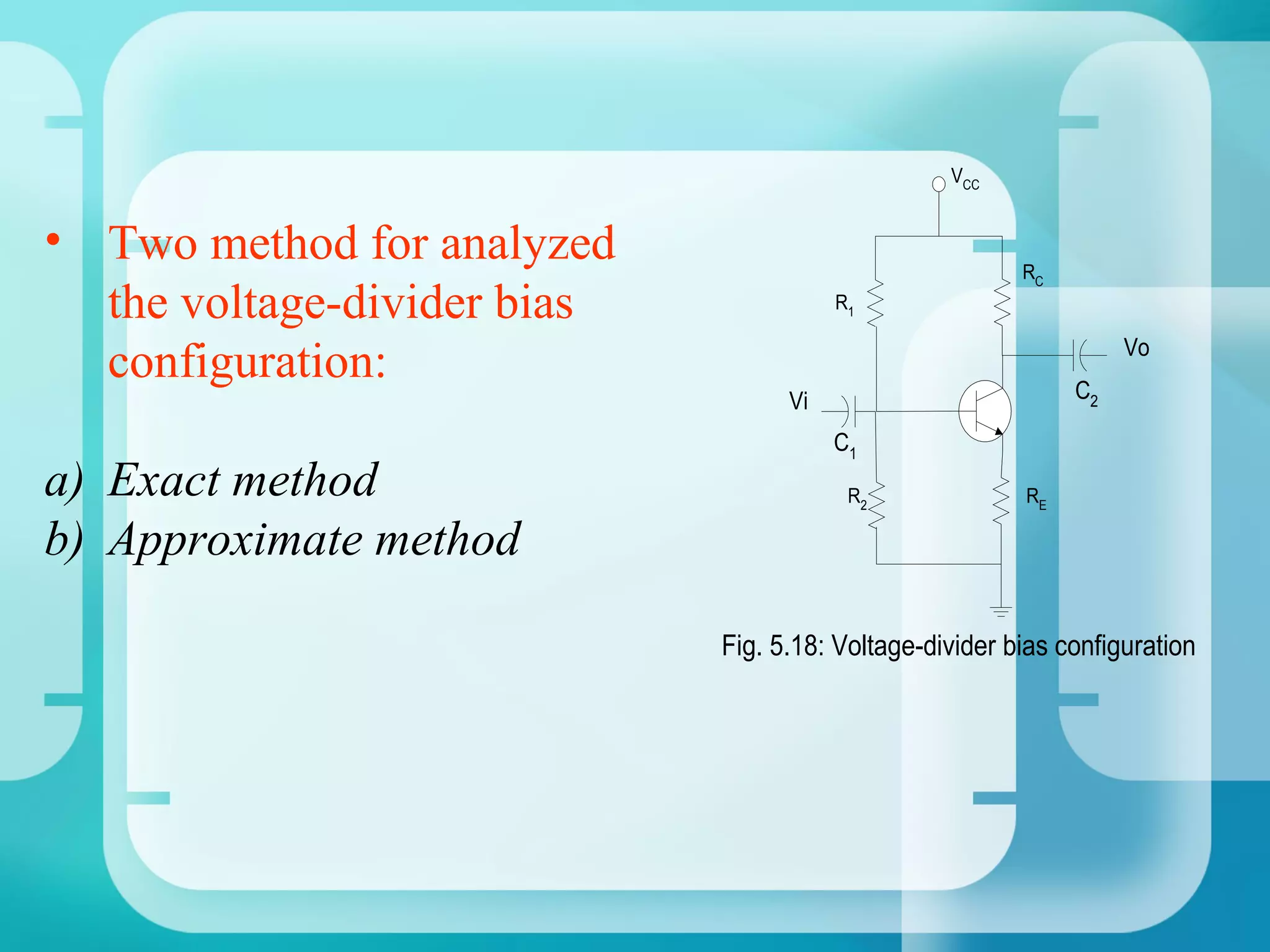
Voltage divider bias


                          VCC


                                 RC
                R1

                                           Vo

           Vi                         C2

                C1

                 R2              RE


     Fig. 5.18: Voltage-divider bias configuration
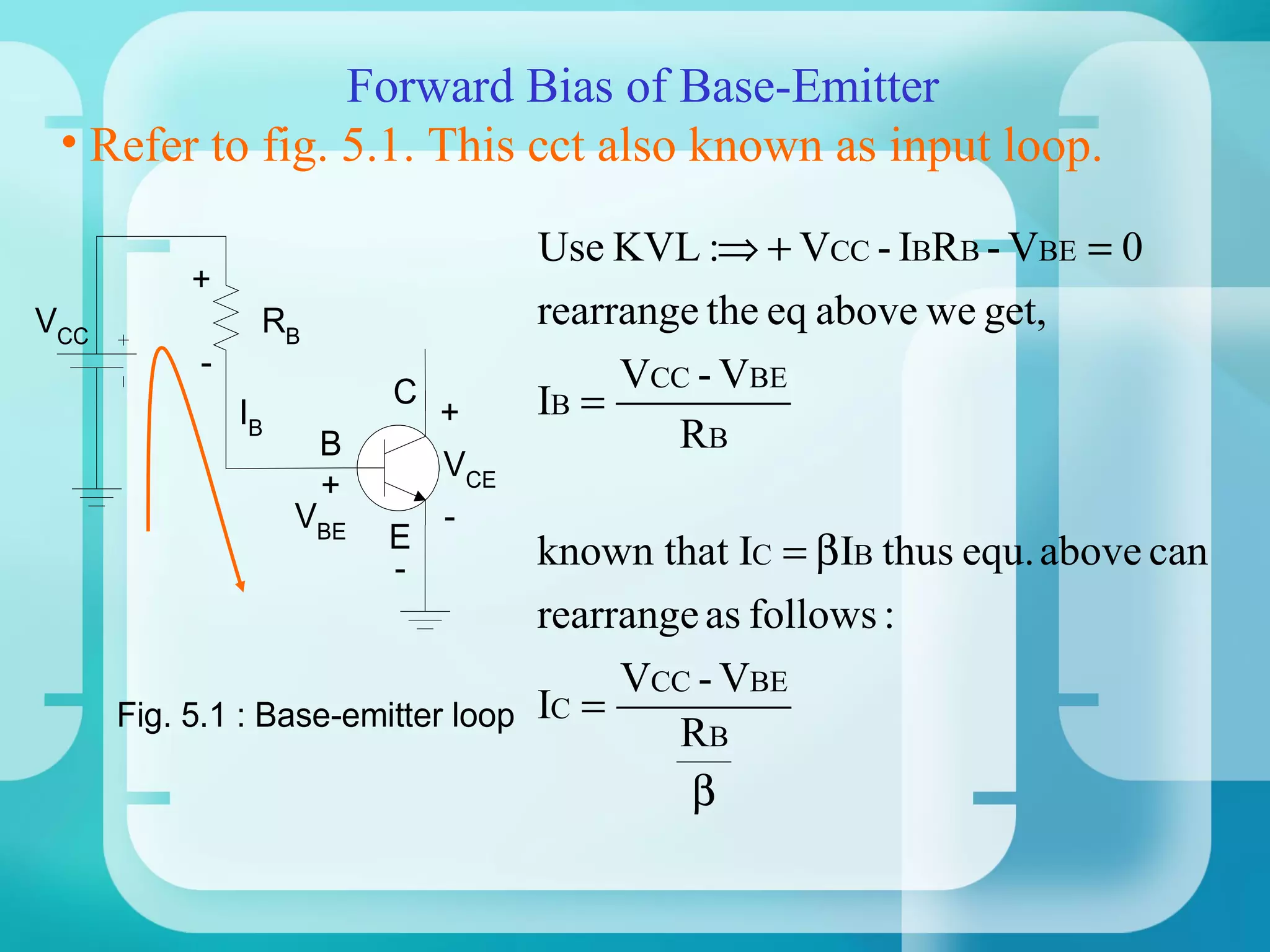
Forward Bias of Base-Emitter
 • Refer to fig. 5.1. This cct also known as input loop.

                                    Use KVL :⇒ + VCC - IBRB - VBE = 0
          +
VCC             RB                  rearrange the eq above we get,
           -                             VCC - VBE
               IB
                          C
                              +     IB =
                     B                      RB
                              VCE
                     +
                    VBE       -
                          E        known that IC = βIB thus equ. above can
                          -
                                   rearrange as follows :
                                        VCC - VBE
      Fig. 5.1 : Base-emitter loop IC =
                                           RB
                                            β
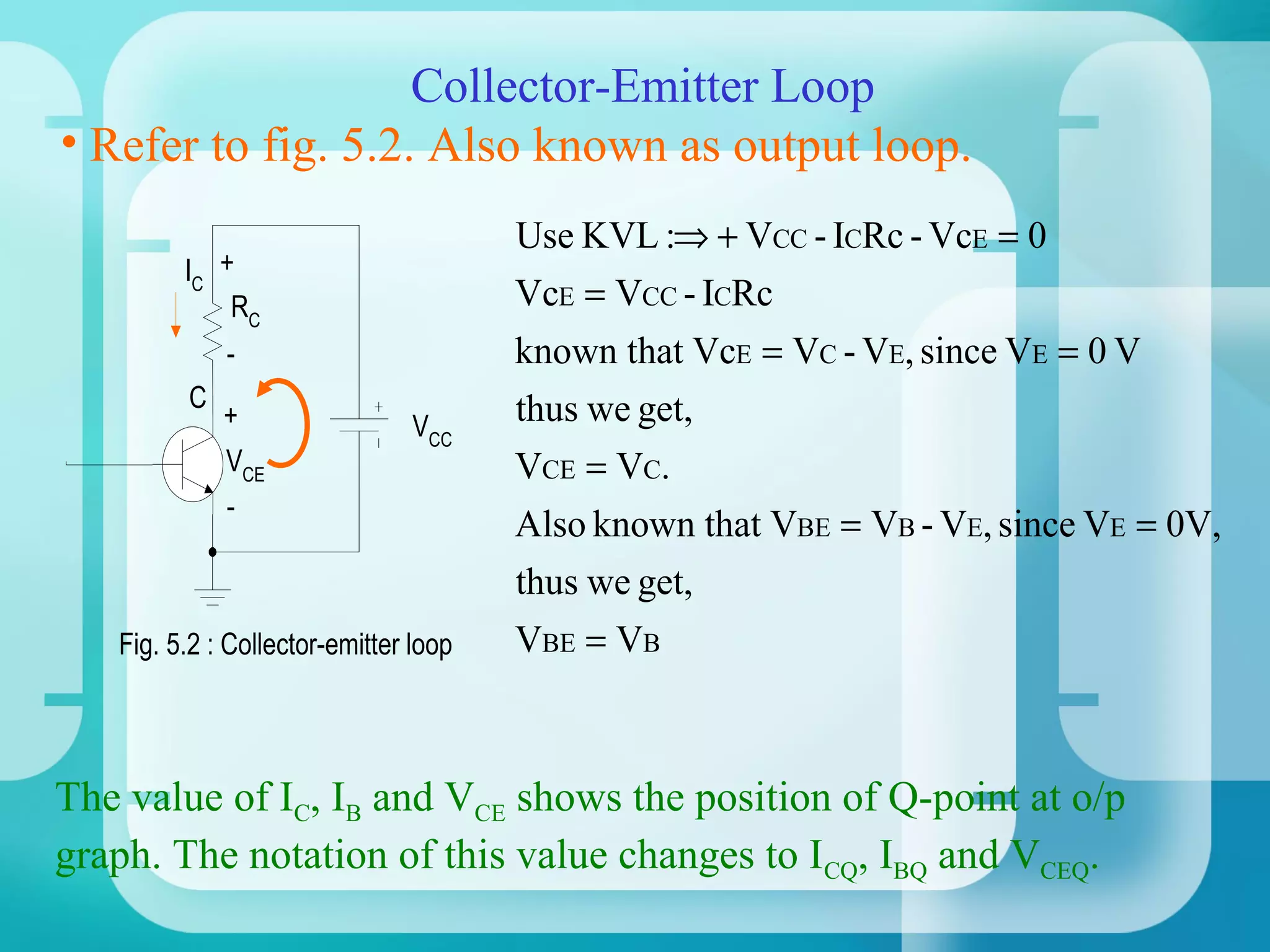
Collector-Emitter Loop
• Refer to fig. 5.2. Also known as output loop.
                                       Use KVL :⇒ + VCC - ICRc - VcE = 0
         IC +
             RC                        VcE = VCC - ICRc
             -                         known that VcE = VC - VE, since VE = 0 V
         C                             thus we get,
             +                  VCC
             VCE                       VCE = VC.
             -
                                       Also known that VBE = VB - VE, since VE = 0V,
                                       thus we get,
   Fig. 5.2 : Collector-emitter loop   VBE = VB


The value of IC, IB and VCE shows the position of Q-point at o/p
graph. The notation of this value changes to ICQ, IBQ and VCEQ.
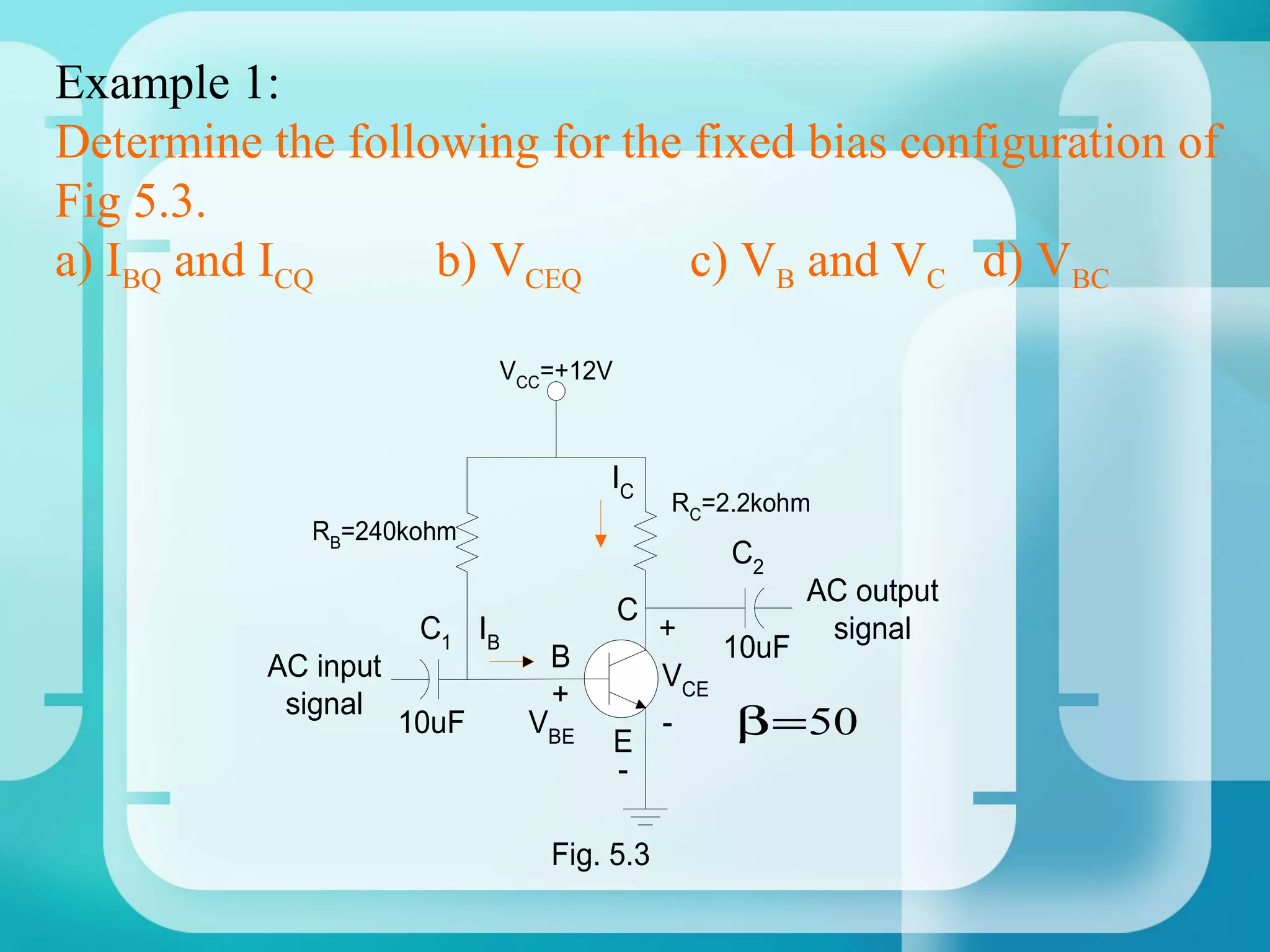
Example 1:
Determine the following for the fixed bias configuration of
Fig 5.3.
a) IBQ and ICQ     b) VCEQ      c) VB and VC d) VBC

                            VCC=+12V


                                    IC
                                           RC=2.2kohm
             RB=240kohm
                                               C2
                                                    AC output
                                       C
                      C1 IB                +         signal
                               B               10uF
          AC input                         VCE
           signal              +
                     10uF     VBE
                                       E
                                           -    β = 50
                                       -

                               Fig. 5.3
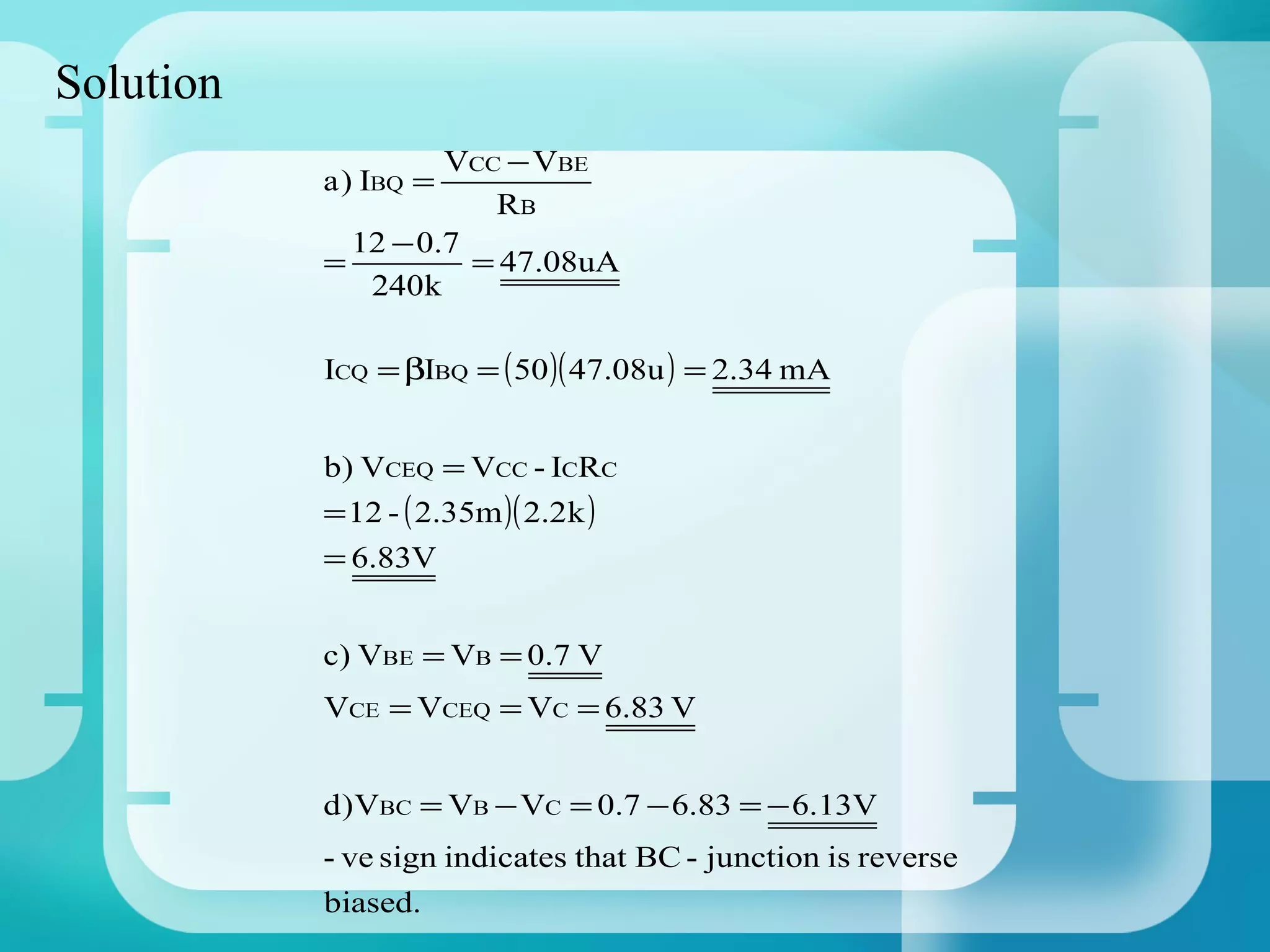
Solution
                    VCC − VBE
           a ) IBQ =
                       RB
             12 − 0.7
           =          = 47.08uA
              240k

           ICQ = βIBQ = ( 50 )( 47.08u ) = 2.34 mA


           b) VCEQ = VCC - ICRC
           = 12 - ( 2.35m )( 2.2k )
           = 6.83V


           c) VBE = VB = 0.7 V
           VCE = VCEQ = VC = 6.83 V


           d )VBC = VB − VC = 0.7 − 6.83 = − 6.13V
           - ve sign indicates that BC - junction is reverse
           biased.
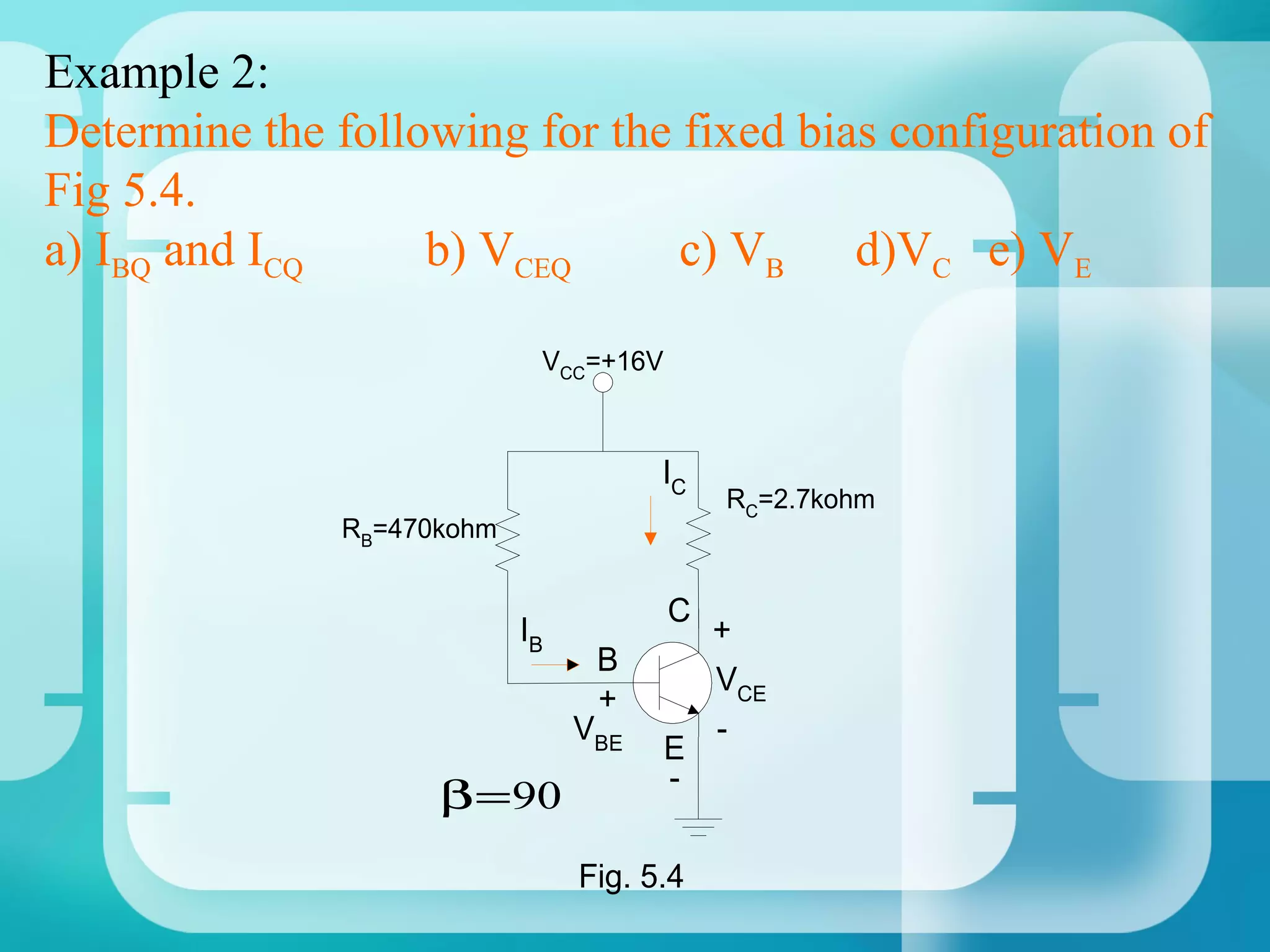
Example 2:
Determine the following for the fixed bias configuration of
Fig 5.4.
a) IBQ and ICQ     b) VCEQ      c) VB d)VC e) VE

                             VCC=+16V


                                       IC
                                            RC=2.7kohm
               RB=470kohm


                                        C
                            IB              +
                                  B
                                            VCE
                                  +
                                 VBE        -
                                        E
                                        -
                     β = 90
                                 Fig. 5.4
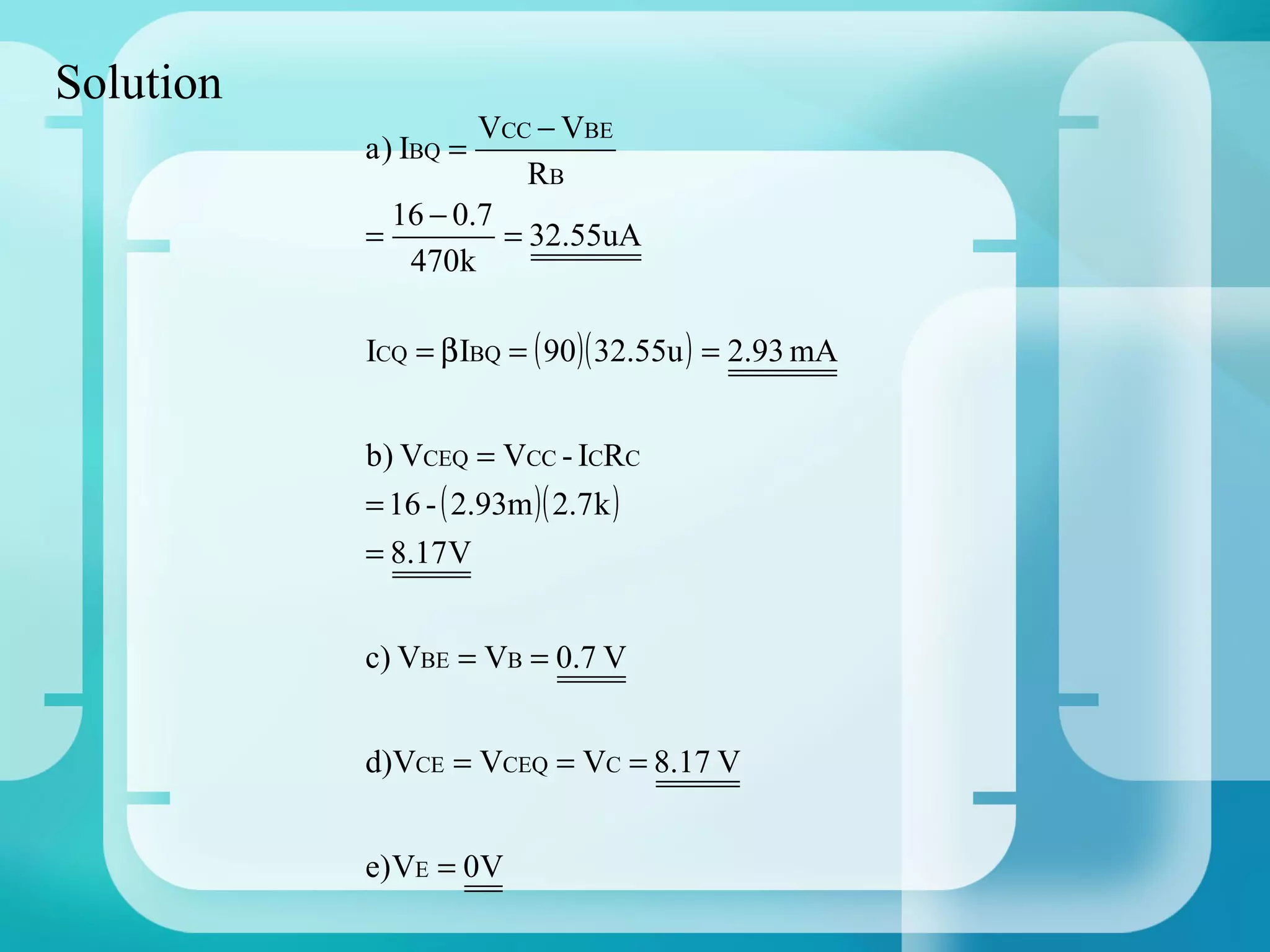
Solution
                    VCC − VBE
           a ) IBQ =
                        RB
             16 − 0.7
           =          = 32.55uA
              470k

           ICQ = β IBQ = ( 90 )( 32.55u ) = 2.93 mA


           b) VCEQ = VCC - ICRC
           = 16 - ( 2.93m )( 2.7 k )
           = 8.17V


           c) VBE = VB = 0.7 V


           d)VCE = VCEQ = VC = 8.17 V


           e) VE = 0V
Transistor Saturation
• Saturation means the level of systems have reached their
maximum values.
• For a transistor operating in the saturation region, the
current is maximum value for a particular design.
• Saturation region are normally avoided because the B-C
junction is no longer reverse-biased and the o/p amplified
signal will be distorted.
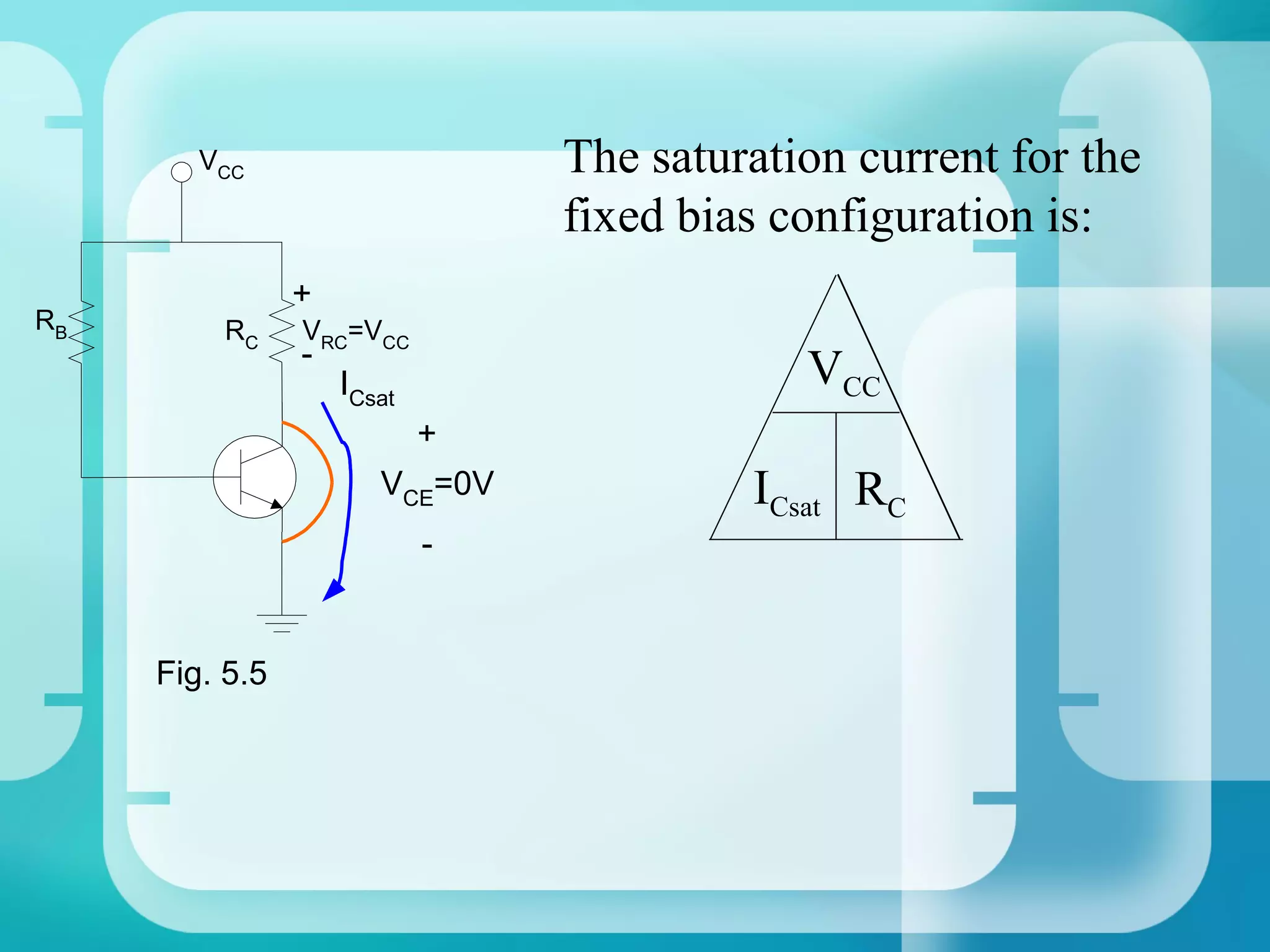
• Fig 5.5 shows the schematic diagram to determine ICsat
for the fixed-bias configuration.
VCC                    The saturation current for the
                               fixed bias configuration is:
                +
RB       RC     V =V
                - RC CC
                   ICsat                   VCC
                       +
                     VCE=0V             ICsat RC
                           -


     Fig. 5.5
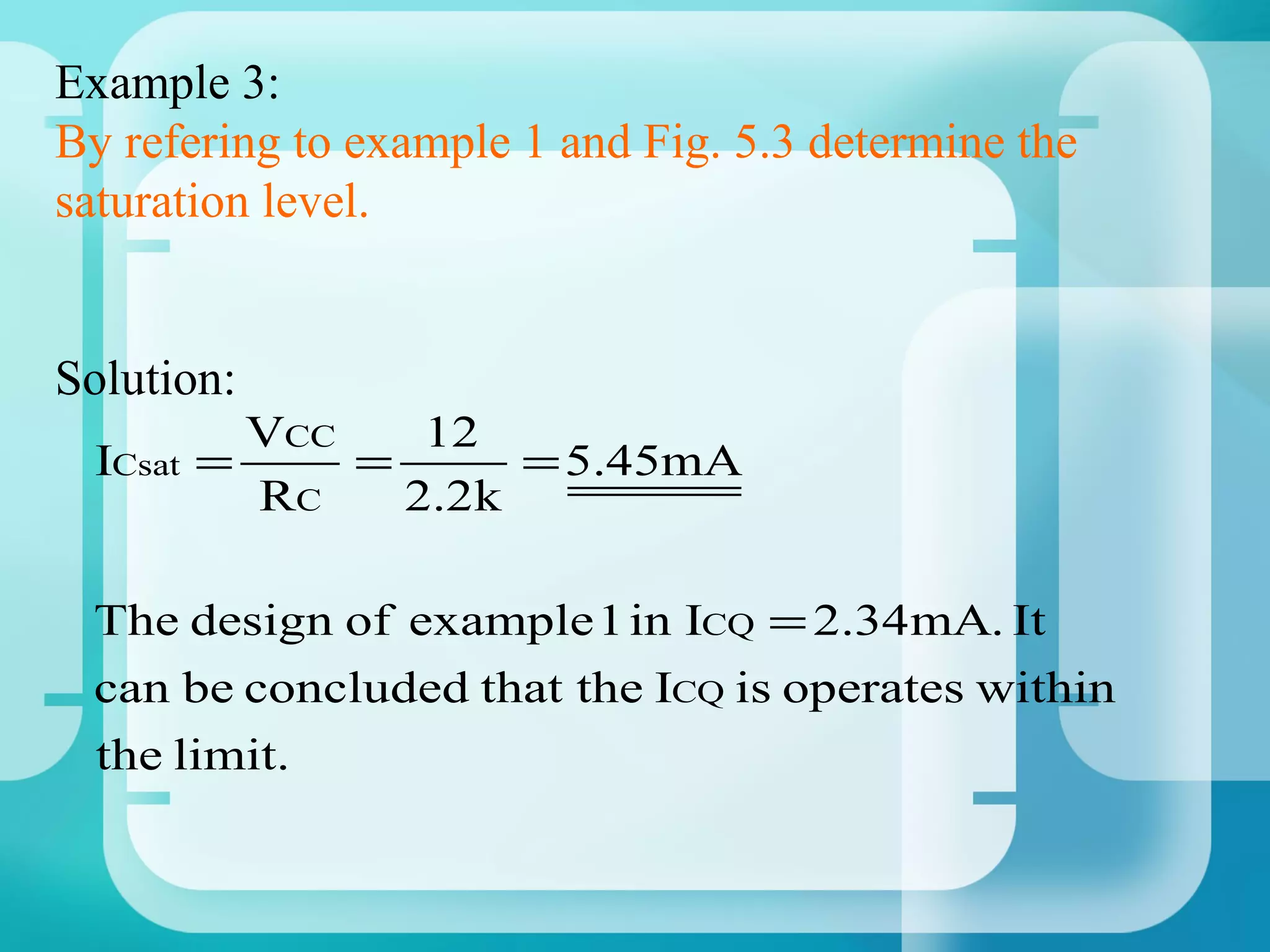
Example 3:
By refering to example 1 and Fig. 5.3 determine the
saturation level.


Solution:
           VCC    12
 ICsat   =     =        = 5.45mA
           RC    2 .2 k

 The design of example 1 in ICQ = 2.34mA. It
 can be concluded that the ICQ is operates within
 the limit.
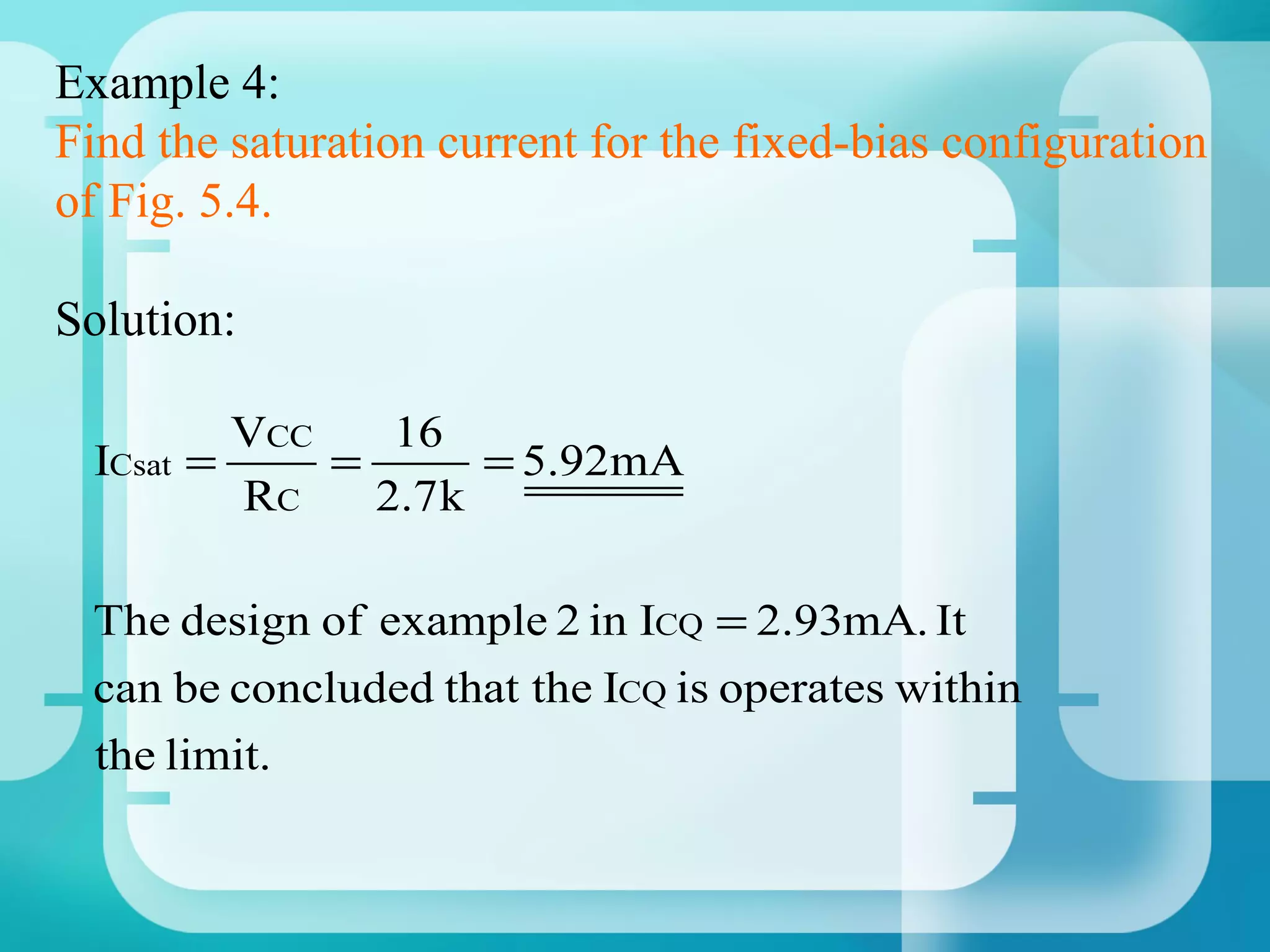
Example 4:
Find the saturation current for the fixed-bias configuration
of Fig. 5.4.

Solution:

            VCC    16
  ICsat   =     =       = 5.92mA
            RC    2.7 k

 The design of example 2 in ICQ = 2.93mA. It
 can be concluded that the ICQ is operates within
 the limit.
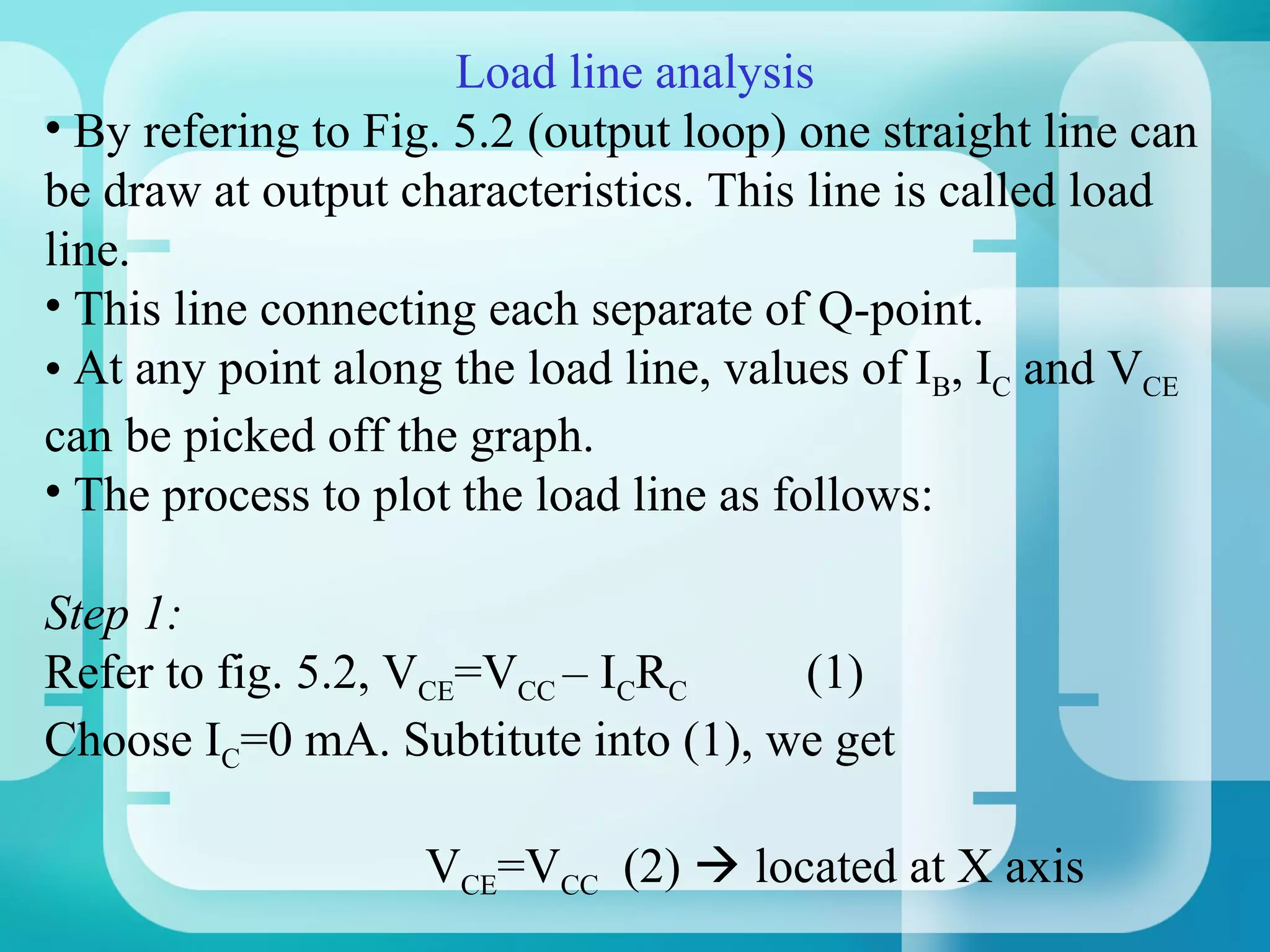
Load line analysis
• By refering to Fig. 5.2 (output loop) one straight line can
be draw at output characteristics. This line is called load
line.
• This line connecting each separate of Q-point.
• At any point along the load line, values of IB, IC and VCE
can be picked off the graph.
• The process to plot the load line as follows:

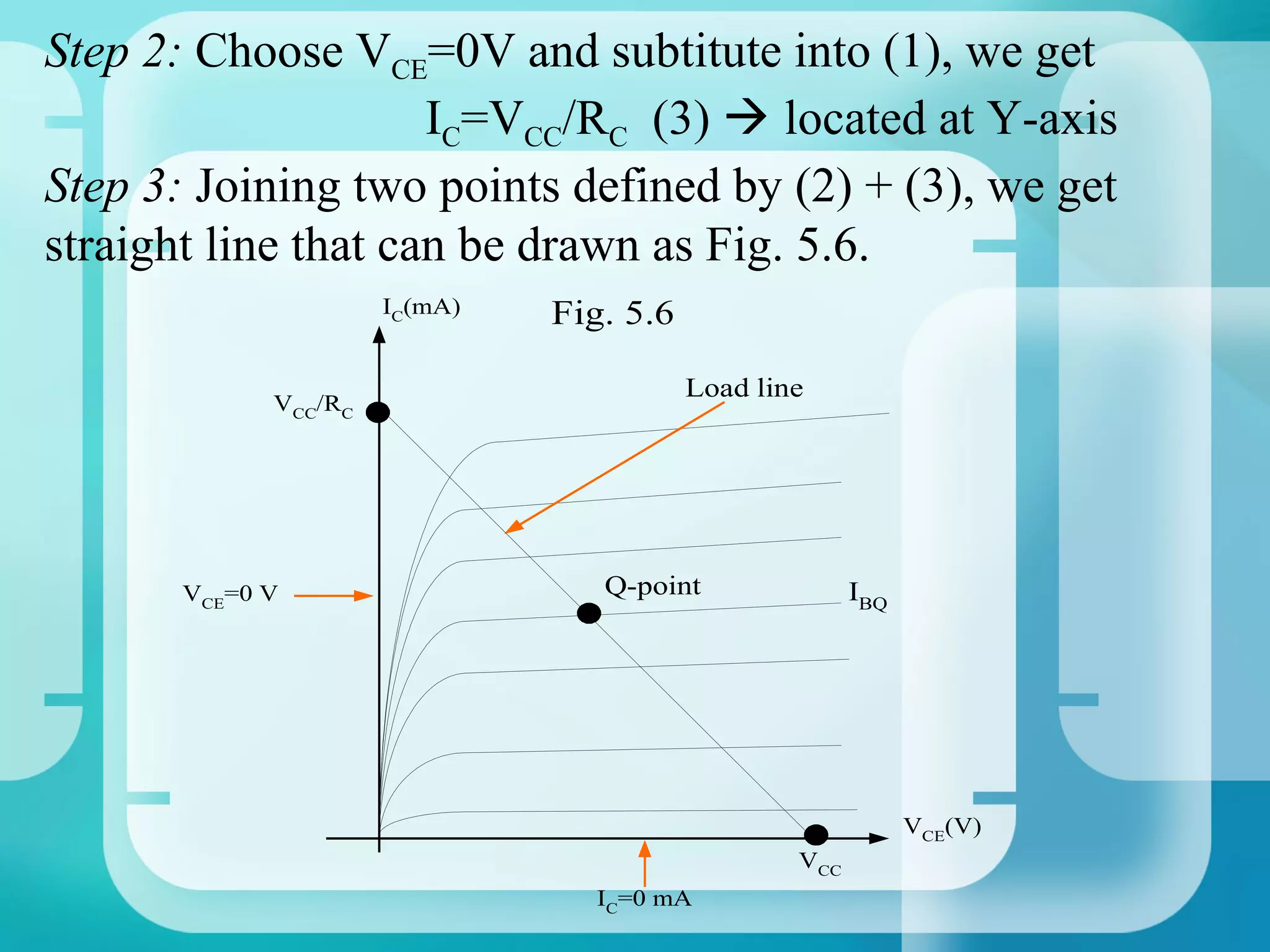
Step 1:
Refer to fig. 5.2, VCE=VCC – ICRC    (1)
Choose IC=0 mA. Subtitute into (1), we get

                    VCE=VCC (2)  located at X axis
Step 2: Choose VCE=0V and subtitute into (1), we get
                     IC=VCC/RC (3)  located at Y-axis
Step 3: Joining two points defined by (2) + (3), we get
straight line that can be drawn as Fig. 5.6.
                      IC(mA)   Fig. 5.6

                                          Load line
             VCC/RC


       VCE=0 V                    Q-point               IBQ


                                                              VCE(V)
                                                  VCC
                                 IC=0 mA
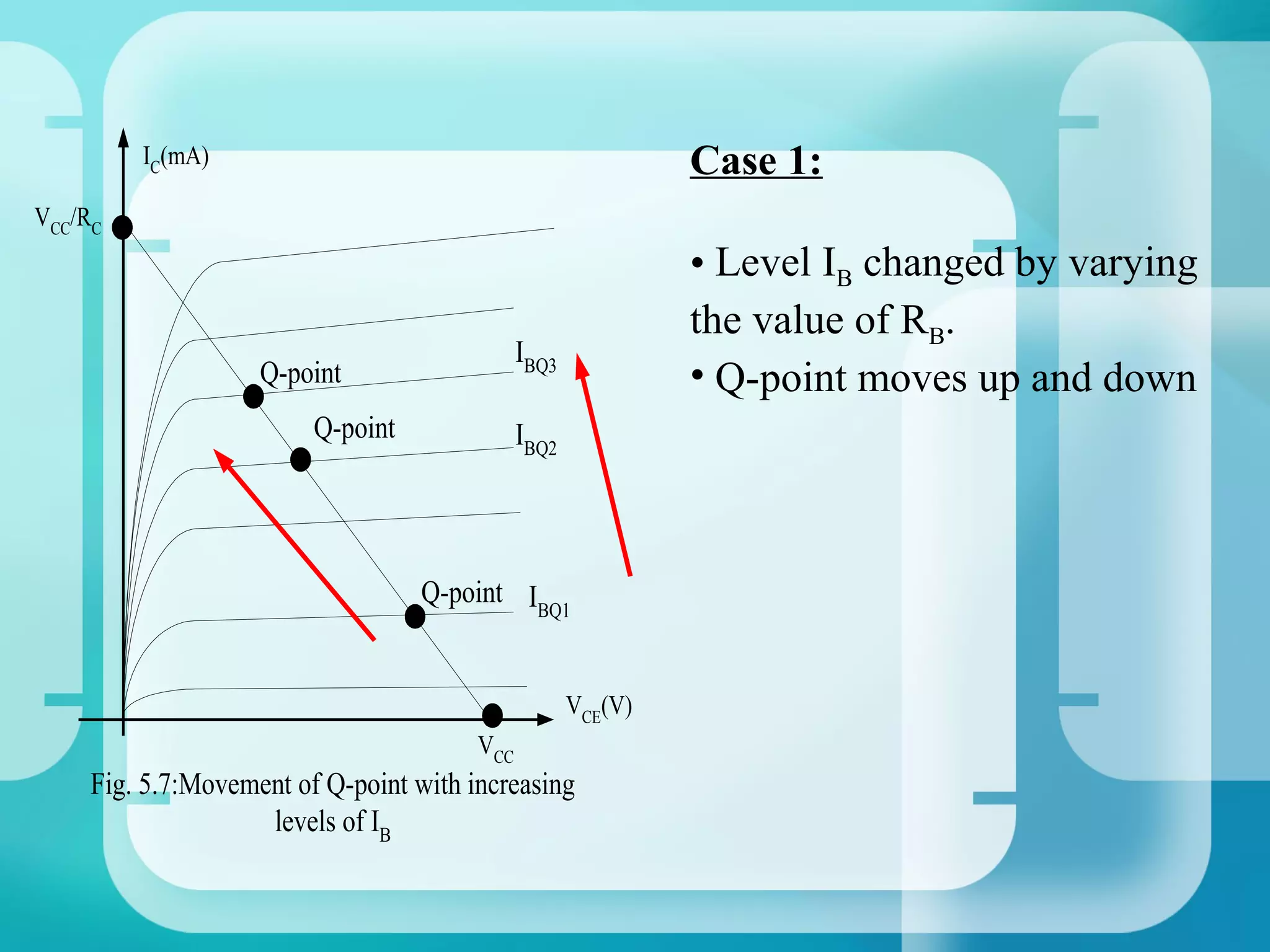
IC(mA)                                               Case 1:
VCC/RC
                                                              • Level IB changed by varying
                                                              the value of RB.
                                              IBQ3
                    Q-point                                   • Q-point moves up and down
                         Q-point              IBQ2


                                   Q-point IBQ1


                                                     VCE(V)
                                        VCC
     Fig. 5.7:Movement of Q-point with increasing
                    levels of IB
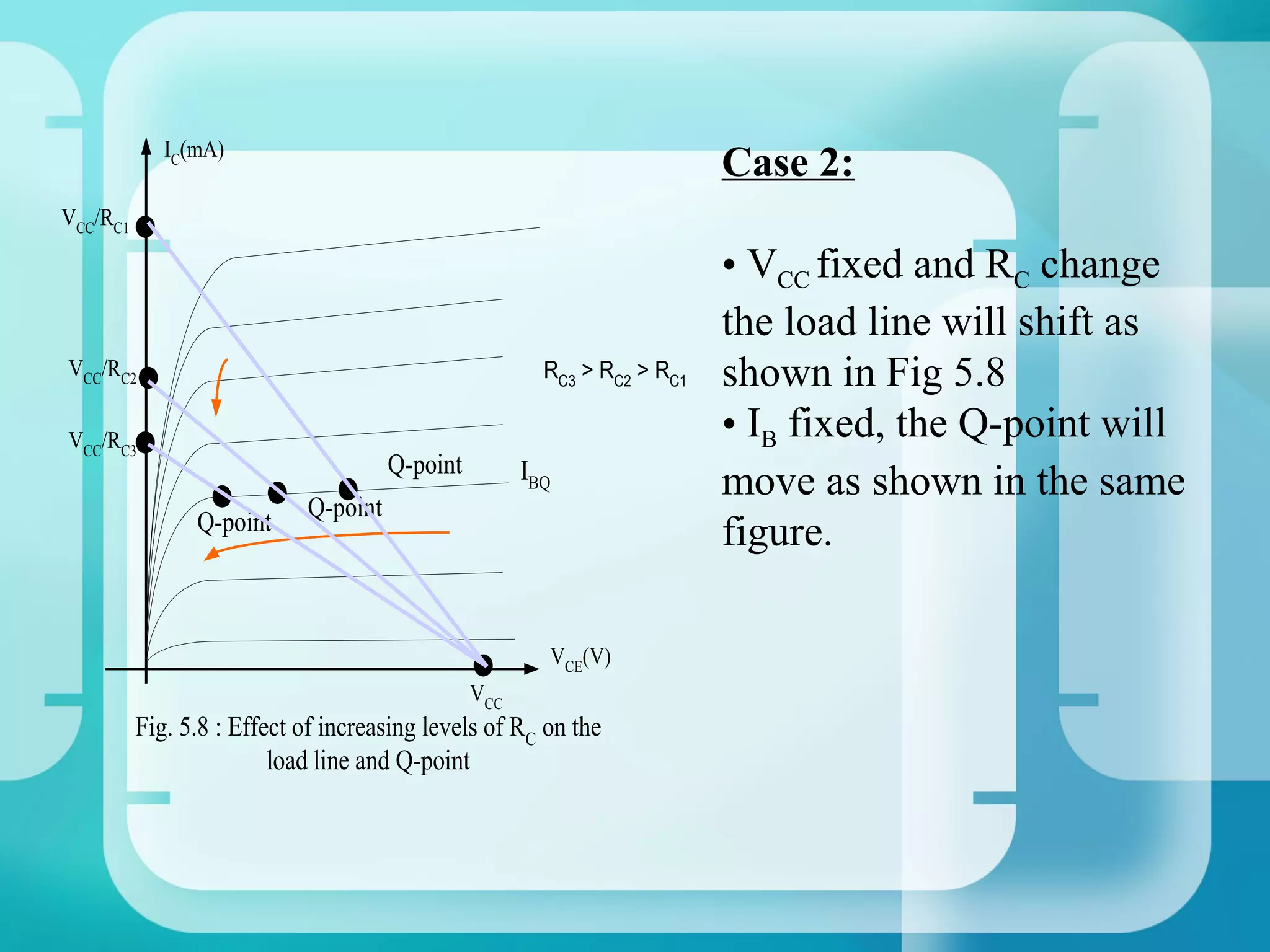
IC(mA)
                                                                          Case 2:
VCC/RC1

                                                                          • VCC fixed and RC change
                                                                          the load line will shift as
VCC/RC2                                                 RC3 > RC2 > RC1   shown in Fig 5.8
VCC/RC3                                                                   • IB fixed, the Q-point will
                                      Q-point         IBQ
                                                                          move as shown in the same
                            Q-point
                Q-point
                                                                          figure.

                                                        VCE(V)
                                                VCC
          Fig. 5.8 : Effect of increasing levels of RC on the
                         load line and Q-point
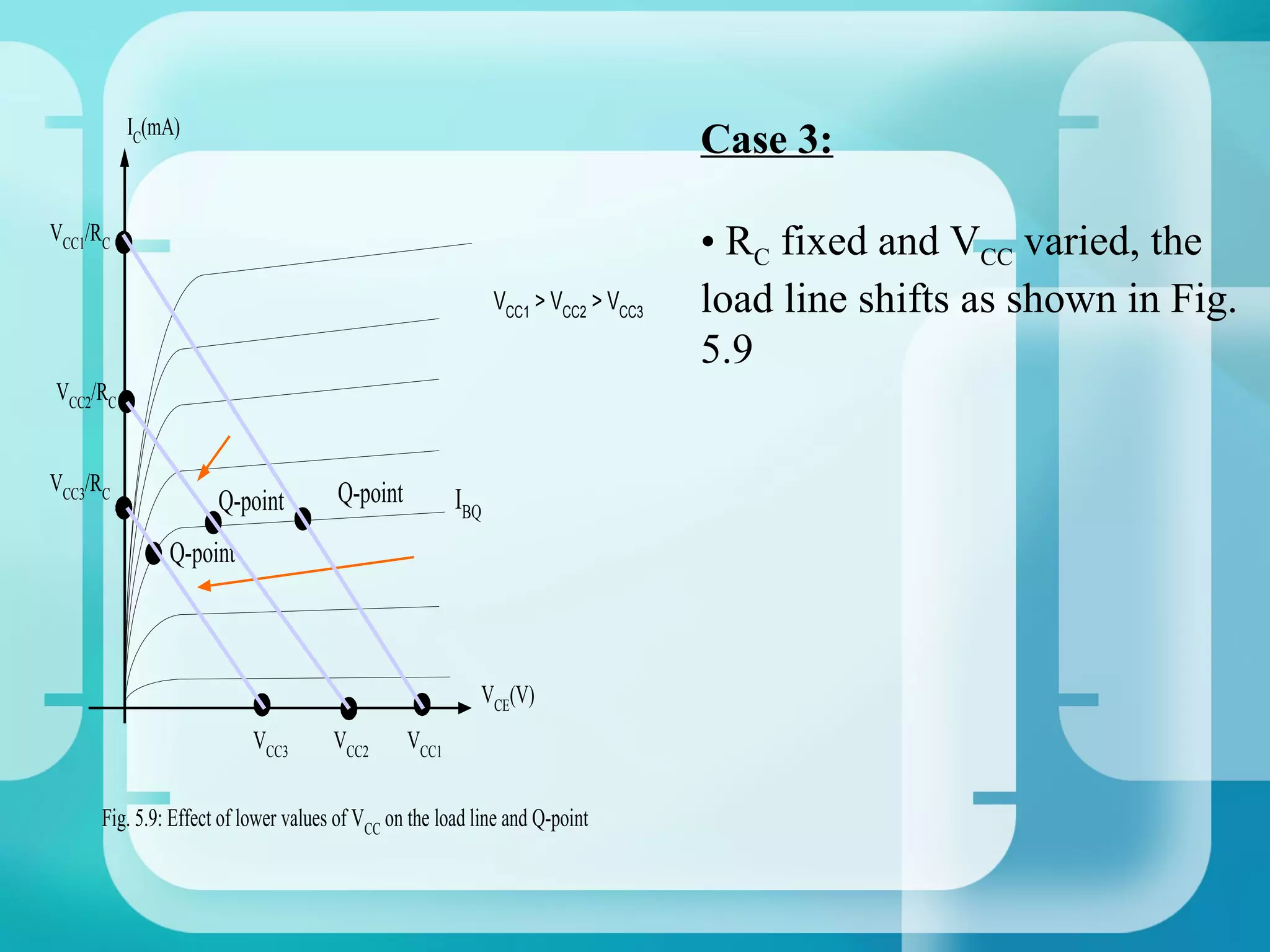
IC(mA)
                                                                                  Case 3:

VCC1/RC
                                                                                  • RC fixed and VCC varied, the
                                                             VCC1 > VCC2 > VCC3   load line shifts as shown in Fig.
                                                                                  5.9
VCC2/RC


VCC3/RC                               Q-point
                      Q-point                          IBQ
               Q-point


                                                           VCE(V)
                           VCC3       VCC2      VCC1


      Fig. 5.9: Effect of lower values of VCC on the load line and Q-point
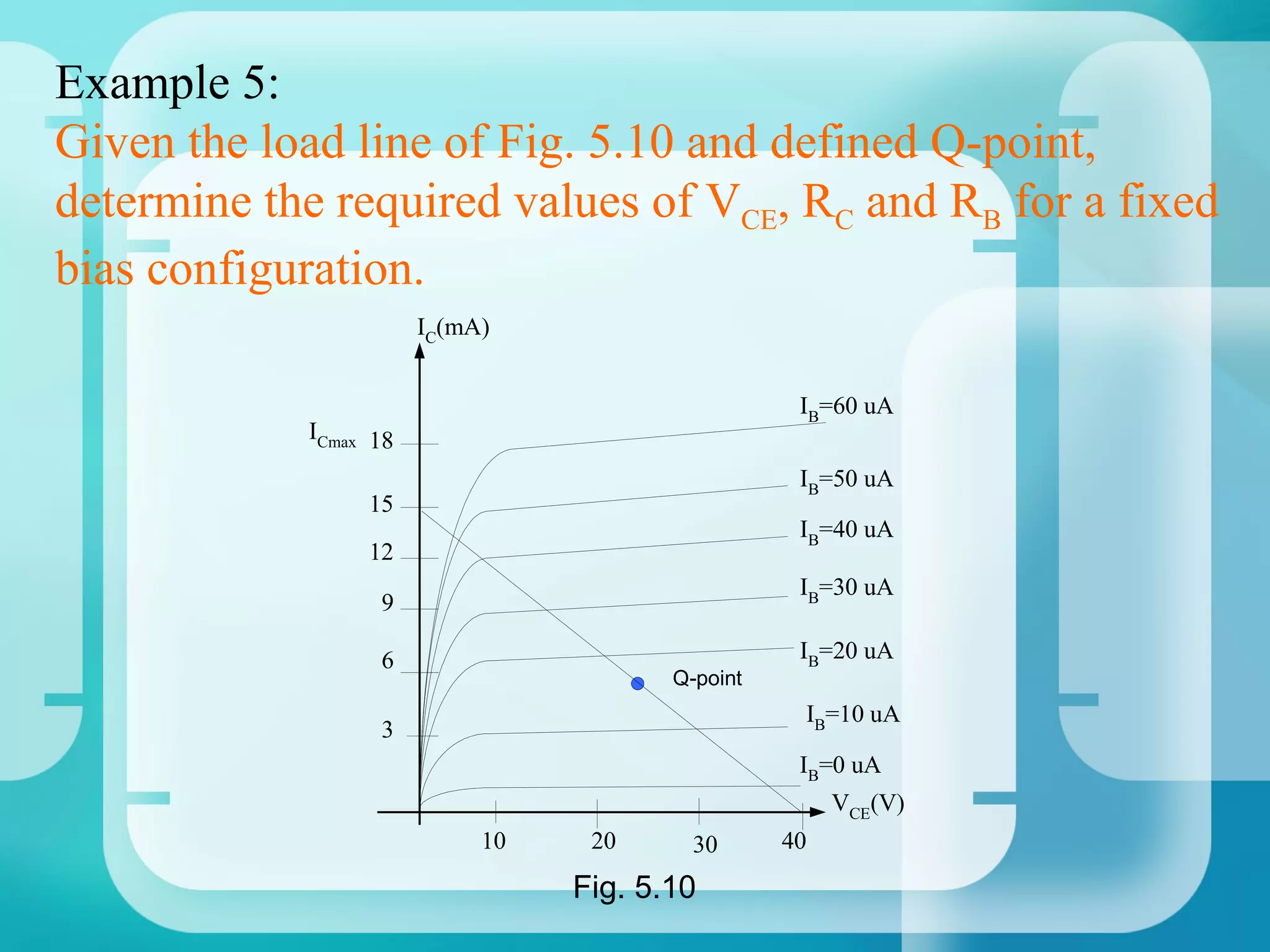
Example 5:
Given the load line of Fig. 5.10 and defined Q-point,
determine the required values of VCE, RC and RB for a fixed
bias configuration.
                       IC(mA)


                                                   IB=60 uA
            ICmax 18
                                                   IB=50 uA
                 15
                                                   IB=40 uA
                 12
                                                   IB=30 uA
                  9

                  6                                IB=20 uA
                                        Q-point
                                                   IB=10 uA
                  3
                                                   IB=0 uA
                                                       VCE(V)
                            10    20      30      40
                                 Fig. 5.10
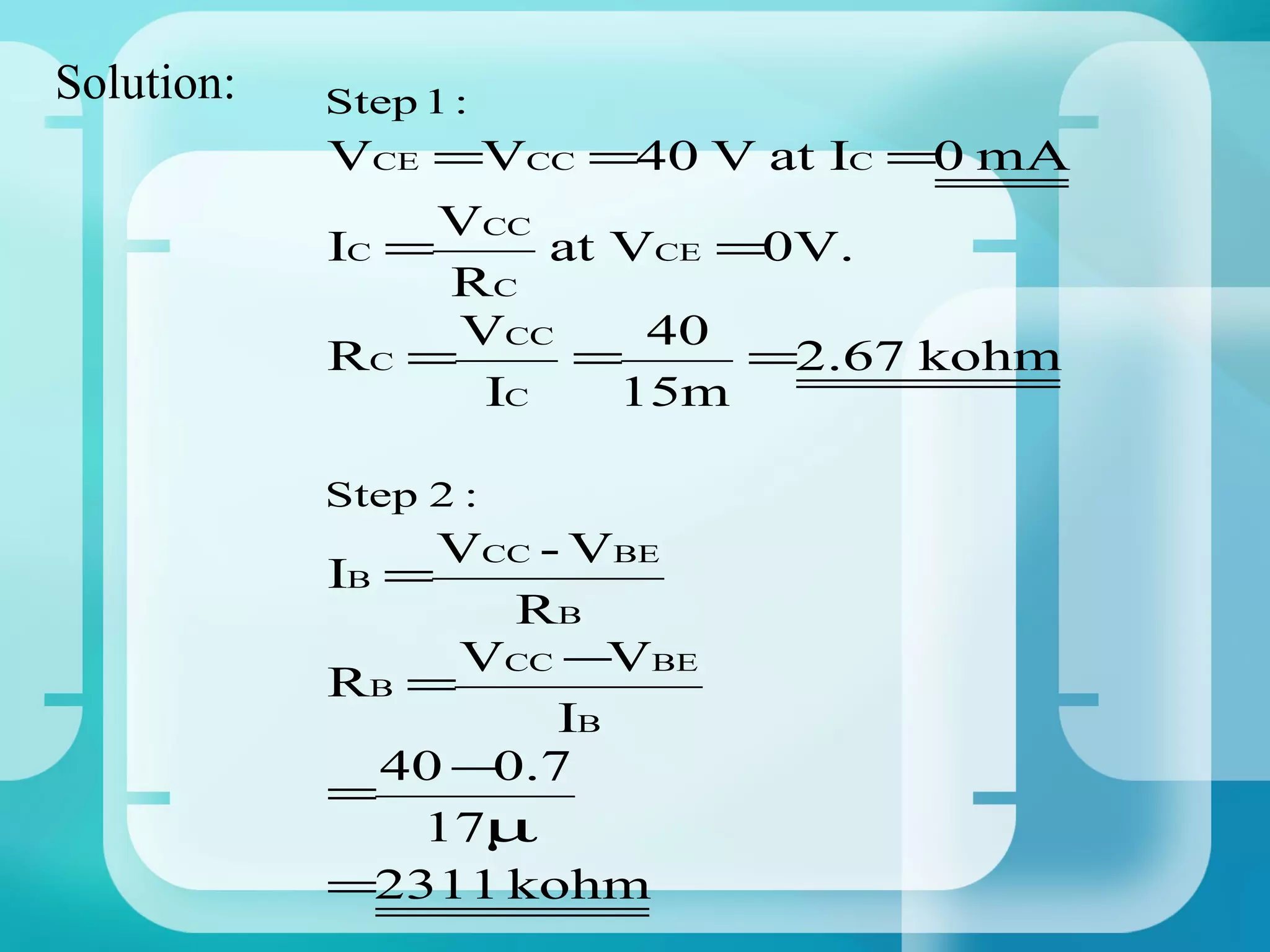
Solution:   Step 1 :
            VCE =VCC =40 V at IC =0 mA
                VCC
            IC =     at VCE =0V.
                RC
                 VCC     40
            RC =      =      =2.67 kohm
                  IC    15m

            Step 2 :
                 VCC - VBE
            IB =
                    RB
                  VCC −VBE
            RB =
                      IB
               40 −0.7
            =
                17µ
            =2311 kohm
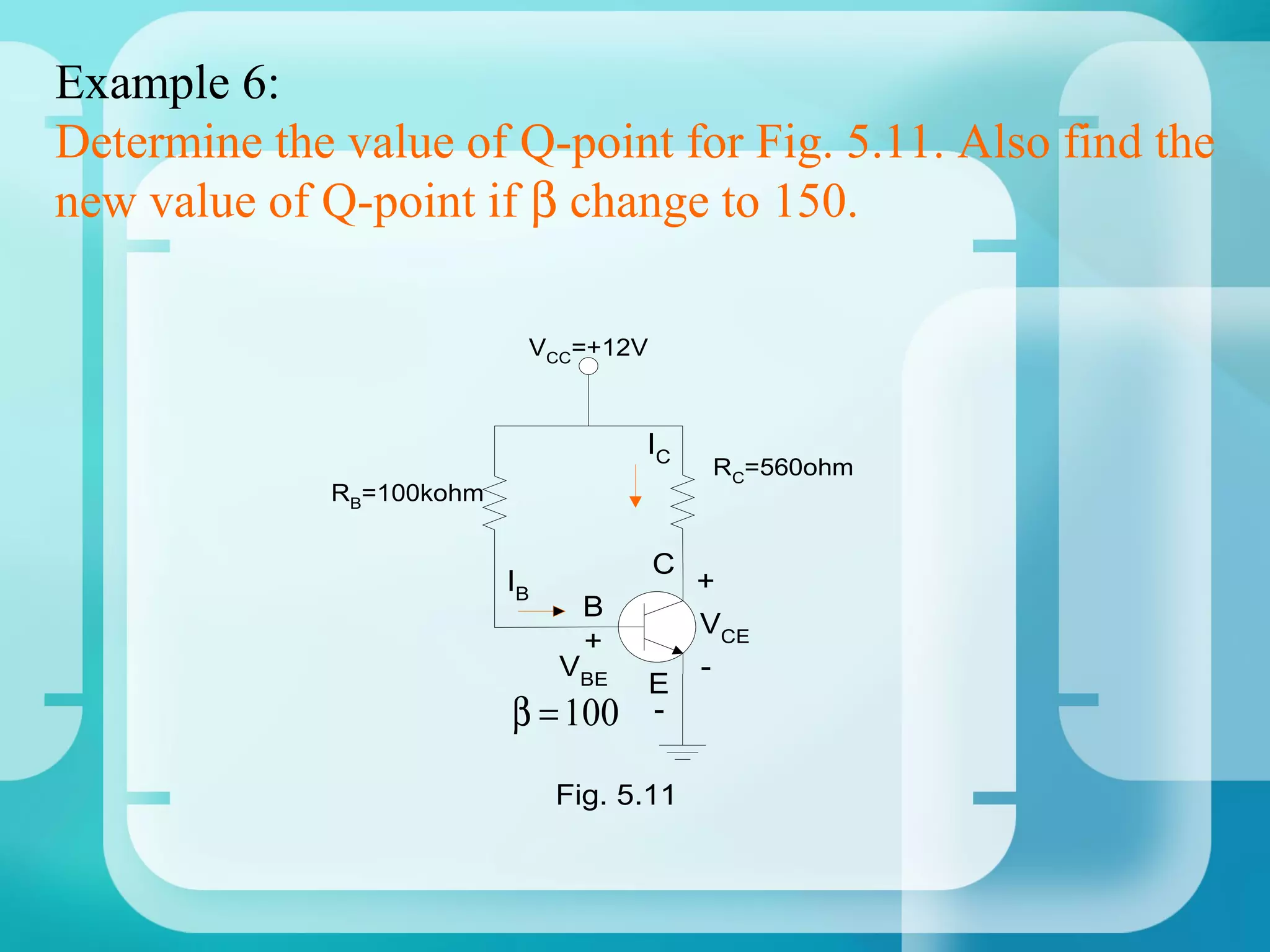
Example 6:
Determine the value of Q-point for Fig. 5.11. Also find the
new value of Q-point if β change to 150.

                            VCC=+12V


                                      IC
                                            RC=560ohm
              RB=100kohm


                                       C
                           IB               +
                                  B
                                            VCE
                                  +
                                VBE         -
                                       E
                           β = 100     -

                                Fig. 5.11
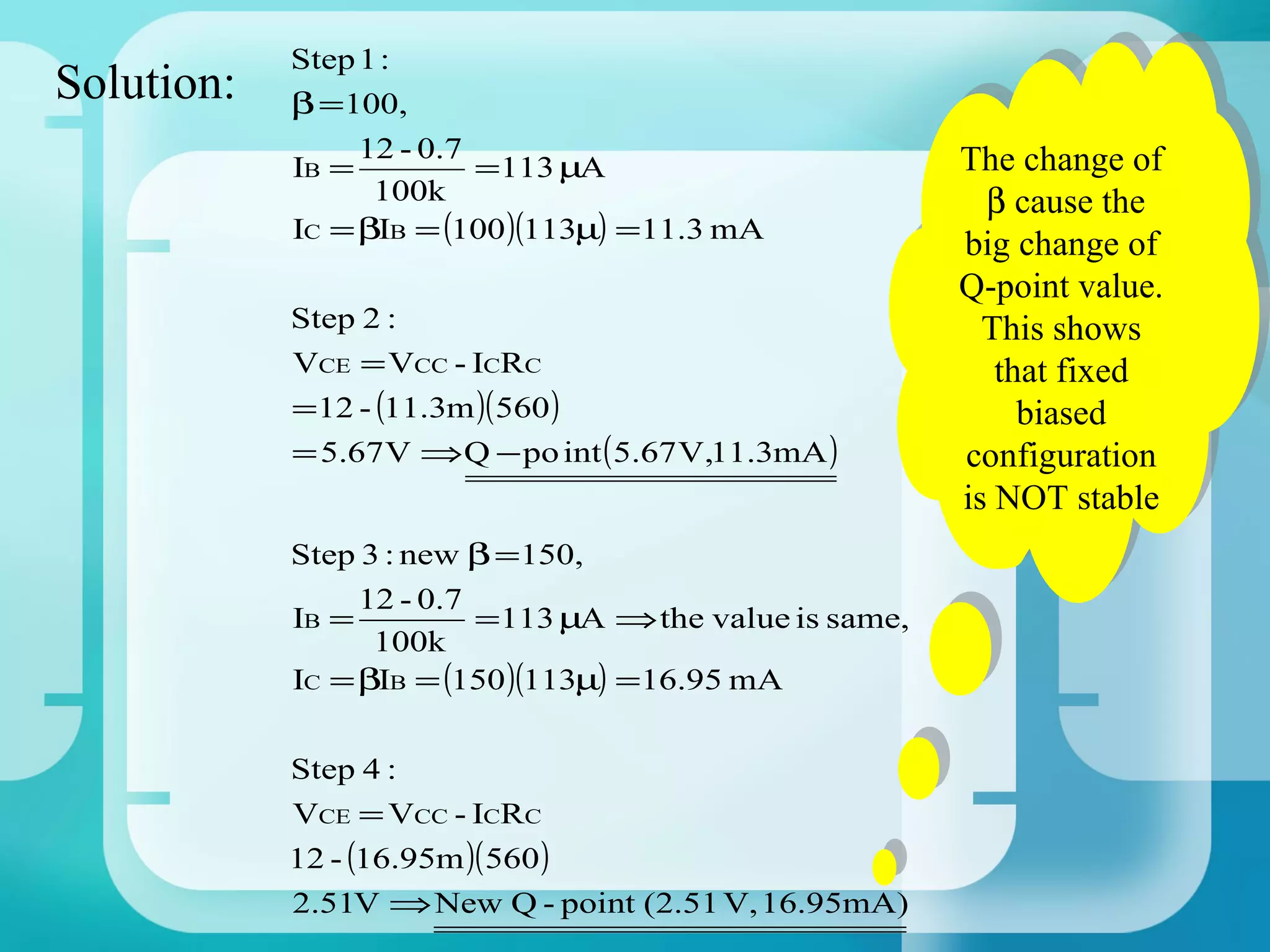
Step 1 :
Solution:   β =100,

            IB =
                 12 - 0.7
                          =113 µA
                                                          The change of
                                                         The change of
                  100k                                      β cause the
                                                           β cause the
            IC = βIB = (100 )(113µ) =11.3 mA              big change of
                                                         big change of
                                                          Q-point value.
                                                         Q-point value.
            Step 2 :                                        This shows
                                                           This shows
            VCE = VCC - ICRC                                 that fixed
                                                            that fixed
            =12 - (11.3m )( 560 )                              biased
                                                              biased
            = 5.67 V ⇒Q − po int ( 5.67 V,11.3mA )        configuration
                                                         configuration
                                                          is NOT stable
                                                         is NOT stable
            Step 3 : new β =150,
                 12 - 0.7
            IB =          =113 µA ⇒ the value is same,
                  100k
            IC = βIB = (150 )(113µ) =16.95 mA

            Step 4 :
            VCE = VCC - ICRC
            12 - (16.95m )( 560 )
            2.51V ⇒ New Q - point (2.51 V, 16.95mA)
EMITTER-STABILIZED BIAS CCT
•     The DC bias network of Fig 5.12 contains an emitter
     resistor to improve the stability level of fixed-bias
     configuration.
•     The analysis consists of two scope:
a)   Examining the base-emitter loop (i/p loop)
b)   Use the result to investigate the collector-emitter loop
     (o/p loop)                          VCC


                                           IC
                                                     RC
                             RB

                                                           Vo
                                  IB
                        Vi                            C2

                             C1

                                                IE

                             Fig. 5.11          RE
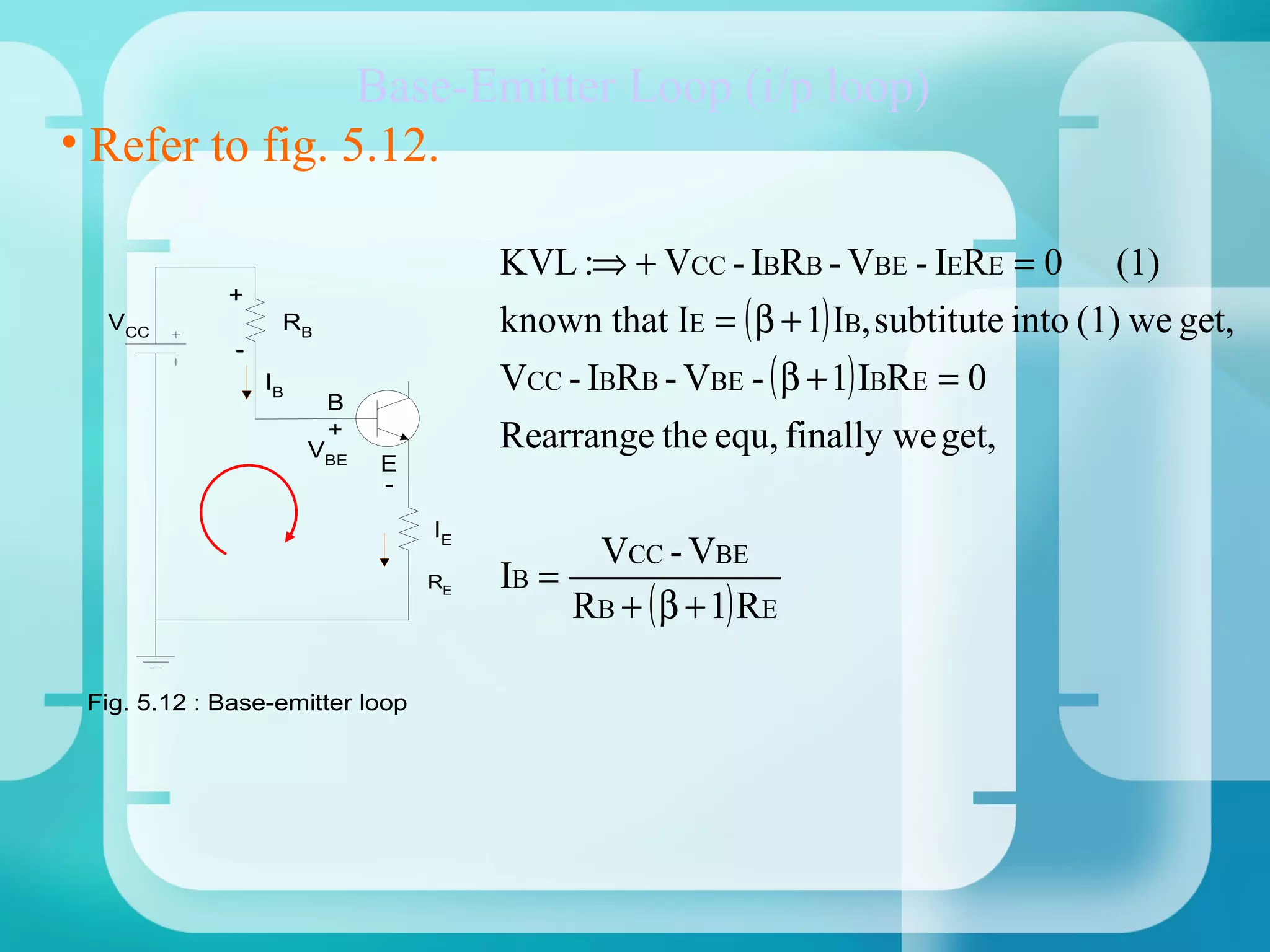
Base-Emitter Loop (i/p loop)
• Refer to fig. 5.12.

                                      KVL :⇒ + VCC - IBRB - VBE - IERE = 0 (1)
                                      known that IE = ( β + 1) IB, subtitute into (1) we get,
             +
  VCC              RB
              -
                  IB                  VCC - IBRB - VBE - ( β + 1) IBRE = 0
                        B
                        +
                       VBE            Rearrange the equ, finally we get,
                             E
                             -

                                 IE
                                            VCC - VBE
                                      IB =
                                           RB + ( β + 1) RE
                                 RE


 Fig. 5.12 : Base-emitter loop
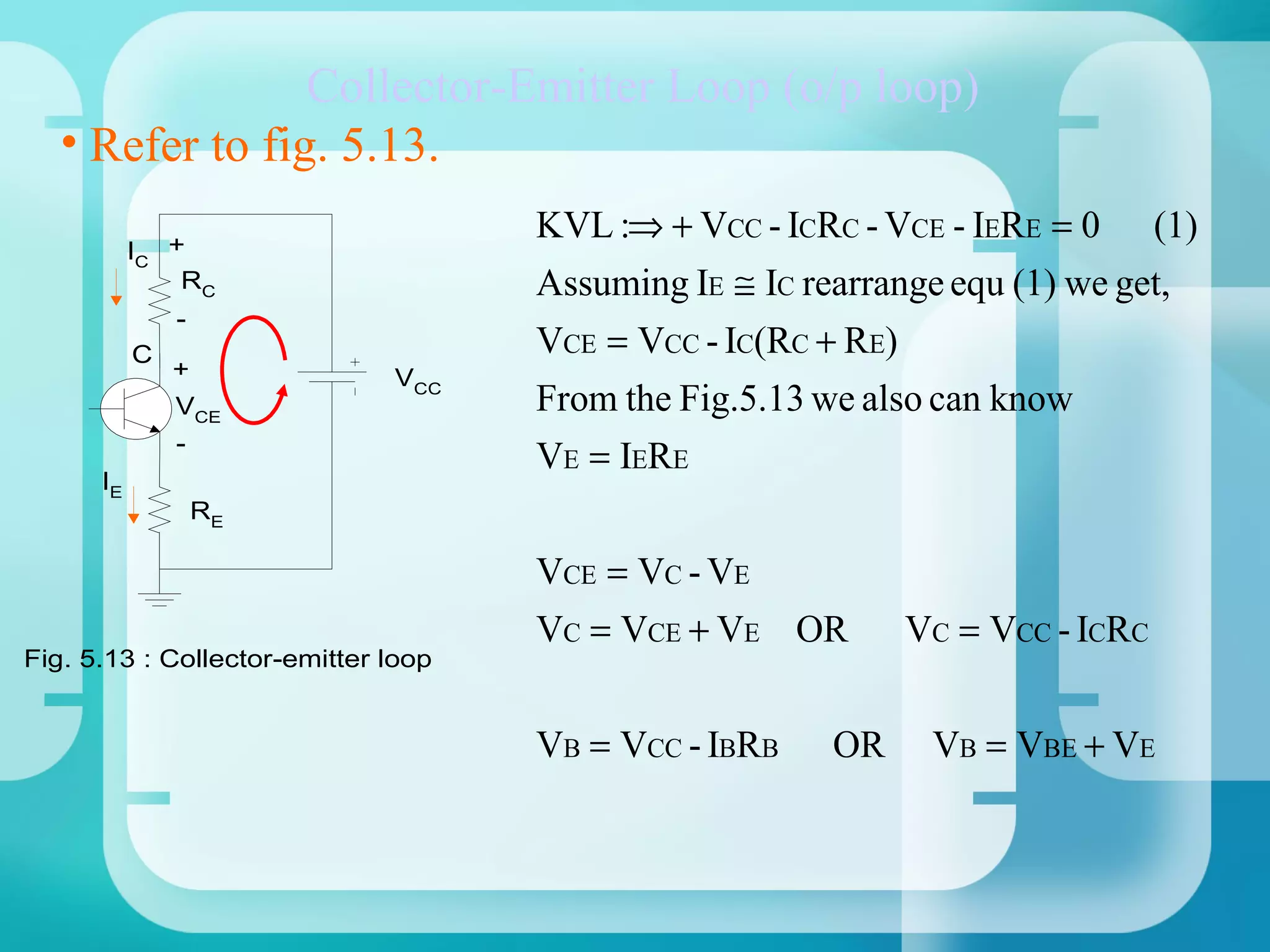
Collector-Emitter Loop (o/p loop)
   • Refer to fig. 5.13.
                                     KVL :⇒ + VCC - ICRC - VCE - IERE = 0        (1)
           IC +
               RC                    Assuming IE ≅ IC rearrange equ (1) we get,
               -
           C                         VCE = VCC - IC(RC + RE)
               +              VCC
               VCE                   From the Fig.5.13 we also can know
               -
                                     VE = IERE
      IE
                   RE

                                     VCE = VC - VE
                                     VC = VCE + VE OR          VC = VCC - ICRC
Fig. 5.13 : Collector-emitter loop


                                     VB = VCC - IBRB    OR      VB = VBE + VE
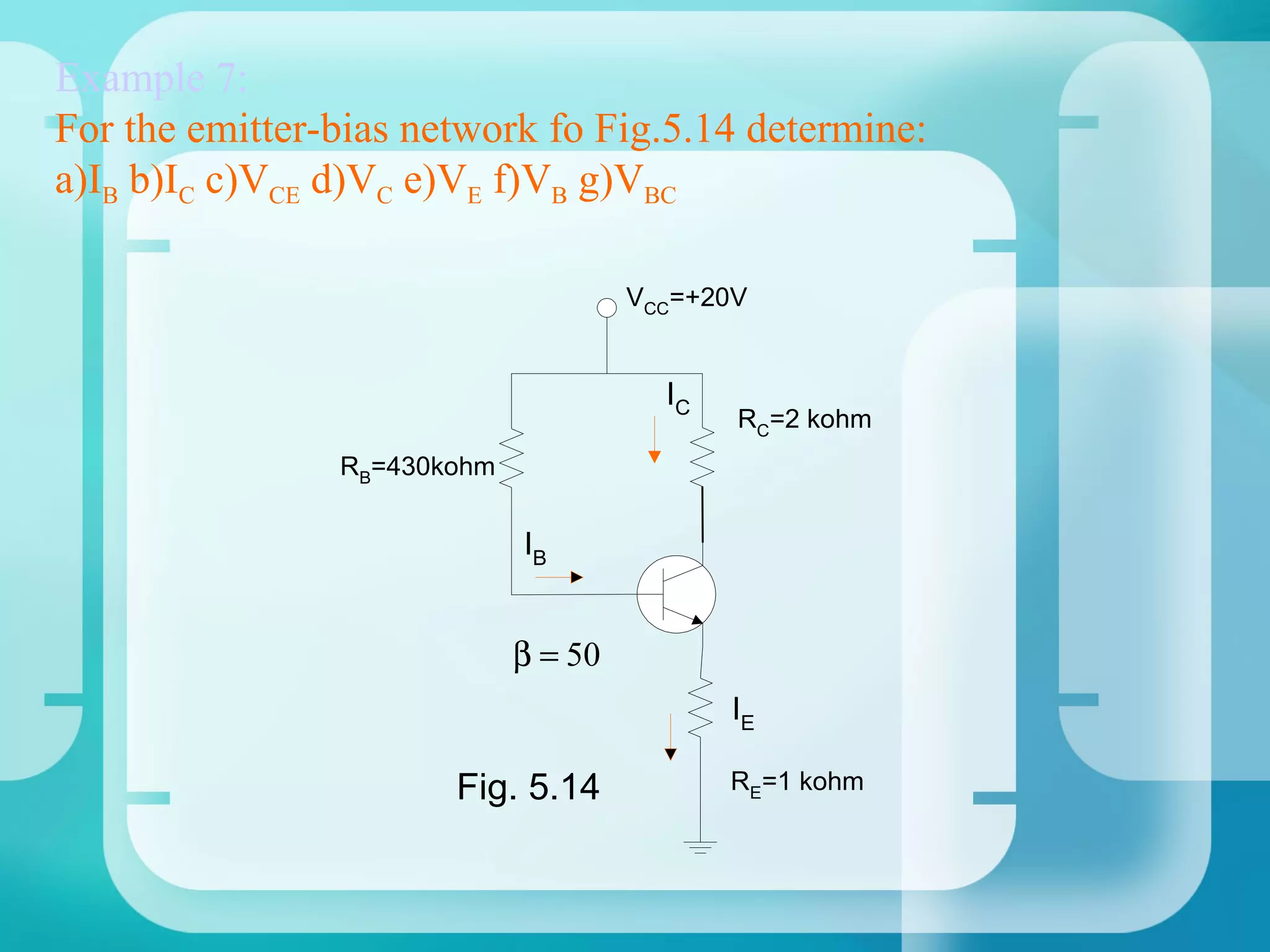
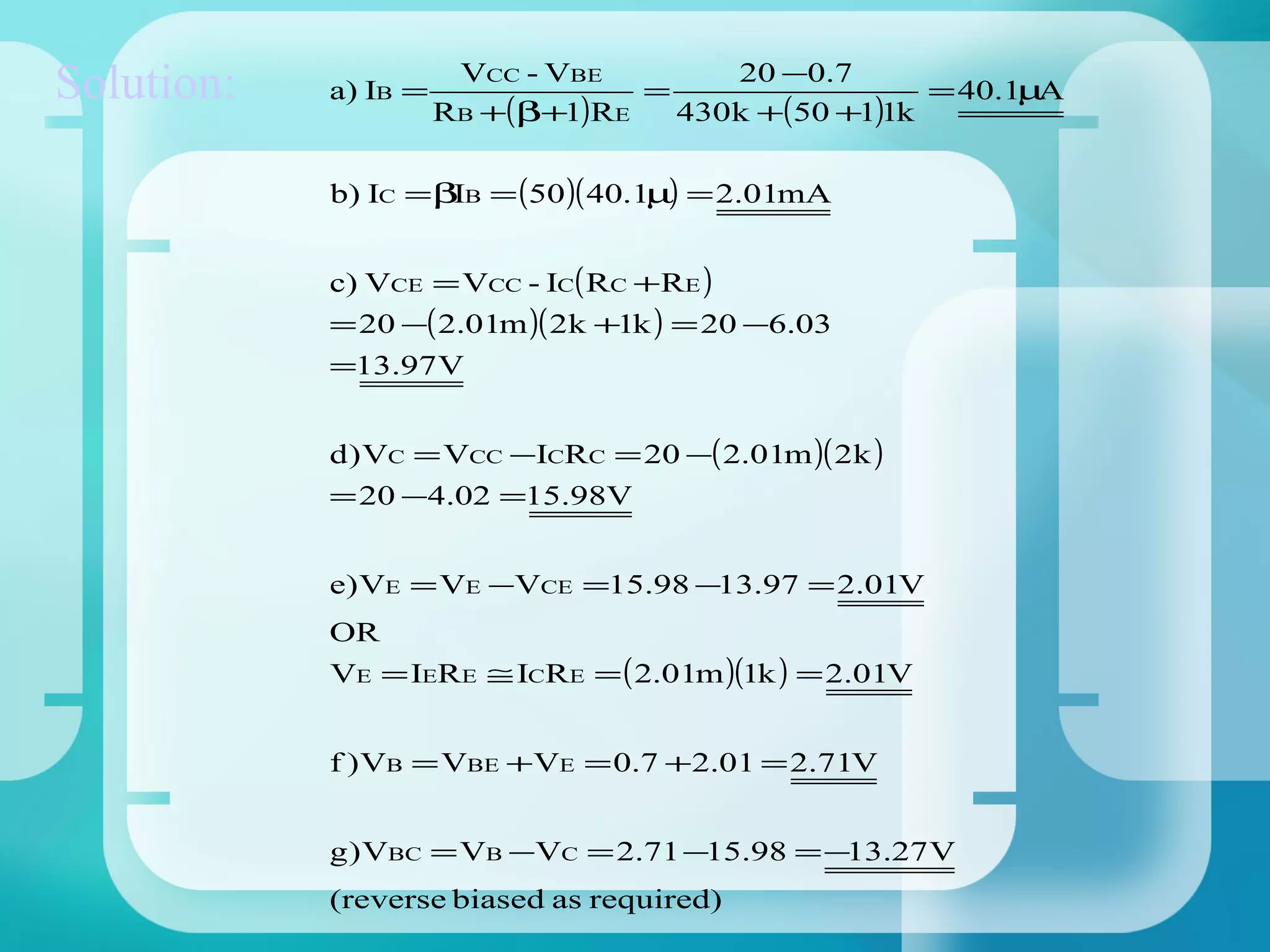
Example 7:
For the emitter-bias network fo Fig.5.14 determine:
a)IB b)IC c)VCE d)VC e)VE f)VB g)VBC

                                      VCC=+20V


                                        IC
                                             RC=2 kohm
                RB=430kohm


                             IB


                             β = 50
                                             IE

                       Fig. 5.14             RE=1 kohm
20 −0.7
Solution:   a) IB =
                       VCC - VBE
                      RB +(β+1)RE
                                  =
                                    430k +(50 +1)1k
                                                    = 40.1µA


            b) IC = βIB = (50 )( 40.1µ) = 2.01mA


            c) VCE = VCC - IC( RC +RE )
            = 20 −( 2.01m )( 2k +1k ) = 20 −6.03
            =13.97 V


            d ) VC = VCC −ICRC = 20 −( 2.01m )( 2k )
            = 20 −4.02 =15.98V


            e) VE = VE −VCE =15.98 −13.97 = 2.01V
            OR
            VE = IERE ≅ ICRE = ( 2.01m )(1k ) = 2.01V


            f ) VB = VBE +VE = 0.7 +2.01 = 2.71V


            g ) VBC = VB −VC = 2.71 −15.98 = −13.27 V
            (reverse biased as required)
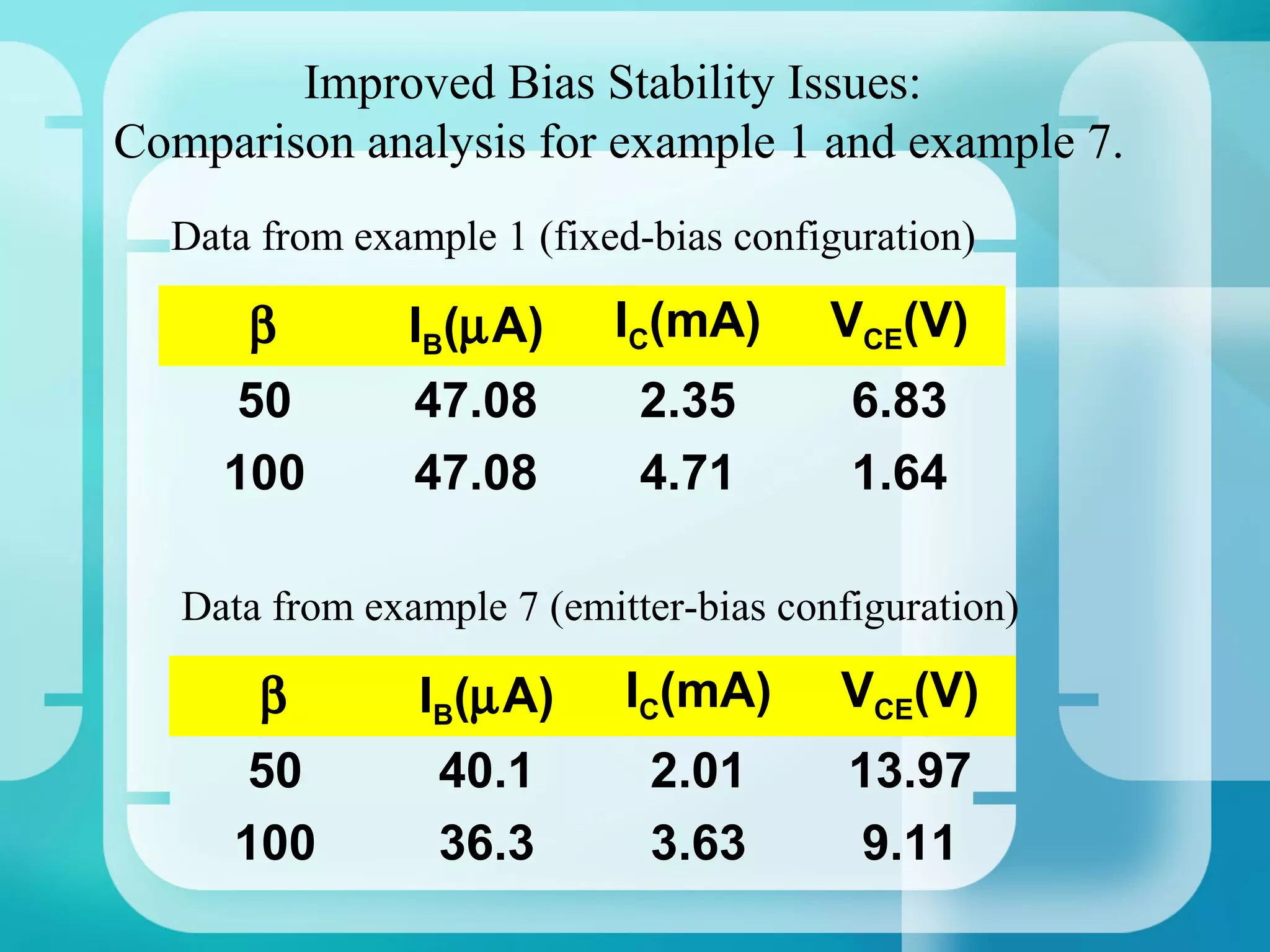
Improved Bias Stability Issues:
Comparison analysis for example 1 and example 7.
  Data from example 1 (fixed-bias configuration)

      β         IB(µA)     IC(mA)       VCE(V)
      50        47.08        2.35        6.83
     100        47.08        4.71        1.64

   Data from example 7 (emitter-bias configuration)

       β        IB(µA)      IC(mA)      VCE(V)
       50        40.1        2.01        13.97
      100        36.3        3.63         9.11
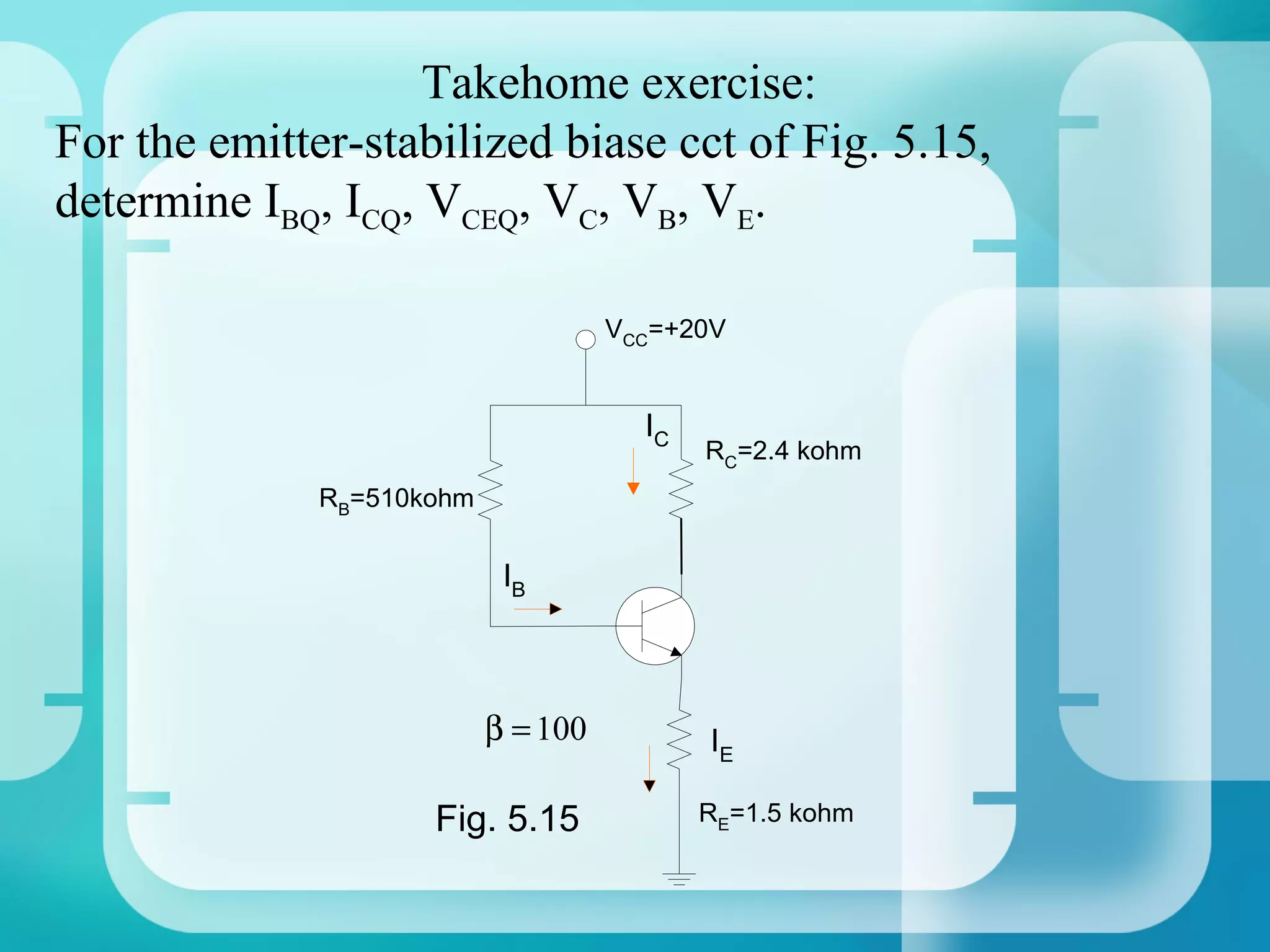
Takehome exercise:
For the emitter-stabilized biase cct of Fig. 5.15,
determine IBQ, ICQ, VCEQ, VC, VB, VE.

                                     VCC=+20V


                                       IC
                                            RC=2.4 kohm
              RB=510kohm


                            IB


                           β = 100          IE

                     Fig. 5.15              RE=1.5 kohm
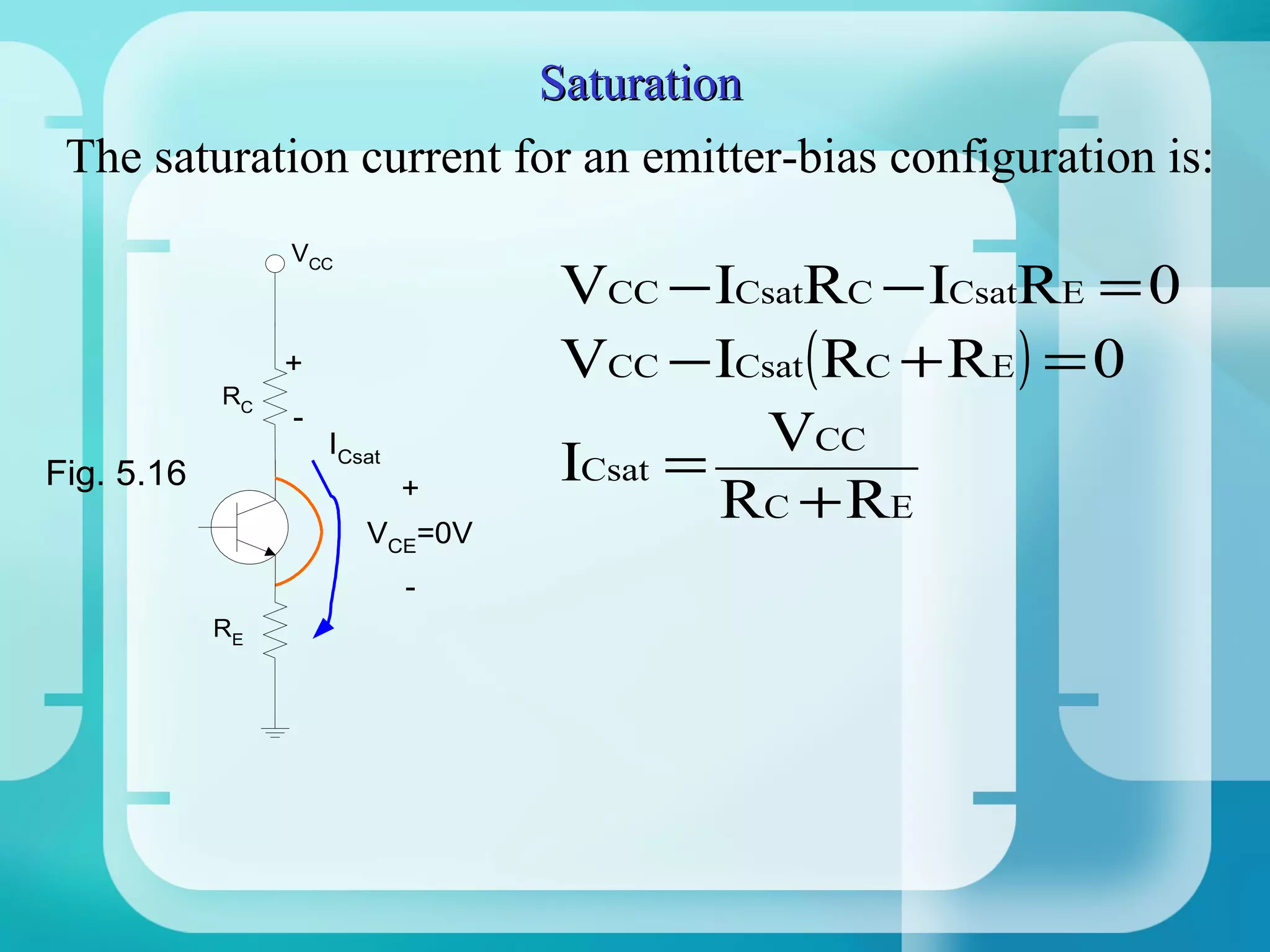
Saturation
 The saturation current for an emitter-bias configuration is:
                 VCC
                                 VCC − ICsatRC − ICsatRE = 0
            RC
                 +               VCC − ICsat ( RC + RE ) = 0
                 -
                                          VCC
Fig. 5.16
                     ICsat
                                 ICsat =
                             +
                        VCE=0V
                                         RC + RE
                             -
            RE
Example 8:
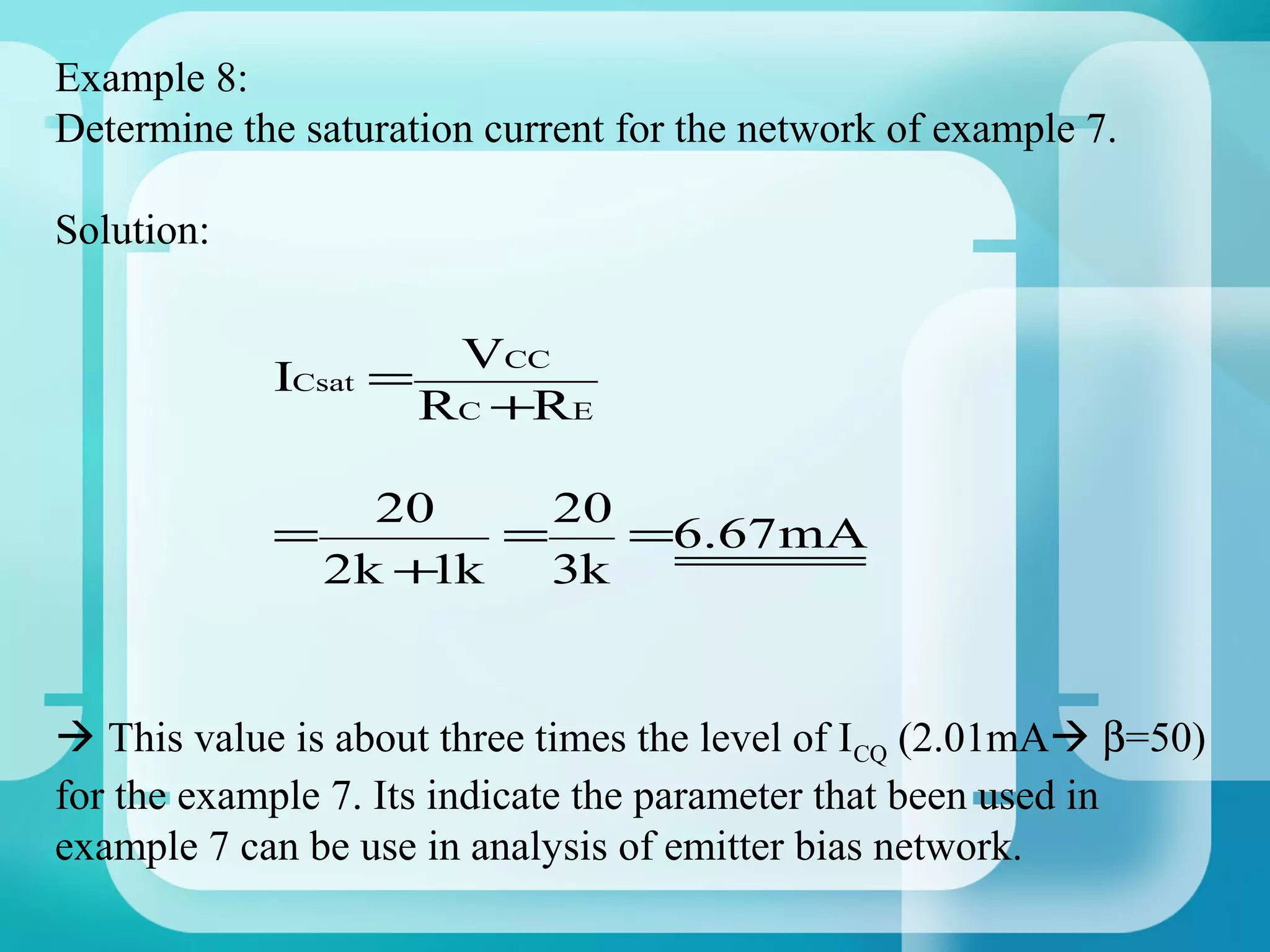
Determine the saturation current for the network of example 7.

Solution:

                       VCC
            ICsat =
                      RC +RE

                  20     20
            =          =    =6.67mA
                2k + k
                    1    3k


 This value is about three times the level of ICQ (2.01mA β=50)
for the example 7. Its indicate the parameter that been used in
example 7 can be use in analysis of emitter bias network.
Load line analysis
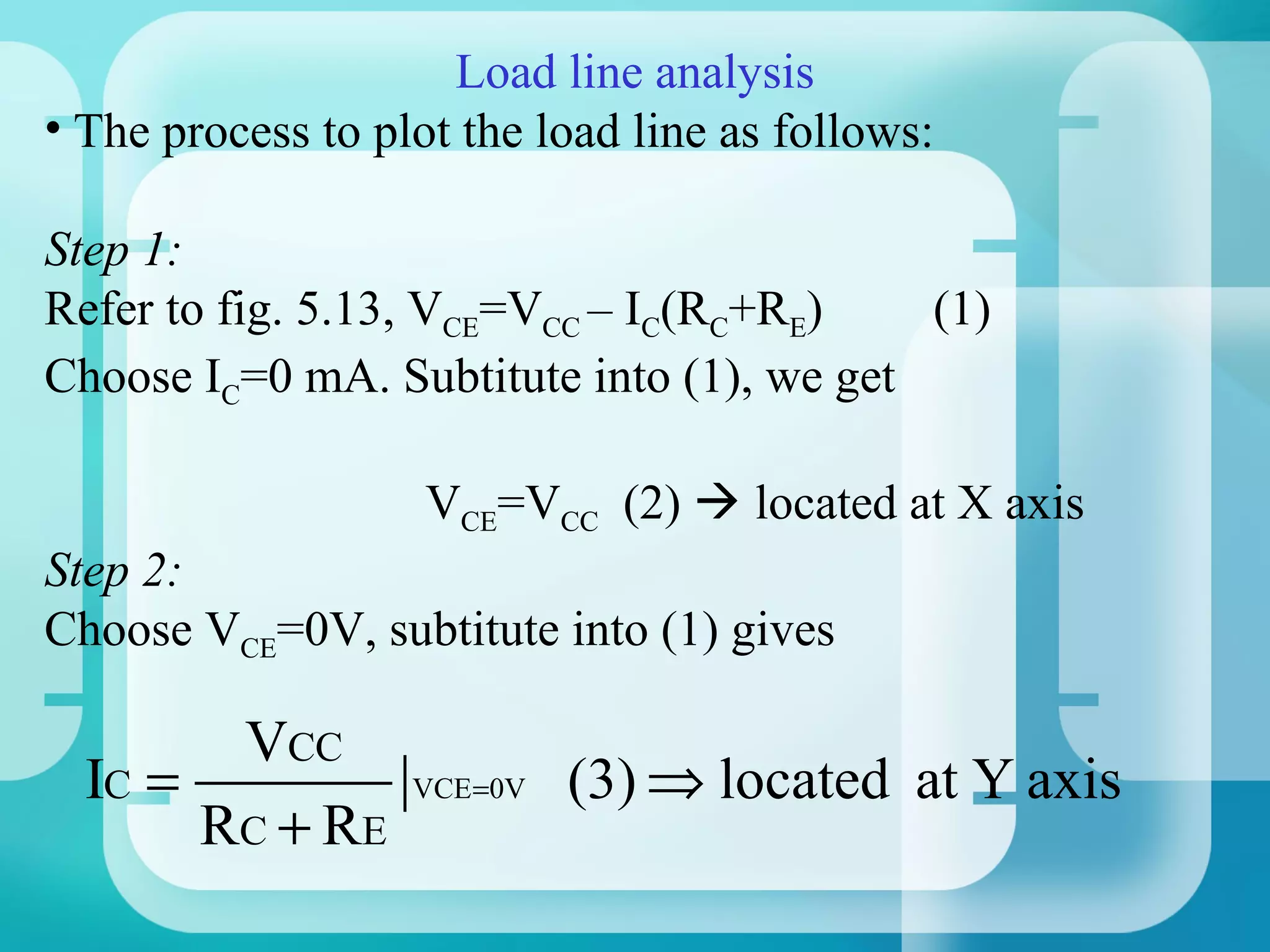
• The process to plot the load line as follows:

Step 1:
Refer to fig. 5.13, VCE=VCC – IC(RC+RE)    (1)
Choose IC=0 mA. Subtitute into (1), we get

                    VCE=VCC (2)  located at X axis
Step 2:
Choose VCE=0V, subtitute into (1) gives

        VCC
  IC =             VCE =0V   (3) ⇒ located at Y axis
       RC + RE
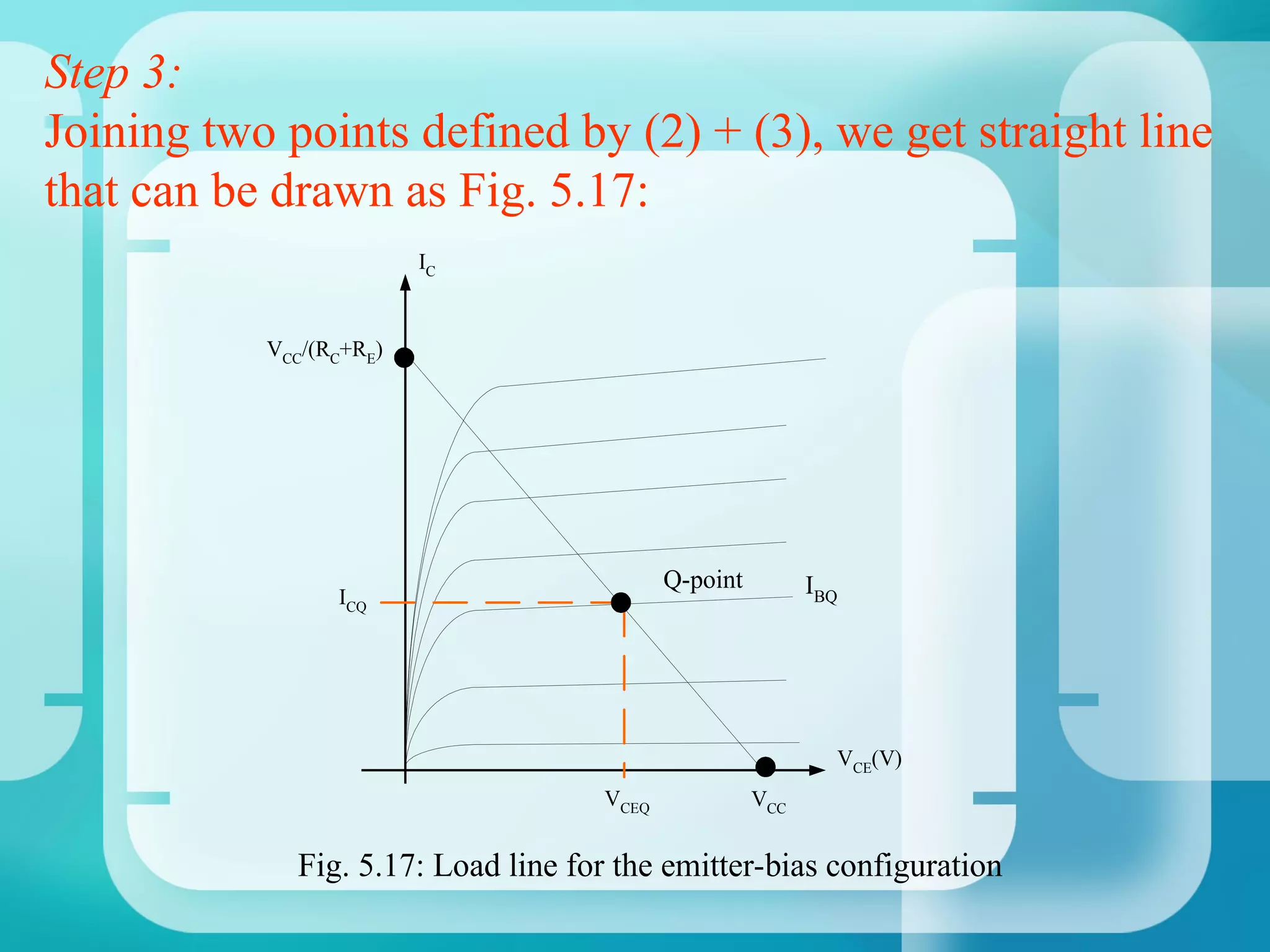
Step 3:
Joining two points defined by (2) + (3), we get straight line
that can be drawn as Fig. 5.17:
                         IC


           VCC/(RC+RE)


                                           Q-point         IBQ
                 ICQ


                                                             VCE(V)
                                    VCEQ             VCC


             Fig. 5.17: Load line for the emitter-bias configuration
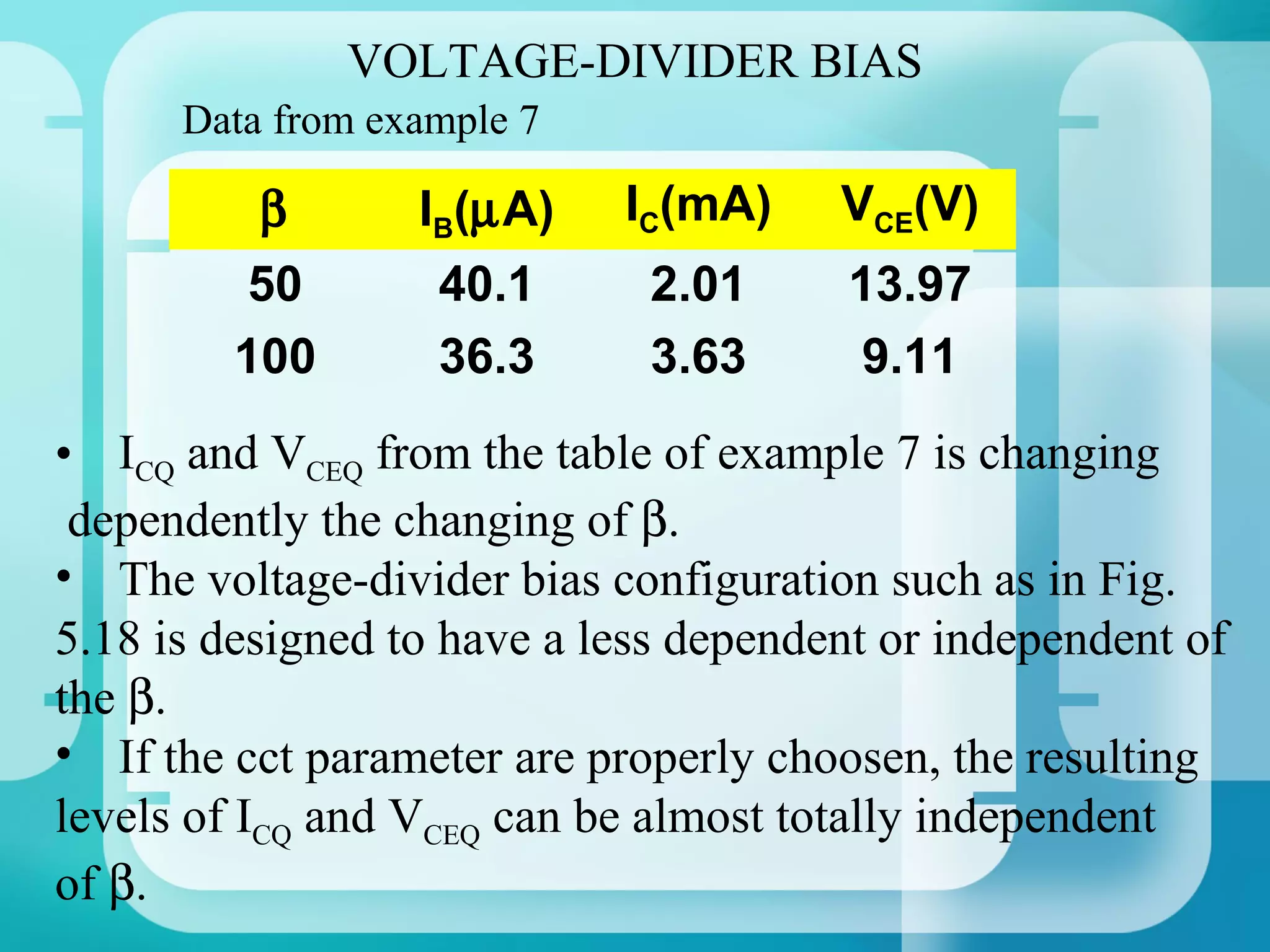
VOLTAGE-DIVIDER BIAS
      Data from example 7

          β       IB(µA)    IC(mA)     VCE(V)
          50       40.1      2.01      13.97
         100       36.3      3.63       9.11
• ICQ and VCEQ from the table of example 7 is changing
 dependently the changing of β.
• The voltage-divider bias configuration such as in Fig.
5.18 is designed to have a less dependent or independent of
the β.
• If the cct parameter are properly choosen, the resulting
levels of ICQ and VCEQ can be almost totally independent
of β.
VCC


• Two method for analyzed                                RC
  the voltage-divider bias              R1


  configuration:                                              C2
                                                                   Vo

                                   Vi
                                        C1
a) Exact method                          R2              RE

b) Approximate method

                             Fig. 5.18: Voltage-divider bias configuration
Exact Analysis
Step 1:
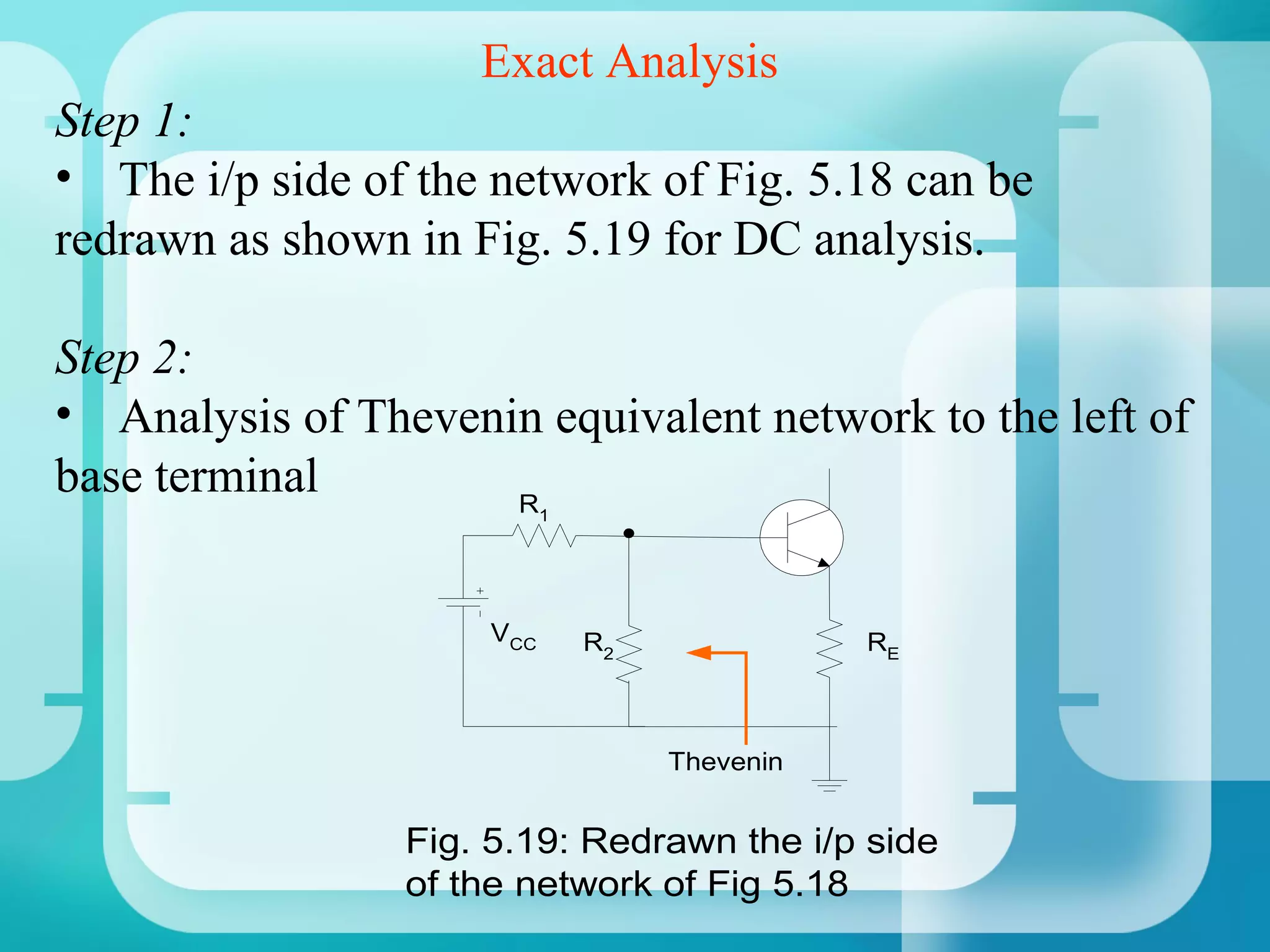
• The i/p side of the network of Fig. 5.18 can be
redrawn as shown in Fig. 5.19 for DC analysis.

Step 2:
• Analysis of Thevenin equivalent network to the left of
base terminal        R     1


                     VCC       R2              RE


                                    Thevenin


                 Fig. 5.19: Redrawn the i/p side
                 of the network of Fig 5.18
Exact Analysis
Step 2(a):
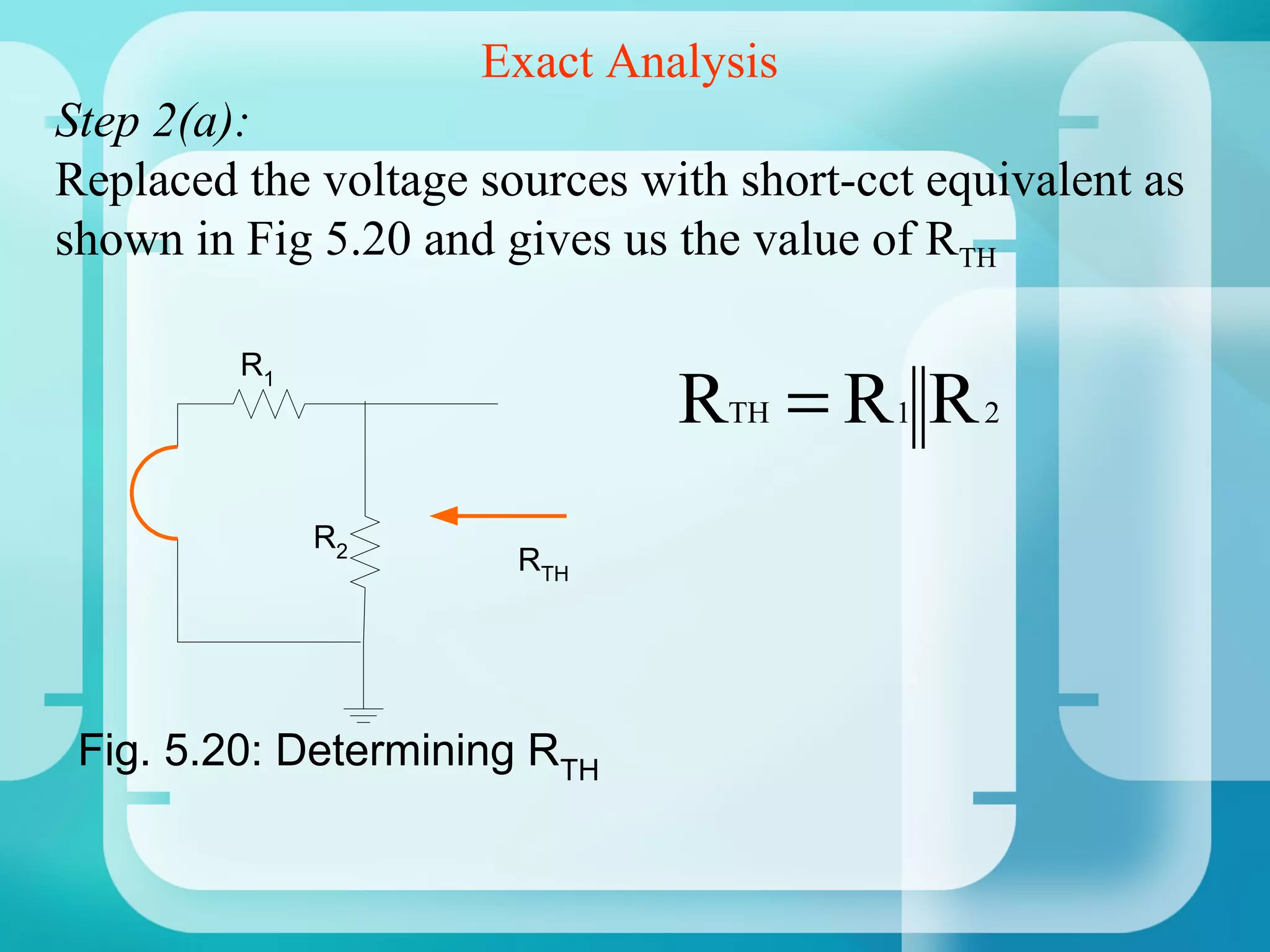
Replaced the voltage sources with short-cct equivalent as
shown in Fig 5.20 and gives us the value of RTH

         R1
                               RTH = R 1 R 2
              R2
                       RTH


 Fig. 5.20: Determining RTH
Exact Analysis
Step 2(b):
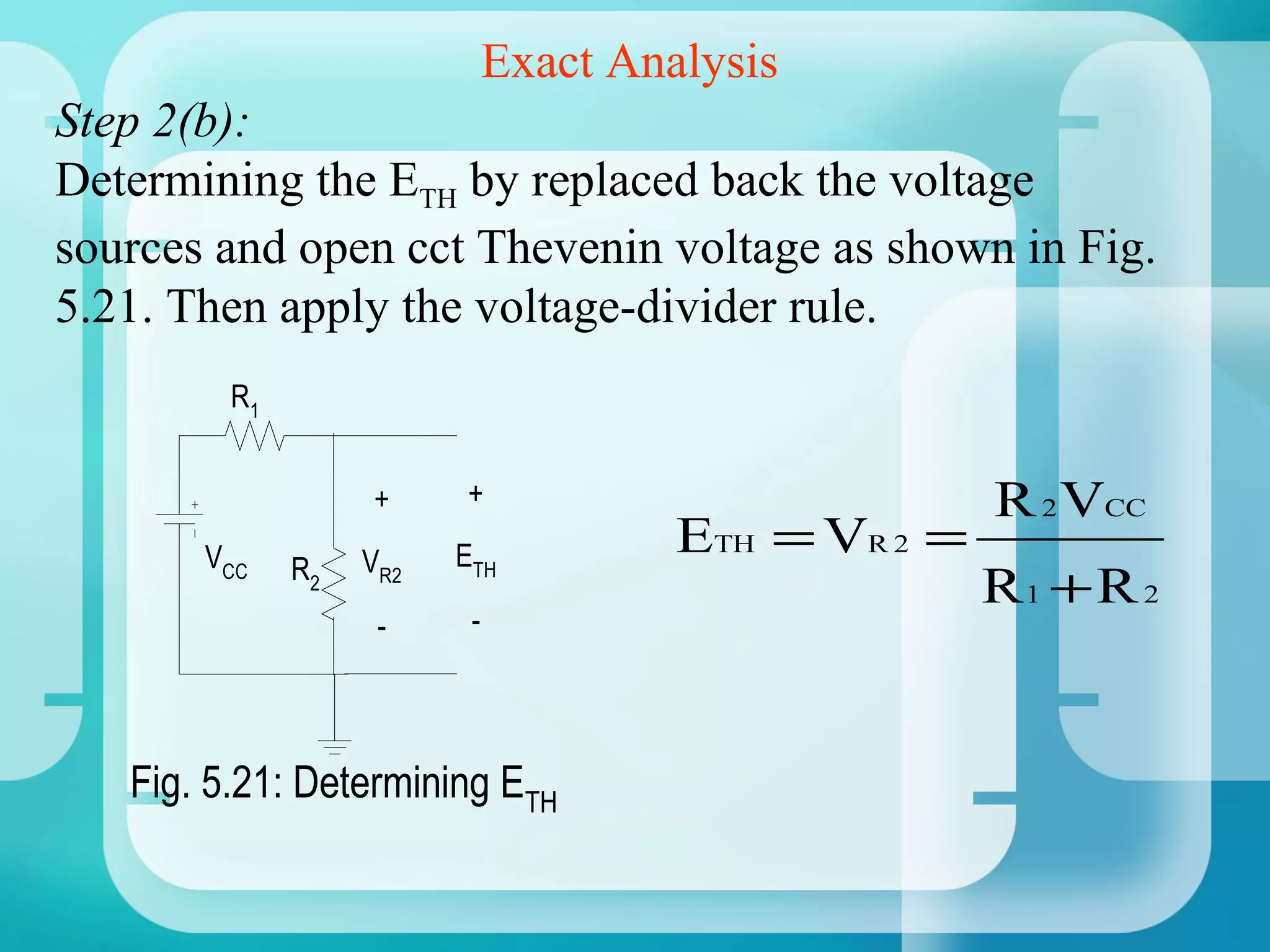
Determining the ETH by replaced back the voltage
sources and open cct Thevenin voltage as shown in Fig.
5.21. Then apply the voltage-divider rule.
         R1


                   +     +                            R 2 VCC
       VCC         VR2   ETH           ETH = VR 2 =
              R2
                                                      R1 + R 2
                    -     -


   Fig. 5.21: Determining ETH
Exact Analysis
Step 3:
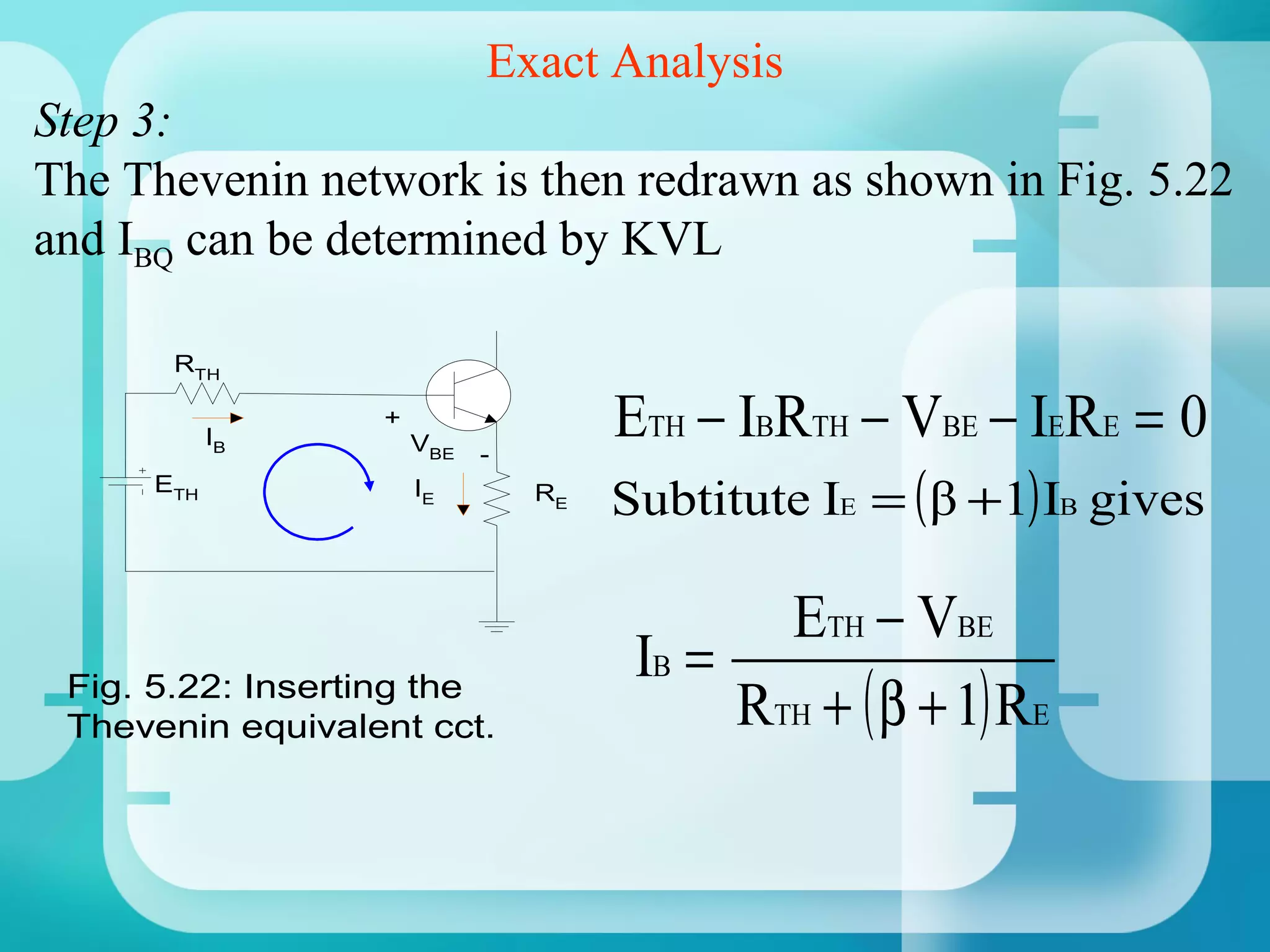
The Thevenin network is then redrawn as shown in Fig. 5.22
and IBQ can be determined by KVL

       RTH


           IB
                  +
                      VBE   -
                                     ETH − IBRTH − VBE − IERE = 0
     ETH              IE        RE
                                     Subtitute IE = ( β +1) IB gives

                                             ETH − VBE
                                      IB =
 Fig. 5.22: Inserting the
 Thevenin equivalent cct.                  RTH + ( β + 1) RE
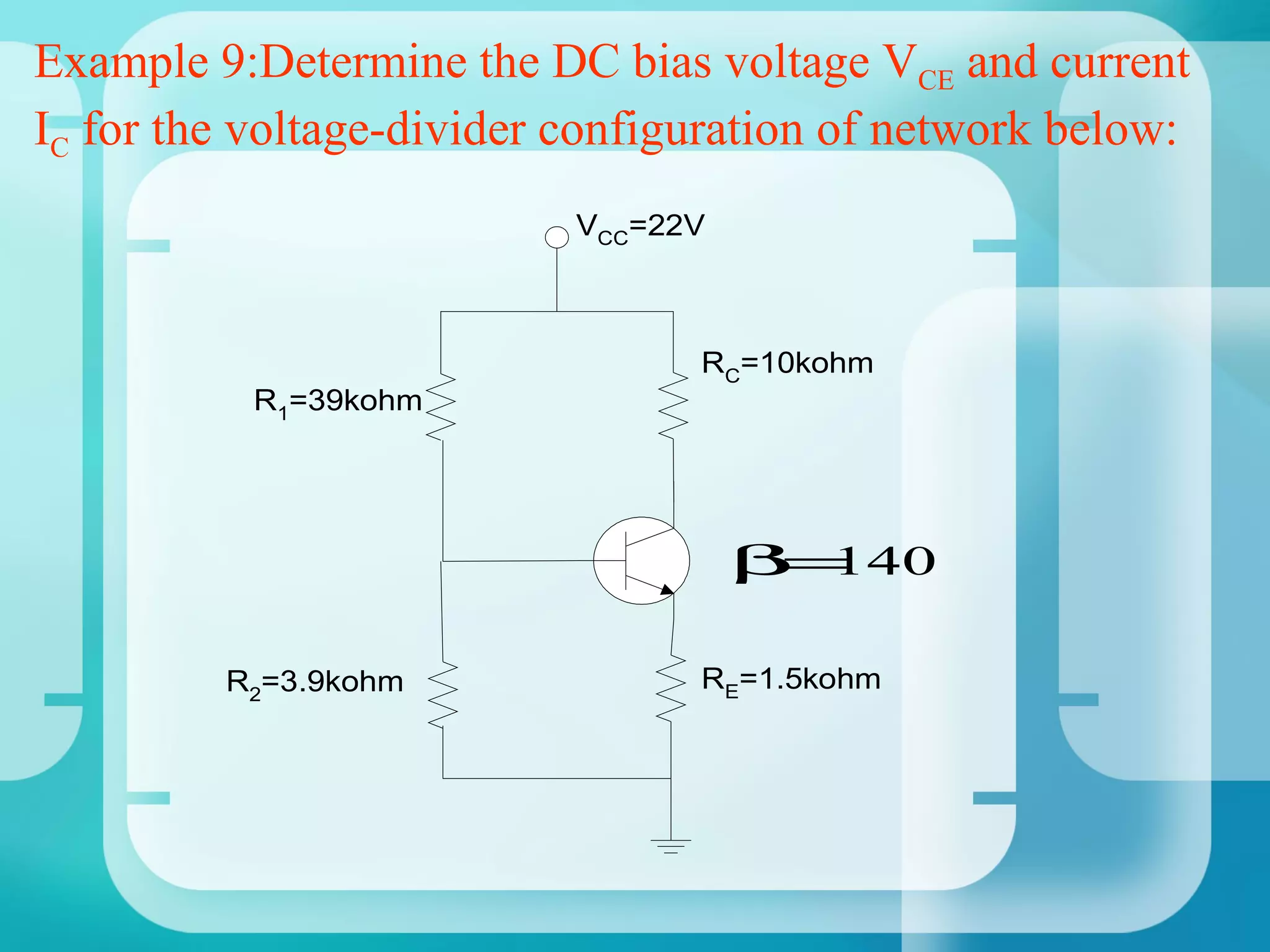
Example 9:Determine the DC bias voltage VCE and current
IC for the voltage-divider configuration of network below:
                           VCC=22V


                                 RC=10kohm
           R1=39kohm


                                     β 140
                                      =

         R2=3.9kohm              RE=1.5kohm
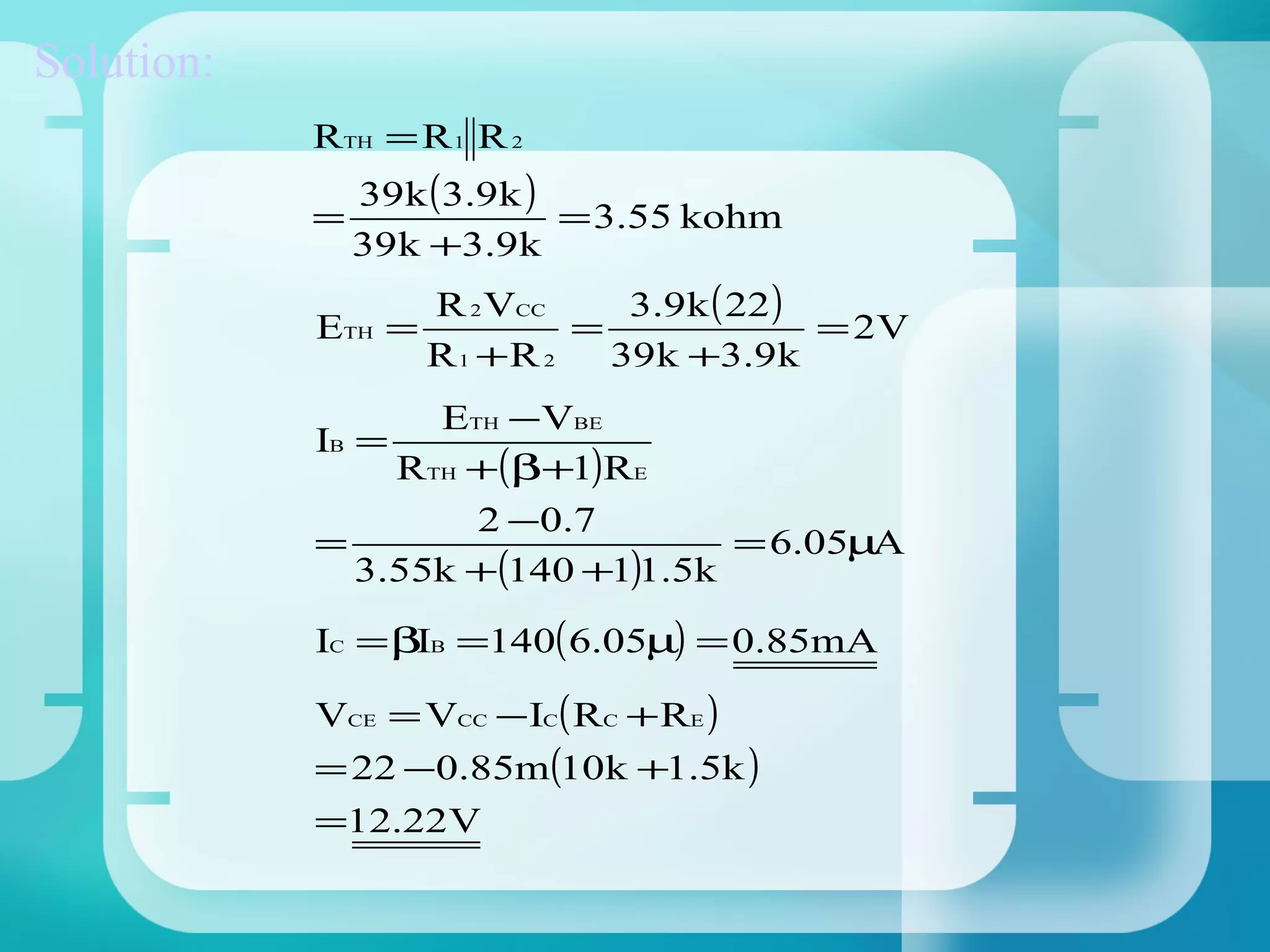
Solution:
            RTH = R 1 R 2
                39k (3.9k )
            =               = 3.55 kohm
                39k +3.9k
                    R 2 VCC    3.9k ( 22 )
            ETH   =         =              = 2V
                    R1 +R 2   39k +3.9k
                   ETH −VBE
            IB =
                 RTH +(β+1)RE
                     2 − 0 .7
            =                      = 6.05µA
               3.55k +(140 +1)1.5k

            IC = βIB =140( 6.05µ) = 0.85mA

            VCE = VCC − IC( RC + RE )
            = 22 −0.85m(10k +1.5k )
            =12.22V
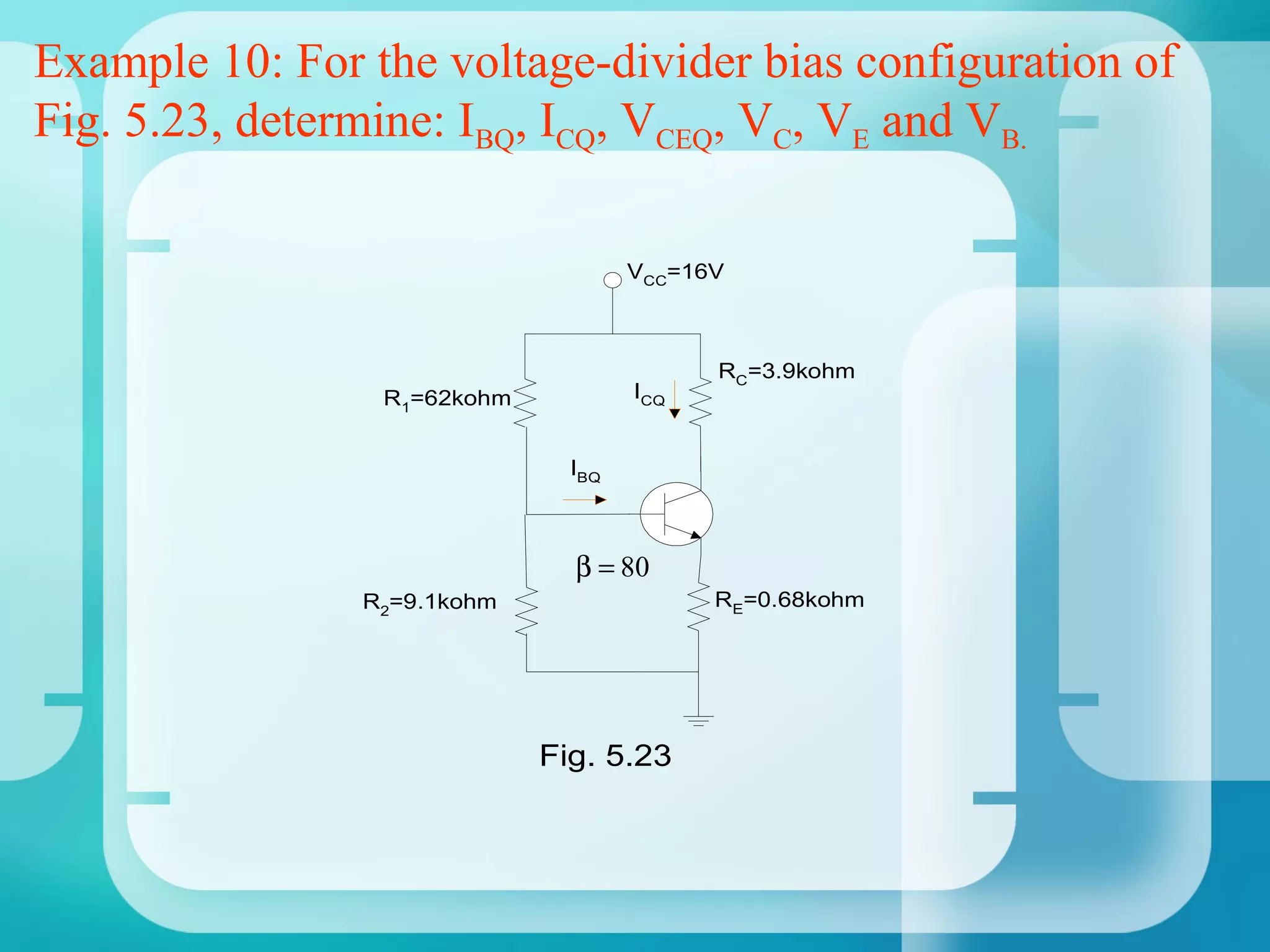
Example 10: For the voltage-divider bias configuration of
Fig. 5.23, determine: IBQ, ICQ, VCEQ, VC, VE and VB.

                                     VCC=16V


                                           RC=3.9kohm
                 R1=62kohm           ICQ


                               IBQ


                               β = 80
                R2=9.1kohm                 RE=0.68kohm


                             Fig. 5.23
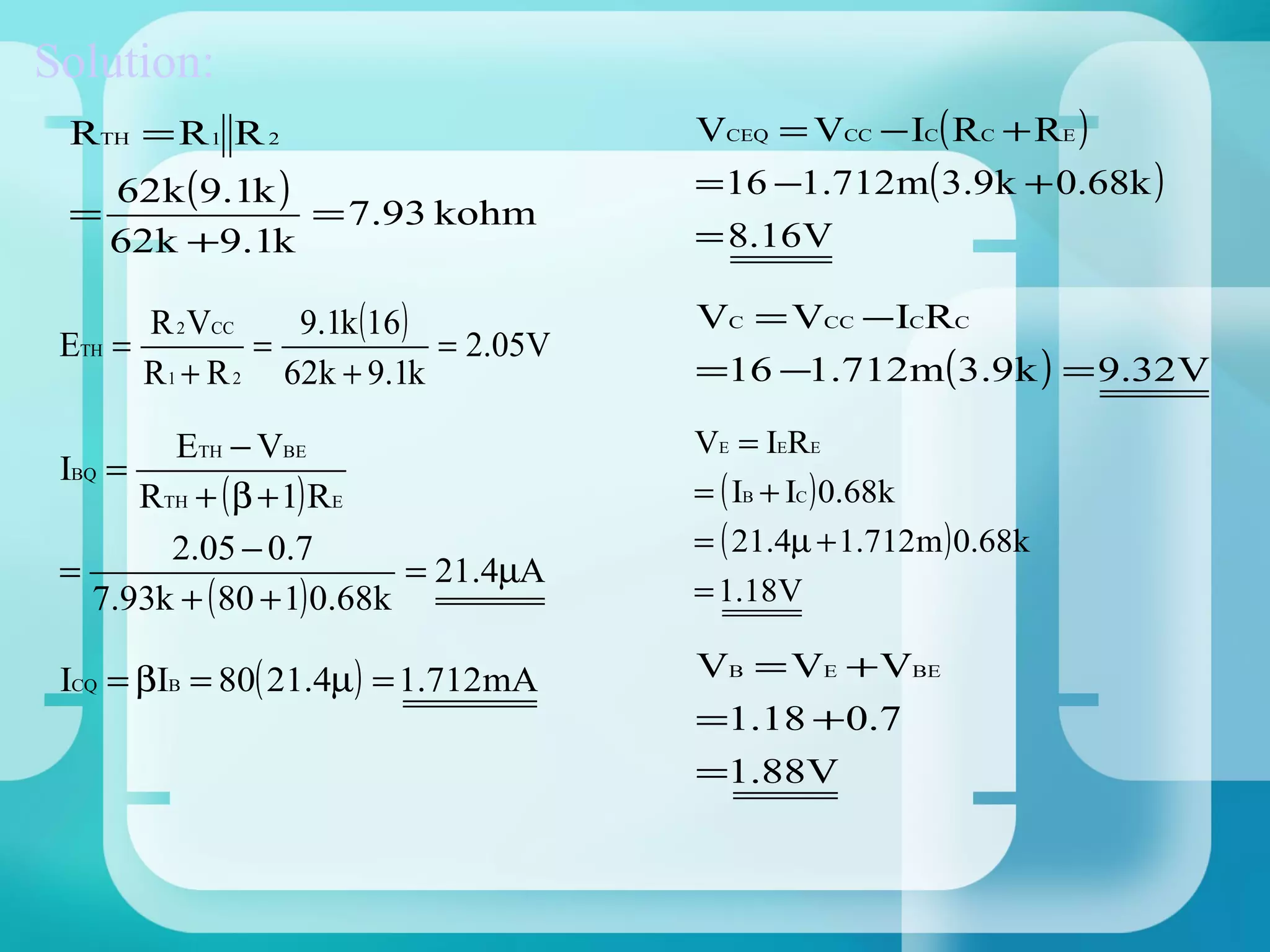
Solution:
 RTH = R 1 R 2                         VCEQ = VCC − IC( RC + RE )
     62k (9.1k )                       = 16 −1.712m( 3.9k + 0.68k )
 =               = 7.93 kohm
     62k +9.1k                         = 8.16V

       R 2 VCC    9.1k (16 )           VC = VCC −ICRC
 ETH =          =            = 2.05V
       R 1 + R 2 62k + 9.1k            =16 −1.712m(3.9k ) = 9.32V

         ETH − VBE                     VE = IERE
 IBQ =
       RTH + ( β + 1) RE               = ( IB + IC ) 0.68k
         2.05 − 0.7                    = ( 21.4µ + 1.712m ) 0.68k
 =                          = 21.4µA
    7.93k + ( 80 + 1) 0.68k            = 1.18V

 ICQ = βIB = 80( 21.4µ) = 1.712mA      VB = VE + VBE
                                       =1.18 + 0.7
                                       =1.88V
Approximate Analysis
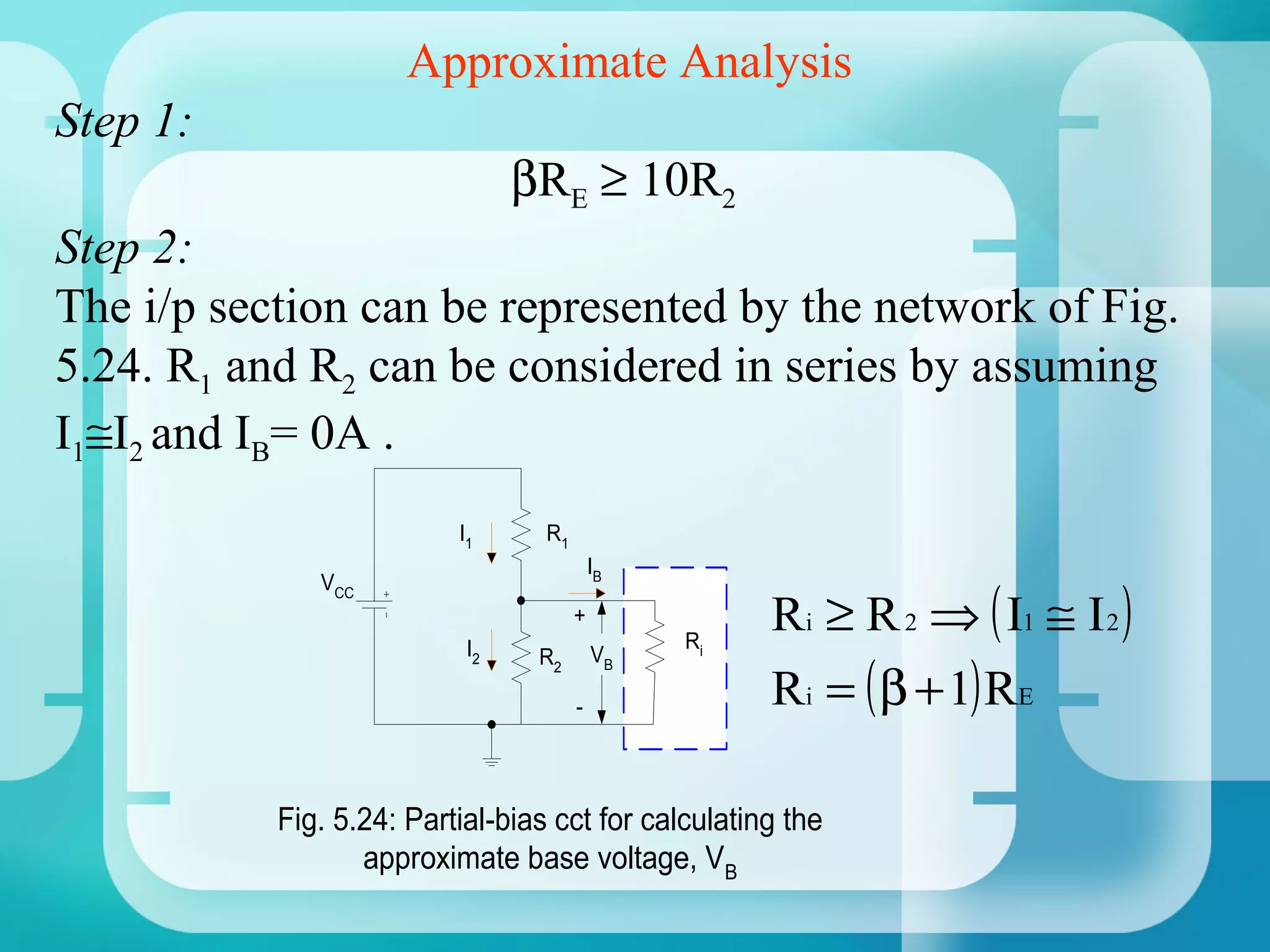
Step 1:
                                βRE ≥ 10R2
Step 2:
The i/p section can be represented by the network of Fig.
5.24. R1 and R2 can be considered in series by assuming
I1≅I2 and IB= 0A .
                          I1      R1
                                           IB

                                                     Ri ≥ R 2 ⇒ ( I1 ≅ I 2 )
              VCC
                                       +
                           I2                   Ri

                                                     Ri = ( β + 1) RE
                                 R2        VB

                                       -


           Fig. 5.24: Partial-bias cct for calculating the
                  approximate base voltage, VB
Approximate Analysis
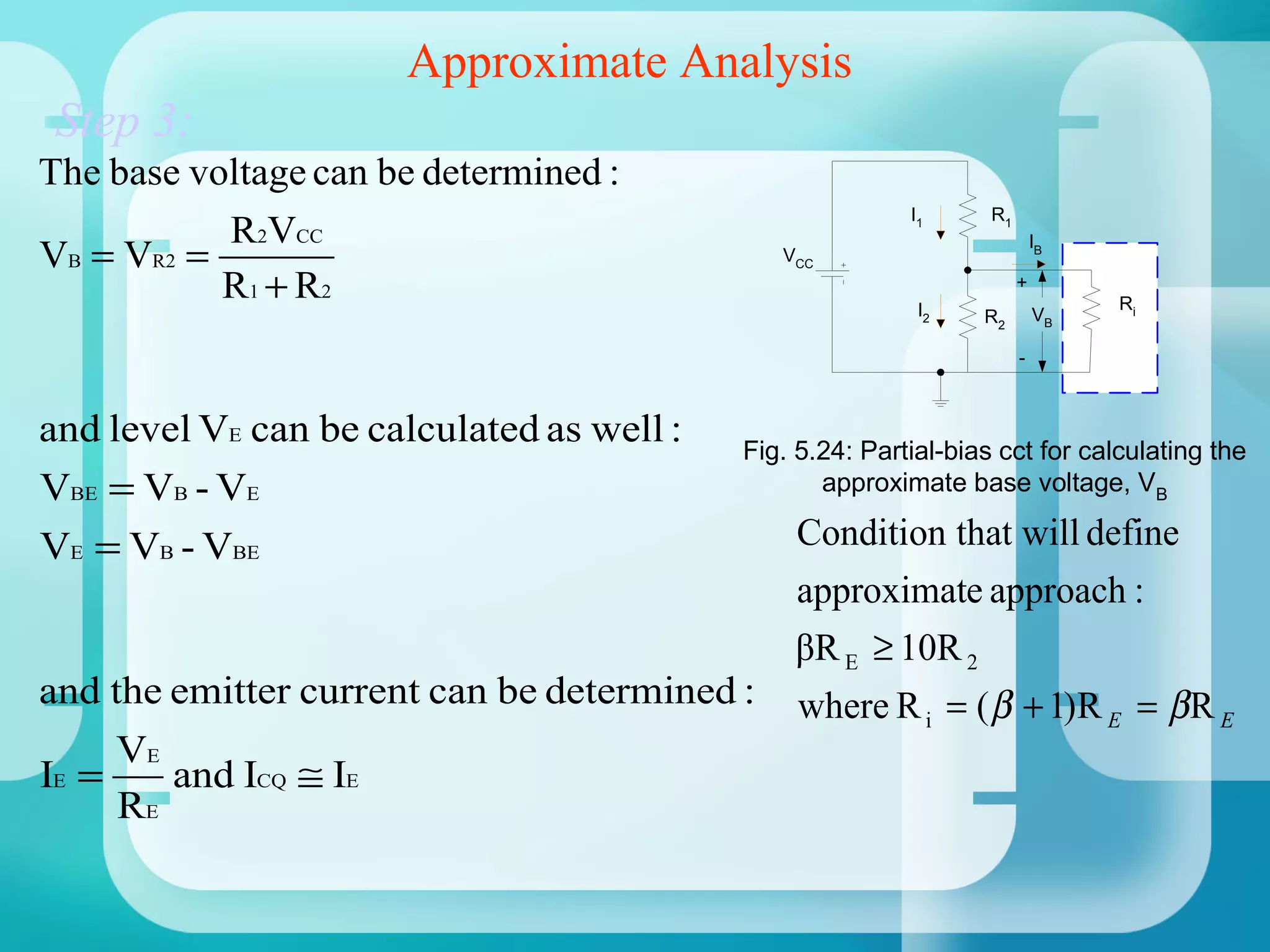
 Step 3:
The base voltage can be determined :
                                                          I1      R1
           R2VCC
VB = VR2 =                                    VCC
                                                                           IB

           R 1 + R2                                        I2
                                                                       +
                                                                                Ri
                                                                 R2        VB

                                                                       -


and level VE can be calculated as well :   Fig. 5.24: Partial-bias cct for calculating the
VBE = VB - VE                                     approximate base voltage, VB

VE = VB - VBE                                   Condition that will define
                                                approximate approach :
                                               βR E ≥ 10R 2
and the emitter current can be determined :     where R i = ( β + 1)R E = β R E
       VE
IE =      and ICQ ≅ IE
       RE
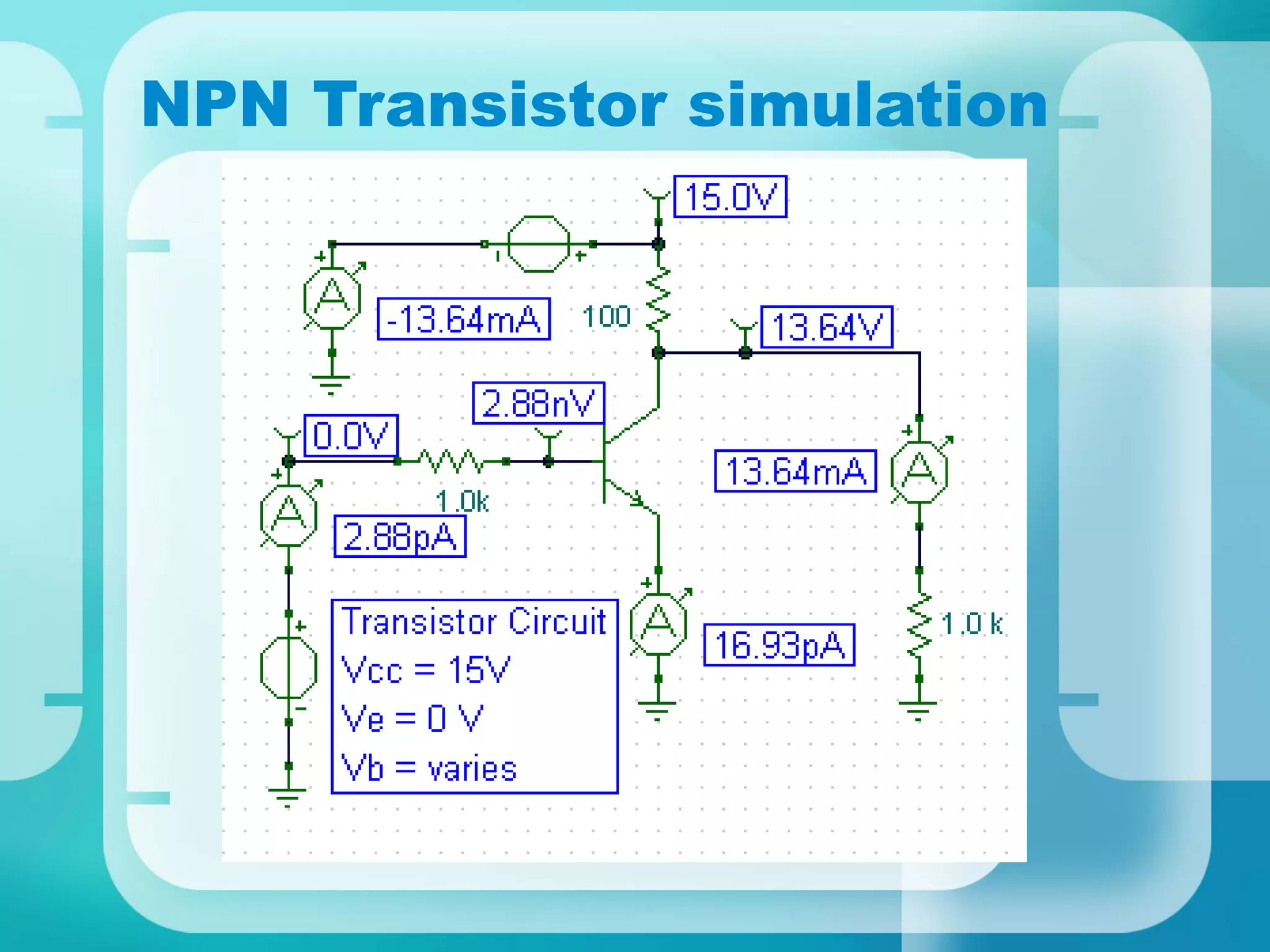
NPN Transistor simulation
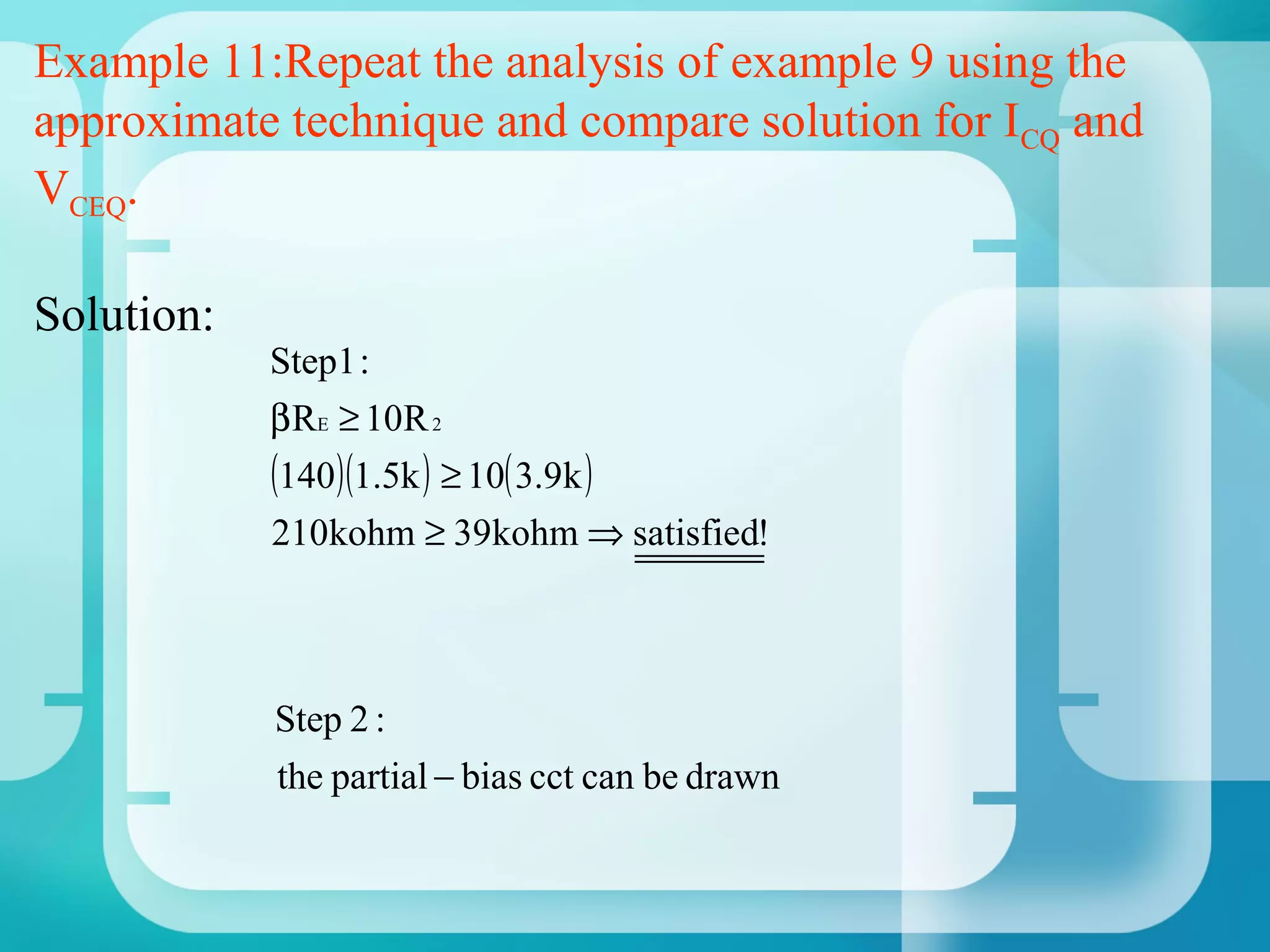
Example 11:Repeat the analysis of example 9 using the
approximate technique and compare solution for ICQ and
VCEQ.

Solution:
            Step1 :
            β RE ≥ 10R 2
            (140)(1.5k ) ≥ 10( 3.9k )
            210kohm ≥ 39kohm ⇒ satisfied!


            Step 2 :
            the partial − bias cct can be drawn
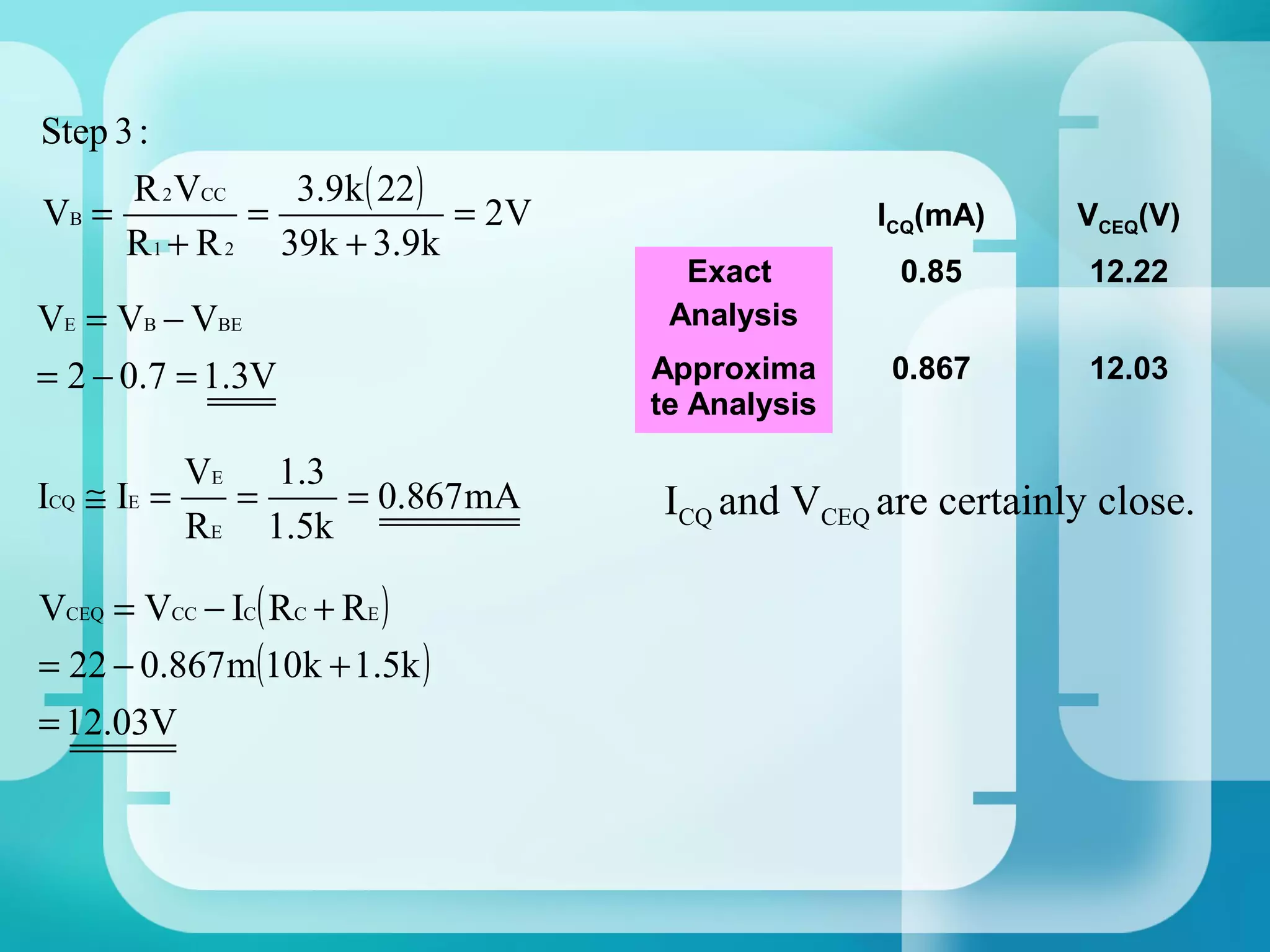
Step 3 :
      R 2 VCC    3.9k ( 22 )
VB =           =             = 2V                 ICQ(mA)    VCEQ(V)
      R 1 + R 2 39k + 3.9k
                                      Exact        0.85       12.22
VE = VB − VBE                        Analysis
= 2 − 0.7 = 1.3V                    Approxima     0.867       12.03
                                    te Analysis

           VE 1.3
ICQ ≅ IE =   =     = 0.867 mA       ICQ and VCEQ are certainly close.
           RE 1.5k

VCEQ = VCC − IC( RC + RE )
= 22 − 0.867 m(10k + 1.5k )
= 12.03V
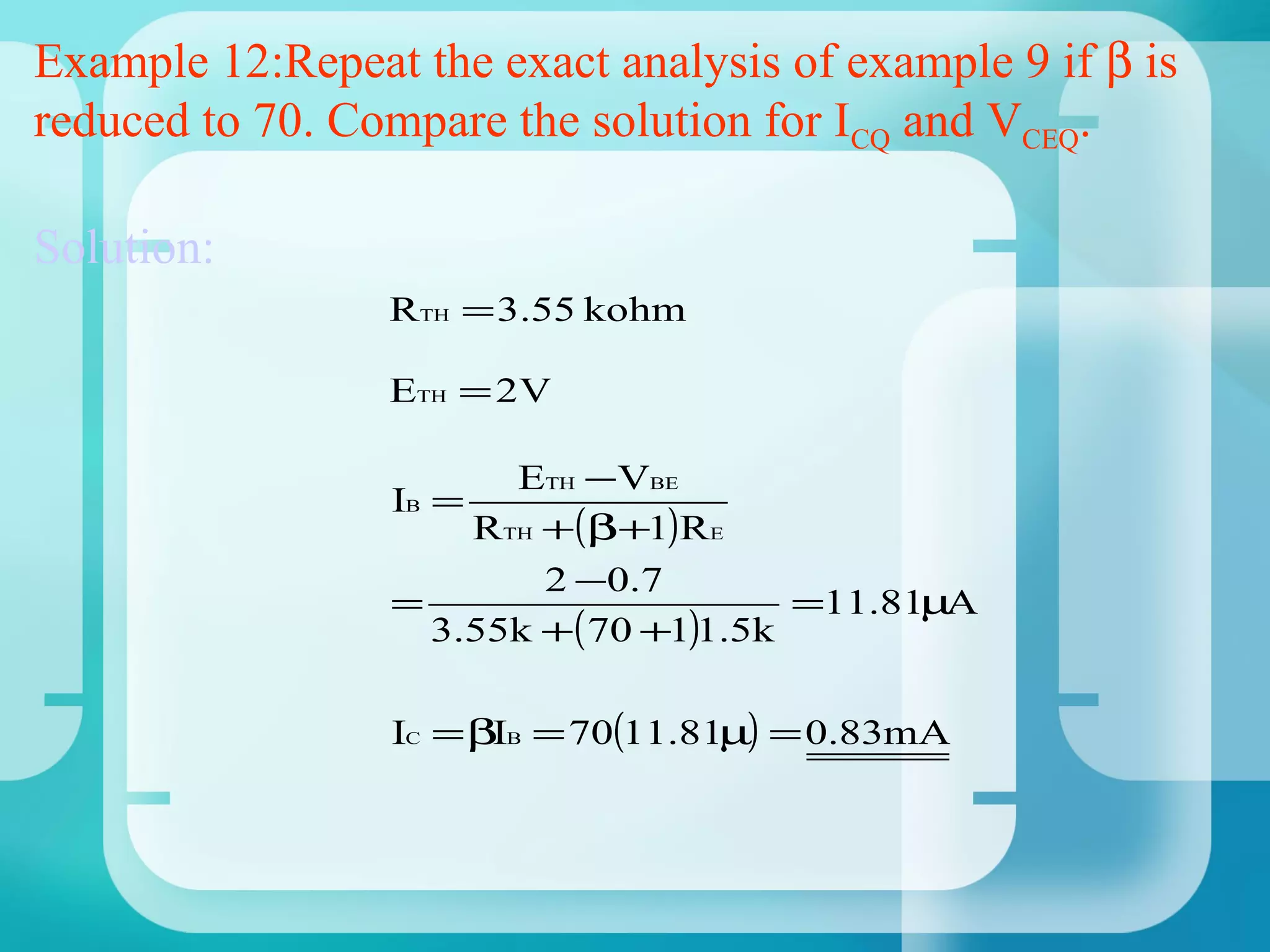
Example 12:Repeat the exact analysis of example 9 if β is
reduced to 70. Compare the solution for ICQ and VCEQ.

Solution:
                 RTH = 3.55 kohm

                 ETH = 2V

                       ETH −VBE
                 IB =
                     RTH +(β+1)RE
                         2 − 0 .7
                 =                     =11.81µA
                   3.55k +( 70 +1)1.5k

                 IC = βIB = 70(11.81µ) = 0.83mA
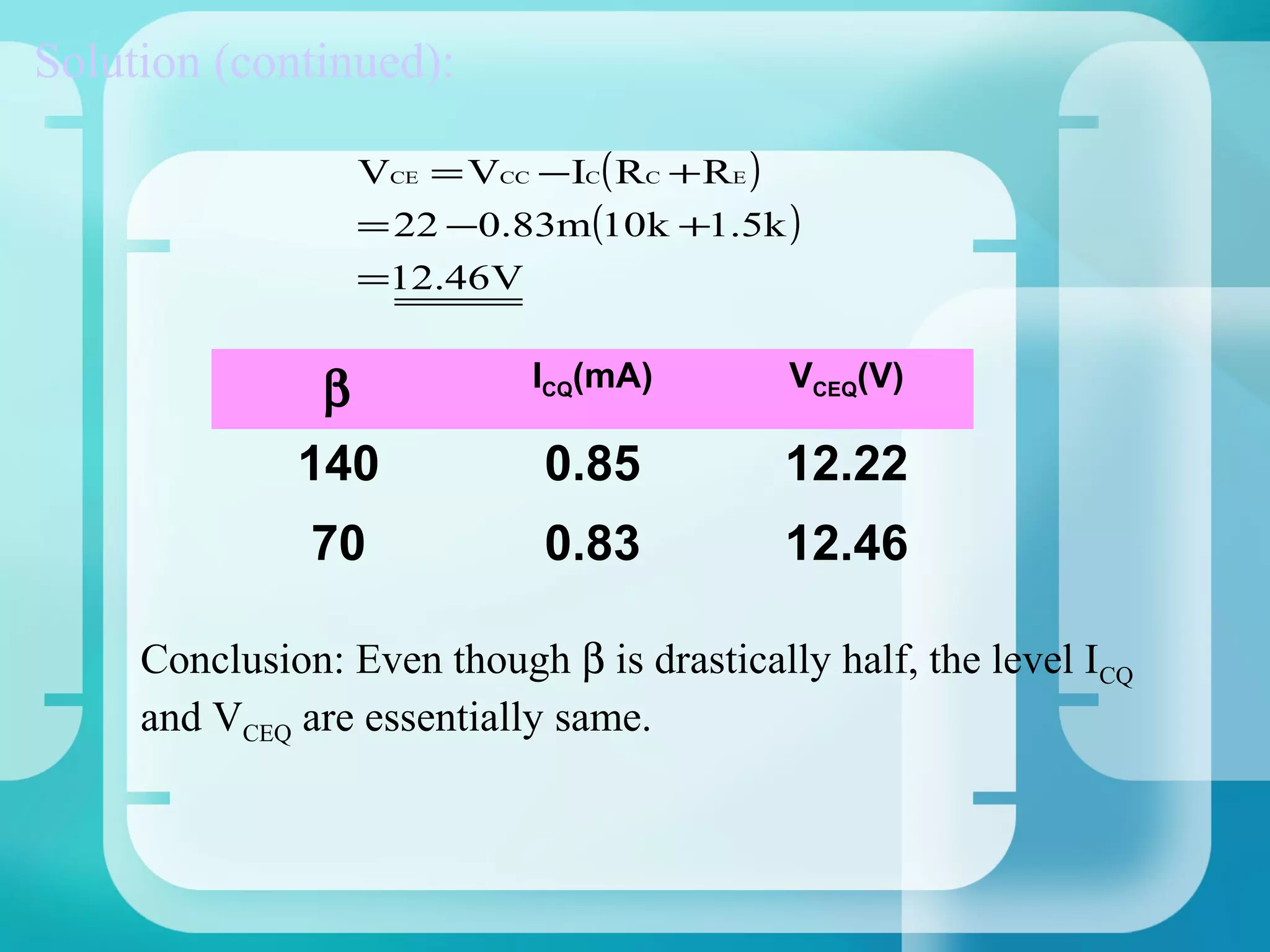
Solution (continued):

                    VCE = VCC − IC( RC + RE )
                    = 22 −0.83m(10k +1.5k )
                    =12.46V

                             ICQ(mA)        VCEQ(V)
                β
              140             0.85          12.22
               70             0.83          12.46

     Conclusion: Even though β is drastically half, the level ICQ
     and VCEQ are essentially same.
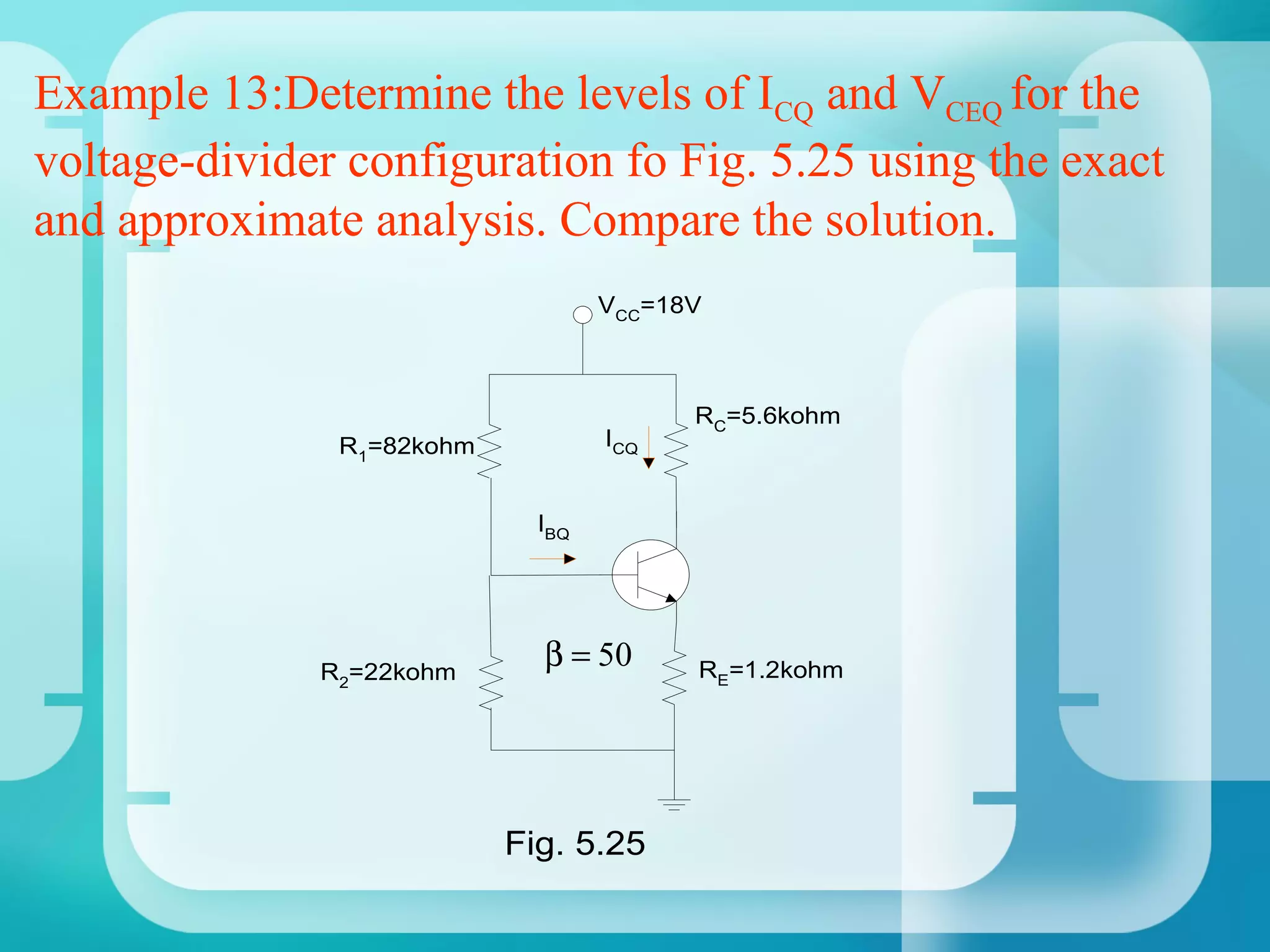
Example 13:Determine the levels of ICQ and VCEQ for the
voltage-divider configuration fo Fig. 5.25 using the exact
and approximate analysis. Compare the solution.
                                   VCC=18V


                                         RC=5.6kohm
               R1=82kohm           ICQ


                             IBQ


              R2=22kohm
                             β = 50      RE=1.2kohm


                           Fig. 5.25
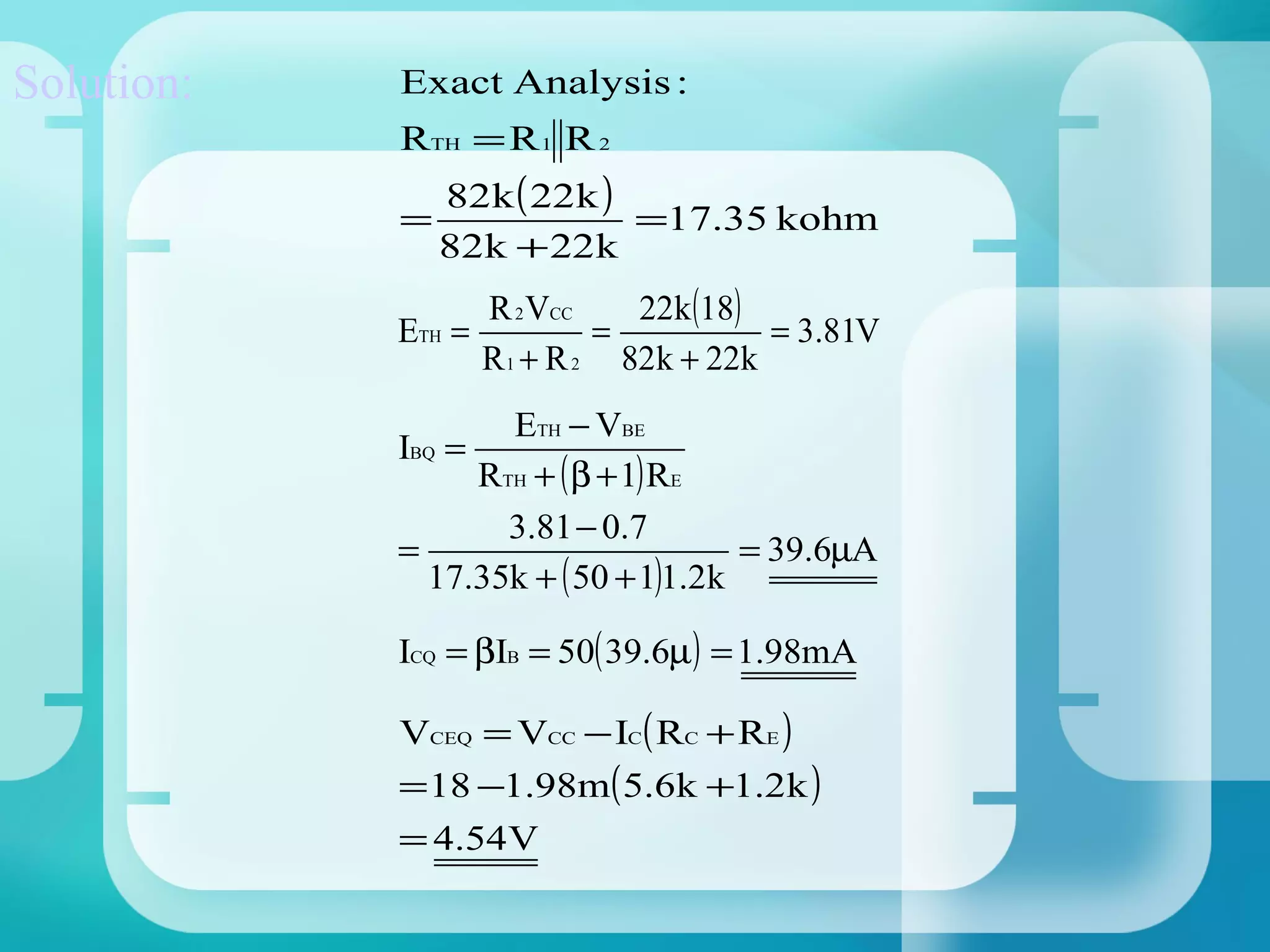
Solution:   Exact Analysis :
            RTH = R 1 R 2
                82k ( 22k )
            =               =17.35 kohm
                82k + 22k
                    R 2 VCC    22k (18)
            ETH =            =          = 3.81V
                    R 1 + R 2 82k + 22k
                    ETH − VBE
            IBQ =
                  RTH + ( β + 1) RE
                    3.81 − 0.7
            =                        = 39.6µA
              17.35k + ( 50 + 1)1.2k

            ICQ = βIB = 50( 39.6µ) = 1.98mA

            VCEQ = VCC − IC ( RC + RE )
            = 18 −1.98m( 5.6k +1.2k )
            = 4.54V
Solution (continued):
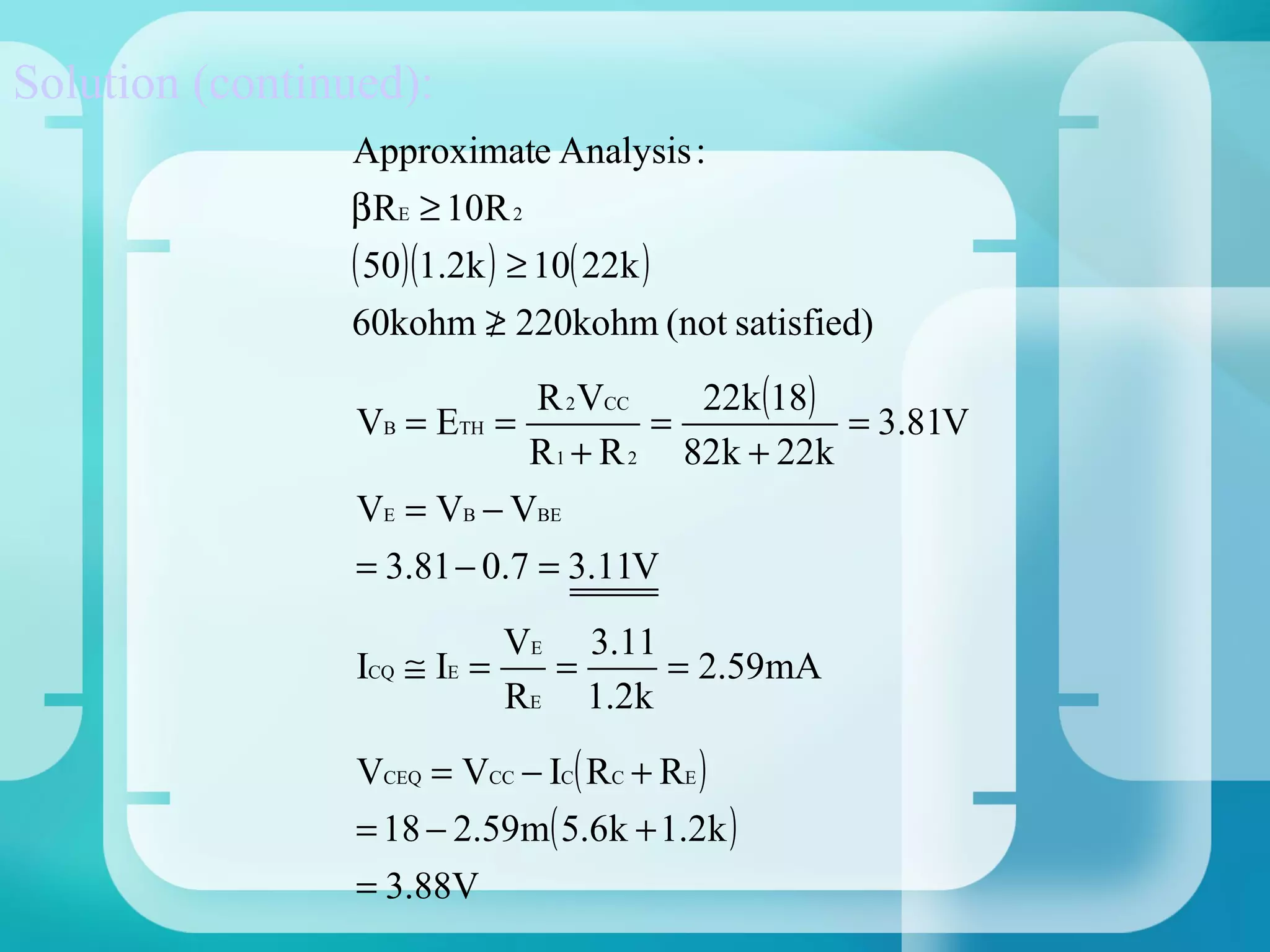
                Approximate Analysis :
                β RE ≥ 10R 2
                ( 50)(1.2k ) ≥ 10( 22k )
                60kohm ≥ 220kohm (not satisfied)
                           /
                              R 2 VCC   22k (18)
                 VB = ETH =           =          = 3.81V
                             R 1 + R 2 82k + 22k
                 VE = VB − VBE
                 = 3.81 − 0.7 = 3.11V
                            VE 3.11
                 ICQ ≅ IE =   =     = 2.59mA
                            RE 1.2k
                 VCEQ = VCC − IC( RC + RE )
                 = 18 − 2.59m( 5.6k + 1.2k )
                 = 3.88V
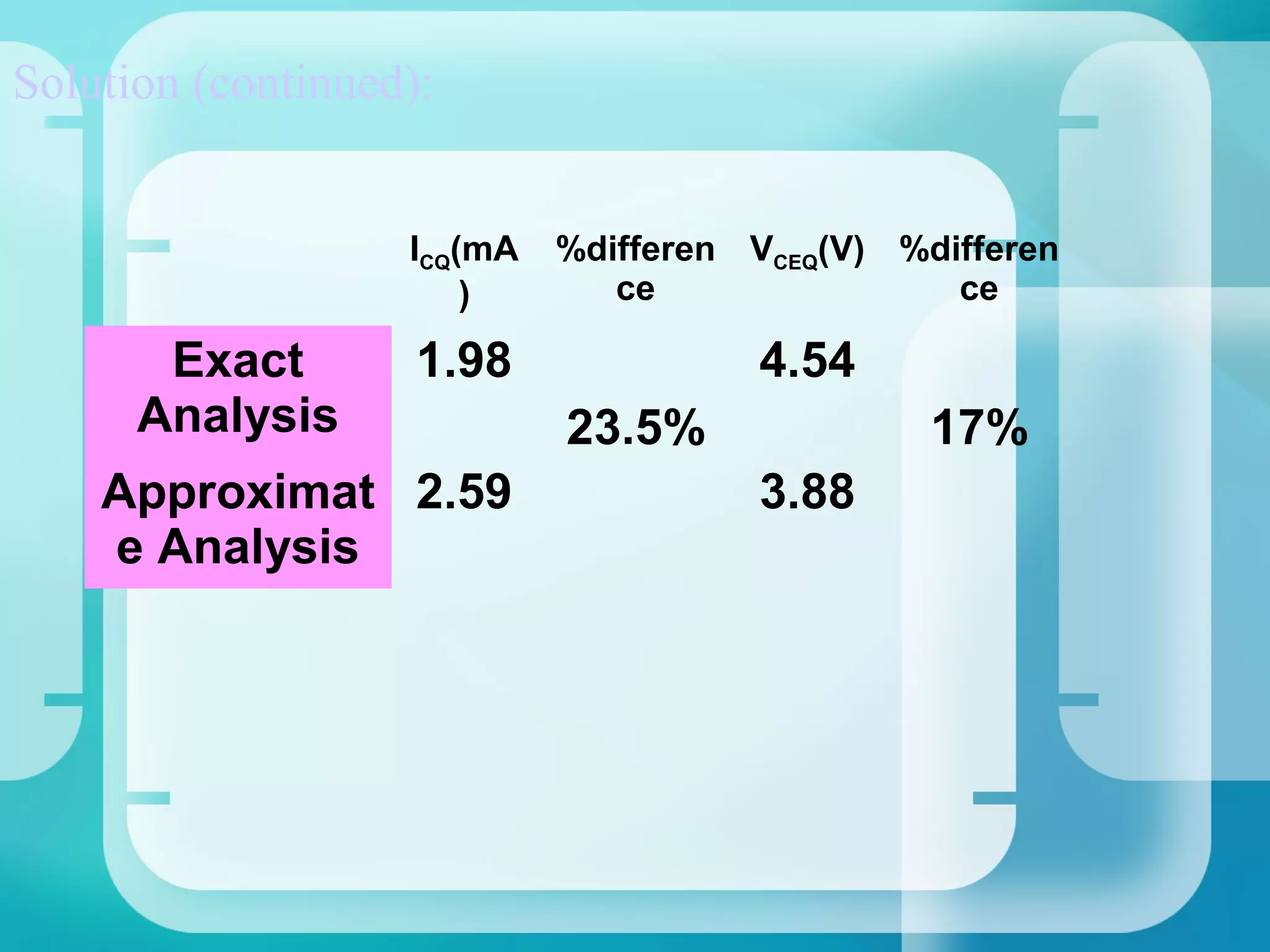
Solution (continued):


                   ICQ(mA   %differen VCEQ(V) %differen
                       )       ce                ce

       Exact        1.98              4.54
      Analysis              23.5%               17%
    Approximat 2.59                   3.88
    e Analysis
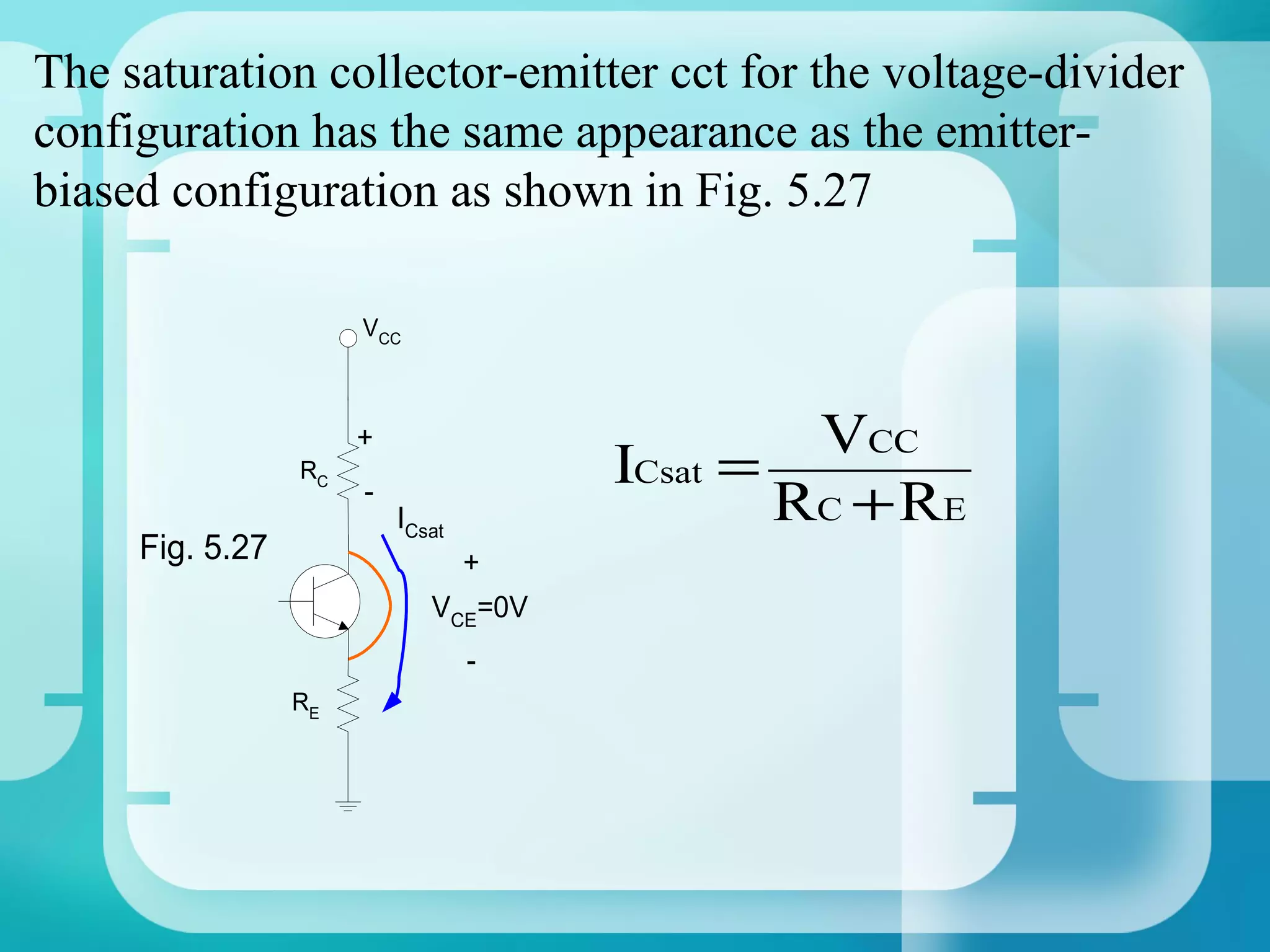
The saturation collector-emitter cct for the voltage-divider
configuration has the same appearance as the emitter-
biased configuration as shown in Fig. 5.27

                      VCC


                      +                        VCC
                 RC                   ICsat =
                      -
                          ICsat               RC + RE
     Fig. 5.27                 +
                             VCE=0V
                                  -
                 RE
Load line analysis

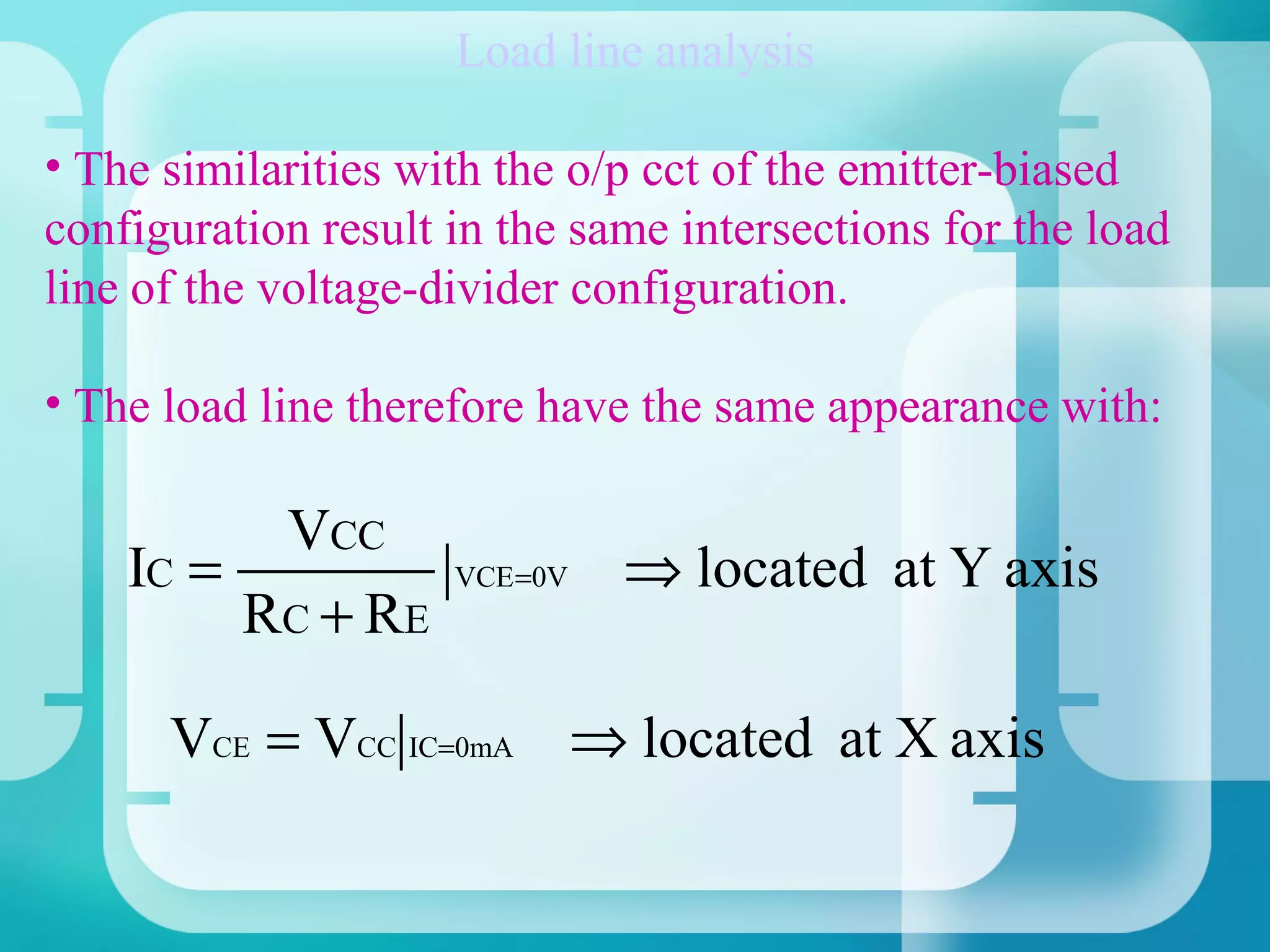
• The similarities with the o/p cct of the emitter-biased
configuration result in the same intersections for the load
line of the voltage-divider configuration.

• The load line therefore have the same appearance with:

          VCC
    IC =             VCE =0V   ⇒ located at Y axis
         RC + RE

      VCE = VCC IC=0mA ⇒ located at X axis
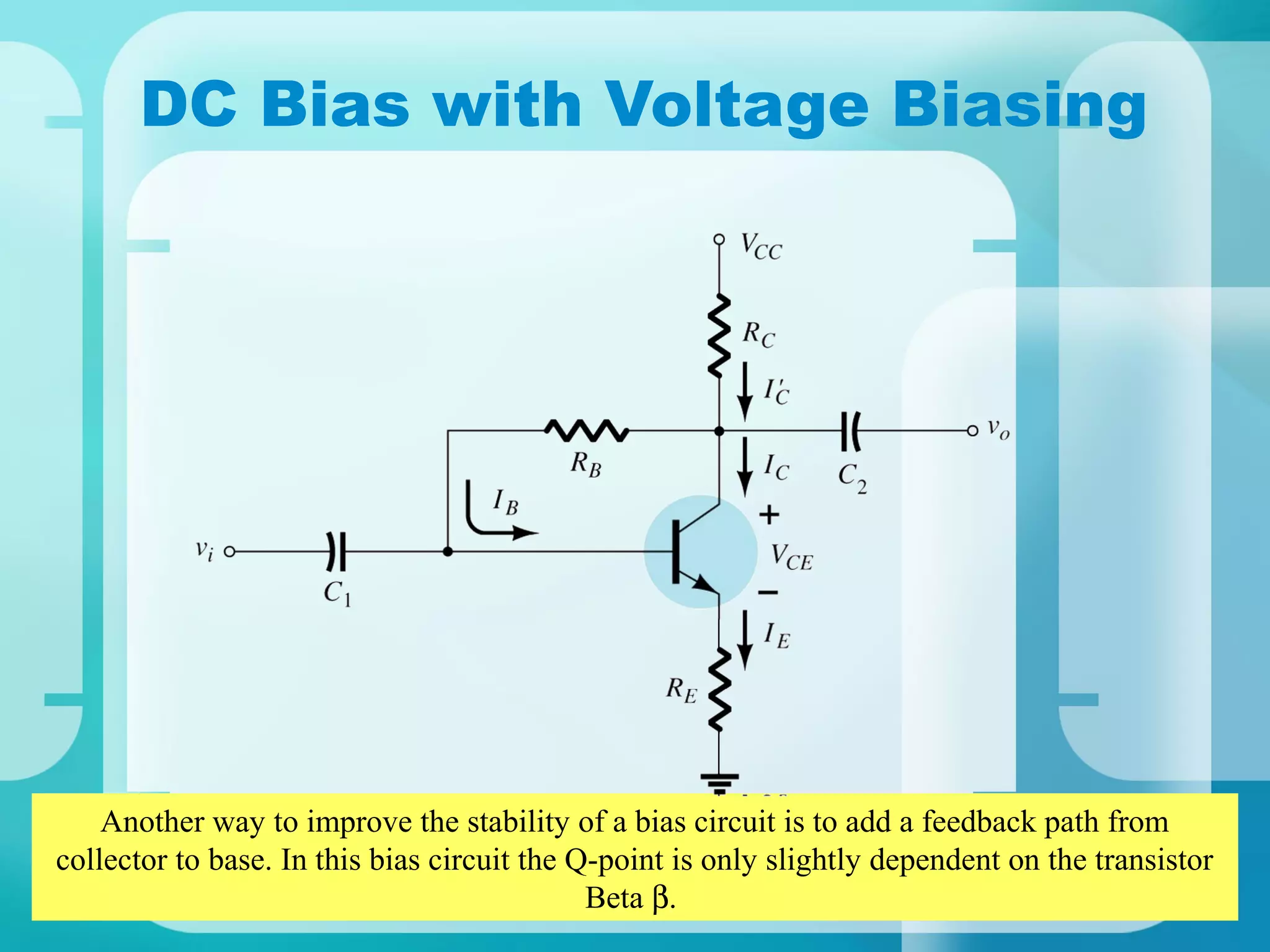
DC Bias with Voltage Biasing


    Another way to improve the stability of a bias circuit is to add a feedback path from
collector to base. In this bias circuit the Q-point is only slightly dependent on the transistor
                                             Beta β.
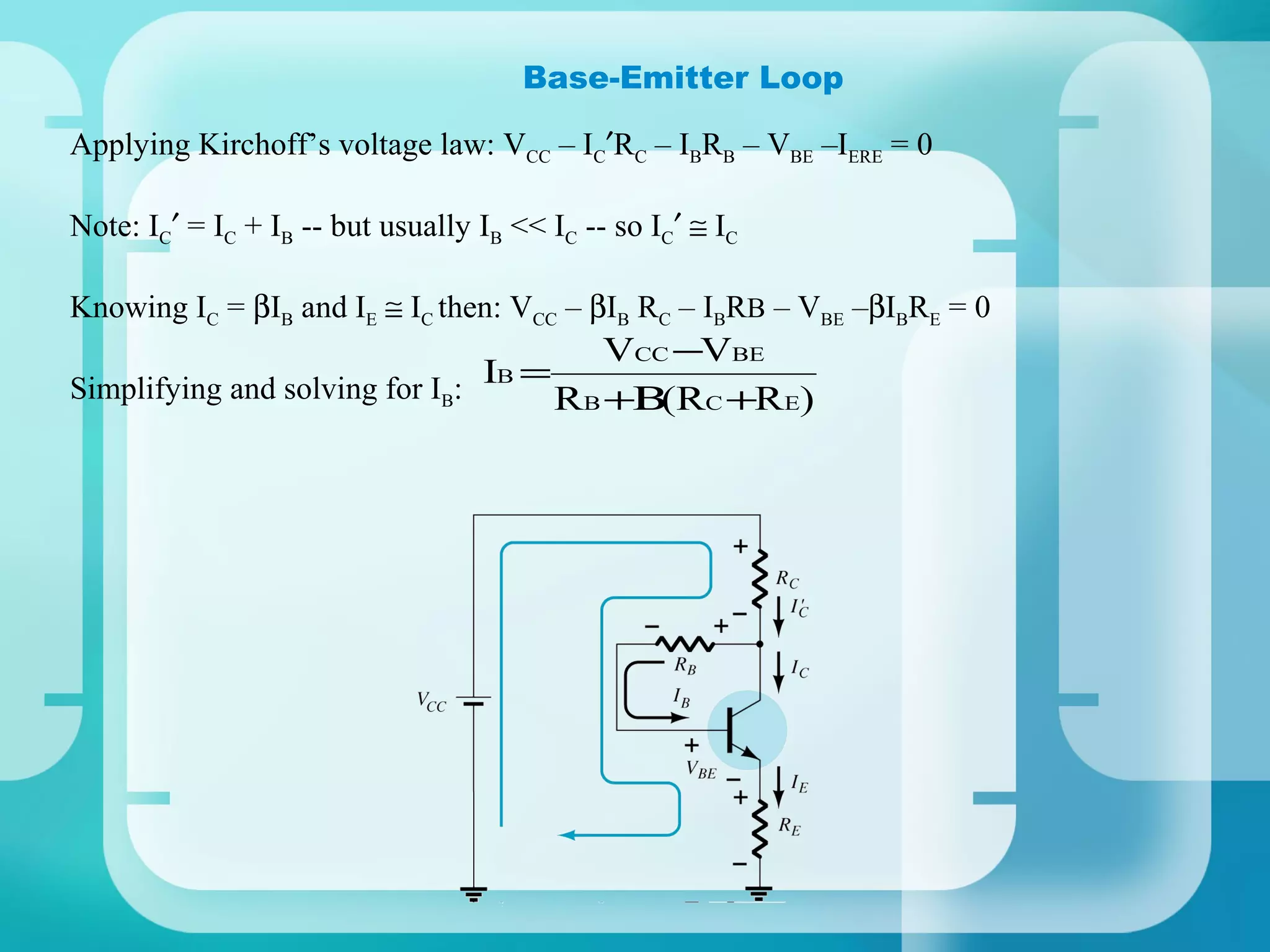
Base-Emitter Loop

Applying Kirchoff’s voltage law: VCC – IC′RC – IBRB – VBE –IERE = 0

Note: IC′ = IC + IB -- but usually IB << IC -- so IC′ ≅ IC

Knowing IC = βIB and IE ≅ IC then: VCC – βIB RC – IBRB – VBE –βIBRE = 0
                                        VCC −VBE
                                IB =
Simplifying and solving for IB:      RB +Β C +RE)
                                           (R
Collector-Emitter Loop


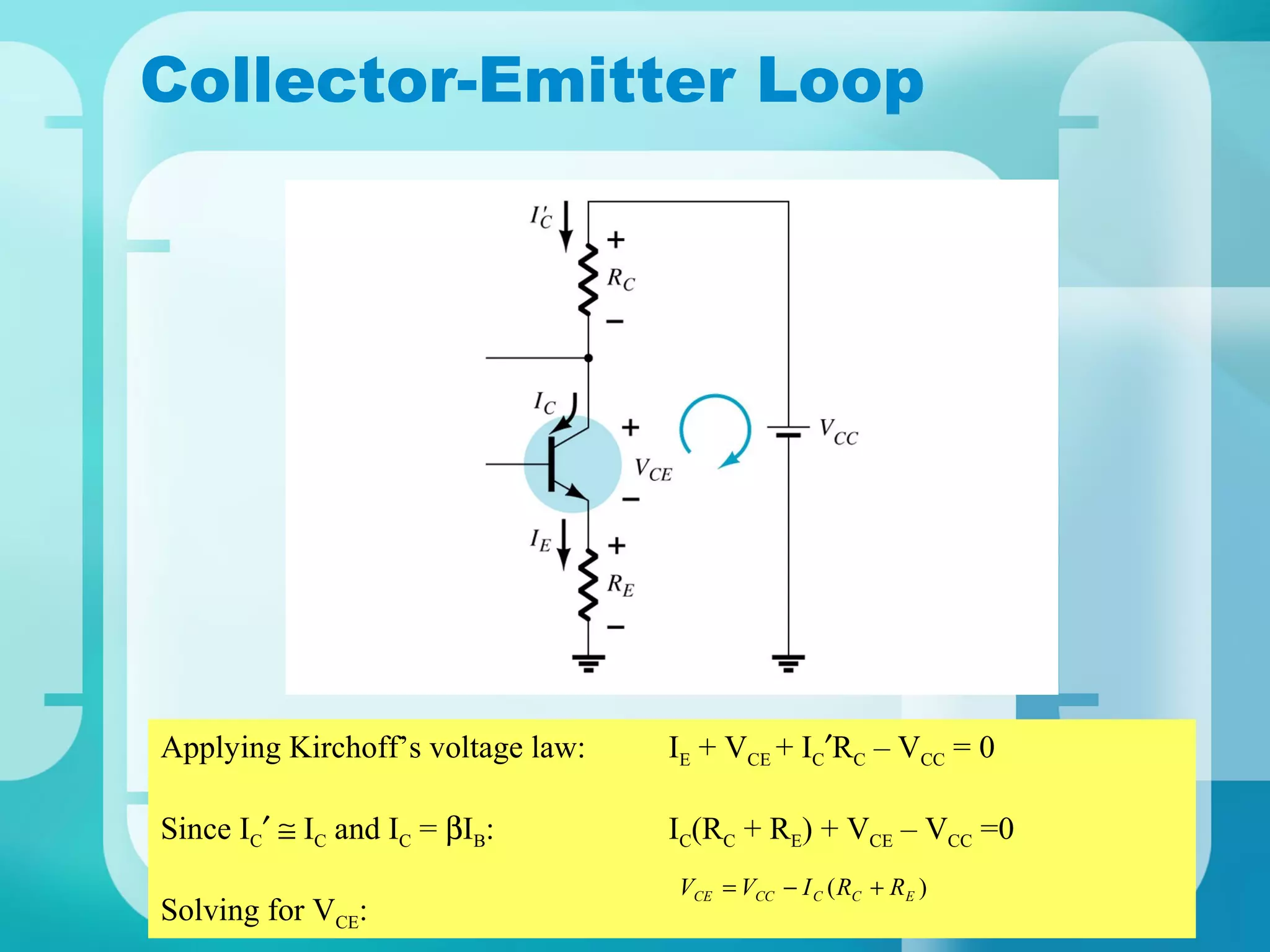
Applying Kirchoff’s voltage law:   IE + VCE + IC′RC – VCC = 0

Since IC′ ≅ IC and IC = βIB:       IC(RC + RE) + VCE – VCC =0
                                   VCE = VCC − I C ( RC + RE )
Solving for VCE:
Transistor Saturation Level

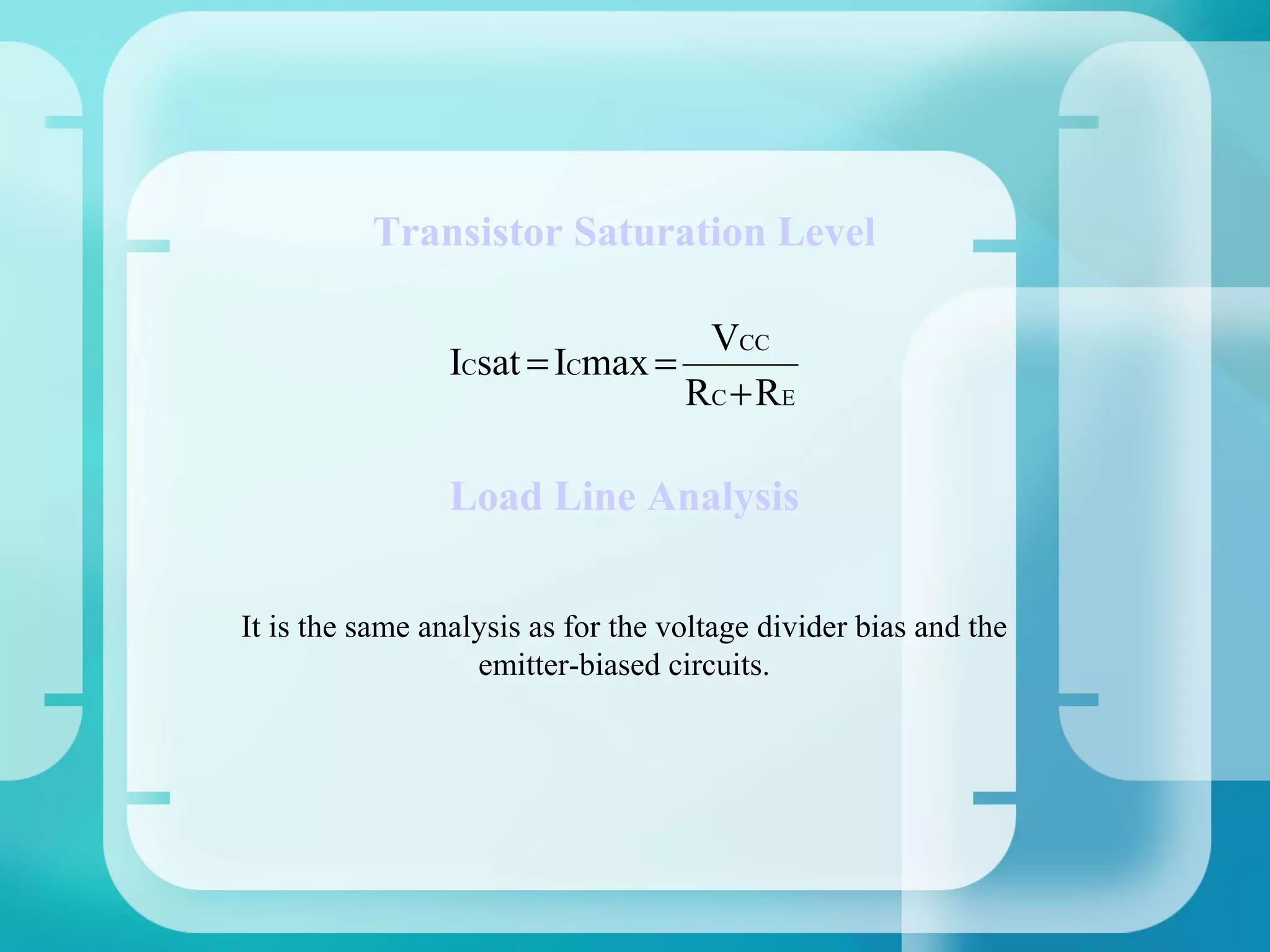
                                  VCC
                 ICsat = ICmax =
                                 RC + RE

                 Load Line Analysis


It is the same analysis as for the voltage divider bias and the
                   emitter-biased circuits.
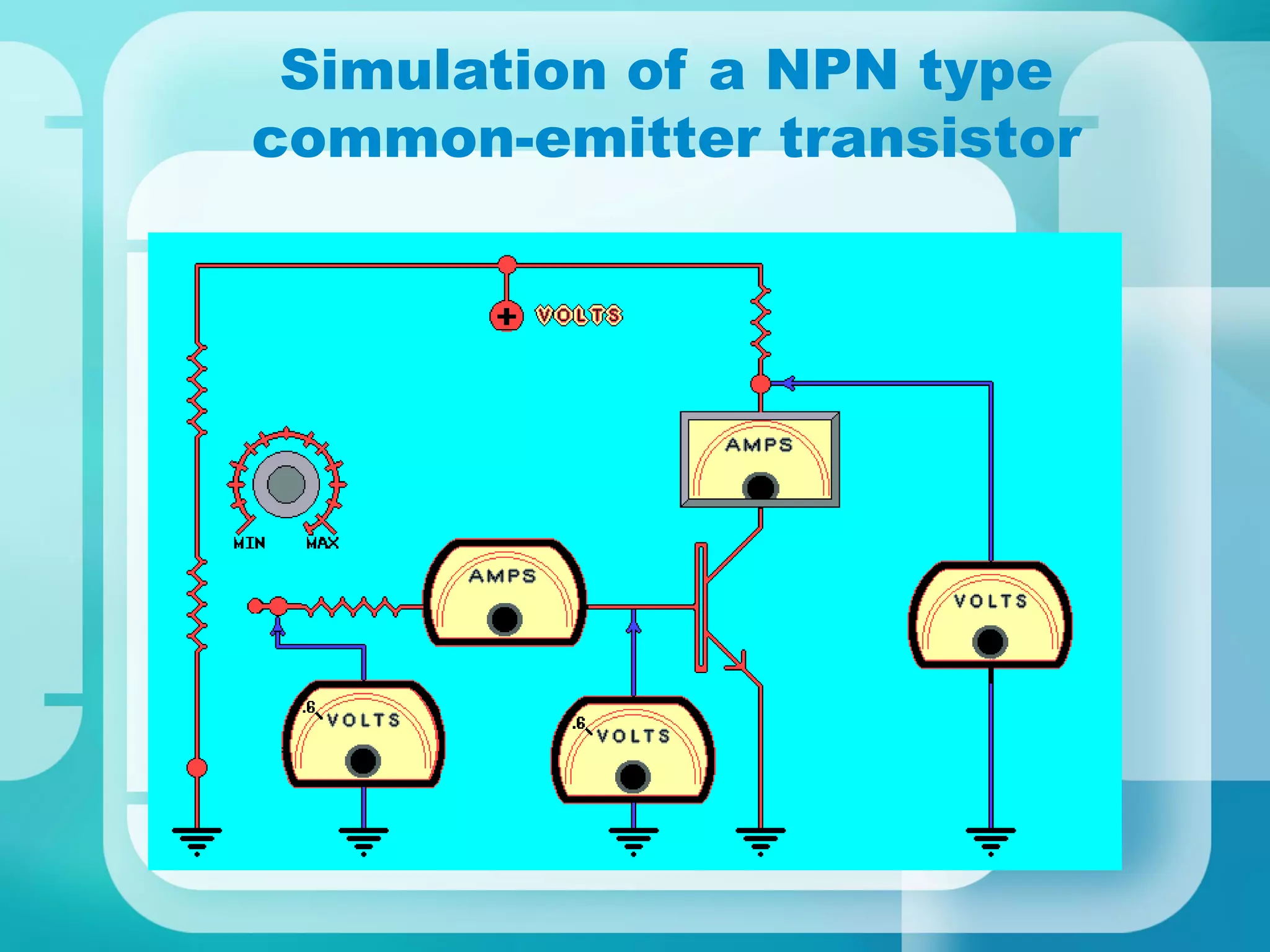
Simulation of a NPN type
common-emitter transistor
Design Operation
• We are able to design the transistor circuit
  using the ideas that we have learnt before
  during analyzing dc biasing circuit.
• How?
   – Understand the Kirchof’s Law and other electric
     circuit law such as Ohms Law, Thevenin Laws
     etc
   – Identify the parameters given
   – Analyze into the input/output for the system and
     build a loop using electric circuit’s law.
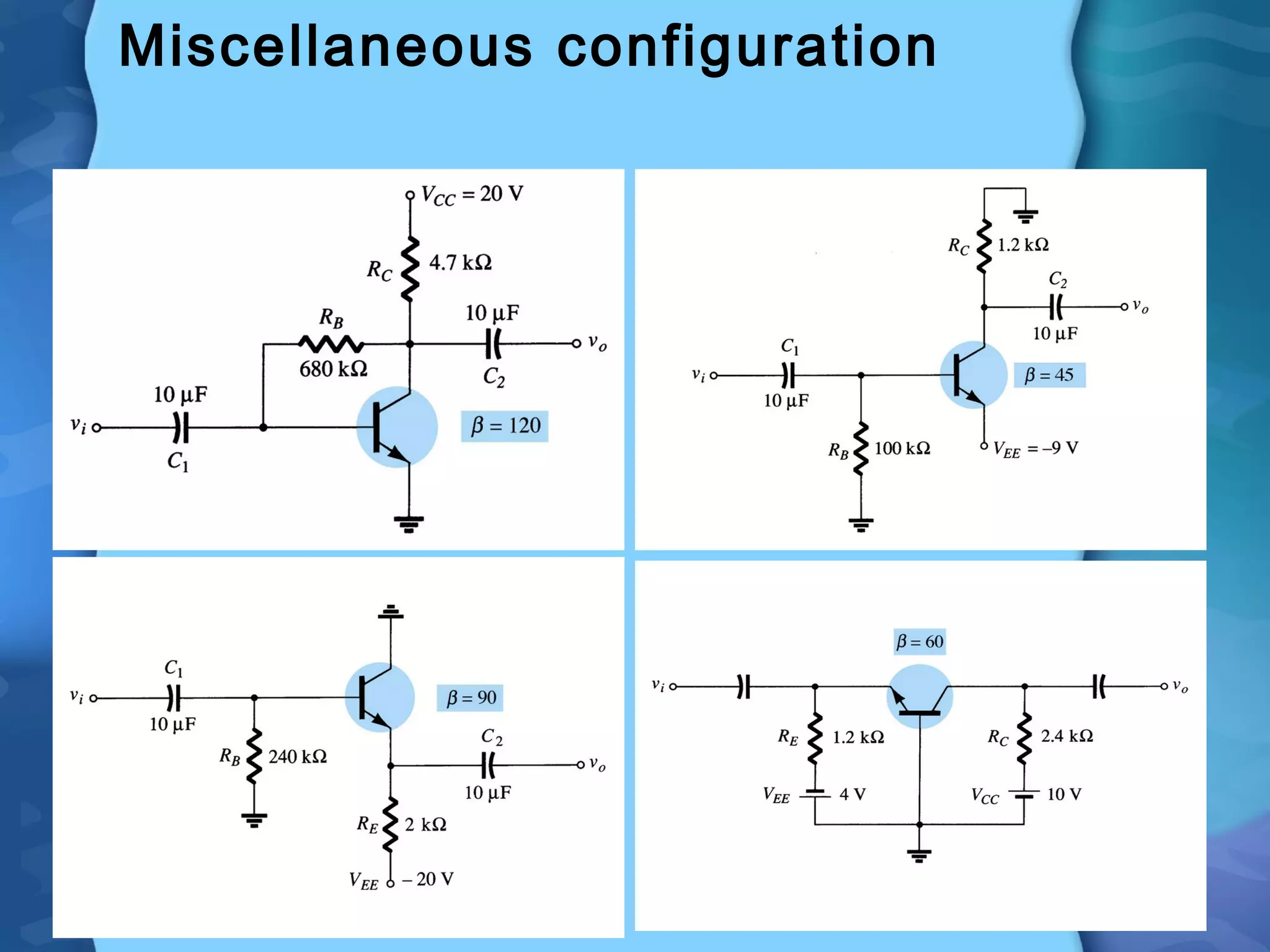
Miscellaneous configuration
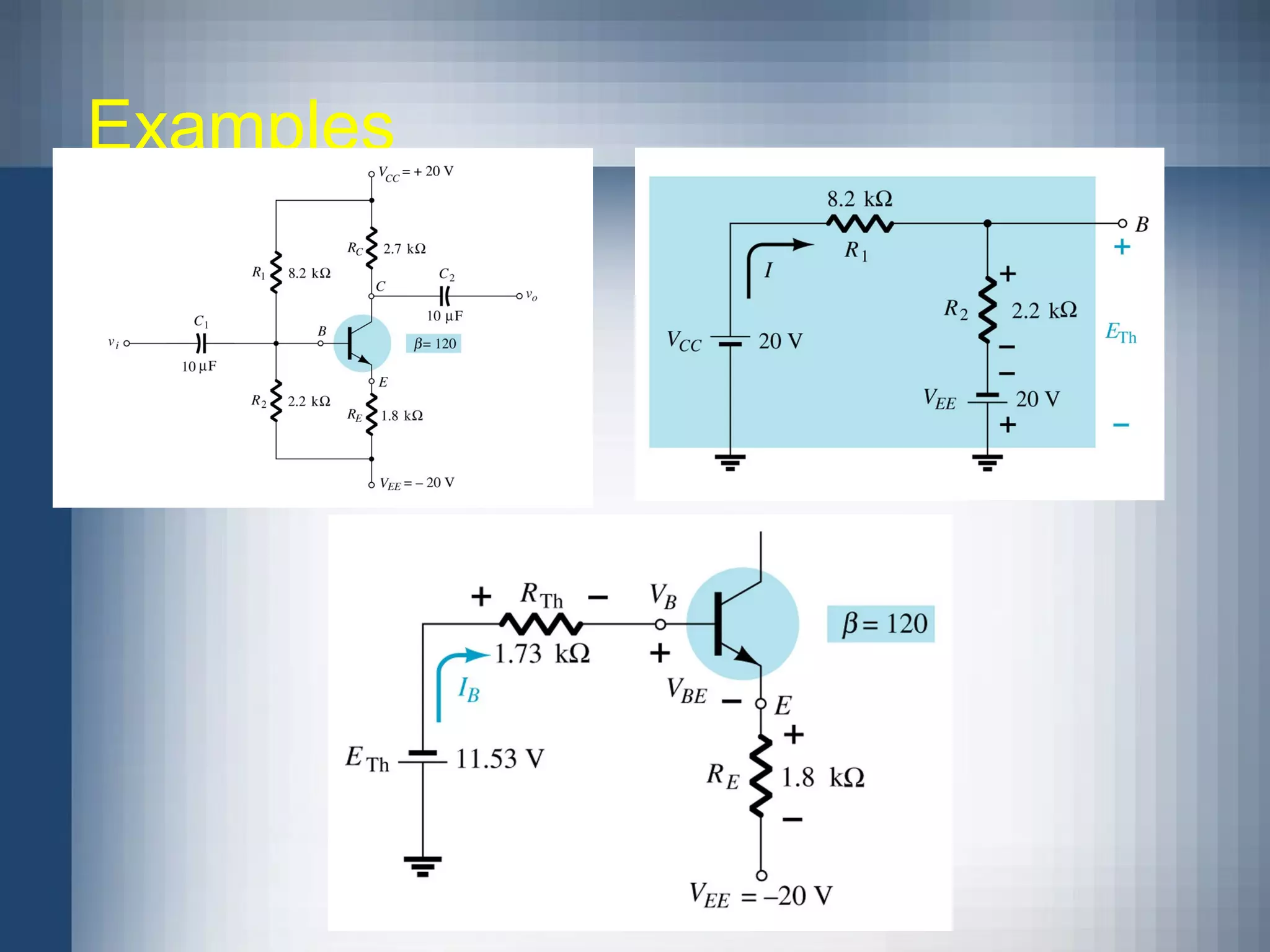
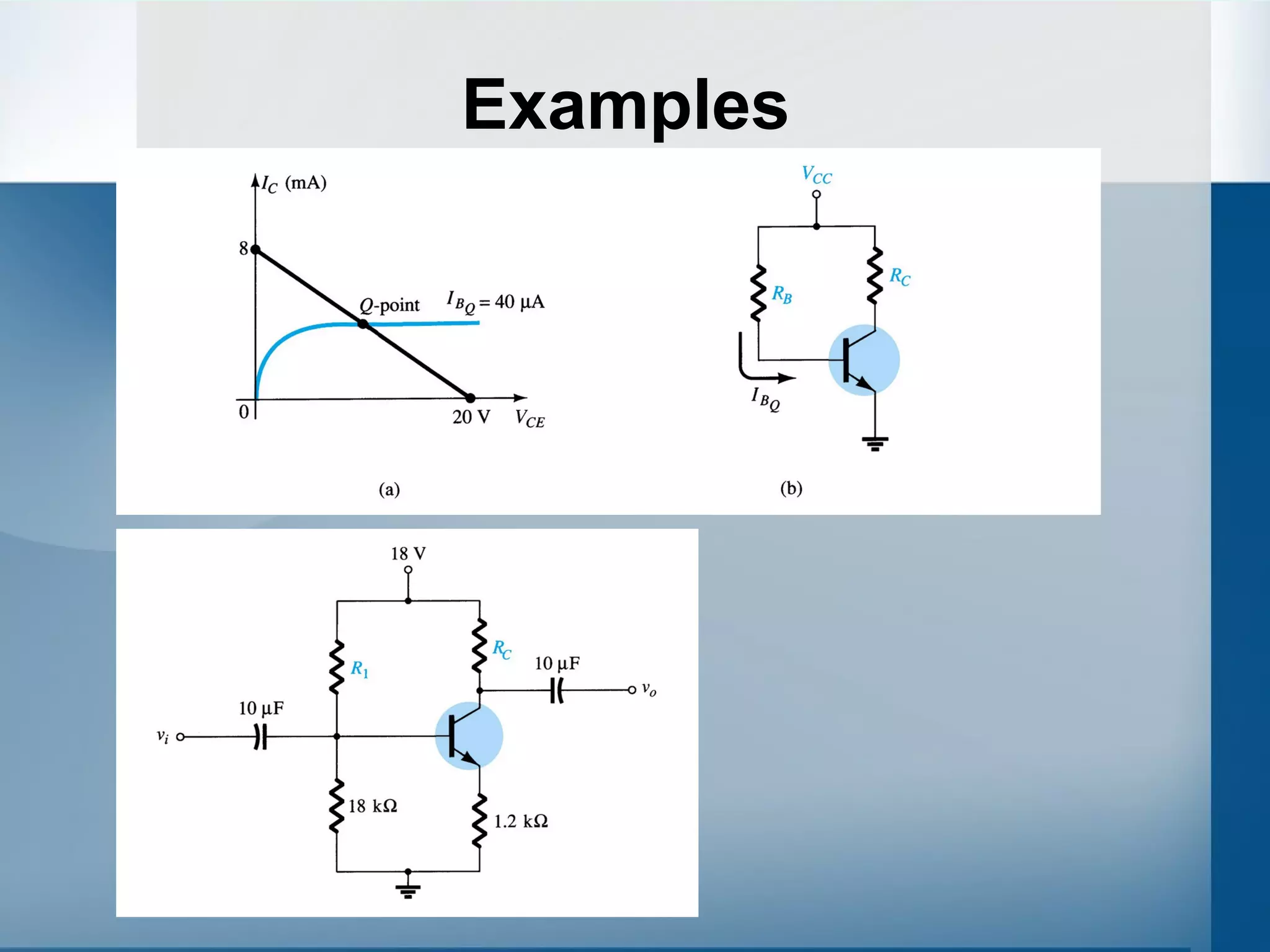
Examples
Examples
Examples of design
• Design of a bias circuit with
  an emitter feedback
  resistor
• Design of a current-gain-
  stabilized circuit (beta
  independent)
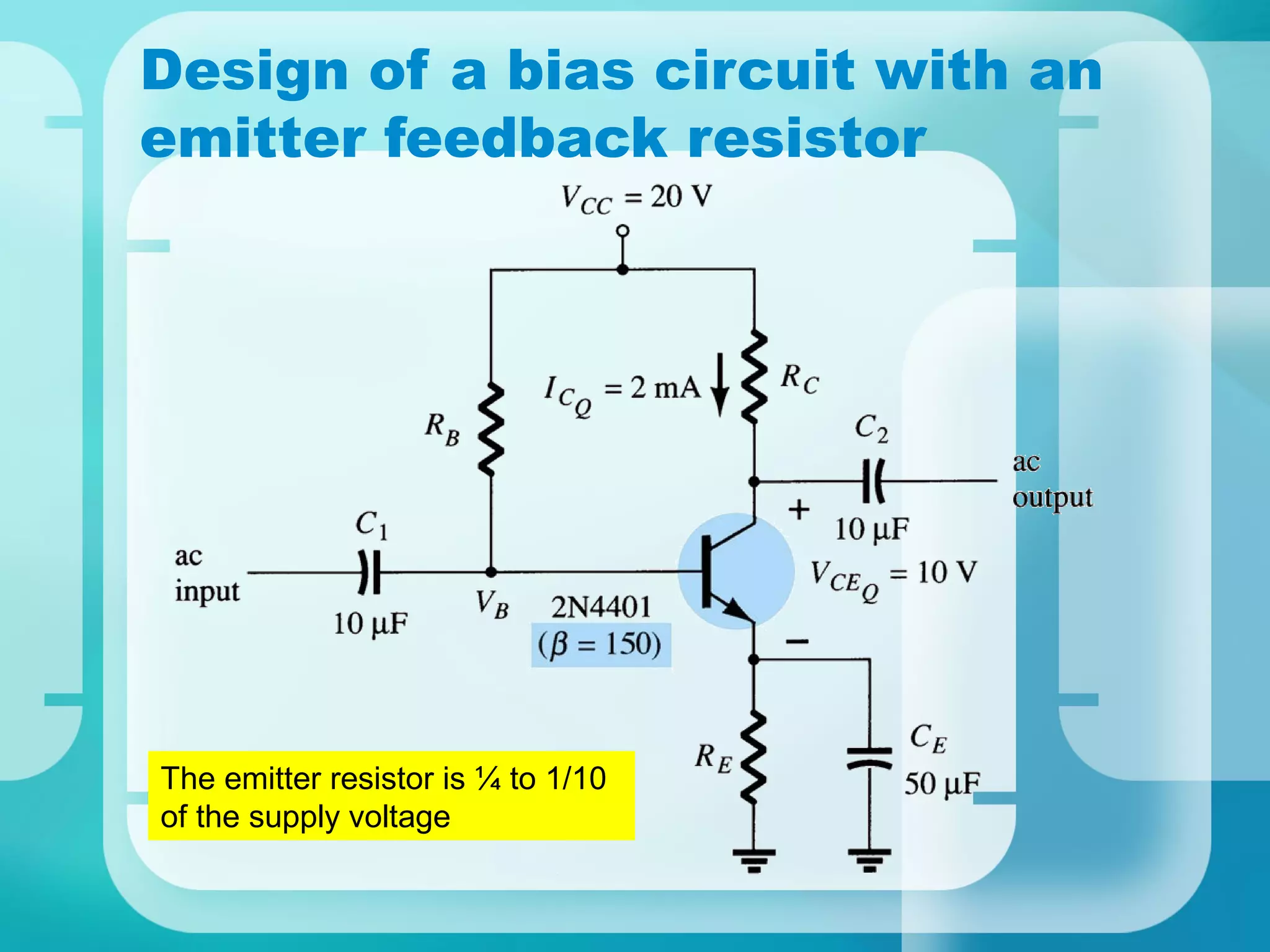
Design of a bias circuit with an
emitter feedback resistor


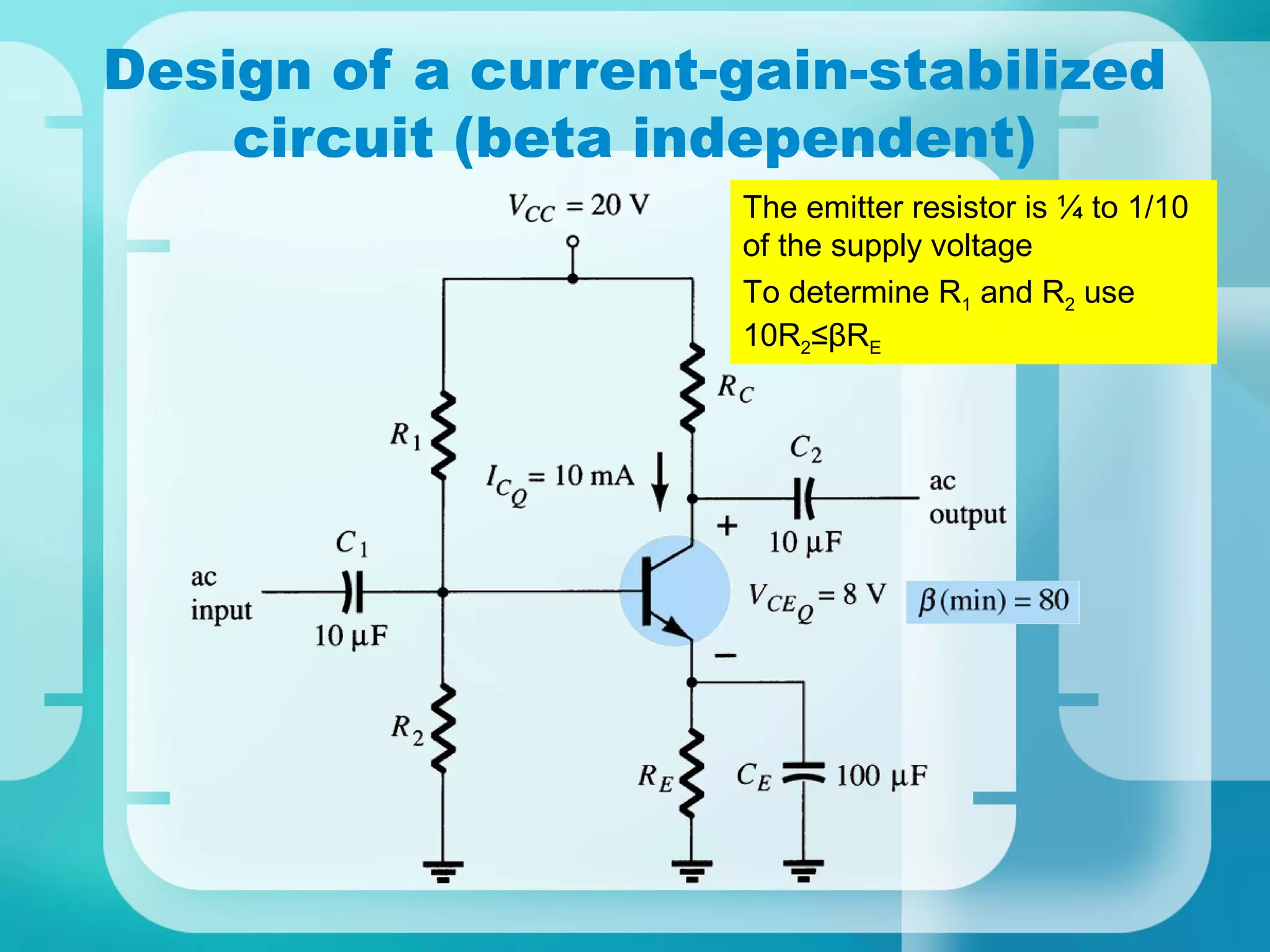
The emitter resistor is ¼ to 1/10
of the supply voltage
Design of a current-gain-stabilized
    circuit (beta independent)
                     The emitter resistor is ¼ to 1/10
                     of the supply voltage
                     To determine R1 and R2 use
                     10R2≤βRE
Transistor as switching
networks
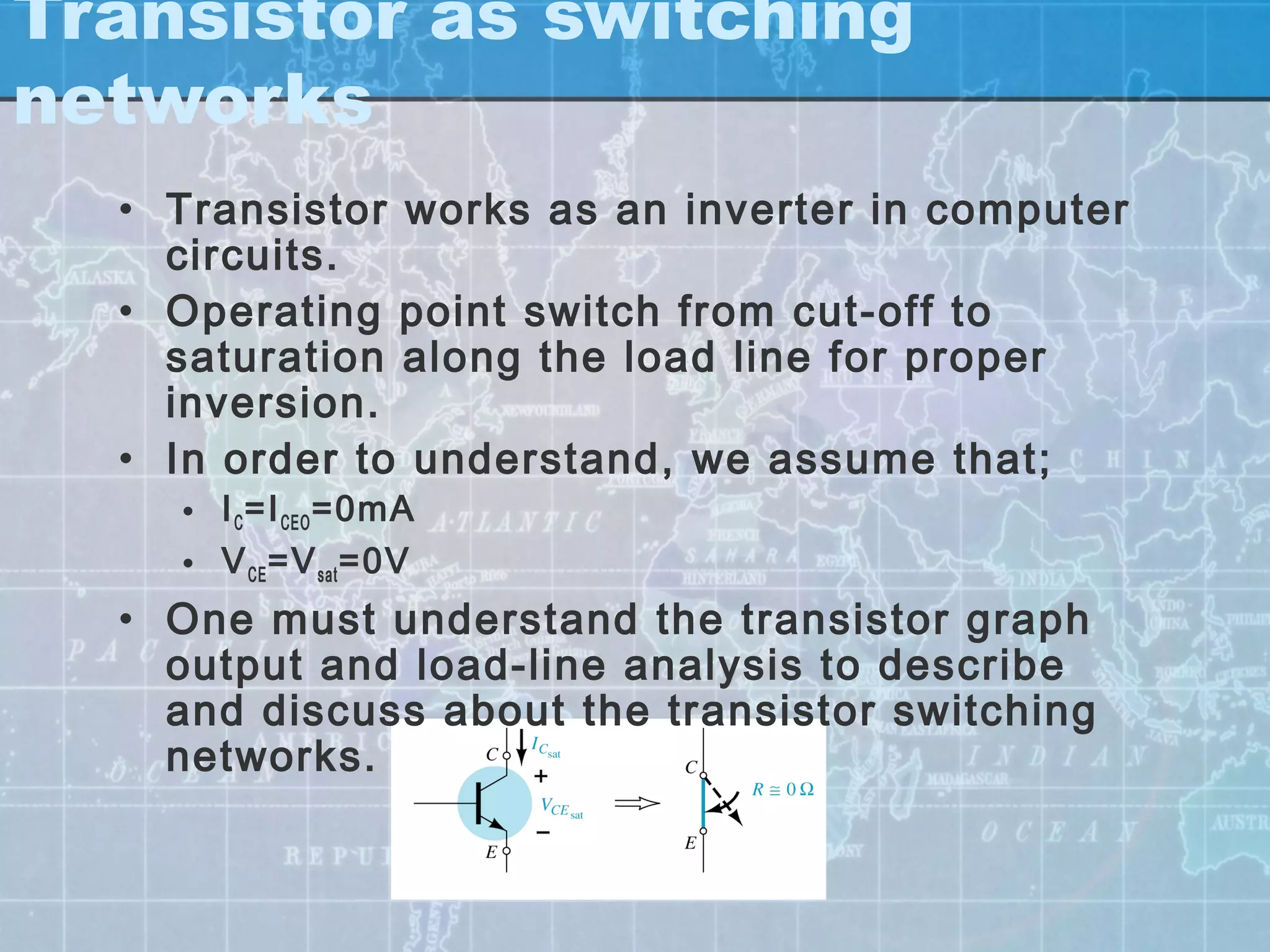
  • Transistor works as an inverter in computer
    circuits.
  • Operating point switch from cut-off to
    saturation along the load line for proper
    inversion.
  • In order to understand, we assume that;
    • I C =I CEO =0mA
    • V CE =V sat =0V
  • One must understand the transistor graph
    output and load-line analysis to describe
    and discuss about the transistor switching
    networks.
Transistor as a switch


                                           ICsat
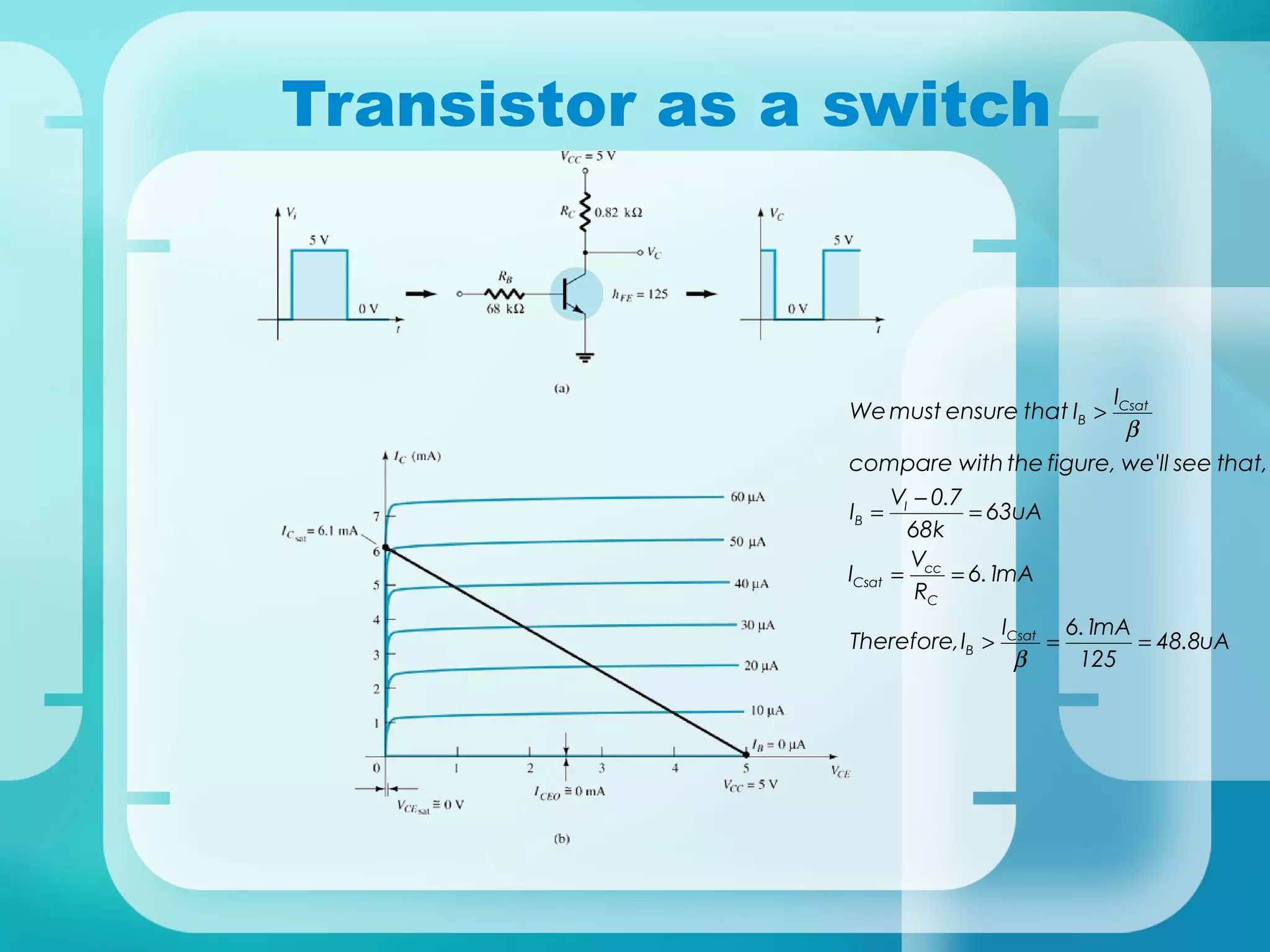
                We must ensure that IB >
                                             β
                compare with the figure, we'll see that,
                      V − 0.7
                IB = I        = 63uA
                       68k
                        V
                ICsat = cc = 6.1mA
                        RC
                                  ICsat 6.1mA
                Therefore, IB >        =      = 48.8uA
                                    β    125
Time interval
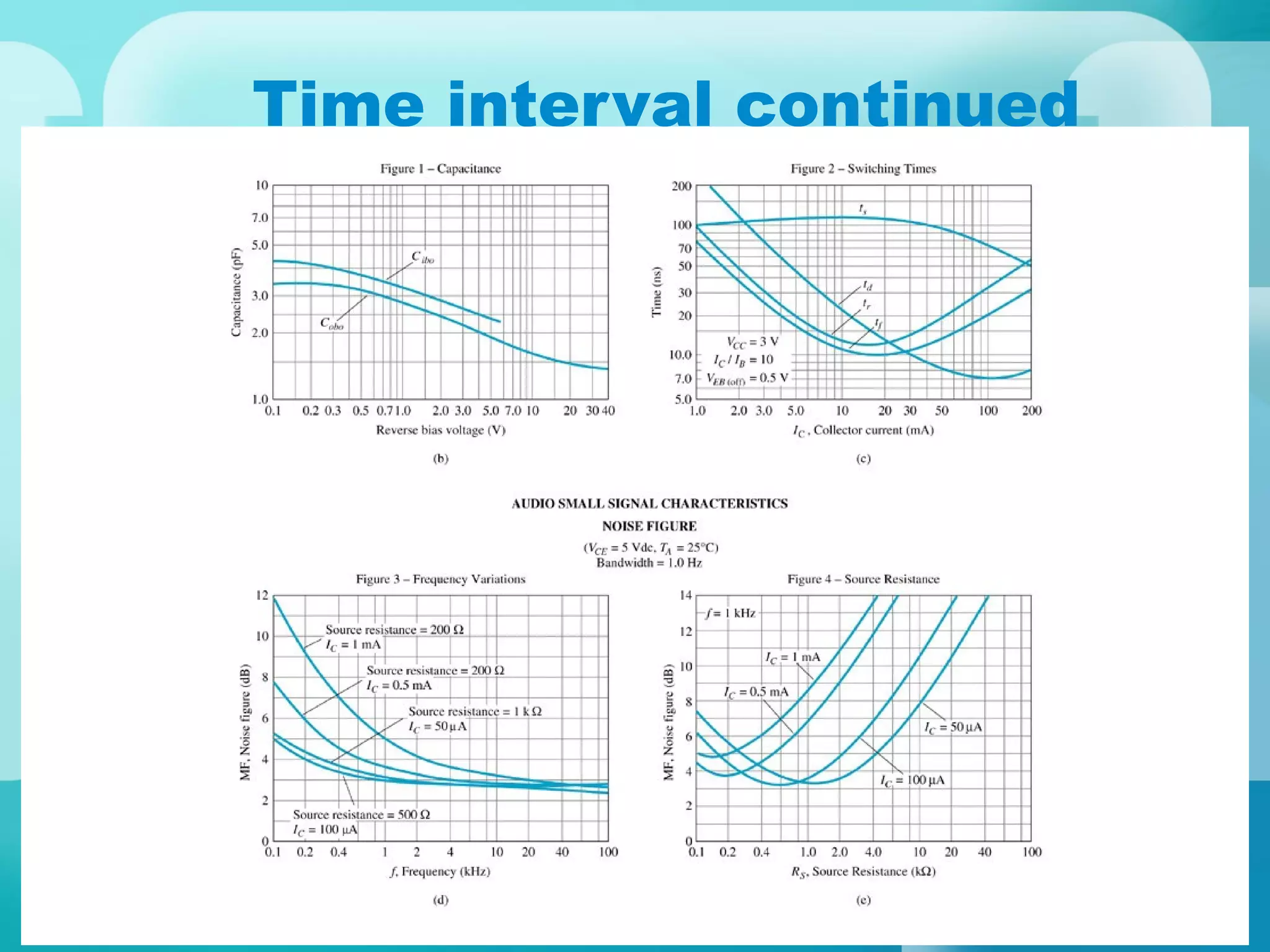
Time interval continued
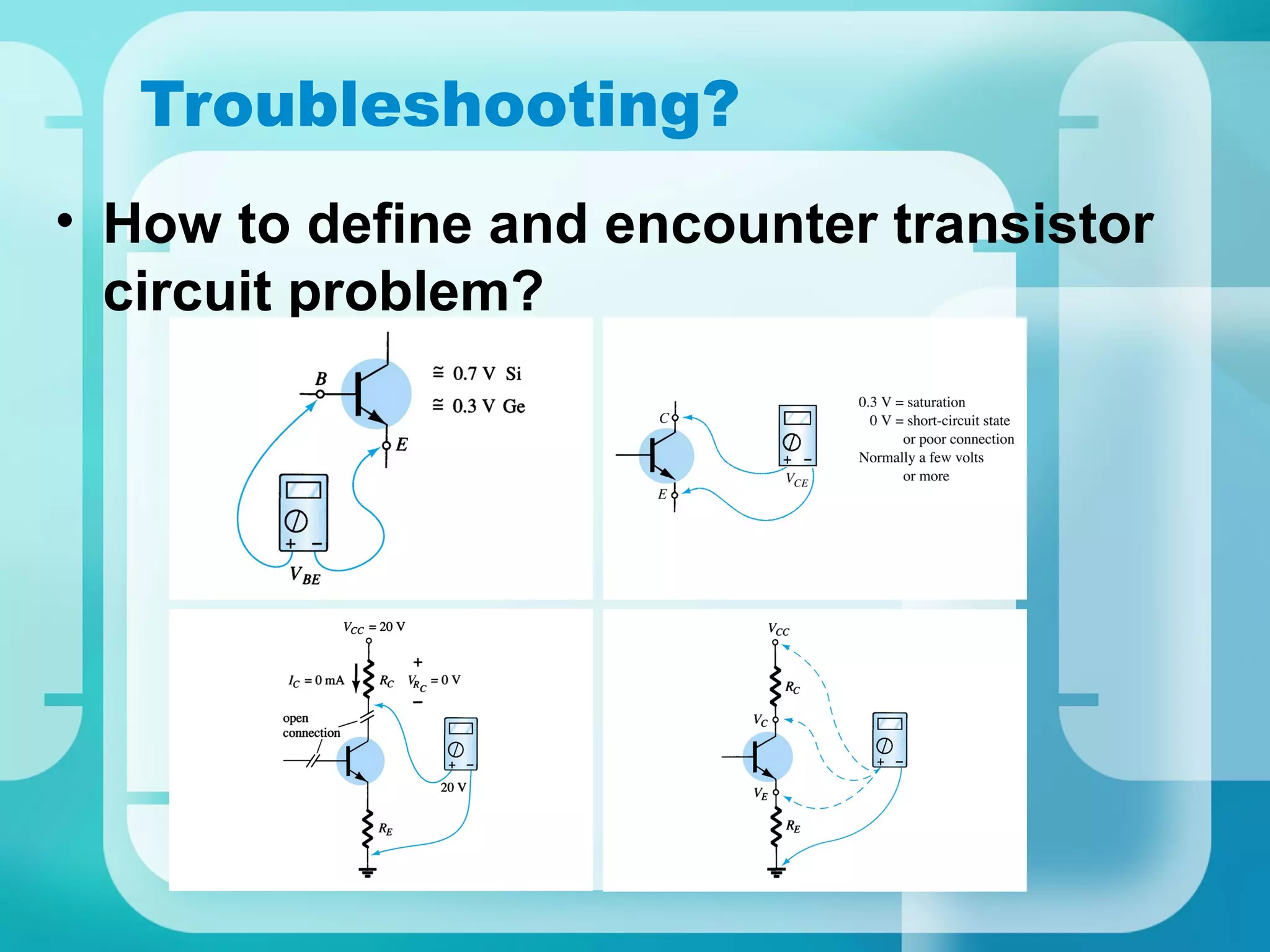
Troubleshooting?
• How to define and encounter transistor
  circuit problem?
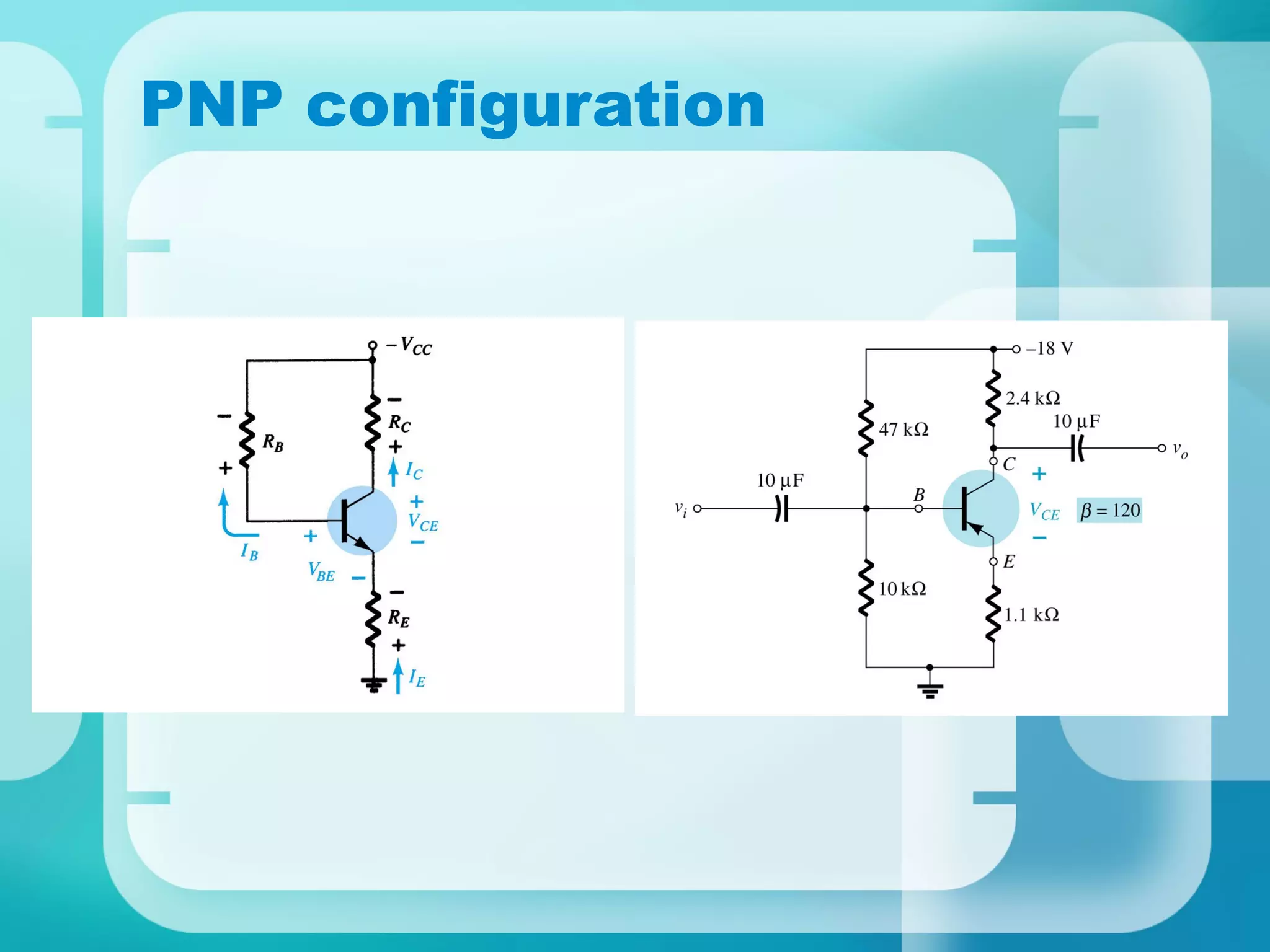
PNP configuration
Bias stabilization

• Stability of a system is a measure of the
  sensitivity of a network to variation in its
  parameter.
   – β increases with increase in temperature
   – VBE decreases 7.5mV every degree celcius
   – ICO doubles every 10 oC increase in temperature
Effect of non-stability circuit/system


  Room temperature                          100oC temperature

We’ll find that β increase after 100OC, base current is same but not
suitable to use due it is very near to the saturation region.
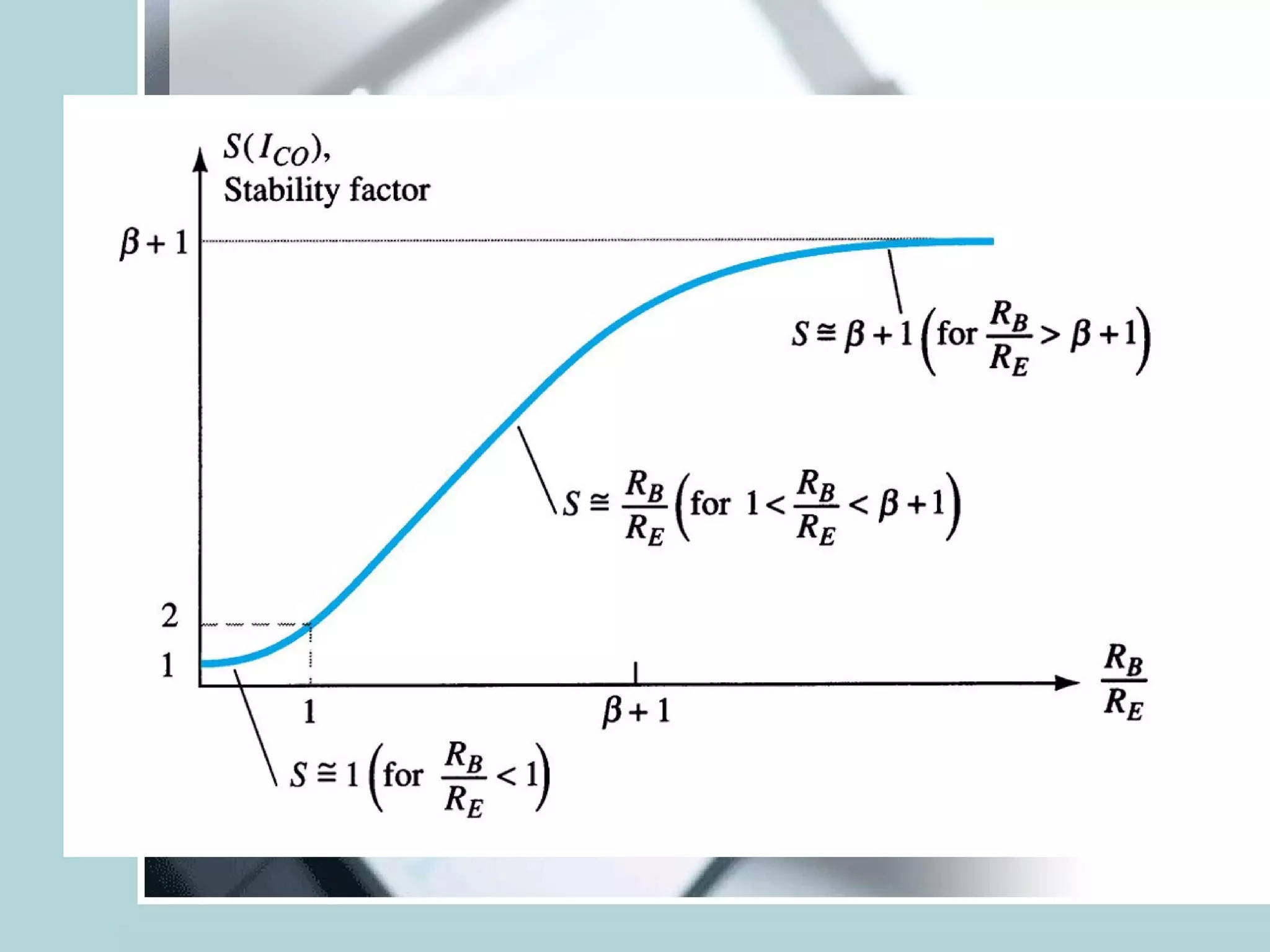
Stability factors
                                         S(ICO)
                    • Emitter bias configuration
          ∆IC
S(ICO ) =                                    RB
                                           1+ ( )
          ∆ICO      S(ICO ) = (β + 1)
                                             RE
                                                R
                                     (β + 1 + ( B )
                                           )
          ∆IC                                   RE
S(VBE ) =           If RB          >> (β + 1 it will reduce to
                                            ),
          ∆VBE                RE
                    S(ICO ) = (β + 1)
        ∆IC         If
                         RB
                                   << (β + 1 it will reduce to
                                            ),
S(β ) =                       RE
        ∆β          S(ICO ) = 1

                    For ranges of RB              from 1to β + 1, stability
                                             RE
                                                     RB
                    factor will be , S(ICO ) ≅
                                                          RE
S(ICO)
 • Fixed bias configuration
                         RB
                   1+ ( )
                         RE
S(ICO ) = (β + 1)
                            R
                 (β + 1 + ( B )
                       )
                            RE
If multiplyin g above equation with REfor the numerator
and denumerator, and assume RE = 0Ω we'll obtain,
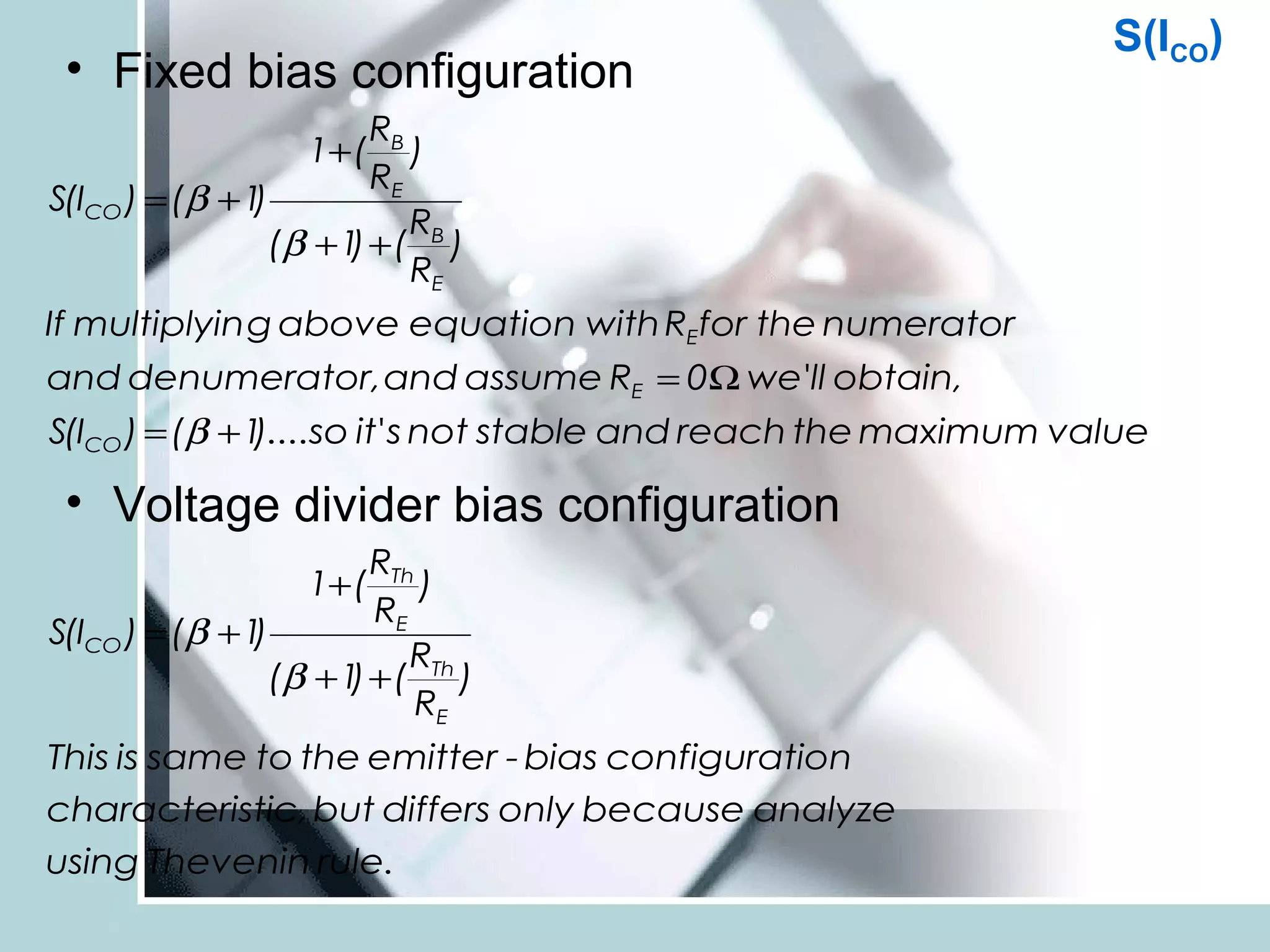
S(ICO ) = (β + 1 so it' s not stable and reach the maximum value
                )....

 • Voltage divider bias configuration
                         RTh
                   1+ (      )
                         RE
S(ICO ) = (β + 1)
                            R
                 (β + 1 + ( Th )
                       )
                            RE
This is same to the emitter - bias configuration
characteristic, but differs only because analyze
using Thevenin rule.
S(ICO)
• Feedback bias configuration
                          RB
                    1+ (     )
                          RC
 S(ICO ) = (β + 1)
                             R
                  (β + 1 + ( B )
                        )
                             RC
 Where RE = 0Ω

• Physical impact
 Fixed bias configuration ; IC=βIB+(β+1)ICO...IC increase but IB
 maintain, so it’s not stable
 Emitter bias configuration ; Increase IC will increase ICO. It affect VE
 since VE=IERE=ICRE. In turn, the output loop will inform that IB will
 decrease if VE is increase, thus affect to reduce the collector current.
 Feedback bias configuration ; same as result of emitter bias
 configuration where IB will decrease if IC increase. (IC proportional to
 VRC)
 Voltage divider bias configuration ; Most stable where as long as
 10R2>> βRE, VB remain constant for any changing in IC.
S(VBE)                               S(β)
          ∆IC                                   ∆IC
S(VBE ) =                               S(β ) =
          ∆VBE                                  ∆β
             −β                                            RB
                                                      IC + (1+)
      =
        RB + (β + 1 RE
                   )                                       RE
                                             = IC
                                                            R
           β                                      β1(1+ β2 + B )
      =−      ......(if RE = 0Ω)                            RE
           RB
or
             −β
             RE
      =
          RB
             + (β + 1)
          RE
           1
      =−      ......(if β + 1 >> RB )
           RE                      RE
References:
1.   Thomas L. Floyd, “ Electronic Devices, Sixth edition”, Prentice Hall,
     2002.
2.    Robert Boylestad, “Electronic Devices and Circuit Theory”, Eighth
     edition, Prentice Hall, 2002.
3.   Puspa Inayat Khalid, Rubita Sudirman, Siti Hawa Ruslan,
     “ModulPengajaran Elektronik 1”, UTM, 2002.
4.    Website : http://www2.eng.tu.ac.th

Chapter 4 bj ts dc biasing

  • 1.
  • 2.
  • 3.
    Chapter 4 Chapter 4 DC biasing- DC biasing- BJTs BJTs Faculty of Electrical and Electronic Engineering
  • 4.
    Topics objectives •You’ll learn • Q-point of a transistor operation • About DC analysis of a transistor circuit • About Transistor biasing configuration • Other available transistor biasing circuits • Stability factor for transistor • Transistor switching
  • 5.
    INTRODUCTION • BJTs amplifierrequires a knowledge of both the DC analysis (LARGE-signal) and AC analysis (small signal). • For a DC analysis a transistor is controlled by a number of factors including the range of possible operating points. • Once the desired DC current and voltage levels have been defined, a network must be constructed that will establish the desired operating point. • BJT need to be operate in active region used as amplifier. • The cutoff and saturation region used as a switches. • For the BJTs to be biased in its linear or active operating region the following must be true: a) BE junction  forward biased, 0.6 or 0.7V b) BC junction  reverse biased
  • 6.
    INTRODUCTION(CONTINUED) • DC biasanalysis  assume all capacitors are open cct. • AC bias analysis : 1) Neglecting all of DC sources 2) Assume coupling capacitors are short cct. The effect of these capacitors is to set a lower cut-off frequency for the cct. 3) Inspect the cct (replace BJTs with its small signal model). 4) Solve for voltage and current transfer function and i/o and o/p impedances. • For transistor amplifiers the resulting DC current and voltage establish an operating point that define the region that can be employed for amplification process.
  • 7.
    Various operating pointswithin the limits of operation of a transistor : C t n i o p - Q • on r e c C IC(mA) I o t e u d s i r a n l B s e g n a h c y l d i p r v u PCmaxB : t n i o p - Q . n o i g e r s h t • o IB=60 uA t n i p g a r e s b h T ICmax 18 t s e g r a l d n i o f t n e r IB=50 uA u c d a g l o v b i s p 15 • fr o n i t d c e s a I i IB=40 uA s y l a n g m 12 Saturation B IB=30 uA 9 6 IB=20 uA : A t n i o p - Q •=V 0 , A I IB=10 uA C •fr o e l b a t i u s N 3 e t a r p o s i n IB=0 uA A VCE(V) 10 20 30 40 VCEsat VCEmax Cutoff
  • 8.
    FIXED-BIAS CCT VCC VCC VCC IC IC RC RB C2 RC RB AC output C IB + signal AC input B C + VCE IB + signal B C1 VBE - VCE E - + VBE - E - C1,C2 = coupling capacitors AC ANALYSIS DC ANALYSIS
  • 9.
    EMITTER-STABILIZED BIAS CCT VCC IC RC RB Vo IB Vi C2 C1 IE Fig. 5.11 RE
  • 10.
    Voltage divider bias VCC RC R1 Vo Vi C2 C1 R2 RE Fig. 5.18: Voltage-divider bias configuration
  • 11.
    Forward Bias ofBase-Emitter • Refer to fig. 5.1. This cct also known as input loop. Use KVL :⇒ + VCC - IBRB - VBE = 0 + VCC RB rearrange the eq above we get, - VCC - VBE IB C + IB = B RB VCE + VBE - E known that IC = βIB thus equ. above can - rearrange as follows : VCC - VBE Fig. 5.1 : Base-emitter loop IC = RB β
  • 12.
    Collector-Emitter Loop • Referto fig. 5.2. Also known as output loop. Use KVL :⇒ + VCC - ICRc - VcE = 0 IC + RC VcE = VCC - ICRc - known that VcE = VC - VE, since VE = 0 V C thus we get, + VCC VCE VCE = VC. - Also known that VBE = VB - VE, since VE = 0V, thus we get, Fig. 5.2 : Collector-emitter loop VBE = VB The value of IC, IB and VCE shows the position of Q-point at o/p graph. The notation of this value changes to ICQ, IBQ and VCEQ.
  • 13.
    Example 1: Determine thefollowing for the fixed bias configuration of Fig 5.3. a) IBQ and ICQ b) VCEQ c) VB and VC d) VBC VCC=+12V IC RC=2.2kohm RB=240kohm C2 AC output C C1 IB + signal B 10uF AC input VCE signal + 10uF VBE E - β = 50 - Fig. 5.3
  • 14.
    Solution VCC − VBE a ) IBQ = RB 12 − 0.7 = = 47.08uA 240k ICQ = βIBQ = ( 50 )( 47.08u ) = 2.34 mA b) VCEQ = VCC - ICRC = 12 - ( 2.35m )( 2.2k ) = 6.83V c) VBE = VB = 0.7 V VCE = VCEQ = VC = 6.83 V d )VBC = VB − VC = 0.7 − 6.83 = − 6.13V - ve sign indicates that BC - junction is reverse biased.
  • 15.
    Example 2: Determine thefollowing for the fixed bias configuration of Fig 5.4. a) IBQ and ICQ b) VCEQ c) VB d)VC e) VE VCC=+16V IC RC=2.7kohm RB=470kohm C IB + B VCE + VBE - E - β = 90 Fig. 5.4
  • 16.
    Solution VCC − VBE a ) IBQ = RB 16 − 0.7 = = 32.55uA 470k ICQ = β IBQ = ( 90 )( 32.55u ) = 2.93 mA b) VCEQ = VCC - ICRC = 16 - ( 2.93m )( 2.7 k ) = 8.17V c) VBE = VB = 0.7 V d)VCE = VCEQ = VC = 8.17 V e) VE = 0V
  • 17.
    Transistor Saturation • Saturationmeans the level of systems have reached their maximum values. • For a transistor operating in the saturation region, the current is maximum value for a particular design. • Saturation region are normally avoided because the B-C junction is no longer reverse-biased and the o/p amplified signal will be distorted. • Fig 5.5 shows the schematic diagram to determine ICsat for the fixed-bias configuration.
  • 18.
    VCC The saturation current for the fixed bias configuration is: + RB RC V =V - RC CC ICsat VCC + VCE=0V ICsat RC - Fig. 5.5
  • 19.
    Example 3: By referingto example 1 and Fig. 5.3 determine the saturation level. Solution: VCC 12 ICsat = = = 5.45mA RC 2 .2 k The design of example 1 in ICQ = 2.34mA. It can be concluded that the ICQ is operates within the limit.
  • 20.
    Example 4: Find thesaturation current for the fixed-bias configuration of Fig. 5.4. Solution: VCC 16 ICsat = = = 5.92mA RC 2.7 k The design of example 2 in ICQ = 2.93mA. It can be concluded that the ICQ is operates within the limit.
  • 21.
    Load line analysis •By refering to Fig. 5.2 (output loop) one straight line can be draw at output characteristics. This line is called load line. • This line connecting each separate of Q-point. • At any point along the load line, values of IB, IC and VCE can be picked off the graph. • The process to plot the load line as follows: Step 1: Refer to fig. 5.2, VCE=VCC – ICRC (1) Choose IC=0 mA. Subtitute into (1), we get VCE=VCC (2)  located at X axis
  • 22.
    Step 2: ChooseVCE=0V and subtitute into (1), we get IC=VCC/RC (3)  located at Y-axis Step 3: Joining two points defined by (2) + (3), we get straight line that can be drawn as Fig. 5.6. IC(mA) Fig. 5.6 Load line VCC/RC VCE=0 V Q-point IBQ VCE(V) VCC IC=0 mA
  • 23.
    IC(mA) Case 1: VCC/RC • Level IB changed by varying the value of RB. IBQ3 Q-point • Q-point moves up and down Q-point IBQ2 Q-point IBQ1 VCE(V) VCC Fig. 5.7:Movement of Q-point with increasing levels of IB
  • 24.
    IC(mA) Case 2: VCC/RC1 • VCC fixed and RC change the load line will shift as VCC/RC2 RC3 > RC2 > RC1 shown in Fig 5.8 VCC/RC3 • IB fixed, the Q-point will Q-point IBQ move as shown in the same Q-point Q-point figure. VCE(V) VCC Fig. 5.8 : Effect of increasing levels of RC on the load line and Q-point
  • 25.
    IC(mA) Case 3: VCC1/RC • RC fixed and VCC varied, the VCC1 > VCC2 > VCC3 load line shifts as shown in Fig. 5.9 VCC2/RC VCC3/RC Q-point Q-point IBQ Q-point VCE(V) VCC3 VCC2 VCC1 Fig. 5.9: Effect of lower values of VCC on the load line and Q-point
  • 26.
    Example 5: Given theload line of Fig. 5.10 and defined Q-point, determine the required values of VCE, RC and RB for a fixed bias configuration. IC(mA) IB=60 uA ICmax 18 IB=50 uA 15 IB=40 uA 12 IB=30 uA 9 6 IB=20 uA Q-point IB=10 uA 3 IB=0 uA VCE(V) 10 20 30 40 Fig. 5.10
  • 27.
    Solution: Step 1 : VCE =VCC =40 V at IC =0 mA VCC IC = at VCE =0V. RC VCC 40 RC = = =2.67 kohm IC 15m Step 2 : VCC - VBE IB = RB VCC −VBE RB = IB 40 −0.7 = 17µ =2311 kohm
  • 28.
    Example 6: Determine thevalue of Q-point for Fig. 5.11. Also find the new value of Q-point if β change to 150. VCC=+12V IC RC=560ohm RB=100kohm C IB + B VCE + VBE - E β = 100 - Fig. 5.11
  • 29.
    Step 1 : Solution: β =100, IB = 12 - 0.7 =113 µA The change of The change of 100k β cause the β cause the IC = βIB = (100 )(113µ) =11.3 mA big change of big change of Q-point value. Q-point value. Step 2 : This shows This shows VCE = VCC - ICRC that fixed that fixed =12 - (11.3m )( 560 ) biased biased = 5.67 V ⇒Q − po int ( 5.67 V,11.3mA ) configuration configuration is NOT stable is NOT stable Step 3 : new β =150, 12 - 0.7 IB = =113 µA ⇒ the value is same, 100k IC = βIB = (150 )(113µ) =16.95 mA Step 4 : VCE = VCC - ICRC 12 - (16.95m )( 560 ) 2.51V ⇒ New Q - point (2.51 V, 16.95mA)
  • 30.
    EMITTER-STABILIZED BIAS CCT • The DC bias network of Fig 5.12 contains an emitter resistor to improve the stability level of fixed-bias configuration. • The analysis consists of two scope: a) Examining the base-emitter loop (i/p loop) b) Use the result to investigate the collector-emitter loop (o/p loop) VCC IC RC RB Vo IB Vi C2 C1 IE Fig. 5.11 RE
  • 31.
    Base-Emitter Loop (i/ploop) • Refer to fig. 5.12. KVL :⇒ + VCC - IBRB - VBE - IERE = 0 (1) known that IE = ( β + 1) IB, subtitute into (1) we get, + VCC RB - IB VCC - IBRB - VBE - ( β + 1) IBRE = 0 B + VBE Rearrange the equ, finally we get, E - IE VCC - VBE IB = RB + ( β + 1) RE RE Fig. 5.12 : Base-emitter loop
  • 32.
    Collector-Emitter Loop (o/ploop) • Refer to fig. 5.13. KVL :⇒ + VCC - ICRC - VCE - IERE = 0 (1) IC + RC Assuming IE ≅ IC rearrange equ (1) we get, - C VCE = VCC - IC(RC + RE) + VCC VCE From the Fig.5.13 we also can know - VE = IERE IE RE VCE = VC - VE VC = VCE + VE OR VC = VCC - ICRC Fig. 5.13 : Collector-emitter loop VB = VCC - IBRB OR VB = VBE + VE
  • 33.
    Example 7: For theemitter-bias network fo Fig.5.14 determine: a)IB b)IC c)VCE d)VC e)VE f)VB g)VBC VCC=+20V IC RC=2 kohm RB=430kohm IB β = 50 IE Fig. 5.14 RE=1 kohm
  • 34.
    20 −0.7 Solution: a) IB = VCC - VBE RB +(β+1)RE = 430k +(50 +1)1k = 40.1µA b) IC = βIB = (50 )( 40.1µ) = 2.01mA c) VCE = VCC - IC( RC +RE ) = 20 −( 2.01m )( 2k +1k ) = 20 −6.03 =13.97 V d ) VC = VCC −ICRC = 20 −( 2.01m )( 2k ) = 20 −4.02 =15.98V e) VE = VE −VCE =15.98 −13.97 = 2.01V OR VE = IERE ≅ ICRE = ( 2.01m )(1k ) = 2.01V f ) VB = VBE +VE = 0.7 +2.01 = 2.71V g ) VBC = VB −VC = 2.71 −15.98 = −13.27 V (reverse biased as required)
  • 35.
    Improved Bias StabilityIssues: Comparison analysis for example 1 and example 7. Data from example 1 (fixed-bias configuration) β IB(µA) IC(mA) VCE(V) 50 47.08 2.35 6.83 100 47.08 4.71 1.64 Data from example 7 (emitter-bias configuration) β IB(µA) IC(mA) VCE(V) 50 40.1 2.01 13.97 100 36.3 3.63 9.11
  • 36.
    Takehome exercise: For theemitter-stabilized biase cct of Fig. 5.15, determine IBQ, ICQ, VCEQ, VC, VB, VE. VCC=+20V IC RC=2.4 kohm RB=510kohm IB β = 100 IE Fig. 5.15 RE=1.5 kohm
  • 37.
    Saturation The saturationcurrent for an emitter-bias configuration is: VCC VCC − ICsatRC − ICsatRE = 0 RC + VCC − ICsat ( RC + RE ) = 0 - VCC Fig. 5.16 ICsat ICsat = + VCE=0V RC + RE - RE
  • 38.
    Example 8: Determine thesaturation current for the network of example 7. Solution: VCC ICsat = RC +RE 20 20 = = =6.67mA 2k + k 1 3k  This value is about three times the level of ICQ (2.01mA β=50) for the example 7. Its indicate the parameter that been used in example 7 can be use in analysis of emitter bias network.
  • 39.
    Load line analysis •The process to plot the load line as follows: Step 1: Refer to fig. 5.13, VCE=VCC – IC(RC+RE) (1) Choose IC=0 mA. Subtitute into (1), we get VCE=VCC (2)  located at X axis Step 2: Choose VCE=0V, subtitute into (1) gives VCC IC = VCE =0V (3) ⇒ located at Y axis RC + RE
  • 40.
    Step 3: Joining twopoints defined by (2) + (3), we get straight line that can be drawn as Fig. 5.17: IC VCC/(RC+RE) Q-point IBQ ICQ VCE(V) VCEQ VCC Fig. 5.17: Load line for the emitter-bias configuration
  • 41.
    VOLTAGE-DIVIDER BIAS Data from example 7 β IB(µA) IC(mA) VCE(V) 50 40.1 2.01 13.97 100 36.3 3.63 9.11 • ICQ and VCEQ from the table of example 7 is changing dependently the changing of β. • The voltage-divider bias configuration such as in Fig. 5.18 is designed to have a less dependent or independent of the β. • If the cct parameter are properly choosen, the resulting levels of ICQ and VCEQ can be almost totally independent of β.
  • 42.
    VCC • Two methodfor analyzed RC the voltage-divider bias R1 configuration: C2 Vo Vi C1 a) Exact method R2 RE b) Approximate method Fig. 5.18: Voltage-divider bias configuration
  • 43.
    Exact Analysis Step 1: •The i/p side of the network of Fig. 5.18 can be redrawn as shown in Fig. 5.19 for DC analysis. Step 2: • Analysis of Thevenin equivalent network to the left of base terminal R 1 VCC R2 RE Thevenin Fig. 5.19: Redrawn the i/p side of the network of Fig 5.18
  • 44.
    Exact Analysis Step 2(a): Replacedthe voltage sources with short-cct equivalent as shown in Fig 5.20 and gives us the value of RTH R1 RTH = R 1 R 2 R2 RTH Fig. 5.20: Determining RTH
  • 45.
    Exact Analysis Step 2(b): Determiningthe ETH by replaced back the voltage sources and open cct Thevenin voltage as shown in Fig. 5.21. Then apply the voltage-divider rule. R1 + + R 2 VCC VCC VR2 ETH ETH = VR 2 = R2 R1 + R 2 - - Fig. 5.21: Determining ETH
  • 46.
    Exact Analysis Step 3: TheThevenin network is then redrawn as shown in Fig. 5.22 and IBQ can be determined by KVL RTH IB + VBE - ETH − IBRTH − VBE − IERE = 0 ETH IE RE Subtitute IE = ( β +1) IB gives ETH − VBE IB = Fig. 5.22: Inserting the Thevenin equivalent cct. RTH + ( β + 1) RE
  • 47.
    Example 9:Determine theDC bias voltage VCE and current IC for the voltage-divider configuration of network below: VCC=22V RC=10kohm R1=39kohm β 140 = R2=3.9kohm RE=1.5kohm
  • 48.
    Solution: RTH = R 1 R 2 39k (3.9k ) = = 3.55 kohm 39k +3.9k R 2 VCC 3.9k ( 22 ) ETH = = = 2V R1 +R 2 39k +3.9k ETH −VBE IB = RTH +(β+1)RE 2 − 0 .7 = = 6.05µA 3.55k +(140 +1)1.5k IC = βIB =140( 6.05µ) = 0.85mA VCE = VCC − IC( RC + RE ) = 22 −0.85m(10k +1.5k ) =12.22V
  • 49.
    Example 10: Forthe voltage-divider bias configuration of Fig. 5.23, determine: IBQ, ICQ, VCEQ, VC, VE and VB. VCC=16V RC=3.9kohm R1=62kohm ICQ IBQ β = 80 R2=9.1kohm RE=0.68kohm Fig. 5.23
  • 50.
    Solution: RTH =R 1 R 2 VCEQ = VCC − IC( RC + RE ) 62k (9.1k ) = 16 −1.712m( 3.9k + 0.68k ) = = 7.93 kohm 62k +9.1k = 8.16V R 2 VCC 9.1k (16 ) VC = VCC −ICRC ETH = = = 2.05V R 1 + R 2 62k + 9.1k =16 −1.712m(3.9k ) = 9.32V ETH − VBE VE = IERE IBQ = RTH + ( β + 1) RE = ( IB + IC ) 0.68k 2.05 − 0.7 = ( 21.4µ + 1.712m ) 0.68k = = 21.4µA 7.93k + ( 80 + 1) 0.68k = 1.18V ICQ = βIB = 80( 21.4µ) = 1.712mA VB = VE + VBE =1.18 + 0.7 =1.88V
  • 51.
    Approximate Analysis Step 1: βRE ≥ 10R2 Step 2: The i/p section can be represented by the network of Fig. 5.24. R1 and R2 can be considered in series by assuming I1≅I2 and IB= 0A . I1 R1 IB Ri ≥ R 2 ⇒ ( I1 ≅ I 2 ) VCC + I2 Ri Ri = ( β + 1) RE R2 VB - Fig. 5.24: Partial-bias cct for calculating the approximate base voltage, VB
  • 52.
    Approximate Analysis Step3: The base voltage can be determined : I1 R1 R2VCC VB = VR2 = VCC IB R 1 + R2 I2 + Ri R2 VB - and level VE can be calculated as well : Fig. 5.24: Partial-bias cct for calculating the VBE = VB - VE approximate base voltage, VB VE = VB - VBE Condition that will define approximate approach : βR E ≥ 10R 2 and the emitter current can be determined : where R i = ( β + 1)R E = β R E VE IE = and ICQ ≅ IE RE
  • 53.
  • 54.
    Example 11:Repeat theanalysis of example 9 using the approximate technique and compare solution for ICQ and VCEQ. Solution: Step1 : β RE ≥ 10R 2 (140)(1.5k ) ≥ 10( 3.9k ) 210kohm ≥ 39kohm ⇒ satisfied! Step 2 : the partial − bias cct can be drawn
  • 55.
    Step 3 : R 2 VCC 3.9k ( 22 ) VB = = = 2V ICQ(mA) VCEQ(V) R 1 + R 2 39k + 3.9k Exact 0.85 12.22 VE = VB − VBE Analysis = 2 − 0.7 = 1.3V Approxima 0.867 12.03 te Analysis VE 1.3 ICQ ≅ IE = = = 0.867 mA ICQ and VCEQ are certainly close. RE 1.5k VCEQ = VCC − IC( RC + RE ) = 22 − 0.867 m(10k + 1.5k ) = 12.03V
  • 56.
    Example 12:Repeat theexact analysis of example 9 if β is reduced to 70. Compare the solution for ICQ and VCEQ. Solution: RTH = 3.55 kohm ETH = 2V ETH −VBE IB = RTH +(β+1)RE 2 − 0 .7 = =11.81µA 3.55k +( 70 +1)1.5k IC = βIB = 70(11.81µ) = 0.83mA
  • 57.
    Solution (continued): VCE = VCC − IC( RC + RE ) = 22 −0.83m(10k +1.5k ) =12.46V ICQ(mA) VCEQ(V) β 140 0.85 12.22 70 0.83 12.46 Conclusion: Even though β is drastically half, the level ICQ and VCEQ are essentially same.
  • 58.
    Example 13:Determine thelevels of ICQ and VCEQ for the voltage-divider configuration fo Fig. 5.25 using the exact and approximate analysis. Compare the solution. VCC=18V RC=5.6kohm R1=82kohm ICQ IBQ R2=22kohm β = 50 RE=1.2kohm Fig. 5.25
  • 59.
    Solution: Exact Analysis : RTH = R 1 R 2 82k ( 22k ) = =17.35 kohm 82k + 22k R 2 VCC 22k (18) ETH = = = 3.81V R 1 + R 2 82k + 22k ETH − VBE IBQ = RTH + ( β + 1) RE 3.81 − 0.7 = = 39.6µA 17.35k + ( 50 + 1)1.2k ICQ = βIB = 50( 39.6µ) = 1.98mA VCEQ = VCC − IC ( RC + RE ) = 18 −1.98m( 5.6k +1.2k ) = 4.54V
  • 60.
    Solution (continued): Approximate Analysis : β RE ≥ 10R 2 ( 50)(1.2k ) ≥ 10( 22k ) 60kohm ≥ 220kohm (not satisfied) / R 2 VCC 22k (18) VB = ETH = = = 3.81V R 1 + R 2 82k + 22k VE = VB − VBE = 3.81 − 0.7 = 3.11V VE 3.11 ICQ ≅ IE = = = 2.59mA RE 1.2k VCEQ = VCC − IC( RC + RE ) = 18 − 2.59m( 5.6k + 1.2k ) = 3.88V
  • 61.
    Solution (continued): ICQ(mA %differen VCEQ(V) %differen ) ce ce Exact 1.98 4.54 Analysis 23.5% 17% Approximat 2.59 3.88 e Analysis
  • 62.
    The saturation collector-emittercct for the voltage-divider configuration has the same appearance as the emitter- biased configuration as shown in Fig. 5.27 VCC + VCC RC ICsat = - ICsat RC + RE Fig. 5.27 + VCE=0V - RE
  • 63.
    Load line analysis •The similarities with the o/p cct of the emitter-biased configuration result in the same intersections for the load line of the voltage-divider configuration. • The load line therefore have the same appearance with: VCC IC = VCE =0V ⇒ located at Y axis RC + RE VCE = VCC IC=0mA ⇒ located at X axis
  • 64.
    DC Bias withVoltage Biasing Another way to improve the stability of a bias circuit is to add a feedback path from collector to base. In this bias circuit the Q-point is only slightly dependent on the transistor Beta β.
  • 65.
    Base-Emitter Loop Applying Kirchoff’svoltage law: VCC – IC′RC – IBRB – VBE –IERE = 0 Note: IC′ = IC + IB -- but usually IB << IC -- so IC′ ≅ IC Knowing IC = βIB and IE ≅ IC then: VCC – βIB RC – IBRB – VBE –βIBRE = 0 VCC −VBE IB = Simplifying and solving for IB: RB +Β C +RE) (R
  • 66.
    Collector-Emitter Loop Applying Kirchoff’svoltage law: IE + VCE + IC′RC – VCC = 0 Since IC′ ≅ IC and IC = βIB: IC(RC + RE) + VCE – VCC =0 VCE = VCC − I C ( RC + RE ) Solving for VCE:
  • 67.
    Transistor Saturation Level VCC ICsat = ICmax = RC + RE Load Line Analysis It is the same analysis as for the voltage divider bias and the emitter-biased circuits.
  • 68.
    Simulation of aNPN type common-emitter transistor
  • 69.
    Design Operation • Weare able to design the transistor circuit using the ideas that we have learnt before during analyzing dc biasing circuit. • How? – Understand the Kirchof’s Law and other electric circuit law such as Ohms Law, Thevenin Laws etc – Identify the parameters given – Analyze into the input/output for the system and build a loop using electric circuit’s law.
  • 70.
  • 71.
  • 72.
  • 73.
    Examples of design •Design of a bias circuit with an emitter feedback resistor • Design of a current-gain- stabilized circuit (beta independent)
  • 74.
    Design of abias circuit with an emitter feedback resistor The emitter resistor is ¼ to 1/10 of the supply voltage
  • 75.
    Design of acurrent-gain-stabilized circuit (beta independent) The emitter resistor is ¼ to 1/10 of the supply voltage To determine R1 and R2 use 10R2≤βRE
  • 76.
    Transistor as switching networks • Transistor works as an inverter in computer circuits. • Operating point switch from cut-off to saturation along the load line for proper inversion. • In order to understand, we assume that; • I C =I CEO =0mA • V CE =V sat =0V • One must understand the transistor graph output and load-line analysis to describe and discuss about the transistor switching networks.
  • 77.
    Transistor as aswitch ICsat We must ensure that IB > β compare with the figure, we'll see that, V − 0.7 IB = I = 63uA 68k V ICsat = cc = 6.1mA RC ICsat 6.1mA Therefore, IB > = = 48.8uA β 125
  • 78.
  • 79.
  • 80.
    Troubleshooting? • How todefine and encounter transistor circuit problem?
  • 81.
  • 82.
    Bias stabilization • Stabilityof a system is a measure of the sensitivity of a network to variation in its parameter. – β increases with increase in temperature – VBE decreases 7.5mV every degree celcius – ICO doubles every 10 oC increase in temperature
  • 83.
    Effect of non-stabilitycircuit/system Room temperature 100oC temperature We’ll find that β increase after 100OC, base current is same but not suitable to use due it is very near to the saturation region.
  • 84.
    Stability factors S(ICO) • Emitter bias configuration ∆IC S(ICO ) = RB 1+ ( ) ∆ICO S(ICO ) = (β + 1) RE R (β + 1 + ( B ) ) ∆IC RE S(VBE ) = If RB >> (β + 1 it will reduce to ), ∆VBE RE S(ICO ) = (β + 1) ∆IC If RB << (β + 1 it will reduce to ), S(β ) = RE ∆β S(ICO ) = 1 For ranges of RB from 1to β + 1, stability RE RB factor will be , S(ICO ) ≅ RE
  • 86.
    S(ICO) • Fixedbias configuration RB 1+ ( ) RE S(ICO ) = (β + 1) R (β + 1 + ( B ) ) RE If multiplyin g above equation with REfor the numerator and denumerator, and assume RE = 0Ω we'll obtain, S(ICO ) = (β + 1 so it' s not stable and reach the maximum value ).... • Voltage divider bias configuration RTh 1+ ( ) RE S(ICO ) = (β + 1) R (β + 1 + ( Th ) ) RE This is same to the emitter - bias configuration characteristic, but differs only because analyze using Thevenin rule.
  • 87.
    S(ICO) • Feedback biasconfiguration RB 1+ ( ) RC S(ICO ) = (β + 1) R (β + 1 + ( B ) ) RC Where RE = 0Ω • Physical impact Fixed bias configuration ; IC=βIB+(β+1)ICO...IC increase but IB maintain, so it’s not stable Emitter bias configuration ; Increase IC will increase ICO. It affect VE since VE=IERE=ICRE. In turn, the output loop will inform that IB will decrease if VE is increase, thus affect to reduce the collector current. Feedback bias configuration ; same as result of emitter bias configuration where IB will decrease if IC increase. (IC proportional to VRC) Voltage divider bias configuration ; Most stable where as long as 10R2>> βRE, VB remain constant for any changing in IC.
  • 88.
    S(VBE) S(β) ∆IC ∆IC S(VBE ) = S(β ) = ∆VBE ∆β −β RB IC + (1+) = RB + (β + 1 RE ) RE = IC R β β1(1+ β2 + B ) =− ......(if RE = 0Ω) RE RB or −β RE = RB + (β + 1) RE 1 =− ......(if β + 1 >> RB ) RE RE
  • 89.
    References: 1. Thomas L. Floyd, “ Electronic Devices, Sixth edition”, Prentice Hall, 2002. 2. Robert Boylestad, “Electronic Devices and Circuit Theory”, Eighth edition, Prentice Hall, 2002. 3. Puspa Inayat Khalid, Rubita Sudirman, Siti Hawa Ruslan, “ModulPengajaran Elektronik 1”, UTM, 2002. 4. Website : http://www2.eng.tu.ac.th