Lecture (9, 10)
Transistors
and transistor circuits
1
Introduction
 Transistors are three terminal devices that
replaced vacuum tubes.
 They are solid state devices that are used for…
 Amplification
 Switching
 Detecting Light
 The three terminals are the…
 Emitter, Base, Collector (BJT)
 Source, Gate, Drain (FET)
2
The BJT
 Bipolar Junction Transistors are made with
n-type and p-type semiconductors.
 There are two types: npn and pnp.
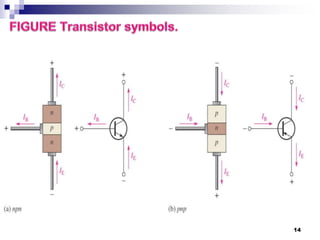
 Circuit Symbols
 Transistor Analogy
3
The three layers of
the sandwich are
conventionally called
the Collector, Base,
and Emitter.
A Bipolar Transistor essentially consists of a pair of PN Junction Diodes that are
joined back-to-back.
This forms a sort of a sandwich where one kind of semiconductor is placed in
between two others.
There are therefore two kinds of Bipolar sandwich, the NPN and PNP varieties.
4
B
C
E
B
C
E
The BJT – Bipolar Junction Transistor
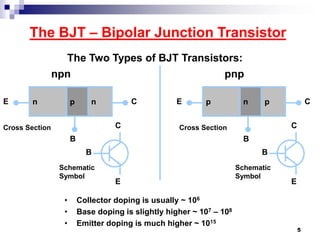
The Two Types of BJT Transistors:
npn pnp
n p nE
B
C p n pE
B
C
Cross Section Cross Section
B
C
E
Schematic
Symbol
B
C
E
Schematic
Symbol
• Collector doping is usually ~ 106
• Base doping is slightly higher ~ 107 – 108
• Emitter doping is much higher ~ 1015
5
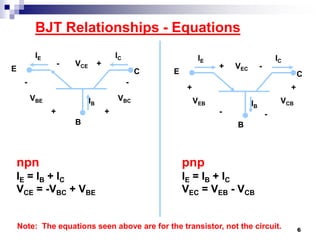
BJT Relationships - Equations
B
CE
IE IC
IB
-
+
VBE VBC
+
-
+- VCE
B
CE
IE IC
IB
-
+
VEB VCB
+
-
+ -VEC
npn
IE = IB + IC
VCE = -VBC + VBE
pnp
IE = IB + IC
VEC = VEB - VCB
Note: The equations seen above are for the transistor, not the circuit. 6
Some of the basic properties exhibited by a
Bipolar Transistor are immediately
recognizable as being diode-like.
However, when the 'filling' of the sandwich is
fairly thin some interesting effects become
possible that allow us to use the Transistor
as an amplifier or a switch.
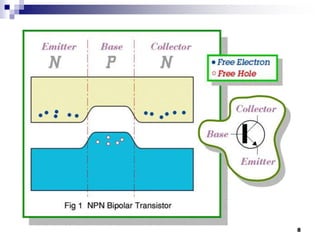
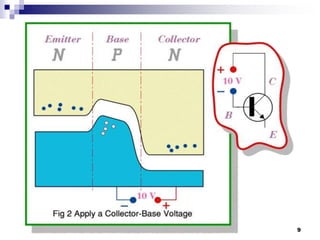
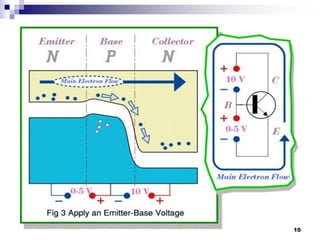
To see how the Bipolar Transistor works we
can concentrate on the NPN variety.
7
8
9
10
What are the primary
uses of transistors?
1. Switching (Logic Gates)
2. Amplification (Op-Amps)
11
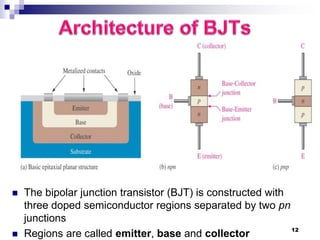
 The bipolar junction transistor (BJT) is constructed with
three doped semiconductor regions separated by two pn
junctions
 Regions are called emitter, base and collector 12
 There are two types of BJTs, the npn and pnp
 The two junctions are termed the base-emitter
junction and the base-collector junction
 The term bipolar refers to the use of both holes and
electrons as charge carriers in the transistor
structure
 In order for the transistor to operate properly, the
two junctions must have the correct dc bias
voltages
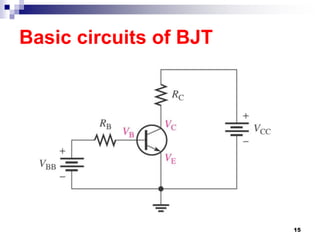
 the base-emitter (BE) junction is forward
biased(>=0.7V for Si, >=0.3V for Ge)
 the base-collector (BC) junction is reverse
biased
13
14
Basic circuits of BJT
15
Operation of BJTs
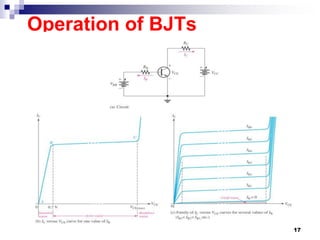
 BJT will operates in one of following
four region
Cutoff region (for digital circuit)
Saturation region (for digital circuit)
Linear (active) region (to be an amplifier)
Breakdown region (always be a disaster)
16
Operation of BJTs
17
DC Analysis of BJTs
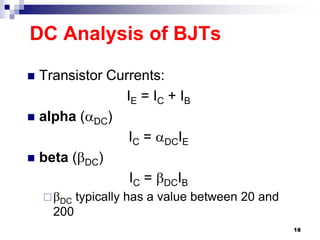
 Transistor Currents:
IE = IC + IB
 alpha (DC)
IC = DCIE
 beta (DC)
IC = DCIB
DC typically has a value between 20 and
200
18
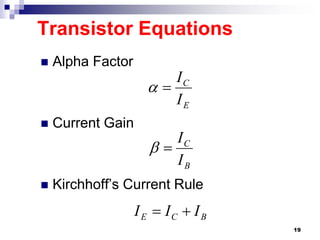
Transistor Equations
 Alpha Factor
 Current Gain
 Kirchhoff’s Current Rule
E
C
I
I

B
C
I
I

BCE III 
19
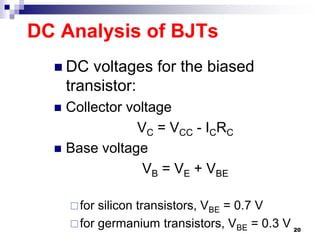
DC Analysis of BJTs
 DC voltages for the biased
transistor:
 Collector voltage
VC = VCC - ICRC
 Base voltage
VB = VE + VBE
for silicon transistors, VBE = 0.7 V
for germanium transistors, VBE = 0.3 V 20
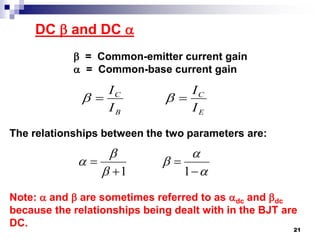
DC  and DC 
 = Common-emitter current gain
 = Common-base current gain
The relationships between the two parameters are:
Note:  and  are sometimes referred to as dc and dc
because the relationships being dealt with in the BJT are
DC.
E
C
B
C
I
I
I
I
 










11
21
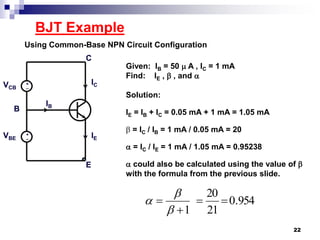
BJT Example
Using Common-Base NPN Circuit Configuration
+
_
+
_
Given: IB = 50  A , IC = 1 mA
Find: IE ,  , and 
Solution:
IE = IB + IC = 0.05 mA + 1 mA = 1.05 mA
 = IC / IB = 1 mA / 0.05 mA = 20
 = IC / IE = 1 mA / 1.05 mA = 0.95238
 could also be calculated using the value of 
with the formula from the previous slide.
IC
IE
IB
VCB
VBE
E
C
B
954.0
21
20
1






22
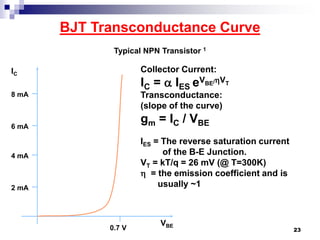
BJT Transconductance Curve
Typical NPN Transistor 1
VBE
IC
2 mA
4 mA
6 mA
8 mA
0.7 V
Collector Current:
IC =  IES eVBE/VT
Transconductance:
(slope of the curve)
gm = IC / VBE
IES = The reverse saturation current
of the B-E Junction.
VT = kT/q = 26 mV (@ T=300K)
 = the emission coefficient and is
usually ~1
23
Modes of Operation
• Most important mode of operation
• Central to amplifier operation
• The region where current curves are practically flat
Active:
Saturation: • Barrier potential of the junctions cancel each other out
causing a virtual short
Cutoff:
• Current reduced to zero
• Ideal transistor behaves like an open switch
* Note: There is also a mode of operation called
inverse active, but it is rarely used.
24
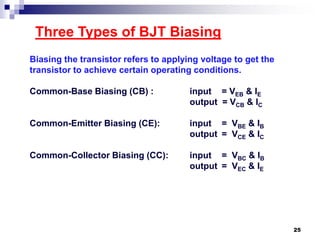
Three Types of BJT Biasing
Biasing the transistor refers to applying voltage to get the
transistor to achieve certain operating conditions.
Common-Base Biasing (CB) : input = VEB & IE
output = VCB & IC
Common-Emitter Biasing (CE): input = VBE & IB
output = VCE & IC
Common-Collector Biasing (CC): input = VBC & IB
output = VEC & IE
25
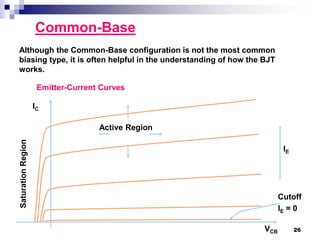
Common-Base
Although the Common-Base configuration is not the most common
biasing type, it is often helpful in the understanding of how the BJT
works.
Emitter-Current Curves
SaturationRegion
IE
IC
VCB
Active Region
Cutoff
IE = 0
26
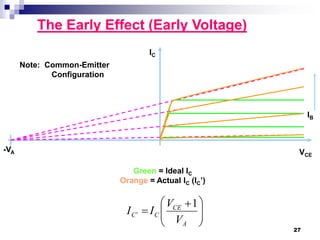
The Early Effect (Early Voltage)
VCE
IC
Note: Common-Emitter
Configuration
-VA
IB
Green = Ideal IC
Orange = Actual IC (IC’)





 

A
CE
CC
V
V
II
1
27
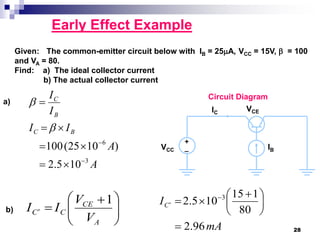
Early Effect Example
Given: The common-emitter circuit below with IB = 25A, VCC = 15V,  = 100
and VA = 80.
Find: a) The ideal collector current
b) The actual collector current
Circuit Diagram
+
_VCC
IC
VCE
IB





 

A
CE
CC
V
V
II
1
mA
IC
96.2
80
115
105.2 3






 
 

A
A
II
I
I
BC
B
C
3
6
105.2
)1025(100







a)
b)
28
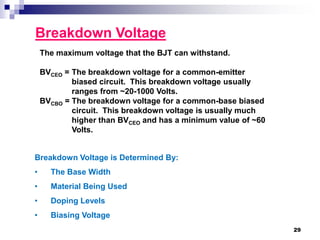
Breakdown Voltage
The maximum voltage that the BJT can withstand.
BVCEO = The breakdown voltage for a common-emitter
biased circuit. This breakdown voltage usually
ranges from ~20-1000 Volts.
BVCBO = The breakdown voltage for a common-base biased
circuit. This breakdown voltage is usually much
higher than BVCEO and has a minimum value of ~60
Volts.
Breakdown Voltage is Determined By:
• The Base Width
• Material Being Used
• Doping Levels
• Biasing Voltage
29
BJT as an amplifier
 Class A Amplifiers
 Class B Amplifiers
30
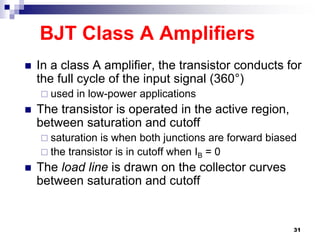
BJT Class A Amplifiers
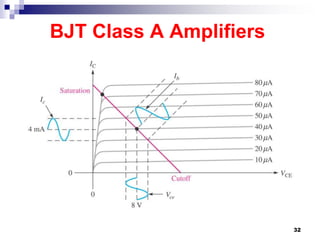
 In a class A amplifier, the transistor conducts for
the full cycle of the input signal (360°)
 used in low-power applications
 The transistor is operated in the active region,
between saturation and cutoff
 saturation is when both junctions are forward biased
 the transistor is in cutoff when IB = 0
 The load line is drawn on the collector curves
between saturation and cutoff
31
BJT Class A Amplifiers
32
BJT Class A Amplifiers
 Three biasing mode for class A amplifiers
common-emitter (CE) amplifier
common-collector (CC) amplifier
common-base (CB) amplifier
33
BJT Class A Amplifiers
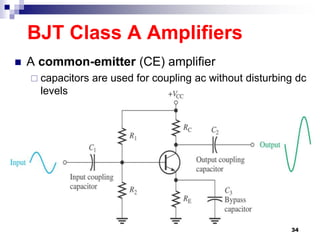
 A common-emitter (CE) amplifier
 capacitors are used for coupling ac without disturbing dc
levels
34
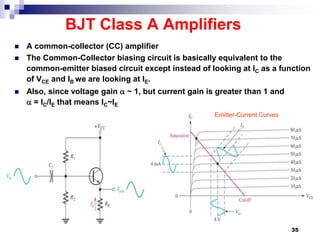
BJT Class A Amplifiers
 A common-collector (CC) amplifier
 The Common-Collector biasing circuit is basically equivalent to the
common-emitter biased circuit except instead of looking at IC as a function
of VCE and IB we are looking at IE.
 Also, since voltage gain  ~ 1, but current gain is greater than 1 and
 = IC/IE that means IC~IE
35
Emitter-Current Curves
BJT Class A Amplifiers
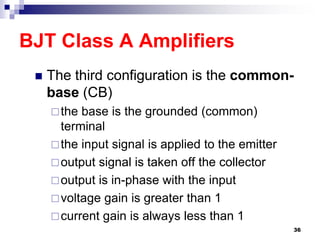
 The third configuration is the common-
base (CB)
the base is the grounded (common)
terminal
the input signal is applied to the emitter
output signal is taken off the collector
output is in-phase with the input
voltage gain is greater than 1
current gain is always less than 1
36
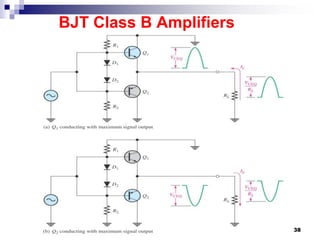
BJT Class B Amplifiers
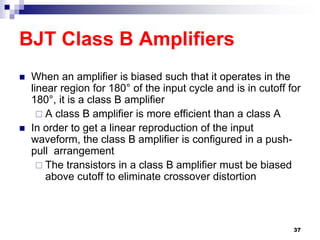
 When an amplifier is biased such that it operates in the
linear region for 180° of the input cycle and is in cutoff for
180°, it is a class B amplifier
 A class B amplifier is more efficient than a class A
 In order to get a linear reproduction of the input
waveform, the class B amplifier is configured in a push-
pull arrangement
 The transistors in a class B amplifier must be biased
above cutoff to eliminate crossover distortion
37
BJT Class B Amplifiers
38
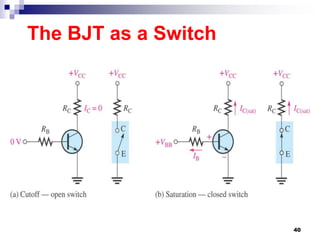
The BJT as a Switch
 When used as an electronic switch, a transistor
normally is operated alternately in cutoff and
saturation
 A transistor is in cutoff when the base-emitter junction
is not forward-biased. VCE is approximately equal to
VCC
 When the base-emitter junction is forward-biased and
there is enough base current to produce a maximum
collector current, the transistor is saturated
39
The BJT as a Switch
40

Phy 4240 lec (9) and (10)

  • 1.
    Lecture (9, 10) Transistors andtransistor circuits 1
  • 2.
    Introduction  Transistors arethree terminal devices that replaced vacuum tubes.  They are solid state devices that are used for…  Amplification  Switching  Detecting Light  The three terminals are the…  Emitter, Base, Collector (BJT)  Source, Gate, Drain (FET) 2
  • 3.
    The BJT  BipolarJunction Transistors are made with n-type and p-type semiconductors.  There are two types: npn and pnp.  Circuit Symbols  Transistor Analogy 3
  • 4.
    The three layersof the sandwich are conventionally called the Collector, Base, and Emitter. A Bipolar Transistor essentially consists of a pair of PN Junction Diodes that are joined back-to-back. This forms a sort of a sandwich where one kind of semiconductor is placed in between two others. There are therefore two kinds of Bipolar sandwich, the NPN and PNP varieties. 4 B C E B C E
  • 5.
    The BJT –Bipolar Junction Transistor The Two Types of BJT Transistors: npn pnp n p nE B C p n pE B C Cross Section Cross Section B C E Schematic Symbol B C E Schematic Symbol • Collector doping is usually ~ 106 • Base doping is slightly higher ~ 107 – 108 • Emitter doping is much higher ~ 1015 5
  • 6.
    BJT Relationships -Equations B CE IE IC IB - + VBE VBC + - +- VCE B CE IE IC IB - + VEB VCB + - + -VEC npn IE = IB + IC VCE = -VBC + VBE pnp IE = IB + IC VEC = VEB - VCB Note: The equations seen above are for the transistor, not the circuit. 6
  • 7.
    Some of thebasic properties exhibited by a Bipolar Transistor are immediately recognizable as being diode-like. However, when the 'filling' of the sandwich is fairly thin some interesting effects become possible that allow us to use the Transistor as an amplifier or a switch. To see how the Bipolar Transistor works we can concentrate on the NPN variety. 7
  • 8.
  • 9.
  • 10.
  • 11.
    What are theprimary uses of transistors? 1. Switching (Logic Gates) 2. Amplification (Op-Amps) 11
  • 12.
     The bipolarjunction transistor (BJT) is constructed with three doped semiconductor regions separated by two pn junctions  Regions are called emitter, base and collector 12
  • 13.
     There aretwo types of BJTs, the npn and pnp  The two junctions are termed the base-emitter junction and the base-collector junction  The term bipolar refers to the use of both holes and electrons as charge carriers in the transistor structure  In order for the transistor to operate properly, the two junctions must have the correct dc bias voltages  the base-emitter (BE) junction is forward biased(>=0.7V for Si, >=0.3V for Ge)  the base-collector (BC) junction is reverse biased 13
  • 14.
  • 15.
  • 16.
    Operation of BJTs BJT will operates in one of following four region Cutoff region (for digital circuit) Saturation region (for digital circuit) Linear (active) region (to be an amplifier) Breakdown region (always be a disaster) 16
  • 17.
  • 18.
    DC Analysis ofBJTs  Transistor Currents: IE = IC + IB  alpha (DC) IC = DCIE  beta (DC) IC = DCIB DC typically has a value between 20 and 200 18
  • 19.
    Transistor Equations  AlphaFactor  Current Gain  Kirchhoff’s Current Rule E C I I  B C I I  BCE III  19
  • 20.
    DC Analysis ofBJTs  DC voltages for the biased transistor:  Collector voltage VC = VCC - ICRC  Base voltage VB = VE + VBE for silicon transistors, VBE = 0.7 V for germanium transistors, VBE = 0.3 V 20
  • 21.
    DC  andDC   = Common-emitter current gain  = Common-base current gain The relationships between the two parameters are: Note:  and  are sometimes referred to as dc and dc because the relationships being dealt with in the BJT are DC. E C B C I I I I             11 21
  • 22.
    BJT Example Using Common-BaseNPN Circuit Configuration + _ + _ Given: IB = 50  A , IC = 1 mA Find: IE ,  , and  Solution: IE = IB + IC = 0.05 mA + 1 mA = 1.05 mA  = IC / IB = 1 mA / 0.05 mA = 20  = IC / IE = 1 mA / 1.05 mA = 0.95238  could also be calculated using the value of  with the formula from the previous slide. IC IE IB VCB VBE E C B 954.0 21 20 1       22
  • 23.
    BJT Transconductance Curve TypicalNPN Transistor 1 VBE IC 2 mA 4 mA 6 mA 8 mA 0.7 V Collector Current: IC =  IES eVBE/VT Transconductance: (slope of the curve) gm = IC / VBE IES = The reverse saturation current of the B-E Junction. VT = kT/q = 26 mV (@ T=300K)  = the emission coefficient and is usually ~1 23
  • 24.
    Modes of Operation •Most important mode of operation • Central to amplifier operation • The region where current curves are practically flat Active: Saturation: • Barrier potential of the junctions cancel each other out causing a virtual short Cutoff: • Current reduced to zero • Ideal transistor behaves like an open switch * Note: There is also a mode of operation called inverse active, but it is rarely used. 24
  • 25.
    Three Types ofBJT Biasing Biasing the transistor refers to applying voltage to get the transistor to achieve certain operating conditions. Common-Base Biasing (CB) : input = VEB & IE output = VCB & IC Common-Emitter Biasing (CE): input = VBE & IB output = VCE & IC Common-Collector Biasing (CC): input = VBC & IB output = VEC & IE 25
  • 26.
    Common-Base Although the Common-Baseconfiguration is not the most common biasing type, it is often helpful in the understanding of how the BJT works. Emitter-Current Curves SaturationRegion IE IC VCB Active Region Cutoff IE = 0 26
  • 27.
    The Early Effect(Early Voltage) VCE IC Note: Common-Emitter Configuration -VA IB Green = Ideal IC Orange = Actual IC (IC’)         A CE CC V V II 1 27
  • 28.
    Early Effect Example Given:The common-emitter circuit below with IB = 25A, VCC = 15V,  = 100 and VA = 80. Find: a) The ideal collector current b) The actual collector current Circuit Diagram + _VCC IC VCE IB         A CE CC V V II 1 mA IC 96.2 80 115 105.2 3            A A II I I BC B C 3 6 105.2 )1025(100        a) b) 28
  • 29.
    Breakdown Voltage The maximumvoltage that the BJT can withstand. BVCEO = The breakdown voltage for a common-emitter biased circuit. This breakdown voltage usually ranges from ~20-1000 Volts. BVCBO = The breakdown voltage for a common-base biased circuit. This breakdown voltage is usually much higher than BVCEO and has a minimum value of ~60 Volts. Breakdown Voltage is Determined By: • The Base Width • Material Being Used • Doping Levels • Biasing Voltage 29
  • 30.
    BJT as anamplifier  Class A Amplifiers  Class B Amplifiers 30
  • 31.
    BJT Class AAmplifiers  In a class A amplifier, the transistor conducts for the full cycle of the input signal (360°)  used in low-power applications  The transistor is operated in the active region, between saturation and cutoff  saturation is when both junctions are forward biased  the transistor is in cutoff when IB = 0  The load line is drawn on the collector curves between saturation and cutoff 31
  • 32.
    BJT Class AAmplifiers 32
  • 33.
    BJT Class AAmplifiers  Three biasing mode for class A amplifiers common-emitter (CE) amplifier common-collector (CC) amplifier common-base (CB) amplifier 33
  • 34.
    BJT Class AAmplifiers  A common-emitter (CE) amplifier  capacitors are used for coupling ac without disturbing dc levels 34
  • 35.
    BJT Class AAmplifiers  A common-collector (CC) amplifier  The Common-Collector biasing circuit is basically equivalent to the common-emitter biased circuit except instead of looking at IC as a function of VCE and IB we are looking at IE.  Also, since voltage gain  ~ 1, but current gain is greater than 1 and  = IC/IE that means IC~IE 35 Emitter-Current Curves
  • 36.
    BJT Class AAmplifiers  The third configuration is the common- base (CB) the base is the grounded (common) terminal the input signal is applied to the emitter output signal is taken off the collector output is in-phase with the input voltage gain is greater than 1 current gain is always less than 1 36
  • 37.
    BJT Class BAmplifiers  When an amplifier is biased such that it operates in the linear region for 180° of the input cycle and is in cutoff for 180°, it is a class B amplifier  A class B amplifier is more efficient than a class A  In order to get a linear reproduction of the input waveform, the class B amplifier is configured in a push- pull arrangement  The transistors in a class B amplifier must be biased above cutoff to eliminate crossover distortion 37
  • 38.
    BJT Class BAmplifiers 38
  • 39.
    The BJT asa Switch  When used as an electronic switch, a transistor normally is operated alternately in cutoff and saturation  A transistor is in cutoff when the base-emitter junction is not forward-biased. VCE is approximately equal to VCC  When the base-emitter junction is forward-biased and there is enough base current to produce a maximum collector current, the transistor is saturated 39
  • 40.
    The BJT asa Switch 40