Analog & Digital Electronics
Course No: PH-218
BJT
Lec-7: Biasing schemes and stability of BJT
Course Instructors:
Dr. A. P. VAJPEYI
Department of Physics,
Indian Institute of Technology Guwahati, India 1
Biasing of BJT
Biasing refers to the application of D.C. voltages to setup the operating
point in such a way that output signal is undistorted throughout the whole
operation.
Also once selected properly, the Q point should not shift because of
change of IC due to
(i) β variation due to replacement of the transistor of same type
(ii) Temperature variation
2
Stabilization
The process of making operating point independent of temperature
changes or variation in transistor parameters is known as stabilization.
Stabilization of operating point is necessary due to
Temperature dependence of IC
Individual variations
Thermal runaway
Stabilization
Temperature dependence of IC & Thermal runaway
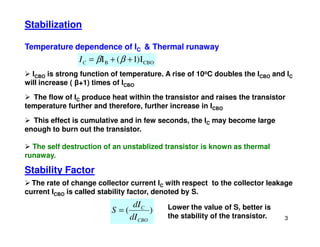
CBOB I)1(I ++= ββCI
ICBO is strong function of temperature. A rise of 10oC doubles the ICBO and IC
will increase ( β+1) times of ICBO
The flow of IC produce heat within the transistor and raises the transistor
temperature further and therefore, further increase in ICBO
This effect is cumulative and in few seconds, the IC may become large
3
This effect is cumulative and in few seconds, the IC may become large
enough to burn out the transistor.
The self destruction of an unstablized transistor is known as thermal
runaway.
Stability Factor
The rate of change collector current IC with respect to the collector leakage
current ICBO is called stability factor, denoted by S.
)(
CBO
C
dI
dI
S = Lower the value of S, better is
the stability of the transistor.
Stability Factor
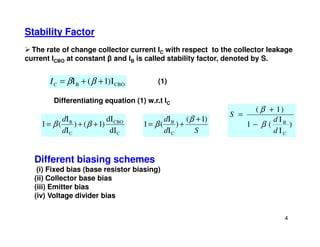
The rate of change collector current IC with respect to the collector leakage
current ICBO at constant β and IB is called stability factor, denoted by S.
CBOB I)1(I ++= ββCI (1)
Differentiating equation (1) w.r.t IC
CBOB dI
)1()
I
(1 ++= ββ
d d )1(
)
I
(1 B +
+=
β
β )
I
(1
)1(
Bd
S
β
β
−
+
=
4
C
CBO
C
B
dI
)1()
I
(1 ++= ββ
d Sd
)
I
(1
C
B
+= β )
I
I
(1
C
B
d
d
β−
Different biasing schemes
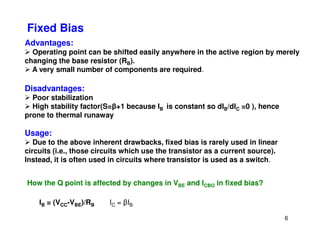
(i) Fixed bias (base resistor biasing)
(ii) Collector base bias
(iii) Emitter bias
(iv) Voltage divider bias
Fixed Bias
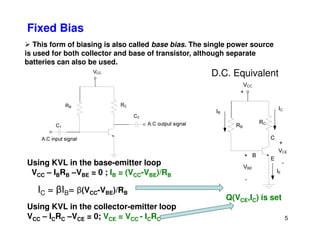
D.C. Equivalent
This form of biasing is also called base bias. The single power source
is used for both collector and base of transistor, although separate
batteries can also be used.
5
Using KVL in the base-emitter loop
VCC – IBRB –VBE = 0 ; IB = (VCC-VBE)/RB
IC = βIB= β(VCC-VBE)/RB
Using KVL in the collector-emitter loop
VCC – ICRC –VCE = 0; VCE = VCC - ICRC
Q(VCE,IC) is set
Advantages:
Operating point can be shifted easily anywhere in the active region by merely
changing the base resistor (RB).
A very small number of components are required.
Disadvantages:
Poor stabilization
High stability factor(S=β+1 because IB is constant so dIB/dIC =0 ), hence
prone to thermal runaway
Fixed Bias
6
Usage:
Due to the above inherent drawbacks, fixed bias is rarely used in linear
circuits (i.e., those circuits which use the transistor as a current source).
Instead, it is often used in circuits where transistor is used as a switch.
How the Q point is affected by changes in VBE and ICBO in fixed bias?
IB = (VCC-VBE)/RB IC = βIB
Collector base bias
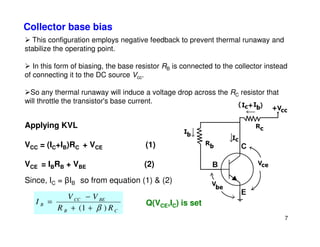
This configuration employs negative feedback to prevent thermal runaway and
stabilize the operating point.
In this form of biasing, the base resistor RB is connected to the collector instead
of connecting it to the DC source Vcc.
So any thermal runaway will induce a voltage drop across the RC resistor that
will throttle the transistor's base current.
Applying KVL
7
Applying KVL
VCC = (IC+IB)RC + VCE (1)
VCE = IBRB + VBE (2)
Since, IC = βIB so from equation (1) & (2)
CB
BECC
B
RR
VV
I
)1( β++
−
= Q(VCE,IC) is set
Collector base bias
Advantages:
Better stabilization compared to fixed bias
Disadvantages:
This circuit provides negative feedback which reduces the gain of the amplifier.
Usage:
The feedback also decreases the input impedance of the amplifier as seen from
the base, which can be advantageous. Due to the gain reduction from feedback, this
biasing form is used only when the trade-off for stability is warranted.
8
How the bias stability is improved in collector base bias?
If IC becomes larger than design value, it causes an increase voltage drop
across RC hence smaller value of VCE which in turn causes IB to be smaller than
its design value. Since IC = βIB thus IC will also tend to be reduced towards its
original value.
biasing form is used only when the trade-off for stability is warranted.
]
)1(
[
CB
BECC
C
RR
VV
I
β
β
++
−
=
C
BECC
C
R
VV
I
−
=If RB<< βRC
For bais Stabilization : RB<< βRC
Voltage Divider Bias
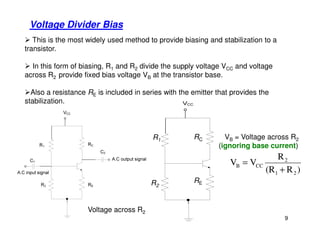
This is the most widely used method to provide biasing and stabilization to a
transistor.
In this form of biasing, R1 and R2 divide the supply voltage VCC and voltage
across R2 provide fixed bias voltage VB at the transistor base.
Also a resistance RE is included in series with the emitter that provides the
stabilization.
9
)R(R
R
VV
21
2
CCB
+
=
VB = Voltage across R2
(ignoring base current)
Voltage across R2
RE
RCR1
R2
)R(R
R
VVV
21
2
CCThB
+
==
Voltage Divider Bias
)R(R
RR
RRR
21
21
21Th
+
==
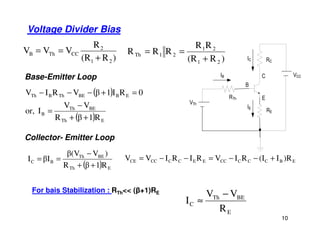
Base-Emitter Loop
( )
( ) ETh
BETh
B
EBBEThBTh
R1βR
VV
Ior,
0RI1βVRIV
++
−
=
=+−−−
10
Collector- Emitter Loop
( ) ETh
BETh
BC
R1βR
)Vβ(V
βII
++
−
== EBCCCCCEECCCCCE )RI(IRIVRIRIVV +−−=−−=
For bais Stabilization : RTh<< (β+1)RE
E
BETh
C
R
VV
I
−
≈
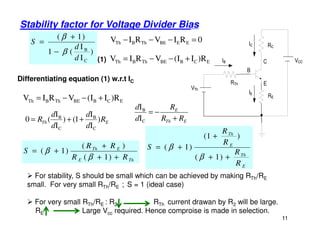
Stability factor for Voltage Divider Bias
0RIVRIV EEBEThBTh =−−−
ECBBEThBTh )RII(VRIV +−−=
Differentiating equation (1) w.r.t IC
(1)
ECBBEThBTh )RII(VRIV +−−=
ETh R
d
d
d
d
R )
I
I
1()
I
I
(0 BB
++=
)
I
I
(1
)1(
C
B
d
d
S
β
β
−
+
=
ETh
E
RR
R
d
d
+
−=
C
B
I
I
11
ETh R
dd
R )
I
1()
I
(0
CC
EThC
ThE
ETh
RR
RR
S
++
+
+=
)1(
)(
)1(
β
β
E
Th
E
Th
R
R
R
R
S
++
+
+=
)1(
)1(
)1(
β
β
For stability, S should be small which can be achieved by making RTh/RE
small. For very small RTh/RE ; S = 1 (ideal case)
For very small RTh/RE : R2 RTh current drawan by R2 will be large.
RE Large Vcc required. Hence comproise is made in selection.
12

Analog & Digital Electronics

  • 1.
    Analog & DigitalElectronics Course No: PH-218 BJT Lec-7: Biasing schemes and stability of BJT Course Instructors: Dr. A. P. VAJPEYI Department of Physics, Indian Institute of Technology Guwahati, India 1
  • 2.
    Biasing of BJT Biasingrefers to the application of D.C. voltages to setup the operating point in such a way that output signal is undistorted throughout the whole operation. Also once selected properly, the Q point should not shift because of change of IC due to (i) β variation due to replacement of the transistor of same type (ii) Temperature variation 2 Stabilization The process of making operating point independent of temperature changes or variation in transistor parameters is known as stabilization. Stabilization of operating point is necessary due to Temperature dependence of IC Individual variations Thermal runaway
  • 3.
    Stabilization Temperature dependence ofIC & Thermal runaway CBOB I)1(I ++= ββCI ICBO is strong function of temperature. A rise of 10oC doubles the ICBO and IC will increase ( β+1) times of ICBO The flow of IC produce heat within the transistor and raises the transistor temperature further and therefore, further increase in ICBO This effect is cumulative and in few seconds, the IC may become large 3 This effect is cumulative and in few seconds, the IC may become large enough to burn out the transistor. The self destruction of an unstablized transistor is known as thermal runaway. Stability Factor The rate of change collector current IC with respect to the collector leakage current ICBO is called stability factor, denoted by S. )( CBO C dI dI S = Lower the value of S, better is the stability of the transistor.
  • 4.
    Stability Factor The rateof change collector current IC with respect to the collector leakage current ICBO at constant β and IB is called stability factor, denoted by S. CBOB I)1(I ++= ββCI (1) Differentiating equation (1) w.r.t IC CBOB dI )1() I (1 ++= ββ d d )1( ) I (1 B + += β β ) I (1 )1( Bd S β β − + = 4 C CBO C B dI )1() I (1 ++= ββ d Sd ) I (1 C B += β ) I I (1 C B d d β− Different biasing schemes (i) Fixed bias (base resistor biasing) (ii) Collector base bias (iii) Emitter bias (iv) Voltage divider bias
  • 5.
    Fixed Bias D.C. Equivalent Thisform of biasing is also called base bias. The single power source is used for both collector and base of transistor, although separate batteries can also be used. 5 Using KVL in the base-emitter loop VCC – IBRB –VBE = 0 ; IB = (VCC-VBE)/RB IC = βIB= β(VCC-VBE)/RB Using KVL in the collector-emitter loop VCC – ICRC –VCE = 0; VCE = VCC - ICRC Q(VCE,IC) is set
  • 6.
    Advantages: Operating point canbe shifted easily anywhere in the active region by merely changing the base resistor (RB). A very small number of components are required. Disadvantages: Poor stabilization High stability factor(S=β+1 because IB is constant so dIB/dIC =0 ), hence prone to thermal runaway Fixed Bias 6 Usage: Due to the above inherent drawbacks, fixed bias is rarely used in linear circuits (i.e., those circuits which use the transistor as a current source). Instead, it is often used in circuits where transistor is used as a switch. How the Q point is affected by changes in VBE and ICBO in fixed bias? IB = (VCC-VBE)/RB IC = βIB
  • 7.
    Collector base bias Thisconfiguration employs negative feedback to prevent thermal runaway and stabilize the operating point. In this form of biasing, the base resistor RB is connected to the collector instead of connecting it to the DC source Vcc. So any thermal runaway will induce a voltage drop across the RC resistor that will throttle the transistor's base current. Applying KVL 7 Applying KVL VCC = (IC+IB)RC + VCE (1) VCE = IBRB + VBE (2) Since, IC = βIB so from equation (1) & (2) CB BECC B RR VV I )1( β++ − = Q(VCE,IC) is set
  • 8.
    Collector base bias Advantages: Betterstabilization compared to fixed bias Disadvantages: This circuit provides negative feedback which reduces the gain of the amplifier. Usage: The feedback also decreases the input impedance of the amplifier as seen from the base, which can be advantageous. Due to the gain reduction from feedback, this biasing form is used only when the trade-off for stability is warranted. 8 How the bias stability is improved in collector base bias? If IC becomes larger than design value, it causes an increase voltage drop across RC hence smaller value of VCE which in turn causes IB to be smaller than its design value. Since IC = βIB thus IC will also tend to be reduced towards its original value. biasing form is used only when the trade-off for stability is warranted. ] )1( [ CB BECC C RR VV I β β ++ − = C BECC C R VV I − =If RB<< βRC For bais Stabilization : RB<< βRC
  • 9.
    Voltage Divider Bias Thisis the most widely used method to provide biasing and stabilization to a transistor. In this form of biasing, R1 and R2 divide the supply voltage VCC and voltage across R2 provide fixed bias voltage VB at the transistor base. Also a resistance RE is included in series with the emitter that provides the stabilization. 9 )R(R R VV 21 2 CCB + = VB = Voltage across R2 (ignoring base current) Voltage across R2 RE RCR1 R2
  • 10.
    )R(R R VVV 21 2 CCThB + == Voltage Divider Bias )R(R RR RRR 21 21 21Th + == Base-EmitterLoop ( ) ( ) ETh BETh B EBBEThBTh R1βR VV Ior, 0RI1βVRIV ++ − = =+−−− 10 Collector- Emitter Loop ( ) ETh BETh BC R1βR )Vβ(V βII ++ − == EBCCCCCEECCCCCE )RI(IRIVRIRIVV +−−=−−= For bais Stabilization : RTh<< (β+1)RE E BETh C R VV I − ≈
  • 11.
    Stability factor forVoltage Divider Bias 0RIVRIV EEBEThBTh =−−− ECBBEThBTh )RII(VRIV +−−= Differentiating equation (1) w.r.t IC (1) ECBBEThBTh )RII(VRIV +−−= ETh R d d d d R ) I I 1() I I (0 BB ++= ) I I (1 )1( C B d d S β β − + = ETh E RR R d d + −= C B I I 11 ETh R dd R ) I 1() I (0 CC EThC ThE ETh RR RR S ++ + += )1( )( )1( β β E Th E Th R R R R S ++ + += )1( )1( )1( β β For stability, S should be small which can be achieved by making RTh/RE small. For very small RTh/RE ; S = 1 (ideal case) For very small RTh/RE : R2 RTh current drawan by R2 will be large. RE Large Vcc required. Hence comproise is made in selection.
  • 12.