Access this lab-manual at:
http://www.docircuits.com/lab-manual/15/jfet-common-drain-characteristics
JFET Common Drain Characteristics
Aim
Aim is to connect a JFET in the common-drain
configuration and plot its characteristics

Related Experiments
JFET

JFET BASICS

COMMON DRAIN CHARACTERISTICS

Description
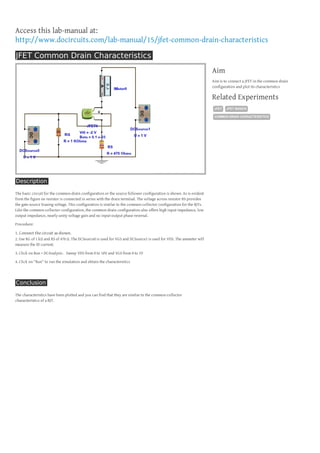
The basic circuit for the common-drain configuration or the source follower configuration is shown. As is evident
from the figure no resistor is connected in series with the drain terminal. The voltage across resistor RS provides
the gate-source biasing voltage. This configuration is similar to the common-collector configuration for the BJTs.
Like the common-collector configuration, the common-drain configuration also offers high input impedance, low
output impedance, nearly unity voltage gain and no input-output phase reversal.
Procedure:

1. Connect the circuit as shown.
2. Use RG of 1 kΩ and RS of 470 Ω. The DCSource0 is used for VGS and DCSource1 is used for VDS. The ammeter will
measure the ID current.
3. Click on Run > DCAnalysis . Sweep VDS from 0 to 10V and VGS from 0 to 2V
4. Click on “Run” to run the simulation and obtain the charactersitics

Conclusion
The characteristics have been plotted and you can find that they are similar to the common-collector
characteristics of a BJT.

JFET common drain characteristics

  • 1.
    Access this lab-manualat: http://www.docircuits.com/lab-manual/15/jfet-common-drain-characteristics JFET Common Drain Characteristics Aim Aim is to connect a JFET in the common-drain configuration and plot its characteristics Related Experiments JFET JFET BASICS COMMON DRAIN CHARACTERISTICS Description The basic circuit for the common-drain configuration or the source follower configuration is shown. As is evident from the figure no resistor is connected in series with the drain terminal. The voltage across resistor RS provides the gate-source biasing voltage. This configuration is similar to the common-collector configuration for the BJTs. Like the common-collector configuration, the common-drain configuration also offers high input impedance, low output impedance, nearly unity voltage gain and no input-output phase reversal. Procedure: 1. Connect the circuit as shown. 2. Use RG of 1 kΩ and RS of 470 Ω. The DCSource0 is used for VGS and DCSource1 is used for VDS. The ammeter will measure the ID current. 3. Click on Run > DCAnalysis . Sweep VDS from 0 to 10V and VGS from 0 to 2V 4. Click on “Run” to run the simulation and obtain the charactersitics Conclusion The characteristics have been plotted and you can find that they are similar to the common-collector characteristics of a BJT.