Zener Diode
And
As Voltage Regulator
BY: Adeel Rasheed
Introduction
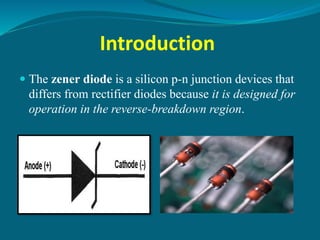
 The zener diode is a silicon p-n junction devices that
differs from rectifier diodes because it is designed for
operation in the reverse-breakdown region.
Circuit of Zener
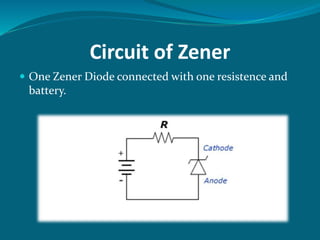
 One Zener Diode connected with one resistence and
battery.
Characteristics
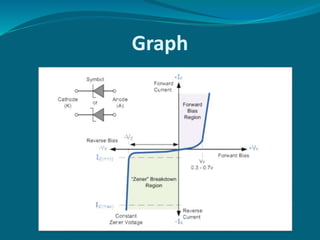
 A Zener diode is always reverse connected
 When forward biased, its characteristics are just like of
ordinary diode
 It has sharp breakdown voltage, called Zener voltage
Graph
Principle of Zener Diode
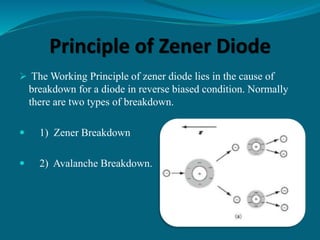
 The Working Principle of zener diode lies in the cause of
breakdown for a diode in reverse biased condition. Normally
there are two types of breakdown.
 1) Zener Breakdown
 2) Avalanche Breakdown.
Zener Breakdown
 This type of breakdown occurs for a reverse bias voltage between 2 to
8V.
 Even at low voltage, the electric field intensity is strong enough to exert
a force.
 The valence electrons of the atom such that they are separated from the
nuclei.
 This type of break down occurs normally for highly doped diode with
low breakdown voltage and larger electric field.
 As temperature increases, the valence electrons gain more energy to
disrupt from the covalent bond and the less amount of external voltage
is required.
 Thus zener breakdown voltage decreases with temperature.
Avalanche Breakdown
 This type of breakdown occurs at the reverse bias voltage
above 8V and higher.
 It occurs for lightly doped diode with large breakdown voltage.
 As minority charge carriers (electrons) flow across the device.
 They tend to collide with the electrons in the covalent bond and
cause the covalent bond to disrupt.
Avalanche Breakdown
 As voltage increases, the kinetic energy (velocity) of the
electrons also increases.
 The covalent bonds are more easily disrupted, causing an
increase in electron hole pairs.
 The avalanche breakdown voltage increases with temperature.
As Voltage Regulator
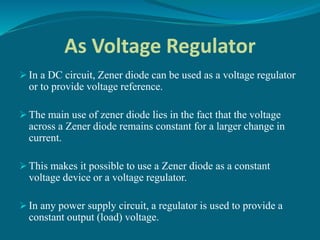
 In a DC circuit, Zener diode can be used as a voltage regulator
or to provide voltage reference.
 The main use of zener diode lies in the fact that the voltage
across a Zener diode remains constant for a larger change in
current.
 This makes it possible to use a Zener diode as a constant
voltage device or a voltage regulator.
 In any power supply circuit, a regulator is used to provide a
constant output (load) voltage.
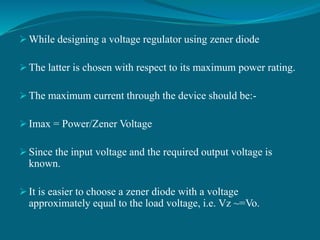
 While designing a voltage regulator using zener diode
 The latter is chosen with respect to its maximum power rating.
 The maximum current through the device should be:-
 Imax = Power/Zener Voltage
 Since the input voltage and the required output voltage is
known.
 It is easier to choose a zener diode with a voltage
approximately equal to the load voltage, i.e. Vz ~=Vo.
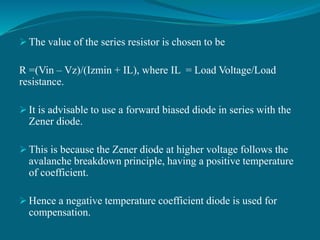
 The value of the series resistor is chosen to be
R =(Vin – Vz)/(Izmin + IL), where IL = Load Voltage/Load
resistance.
 It is advisable to use a forward biased diode in series with the
Zener diode.
 This is because the Zener diode at higher voltage follows the
avalanche breakdown principle, having a positive temperature
of coefficient.
 Hence a negative temperature coefficient diode is used for
compensation.
Zener Diode-As Voltage Regulator

Zener Diode-As Voltage Regulator

  • 1.
  • 2.
  • 3.
    Introduction  The zenerdiode is a silicon p-n junction devices that differs from rectifier diodes because it is designed for operation in the reverse-breakdown region.
  • 4.
    Circuit of Zener One Zener Diode connected with one resistence and battery.
  • 5.
    Characteristics  A Zenerdiode is always reverse connected  When forward biased, its characteristics are just like of ordinary diode  It has sharp breakdown voltage, called Zener voltage
  • 6.
  • 7.
    Principle of ZenerDiode  The Working Principle of zener diode lies in the cause of breakdown for a diode in reverse biased condition. Normally there are two types of breakdown.  1) Zener Breakdown  2) Avalanche Breakdown.
  • 8.
    Zener Breakdown  Thistype of breakdown occurs for a reverse bias voltage between 2 to 8V.  Even at low voltage, the electric field intensity is strong enough to exert a force.  The valence electrons of the atom such that they are separated from the nuclei.  This type of break down occurs normally for highly doped diode with low breakdown voltage and larger electric field.  As temperature increases, the valence electrons gain more energy to disrupt from the covalent bond and the less amount of external voltage is required.  Thus zener breakdown voltage decreases with temperature.
  • 9.
    Avalanche Breakdown  Thistype of breakdown occurs at the reverse bias voltage above 8V and higher.  It occurs for lightly doped diode with large breakdown voltage.  As minority charge carriers (electrons) flow across the device.  They tend to collide with the electrons in the covalent bond and cause the covalent bond to disrupt.
  • 10.
    Avalanche Breakdown  Asvoltage increases, the kinetic energy (velocity) of the electrons also increases.  The covalent bonds are more easily disrupted, causing an increase in electron hole pairs.  The avalanche breakdown voltage increases with temperature.
  • 11.
  • 12.
    As Voltage Regulator In a DC circuit, Zener diode can be used as a voltage regulator or to provide voltage reference.  The main use of zener diode lies in the fact that the voltage across a Zener diode remains constant for a larger change in current.  This makes it possible to use a Zener diode as a constant voltage device or a voltage regulator.  In any power supply circuit, a regulator is used to provide a constant output (load) voltage.
  • 13.
     While designinga voltage regulator using zener diode  The latter is chosen with respect to its maximum power rating.  The maximum current through the device should be:-  Imax = Power/Zener Voltage  Since the input voltage and the required output voltage is known.  It is easier to choose a zener diode with a voltage approximately equal to the load voltage, i.e. Vz ~=Vo.
  • 14.
     The valueof the series resistor is chosen to be R =(Vin – Vz)/(Izmin + IL), where IL = Load Voltage/Load resistance.  It is advisable to use a forward biased diode in series with the Zener diode.  This is because the Zener diode at higher voltage follows the avalanche breakdown principle, having a positive temperature of coefficient.  Hence a negative temperature coefficient diode is used for compensation.