Diode
Engr. Maria Romina P. Angustia
-Professor-
Once you graduate from the
simple, passive components that
are resistors, capacitors and
inductors, it’s time to step on up to
the wonderful world of
semiconductors. One of the most
widely used semiconductor
components is the diode.
Diode
A diode is a specialized electronic component
with two electrodes called the anode and the
cathode. Most diodes are made with
semiconductor materials such as silicon,
germanium, or selenium.
The key function of a diode is to control
the direction of current-flow.
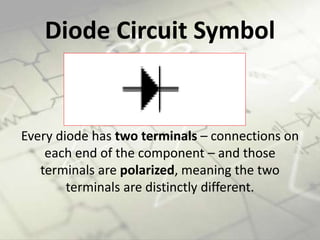
Diode Circuit Symbol
Every diode has two terminals – connections on
each end of the component – and those
terminals are polarized, meaning the two
terminals are distinctly different.
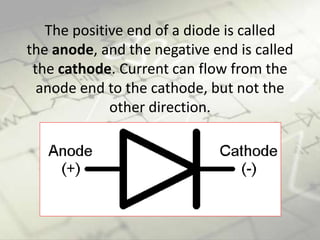
The positive end of a diode is called
the anode, and the negative end is called
the cathode. Current can flow from the
anode end to the cathode, but not the
other direction.
Current passing through a diode can only go in
one direction, called the forward direction.
Current trying to flow the reverse direction is
blocked. They’re like the one-way valve of
electronics.
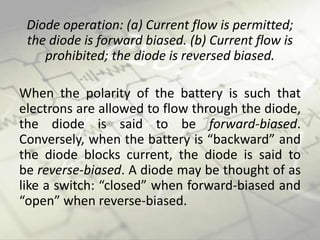
Diode operation: (a) Current flow is permitted;
the diode is forward biased. (b) Current flow is
prohibited; the diode is reversed biased.
When the polarity of the battery is such that
electrons are allowed to flow through the diode,
the diode is said to be forward-biased.
Conversely, when the battery is “backward” and
the diode blocks current, the diode is said to
be reverse-biased. A diode may be thought of as
like a switch: “closed” when forward-biased and
“open” when reverse-biased.
Oddly enough, the direction of the diode
symbol’s “arrowhead” points against the
direction of electron flow. This is because the
diode symbol was invented by engineers, who
predominantly use conventional flow notation in
their schematics, showing current as a flow of
charge from the positive (+) side of the voltage
source to the negative (-). This convention holds
true for all semiconductor symbols possessing
“arrowheads:” the arrow points in the permitted
direction of conventional flow, and against the
permitted direction of electron flow.
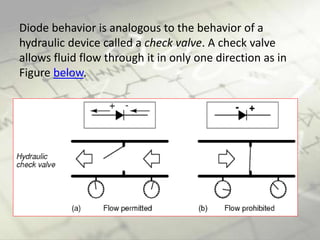
Diode behavior is analogous to the behavior of a
hydraulic device called a check valve. A check valve
allows fluid flow through it in only one direction as in
Figure below.
• If a reverse-biasing voltage is applied
across the P-N junction, this depletion
region expands, further resisting any
current through it. (Figure below)
Depletion region expands with reverse bias.
• Conversely, if a forward-biasing voltage is
applied across the P-N junction, the depletion
region collapses becoming thinner. The diode
becomes less resistive to current through it.
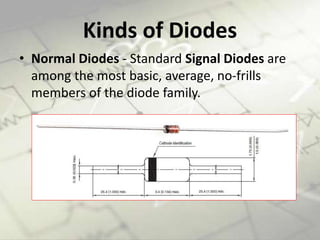
Kinds of Diodes
• Normal Diodes - Standard Signal Diodes are
among the most basic, average, no-frills
members of the diode family.
• A rectifier or power diode is a standard diode
with a much higher maximum current rating.
• Light-Emitting Diodes (LEDs) - The flashiest
member of the diode family must be the light
emitting diode (LED). These diodes quite
literally light up when a positive voltage is
applied.
• Schottky Diodes -
Schottky diodes are
especially useful in
limiting losses
• Zener Diodes - are the
weird outcast of the
diode family. They’re
usually used to
intentionally conduct
reverse current.
• Photodiodes - are specially constructed
diodes, which capture energy from photons of
light to generate electrical current. Kind of
operating as an anti-LED.
Some Diode Applications
• Rectifiers - A rectifier is a circuit that
converts alternating current (AC) to direct
current (DC). This conversion is critical for all
sorts of household electronics.
• Reverse Current Protection
Ever stick a battery in the wrong way? Or switch
up the red and black power wires? If so, a diode
might be to thank for your circuit still being
alive. A diode placed in series with the positive
side of the power supply is called a reverse
protection diode. It ensures that current can
only flow in the positive direction, and the
power supply only applies a positive voltage to
your circuit. Schottky diodes an excellent choice
for reverse protection diodes.
• Logic Gates
• Flyback Diodes and Voltage Spike
Suppression - Diodes are very often
used to limit potential damage from
unexpected large spikes in voltage.
Transient-voltage-suppression (TVS)
diodes are specialty diodes, kind of
like zener diodes.

Diode

  • 1.
    Diode Engr. Maria RominaP. Angustia -Professor-
  • 2.
    Once you graduatefrom the simple, passive components that are resistors, capacitors and inductors, it’s time to step on up to the wonderful world of semiconductors. One of the most widely used semiconductor components is the diode.
  • 3.
    Diode A diode isa specialized electronic component with two electrodes called the anode and the cathode. Most diodes are made with semiconductor materials such as silicon, germanium, or selenium. The key function of a diode is to control the direction of current-flow.
  • 4.
    Diode Circuit Symbol Everydiode has two terminals – connections on each end of the component – and those terminals are polarized, meaning the two terminals are distinctly different.
  • 5.
    The positive endof a diode is called the anode, and the negative end is called the cathode. Current can flow from the anode end to the cathode, but not the other direction.
  • 7.
    Current passing througha diode can only go in one direction, called the forward direction. Current trying to flow the reverse direction is blocked. They’re like the one-way valve of electronics.
  • 8.
    Diode operation: (a)Current flow is permitted; the diode is forward biased. (b) Current flow is prohibited; the diode is reversed biased. When the polarity of the battery is such that electrons are allowed to flow through the diode, the diode is said to be forward-biased. Conversely, when the battery is “backward” and the diode blocks current, the diode is said to be reverse-biased. A diode may be thought of as like a switch: “closed” when forward-biased and “open” when reverse-biased.
  • 9.
    Oddly enough, thedirection of the diode symbol’s “arrowhead” points against the direction of electron flow. This is because the diode symbol was invented by engineers, who predominantly use conventional flow notation in their schematics, showing current as a flow of charge from the positive (+) side of the voltage source to the negative (-). This convention holds true for all semiconductor symbols possessing “arrowheads:” the arrow points in the permitted direction of conventional flow, and against the permitted direction of electron flow.
  • 10.
    Diode behavior isanalogous to the behavior of a hydraulic device called a check valve. A check valve allows fluid flow through it in only one direction as in Figure below.
  • 11.
    • If areverse-biasing voltage is applied across the P-N junction, this depletion region expands, further resisting any current through it. (Figure below) Depletion region expands with reverse bias.
  • 12.
    • Conversely, ifa forward-biasing voltage is applied across the P-N junction, the depletion region collapses becoming thinner. The diode becomes less resistive to current through it.
  • 13.
    Kinds of Diodes •Normal Diodes - Standard Signal Diodes are among the most basic, average, no-frills members of the diode family.
  • 14.
    • A rectifieror power diode is a standard diode with a much higher maximum current rating.
  • 15.
    • Light-Emitting Diodes(LEDs) - The flashiest member of the diode family must be the light emitting diode (LED). These diodes quite literally light up when a positive voltage is applied.
  • 16.
    • Schottky Diodes- Schottky diodes are especially useful in limiting losses • Zener Diodes - are the weird outcast of the diode family. They’re usually used to intentionally conduct reverse current.
  • 17.
    • Photodiodes -are specially constructed diodes, which capture energy from photons of light to generate electrical current. Kind of operating as an anti-LED.
  • 18.
    Some Diode Applications •Rectifiers - A rectifier is a circuit that converts alternating current (AC) to direct current (DC). This conversion is critical for all sorts of household electronics.
  • 19.
    • Reverse CurrentProtection Ever stick a battery in the wrong way? Or switch up the red and black power wires? If so, a diode might be to thank for your circuit still being alive. A diode placed in series with the positive side of the power supply is called a reverse protection diode. It ensures that current can only flow in the positive direction, and the power supply only applies a positive voltage to your circuit. Schottky diodes an excellent choice for reverse protection diodes.
  • 20.
    • Logic Gates •Flyback Diodes and Voltage Spike Suppression - Diodes are very often used to limit potential damage from unexpected large spikes in voltage. Transient-voltage-suppression (TVS) diodes are specialty diodes, kind of like zener diodes.