Prof. Sohaib Hasnain
Punjab Group of Colleges, Faisalabad
CHEMISTRY
LIMITING
REACTANT
A Reactant Which Is Used Or
Consumed Earlier Due To Its Lesser
Amount And Controls The Amount Of
Product Formed In A Chemical
Reaction
Limiting Reactant
It Controls the amount of product formed
It is taken in lesser amount
It is consumed earlier
It produces least amount of product
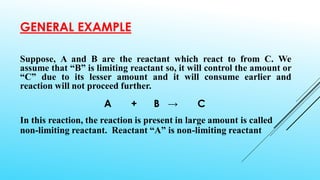
GENERAL EXAMPLE
Suppose, A and B are the reactant which react to from C. We
assume that “B” is limiting reactant so, it will control the amount or
“C” due to its lesser amount and it will consume earlier and
reaction will not proceed further.
A + B → C
In this reaction, the reaction is present in large amount is called
non-limiting reactant. Reactant “A” is non-limiting reactant
EXAPLES OF LIMITING
REACTANT RELTAED TO
CHEMICAL REACTIONS
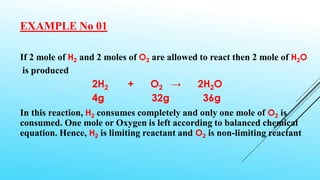
EXAMPLE No 01
If 2 mole of H2 and 2 moles of O2 are allowed to react then 2 mole of H2O
is produced
2H2 + O2 → 2H2O
4g 32g 36g
In this reaction, H2 consumes completely and only one mole of O2 is
consumed. One mole or Oxygen is left according to balanced chemical
equation. Hence, H2 is limiting reactant and O2 is non-limiting reactant
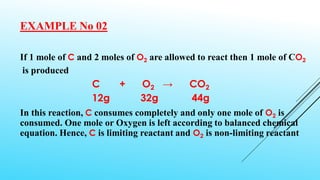
EXAMPLE No 02
If 1 mole of C and 2 moles of O2 are allowed to react then 1 mole of CO2
is produced
C + O2 → CO2
12g 32g 44g
In this reaction, C consumes completely and only one mole of O2 is
consumed. One mole or Oxygen is left according to balanced chemical
equation. Hence, C is limiting reactant and O2 is non-limiting reactant
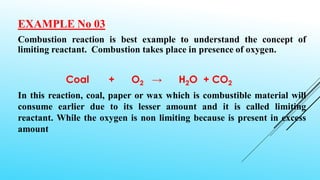
EXAMPLE No 03
Combustion reaction is best example to understand the concept of
limiting reactant. Combustion takes place in presence of oxygen.
Coal + O2 → H2O + CO2
In this reaction, coal, paper or wax which is combustible material will
consume earlier due to its lesser amount and it is called limiting
reactant. While the oxygen is non limiting because is present in excess
amount
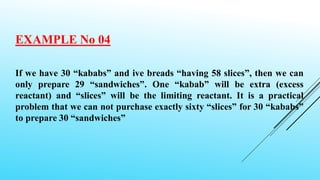
EXAMPLE No 04
If we have 30 “kababs” and ive breads “having 58 slices”, then we can
only prepare 29 “sandwiches”. One “kabab” will be extra (excess
reactant) and “slices” will be the limiting reactant. It is a practical
problem that we can not purchase exactly sixty “slices” for 30 “kababs”
to prepare 30 “sandwiches”
IDENTIFICATION OF
LIMITING REACTANT
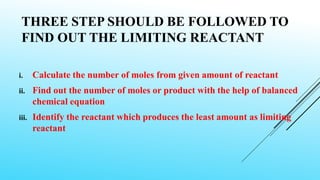
THREE STEP SHOULD BE FOLLOWED TO
FIND OUT THE LIMITING REACTANT
i. Calculate the number of moles from given amount of reactant
ii. Find out the number of moles or product with the help of balanced
chemical equation
iii. Identify the reactant which produces the least amount as limiting
reactant
CONCEPT OF LIMITING
REACTANT IS NOT
APPLICABLE ON THE
REVERSIBLE REACTION
JUSTIFICATION
“A Reactant Which Is Used Or Consumed Earlier Due To Its Lesser
Amount And Controls The Amount Of Product Formed In A
Chemical Reaction”
During a reversible reaction, reactants are converted into product and
products convert back into reactant. So reactants are not completely
consumed. As a result a limiting reactant cannot be identified in
reversible reaction

Limiting Reactant

  • 2.
    Prof. Sohaib Hasnain PunjabGroup of Colleges, Faisalabad CHEMISTRY
  • 3.
  • 4.
    A Reactant WhichIs Used Or Consumed Earlier Due To Its Lesser Amount And Controls The Amount Of Product Formed In A Chemical Reaction
  • 5.
    Limiting Reactant It Controlsthe amount of product formed It is taken in lesser amount It is consumed earlier It produces least amount of product
  • 6.
    GENERAL EXAMPLE Suppose, Aand B are the reactant which react to from C. We assume that “B” is limiting reactant so, it will control the amount or “C” due to its lesser amount and it will consume earlier and reaction will not proceed further. A + B → C In this reaction, the reaction is present in large amount is called non-limiting reactant. Reactant “A” is non-limiting reactant
  • 7.
    EXAPLES OF LIMITING REACTANTRELTAED TO CHEMICAL REACTIONS
  • 8.
    EXAMPLE No 01 If2 mole of H2 and 2 moles of O2 are allowed to react then 2 mole of H2O is produced 2H2 + O2 → 2H2O 4g 32g 36g In this reaction, H2 consumes completely and only one mole of O2 is consumed. One mole or Oxygen is left according to balanced chemical equation. Hence, H2 is limiting reactant and O2 is non-limiting reactant
  • 9.
    EXAMPLE No 02 If1 mole of C and 2 moles of O2 are allowed to react then 1 mole of CO2 is produced C + O2 → CO2 12g 32g 44g In this reaction, C consumes completely and only one mole of O2 is consumed. One mole or Oxygen is left according to balanced chemical equation. Hence, C is limiting reactant and O2 is non-limiting reactant
  • 10.
    EXAMPLE No 03 Combustionreaction is best example to understand the concept of limiting reactant. Combustion takes place in presence of oxygen. Coal + O2 → H2O + CO2 In this reaction, coal, paper or wax which is combustible material will consume earlier due to its lesser amount and it is called limiting reactant. While the oxygen is non limiting because is present in excess amount
  • 11.
    EXAMPLE No 04 Ifwe have 30 “kababs” and ive breads “having 58 slices”, then we can only prepare 29 “sandwiches”. One “kabab” will be extra (excess reactant) and “slices” will be the limiting reactant. It is a practical problem that we can not purchase exactly sixty “slices” for 30 “kababs” to prepare 30 “sandwiches”
  • 12.
  • 13.
    THREE STEP SHOULDBE FOLLOWED TO FIND OUT THE LIMITING REACTANT i. Calculate the number of moles from given amount of reactant ii. Find out the number of moles or product with the help of balanced chemical equation iii. Identify the reactant which produces the least amount as limiting reactant
  • 14.
    CONCEPT OF LIMITING REACTANTIS NOT APPLICABLE ON THE REVERSIBLE REACTION
  • 15.
    JUSTIFICATION “A Reactant WhichIs Used Or Consumed Earlier Due To Its Lesser Amount And Controls The Amount Of Product Formed In A Chemical Reaction” During a reversible reaction, reactants are converted into product and products convert back into reactant. So reactants are not completely consumed. As a result a limiting reactant cannot be identified in reversible reaction