INTERMOLECULAR FORCES
The forces between MOLECULES
INTERMOLECULAR FORCES
Ionic bonds
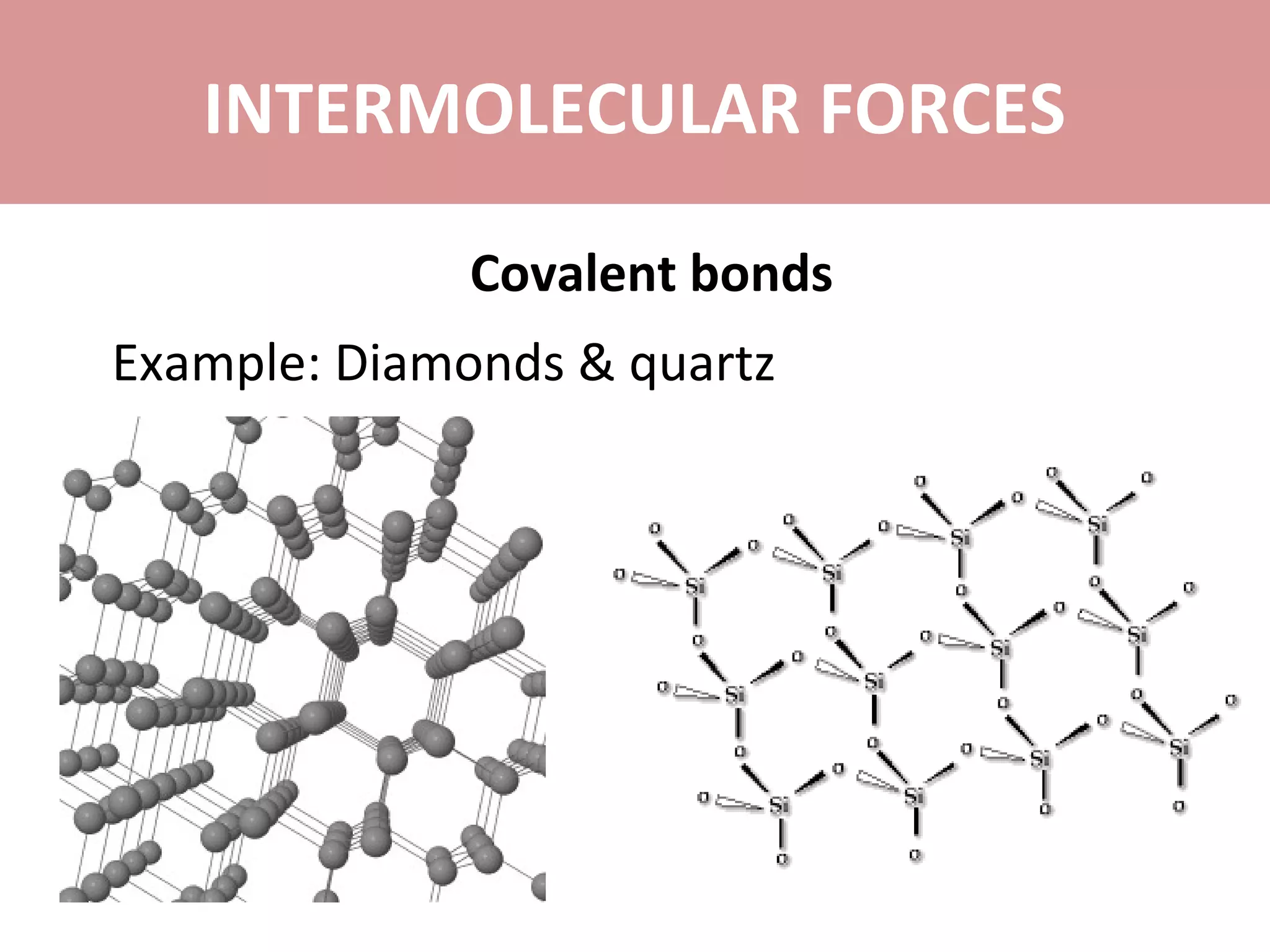
Covalent bonds
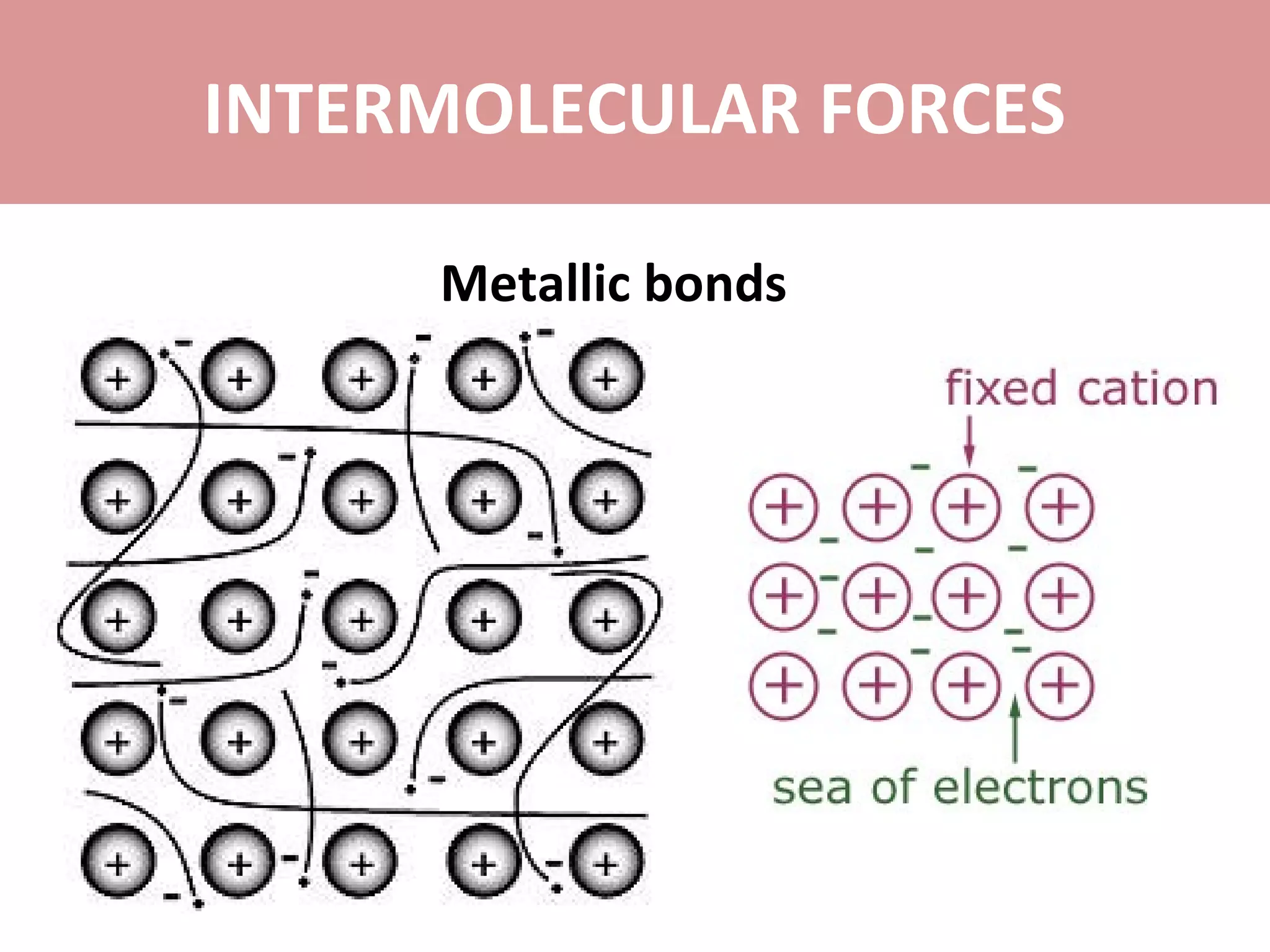
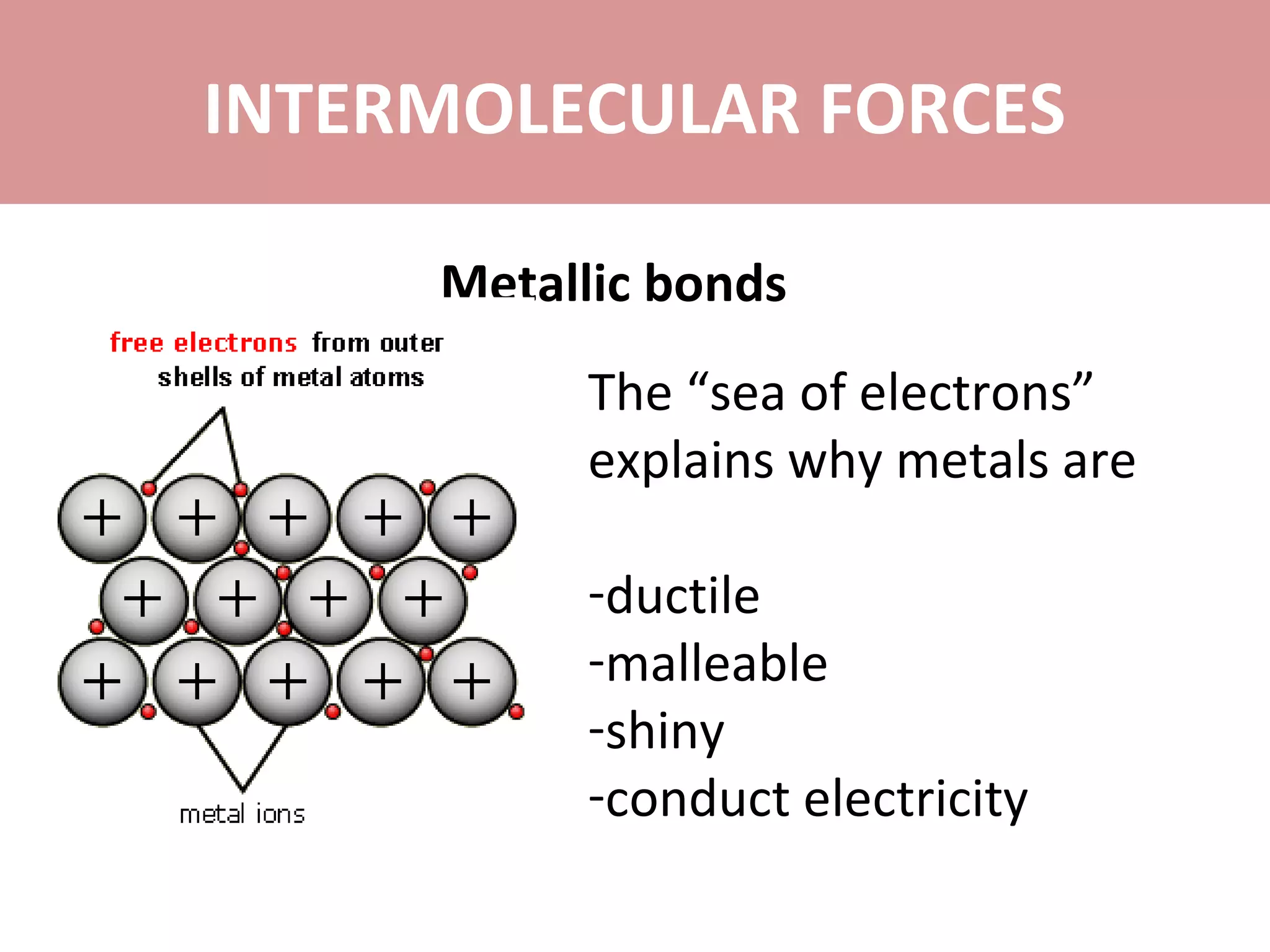
Metallic bonds
Dipole-Ion Attraction
Hydrogen bonds
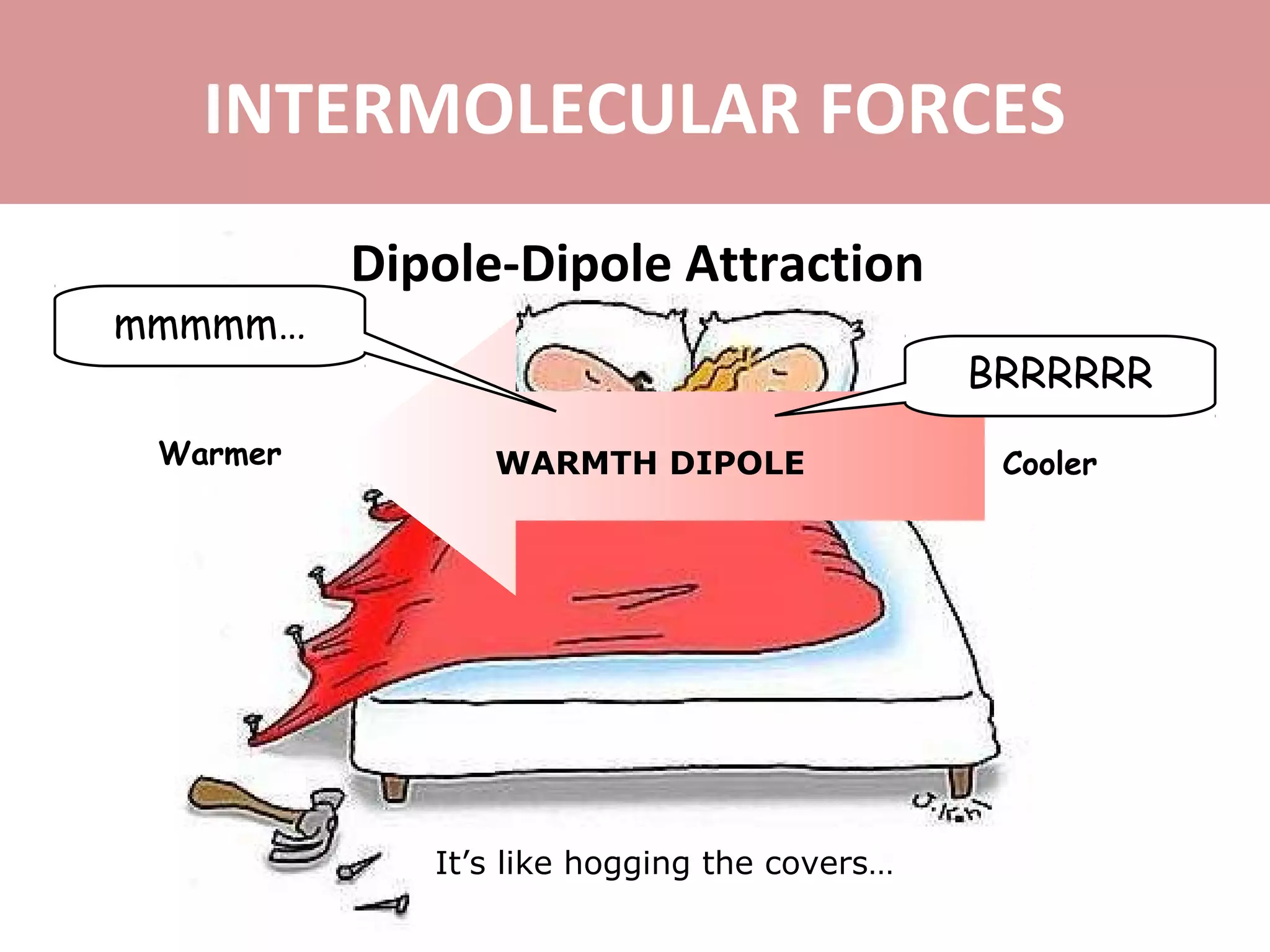
Dipole-Dipole Attraction
Induced-Dipole Forces (Debye Forces)
London Dispersion Forces
INCREASINGSTRENGTH
Van der Waal’s forces
LONDON DISPERSION FORCES
These forces involve molecules that have no polarity
INTERMOLECULAR FORCES
A subset of Van der Waal’s forces
INTERMOLECULAR FORCES
London dispersion forces
Electrons are not stationary in a molecule. Rather,
they are free to disperse throughout the molecule.
(electrons move freely inside a molecule).
By chance, electrons will disperse unevenly and
generate a temporary dipole in the molecule.
A temporary dipole can induce a temporary dipole in a
neighbouring molecule
INTERMOLECULAR FORCES
INDUCED-DIPOLE FORCES
(Debye Forces)
These forces involve polar molecules attracting molecules
that have no polarity
A subset of Van der Waal’s forces
INTERMOLECULAR FORCES
Induced-dipole forces (Debye Forces)
Induced-dipole forces involve a molecule with a
permanent dipole inducing a temporary dipole in a
neighbouring non-polar molecule
OH
INTERMOLECULAR FORCES
DIPOLE-DIPOLE ATTRACTION
These forces involve polar molecules
INTERMOLECULAR FORCES
A subset of Van der Waal’s forces
INTERMOLECULAR FORCES
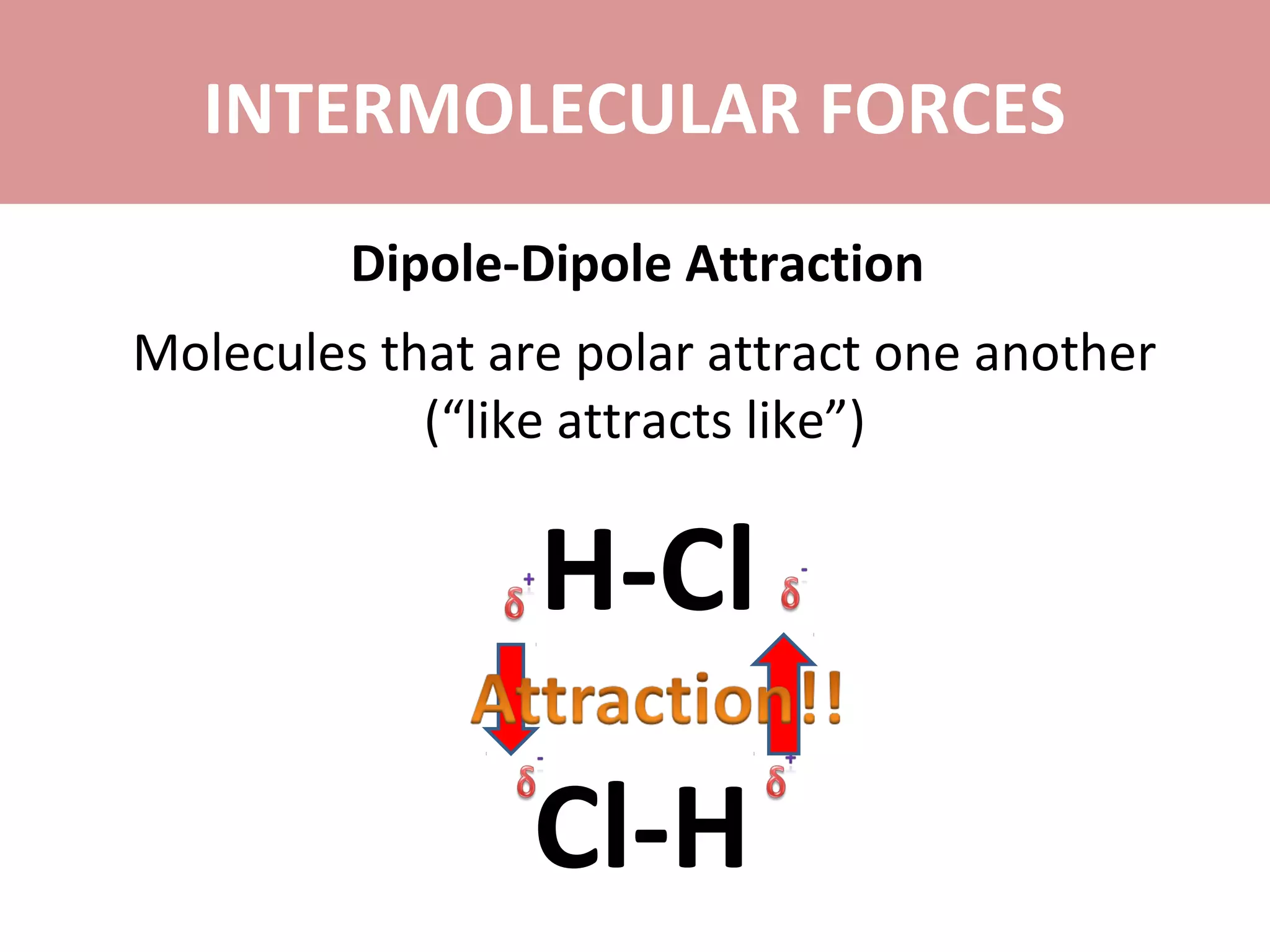
Dipole-Dipole Attraction
Molecules that are polar attract one another
(“like attracts like”)
H-Cl
Cl-H
INTERMOLECULAR FORCES
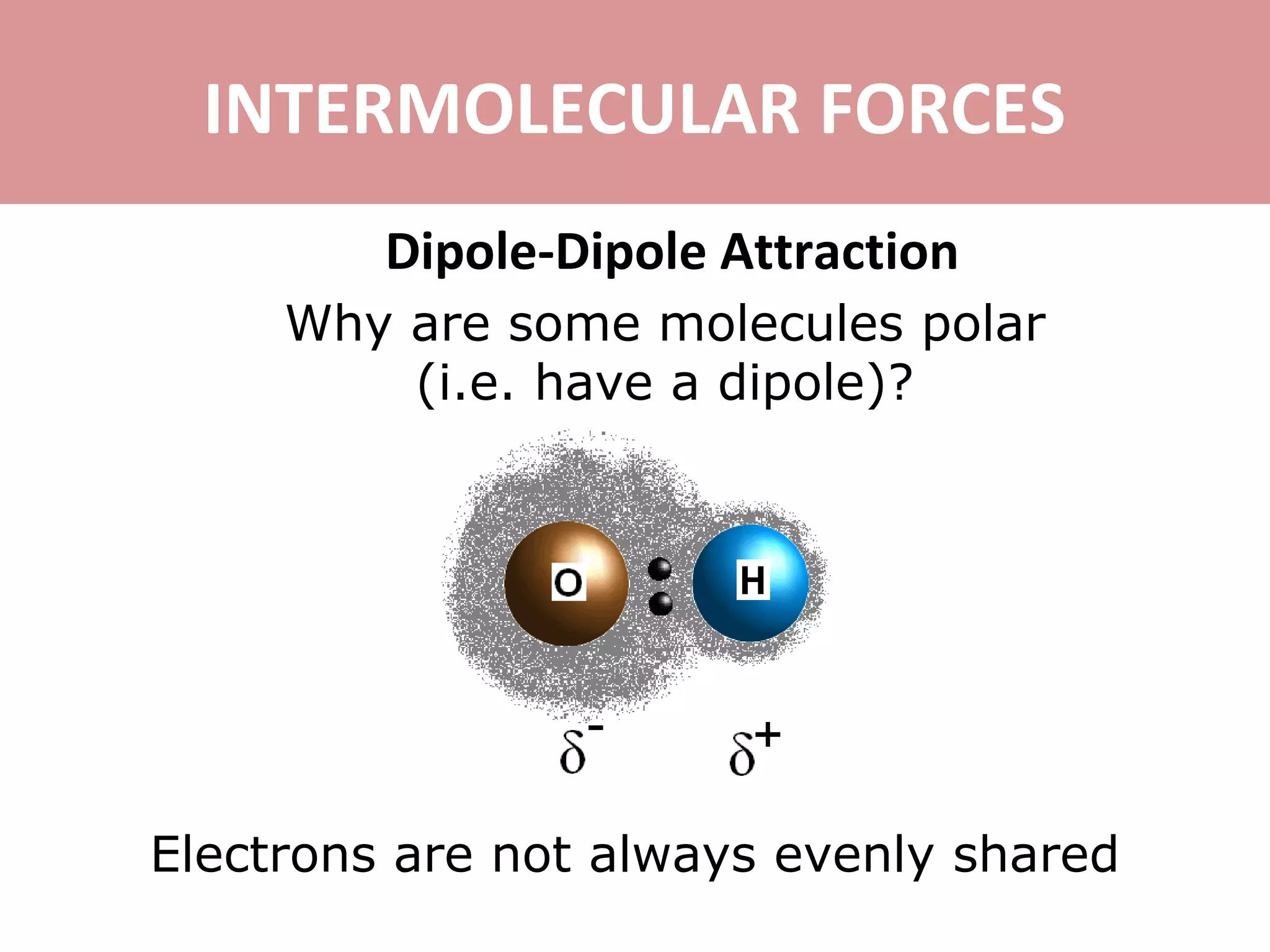
Dipole-Dipole Attraction
Why are some molecules polar
(i.e. have a dipole)?
Electrons are not always evenly shared
INTERMOLECULAR FORCES
Dipole-Dipole Attraction
It’s like hogging the covers…
Warmer CoolerWARMTH DIPOLE
BRRRRRR
mmmmm…
HYDROGEN BOND
These forces are very strong dipole-dipole bonds (and given a
different name)
These forces are the most significant to biology.
INTERMOLECULAR FORCES
Hydrogen bonds
These forces exist between molecules with
oxygen, nitrogen, and/or fluorine bound to
hydrogen.
O, N, and F are very electronegative and pull
electrons shared with hydrogen towards
themselves, producing an unusually strong
dipole.
INTERMOLECULAR FORCES
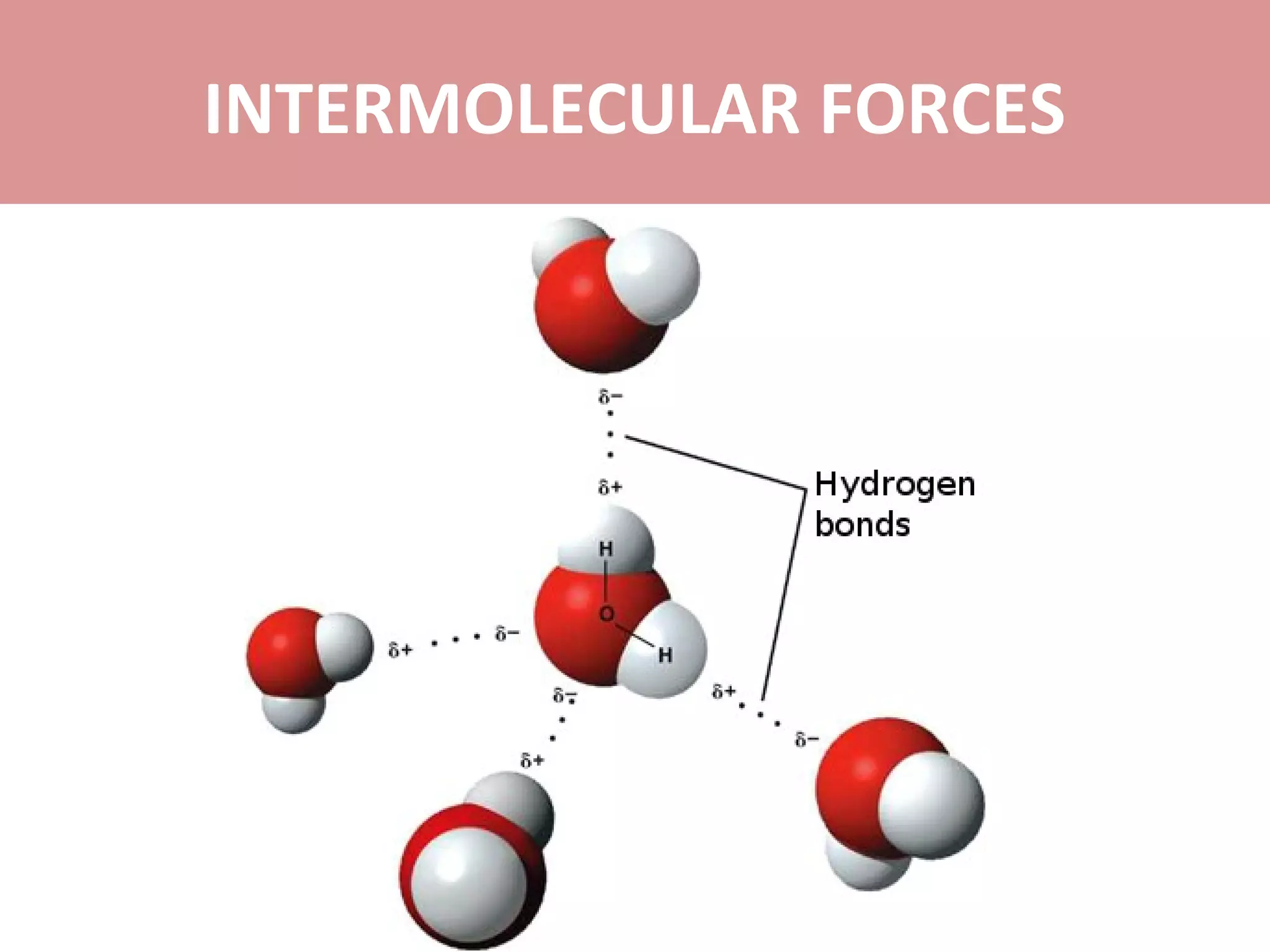
Hydrogen bonds
INTERMOLECULAR FORCES
DIPOLE-ION ATTRACTION
These forces involve a charged molecule attracting a polar
molecule
INTERMOLECULAR FORCES
Dipole-Ion Attraction
Polar molecules have partial charges which
exert attraction for charged molecules.
For example, the partial negative charge on a
polar molecule will attract a positively charged
ion, and vice versa.
INTERMOLECULAR FORCES
Dipole-Ion Attraction
METALLIC BONDS
These bonds exist between metal atoms only.
INTERMOLECULAR FORCES
Metallic bonds
Metals generally have low electronegativity
and “lose” their electrons easily.
Metal atoms lose their valence electrons when
they “bond” together, thus allowing positively
charged metal ions to float in a “sea of
electrons”
INTERMOLECULAR FORCES
Metallic bonds
INTERMOLECULAR FORCES
Metallic bonds
The “sea of electrons”
explains why metals are
-ductile
-malleable
-shiny
-conduct electricity
--
- -
-
--
---
- -
-
-
- -
+
+
+
+
+
+
+
+
+
+
+
+
+
+
+
+
+
+
+
+
- -
COVALENT BONDS
Covalent bonds can hold molecules together too.
INTERMOLECULAR FORCES
Covalent bonds
Example: Diamonds & quartz
IONIC BONDS
Ionic bonds can hold molecules together too.
INTERMOLECULAR FORCES
Ionic bonds
Example: Crystal of salt
06 intermolecular forces

06 intermolecular forces