INTRAMOLECULAR BONDS
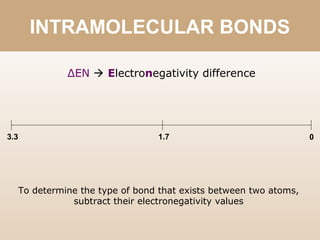
3.3 1.7 0
ΔEN  Electronegativity difference
To determine the type of bond that exists between two atoms,
subtract their electronegativity values
INTRAMOLECULAR BONDS
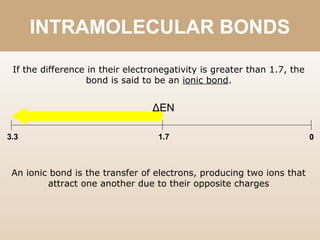
3.3 1.7 0
ΔEN
If the difference in their electronegativity is greater than 1.7, the
bond is said to be an ionic bond.
An ionic bond is the transfer of electrons, producing two ions that
attract one another due to their opposite charges
INTRAMOLECULAR BONDS
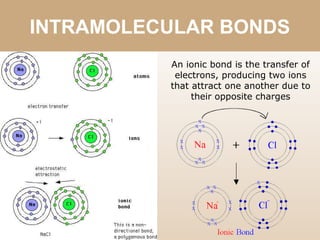
An ionic bond is the transfer of
electrons, producing two ions
that attract one another due to
their opposite charges
INTRAMOLECULAR BONDS
3.3 1.7 0
ΔEN
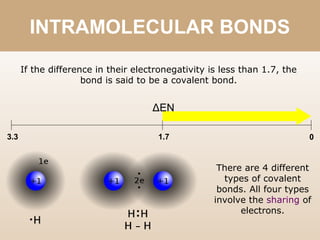
If the difference in their electronegativity is less than 1.7, the
bond is said to be a covalent bond.
There are 4 different
types of covalent
bonds. All four types
involve the sharing of
electrons.
INTRAMOLECULAR BONDS
3.3 1.7 0
ΔEN
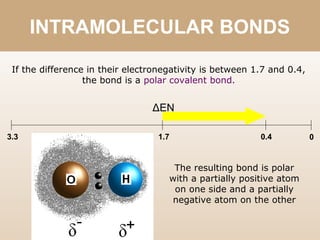
If the difference in their electronegativity is between 1.7 and 0.4,
the bond is a polar covalent bond.
The resulting bond is polar
with a partially positive atom
on one side and a partially
negative atom on the other
0.4
INTRAMOLECULAR BONDS
3.3 1.7 0
ΔEN
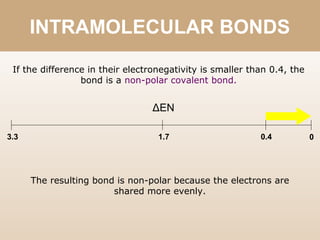
If the difference in their electronegativity is smaller than 0.4, the
bond is a non-polar covalent bond.
The resulting bond is non-polar because the electrons are
shared more evenly.
0.4
INTRAMOLECULAR BONDS
3.3 1.7 0
ΔEN
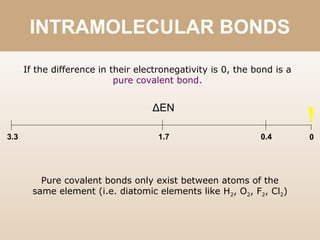
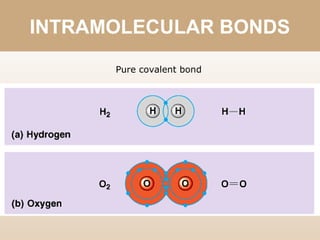
If the difference in their electronegativity is 0, the bond is a
pure covalent bond.
Pure covalent bonds only exist between atoms of the
same element (i.e. diatomic elements like H2, O2, F2, Cl2)
0.4
INTRAMOLECULAR BONDS
Pure covalent bond
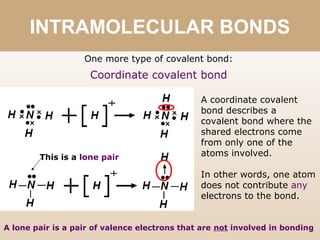
INTRAMOLECULAR BONDS
One more type of covalent bond:
Coordinate covalent bond
A coordinate covalent
bond describes a
covalent bond where the
shared electrons come
from only one of the
atoms involved.
In other words, one atom
does not contribute any
electrons to the bond.
This is a lone pair
A lone pair is a pair of valence electrons that are not involved in bonding

05 intramolecular bonds

  • 1.
  • 2.
    INTRAMOLECULAR BONDS 3.3 1.70 ΔEN  Electronegativity difference To determine the type of bond that exists between two atoms, subtract their electronegativity values
  • 3.
    INTRAMOLECULAR BONDS 3.3 1.70 ΔEN If the difference in their electronegativity is greater than 1.7, the bond is said to be an ionic bond. An ionic bond is the transfer of electrons, producing two ions that attract one another due to their opposite charges
  • 4.
    INTRAMOLECULAR BONDS An ionicbond is the transfer of electrons, producing two ions that attract one another due to their opposite charges
  • 5.
    INTRAMOLECULAR BONDS 3.3 1.70 ΔEN If the difference in their electronegativity is less than 1.7, the bond is said to be a covalent bond. There are 4 different types of covalent bonds. All four types involve the sharing of electrons.
  • 6.
    INTRAMOLECULAR BONDS 3.3 1.70 ΔEN If the difference in their electronegativity is between 1.7 and 0.4, the bond is a polar covalent bond. The resulting bond is polar with a partially positive atom on one side and a partially negative atom on the other 0.4
  • 7.
    INTRAMOLECULAR BONDS 3.3 1.70 ΔEN If the difference in their electronegativity is smaller than 0.4, the bond is a non-polar covalent bond. The resulting bond is non-polar because the electrons are shared more evenly. 0.4
  • 8.
    INTRAMOLECULAR BONDS 3.3 1.70 ΔEN If the difference in their electronegativity is 0, the bond is a pure covalent bond. Pure covalent bonds only exist between atoms of the same element (i.e. diatomic elements like H2, O2, F2, Cl2) 0.4
  • 9.
  • 10.
    INTRAMOLECULAR BONDS One moretype of covalent bond: Coordinate covalent bond A coordinate covalent bond describes a covalent bond where the shared electrons come from only one of the atoms involved. In other words, one atom does not contribute any electrons to the bond. This is a lone pair A lone pair is a pair of valence electrons that are not involved in bonding

Editor's Notes

  • #2 http://www.youtube.com/watch?v=Kj3o0XvhVqQ