INTERMOLECULAR FORCES
AND POLARITY
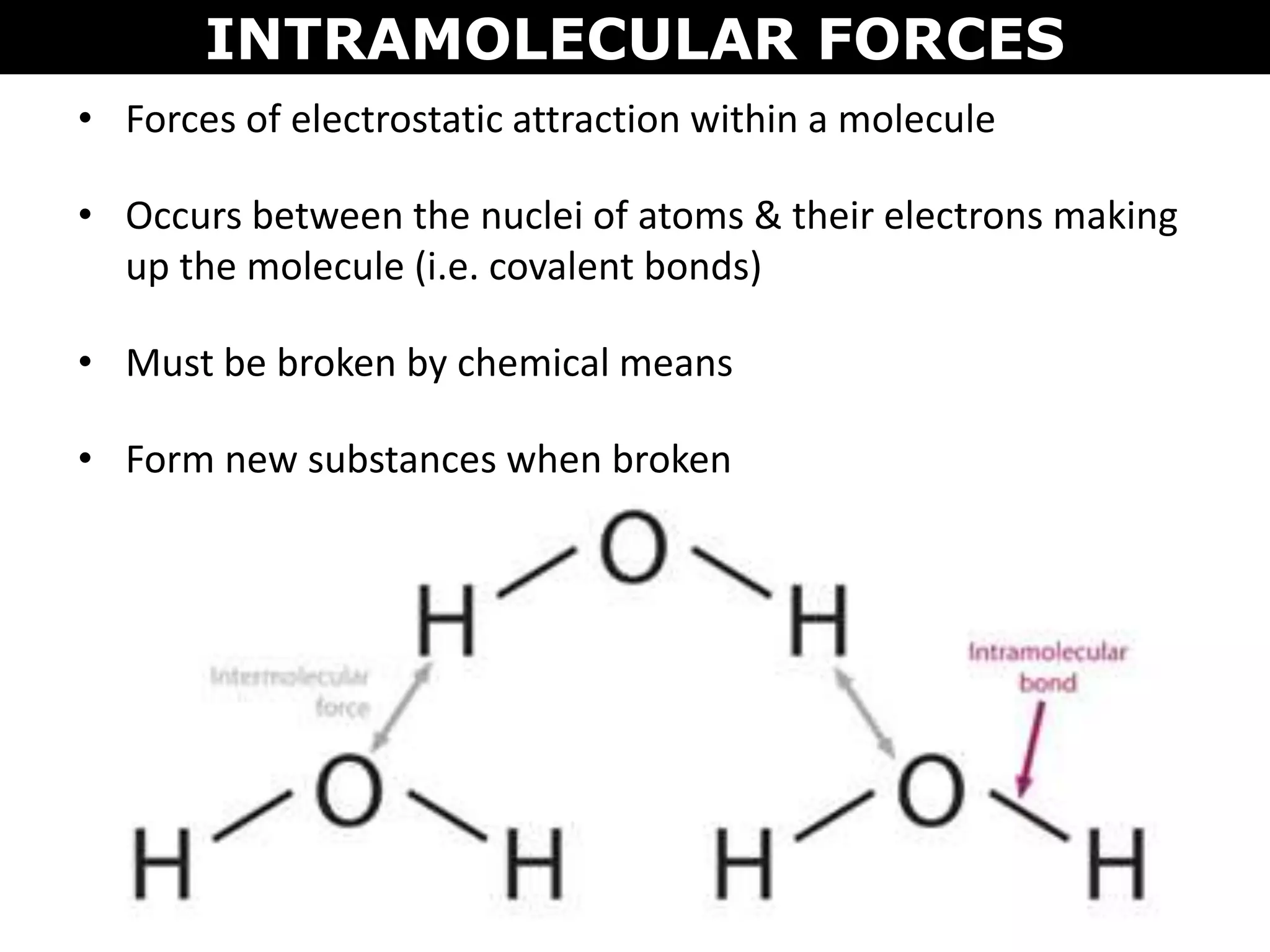
INTRAMOLECULAR FORCES
• Forces of electrostatic attraction within a molecule
• Occurs between the nuclei of atoms & their electrons making
up the molecule (i.e. covalent bonds)
• Must be broken by chemical means
• Form new substances when broken
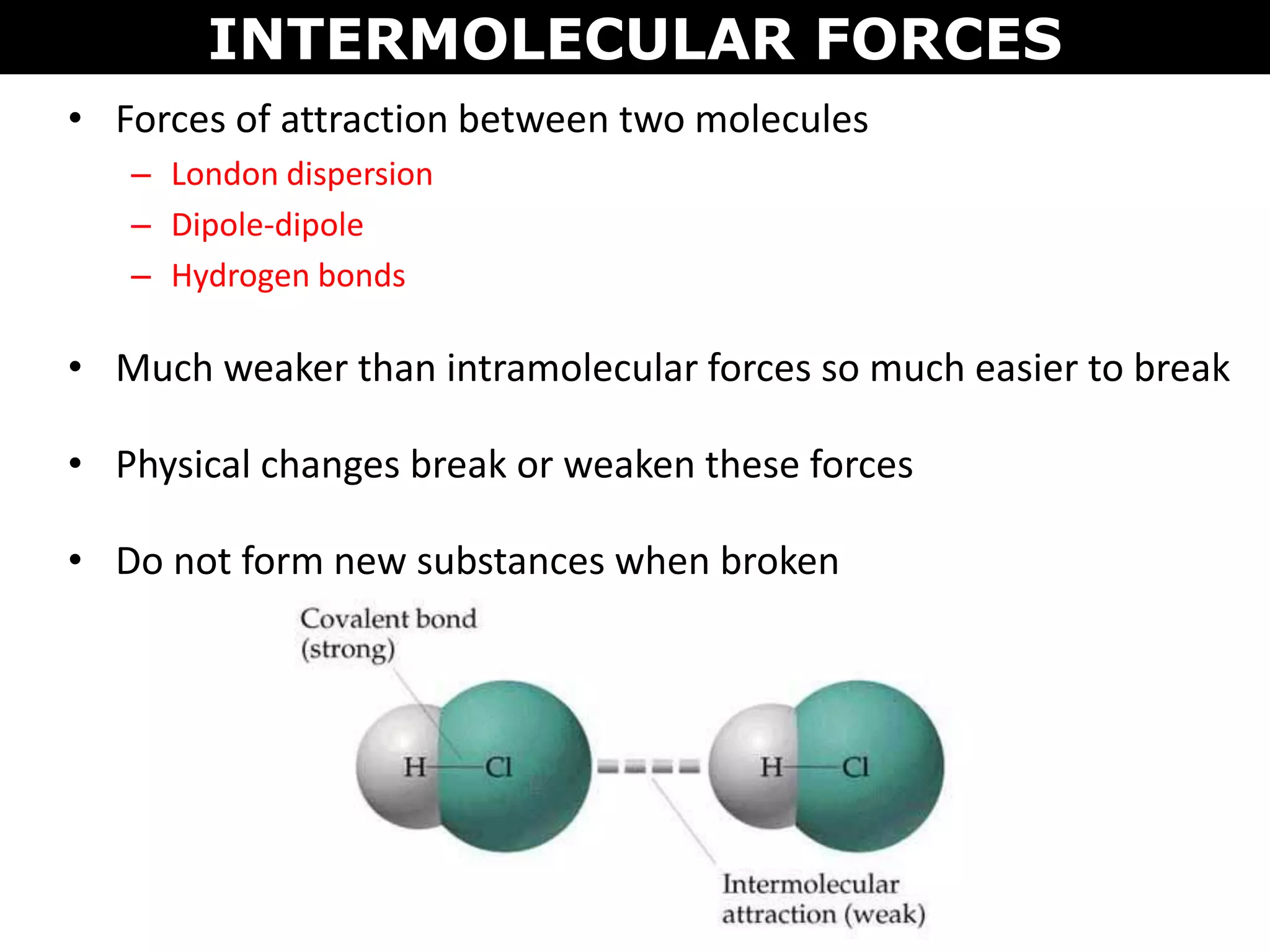
INTERMOLECULAR FORCES
• Forces of attraction between two molecules
– London dispersion
– Dipole-dipole
– Hydrogen bonds
• Much weaker than intramolecular forces so much easier to break
• Physical changes break or weaken these forces
• Do not form new substances when broken
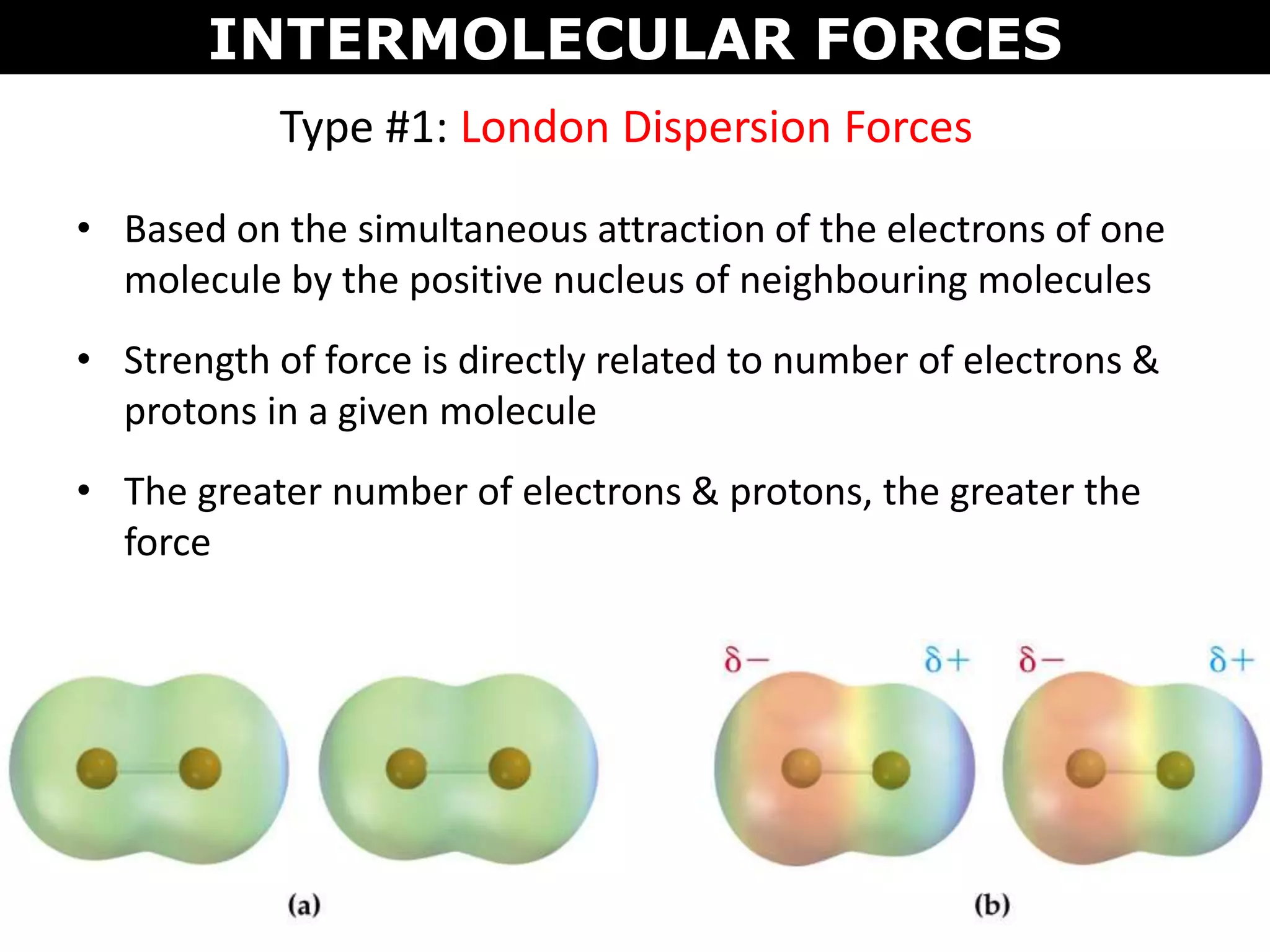
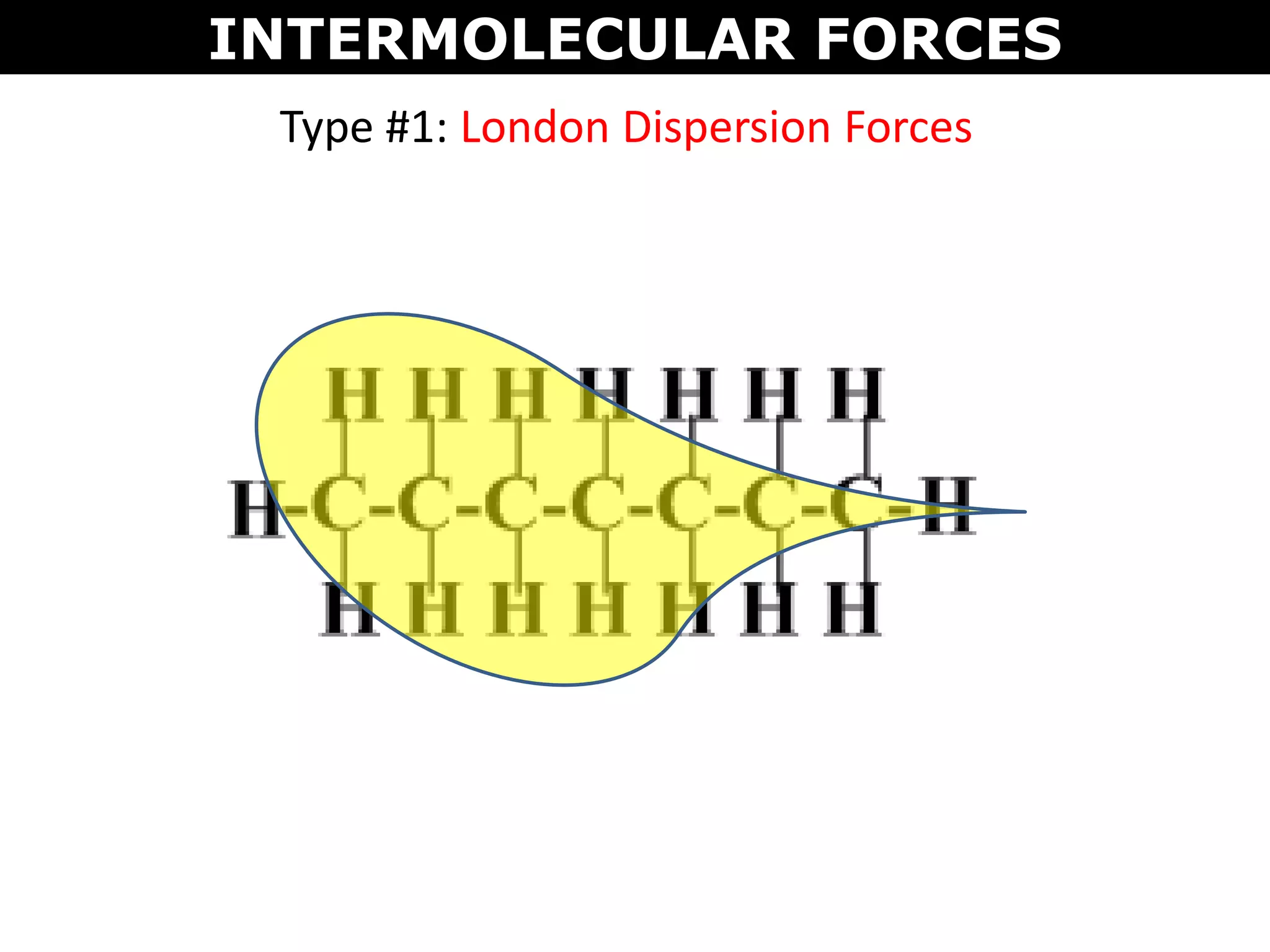
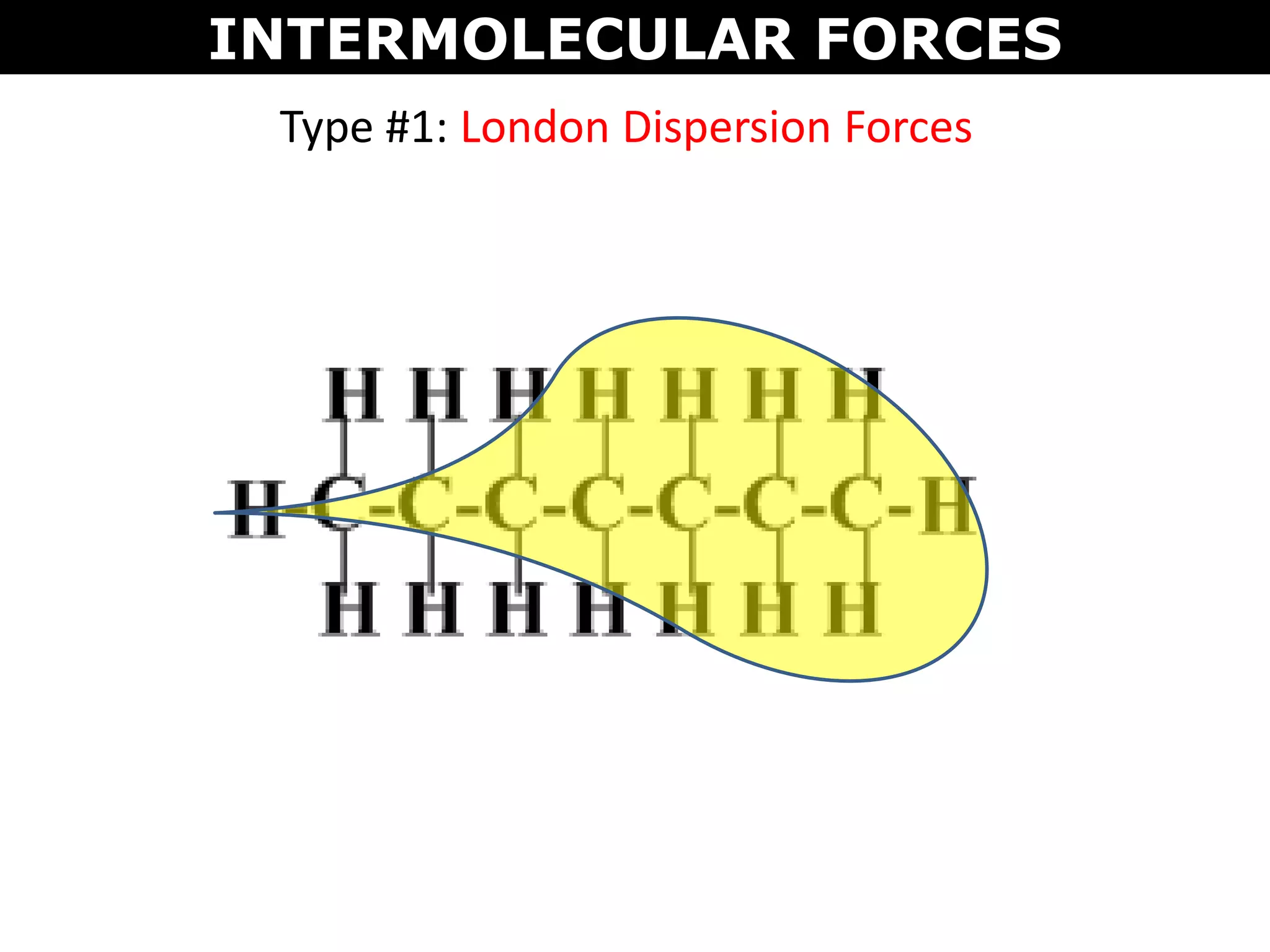
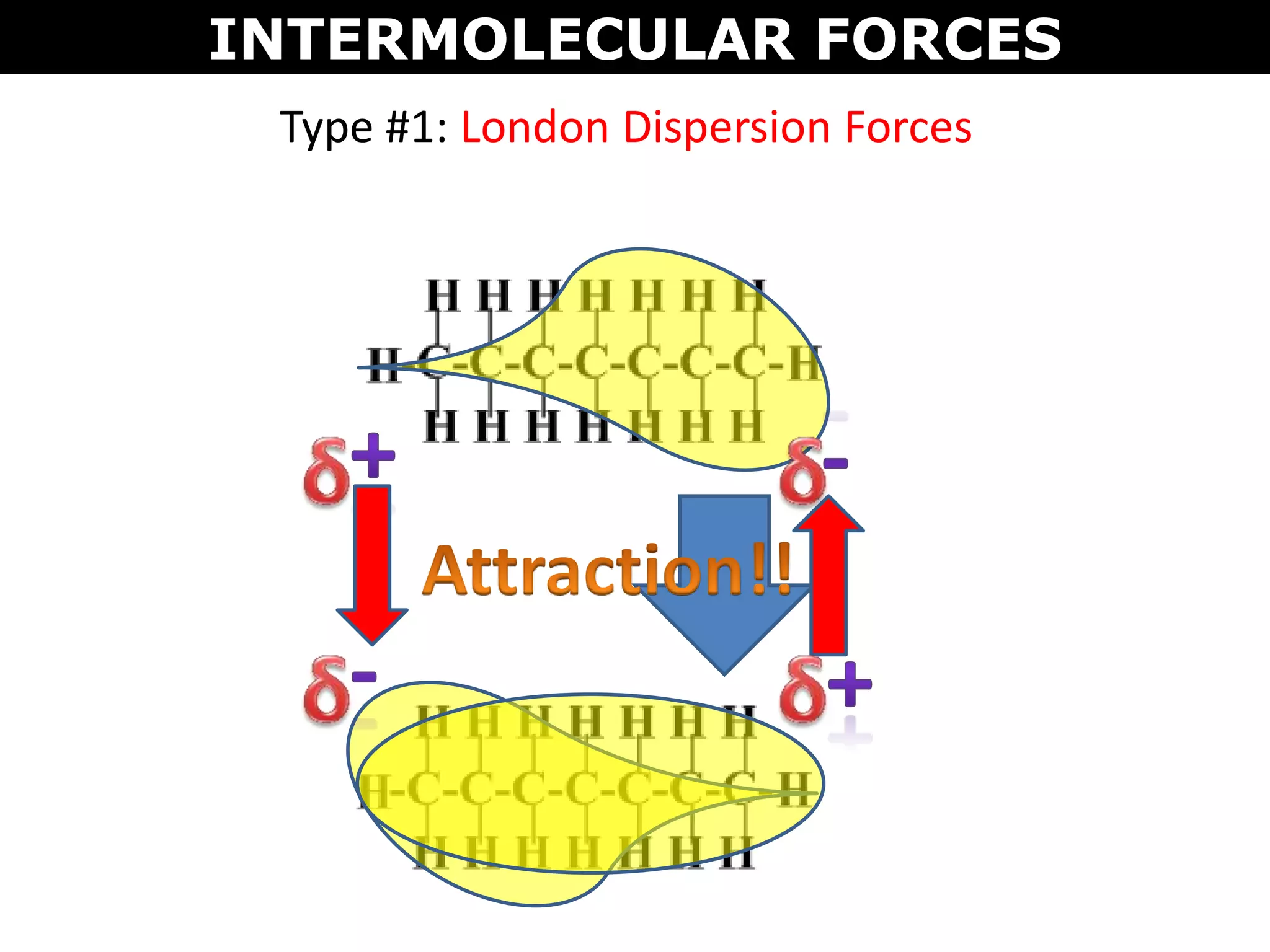
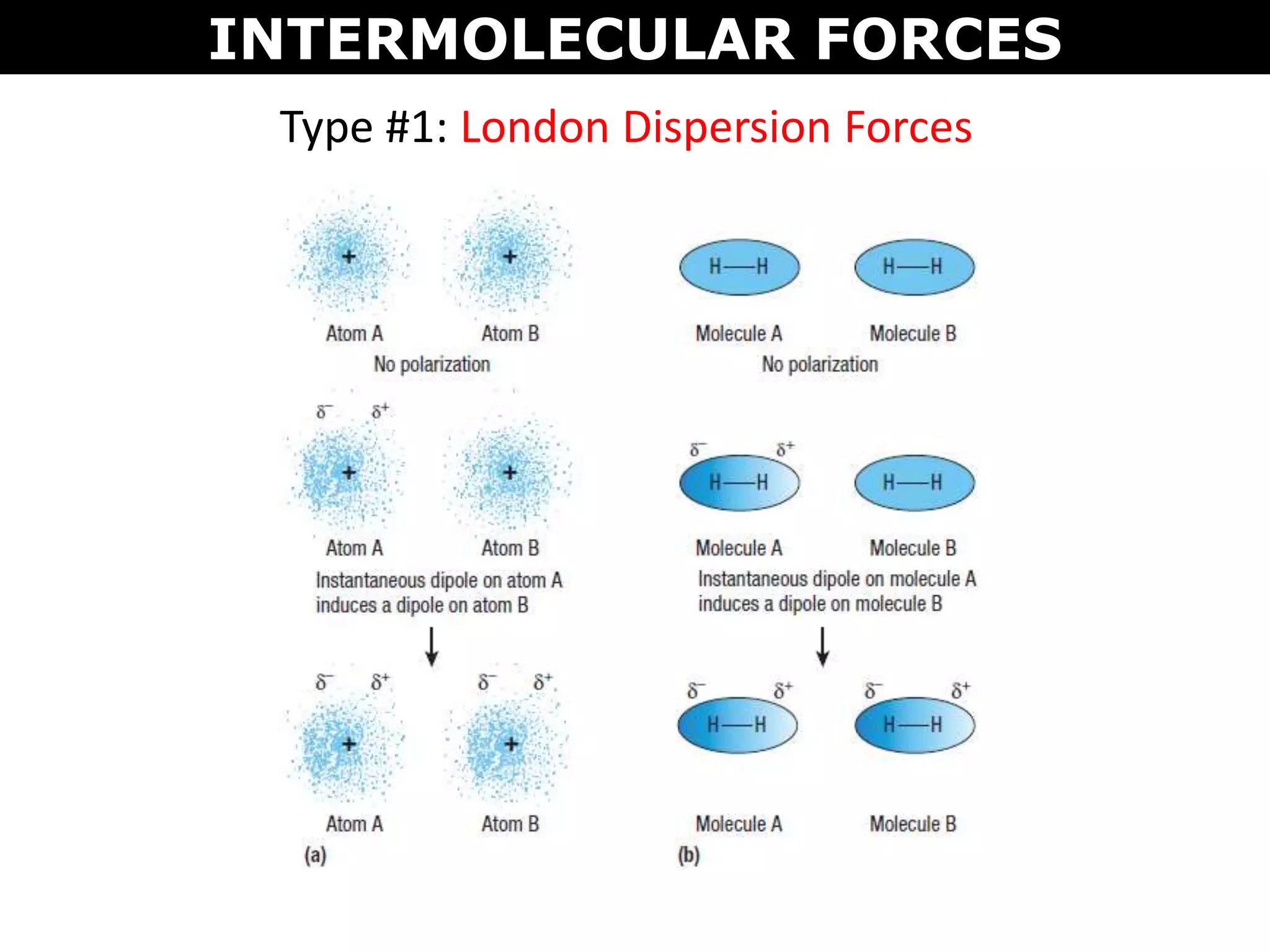
Type #1: London Dispersion Forces
• Based on the simultaneous attraction of the electrons of one
molecule by the positive nucleus of neighbouring molecules
• Strength of force is directly related to number of electrons &
protons in a given molecule
• The greater number of electrons & protons, the greater the
force
INTERMOLECULAR FORCES
Type #1: London Dispersion Forces
INTERMOLECULAR FORCES
Type #1: London Dispersion Forces
INTERMOLECULAR FORCES
Type #1: London Dispersion Forces
INTERMOLECULAR FORCES
Type #1: London Dispersion Forces
INTERMOLECULAR FORCES
Type #1: London Dispersion Forces
INTERMOLECULAR FORCES
Type #1: London Dispersion Forces
INTERMOLECULAR FORCES
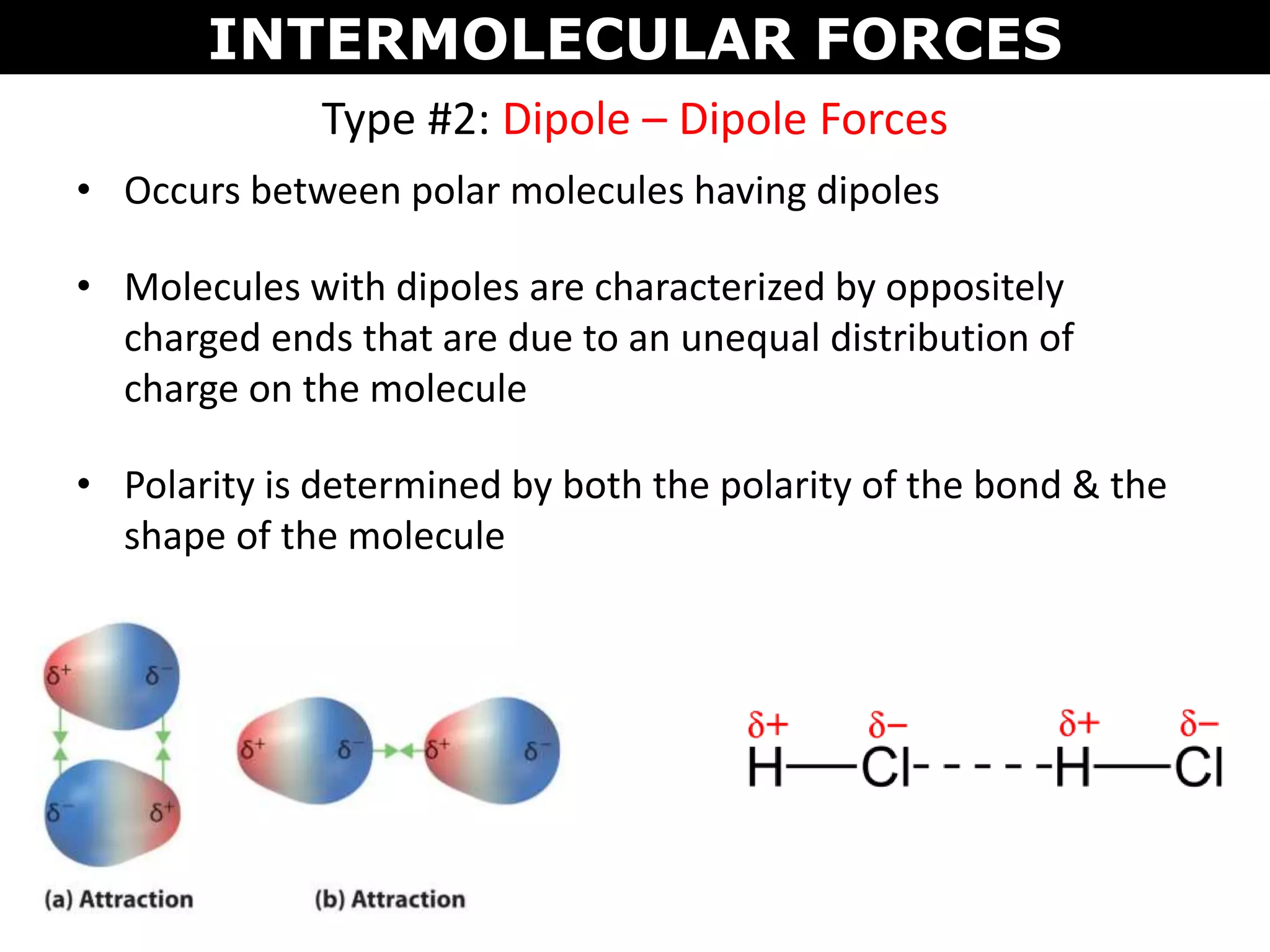
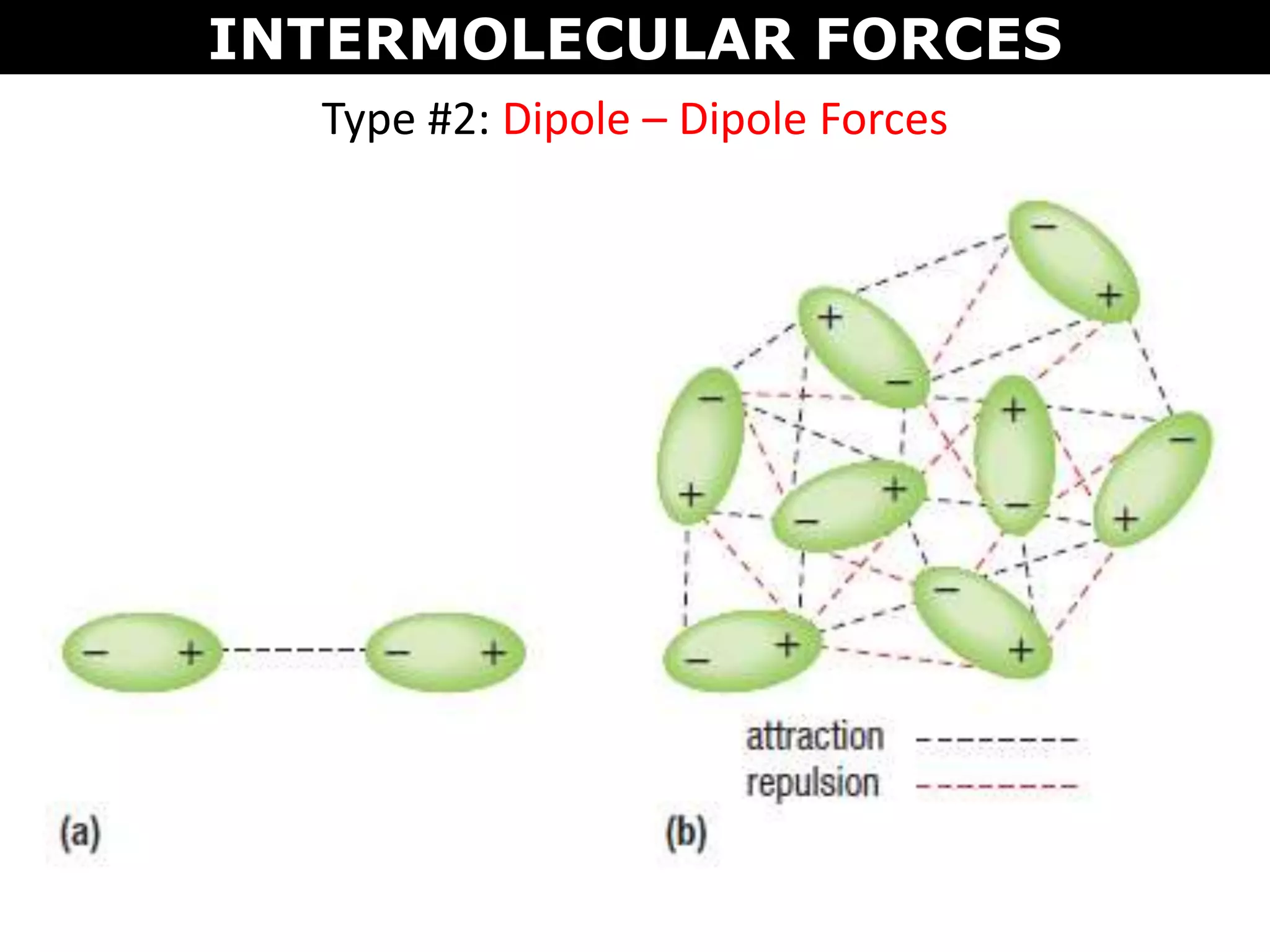
Type #2: Dipole – Dipole Forces
• Occurs between polar molecules having dipoles
• Molecules with dipoles are characterized by oppositely
charged ends that are due to an unequal distribution of
charge on the molecule
• Polarity is determined by both the polarity of the bond & the
shape of the molecule
INTERMOLECULAR FORCES
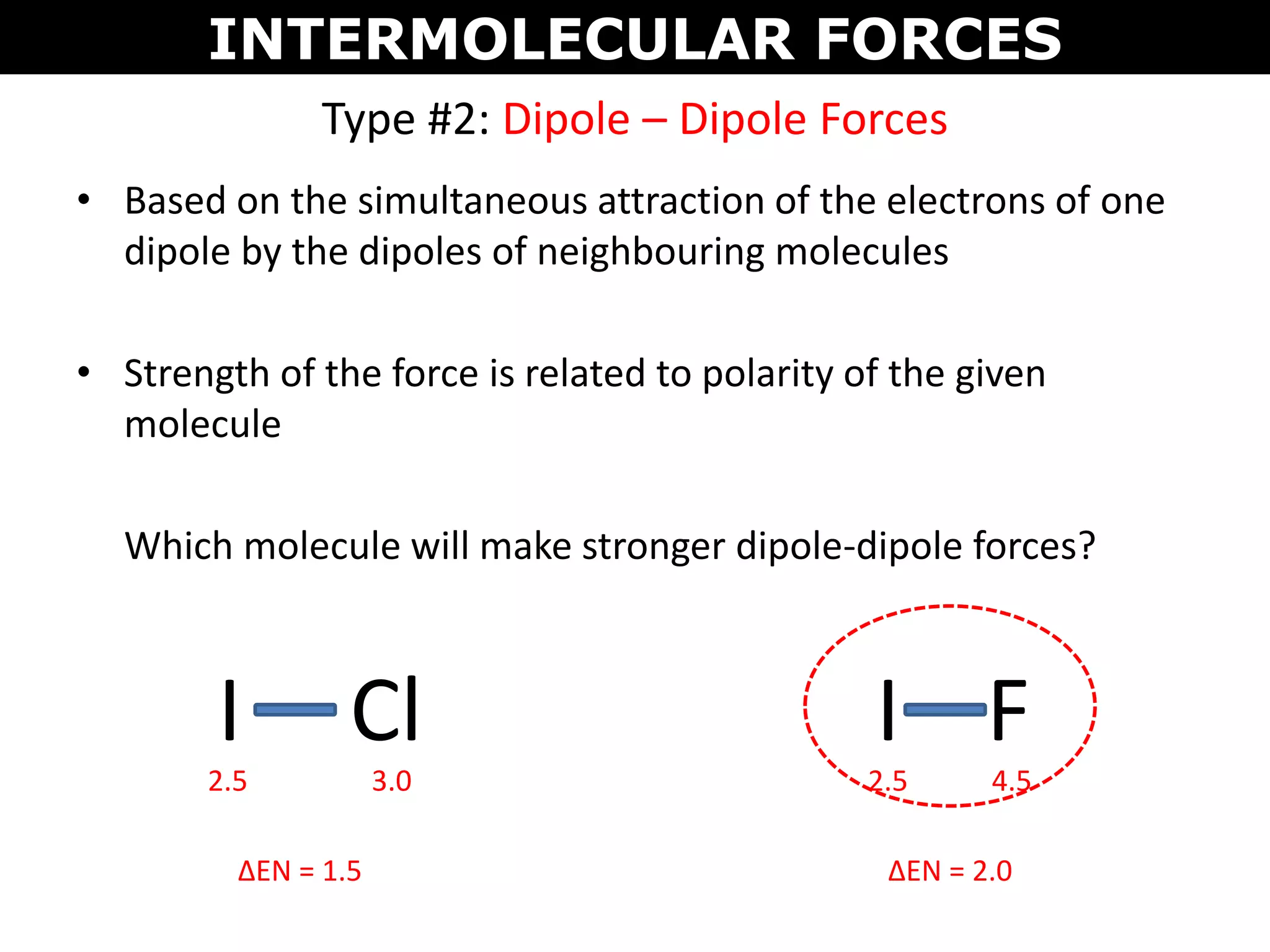
• Based on the simultaneous attraction of the electrons of one
dipole by the dipoles of neighbouring molecules
• Strength of the force is related to polarity of the given
molecule
Which molecule will make stronger dipole-dipole forces?
Type #2: Dipole – Dipole Forces
INTERMOLECULAR FORCES
I Cl I F
2.5 3.0 2.5 4.5
ΔEN = 1.5 ΔEN = 2.0
Type #2: Dipole – Dipole Forces
INTERMOLECULAR FORCES
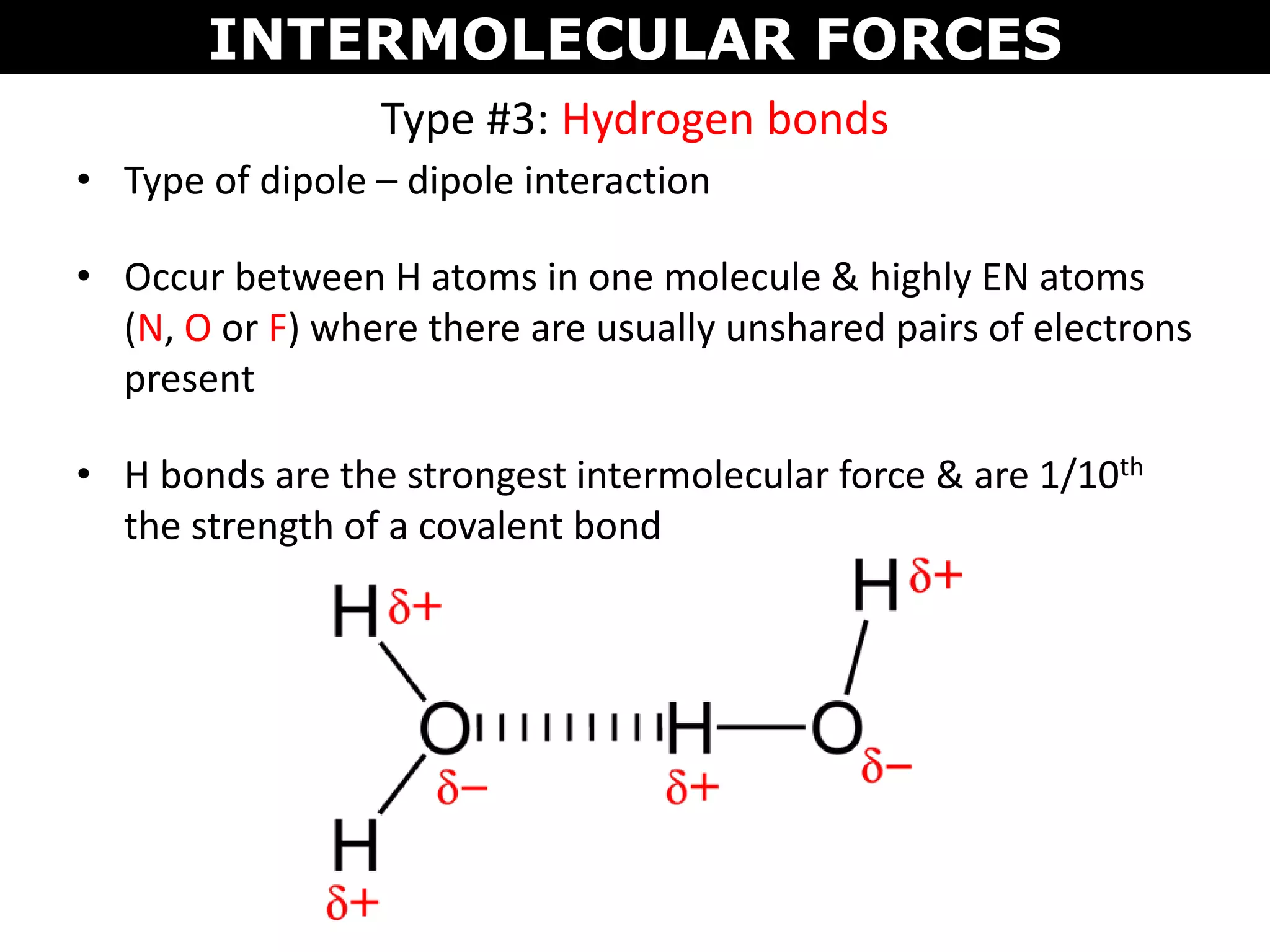
• Type of dipole – dipole interaction
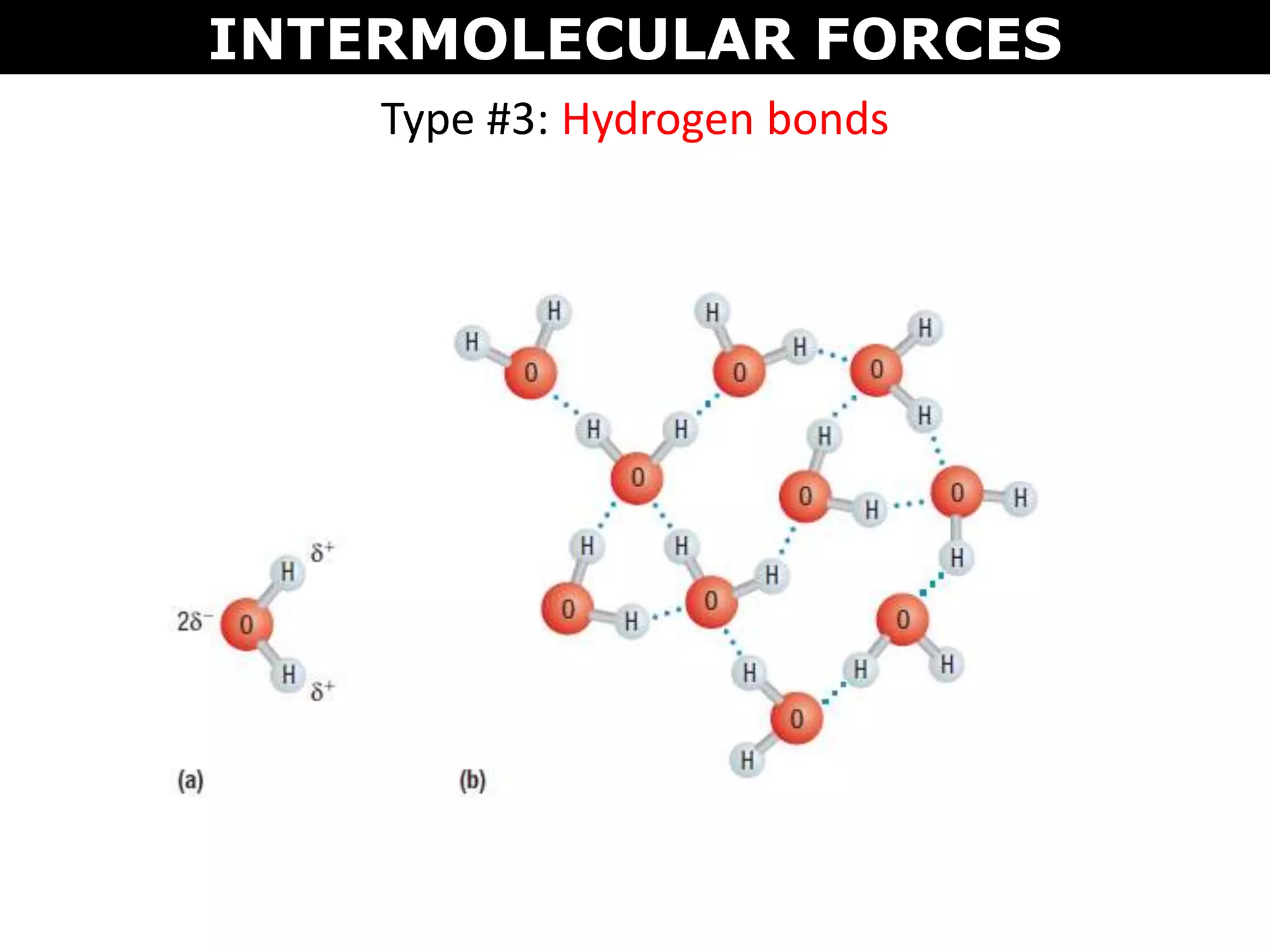
• Occur between H atoms in one molecule & highly EN atoms
(N, O or F) where there are usually unshared pairs of electrons
present
• H bonds are the strongest intermolecular force & are 1/10th
the strength of a covalent bond
Type #3: Hydrogen bonds
INTERMOLECULAR FORCES
Type #3: Hydrogen bonds
INTERMOLECULAR FORCES
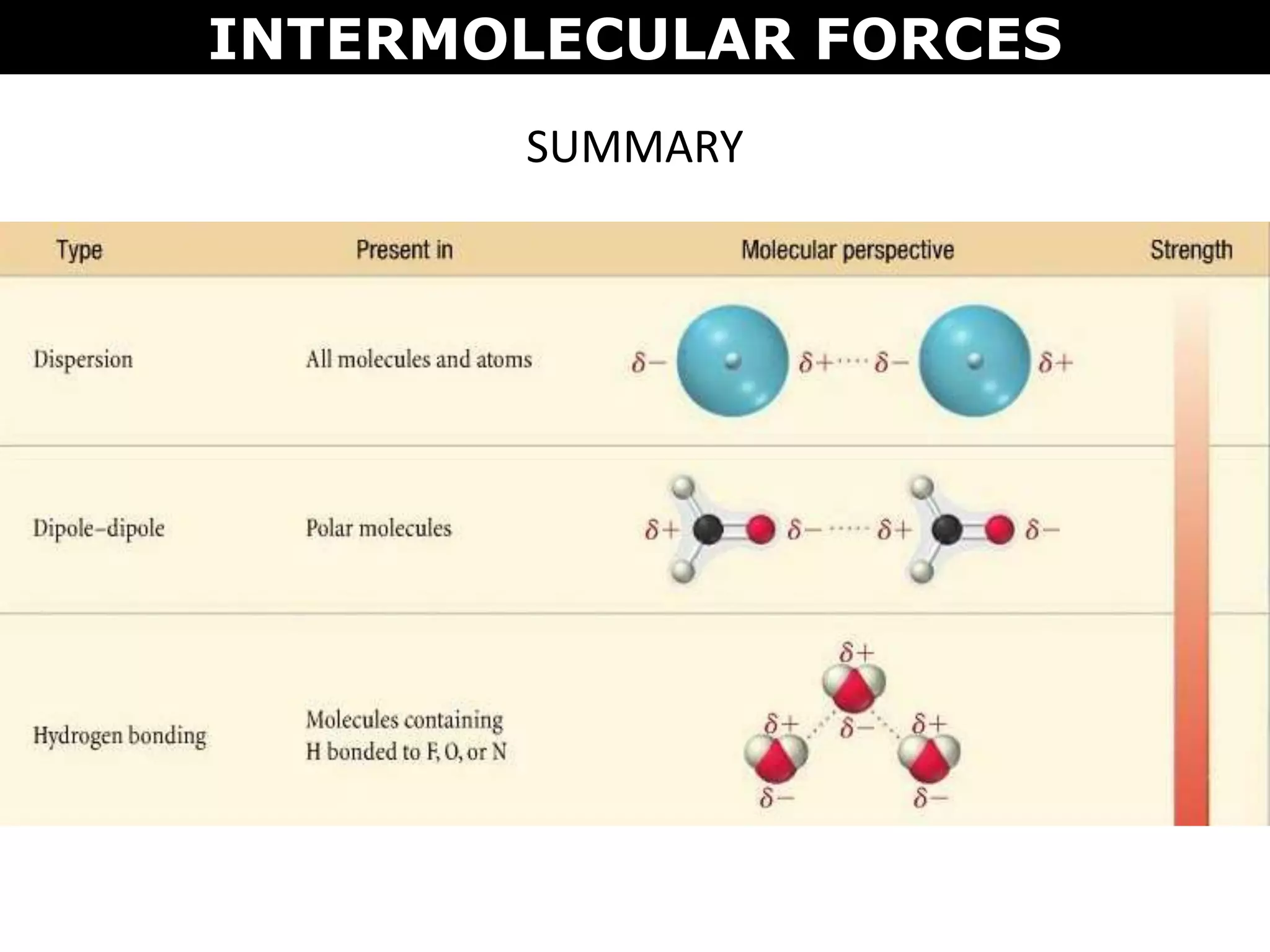
SUMMARY
INTERMOLECULAR FORCES
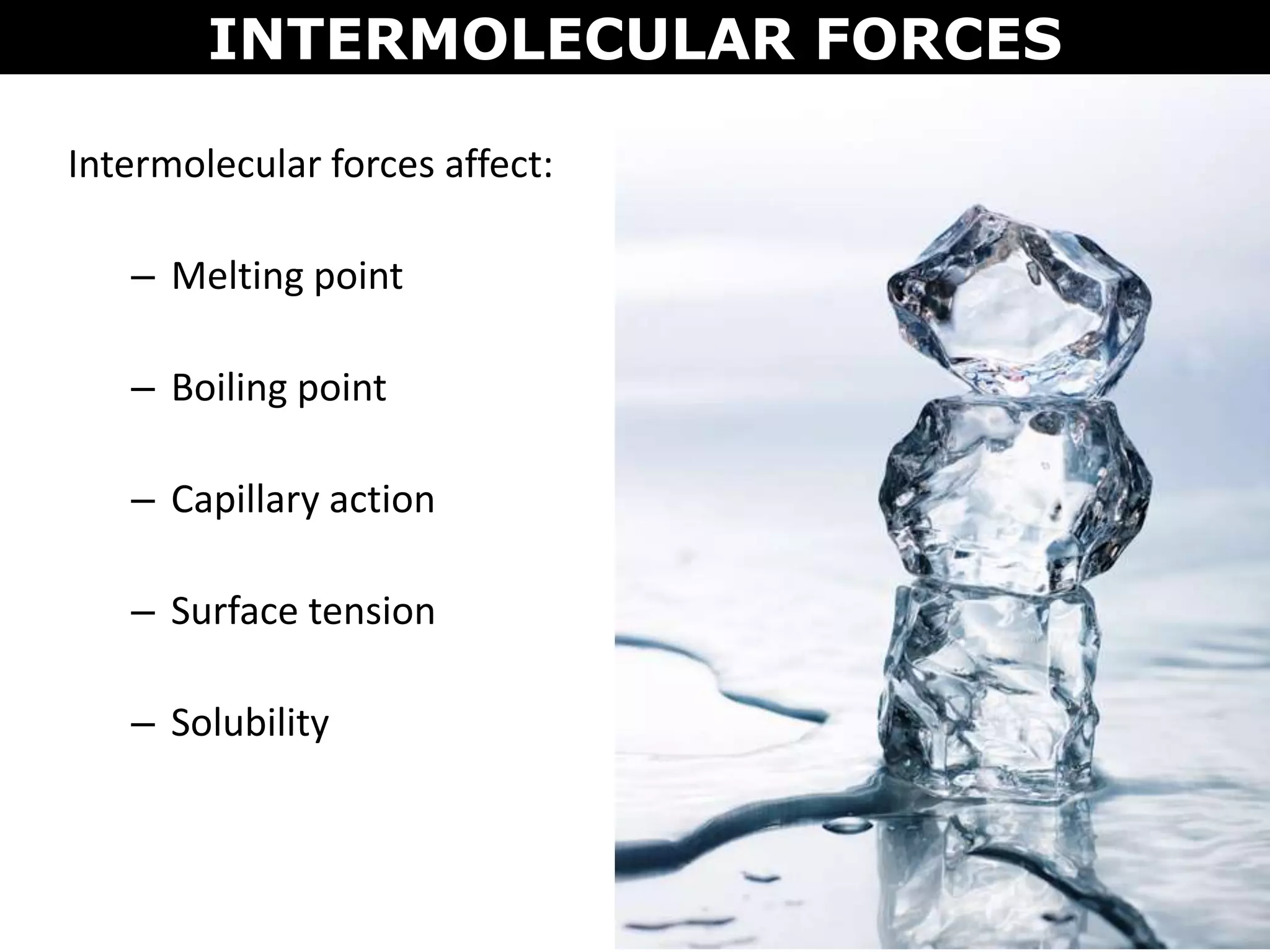
Intermolecular forces affect:
– Melting point
– Boiling point
– Capillary action
– Surface tension
– Solubility
INTERMOLECULAR FORCES
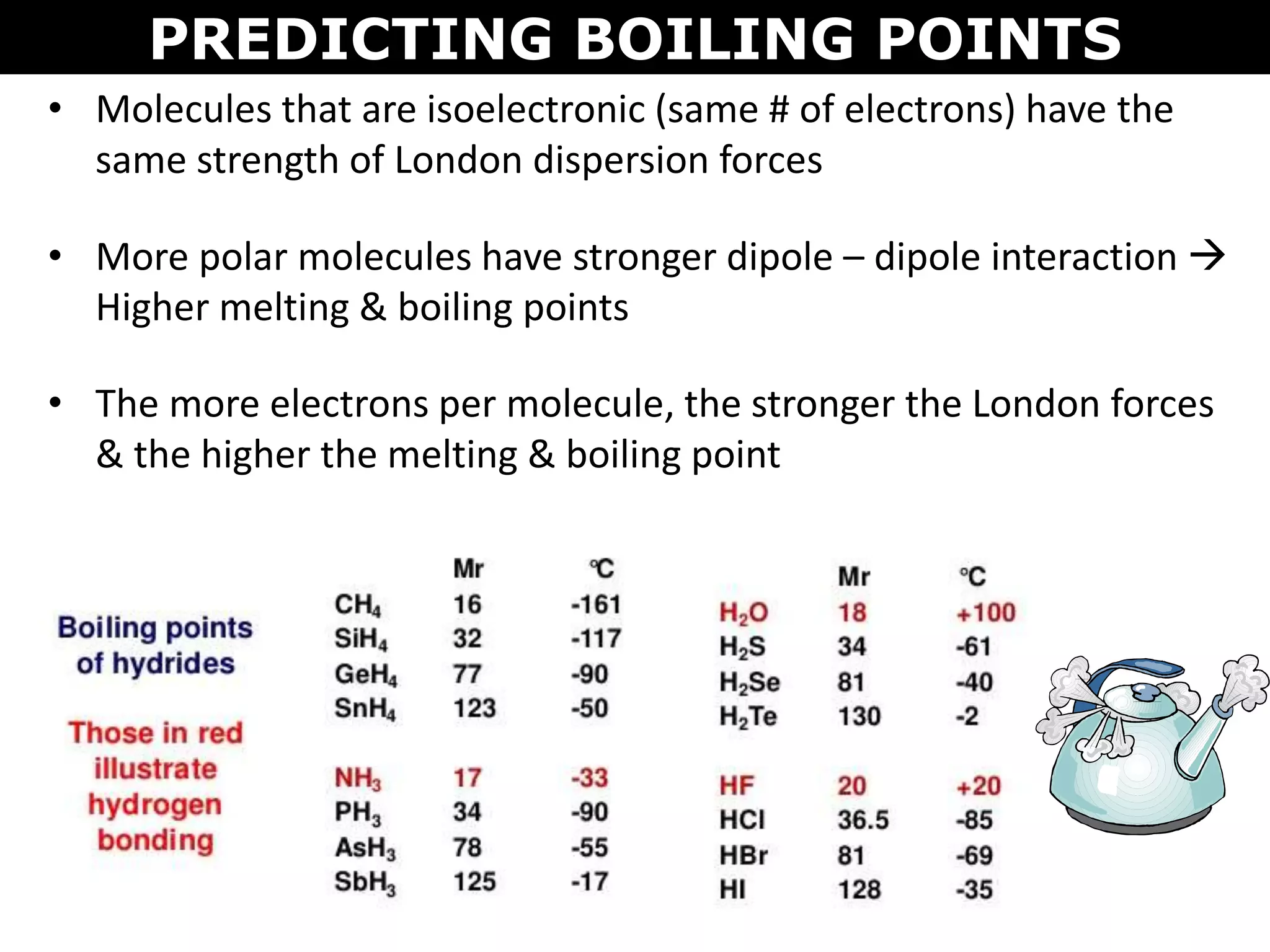
• Molecules that are isoelectronic (same # of electrons) have the
same strength of London dispersion forces
• More polar molecules have stronger dipole – dipole interaction 
Higher melting & boiling points
• The more electrons per molecule, the stronger the London forces
& the higher the melting & boiling point
PREDICTING BOILING POINTS
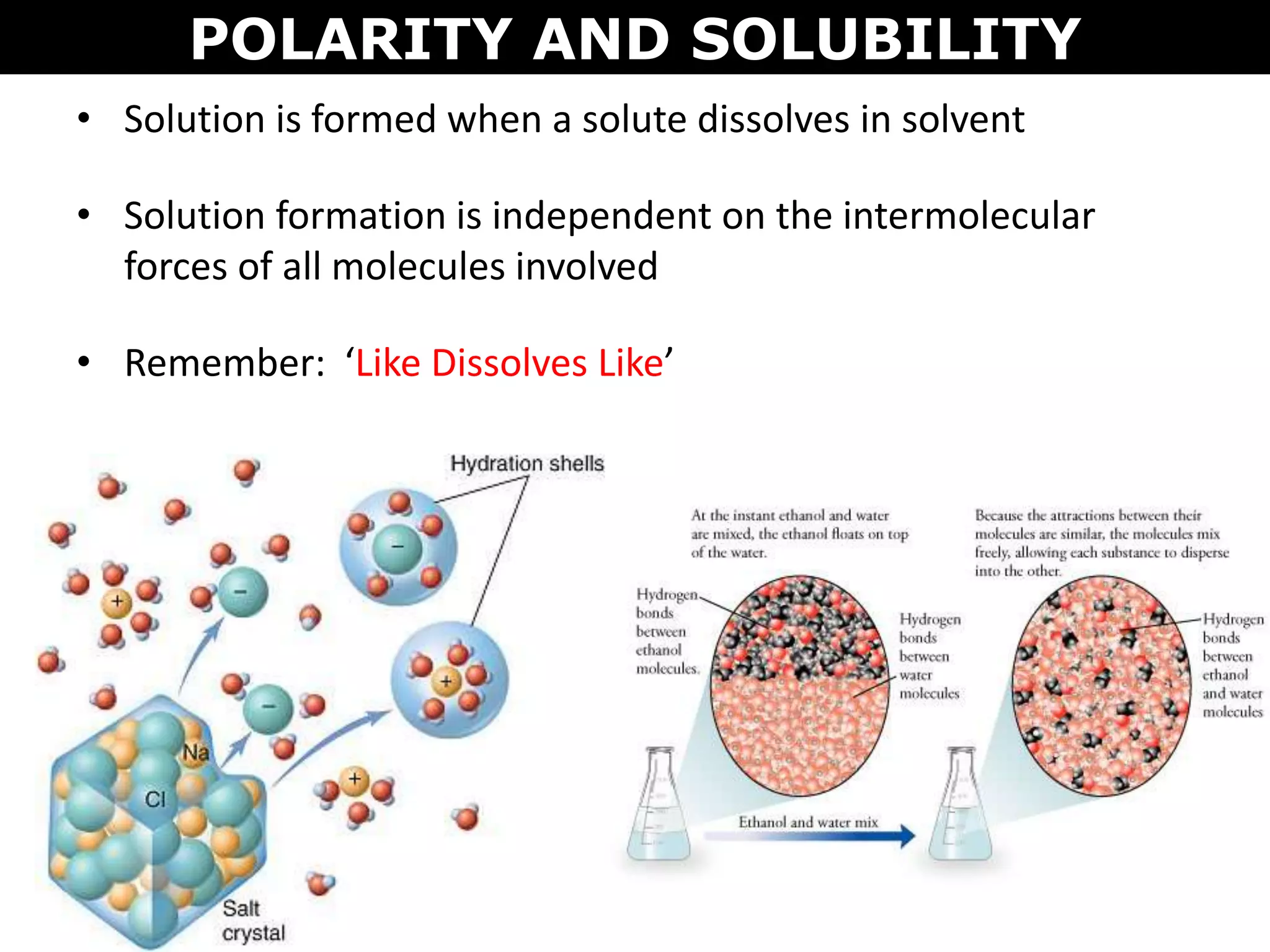
• Solution is formed when a solute dissolves in solvent
• Solution formation is independent on the intermolecular
forces of all molecules involved
• Remember: ‘Like Dissolves Like’
POLARITY AND SOLUBILITY
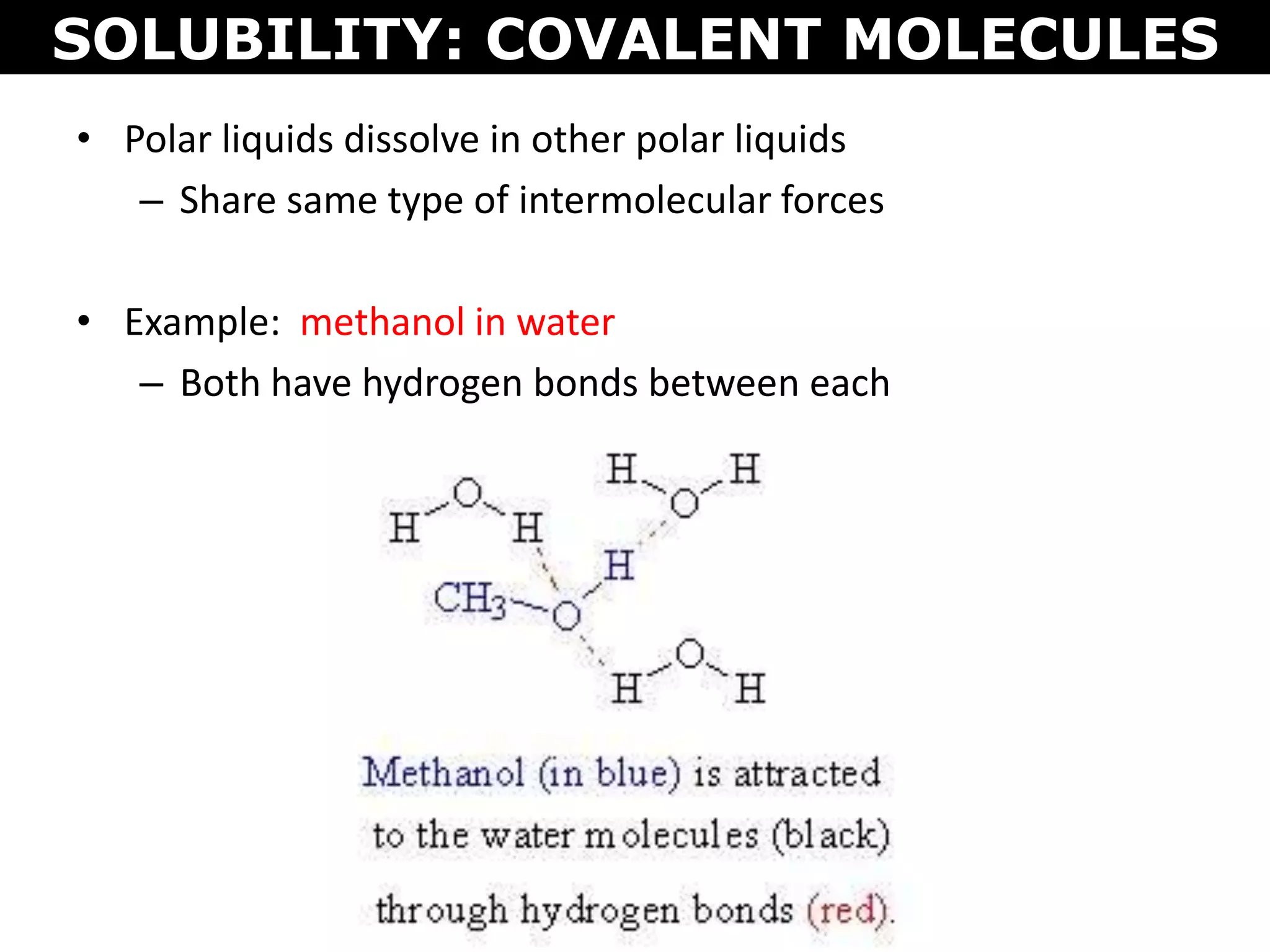
• Polar liquids dissolve in other polar liquids
– Share same type of intermolecular forces
• Example: methanol in water
– Both have hydrogen bonds between each
SOLUBILITY: COVALENT MOLECULES
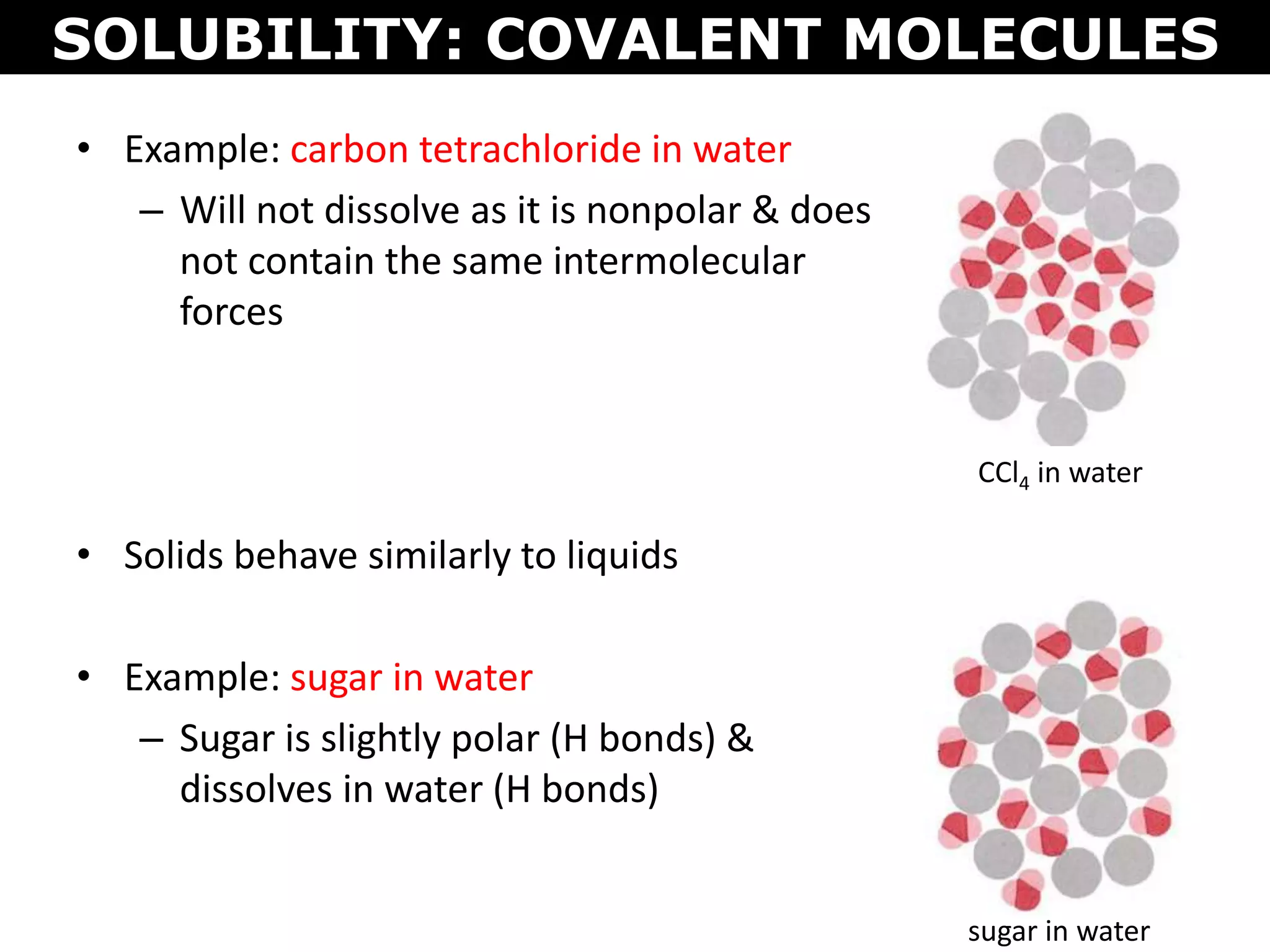
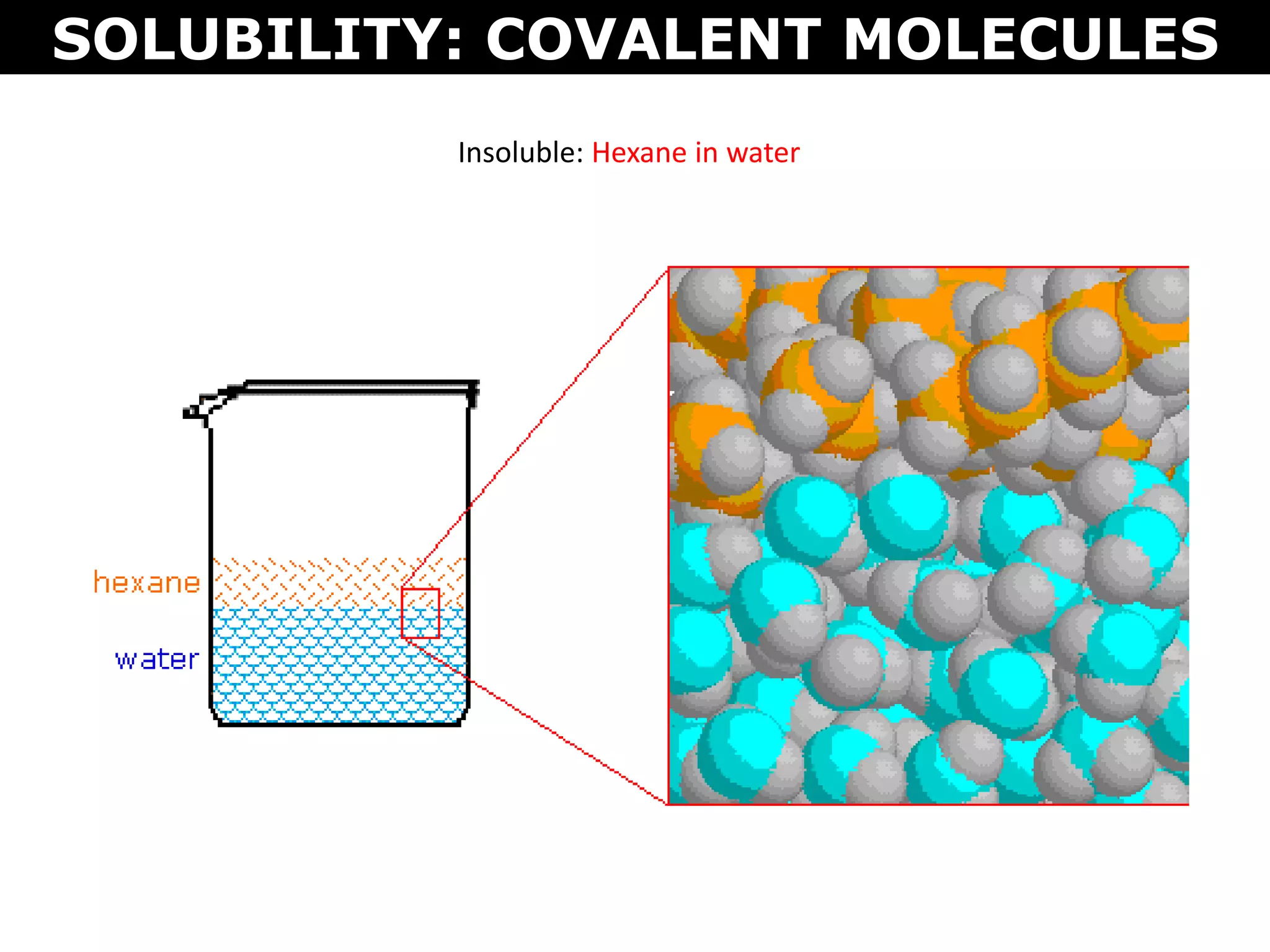
• Example: carbon tetrachloride in water
– Will not dissolve as it is nonpolar & does
not contain the same intermolecular
forces
• Solids behave similarly to liquids
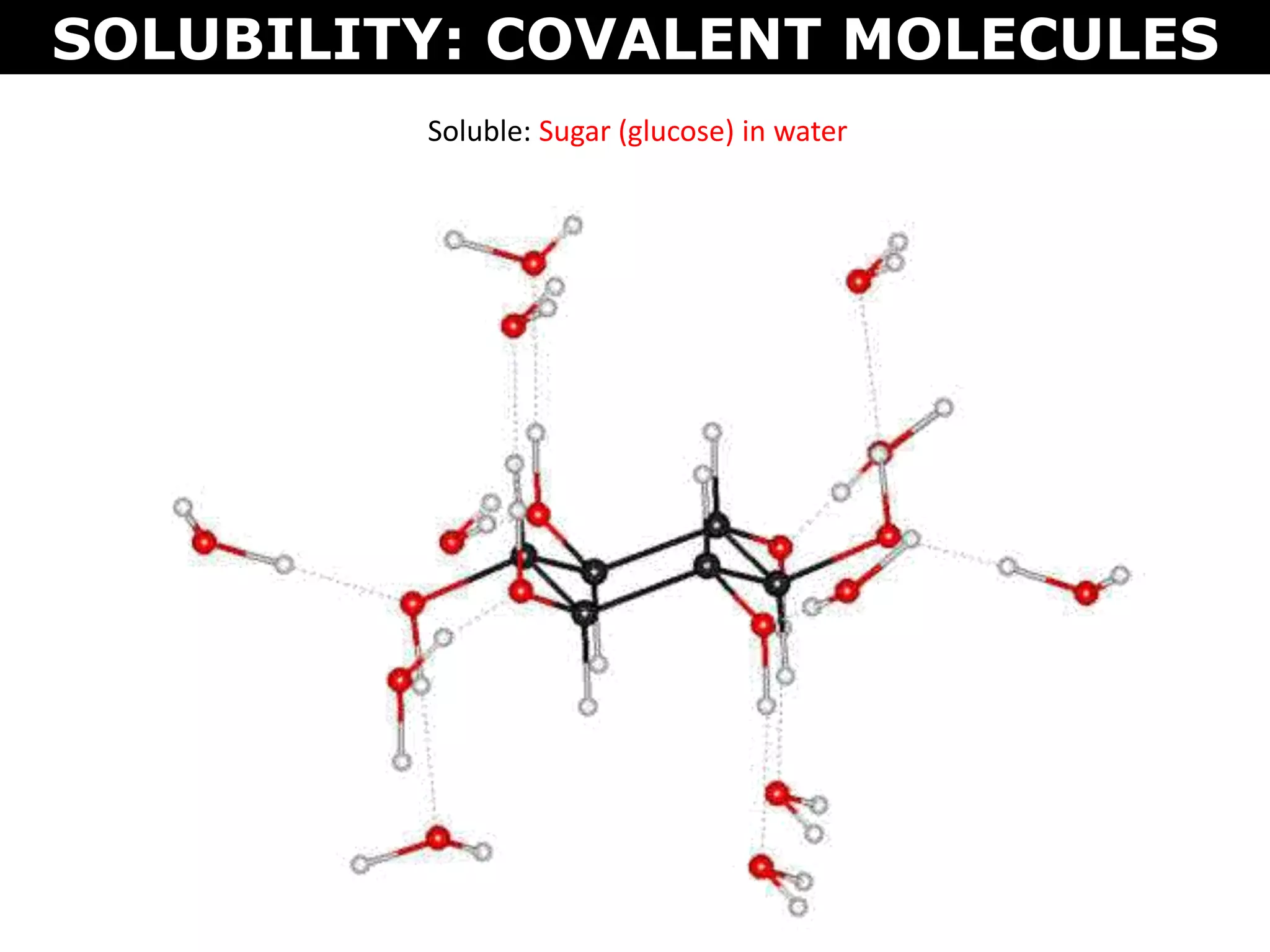
• Example: sugar in water
– Sugar is slightly polar (H bonds) &
dissolves in water (H bonds)
SOLUBILITY: COVALENT MOLECULES
CCl4 in water
sugar in water
SOLUBILITY: COVALENT MOLECULES
Soluble: Sugar (glucose) in water
SOLUBILITY: COVALENT MOLECULES
Insoluble: Hexane in water
• Rarely soluble in nonpolar or low polar solvents
• Sometimes soluble in water
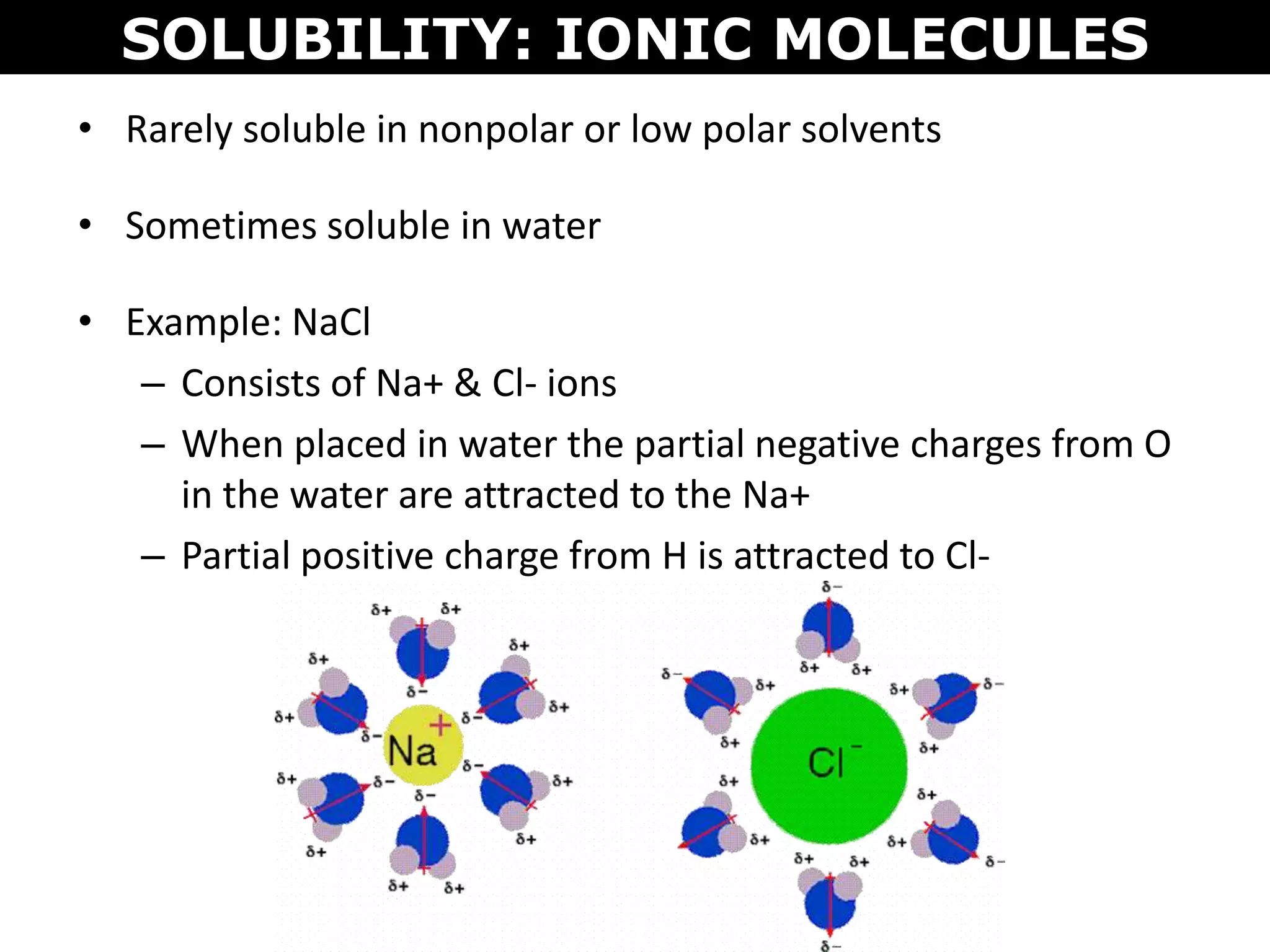
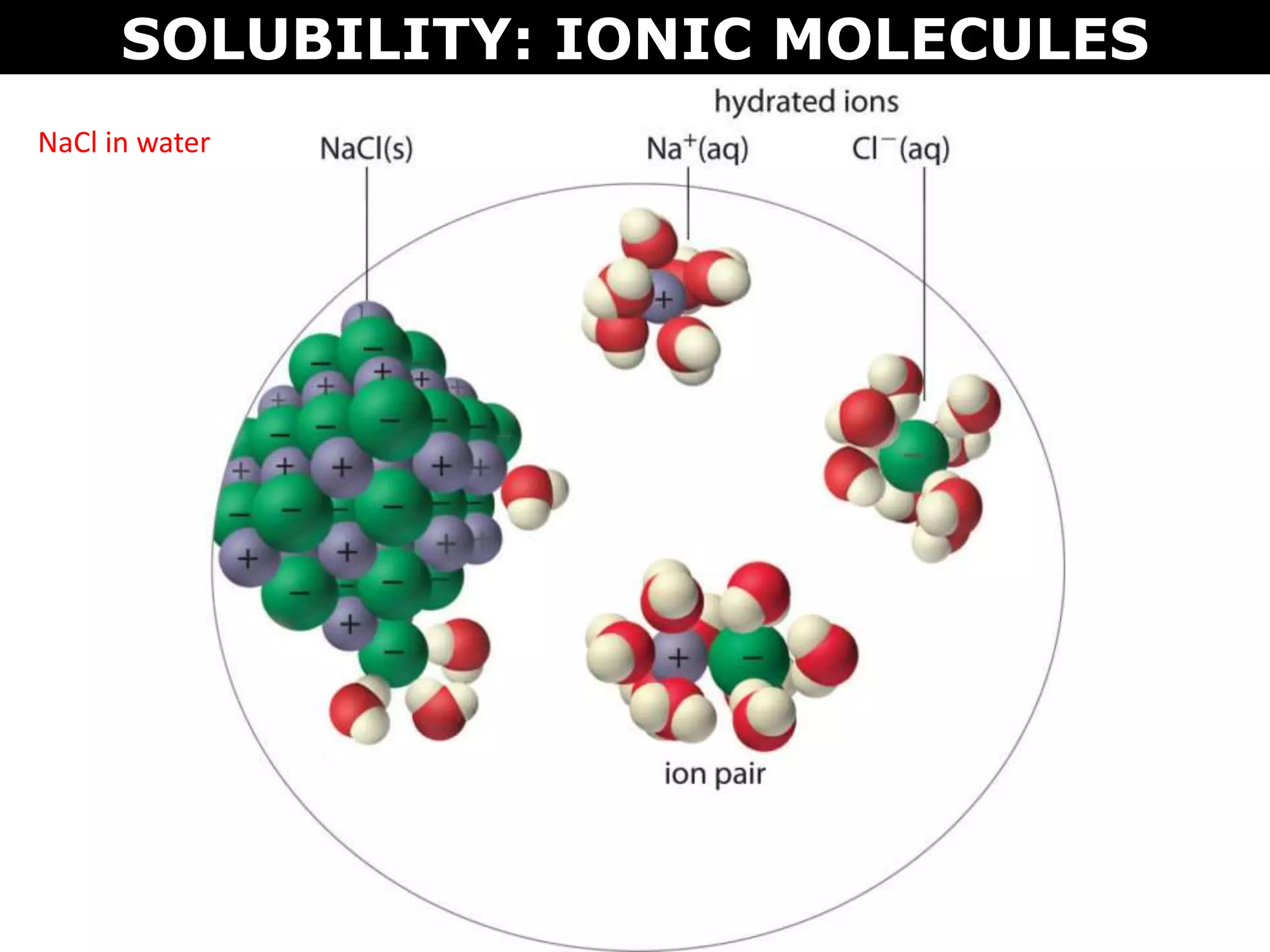
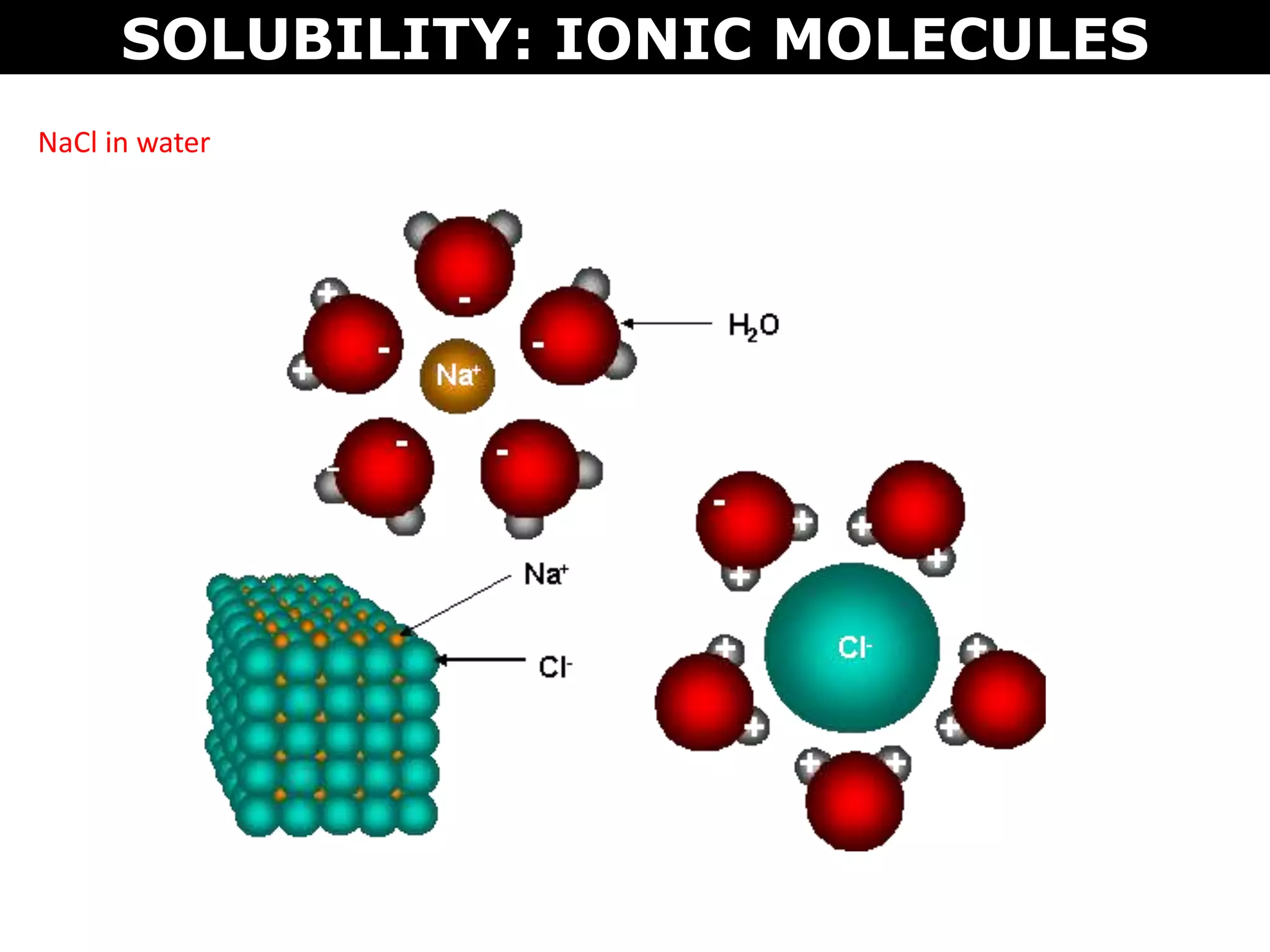
• Example: NaCl
– Consists of Na+ & Cl- ions
– When placed in water the partial negative charges from O
in the water are attracted to the Na+
– Partial positive charge from H is attracted to Cl-
SOLUBILITY: IONIC MOLECULES
NaCl in water
SOLUBILITY: IONIC MOLECULES
NaCl in water
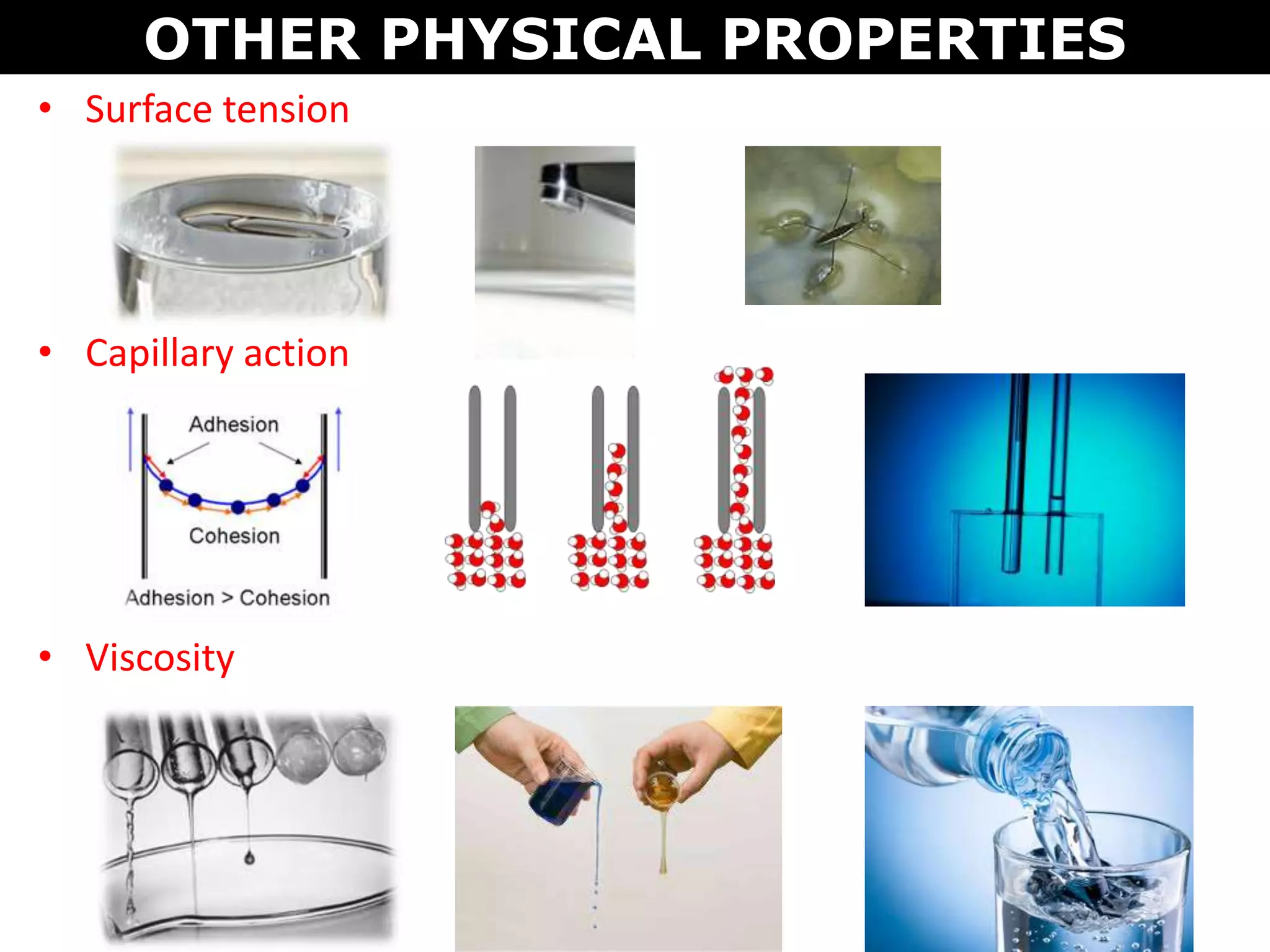
• Surface tension
• Capillary action
• Viscosity
OTHER PHYSICAL PROPERTIES
Homework
• Page 247 #1 – 8
• Complete pre-lab for access to lab tomorrow
INTERMOLECULAR FORCES & SOLUBILITY

Tang 09 intermolecular forces and solubility

  • 1.
  • 2.
    INTRAMOLECULAR FORCES • Forcesof electrostatic attraction within a molecule • Occurs between the nuclei of atoms & their electrons making up the molecule (i.e. covalent bonds) • Must be broken by chemical means • Form new substances when broken
  • 3.
    INTERMOLECULAR FORCES • Forcesof attraction between two molecules – London dispersion – Dipole-dipole – Hydrogen bonds • Much weaker than intramolecular forces so much easier to break • Physical changes break or weaken these forces • Do not form new substances when broken
  • 4.
    Type #1: LondonDispersion Forces • Based on the simultaneous attraction of the electrons of one molecule by the positive nucleus of neighbouring molecules • Strength of force is directly related to number of electrons & protons in a given molecule • The greater number of electrons & protons, the greater the force INTERMOLECULAR FORCES
  • 5.
    Type #1: LondonDispersion Forces INTERMOLECULAR FORCES
  • 6.
    Type #1: LondonDispersion Forces INTERMOLECULAR FORCES
  • 7.
    Type #1: LondonDispersion Forces INTERMOLECULAR FORCES
  • 8.
    Type #1: LondonDispersion Forces INTERMOLECULAR FORCES
  • 9.
    Type #1: LondonDispersion Forces INTERMOLECULAR FORCES
  • 10.
    Type #1: LondonDispersion Forces INTERMOLECULAR FORCES
  • 11.
    Type #2: Dipole– Dipole Forces • Occurs between polar molecules having dipoles • Molecules with dipoles are characterized by oppositely charged ends that are due to an unequal distribution of charge on the molecule • Polarity is determined by both the polarity of the bond & the shape of the molecule INTERMOLECULAR FORCES
  • 12.
    • Based onthe simultaneous attraction of the electrons of one dipole by the dipoles of neighbouring molecules • Strength of the force is related to polarity of the given molecule Which molecule will make stronger dipole-dipole forces? Type #2: Dipole – Dipole Forces INTERMOLECULAR FORCES I Cl I F 2.5 3.0 2.5 4.5 ΔEN = 1.5 ΔEN = 2.0
  • 13.
    Type #2: Dipole– Dipole Forces INTERMOLECULAR FORCES
  • 14.
    • Type ofdipole – dipole interaction • Occur between H atoms in one molecule & highly EN atoms (N, O or F) where there are usually unshared pairs of electrons present • H bonds are the strongest intermolecular force & are 1/10th the strength of a covalent bond Type #3: Hydrogen bonds INTERMOLECULAR FORCES
  • 15.
    Type #3: Hydrogenbonds INTERMOLECULAR FORCES
  • 16.
  • 17.
    Intermolecular forces affect: –Melting point – Boiling point – Capillary action – Surface tension – Solubility INTERMOLECULAR FORCES
  • 18.
    • Molecules thatare isoelectronic (same # of electrons) have the same strength of London dispersion forces • More polar molecules have stronger dipole – dipole interaction  Higher melting & boiling points • The more electrons per molecule, the stronger the London forces & the higher the melting & boiling point PREDICTING BOILING POINTS
  • 19.
    • Solution isformed when a solute dissolves in solvent • Solution formation is independent on the intermolecular forces of all molecules involved • Remember: ‘Like Dissolves Like’ POLARITY AND SOLUBILITY
  • 20.
    • Polar liquidsdissolve in other polar liquids – Share same type of intermolecular forces • Example: methanol in water – Both have hydrogen bonds between each SOLUBILITY: COVALENT MOLECULES
  • 21.
    • Example: carbontetrachloride in water – Will not dissolve as it is nonpolar & does not contain the same intermolecular forces • Solids behave similarly to liquids • Example: sugar in water – Sugar is slightly polar (H bonds) & dissolves in water (H bonds) SOLUBILITY: COVALENT MOLECULES CCl4 in water sugar in water
  • 22.
  • 23.
  • 24.
    • Rarely solublein nonpolar or low polar solvents • Sometimes soluble in water • Example: NaCl – Consists of Na+ & Cl- ions – When placed in water the partial negative charges from O in the water are attracted to the Na+ – Partial positive charge from H is attracted to Cl- SOLUBILITY: IONIC MOLECULES
  • 25.
  • 26.
  • 27.
    • Surface tension •Capillary action • Viscosity OTHER PHYSICAL PROPERTIES
  • 28.
    Homework • Page 247#1 – 8 • Complete pre-lab for access to lab tomorrow INTERMOLECULAR FORCES & SOLUBILITY