Volumetric Analysis
Concentration of Solutions
Remember:
 Solution – A mixture of a solute and a
solvent
 Solvent – The liquid in which the solute is
dissolved
 Solute – The substance that is dissolved in
the solvent


Dilute Solution – contains a small amount
of solute per solvent



Concentrated Solution – contains a large
amount of solute per solvent



Concentration – the amount of solute that
is dissolved in a specific volume of
solution
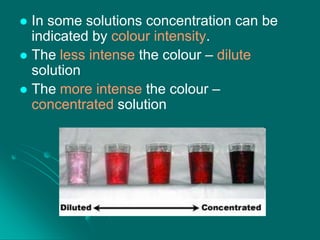
In some solutions concentration can be
indicated by colour intensity.
 The less intense the colour – dilute
solution
 The more intense the colour –
concentrated solution

1.

% Weight per weight (% w/w)



Mass per 100g
Example:






12% w/w means that there is 12g per 100g
Concentrated acid/base
% iron in iron tablets

Q: In a 125g solution, there is 22.5g of HCl.
Express this concentration as %w/w.
A: 22.5 125 x 100 = 18% w/w
2.

% Weight per volume (%w/v)



Mass per 100cm3
Example:





30% w/v means that there is 30g per 100cm3
Saline solution – 0.91% w/v NaCl

Q: A 1.4% solution of CaCl is required for an
experiment. If you need 250cm3 of this
solution, how much CaCl should be weighed
out?
A: 1.4 x 2.5 = 3.5g
3.

% Volume per volume (%v/v)



Volume per 100cm3
Example:





9% v/v contains 9cm3 per 100cm3
Concentration of alcohol in beverages

Q: Wine contains 14% v/v. If a person
consumes a 40cm3 glass of wine, how much
alcohol do they consume?
A: 14 100 x 40 = 5.6cm3
Parts per million (ppm)

4.





Number of milligrams per litre
1 ppm = 1mg per L (remember 1000mg = 1g)
Used for very dilute solutions
Example:




Concentrations of pollutants in water

Q: A sample of water is found to contain
0.003g of lead in a 250cm3 sample. What is
the concentration of lead in ppm?
A: 0.003 x 4 x 1000 = 12ppm
5.

Molarity


Number of moles per litre



Most common method of expressing
concentration



1M = 1 mol/litre = 1 mol l-1



A 1 Molar solution contains one mole of
solute dissolved in 1 litre of solution


Q: A solution is labelled 0.15M HCl. How
many grams of HCl are present in 1 litre?
A: Mr of HCl = 36.5g
1M solution contains 36.5g / l
0.15M solution = 36.5 x 0.15 = 5.475g



Q: A solution contains 4.9g H2SO4 in 100cm3.
Calculate the concentration in mol/l.
A: Mr of H2SO4 = 98g
4.9 98 = 0.05mol in 100cm3
0.05 x 10 = 0.5mol/l
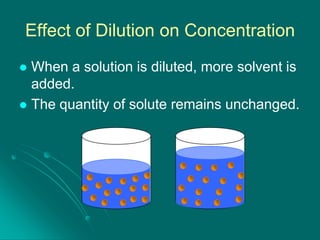
Effect of Dilution on Concentration
When a solution is diluted, more solvent is
added.
 The quantity of solute remains unchanged.



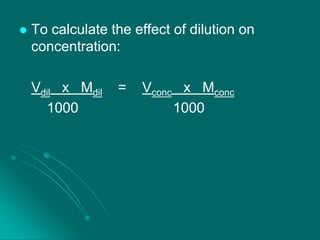
To calculate the effect of dilution on
concentration:
Vdil x Mdil
1000

=

Vconc x Mconc
1000


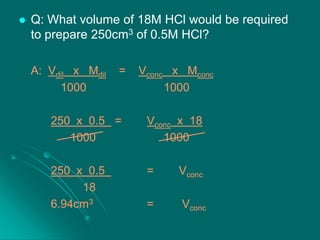
Q: What volume of 18M HCl would be required
to prepare 250cm3 of 0.5M HCl?
A: Vdil x Mdil
1000

=

Vconc x Mconc
1000

250 x 0.5 =
1000

Vconc x 18
1000

250 x 0.5
18
6.94cm3

=

Vconc

=

Vconc
Standard Solutions
A standard solution is a solution of
accurately known concentration
 It is prepared by dissolving an exact mass
of solute in a solvent producing a definite
known volume of the solution

Primary Standard










Pure and stable state
Soluble in water
Anhydrous (not hydrated)
No water loss (no efflorescence)
Not deliquescent
Not hygroscopic
Does not sublime
High Molecular Mass
Used to produce a solution of accurately known
concentration
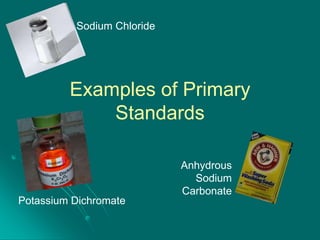
Sodium Chloride

Examples of Primary
Standards

Potassium Dichromate

Anhydrous
Sodium
Carbonate
Common substances that are not primary
standards include:
Sulfuric acid – absorbs water vapour from the
air.
 Sodium hydroxide – absorbs water vapour
from the air.
 Iodine – sublimes.


4.1 concentration of solutions

  • 1.
  • 2.
    Concentration of Solutions Remember: Solution – A mixture of a solute and a solvent  Solvent – The liquid in which the solute is dissolved  Solute – The substance that is dissolved in the solvent
  • 3.
     Dilute Solution –contains a small amount of solute per solvent  Concentrated Solution – contains a large amount of solute per solvent  Concentration – the amount of solute that is dissolved in a specific volume of solution
  • 4.
    In some solutionsconcentration can be indicated by colour intensity.  The less intense the colour – dilute solution  The more intense the colour – concentrated solution 
  • 5.
    1. % Weight perweight (% w/w)   Mass per 100g Example:     12% w/w means that there is 12g per 100g Concentrated acid/base % iron in iron tablets Q: In a 125g solution, there is 22.5g of HCl. Express this concentration as %w/w. A: 22.5 125 x 100 = 18% w/w
  • 6.
    2. % Weight pervolume (%w/v)   Mass per 100cm3 Example:    30% w/v means that there is 30g per 100cm3 Saline solution – 0.91% w/v NaCl Q: A 1.4% solution of CaCl is required for an experiment. If you need 250cm3 of this solution, how much CaCl should be weighed out? A: 1.4 x 2.5 = 3.5g
  • 7.
    3. % Volume pervolume (%v/v)   Volume per 100cm3 Example:    9% v/v contains 9cm3 per 100cm3 Concentration of alcohol in beverages Q: Wine contains 14% v/v. If a person consumes a 40cm3 glass of wine, how much alcohol do they consume? A: 14 100 x 40 = 5.6cm3
  • 8.
    Parts per million(ppm) 4.     Number of milligrams per litre 1 ppm = 1mg per L (remember 1000mg = 1g) Used for very dilute solutions Example:   Concentrations of pollutants in water Q: A sample of water is found to contain 0.003g of lead in a 250cm3 sample. What is the concentration of lead in ppm? A: 0.003 x 4 x 1000 = 12ppm
  • 9.
    5. Molarity  Number of molesper litre  Most common method of expressing concentration  1M = 1 mol/litre = 1 mol l-1  A 1 Molar solution contains one mole of solute dissolved in 1 litre of solution
  • 10.
     Q: A solutionis labelled 0.15M HCl. How many grams of HCl are present in 1 litre? A: Mr of HCl = 36.5g 1M solution contains 36.5g / l 0.15M solution = 36.5 x 0.15 = 5.475g  Q: A solution contains 4.9g H2SO4 in 100cm3. Calculate the concentration in mol/l. A: Mr of H2SO4 = 98g 4.9 98 = 0.05mol in 100cm3 0.05 x 10 = 0.5mol/l
  • 11.
    Effect of Dilutionon Concentration When a solution is diluted, more solvent is added.  The quantity of solute remains unchanged. 
  • 12.
     To calculate theeffect of dilution on concentration: Vdil x Mdil 1000 = Vconc x Mconc 1000
  • 13.
     Q: What volumeof 18M HCl would be required to prepare 250cm3 of 0.5M HCl? A: Vdil x Mdil 1000 = Vconc x Mconc 1000 250 x 0.5 = 1000 Vconc x 18 1000 250 x 0.5 18 6.94cm3 = Vconc = Vconc
  • 14.
    Standard Solutions A standardsolution is a solution of accurately known concentration  It is prepared by dissolving an exact mass of solute in a solvent producing a definite known volume of the solution 
  • 15.
    Primary Standard          Pure andstable state Soluble in water Anhydrous (not hydrated) No water loss (no efflorescence) Not deliquescent Not hygroscopic Does not sublime High Molecular Mass Used to produce a solution of accurately known concentration
  • 16.
    Sodium Chloride Examples ofPrimary Standards Potassium Dichromate Anhydrous Sodium Carbonate
  • 17.
    Common substances thatare not primary standards include: Sulfuric acid – absorbs water vapour from the air.  Sodium hydroxide – absorbs water vapour from the air.  Iodine – sublimes. 