TYPES OF SOLIDS
Two types (based upon atomic arrangement, binding
energy, physical & chemical properties):
1. Crystalline
2. Amorphous
Crystalline solids
 The building constituents arrange themselves in regular
manner throughout the entire three dimensional network.
 Existence of crystalline lattice.
 A crystalline lattice is a solid figure which has a definite
geometrical shape, with flat faces and sharp edges.
 Incompressible orderly arranged units.
 Definite sharp melting point.
 Anisotropy.
 Definite geometry.
 Give x-ray diffraction bands.
 Examples: NaCl, CsCl, etc.
AMORPHOUS SOLIDS
 Derived from Greek word ‘Omorphe’ meaning
shapeless.
 No regular but haphazard arrangement of atoms or
molecules.
 Also considered as non-crystalline solids or super-
cooled liquids.
 No sharp m.p.
 Isotropic.
 No definite geometrical shape.
 Do not give x-ray diffraction bands.
 Examples: glass, rubber, plastics.
Types of crystal structures
 Ionic crystals
 Covalent crystals
 Molecular crystals
 Metallic crystals
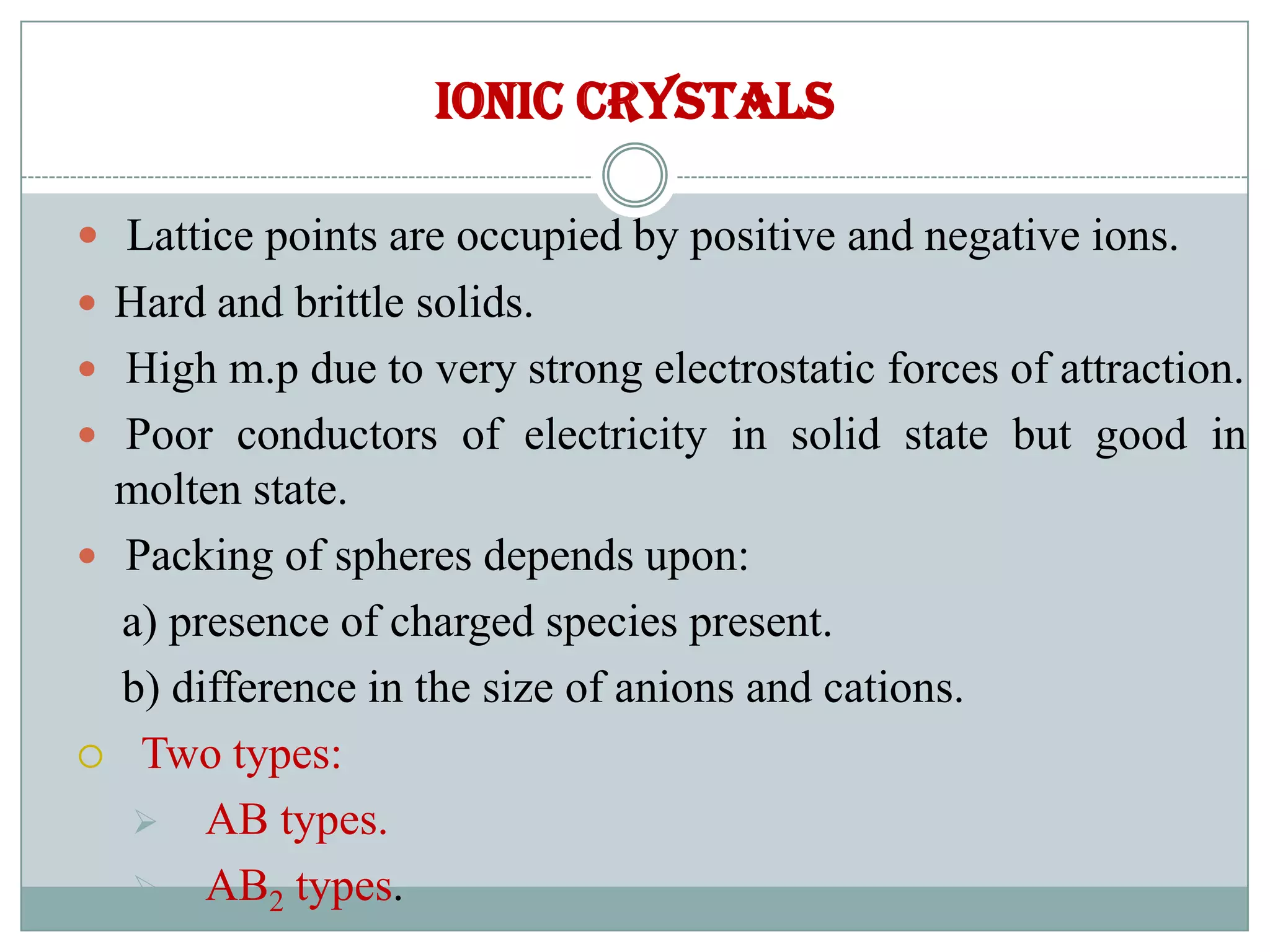
Ionic crystals
 Lattice points are occupied by positive and negative ions.
 Hard and brittle solids.
 High m.p due to very strong electrostatic forces of attraction.
 Poor conductors of electricity in solid state but good in
molten state.
 Packing of spheres depends upon:
a) presence of charged species present.
b) difference in the size of anions and cations.
 Two types:
 AB types.
 AB2 types.
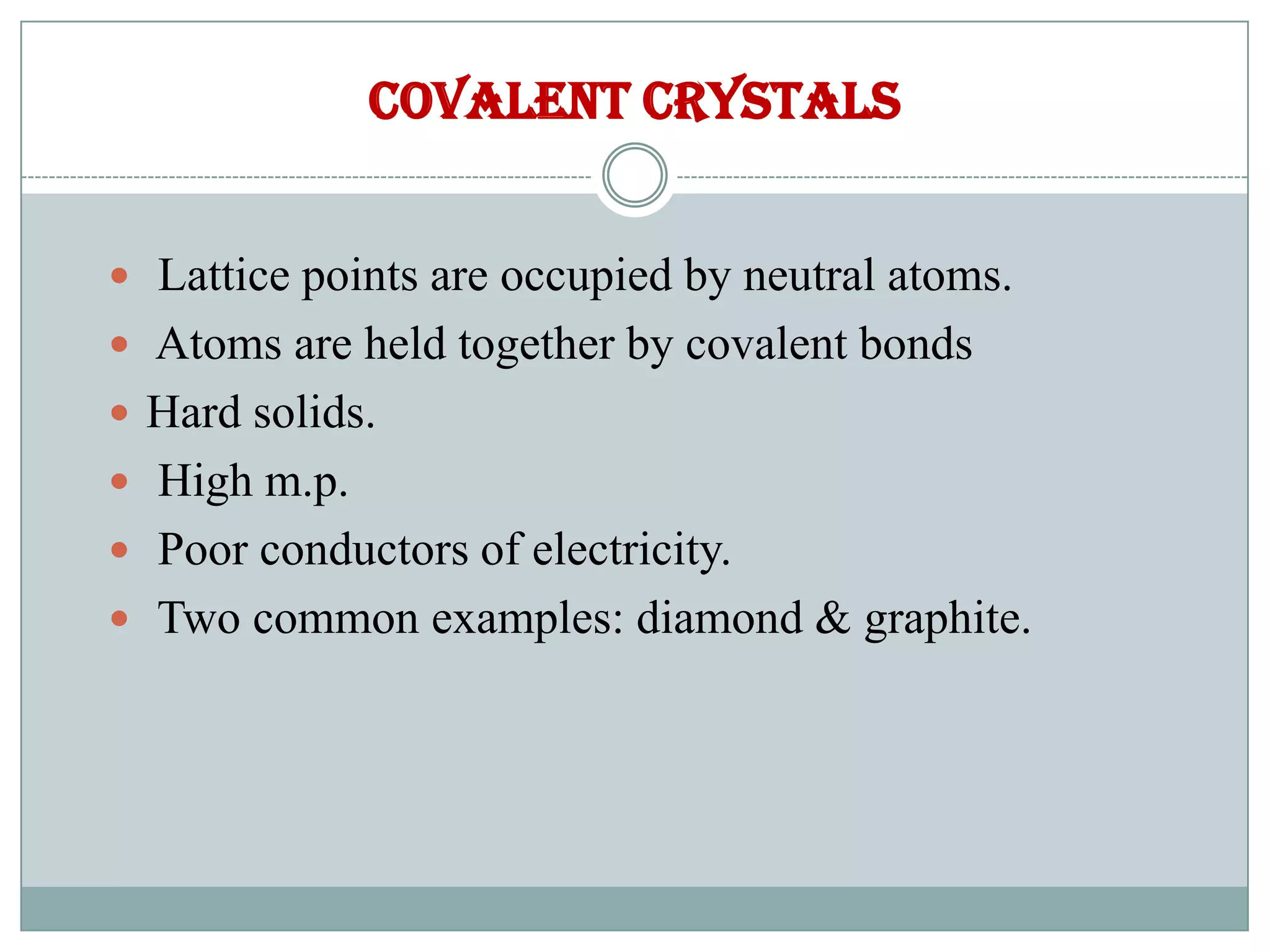
Covalent crystals
 Lattice points are occupied by neutral atoms.
 Atoms are held together by covalent bonds
 Hard solids.
 High m.p.
 Poor conductors of electricity.
 Two common examples: diamond & graphite.
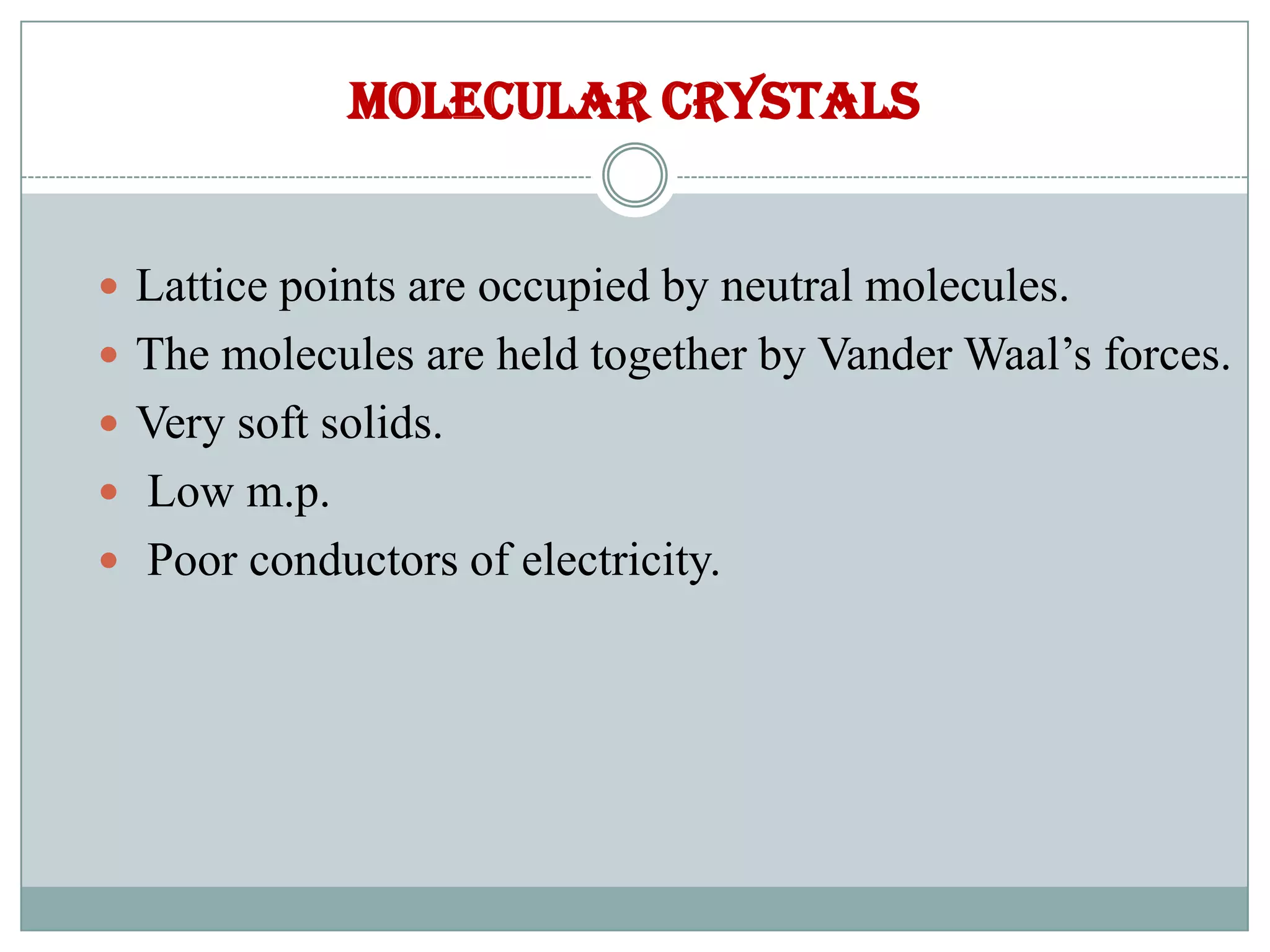
Molecular crystals
 Lattice points are occupied by neutral molecules.
 The molecules are held together by Vander Waal’s forces.
 Very soft solids.
 Low m.p.
 Poor conductors of electricity.
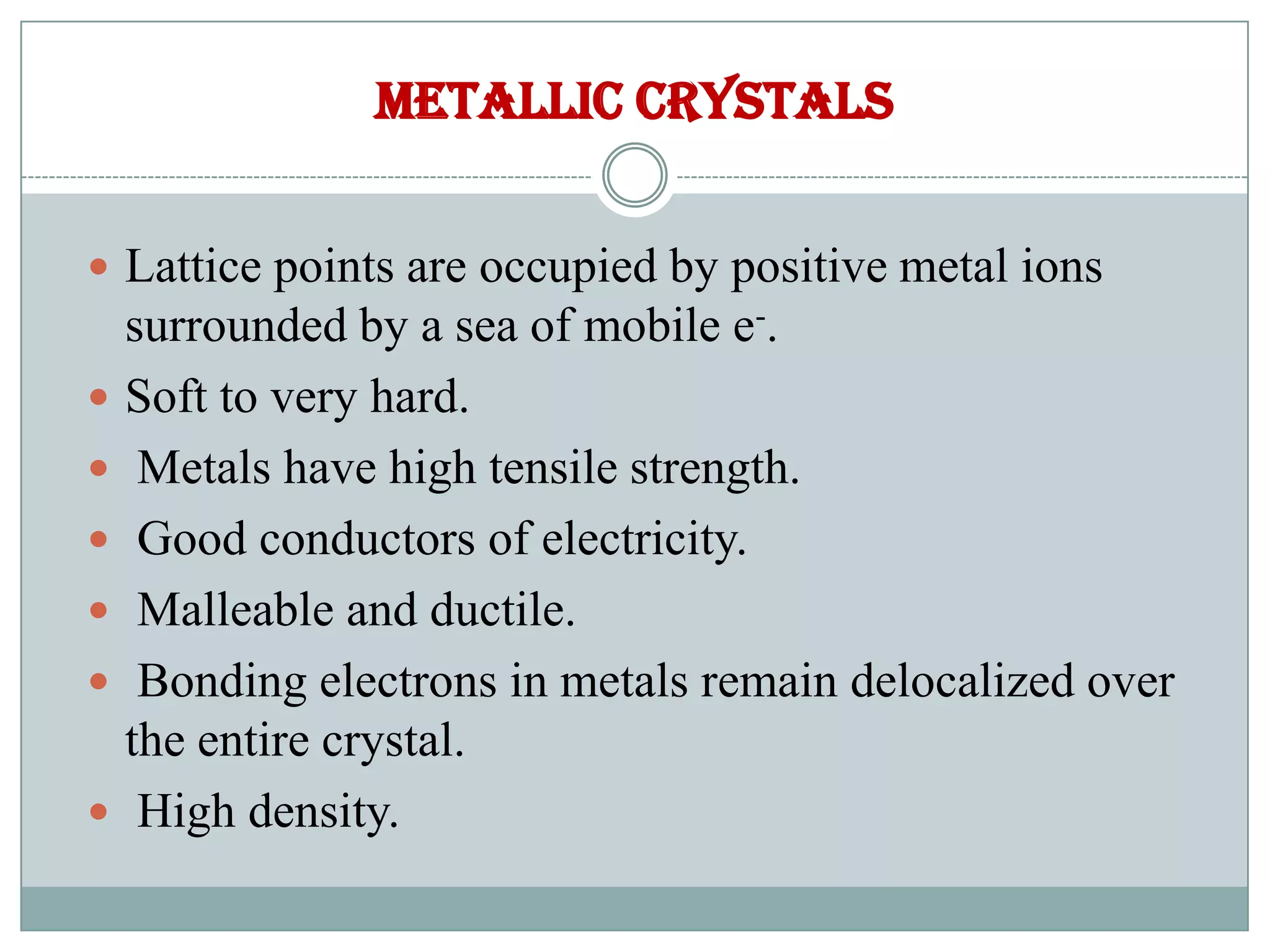
Metallic crystals
 Lattice points are occupied by positive metal ions
surrounded by a sea of mobile e-.
 Soft to very hard.
 Metals have high tensile strength.
 Good conductors of electricity.
 Malleable and ductile.
 Bonding electrons in metals remain delocalized over
the entire crystal.
 High density.

Types of solids

  • 1.
    TYPES OF SOLIDS Twotypes (based upon atomic arrangement, binding energy, physical & chemical properties): 1. Crystalline 2. Amorphous
  • 2.
    Crystalline solids  Thebuilding constituents arrange themselves in regular manner throughout the entire three dimensional network.  Existence of crystalline lattice.  A crystalline lattice is a solid figure which has a definite geometrical shape, with flat faces and sharp edges.  Incompressible orderly arranged units.  Definite sharp melting point.  Anisotropy.  Definite geometry.  Give x-ray diffraction bands.  Examples: NaCl, CsCl, etc.
  • 3.
    AMORPHOUS SOLIDS  Derivedfrom Greek word ‘Omorphe’ meaning shapeless.  No regular but haphazard arrangement of atoms or molecules.  Also considered as non-crystalline solids or super- cooled liquids.  No sharp m.p.  Isotropic.  No definite geometrical shape.  Do not give x-ray diffraction bands.  Examples: glass, rubber, plastics.
  • 4.
    Types of crystalstructures  Ionic crystals  Covalent crystals  Molecular crystals  Metallic crystals
  • 5.
    Ionic crystals  Latticepoints are occupied by positive and negative ions.  Hard and brittle solids.  High m.p due to very strong electrostatic forces of attraction.  Poor conductors of electricity in solid state but good in molten state.  Packing of spheres depends upon: a) presence of charged species present. b) difference in the size of anions and cations.  Two types:  AB types.  AB2 types.
  • 6.
    Covalent crystals  Latticepoints are occupied by neutral atoms.  Atoms are held together by covalent bonds  Hard solids.  High m.p.  Poor conductors of electricity.  Two common examples: diamond & graphite.
  • 7.
    Molecular crystals  Latticepoints are occupied by neutral molecules.  The molecules are held together by Vander Waal’s forces.  Very soft solids.  Low m.p.  Poor conductors of electricity.
  • 8.
    Metallic crystals  Latticepoints are occupied by positive metal ions surrounded by a sea of mobile e-.  Soft to very hard.  Metals have high tensile strength.  Good conductors of electricity.  Malleable and ductile.  Bonding electrons in metals remain delocalized over the entire crystal.  High density.