Laboratory Apparatuses
By Prof. Liwayway Memije-Cruz
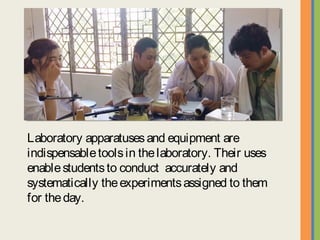
Laboratory apparatuses and equipment are
indispensable tools in the laboratory. Their uses enable
students to conduct accurately and systematically the
experiments assigned to them for the day.
Laboratory Apparatuses
• A beaker is a common
container in most
laboratories for mixing,
stirring, and heating
chemicals.
• useful as a reaction
container or to hold liquid
or solid samples.
• used to catch liquids
from titration and filtrates
from filtering operations.
• used to measure
approximate volume.
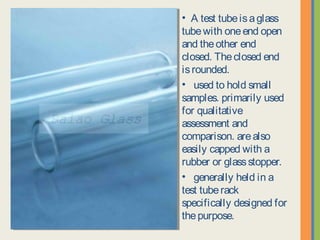
• A test tube is a glass
tube with one end open
and the other end closed.
The closed end is rounded.
• used to hold small
samples. primarily used for
qualitative assessment and
comparison. are also
easily capped with a
rubber or glass stopper.
• generally held in a test
tube rack specifically
designed for the purpose.
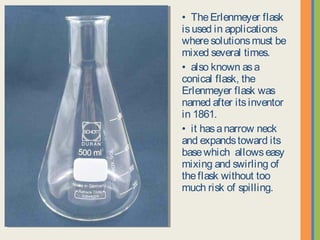
• The Erlenmeyer flask is
used in applications where
solutions must be mixed
several times.
• also known as a conical
flask, the Erlenmeyer flask
was named after its
inventor in 1861.
• it has a narrow neck and
expands toward its base
which allows easy mixing
and swirling of the flask
without too much risk of
spilling.
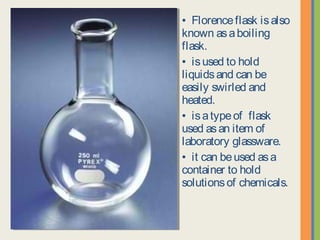
• Florence flask is also
known as a boiling flask.
• is used to hold liquids
and can be easily swirled
and heated.
• is a type of flask used
as an item of laboratory
glassware.
• it can be used as a
container to hold solutions
of chemicals.
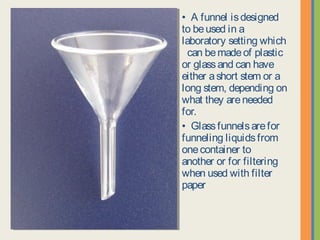
• A funnel is designed to
be used in a laboratory
setting which can be
made of plastic or glass
and can have either a
short stem or a long stem,
depending on what they
are needed for.
• Glass funnels are for
funneling liquids from one
container to another or for
filtering when used with
filter paper.
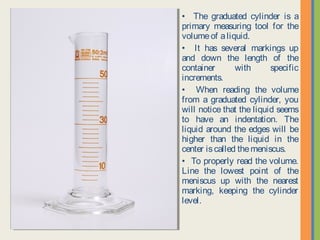
• The graduated cylinder is a
primary measuring tool for the
volume of a liquid.
• It has several markings up and
down the length of the container
with specific increments.
• When reading the volume from a
graduated cylinder, you will notice
that the liquid seems to have an
indentation. The liquid around the
edges will be higher than the liquid
in the center is called the meniscus.
• To properly read the volume. Line
the lowest point of the meniscus up
with the nearest marking, keeping
the cylinder level.
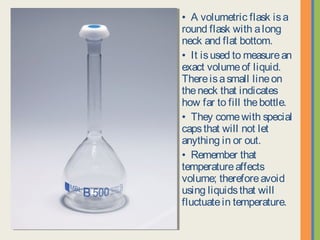
• A volumetric flask is a round
flask with a long neck and flat
bottom.
• It is used to measure an
exact volume of liquid. There is
a small line on the neck that
indicates how far to fill the
bottle.
• They come with special caps
that will not let anything in or
out.
• Remember that temperature
affects volume; therefore avoid
using liquids that will fluctuate in
temperature.
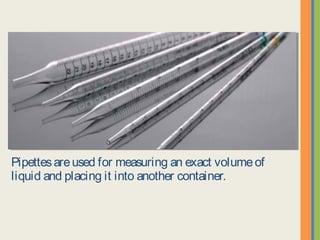
Pipettes are used for measuring an exact volume of liquid and
placing it into another container.
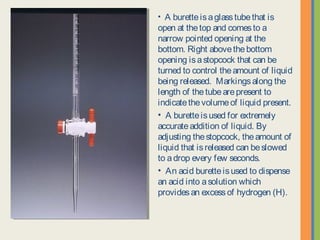
• A burette is a glass tube that is open at
the top and comes to a narrow pointed
opening at the bottom. Right above the
bottom opening is a stopcock that can be
turned to control the amount of liquid
being released. Markings along the
length of the tube are present to indicate
the volume of liquid present.
• A burette is used for extremely
accurate addition of liquid. By adjusting
the stopcock, the amount of liquid that is
released can be slowed to a drop every
few seconds.
• An acid burette is used to dispense an
acid into a solution which provides an
excess of hydrogen (H).
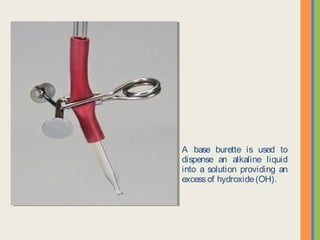
A base burette is used to
dispense an alkaline liquid into a
solution providing an excess of
hydroxide (OH).
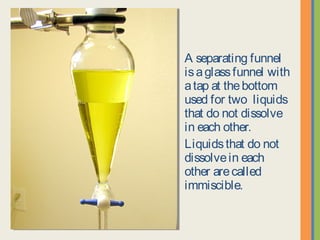
A separating funnel is
a glass funnel with a
tap at the bottom used
for two liquids that do
not dissolve in each
other.
Liquids that do not
dissolve in each other
are called immiscible.
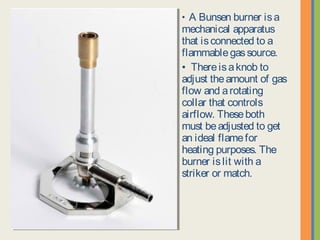
• A Bunsen burner is a
mechanical apparatus that
is connected to a
flammable gas source.
• There is a knob to adjust
the amount of gas flow and
a rotating collar that
controls airflow. These
both must be adjusted to
get an ideal flame for
heating purposes. The
burner is lit with a striker or
match.
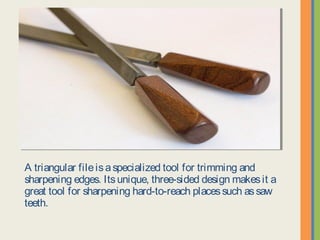
A triangular file is a specialized tool for trimming and sharpening
edges. Its unique, three-sided design makes it a great tool for
sharpening hard-to-reach places such as saw teeth.
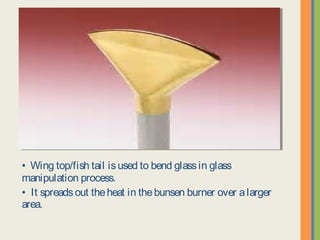
• Wing top/fish tail is used to bend glass in glass manipulation
process.
• It spreads out the heat in the bunsen burner over a larger area.
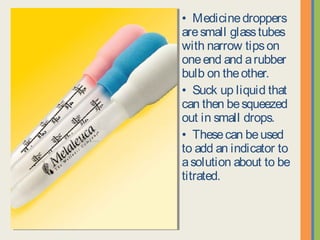
• Medicinedroppers
aresmall glasstubes
with narrow tipson
oneend and arubber
bulb on theother.
• Suck up liquid that
can then besqueezed
out in small drops.
• Thesecan beused
to add an indicator to
asolution about to be
titrated.
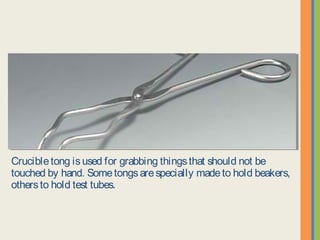
Crucible tong is used for grabbing things that should not be touched by
hand. Some tongs are specially made to hold beakers, others to hold test
tubes.
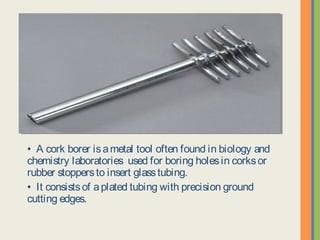
• A cork borer is a metal tool often found in biology and
chemistry laboratories used for boring holes in corks or rubber
stoppers to insert glass tubing.
• It consists of a plated tubing with precision ground cutting
edges.
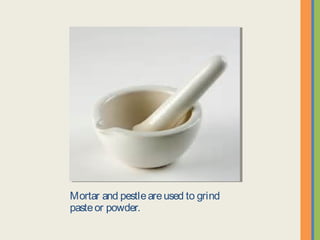
Mortar and pestle are used to grind paste or
powder.
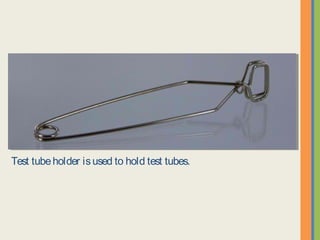
Test tube holder is used to hold test tubes.
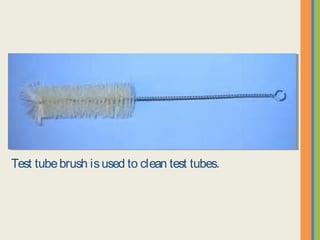
Test tube brush is used to clean test tubes.
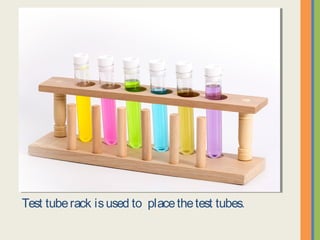
Test tube rack is used to place the test tubes.
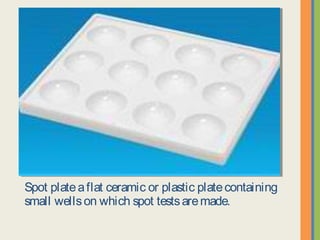
Spot plate a flat ceramic or plastic plate containing small
wells on which spot tests are made.
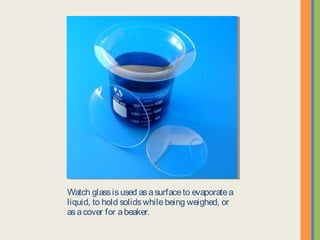
Watch glass is used as a surface to evaporate a
liquid, to hold solids while being weighed, or as a
cover for a beaker.
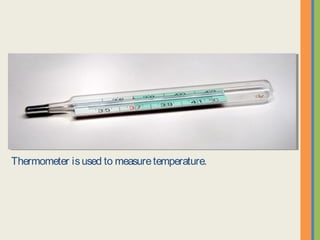
Thermometer is used to measure temperature.
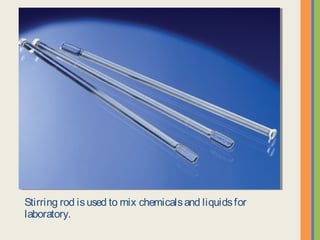
Stirring rod is used to mix chemicals and liquids for laboratory.
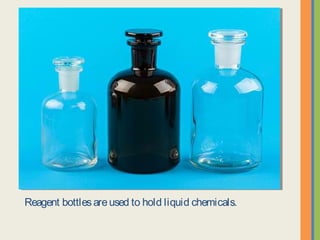
Reagent bottles are used to hold liquid chemicals.
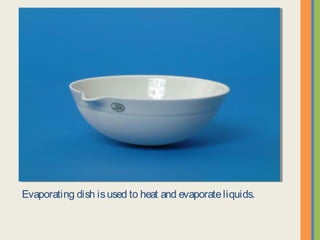
Evaporating dish is used to heat and evaporate liquids.
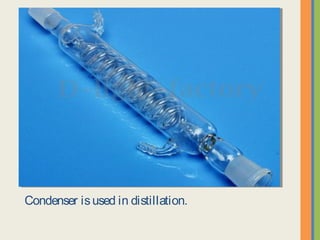
Condenser is used in distillation.
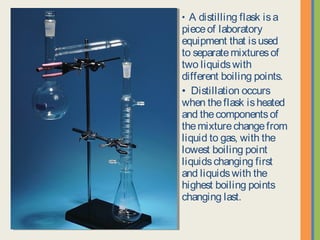
• A distilling flask is a
piece of laboratory
equipment that is used to
separate mixtures of two
liquids with different boiling
points.
• Distillation occurs when
the flask is heated and the
components of the mixture
change from liquid to gas,
with the lowest boiling
point liquids changing first
and liquids with the highest
boiling points changing
last.
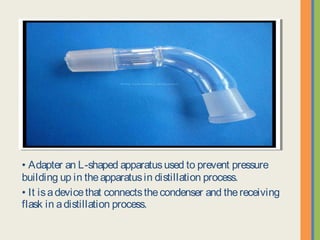
• Adapter an L-shaped apparatus used to prevent pressure
building up in the apparatus in distillation process.
• It is a device that connects the condenser and the receiving flask
in a distillation process.
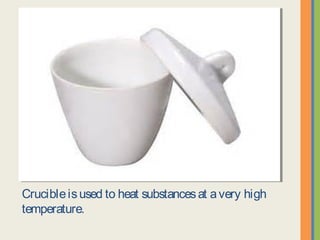
Crucible is used to heat substances at a very high
temperature.
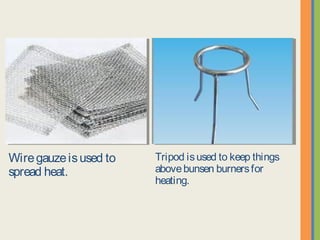
Wire gauze is used to spread
heat.
Tripod is used to keep things
above bunsen burners for heating.
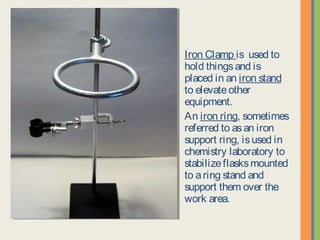
Iron Clamp is used to hold
things and is placed in an
iron stand to elevate other
equipment.
An iron ring, sometimes
referred to as an iron
support ring, is used in
chemistry laboratory to
stabilize flasks mounted to
a ring stand and support
them over the work area.
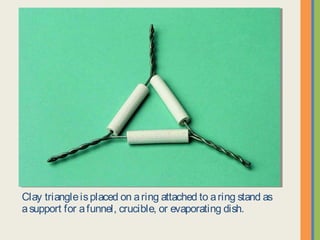
Clay triangle is placed on a ring attached to a ring stand as a
support for a funnel, crucible, or evaporating dish.
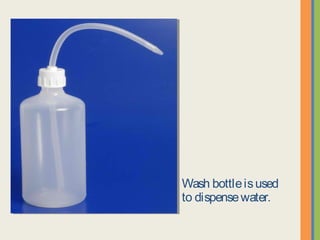
Wash bottle is used to
dispense water.
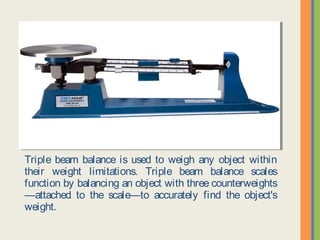
Triple beam balance is used to weigh any object within their
weight limitations. Triple beam balance scales function by
balancing an object with three counterweights—attached to the
scale—to accurately find the object's weight.
References:
https://www.scribd.com/doc/33552521/Laboratory-Apparatuses-and-Uses
https://owlcation.com/stem/A-Chemistry-Guide-List-of-Common-Laboratory-
Equipment-Names-and-Uses
http://sciencing.com/uses-distilling-flask-8111625.html
http://www.answers.com/Q/What_is_the_use_of_laboratory_iron_clamp#slide=1
http://www.wisegeek.com/what-is-a-triangular-file.htm
https://www.scribd.com/doc/57465131/Laboratory-Apparatus

Laboratory apparatus. final copy ppt

  • 1.
    Laboratory Apparatuses By Prof.Liwayway Memije-Cruz
  • 2.
    Laboratory apparatuses andequipment are indispensable tools in the laboratory. Their uses enable students to conduct accurately and systematically the experiments assigned to them for the day.
  • 3.
  • 4.
    • A beakeris a common container in most laboratories for mixing, stirring, and heating chemicals. • useful as a reaction container or to hold liquid or solid samples. • used to catch liquids from titration and filtrates from filtering operations. • used to measure approximate volume.
  • 5.
    • A testtube is a glass tube with one end open and the other end closed. The closed end is rounded. • used to hold small samples. primarily used for qualitative assessment and comparison. are also easily capped with a rubber or glass stopper. • generally held in a test tube rack specifically designed for the purpose.
  • 6.
    • The Erlenmeyerflask is used in applications where solutions must be mixed several times. • also known as a conical flask, the Erlenmeyer flask was named after its inventor in 1861. • it has a narrow neck and expands toward its base which allows easy mixing and swirling of the flask without too much risk of spilling.
  • 7.
    • Florence flaskis also known as a boiling flask. • is used to hold liquids and can be easily swirled and heated. • is a type of flask used as an item of laboratory glassware. • it can be used as a container to hold solutions of chemicals.
  • 8.
    • A funnelis designed to be used in a laboratory setting which can be made of plastic or glass and can have either a short stem or a long stem, depending on what they are needed for. • Glass funnels are for funneling liquids from one container to another or for filtering when used with filter paper.
  • 9.
    • The graduatedcylinder is a primary measuring tool for the volume of a liquid. • It has several markings up and down the length of the container with specific increments. • When reading the volume from a graduated cylinder, you will notice that the liquid seems to have an indentation. The liquid around the edges will be higher than the liquid in the center is called the meniscus. • To properly read the volume. Line the lowest point of the meniscus up with the nearest marking, keeping the cylinder level.
  • 10.
    • A volumetricflask is a round flask with a long neck and flat bottom. • It is used to measure an exact volume of liquid. There is a small line on the neck that indicates how far to fill the bottle. • They come with special caps that will not let anything in or out. • Remember that temperature affects volume; therefore avoid using liquids that will fluctuate in temperature.
  • 11.
    Pipettes are usedfor measuring an exact volume of liquid and placing it into another container.
  • 12.
    • A buretteis a glass tube that is open at the top and comes to a narrow pointed opening at the bottom. Right above the bottom opening is a stopcock that can be turned to control the amount of liquid being released. Markings along the length of the tube are present to indicate the volume of liquid present. • A burette is used for extremely accurate addition of liquid. By adjusting the stopcock, the amount of liquid that is released can be slowed to a drop every few seconds. • An acid burette is used to dispense an acid into a solution which provides an excess of hydrogen (H).
  • 13.
    A base buretteis used to dispense an alkaline liquid into a solution providing an excess of hydroxide (OH).
  • 14.
    A separating funnelis a glass funnel with a tap at the bottom used for two liquids that do not dissolve in each other. Liquids that do not dissolve in each other are called immiscible.
  • 15.
    • A Bunsenburner is a mechanical apparatus that is connected to a flammable gas source. • There is a knob to adjust the amount of gas flow and a rotating collar that controls airflow. These both must be adjusted to get an ideal flame for heating purposes. The burner is lit with a striker or match.
  • 16.
    A triangular fileis a specialized tool for trimming and sharpening edges. Its unique, three-sided design makes it a great tool for sharpening hard-to-reach places such as saw teeth.
  • 17.
    • Wing top/fishtail is used to bend glass in glass manipulation process. • It spreads out the heat in the bunsen burner over a larger area.
  • 18.
    • Medicinedroppers aresmall glasstubes withnarrow tipson oneend and arubber bulb on theother. • Suck up liquid that can then besqueezed out in small drops. • Thesecan beused to add an indicator to asolution about to be titrated.
  • 19.
    Crucible tong isused for grabbing things that should not be touched by hand. Some tongs are specially made to hold beakers, others to hold test tubes.
  • 20.
    • A corkborer is a metal tool often found in biology and chemistry laboratories used for boring holes in corks or rubber stoppers to insert glass tubing. • It consists of a plated tubing with precision ground cutting edges.
  • 21.
    Mortar and pestleare used to grind paste or powder.
  • 22.
    Test tube holderis used to hold test tubes.
  • 23.
    Test tube brushis used to clean test tubes.
  • 24.
    Test tube rackis used to place the test tubes.
  • 25.
    Spot plate aflat ceramic or plastic plate containing small wells on which spot tests are made.
  • 26.
    Watch glass isused as a surface to evaporate a liquid, to hold solids while being weighed, or as a cover for a beaker.
  • 27.
    Thermometer is usedto measure temperature.
  • 28.
    Stirring rod isused to mix chemicals and liquids for laboratory.
  • 29.
    Reagent bottles areused to hold liquid chemicals.
  • 30.
    Evaporating dish isused to heat and evaporate liquids.
  • 31.
    Condenser is usedin distillation.
  • 32.
    • A distillingflask is a piece of laboratory equipment that is used to separate mixtures of two liquids with different boiling points. • Distillation occurs when the flask is heated and the components of the mixture change from liquid to gas, with the lowest boiling point liquids changing first and liquids with the highest boiling points changing last.
  • 33.
    • Adapter anL-shaped apparatus used to prevent pressure building up in the apparatus in distillation process. • It is a device that connects the condenser and the receiving flask in a distillation process.
  • 34.
    Crucible is usedto heat substances at a very high temperature.
  • 35.
    Wire gauze isused to spread heat. Tripod is used to keep things above bunsen burners for heating.
  • 36.
    Iron Clamp isused to hold things and is placed in an iron stand to elevate other equipment. An iron ring, sometimes referred to as an iron support ring, is used in chemistry laboratory to stabilize flasks mounted to a ring stand and support them over the work area.
  • 37.
    Clay triangle isplaced on a ring attached to a ring stand as a support for a funnel, crucible, or evaporating dish.
  • 38.
    Wash bottle isused to dispense water.
  • 39.
    Triple beam balanceis used to weigh any object within their weight limitations. Triple beam balance scales function by balancing an object with three counterweights—attached to the scale—to accurately find the object's weight.
  • 41.