Formulas Based on Cross Sections
The cross–sectional lengths L(x) of a region and
the cross–sectional areas A(x) of a solid are the bases for
many of the formulas for area, volume, work/H2O pressure.
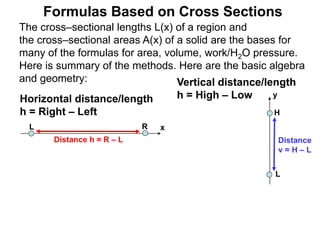
Here is summary of the methods. Here are the basic algebra
and geometry:
R
L
Horizontal distance/length
h = Right – Left
Distance h = R – L
x
y
H
L
Distance
v = H – L
Vertical distance/length
h = High – Low
Formulas Based on Cross Sections
The cross–sectional lengths L(x) of a region and
the cross–sectional areas A(x) of a solid are the bases for
many of the formulas for area, volume, work/H2O pressure.
Here is summary of the methods. Here are the basic algebra
and geometry:
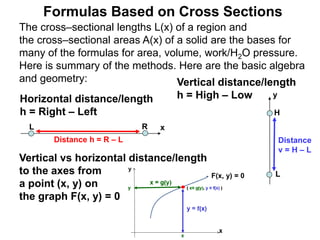
Vertical vs horizontal distance/length
to the axes from
a point (x, y) on
the graph F(x, y) = 0
F(x, y) = 0
R
L
Horizontal distance/length
h = Right – Left
Distance h = R – L
x
y
H
L
Distance
v = H – L
Vertical distance/length
h = High – Low
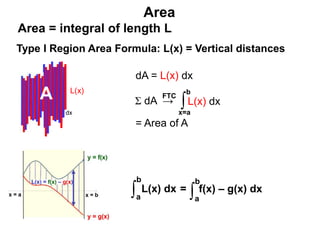
Area = integral of length L
dx
L(x)
dA = L(x) dx
Σ dA → ∫
x=a
b
L(x) dx
= Area of A
A FTC
Type I Region Area Formula: L(x) = Vertical distances
∫
b
L(x) dx
a
=
∫
b
f(x) – g(x) dx
a
Area
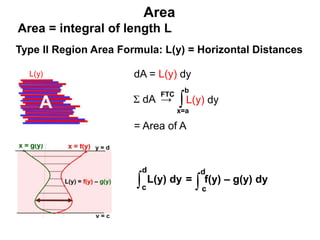
Type Il Region Area Formula: L(y) = Horizontal Distances
∫
d
L(y) dy
c
=
∫
d
f(y) – g(y) dy
c
L(y) dA = L(y) dy
Σ dA → ∫
x=a
b
L(y) dy
= Area of A
FTC
A
Area = integral of length L
Area
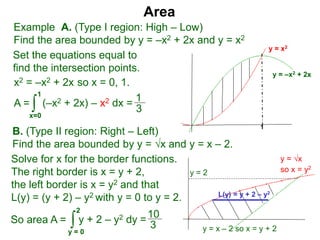
Example A. (Type I region: High – Low)
Find the area bounded by y = –x2 + 2x and y = x2
Area
Set the equations equal to
find the intersection points.
x2 = –x2 + 2x so x = 0, 1.
A = ∫
x=0
1
(–x2 + 2x) – x2 dx = 1
3
y = –x2 + 2x
y = x2
1
y = x – 2 so x = y + 2
y = √x
so x = y2
L(y) = y + 2 – y2
y = 2
Solve for x for the border functions.
The right border is x = y + 2,
the left border is x = y2 and that
L(y) = (y + 2) – y2 with y = 0 to y = 2.
So area A = y + 2 – y2 dy
∫
y = 0
2
=
10
3
B. (Type II region: Right – Left)
Find the area bounded by y = √x and y = x – 2.
dV = A(x) dx
V A(x)
dx
Σ dV → ∫
x=a
b
A(x) dx
= Volume of V
FTC
Volume = integral of area
Volume of revolution–solid
Solids of Revolution
∫
x=a
b
dx
V = π [f (x)]2
Cross–section–area A(x) = π [f (x)]2:
dV = A(y) dy
V
A(y)
dy
Σ dV → ∫
x=a
b
A(y) dy
= Volume of V
FTC
∫y=a
dy
π [f (y)]2
V =
Solids of Revolution
Volume = integral of area
Volume of revolution–solid
Cross–section–area A(x) = π [f (y)]2:
b
Solids of Revolution
Example C. Find the volume of revolution around the
x axis formed by the curve y = √x from x = 0 to x = 2.
The cross–sections are discs with
radius r = √x so A(x) = π (√x)2.
∫
x=0
2
dx
So the volume V = πx = 2π
∫
y=1
π [(1/2 + y–1/2)2 – 1/2 2] dy
4
So the volume V =
D. Find the volume of revolution around
the axis x = –½ formed by the template as shown.
The inner radius r = ½,
outer radius R = ½ + y –1/2.
2
=19π
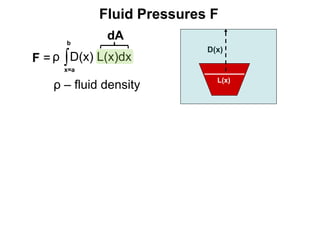
∫
b
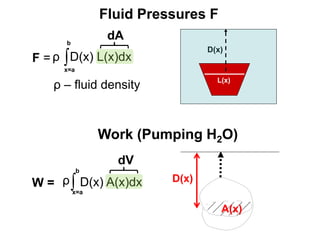
ρ D(x) L(x)dx
F =
D(x)
L(x)
x=a
Fluid Pressures F
ρ – fluid density
dA
∫
b
ρ D(x) L(x)dx
F =
D(x)
L(x)
x=a
Fluid Pressures F
ρ – fluid density
Work (Pumping H2O)
W = ∫x=a
b
D(x) A(x)dx
ρ
A(x)
D(x)
dA
dV
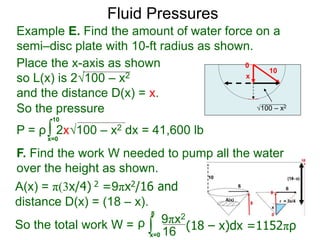
Place the x-axis as shown
so L(x) is 2100 – x2
and the distance D(x) = x.
0
x
10
100 – x2
So the pressure
P = ρ 2x100 – x2 dx = 41,600 lb
∫
x=0
10
Example E. Find the amount of water force on a
semi–disc plate with 10-ft radius as shown.
Fluid Pressures
A(x) = π(3x/4) 2 =9πx2/16 and
distance D(x) = (18 – x).
So the total work W = ∫
x=0
8
9πx2
(18 – x)dx =1152πρ
16
ρ
F. Find the work W needed to pump all the water
over the height as shown.

10 b review-cross-sectional formula

  • 1.
    Formulas Based onCross Sections
  • 2.
    Formulas Based onCross Sections The cross–sectional lengths L(x) of a region and the cross–sectional areas A(x) of a solid are the bases for many of the formulas for area, volume, work/H2O pressure. Here is summary of the methods. Here are the basic algebra and geometry: R L Horizontal distance/length h = Right – Left Distance h = R – L x y H L Distance v = H – L Vertical distance/length h = High – Low
  • 3.
    Formulas Based onCross Sections The cross–sectional lengths L(x) of a region and the cross–sectional areas A(x) of a solid are the bases for many of the formulas for area, volume, work/H2O pressure. Here is summary of the methods. Here are the basic algebra and geometry: Vertical vs horizontal distance/length to the axes from a point (x, y) on the graph F(x, y) = 0 F(x, y) = 0 R L Horizontal distance/length h = Right – Left Distance h = R – L x y H L Distance v = H – L Vertical distance/length h = High – Low
  • 4.
    Area = integralof length L dx L(x) dA = L(x) dx Σ dA → ∫ x=a b L(x) dx = Area of A A FTC Type I Region Area Formula: L(x) = Vertical distances ∫ b L(x) dx a = ∫ b f(x) – g(x) dx a Area
  • 5.
    Type Il RegionArea Formula: L(y) = Horizontal Distances ∫ d L(y) dy c = ∫ d f(y) – g(y) dy c L(y) dA = L(y) dy Σ dA → ∫ x=a b L(y) dy = Area of A FTC A Area = integral of length L Area
  • 6.
    Example A. (TypeI region: High – Low) Find the area bounded by y = –x2 + 2x and y = x2 Area Set the equations equal to find the intersection points. x2 = –x2 + 2x so x = 0, 1. A = ∫ x=0 1 (–x2 + 2x) – x2 dx = 1 3 y = –x2 + 2x y = x2 1 y = x – 2 so x = y + 2 y = √x so x = y2 L(y) = y + 2 – y2 y = 2 Solve for x for the border functions. The right border is x = y + 2, the left border is x = y2 and that L(y) = (y + 2) – y2 with y = 0 to y = 2. So area A = y + 2 – y2 dy ∫ y = 0 2 = 10 3 B. (Type II region: Right – Left) Find the area bounded by y = √x and y = x – 2.
  • 7.
    dV = A(x)dx V A(x) dx Σ dV → ∫ x=a b A(x) dx = Volume of V FTC Volume = integral of area Volume of revolution–solid Solids of Revolution ∫ x=a b dx V = π [f (x)]2 Cross–section–area A(x) = π [f (x)]2:
  • 8.
    dV = A(y)dy V A(y) dy Σ dV → ∫ x=a b A(y) dy = Volume of V FTC ∫y=a dy π [f (y)]2 V = Solids of Revolution Volume = integral of area Volume of revolution–solid Cross–section–area A(x) = π [f (y)]2: b
  • 9.
    Solids of Revolution ExampleC. Find the volume of revolution around the x axis formed by the curve y = √x from x = 0 to x = 2. The cross–sections are discs with radius r = √x so A(x) = π (√x)2. ∫ x=0 2 dx So the volume V = πx = 2π ∫ y=1 π [(1/2 + y–1/2)2 – 1/2 2] dy 4 So the volume V = D. Find the volume of revolution around the axis x = –½ formed by the template as shown. The inner radius r = ½, outer radius R = ½ + y –1/2. 2 =19π
  • 10.
    ∫ b ρ D(x) L(x)dx F= D(x) L(x) x=a Fluid Pressures F ρ – fluid density dA
  • 11.
    ∫ b ρ D(x) L(x)dx F= D(x) L(x) x=a Fluid Pressures F ρ – fluid density Work (Pumping H2O) W = ∫x=a b D(x) A(x)dx ρ A(x) D(x) dA dV
  • 12.
    Place the x-axisas shown so L(x) is 2100 – x2 and the distance D(x) = x. 0 x 10 100 – x2 So the pressure P = ρ 2x100 – x2 dx = 41,600 lb ∫ x=0 10 Example E. Find the amount of water force on a semi–disc plate with 10-ft radius as shown. Fluid Pressures A(x) = π(3x/4) 2 =9πx2/16 and distance D(x) = (18 – x). So the total work W = ∫ x=0 8 9πx2 (18 – x)dx =1152πρ 16 ρ F. Find the work W needed to pump all the water over the height as shown.