Volumes and Cavalieri’s Principle
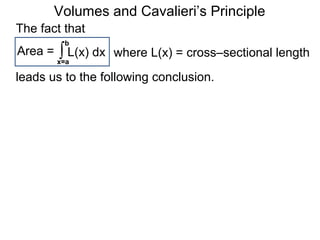
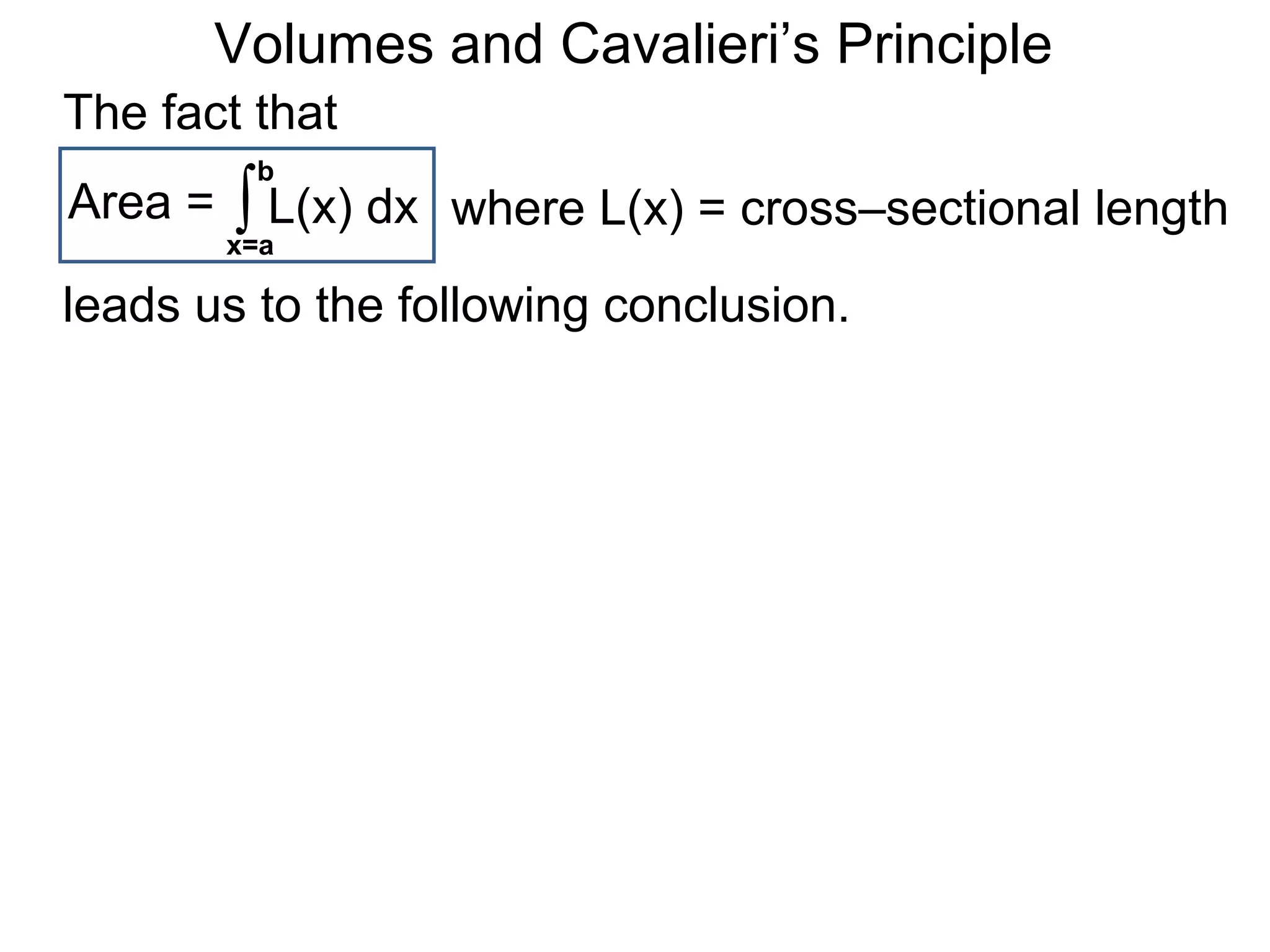
The fact that
Area = ∫x=a
b
L(x) dx
leads us to the following conclusion.
where L(x) = cross–sectional length
Volumes and Cavalieri’s Principle
Two 2D regions that have identical
cross–sectional lengths L(x) have the
same areas.
The fact that
Area = ∫x=a
b
L(x) dx
leads us to the following conclusion.
where L(x) = cross–sectional length
Volumes and Cavalieri’s Principle
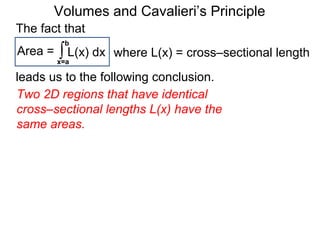
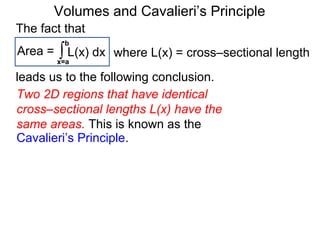
The fact that
Two 2D regions that have identical
cross–sectional lengths L(x) have the
same areas. This is known as the
Area = ∫x=a
b
L(x) dx
leads us to the following conclusion.
Cavalieri’s Principle.
where L(x) = cross–sectional length
Volumes and Cavalieri’s Principle
Two 2D regions that have identical
cross–sectional lengths L(x) have the
same areas. This is known as the
Cavalieri’s Principle.
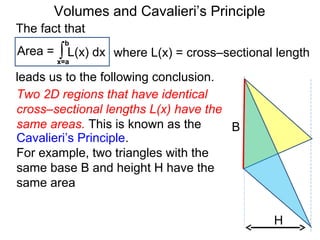
For example, two triangles with the
same base B and height H have the
same area
H
B
The fact that
Area = ∫x=a
b
L(x) dx
leads us to the following conclusion.
where L(x) = cross–sectional length
Volumes and Cavalieri’s Principle
Two 2D regions that have identical
cross–sectional lengths L(x) have the
same areas. This is known as the
Cavalieri’s Principle.
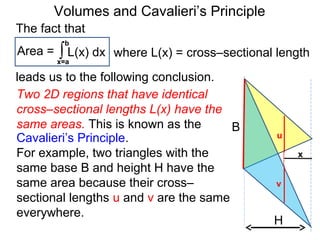
For example, two triangles with the
same base B and height H have the
same area because their cross–
sectional lengths u and v are the same
everywhere.
H
B
x
u
v
The fact that
Area = ∫x=a
b
L(x) dx
leads us to the following conclusion.
where L(x) = cross–sectional length
Volumes and Cavalieri’s Principle
Two 2D regions that have identical
cross–sectional lengths L(x) have the
same areas. This is known as the
Cavalieri’s Principle.
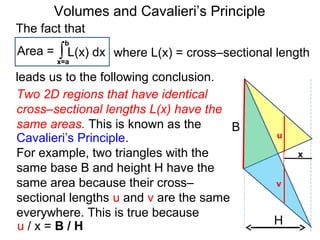
For example, two triangles with the
same base B and height H have the
same area because their cross–
sectional lengths u and v are the same
everywhere. This is true because
H
B
x
u
v
u / x = B / H
The fact that
Area = ∫x=a
b
L(x) dx
leads us to the following conclusion.
where L(x) = cross–sectional length
Volumes and Cavalieri’s Principle
Two 2D regions that have identical
cross–sectional lengths L(x) have the
same areas. This is known as the
Cavalieri’s Principle.
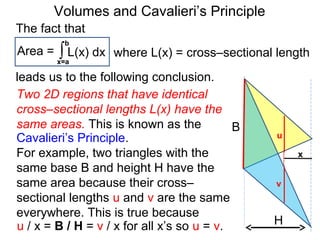
For example, two triangles with the
same base B and height H have the
same area because their cross–
sectional lengths u and v are the same
everywhere. This is true because
H
B
x
u
v
u / x = B / H = v / x for all x’s so u = v.
The fact that
Area = ∫x=a
b
L(x) dx
leads us to the following conclusion.
where L(x) = cross–sectional length
Area of Circles (From circles to triangles)
Volumes and Cavalieri’s Principle A variation
of Cavalieri’s
principle
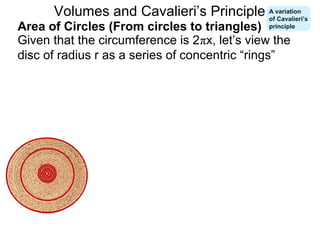
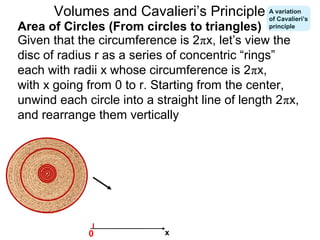
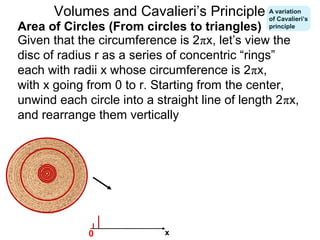
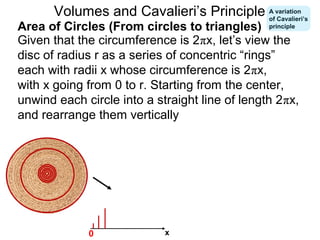
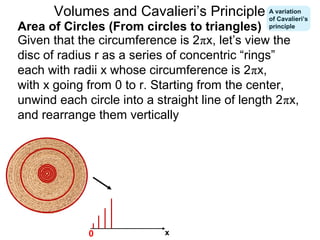
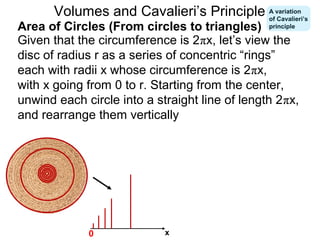
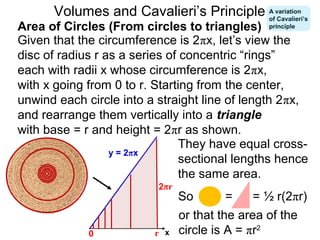
Given that the circumference is 2πx, let’s view the
disc of radius r as a series of concentric “rings”
Area of Circles (From circles to triangles)
Volumes and Cavalieri’s Principle A variation
of Cavalieri’s
principle
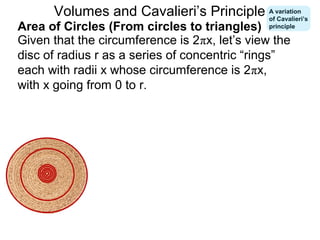
Given that the circumference is 2πx, let’s view the
disc of radius r as a series of concentric “rings”
each with radii x whose circumference is 2πx,
with x going from 0 to r.
Area of Circles (From circles to triangles)
Volumes and Cavalieri’s Principle A variation
of Cavalieri’s
principle
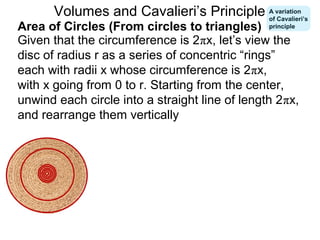
Given that the circumference is 2πx, let’s view the
disc of radius r as a series of concentric “rings”
each with radii x whose circumference is 2πx,
with x going from 0 to r. Starting from the center,
unwind each circle into a straight line of length 2πx,
and rearrange them vertically
Area of Circles (From circles to triangles)
Volumes and Cavalieri’s Principle A variation
of Cavalieri’s
principle
x0
Given that the circumference is 2πx, let’s view the
disc of radius r as a series of concentric “rings”
each with radii x whose circumference is 2πx,
with x going from 0 to r. Starting from the center,
unwind each circle into a straight line of length 2πx,
and rearrange them vertically
Area of Circles (From circles to triangles)
Volumes and Cavalieri’s Principle A variation
of Cavalieri’s
principle
x0
Given that the circumference is 2πx, let’s view the
disc of radius r as a series of concentric “rings”
each with radii x whose circumference is 2πx,
with x going from 0 to r. Starting from the center,
unwind each circle into a straight line of length 2πx,
and rearrange them vertically
Area of Circles (From circles to triangles)
Volumes and Cavalieri’s Principle A variation
of Cavalieri’s
principle
x0
Given that the circumference is 2πx, let’s view the
disc of radius r as a series of concentric “rings”
each with radii x whose circumference is 2πx,
with x going from 0 to r. Starting from the center,
unwind each circle into a straight line of length 2πx,
and rearrange them vertically
Area of Circles (From circles to triangles)
Volumes and Cavalieri’s Principle A variation
of Cavalieri’s
principle
x0
Given that the circumference is 2πx, let’s view the
disc of radius r as a series of concentric “rings”
each with radii x whose circumference is 2πx,
with x going from 0 to r. Starting from the center,
unwind each circle into a straight line of length 2πx,
and rearrange them vertically
Area of Circles (From circles to triangles)
Volumes and Cavalieri’s Principle A variation
of Cavalieri’s
principle
x0
Given that the circumference is 2πx, let’s view the
disc of radius r as a series of concentric “rings”
each with radii x whose circumference is 2πx,
with x going from 0 to r. Starting from the center,
unwind each circle into a straight line of length 2πx,
and rearrange them vertically
Area of Circles (From circles to triangles)
Volumes and Cavalieri’s Principle A variation
of Cavalieri’s
principle
x0
y = 2πx
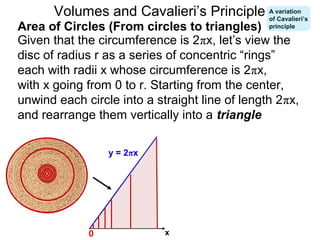
Given that the circumference is 2πx, let’s view the
disc of radius r as a series of concentric “rings”
each with radii x whose circumference is 2πx,
with x going from 0 to r. Starting from the center,
unwind each circle into a straight line of length 2πx,
and rearrange them vertically into a triangle
Area of Circles (From circles to triangles)
Volumes and Cavalieri’s Principle A variation
of Cavalieri’s
principle
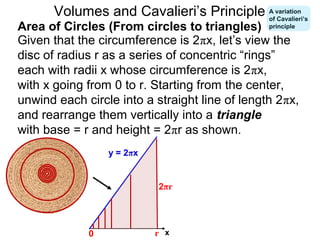
Given that the circumference is 2πx, let’s view the
disc of radius r as a series of concentric “rings”
each with radii x whose circumference is 2πx,
with x going from 0 to r. Starting from the center,
unwind each circle into a straight line of length 2πx,
and rearrange them vertically into a triangle
with base = r and height = 2πr as shown.
Area of Circles (From circles to triangles)
Volumes and Cavalieri’s Principle
x0
y = 2πx
2πr
r
A variation
of Cavalieri’s
principle
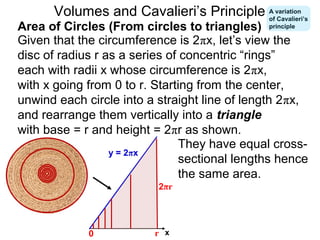
Given that the circumference is 2πx, let’s view the
disc of radius r as a series of concentric “rings”
each with radii x whose circumference is 2πx,
with x going from 0 to r. Starting from the center,
unwind each circle into a straight line of length 2πx,
and rearrange them vertically into a triangle
with base = r and height = 2πr as shown.
They have equal cross-
sectional lengths hence
the same area.
Area of Circles (From circles to triangles)
Volumes and Cavalieri’s Principle
x0
y = 2πx
2πr
r
A variation
of Cavalieri’s
principle
Given that the circumference is 2πx, let’s view the
disc of radius r as a series of concentric “rings”
each with radii x whose circumference is 2πx,
with x going from 0 to r. Starting from the center,
unwind each circle into a straight line of length 2πx,
and rearrange them vertically into a triangle
with base = r and height = 2πr as shown.
They have equal cross-
sectional lengths hence
the same area.
Area of Circles (From circles to triangles)
= = ½ r(2πr)
or that the area of the
circle is A = πr2
Volumes and Cavalieri’s Principle
x0
y = 2πx
2πr
r
So
A variation
of Cavalieri’s
principle
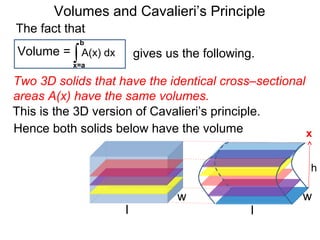
Volumes and Cavalieri’s Principle
∫x=a
b
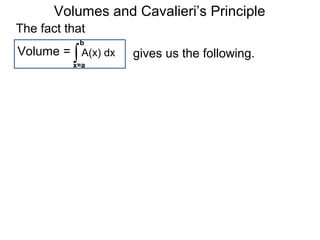
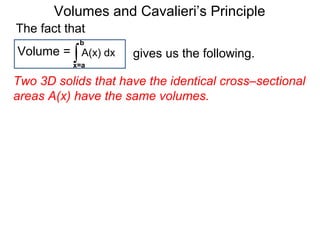
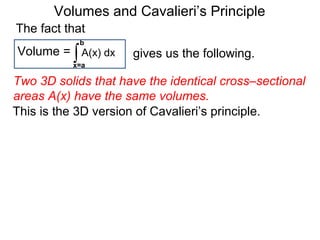
A(x) dxVolume =
The fact that
gives us the following.
Volumes and Cavalieri’s Principle
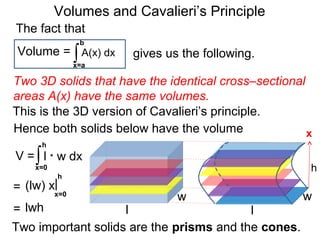
Two 3D solids that have the identical cross–sectional
areas A(x) have the same volumes.
∫x=a
b
A(x) dxVolume =
The fact that
gives us the following.
Volumes and Cavalieri’s Principle
This is the 3D version of Cavalieri’s principle.
Two 3D solids that have the identical cross–sectional
areas A(x) have the same volumes.
∫x=a
b
A(x) dxVolume =
The fact that
gives us the following.
Volumes and Cavalieri’s Principle
Two 3D solids that have the identical cross–sectional
areas A(x) have the same volumes.
∫x=a
b
A(x) dxVolume =
The fact that
gives us the following.
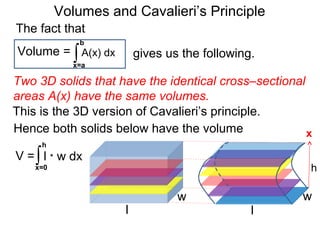
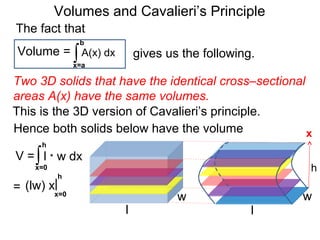
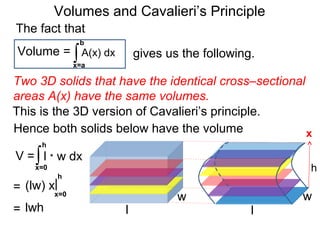
Hence both solids below have the volume
l
w
l
w
h
x
This is the 3D version of Cavalieri’s principle.
Volumes and Cavalieri’s Principle
Two 3D solids that have the identical cross–sectional
areas A(x) have the same volumes.
∫x=a
b
A(x) dxVolume =
The fact that
gives us the following.
Hence both solids below have the volume
l
w
l
w
h
∫x=0
h
l * w dx
x
V =
This is the 3D version of Cavalieri’s principle.
Volumes and Cavalieri’s Principle
Two 3D solids that have the identical cross–sectional
areas A(x) have the same volumes.
∫x=a
b
A(x) dxVolume =
The fact that
gives us the following.
Hence both solids below have the volume
l
w
l
w
h
∫x=0
h
l * w dx
x
= x=0
h
|(lw) x
V =
This is the 3D version of Cavalieri’s principle.
Volumes and Cavalieri’s Principle
Two 3D solids that have the identical cross–sectional
areas A(x) have the same volumes.
∫x=a
b
A(x) dxVolume =
The fact that
gives us the following.
Hence both solids below have the volume
l
w
l
w
h
∫x=0
h
l * w dx
x
= x=0
h
|(lw) x
= lwh
V =
This is the 3D version of Cavalieri’s principle.
Volumes and Cavalieri’s Principle
Two 3D solids that have the identical cross–sectional
areas A(x) have the same volumes.
∫x=a
b
A(x) dxVolume =
The fact that
Hence both solids below have the volume
l
w
l
w
h
∫x=0
h
l * w dx
x
= x=0
h
|(lw) x
= lwh
V =
Two important solids are the prisms and the cones.
This is the 3D version of Cavalieri’s principle.
gives us the following.
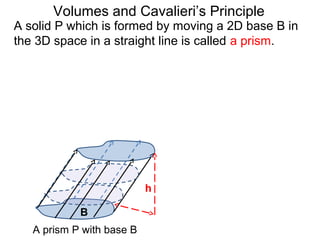
A solid P which is formed by moving a 2D base B in
the 3D space in a straight line is called a prism.
Volumes and Cavalieri’s Principle
B
A prism P with base B
h
A solid P which is formed by moving a 2D base B in
the 3D space in a straight line is called a prism.
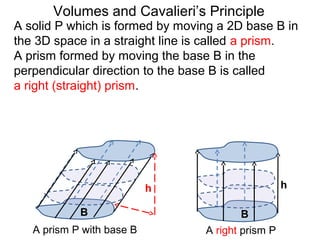
A prism formed by moving the base B in the
perpendicular direction to the base B is called
a right (straight) prism.
Volumes and Cavalieri’s Principle
B B
A prism P with base B A right prism P
h h
A solid P which is formed by moving a 2D base B in
the 3D space in a straight line is called a prism.
A prism formed by moving the base B in the
perpendicular direction to the base B is called
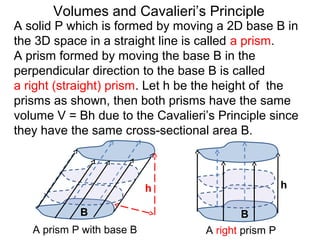
a right (straight) prism. Let h be the height of the
prisms as shown, then both prisms have the same
volume V = Bh due to the Cavalieri’s Principle since
they have the same cross-sectional area B.
Volumes and Cavalieri’s Principle
B B
A prism P with base B A right prism P
h h
Volumes and Cavalieri’s Principle
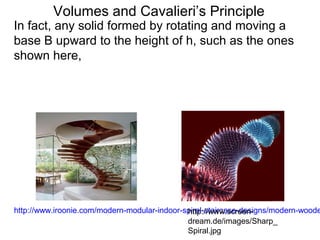
In fact, any solid formed by rotating and moving a
base B upward to the height of h, such as the ones
shown here,
Volumes and Cavalieri’s Principle
http://www.iroonie.com/modern-modular-indoor-spiral-staircase-designs/modern-woodehttp://www.screen-
dream.de/images/Sharp_
Spiral.jpg
In fact, any solid formed by rotating and moving a
base B upward to the height of h, such as the ones
shown here,
Volumes and Cavalieri’s Principle
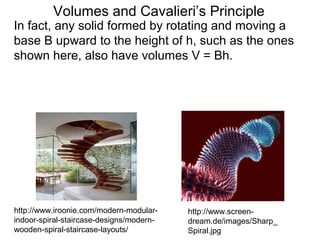
In fact, any solid formed by rotating and moving a
base B upward to the height of h, such as the ones
shown here, also have volumes V = Bh.
http://www.iroonie.com/modern-modular-
indoor-spiral-staircase-designs/modern-
wooden-spiral-staircase-layouts/
http://www.screen-
dream.de/images/Sharp_
Spiral.jpg
Volumes and Cavalieri’s Principle
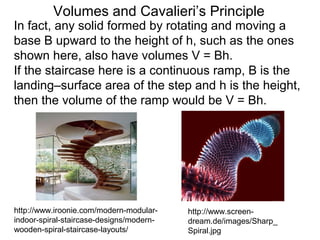
In fact, any solid formed by rotating and moving a
base B upward to the height of h, such as the ones
shown here, also have volumes V = Bh.
If the staircase here is a continuous ramp, B is the
landing–surface area of the step and h is the height,
then the volume of the ramp would be V = Bh.
http://www.iroonie.com/modern-modular-
indoor-spiral-staircase-designs/modern-
wooden-spiral-staircase-layouts/
http://www.screen-
dream.de/images/Sharp_
Spiral.jpg
Volumes and Cavalieri’s Principle
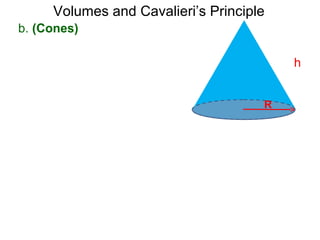
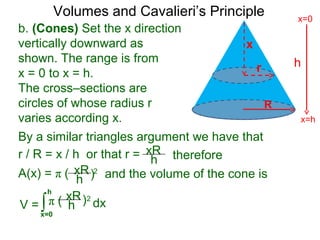
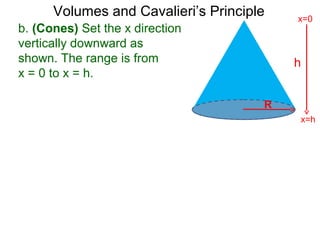
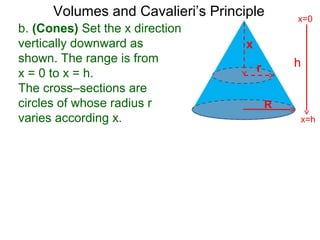
b. (Cones)
h
R
Volumes and Cavalieri’s Principle
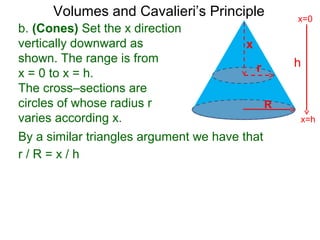
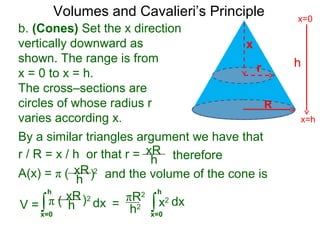
b. (Cones) Set the x direction
vertically downward as
shown. The range is from
x = 0 to x = h.
h
x=h
x=0
R
Volumes and Cavalieri’s Principle
b. (Cones) Set the x direction
vertically downward as
shown. The range is from
x = 0 to x = h.
The cross–sections are
circles of whose radius r
varies according x.
h
x=h
x=0
R
x
r
Volumes and Cavalieri’s Principle
b. (Cones) Set the x direction
vertically downward as
shown. The range is from
x = 0 to x = h.
The cross–sections are
circles of whose radius r
varies according x.
r / R = x / h
h
x=h
x=0
R
x
r
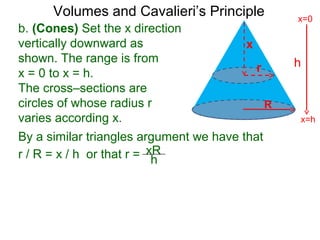
By a similar triangles argument we have that
Volumes and Cavalieri’s Principle
b. (Cones) Set the x direction
vertically downward as
shown. The range is from
x = 0 to x = h.
The cross–sections are
circles of whose radius r
varies according x.
r / R = x / h or that r = xR
h
By a similar triangles argument we have that
h
x=h
x=0
R
x
r
Volumes and Cavalieri’s Principle
b. (Cones) Set the x direction
vertically downward as
shown. The range is from
x = 0 to x = h.
The cross–sections are
circles of whose radius r
varies according x.
r / R = x / h or that r = xR
h
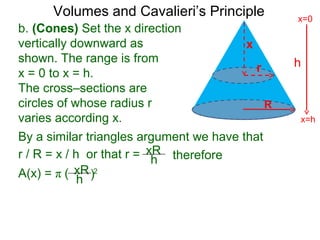
A(x) = π ( 2
therefore
xR
h )
By a similar triangles argument we have that
h
x=h
x=0
R
x
r
Volumes and Cavalieri’s Principle
b. (Cones) Set the x direction
vertically downward as
shown. The range is from
x = 0 to x = h.
The cross–sections are
circles of whose radius r
varies according x.
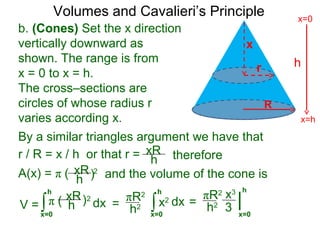
r / R = x / h or that r =
∫x=0
h
dxV =
xR
h
A(x) = π ( 2
therefore
xR
h ) and the volume of the cone is
π ( 2xR
h )
By a similar triangles argument we have that
h
x=h
x=0
R
x
r
Volumes and Cavalieri’s Principle
b. (Cones) Set the x direction
vertically downward as
shown. The range is from
x = 0 to x = h.
The cross–sections are
circles of whose radius r
varies according x.
r / R = x / h or that r =
∫x=0
h
dxV =
xR
h
A(x) = π ( 2
therefore
xR
h ) and the volume of the cone is
π ( 2xR
h ) ∫x=0
h
dx=
πR2
h2
By a similar triangles argument we have that
x2
h
x=h
x=0
R
x
r
Volumes and Cavalieri’s Principle
b. (Cones) Set the x direction
vertically downward as
shown. The range is from
x = 0 to x = h.
The cross–sections are
circles of whose radius r
varies according x.
r / R = x / h or that r =
∫x=0
h
dxV =
xR
h
A(x) = π ( 2
therefore
xR
h ) and the volume of the cone is
π ( 2xR
h ) ∫x=0
h
dx=
πR2
h2
By a similar triangles argument we have that
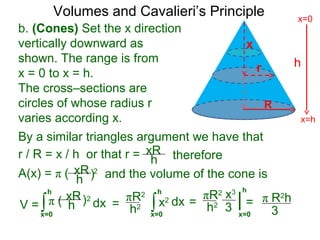
x2 |
x=0
h
=
πR2
h2
x3
3
h
x=h
x=0
R
x
r
Volumes and Cavalieri’s Principle
b. (Cones) Set the x direction
vertically downward as
shown. The range is from
x = 0 to x = h.
The cross–sections are
circles of whose radius r
varies according x.
r / R = x / h or that r =
h
x=h
x=0
∫x=0
h
dxV =
R
x
r
xR
h
A(x) = π ( 2
therefore
xR
h ) and the volume of the cone is
π ( 2xR
h ) ∫x=0
h
dx=
πR2
h2
By a similar triangles argument we have that
x2 |
x=0
h
==
πR2
h2
x3
3
π R2
h
3
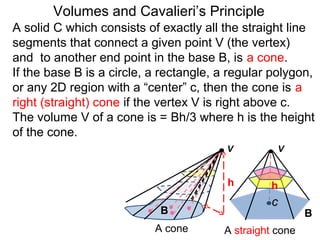
A solid C which consists of exactly all the straight line
segments that connect a given point V (the vertex)
and to another end point in the base B, is a cone
Volumes and Cavalieri’s Principle
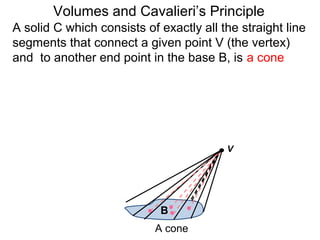
A solid C which consists of exactly all the straight line
segments that connect a given point V (the vertex)
and to another end point in the base B, is a cone
Volumes and Cavalieri’s Principle
B
A cone
V
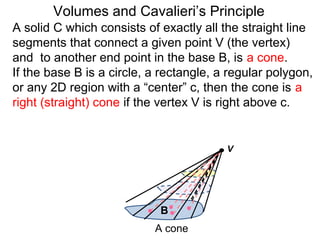
A solid C which consists of exactly all the straight line
segments that connect a given point V (the vertex)
and to another end point in the base B, is a cone.
If the base B is a circle, a rectangle, a regular polygon,
or any 2D region with a “center” c, then the cone is a
right (straight) cone if the vertex V is right above c.
Volumes and Cavalieri’s Principle
B
A cone
V
A solid C which consists of exactly all the straight line
segments that connect a given point V (the vertex)
and to another end point in the base B, is a cone.
If the base B is a circle, a rectangle, a regular polygon,
or any 2D region with a “center” c, then the cone is a
right (straight) cone if the vertex V is right above c.
Volumes and Cavalieri’s Principle
B B
A cone A straight cone
V V
c
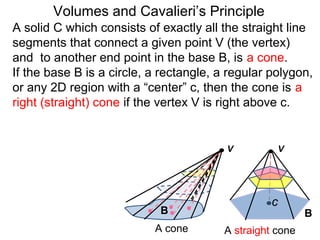
A solid C which consists of exactly all the straight line
segments that connect a given point V (the vertex)
and to another end point in the base B, is a cone.
If the base B is a circle, a rectangle, a regular polygon,
or any 2D region with a “center” c, then the cone is a
right (straight) cone if the vertex V is right above c.
The volume V of a cone is = Bh/3 where h is the height
of the cone.
Volumes and Cavalieri’s Principle
B B
A cone A straight cone
h
V V
c
h
Volumes and Cavalieri’s Principle
B B
A cone A straight cone
h
V V
c
h
x
A(x)
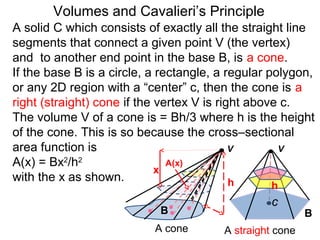
A solid C which consists of exactly all the straight line
segments that connect a given point V (the vertex)
and to another end point in the base B, is a cone.
If the base B is a circle, a rectangle, a regular polygon,
or any 2D region with a “center” c, then the cone is a
right (straight) cone if the vertex V is right above c.
The volume V of a cone is = Bh/3 where h is the height
of the cone. This is so because the cross–sectional
area function is
A(x) = Bx2
/h2
with the x as shown.
Volumes and Cavalieri’s Principle
B B
A cone A straight cone
h
V V
c
h
x
A(x)
∫x=0
h
dx
Bx2
h2 = Bh/3
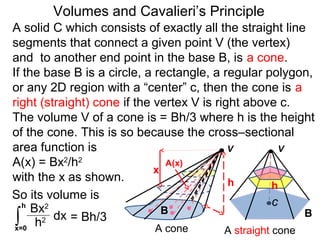
A solid C which consists of exactly all the straight line
segments that connect a given point V (the vertex)
and to another end point in the base B, is a cone.
If the base B is a circle, a rectangle, a regular polygon,
or any 2D region with a “center” c, then the cone is a
right (straight) cone if the vertex V is right above c.
The volume V of a cone is = Bh/3 where h is the height
of the cone. This is so because the cross–sectional
area function is
A(x) = Bx2
/h2
with the x as shown.
So its volume is
Volume of Spheres (From discs to rings)
Volumes and Cavalieri’s Principle
Volume of Spheres (From discs to rings)
Volumes and Cavalieri’s Principle
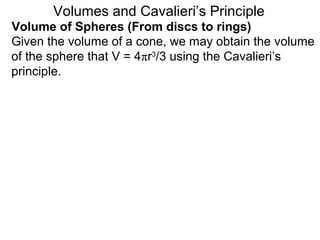
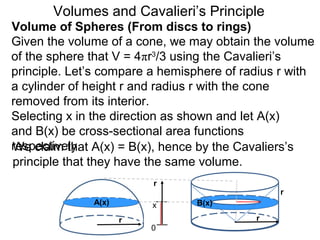
Given the volume of a cone, we may obtain the volume
of the sphere that V = 4πr3
/3 using the Cavalieri’s
principle.
Volume of Spheres (From discs to rings)
Volumes and Cavalieri’s Principle
Given the volume of a cone, we may obtain the volume
of the sphere that V = 4πr3
/3 using the Cavalieri’s
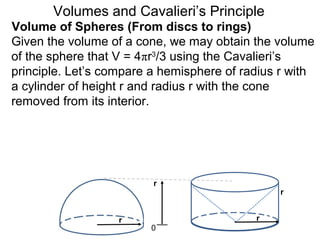
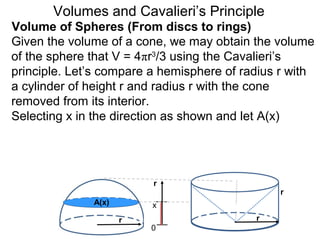
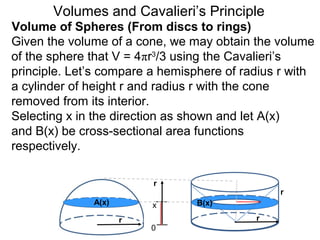
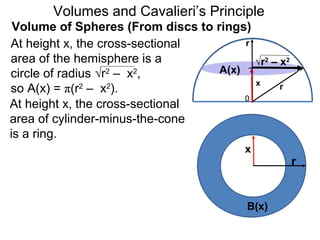
principle. Let’s compare a hemisphere of radius r with
a cylinder of height r and radius r with the cone
removed from its interior.
r
0
r r
r
Volume of Spheres (From discs to rings)
Volumes and Cavalieri’s Principle
Given the volume of a cone, we may obtain the volume
of the sphere that V = 4πr3
/3 using the Cavalieri’s
principle. Let’s compare a hemisphere of radius r with
a cylinder of height r and radius r with the cone
removed from its interior.
Selecting x in the direction as shown and let A(x)
r
0
A(x)
r r
r
x
Volume of Spheres (From discs to rings)
Volumes and Cavalieri’s Principle
Given the volume of a cone, we may obtain the volume
of the sphere that V = 4πr3
/3 using the Cavalieri’s
principle. Let’s compare a hemisphere of radius r with
a cylinder of height r and radius r with the cone
removed from its interior.
Selecting x in the direction as shown and let A(x)
and B(x) be cross-sectional area functions
respectively.
r
0
A(x) B(x)
r r
r
x
Volume of Spheres (From discs to rings)
Volumes and Cavalieri’s Principle
Given the volume of a cone, we may obtain the volume
of the sphere that V = 4πr3
/3 using the Cavalieri’s
principle. Let’s compare a hemisphere of radius r with
a cylinder of height r and radius r with the cone
removed from its interior.
Selecting x in the direction as shown and let A(x)
and B(x) be cross-sectional area functions
respectively.
r
0
A(x) B(x)
We claim that A(x) = B(x), hence by the Cavaliers’s
principle that they have the same volume.
r r
r
x
Volume of Spheres (From discs to rings)
Volumes and Cavalieri’s Principle
r
0
x r
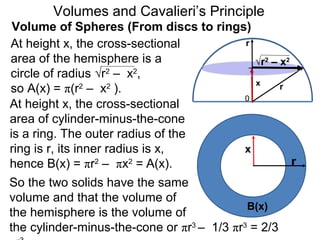
At height x, the cross-sectional
area of the hemisphere is a
circle of radius √r2
– x2
,
so A(x) = π(r2
– x2
).
At height x, the cross-sectional
area of cylinder-minus-the-cone
is a ring. The outer radius of the
ring is r, its inner radius is x,
hence B(x) = πr2
– πx2
= A(x). r
x
So the two solids have the same
volume and that the volume of
the hemisphere is the volume of
the cylinder-minus-the-cone or πr3
– 1/3 πr3
= 2/3
B(x)
√r2
– x2
Volume of Spheres (From discs to rings)
Volumes and Cavalieri’s Principle
r
0
x r
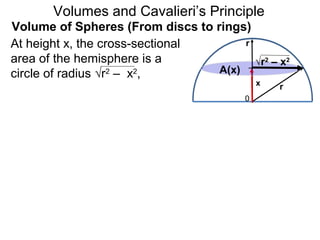
At height x, the cross-sectional
area of the hemisphere is a
circle of radius √r2
– x2
,
√r2
– x2
A(x)
Volume of Spheres (From discs to rings)
Volumes and Cavalieri’s Principle
r
0
x r
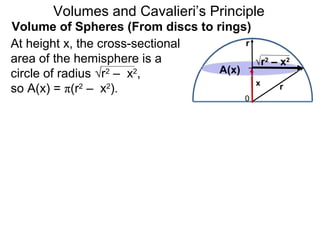
At height x, the cross-sectional
area of the hemisphere is a
circle of radius √r2
– x2
,
so A(x) = π(r2
– x2
).
√r2
– x2
A(x)
Volume of Spheres (From discs to rings)
Volumes and Cavalieri’s Principle
r
0
x r
At height x, the cross-sectional
area of the hemisphere is a
circle of radius √r2
– x2
,
so A(x) = π(r2
– x2
).
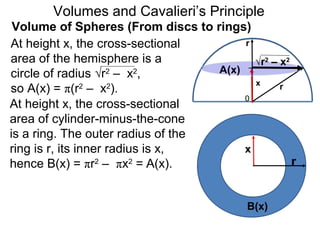
At height x, the cross-sectional
area of cylinder-minus-the-cone
is a ring.
r
x
B(x)
√r2
– x2
A(x)
Volume of Spheres (From discs to rings)
Volumes and Cavalieri’s Principle
r
0
x r
At height x, the cross-sectional
area of the hemisphere is a
circle of radius √r2
– x2
,
so A(x) = π(r2
– x2
).
At height x, the cross-sectional
area of cylinder-minus-the-cone
is a ring. The outer radius of the
ring is r, its inner radius is x,
hence B(x) = πr2
– πx2
= A(x). r
x
B(x)
√r2
– x2
A(x)
Volume of Spheres (From discs to rings)
Volumes and Cavalieri’s Principle
r
0
x r
At height x, the cross-sectional
area of the hemisphere is a
circle of radius √r2
– x2
,
so A(x) = π(r2
– x2
).
At height x, the cross-sectional
area of cylinder-minus-the-cone
is a ring. The outer radius of the
ring is r, its inner radius is x,
hence B(x) = πr2
– πx2
= A(x). r
x
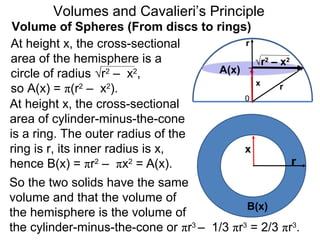
So the two solids have the same
volume and that the volume of
the hemisphere is the volume of
the cylinder-minus-the-cone or πr3
– 1/3 πr3
= 2/3 πr3
.
B(x)
√r2
– x2
A(x)
The Volume of the Intersection of Two Pipes
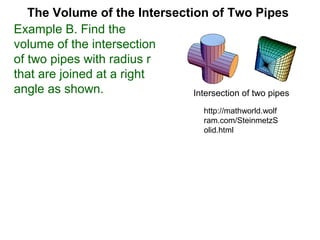
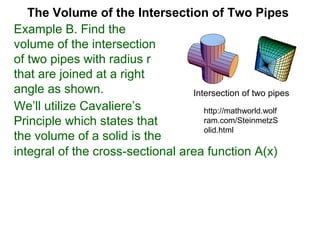
Example B. Find the
volume of the intersection
of two pipes with radius r
that are joined at a right
angle as shown. Intersection of two pipes
http://mathworld.wolf
ram.com/SteinmetzS
olid.html
The Volume of the Intersection of Two Pipes
integral of the cross-sectional area function A(x)
We’ll utilize Cavaliere’s
Principle which states that
the volume of a solid is the
Example B. Find the
volume of the intersection
of two pipes with radius r
that are joined at a right
angle as shown. Intersection of two pipes
http://mathworld.wolf
ram.com/SteinmetzS
olid.html
The Volume of the Intersection of Two Pipes
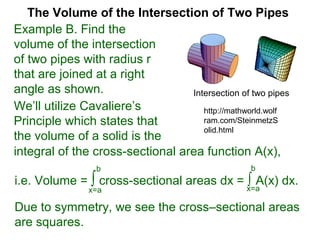
integral of the cross-sectional area function A(x),
We’ll utilize Cavaliere’s
Principle which states that
the volume of a solid is the
Due to symmetry, we see the cross–sectional areas
are squares.
i.e. Volume = ∫ cross-sectional areas dx = ∫ A(x) dx.
x=a x=a
bb
Example B. Find the
volume of the intersection
of two pipes with radius r
that are joined at a right
angle as shown. Intersection of two pipes
http://mathworld.wolf
ram.com/SteinmetzS
olid.html
The Volume of the Intersection of Two Pipes
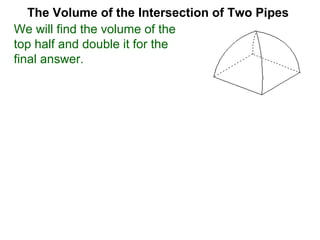
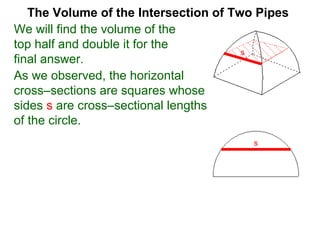
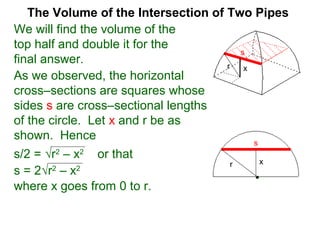
We will find the volume of the
top half and double it for the
final answer.
The Volume of the Intersection of Two Pipes
We will find the volume of the
top half and double it for the
final answer.
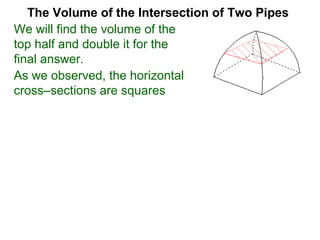
As we observed, the horizontal
cross–sections are squares
The Volume of the Intersection of Two Pipes
We will find the volume of the
top half and double it for the
final answer.
s
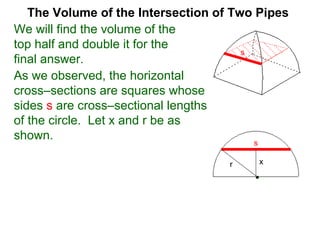
As we observed, the horizontal
cross–sections are squares whose
sides s are cross–sectional lengths
of the circle.
s
The Volume of the Intersection of Two Pipes
We will find the volume of the
top half and double it for the
final answer.
As we observed, the horizontal
cross–sections are squares whose
sides s are cross–sectional lengths
of the circle. Let x and r be as
shown.
s
xr
s
The Volume of the Intersection of Two Pipes
We will find the volume of the
top half and double it for the
final answer.
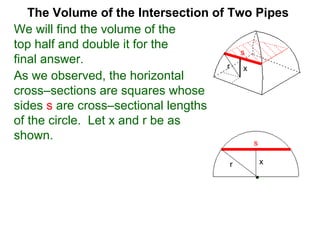
As we observed, the horizontal
cross–sections are squares whose
sides s are cross–sectional lengths
of the circle. Let x and r be as
shown.
s
xr
xr
s
The Volume of the Intersection of Two Pipes
We will find the volume of the
top half and double it for the
final answer.
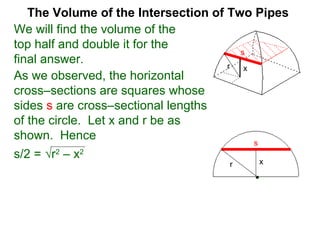
As we observed, the horizontal
cross–sections are squares whose
sides s are cross–sectional lengths
of the circle. Let x and r be as
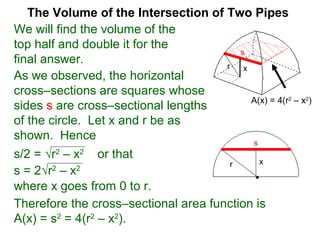
shown. Hence
s/2 = √r2
– x2
s
xr
xr
s
The Volume of the Intersection of Two Pipes
We will find the volume of the
top half and double it for the
final answer.
As we observed, the horizontal
cross–sections are squares whose
sides s are cross–sectional lengths
of the circle. Let x and r be as
shown. Hence
s/2 = √r2
– x2
or that
s
xr
s = 2√r2
– x2
where x goes from 0 to r.
xr
s
The Volume of the Intersection of Two Pipes
We will find the volume of the
top half and double it for the
final answer.
As we observed, the horizontal
cross–sections are squares whose
sides s are cross–sectional lengths
of the circle. Let x and r be as
shown. Hence
s/2 = √r2
– x2
or that
s
xr
s = 2√r2
– x2
where x goes from 0 to r.
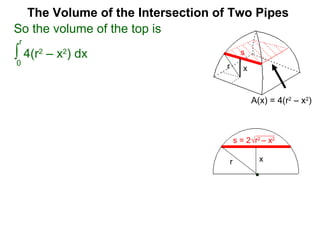
Therefore the cross–sectional area function is
A(x) = s2
= 4(r2
– x2
).
A(x) = 4(r2
– x2
)
xr
s
The Volume of the Intersection of Two Pipes
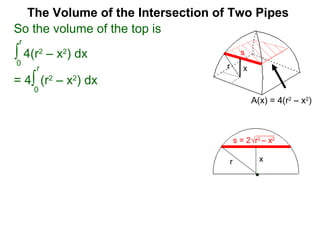
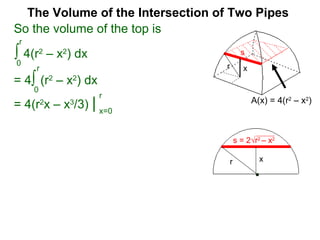
So the volume of the top is
∫ 4(r2
– x2
) dx
0
r
x=a
b
s = 2√r2
– x2
s
xr
A(x) = 4(r2
– x2
)
xr
s
The Volume of the Intersection of Two Pipes
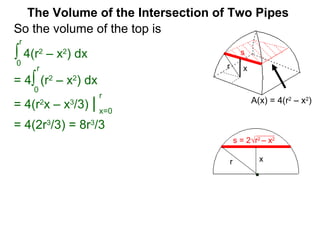
So the volume of the top is
∫ 4(r2
– x2
) dx
0
r
x=a
b
s = 2√r2
– x2
s
xr
= 4∫ (r2
– x2
) dx
0
r
A(x) = 4(r2
– x2
)
xr
s
The Volume of the Intersection of Two Pipes
So the volume of the top is
∫ 4(r2
– x2
) dx
0
r
x=a
b
s = 2√r2
– x2
s
xr
= 4∫ (r2
– x2
) dx
0
r
= 4(r2
x – x3
/3) | x=0
r
A(x) = 4(r2
– x2
)
xr
s
The Volume of the Intersection of Two Pipes
So the volume of the top is
∫ 4(r2
– x2
) dx
0
r
x=a
b
s = 2√r2
– x2
s
xr
= 4∫ (r2
– x2
) dx
0
r
= 4(r2
x – x3
/3) | x=0
r
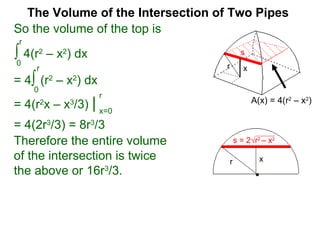
= 4(2r3
/3) = 8r3
/3
A(x) = 4(r2
– x2
)
xr
s
The Volume of the Intersection of Two Pipes
So the volume of the top is
∫ 4(r2
– x2
) dx
0
r
x=a
b
s = 2√r2
– x2
s
xr
Therefore the entire volume
of the intersection is twice
the above or 16r3
/3.
= 4∫ (r2
– x2
) dx
0
r
= 4(r2
x – x3
/3) | x=0
r
= 4(2r3
/3) = 8r3
/3
A(x) = 4(r2
– x2
)
xr
s
Volumes and Cavalieri’s Principle
Following are more examples of solids whose
cross–sectional areas are tractable so that we may
use the Cavalieri’s principle to find their volumes.
One group of such solids has cross–sectional areas
that are formed from the linear cross–sections of the
base regions of the solids.
Volumes and Cavalieri’s Principle
Following are more examples of solids whose
cross–sectional areas are tractable so that we may
use the Cavalieri’s principle to find their volumes.
One group of such solids has cross–sectional areas
that are formed from the linear cross–sections of the
base regions of the solids.
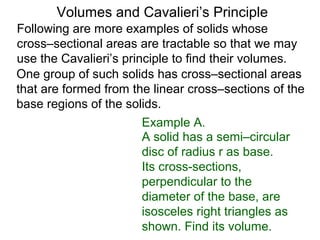
A solid has a semi–circular
disc of radius r as base.
Its cross-sections,
perpendicular to the
diameter of the base, are
isosceles right triangles as
shown. Find its volume.
Example A.
Volumes and Cavalieri’s Principle
Following are more examples of solids whose
cross–sectional areas are tractable so that we may
use the Cavalieri’s principle to find their volumes.
One group of such solids has cross–sectional areas
that are formed from the linear cross–sections of the
base regions of the solids.
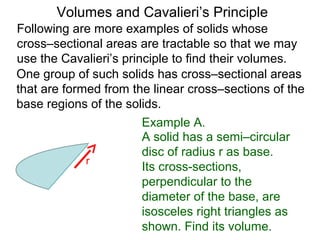
Example A.
A solid has a semi–circular
disc of radius r as base.
Its cross-sections,
perpendicular to the
diameter of the base, are
isosceles right triangles as
shown. Find its volume.
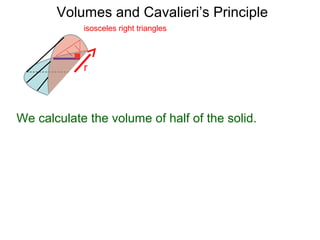
r
Volumes and Cavalieri’s Principle
Following are more examples of solids whose
cross–sectional areas are tractable so that we may
use the Cavalieri’s principle to find their volumes.
One group of such solids has cross–sectional areas
that are formed from the linear cross–sections of the
base regions of the solids.
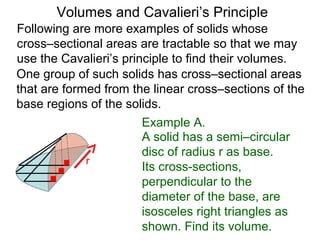
Example A.
A solid has a semi–circular
disc of radius r as base.
Its cross-sections,
perpendicular to the
diameter of the base, are
isosceles right triangles as
shown. Find its volume.
r
Volumes and Cavalieri’s Principle
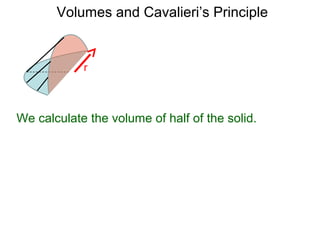
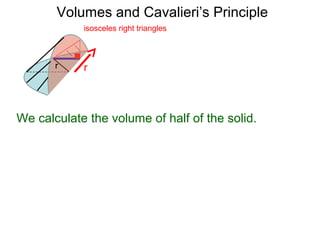
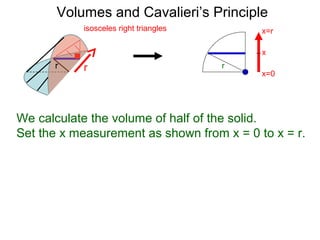
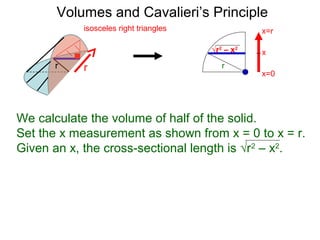
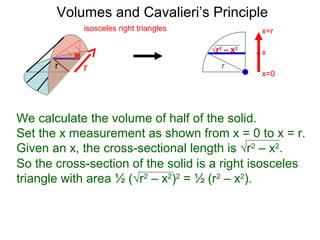
We calculate the volume of half of the solid.
r
Volumes and Cavalieri’s Principle
r
isosceles right triangles
We calculate the volume of half of the solid.
Volumes and Cavalieri’s Principle
rr
isosceles right triangles
We calculate the volume of half of the solid.
Volumes and Cavalieri’s Principle
r
We calculate the volume of half of the solid.
Set the x measurement as shown from x = 0 to x = r.
rr
isosceles right triangles
x=0
x=r
x
Volumes and Cavalieri’s Principle
√r2
– x2
r
We calculate the volume of half of the solid.
Set the x measurement as shown from x = 0 to x = r.
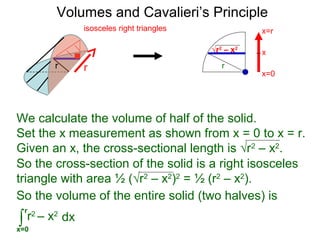
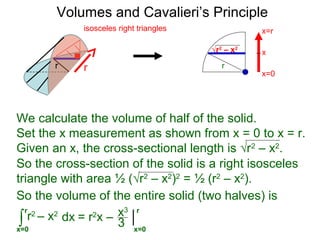
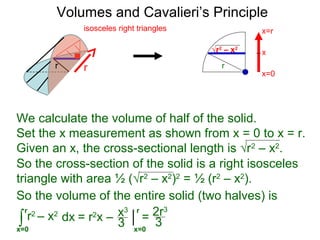
Given an x, the cross-sectional length is √r2
– x2
.
rr
isosceles right triangles
x=0
x=r
x
Volumes and Cavalieri’s Principle
So the cross-section of the solid is a right isosceles
triangle with area ½ (√r2
– x2
)2
= ½ (r2
– x2
).
√r2
– x2
r
We calculate the volume of half of the solid.
Set the x measurement as shown from x = 0 to x = r.
Given an x, the cross-sectional length is √r2
– x2
.
rr
isosceles right triangles
x=0
x=r
x
Volumes and Cavalieri’s Principle
So the cross-section of the solid is a right isosceles
triangle with area ½ (√r2
– x2
)2
= ½ (r2
– x2
).
So the volume of the entire solid (two halves) is
∫x=0
r
dxr2
– x2
√r2
– x2
r
We calculate the volume of half of the solid.
Set the x measurement as shown from x = 0 to x = r.
Given an x, the cross-sectional length is √r2
– x2
.
rr
isosceles right triangles
x=0
x=r
x
Volumes and Cavalieri’s Principle
So the cross-section of the solid is a right isosceles
triangle with area ½ (√r2
– x2
)2
= ½ (r2
– x2
).
So the volume of the entire solid (two halves) is
∫x=0
r
dxr2
– x2
= r2
x – x3
3 x=0
r
√r2
– x2
r
We calculate the volume of half of the solid.
Set the x measurement as shown from x = 0 to x = r.
Given an x, the cross-sectional length is √r2
– x2
.
rr
isosceles right triangles
x=0
x=r
x
Volumes and Cavalieri’s Principle
So the cross-section of the solid is a right isosceles
triangle with area ½ (√r2
– x2
)2
= ½ (r2
– x2
).
So the volume of the entire solid (two halves) is
∫x=0
r
dxr2
– x2
= r2
x – x3
3 x=0
r
= 2r3
3
x=0
x=r
x√r2
– x2
r
We calculate the volume of half of the solid.
Set the x measurement as shown from x = 0 to x = r.
Given an x, the cross-sectional length is √r2
– x2
.
rr
isosceles right triangles
Volumes and Cavalieri’s Principle
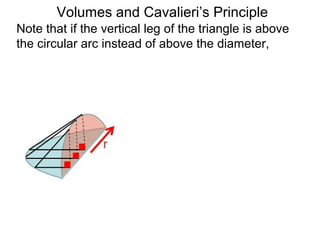
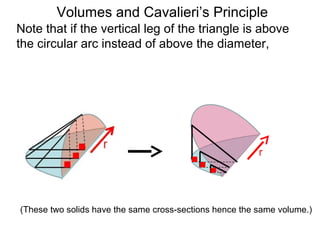
Note that if the vertical leg of the triangle is above
the circular arc instead of above the diameter,
Volumes and Cavalieri’s Principle
Note that if the vertical leg of the triangle is above
the circular arc instead of above the diameter,
(These two solids have the same cross-sections hence the same volume.)
r
Volumes and Cavalieri’s Principle
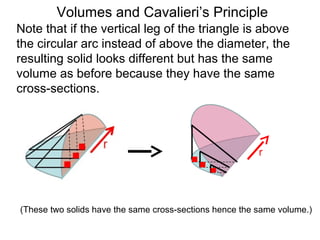
Note that if the vertical leg of the triangle is above
the circular arc instead of above the diameter, the
resulting solid looks different but has the same
volume as before because they have the same
cross-sections.
(These two solids have the same cross-sections hence the same volume.)
r
‘
The Volume of the Intersection of Two Pipes
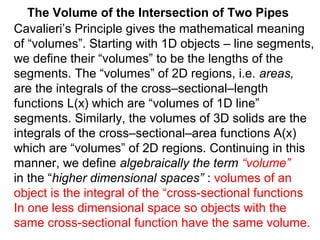
Cavalieri’s Principle gives the mathematical meaning
of “volumes”. Starting with 1D objects – line segments,
we define their “volumes” to be the lengths of the
segments. The “volumes” of 2D regions, i.e. areas,
are the integrals of the cross–sectional–length
functions L(x) which are “volumes of 1D line”
segments. Similarly, the volumes of 3D solids are the
integrals of the cross–sectional–area functions A(x)
which are “volumes” of 2D regions. Continuing in this
manner, we define algebraically the term “volume”
in the “higher dimensional spaces” : volumes of an
object is the integral of the “cross-sectional functions
In one less dimensional space so objects with the
same cross-sectional function have the same volume.

7 cavalieri principle-x

  • 1.
    Volumes and Cavalieri’sPrinciple The fact that Area = ∫x=a b L(x) dx leads us to the following conclusion. where L(x) = cross–sectional length
  • 2.
    Volumes and Cavalieri’sPrinciple Two 2D regions that have identical cross–sectional lengths L(x) have the same areas. The fact that Area = ∫x=a b L(x) dx leads us to the following conclusion. where L(x) = cross–sectional length
  • 3.
    Volumes and Cavalieri’sPrinciple The fact that Two 2D regions that have identical cross–sectional lengths L(x) have the same areas. This is known as the Area = ∫x=a b L(x) dx leads us to the following conclusion. Cavalieri’s Principle. where L(x) = cross–sectional length
  • 4.
    Volumes and Cavalieri’sPrinciple Two 2D regions that have identical cross–sectional lengths L(x) have the same areas. This is known as the Cavalieri’s Principle. For example, two triangles with the same base B and height H have the same area H B The fact that Area = ∫x=a b L(x) dx leads us to the following conclusion. where L(x) = cross–sectional length
  • 5.
    Volumes and Cavalieri’sPrinciple Two 2D regions that have identical cross–sectional lengths L(x) have the same areas. This is known as the Cavalieri’s Principle. For example, two triangles with the same base B and height H have the same area because their cross– sectional lengths u and v are the same everywhere. H B x u v The fact that Area = ∫x=a b L(x) dx leads us to the following conclusion. where L(x) = cross–sectional length
  • 6.
    Volumes and Cavalieri’sPrinciple Two 2D regions that have identical cross–sectional lengths L(x) have the same areas. This is known as the Cavalieri’s Principle. For example, two triangles with the same base B and height H have the same area because their cross– sectional lengths u and v are the same everywhere. This is true because H B x u v u / x = B / H The fact that Area = ∫x=a b L(x) dx leads us to the following conclusion. where L(x) = cross–sectional length
  • 7.
    Volumes and Cavalieri’sPrinciple Two 2D regions that have identical cross–sectional lengths L(x) have the same areas. This is known as the Cavalieri’s Principle. For example, two triangles with the same base B and height H have the same area because their cross– sectional lengths u and v are the same everywhere. This is true because H B x u v u / x = B / H = v / x for all x’s so u = v. The fact that Area = ∫x=a b L(x) dx leads us to the following conclusion. where L(x) = cross–sectional length
  • 8.
    Area of Circles(From circles to triangles) Volumes and Cavalieri’s Principle A variation of Cavalieri’s principle
  • 9.
    Given that thecircumference is 2πx, let’s view the disc of radius r as a series of concentric “rings” Area of Circles (From circles to triangles) Volumes and Cavalieri’s Principle A variation of Cavalieri’s principle
  • 10.
    Given that thecircumference is 2πx, let’s view the disc of radius r as a series of concentric “rings” each with radii x whose circumference is 2πx, with x going from 0 to r. Area of Circles (From circles to triangles) Volumes and Cavalieri’s Principle A variation of Cavalieri’s principle
  • 11.
    Given that thecircumference is 2πx, let’s view the disc of radius r as a series of concentric “rings” each with radii x whose circumference is 2πx, with x going from 0 to r. Starting from the center, unwind each circle into a straight line of length 2πx, and rearrange them vertically Area of Circles (From circles to triangles) Volumes and Cavalieri’s Principle A variation of Cavalieri’s principle
  • 12.
    x0 Given that thecircumference is 2πx, let’s view the disc of radius r as a series of concentric “rings” each with radii x whose circumference is 2πx, with x going from 0 to r. Starting from the center, unwind each circle into a straight line of length 2πx, and rearrange them vertically Area of Circles (From circles to triangles) Volumes and Cavalieri’s Principle A variation of Cavalieri’s principle
  • 13.
    x0 Given that thecircumference is 2πx, let’s view the disc of radius r as a series of concentric “rings” each with radii x whose circumference is 2πx, with x going from 0 to r. Starting from the center, unwind each circle into a straight line of length 2πx, and rearrange them vertically Area of Circles (From circles to triangles) Volumes and Cavalieri’s Principle A variation of Cavalieri’s principle
  • 14.
    x0 Given that thecircumference is 2πx, let’s view the disc of radius r as a series of concentric “rings” each with radii x whose circumference is 2πx, with x going from 0 to r. Starting from the center, unwind each circle into a straight line of length 2πx, and rearrange them vertically Area of Circles (From circles to triangles) Volumes and Cavalieri’s Principle A variation of Cavalieri’s principle
  • 15.
    x0 Given that thecircumference is 2πx, let’s view the disc of radius r as a series of concentric “rings” each with radii x whose circumference is 2πx, with x going from 0 to r. Starting from the center, unwind each circle into a straight line of length 2πx, and rearrange them vertically Area of Circles (From circles to triangles) Volumes and Cavalieri’s Principle A variation of Cavalieri’s principle
  • 16.
    x0 Given that thecircumference is 2πx, let’s view the disc of radius r as a series of concentric “rings” each with radii x whose circumference is 2πx, with x going from 0 to r. Starting from the center, unwind each circle into a straight line of length 2πx, and rearrange them vertically Area of Circles (From circles to triangles) Volumes and Cavalieri’s Principle A variation of Cavalieri’s principle
  • 17.
    x0 y = 2πx Giventhat the circumference is 2πx, let’s view the disc of radius r as a series of concentric “rings” each with radii x whose circumference is 2πx, with x going from 0 to r. Starting from the center, unwind each circle into a straight line of length 2πx, and rearrange them vertically into a triangle Area of Circles (From circles to triangles) Volumes and Cavalieri’s Principle A variation of Cavalieri’s principle
  • 18.
    Given that thecircumference is 2πx, let’s view the disc of radius r as a series of concentric “rings” each with radii x whose circumference is 2πx, with x going from 0 to r. Starting from the center, unwind each circle into a straight line of length 2πx, and rearrange them vertically into a triangle with base = r and height = 2πr as shown. Area of Circles (From circles to triangles) Volumes and Cavalieri’s Principle x0 y = 2πx 2πr r A variation of Cavalieri’s principle
  • 19.
    Given that thecircumference is 2πx, let’s view the disc of radius r as a series of concentric “rings” each with radii x whose circumference is 2πx, with x going from 0 to r. Starting from the center, unwind each circle into a straight line of length 2πx, and rearrange them vertically into a triangle with base = r and height = 2πr as shown. They have equal cross- sectional lengths hence the same area. Area of Circles (From circles to triangles) Volumes and Cavalieri’s Principle x0 y = 2πx 2πr r A variation of Cavalieri’s principle
  • 20.
    Given that thecircumference is 2πx, let’s view the disc of radius r as a series of concentric “rings” each with radii x whose circumference is 2πx, with x going from 0 to r. Starting from the center, unwind each circle into a straight line of length 2πx, and rearrange them vertically into a triangle with base = r and height = 2πr as shown. They have equal cross- sectional lengths hence the same area. Area of Circles (From circles to triangles) = = ½ r(2πr) or that the area of the circle is A = πr2 Volumes and Cavalieri’s Principle x0 y = 2πx 2πr r So A variation of Cavalieri’s principle
  • 21.
    Volumes and Cavalieri’sPrinciple ∫x=a b A(x) dxVolume = The fact that gives us the following.
  • 22.
    Volumes and Cavalieri’sPrinciple Two 3D solids that have the identical cross–sectional areas A(x) have the same volumes. ∫x=a b A(x) dxVolume = The fact that gives us the following.
  • 23.
    Volumes and Cavalieri’sPrinciple This is the 3D version of Cavalieri’s principle. Two 3D solids that have the identical cross–sectional areas A(x) have the same volumes. ∫x=a b A(x) dxVolume = The fact that gives us the following.
  • 24.
    Volumes and Cavalieri’sPrinciple Two 3D solids that have the identical cross–sectional areas A(x) have the same volumes. ∫x=a b A(x) dxVolume = The fact that gives us the following. Hence both solids below have the volume l w l w h x This is the 3D version of Cavalieri’s principle.
  • 25.
    Volumes and Cavalieri’sPrinciple Two 3D solids that have the identical cross–sectional areas A(x) have the same volumes. ∫x=a b A(x) dxVolume = The fact that gives us the following. Hence both solids below have the volume l w l w h ∫x=0 h l * w dx x V = This is the 3D version of Cavalieri’s principle.
  • 26.
    Volumes and Cavalieri’sPrinciple Two 3D solids that have the identical cross–sectional areas A(x) have the same volumes. ∫x=a b A(x) dxVolume = The fact that gives us the following. Hence both solids below have the volume l w l w h ∫x=0 h l * w dx x = x=0 h |(lw) x V = This is the 3D version of Cavalieri’s principle.
  • 27.
    Volumes and Cavalieri’sPrinciple Two 3D solids that have the identical cross–sectional areas A(x) have the same volumes. ∫x=a b A(x) dxVolume = The fact that gives us the following. Hence both solids below have the volume l w l w h ∫x=0 h l * w dx x = x=0 h |(lw) x = lwh V = This is the 3D version of Cavalieri’s principle.
  • 28.
    Volumes and Cavalieri’sPrinciple Two 3D solids that have the identical cross–sectional areas A(x) have the same volumes. ∫x=a b A(x) dxVolume = The fact that Hence both solids below have the volume l w l w h ∫x=0 h l * w dx x = x=0 h |(lw) x = lwh V = Two important solids are the prisms and the cones. This is the 3D version of Cavalieri’s principle. gives us the following.
  • 29.
    A solid Pwhich is formed by moving a 2D base B in the 3D space in a straight line is called a prism. Volumes and Cavalieri’s Principle B A prism P with base B h
  • 30.
    A solid Pwhich is formed by moving a 2D base B in the 3D space in a straight line is called a prism. A prism formed by moving the base B in the perpendicular direction to the base B is called a right (straight) prism. Volumes and Cavalieri’s Principle B B A prism P with base B A right prism P h h
  • 31.
    A solid Pwhich is formed by moving a 2D base B in the 3D space in a straight line is called a prism. A prism formed by moving the base B in the perpendicular direction to the base B is called a right (straight) prism. Let h be the height of the prisms as shown, then both prisms have the same volume V = Bh due to the Cavalieri’s Principle since they have the same cross-sectional area B. Volumes and Cavalieri’s Principle B B A prism P with base B A right prism P h h
  • 32.
    Volumes and Cavalieri’sPrinciple In fact, any solid formed by rotating and moving a base B upward to the height of h, such as the ones shown here,
  • 33.
    Volumes and Cavalieri’sPrinciple http://www.iroonie.com/modern-modular-indoor-spiral-staircase-designs/modern-woodehttp://www.screen- dream.de/images/Sharp_ Spiral.jpg In fact, any solid formed by rotating and moving a base B upward to the height of h, such as the ones shown here,
  • 34.
    Volumes and Cavalieri’sPrinciple In fact, any solid formed by rotating and moving a base B upward to the height of h, such as the ones shown here, also have volumes V = Bh. http://www.iroonie.com/modern-modular- indoor-spiral-staircase-designs/modern- wooden-spiral-staircase-layouts/ http://www.screen- dream.de/images/Sharp_ Spiral.jpg
  • 35.
    Volumes and Cavalieri’sPrinciple In fact, any solid formed by rotating and moving a base B upward to the height of h, such as the ones shown here, also have volumes V = Bh. If the staircase here is a continuous ramp, B is the landing–surface area of the step and h is the height, then the volume of the ramp would be V = Bh. http://www.iroonie.com/modern-modular- indoor-spiral-staircase-designs/modern- wooden-spiral-staircase-layouts/ http://www.screen- dream.de/images/Sharp_ Spiral.jpg
  • 36.
    Volumes and Cavalieri’sPrinciple b. (Cones) h R
  • 37.
    Volumes and Cavalieri’sPrinciple b. (Cones) Set the x direction vertically downward as shown. The range is from x = 0 to x = h. h x=h x=0 R
  • 38.
    Volumes and Cavalieri’sPrinciple b. (Cones) Set the x direction vertically downward as shown. The range is from x = 0 to x = h. The cross–sections are circles of whose radius r varies according x. h x=h x=0 R x r
  • 39.
    Volumes and Cavalieri’sPrinciple b. (Cones) Set the x direction vertically downward as shown. The range is from x = 0 to x = h. The cross–sections are circles of whose radius r varies according x. r / R = x / h h x=h x=0 R x r By a similar triangles argument we have that
  • 40.
    Volumes and Cavalieri’sPrinciple b. (Cones) Set the x direction vertically downward as shown. The range is from x = 0 to x = h. The cross–sections are circles of whose radius r varies according x. r / R = x / h or that r = xR h By a similar triangles argument we have that h x=h x=0 R x r
  • 41.
    Volumes and Cavalieri’sPrinciple b. (Cones) Set the x direction vertically downward as shown. The range is from x = 0 to x = h. The cross–sections are circles of whose radius r varies according x. r / R = x / h or that r = xR h A(x) = π ( 2 therefore xR h ) By a similar triangles argument we have that h x=h x=0 R x r
  • 42.
    Volumes and Cavalieri’sPrinciple b. (Cones) Set the x direction vertically downward as shown. The range is from x = 0 to x = h. The cross–sections are circles of whose radius r varies according x. r / R = x / h or that r = ∫x=0 h dxV = xR h A(x) = π ( 2 therefore xR h ) and the volume of the cone is π ( 2xR h ) By a similar triangles argument we have that h x=h x=0 R x r
  • 43.
    Volumes and Cavalieri’sPrinciple b. (Cones) Set the x direction vertically downward as shown. The range is from x = 0 to x = h. The cross–sections are circles of whose radius r varies according x. r / R = x / h or that r = ∫x=0 h dxV = xR h A(x) = π ( 2 therefore xR h ) and the volume of the cone is π ( 2xR h ) ∫x=0 h dx= πR2 h2 By a similar triangles argument we have that x2 h x=h x=0 R x r
  • 44.
    Volumes and Cavalieri’sPrinciple b. (Cones) Set the x direction vertically downward as shown. The range is from x = 0 to x = h. The cross–sections are circles of whose radius r varies according x. r / R = x / h or that r = ∫x=0 h dxV = xR h A(x) = π ( 2 therefore xR h ) and the volume of the cone is π ( 2xR h ) ∫x=0 h dx= πR2 h2 By a similar triangles argument we have that x2 | x=0 h = πR2 h2 x3 3 h x=h x=0 R x r
  • 45.
    Volumes and Cavalieri’sPrinciple b. (Cones) Set the x direction vertically downward as shown. The range is from x = 0 to x = h. The cross–sections are circles of whose radius r varies according x. r / R = x / h or that r = h x=h x=0 ∫x=0 h dxV = R x r xR h A(x) = π ( 2 therefore xR h ) and the volume of the cone is π ( 2xR h ) ∫x=0 h dx= πR2 h2 By a similar triangles argument we have that x2 | x=0 h == πR2 h2 x3 3 π R2 h 3
  • 46.
    A solid Cwhich consists of exactly all the straight line segments that connect a given point V (the vertex) and to another end point in the base B, is a cone Volumes and Cavalieri’s Principle
  • 47.
    A solid Cwhich consists of exactly all the straight line segments that connect a given point V (the vertex) and to another end point in the base B, is a cone Volumes and Cavalieri’s Principle B A cone V
  • 48.
    A solid Cwhich consists of exactly all the straight line segments that connect a given point V (the vertex) and to another end point in the base B, is a cone. If the base B is a circle, a rectangle, a regular polygon, or any 2D region with a “center” c, then the cone is a right (straight) cone if the vertex V is right above c. Volumes and Cavalieri’s Principle B A cone V
  • 49.
    A solid Cwhich consists of exactly all the straight line segments that connect a given point V (the vertex) and to another end point in the base B, is a cone. If the base B is a circle, a rectangle, a regular polygon, or any 2D region with a “center” c, then the cone is a right (straight) cone if the vertex V is right above c. Volumes and Cavalieri’s Principle B B A cone A straight cone V V c
  • 50.
    A solid Cwhich consists of exactly all the straight line segments that connect a given point V (the vertex) and to another end point in the base B, is a cone. If the base B is a circle, a rectangle, a regular polygon, or any 2D region with a “center” c, then the cone is a right (straight) cone if the vertex V is right above c. The volume V of a cone is = Bh/3 where h is the height of the cone. Volumes and Cavalieri’s Principle B B A cone A straight cone h V V c h
  • 51.
    Volumes and Cavalieri’sPrinciple B B A cone A straight cone h V V c h x A(x) A solid C which consists of exactly all the straight line segments that connect a given point V (the vertex) and to another end point in the base B, is a cone. If the base B is a circle, a rectangle, a regular polygon, or any 2D region with a “center” c, then the cone is a right (straight) cone if the vertex V is right above c. The volume V of a cone is = Bh/3 where h is the height of the cone. This is so because the cross–sectional area function is A(x) = Bx2 /h2 with the x as shown.
  • 52.
    Volumes and Cavalieri’sPrinciple B B A cone A straight cone h V V c h x A(x) ∫x=0 h dx Bx2 h2 = Bh/3 A solid C which consists of exactly all the straight line segments that connect a given point V (the vertex) and to another end point in the base B, is a cone. If the base B is a circle, a rectangle, a regular polygon, or any 2D region with a “center” c, then the cone is a right (straight) cone if the vertex V is right above c. The volume V of a cone is = Bh/3 where h is the height of the cone. This is so because the cross–sectional area function is A(x) = Bx2 /h2 with the x as shown. So its volume is
  • 53.
    Volume of Spheres(From discs to rings) Volumes and Cavalieri’s Principle
  • 54.
    Volume of Spheres(From discs to rings) Volumes and Cavalieri’s Principle Given the volume of a cone, we may obtain the volume of the sphere that V = 4πr3 /3 using the Cavalieri’s principle.
  • 55.
    Volume of Spheres(From discs to rings) Volumes and Cavalieri’s Principle Given the volume of a cone, we may obtain the volume of the sphere that V = 4πr3 /3 using the Cavalieri’s principle. Let’s compare a hemisphere of radius r with a cylinder of height r and radius r with the cone removed from its interior. r 0 r r r
  • 56.
    Volume of Spheres(From discs to rings) Volumes and Cavalieri’s Principle Given the volume of a cone, we may obtain the volume of the sphere that V = 4πr3 /3 using the Cavalieri’s principle. Let’s compare a hemisphere of radius r with a cylinder of height r and radius r with the cone removed from its interior. Selecting x in the direction as shown and let A(x) r 0 A(x) r r r x
  • 57.
    Volume of Spheres(From discs to rings) Volumes and Cavalieri’s Principle Given the volume of a cone, we may obtain the volume of the sphere that V = 4πr3 /3 using the Cavalieri’s principle. Let’s compare a hemisphere of radius r with a cylinder of height r and radius r with the cone removed from its interior. Selecting x in the direction as shown and let A(x) and B(x) be cross-sectional area functions respectively. r 0 A(x) B(x) r r r x
  • 58.
    Volume of Spheres(From discs to rings) Volumes and Cavalieri’s Principle Given the volume of a cone, we may obtain the volume of the sphere that V = 4πr3 /3 using the Cavalieri’s principle. Let’s compare a hemisphere of radius r with a cylinder of height r and radius r with the cone removed from its interior. Selecting x in the direction as shown and let A(x) and B(x) be cross-sectional area functions respectively. r 0 A(x) B(x) We claim that A(x) = B(x), hence by the Cavaliers’s principle that they have the same volume. r r r x
  • 59.
    Volume of Spheres(From discs to rings) Volumes and Cavalieri’s Principle r 0 x r At height x, the cross-sectional area of the hemisphere is a circle of radius √r2 – x2 , so A(x) = π(r2 – x2 ). At height x, the cross-sectional area of cylinder-minus-the-cone is a ring. The outer radius of the ring is r, its inner radius is x, hence B(x) = πr2 – πx2 = A(x). r x So the two solids have the same volume and that the volume of the hemisphere is the volume of the cylinder-minus-the-cone or πr3 – 1/3 πr3 = 2/3 B(x) √r2 – x2
  • 60.
    Volume of Spheres(From discs to rings) Volumes and Cavalieri’s Principle r 0 x r At height x, the cross-sectional area of the hemisphere is a circle of radius √r2 – x2 , √r2 – x2 A(x)
  • 61.
    Volume of Spheres(From discs to rings) Volumes and Cavalieri’s Principle r 0 x r At height x, the cross-sectional area of the hemisphere is a circle of radius √r2 – x2 , so A(x) = π(r2 – x2 ). √r2 – x2 A(x)
  • 62.
    Volume of Spheres(From discs to rings) Volumes and Cavalieri’s Principle r 0 x r At height x, the cross-sectional area of the hemisphere is a circle of radius √r2 – x2 , so A(x) = π(r2 – x2 ). At height x, the cross-sectional area of cylinder-minus-the-cone is a ring. r x B(x) √r2 – x2 A(x)
  • 63.
    Volume of Spheres(From discs to rings) Volumes and Cavalieri’s Principle r 0 x r At height x, the cross-sectional area of the hemisphere is a circle of radius √r2 – x2 , so A(x) = π(r2 – x2 ). At height x, the cross-sectional area of cylinder-minus-the-cone is a ring. The outer radius of the ring is r, its inner radius is x, hence B(x) = πr2 – πx2 = A(x). r x B(x) √r2 – x2 A(x)
  • 64.
    Volume of Spheres(From discs to rings) Volumes and Cavalieri’s Principle r 0 x r At height x, the cross-sectional area of the hemisphere is a circle of radius √r2 – x2 , so A(x) = π(r2 – x2 ). At height x, the cross-sectional area of cylinder-minus-the-cone is a ring. The outer radius of the ring is r, its inner radius is x, hence B(x) = πr2 – πx2 = A(x). r x So the two solids have the same volume and that the volume of the hemisphere is the volume of the cylinder-minus-the-cone or πr3 – 1/3 πr3 = 2/3 πr3 . B(x) √r2 – x2 A(x)
  • 65.
    The Volume ofthe Intersection of Two Pipes Example B. Find the volume of the intersection of two pipes with radius r that are joined at a right angle as shown. Intersection of two pipes http://mathworld.wolf ram.com/SteinmetzS olid.html
  • 66.
    The Volume ofthe Intersection of Two Pipes integral of the cross-sectional area function A(x) We’ll utilize Cavaliere’s Principle which states that the volume of a solid is the Example B. Find the volume of the intersection of two pipes with radius r that are joined at a right angle as shown. Intersection of two pipes http://mathworld.wolf ram.com/SteinmetzS olid.html
  • 67.
    The Volume ofthe Intersection of Two Pipes integral of the cross-sectional area function A(x), We’ll utilize Cavaliere’s Principle which states that the volume of a solid is the Due to symmetry, we see the cross–sectional areas are squares. i.e. Volume = ∫ cross-sectional areas dx = ∫ A(x) dx. x=a x=a bb Example B. Find the volume of the intersection of two pipes with radius r that are joined at a right angle as shown. Intersection of two pipes http://mathworld.wolf ram.com/SteinmetzS olid.html
  • 68.
    The Volume ofthe Intersection of Two Pipes We will find the volume of the top half and double it for the final answer.
  • 69.
    The Volume ofthe Intersection of Two Pipes We will find the volume of the top half and double it for the final answer. As we observed, the horizontal cross–sections are squares
  • 70.
    The Volume ofthe Intersection of Two Pipes We will find the volume of the top half and double it for the final answer. s As we observed, the horizontal cross–sections are squares whose sides s are cross–sectional lengths of the circle. s
  • 71.
    The Volume ofthe Intersection of Two Pipes We will find the volume of the top half and double it for the final answer. As we observed, the horizontal cross–sections are squares whose sides s are cross–sectional lengths of the circle. Let x and r be as shown. s xr s
  • 72.
    The Volume ofthe Intersection of Two Pipes We will find the volume of the top half and double it for the final answer. As we observed, the horizontal cross–sections are squares whose sides s are cross–sectional lengths of the circle. Let x and r be as shown. s xr xr s
  • 73.
    The Volume ofthe Intersection of Two Pipes We will find the volume of the top half and double it for the final answer. As we observed, the horizontal cross–sections are squares whose sides s are cross–sectional lengths of the circle. Let x and r be as shown. Hence s/2 = √r2 – x2 s xr xr s
  • 74.
    The Volume ofthe Intersection of Two Pipes We will find the volume of the top half and double it for the final answer. As we observed, the horizontal cross–sections are squares whose sides s are cross–sectional lengths of the circle. Let x and r be as shown. Hence s/2 = √r2 – x2 or that s xr s = 2√r2 – x2 where x goes from 0 to r. xr s
  • 75.
    The Volume ofthe Intersection of Two Pipes We will find the volume of the top half and double it for the final answer. As we observed, the horizontal cross–sections are squares whose sides s are cross–sectional lengths of the circle. Let x and r be as shown. Hence s/2 = √r2 – x2 or that s xr s = 2√r2 – x2 where x goes from 0 to r. Therefore the cross–sectional area function is A(x) = s2 = 4(r2 – x2 ). A(x) = 4(r2 – x2 ) xr s
  • 76.
    The Volume ofthe Intersection of Two Pipes So the volume of the top is ∫ 4(r2 – x2 ) dx 0 r x=a b s = 2√r2 – x2 s xr A(x) = 4(r2 – x2 ) xr s
  • 77.
    The Volume ofthe Intersection of Two Pipes So the volume of the top is ∫ 4(r2 – x2 ) dx 0 r x=a b s = 2√r2 – x2 s xr = 4∫ (r2 – x2 ) dx 0 r A(x) = 4(r2 – x2 ) xr s
  • 78.
    The Volume ofthe Intersection of Two Pipes So the volume of the top is ∫ 4(r2 – x2 ) dx 0 r x=a b s = 2√r2 – x2 s xr = 4∫ (r2 – x2 ) dx 0 r = 4(r2 x – x3 /3) | x=0 r A(x) = 4(r2 – x2 ) xr s
  • 79.
    The Volume ofthe Intersection of Two Pipes So the volume of the top is ∫ 4(r2 – x2 ) dx 0 r x=a b s = 2√r2 – x2 s xr = 4∫ (r2 – x2 ) dx 0 r = 4(r2 x – x3 /3) | x=0 r = 4(2r3 /3) = 8r3 /3 A(x) = 4(r2 – x2 ) xr s
  • 80.
    The Volume ofthe Intersection of Two Pipes So the volume of the top is ∫ 4(r2 – x2 ) dx 0 r x=a b s = 2√r2 – x2 s xr Therefore the entire volume of the intersection is twice the above or 16r3 /3. = 4∫ (r2 – x2 ) dx 0 r = 4(r2 x – x3 /3) | x=0 r = 4(2r3 /3) = 8r3 /3 A(x) = 4(r2 – x2 ) xr s
  • 81.
    Volumes and Cavalieri’sPrinciple Following are more examples of solids whose cross–sectional areas are tractable so that we may use the Cavalieri’s principle to find their volumes. One group of such solids has cross–sectional areas that are formed from the linear cross–sections of the base regions of the solids.
  • 82.
    Volumes and Cavalieri’sPrinciple Following are more examples of solids whose cross–sectional areas are tractable so that we may use the Cavalieri’s principle to find their volumes. One group of such solids has cross–sectional areas that are formed from the linear cross–sections of the base regions of the solids. A solid has a semi–circular disc of radius r as base. Its cross-sections, perpendicular to the diameter of the base, are isosceles right triangles as shown. Find its volume. Example A.
  • 83.
    Volumes and Cavalieri’sPrinciple Following are more examples of solids whose cross–sectional areas are tractable so that we may use the Cavalieri’s principle to find their volumes. One group of such solids has cross–sectional areas that are formed from the linear cross–sections of the base regions of the solids. Example A. A solid has a semi–circular disc of radius r as base. Its cross-sections, perpendicular to the diameter of the base, are isosceles right triangles as shown. Find its volume. r
  • 84.
    Volumes and Cavalieri’sPrinciple Following are more examples of solids whose cross–sectional areas are tractable so that we may use the Cavalieri’s principle to find their volumes. One group of such solids has cross–sectional areas that are formed from the linear cross–sections of the base regions of the solids. Example A. A solid has a semi–circular disc of radius r as base. Its cross-sections, perpendicular to the diameter of the base, are isosceles right triangles as shown. Find its volume. r
  • 85.
    Volumes and Cavalieri’sPrinciple We calculate the volume of half of the solid. r
  • 86.
    Volumes and Cavalieri’sPrinciple r isosceles right triangles We calculate the volume of half of the solid.
  • 87.
    Volumes and Cavalieri’sPrinciple rr isosceles right triangles We calculate the volume of half of the solid.
  • 88.
    Volumes and Cavalieri’sPrinciple r We calculate the volume of half of the solid. Set the x measurement as shown from x = 0 to x = r. rr isosceles right triangles x=0 x=r x
  • 89.
    Volumes and Cavalieri’sPrinciple √r2 – x2 r We calculate the volume of half of the solid. Set the x measurement as shown from x = 0 to x = r. Given an x, the cross-sectional length is √r2 – x2 . rr isosceles right triangles x=0 x=r x
  • 90.
    Volumes and Cavalieri’sPrinciple So the cross-section of the solid is a right isosceles triangle with area ½ (√r2 – x2 )2 = ½ (r2 – x2 ). √r2 – x2 r We calculate the volume of half of the solid. Set the x measurement as shown from x = 0 to x = r. Given an x, the cross-sectional length is √r2 – x2 . rr isosceles right triangles x=0 x=r x
  • 91.
    Volumes and Cavalieri’sPrinciple So the cross-section of the solid is a right isosceles triangle with area ½ (√r2 – x2 )2 = ½ (r2 – x2 ). So the volume of the entire solid (two halves) is ∫x=0 r dxr2 – x2 √r2 – x2 r We calculate the volume of half of the solid. Set the x measurement as shown from x = 0 to x = r. Given an x, the cross-sectional length is √r2 – x2 . rr isosceles right triangles x=0 x=r x
  • 92.
    Volumes and Cavalieri’sPrinciple So the cross-section of the solid is a right isosceles triangle with area ½ (√r2 – x2 )2 = ½ (r2 – x2 ). So the volume of the entire solid (two halves) is ∫x=0 r dxr2 – x2 = r2 x – x3 3 x=0 r √r2 – x2 r We calculate the volume of half of the solid. Set the x measurement as shown from x = 0 to x = r. Given an x, the cross-sectional length is √r2 – x2 . rr isosceles right triangles x=0 x=r x
  • 93.
    Volumes and Cavalieri’sPrinciple So the cross-section of the solid is a right isosceles triangle with area ½ (√r2 – x2 )2 = ½ (r2 – x2 ). So the volume of the entire solid (two halves) is ∫x=0 r dxr2 – x2 = r2 x – x3 3 x=0 r = 2r3 3 x=0 x=r x√r2 – x2 r We calculate the volume of half of the solid. Set the x measurement as shown from x = 0 to x = r. Given an x, the cross-sectional length is √r2 – x2 . rr isosceles right triangles
  • 94.
    Volumes and Cavalieri’sPrinciple Note that if the vertical leg of the triangle is above the circular arc instead of above the diameter,
  • 95.
    Volumes and Cavalieri’sPrinciple Note that if the vertical leg of the triangle is above the circular arc instead of above the diameter, (These two solids have the same cross-sections hence the same volume.) r
  • 96.
    Volumes and Cavalieri’sPrinciple Note that if the vertical leg of the triangle is above the circular arc instead of above the diameter, the resulting solid looks different but has the same volume as before because they have the same cross-sections. (These two solids have the same cross-sections hence the same volume.) r ‘
  • 97.
    The Volume ofthe Intersection of Two Pipes Cavalieri’s Principle gives the mathematical meaning of “volumes”. Starting with 1D objects – line segments, we define their “volumes” to be the lengths of the segments. The “volumes” of 2D regions, i.e. areas, are the integrals of the cross–sectional–length functions L(x) which are “volumes of 1D line” segments. Similarly, the volumes of 3D solids are the integrals of the cross–sectional–area functions A(x) which are “volumes” of 2D regions. Continuing in this manner, we define algebraically the term “volume” in the “higher dimensional spaces” : volumes of an object is the integral of the “cross-sectional functions In one less dimensional space so objects with the same cross-sectional function have the same volume.