L'Hopital's Rule (0/0, ∞/∞, ∞*0 forms)
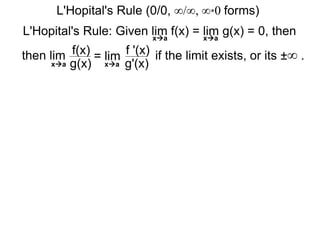
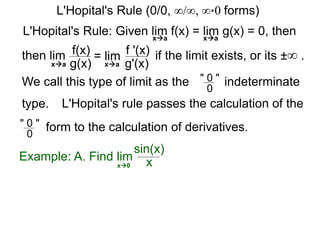
L'Hopital's Rule: Given lim f(x) = lim g(x) = 0, then
then lim f(x)
g(x)
= lim f '(x)
g'(x)
if the limit exists, or its ±∞ .
xa xa
xa xa
L'Hopital's Rule (0/0, ∞/∞, ∞*0 forms)
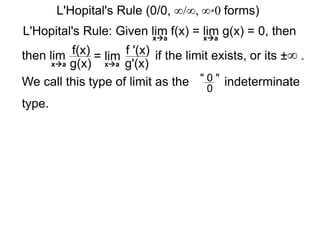
L'Hopital's Rule: Given lim f(x) = lim g(x) = 0, then
then lim f(x)
g(x)
= lim f '(x)
g'(x)
if the limit exists, or its ±∞ .
xa xa
xa xa
We call this type of limit as the " 0 "
0
indeterminate
type.
L'Hopital's Rule (0/0, ∞/∞, ∞*0 forms)
L'Hopital's Rule: Given lim f(x) = lim g(x) = 0, then
then lim f(x)
g(x)
= lim f '(x)
g'(x)
if the limit exists, or its ±∞ .
xa xa
xa xa
We call this type of limit as the " 0 "
0
indeterminate
L'Hopital's rule passes the calculation of the
" 0 "
0
form to the calculation of derivatives.
L'Hopital's Rule (0/0, ∞/∞, ∞*0 forms)
type.
L'Hopital's Rule: Given lim f(x) = lim g(x) = 0, then
then lim f(x)
g(x)
= lim f '(x)
g'(x)
if the limit exists, or its ±∞ .
xa xa
xa xa
We call this type of limit as the " 0 "
0
indeterminate
L'Hopital's rule passes the calculation of the
" 0 "
0
form to the calculation of derivatives.
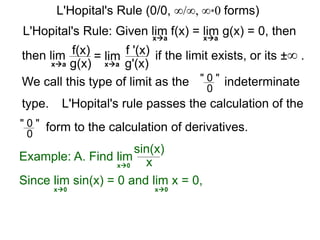
Example: A. Find lim
sin(x)
xx0
L'Hopital's Rule (0/0, ∞/∞, ∞*0 forms)
type.
L'Hopital's Rule: Given lim f(x) = lim g(x) = 0, then
then lim f(x)
g(x)
= lim f '(x)
g'(x)
if the limit exists, or its ±∞ .
xa xa
xa xa
We call this type of limit as the " 0 "
0
indeterminate
L'Hopital's rule passes the calculation of the
" 0 "
0
form to the calculation of derivatives.
Example: A. Find lim
sin(x)
xx0
Since lim sin(x) = 0 and lim x = 0,
x0 x0
L'Hopital's Rule (0/0, ∞/∞, ∞*0 forms)
type.
L'Hopital's Rule: Given lim f(x) = lim g(x) = 0, then
then lim f(x)
g(x)
= lim f '(x)
g'(x)
if the limit exists, or its ±∞ .
xa xa
xa xa
We call this type of limit as the " 0 "
0
indeterminate
L'Hopital's rule passes the calculation of the
" 0 "
0
form to the calculation of derivatives.
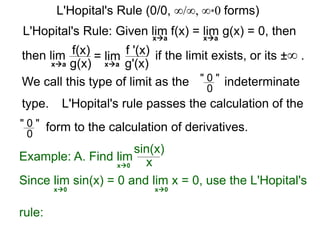
Example: A. Find lim
sin(x)
xx0
Since lim sin(x) = 0 and lim x = 0, use the L'Hopital's
rule:
x0 x0
L'Hopital's Rule (0/0, ∞/∞, ∞*0 forms)
type.
L'Hopital's Rule: Given lim f(x) = lim g(x) = 0, then
then lim f(x)
g(x)
= lim f '(x)
g'(x)
if the limit exists, or its ±∞ .
xa xa
xa xa
We call this type of limit as the " 0 "
0
indeterminate
L'Hopital's rule passes the calculation of the
" 0 "
0
form to the calculation of derivatives.
Example: A. Find lim
sin(x)
xx0
Since lim sin(x) = 0 and lim x = 0, use the L'Hopital's
rule:
x0 x0
lim
sin(x)
x = lim
[sin(x)]'
[x]'x0 x0
L'Hopital's Rule (0/0, ∞/∞, ∞*0 forms)
type.
L'Hopital's Rule: Given lim f(x) = lim g(x) = 0, then
then lim f(x)
g(x)
= lim f '(x)
g'(x)
if the limit exists, or its ±∞ .
xa xa
xa xa
We call this type of limit as the " 0 "
0
indeterminate
L'Hopital's rule passes the calculation of the
" 0 "
0
form to the calculation of derivatives.
Example: A. Find lim
sin(x)
xx0
Since lim sin(x) = 0 and lim x = 0, use the L'Hopital's
rule:
x0 x0
lim
sin(x)
x = lim
[sin(x)]'
[x]'x0 x0
= lim
cos(x)
1x0
L'Hopital's Rule (0/0, ∞/∞, ∞*0 forms)
type.
L'Hopital's Rule: Given lim f(x) = lim g(x) = 0, then
then lim f(x)
g(x)
= lim f '(x)
g'(x)
if the limit exists, or its ±∞ .
xa xa
xa xa
We call this type of limit as the " 0 "
0
indeterminate
L'Hopital's rule passes the calculation of the
" 0 "
0
form to the calculation of derivatives.
Example: A. Find lim
sin(x)
xx0
Since lim sin(x) = 0 and lim x = 0, use the L'Hopital's
rule:
x0 x0
lim
sin(x)
x = lim
[sin(x)]'
[x]'x0 x0
= lim
cos(x)
1x0
= 1.
L'Hopital's Rule (0/0, ∞/∞, ∞*0 forms)
type.
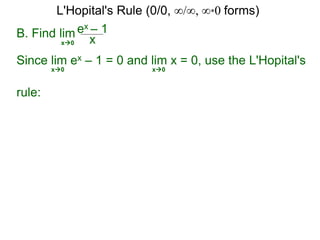
B. Find lim ex – 1
xx0
L'Hopital's Rule (0/0, ∞/∞, ∞*0 forms)
B. Find lim ex – 1
xx0
Since lim ex – 1 = 0 and lim x = 0, use the L'Hopital's
rule:
x0 x0
L'Hopital's Rule (0/0, ∞/∞, ∞*0 forms)
B. Find lim ex – 1
xx0
Since lim ex – 1 = 0 and lim x = 0, use the L'Hopital's
rule:
x0 x0
lim ex – 1
x = lim [ex – 1 ]'
[x]'x0 x0
L'Hopital's Rule (0/0, ∞/∞, ∞*0 forms)
B. Find lim ex – 1
xx0
Since lim ex – 1 = 0 and lim x = 0, use the L'Hopital's
rule:
x0 x0
lim ex – 1
x = lim [ex – 1 ]'
[x]'x0 x0
= lim
ex
1x0
L'Hopital's Rule (0/0, ∞/∞, ∞*0 forms)
B. Find lim ex – 1
xx0
Since lim ex – 1 = 0 and lim x = 0, use the L'Hopital's
rule:
x0 x0
lim ex – 1
x = lim [ex – 1 ]'
[x]'x0 x0
= lim
ex
1x0
= 1.
L'Hopital's Rule (0/0, ∞/∞, ∞*0 forms)
B. Find lim ex – 1
xx0
Since lim ex – 1 = 0 and lim x = 0, use the L'Hopital's
rule:
x0 x0
lim ex – 1
x = lim [ex – 1 ]'
[x]'x0 x0
= lim
ex
1x0
= 1.
C. Find lim ex – 1
x2x0+
L'Hopital's Rule (0/0, ∞/∞, ∞*0 forms)
B. Find lim ex – 1
xx0
Since lim ex – 1 = 0 and lim x = 0, use the L'Hopital's
rule:
x0 x0
lim ex – 1
x = lim [ex – 1 ]'
[x]'x0 x0
= lim
ex
1x0
= 1.
C. Find lim ex – 1
x2x0+
Since lim ex – 1 = 0 and lim x2 = 0, use the L'Hopital's
rule:
x0+ x0+
L'Hopital's Rule (0/0, ∞/∞, ∞*0 forms)
B. Find lim ex – 1
xx0
Since lim ex – 1 = 0 and lim x = 0, use the L'Hopital's
rule:
x0 x0
lim ex – 1
x = lim [ex – 1 ]'
[x]'x0 x0
= lim
ex
1x0
= 1.
C. Find lim ex – 1
x2x0+
Since lim ex – 1 = 0 and lim x2 = 0, use the L'Hopital's
rule: lim ex – 1
x2 = lim [ex – 1 ]'
[x2]'x0+
x0+ x0+
x0+
L'Hopital's Rule (0/0, ∞/∞, ∞*0 forms)
B. Find lim ex – 1
xx0
Since lim ex – 1 = 0 and lim x = 0, use the L'Hopital's
rule:
x0 x0
lim ex – 1
x = lim [ex – 1 ]'
[x]'x0 x0
= lim
ex
1x0
= 1.
C. Find lim ex – 1
x2x0+
Since lim ex – 1 = 0 and lim x2 = 0, use the L'Hopital's
rule: lim ex – 1
x2 = lim [ex – 1 ]'
[x2]'x0+
= lim
ex
2xx0+
x0+ x0+
x0+
L'Hopital's Rule (0/0, ∞/∞, ∞*0 forms)
B. Find lim ex – 1
xx0
Since lim ex – 1 = 0 and lim x = 0, use the L'Hopital's
rule:
x0 x0
lim ex – 1
x = lim [ex – 1 ]'
[x]'x0 x0
= lim
ex
1x0
= 1.
C. Find lim ex – 1
x2x0+
Since lim ex – 1 = 0 and lim x2 = 0, use the L'Hopital's
rule: lim ex – 1
x2 = lim [ex – 1 ]'
[x2]'x0+
= lim
ex
2xx0+
= ∞.
x0+ x0+
x0+
L'Hopital's Rule (0/0, ∞/∞, ∞*0 forms)
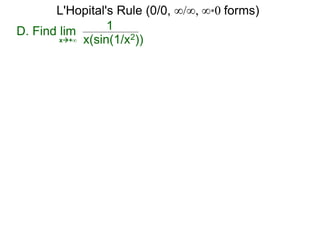
D. Find lim 1
x(sin(1/x2))x+∞
L'Hopital's Rule (0/0, ∞/∞, ∞*0 forms)
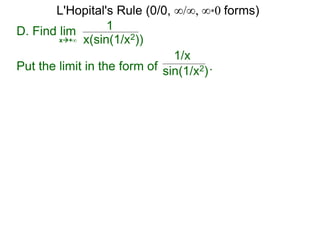
D. Find lim 1
x(sin(1/x2))x+∞
Put the limit in the form of .
1/x
sin(1/x2)
L'Hopital's Rule (0/0, ∞/∞, ∞*0 forms)
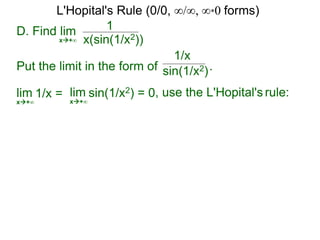
D. Find lim 1
x(sin(1/x2))x+∞
Put the limit in the form of .
lim
1/x
x+∞
1/x = lim
x+∞
sin(1/x2) = 0, use the L'Hopital's rule:
sin(1/x2)
L'Hopital's Rule (0/0, ∞/∞, ∞*0 forms)
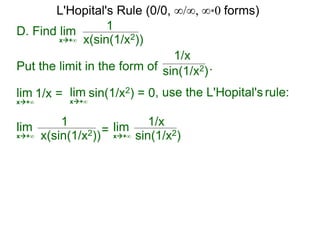
D. Find lim 1
x(sin(1/x2))x+∞
Put the limit in the form of .
lim
1/x
x+∞
1/x = lim
x+∞
sin(1/x2) = 0, use the L'Hopital's rule:
lim 1
x(sin(1/x2))x+∞
sin(1/x2)
= lim 1/x
sin(1/x2)x+∞
L'Hopital's Rule (0/0, ∞/∞, ∞*0 forms)
D. Find lim 1
x(sin(1/x2))x+∞
Put the limit in the form of .
lim
1/x
x+∞
1/x = lim
x+∞
sin(1/x2) = 0, use the L'Hopital's rule:
lim 1
x(sin(1/x2))x+∞
sin(1/x2)
= lim 1/x
sin(1/x2)x+∞
= lim
[1/x]'
[sin(1/x2)]'x+∞
L'Hopital's Rule (0/0, ∞/∞, ∞*0 forms)
D. Find lim 1
x(sin(1/x2))x+∞
Put the limit in the form of .
lim
1/x
x+∞
1/x = lim
x+∞
sin(1/x2) = 0, use the L'Hopital's rule:
lim 1
x(sin(1/x2))x+∞
sin(1/x2)
= lim 1/x
sin(1/x2)x+∞
= lim
[1/x]'
[sin(1/x2)]'x+∞
= lim
-x-2
cos(1/x2)(-2x-3)x+∞
L'Hopital's Rule (0/0, ∞/∞, ∞*0 forms)
D. Find lim 1
x(sin(1/x2))x+∞
Put the limit in the form of .
lim
1/x
x+∞
1/x = lim
x+∞
sin(1/x2) = 0, use the L'Hopital's rule:
lim 1
x(sin(1/x2))x+∞
sin(1/x2)
= lim 1/x
sin(1/x2)x+∞
= lim
[1/x]'
[sin(1/x2)]'x+∞
= lim
-x-2
cos(1/x2)(-2x-3)x+∞
= lim x
2cos(1/x2)x+∞
L'Hopital's Rule (0/0, ∞/∞, ∞*0 forms)
D. Find lim 1
x(sin(1/x2))x+∞
Put the limit in the form of .
lim
1/x
x+∞
1/x = lim
x+∞
sin(1/x2) = 0, use the L'Hopital's rule:
lim 1
x(sin(1/x2))x+∞
sin(1/x2)
= lim 1/x
sin(1/x2)x+∞
= lim
[1/x]'
[sin(1/x2)]'x+∞
= lim
-x-2
cos(1/x2)(-2x-3)x+∞
= lim x
2cos(1/x2)x+∞
= ∞
L'Hopital's Rule (0/0, ∞/∞, ∞*0 forms)
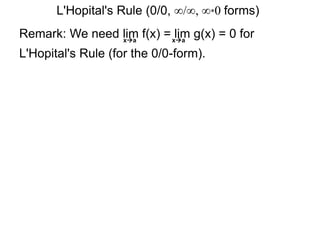
Remark: We need lim f(x) = lim g(x) = 0 for
L'Hopital's Rule (for the 0/0-form).
xa xa
L'Hopital's Rule (0/0, ∞/∞, ∞*0 forms)
Remark: We need lim f(x) = lim g(x) = 0 for
L'Hopital's Rule (for the 0/0-form).
xa xa
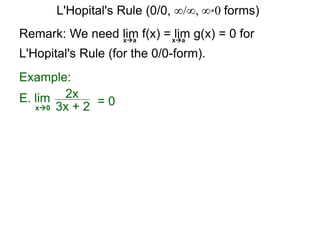
E. lim 2x
3x + 2x0
Example:
= 0
L'Hopital's Rule (0/0, ∞/∞, ∞*0 forms)
Remark: We need lim f(x) = lim g(x) = 0 for
L'Hopital's Rule (for the 0/0-form).
xa xa
E. lim 2x
3x + 2x0
Example:
= 0 = lim [2x]'
[3x + 2]'x0
L'Hopital's Rule (0/0, ∞/∞, ∞*0 forms)
Remark: We need lim f(x) = lim g(x) = 0 for
L'Hopital's Rule (for the 0/0-form).
xa xa
E. lim 2x
3x + 2x0
Example:
= 0 = lim [2x]'
[3x + 2]'x0 = 2
3 .
L'Hopital's Rule (0/0, ∞/∞, ∞*0 forms)
Remark: We need lim f(x) = lim g(x) = 0 for
L'Hopital's Rule (for the 0/0-form).
xa xa
E. lim 2x
3x + 2x0
Example:
= 0 = lim [2x]'
[3x + 2]'x0 = 2
3 .
are of the
" ∞ " indeterminate forms.∞
If lim f(x) = lim g(x) = ∞, then limxa xa
f(x)
g(x)xa
L'Hopital's Rule (0/0, ∞/∞, ∞*0 forms)
Remark: We need lim f(x) = lim g(x) = 0 for
L'Hopital's Rule (for the 0/0-form).
xa xa
E. lim 2x
3x + 2x0
Example:
= 0 = lim [2x]'
[3x + 2]'x0 = 2
3 .
are of the
" ∞ " indeterminate forms. L'Hopital’s Rule applies∞
If lim f(x) = lim g(x) = ∞, then limxa xa
f(x)
g(x)xa
in these situations also,
L'Hopital's Rule (0/0, ∞/∞, ∞*0 forms)
Remark: We need lim f(x) = lim g(x) = 0 for
L'Hopital's Rule (for the 0/0-form).
xa xa
E. lim 2x
3x + 2x0
Example:
= 0 = lim [2x]'
[3x + 2]'x0 = 2
3 .
are of the
" ∞ " indeterminate forms. L'Hopital’s Rule applies∞
If lim f(x) = lim g(x) = ∞, then limxa xa
f(x)
g(x)xa
in these situations also,
lim f(x)
g(x)
= lim f '(x)
g'(x).xa xa
that is
L'Hopital's Rule (0/0, ∞/∞, ∞*0 forms)
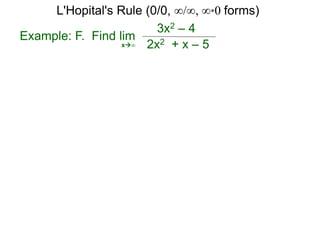
Example: F. Find lim
3x2 – 4
2x2 + x – 5x∞
L'Hopital's Rule (0/0, ∞/∞, ∞*0 forms)
Example: F. Find lim
3x2 – 4
2x2 + x – 5x∞
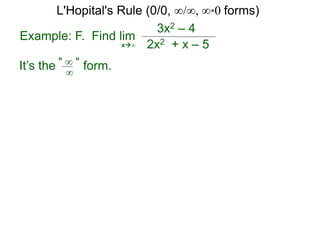
It’s the form." ∞ "
∞
L'Hopital's Rule (0/0, ∞/∞, ∞*0 forms)
Example: F. Find lim
3x2 – 4
2x2 + x – 5x∞
It’s the form." ∞ "
∞
Hence 3x2 – 4
2x2 + x – 5
limx∞
=
[3x2 – 4]'
[2x2 + x – 5]'
limx∞
L'Hopital's Rule (0/0, ∞/∞, ∞*0 forms)
Example: F. Find lim
3x2 – 4
2x2 + x – 5x∞
It’s the form." ∞ "
∞
Hence 3x2 – 4
2x2 + x – 5
limx∞
=
[3x2 – 4]'
[2x2 + x – 5]'
limx∞
6x
4x + 1
limx∞
=
L'Hopital's Rule (0/0, ∞/∞, ∞*0 forms)
Example: F. Find lim
3x2 – 4
2x2 + x – 5x∞
It’s the form." ∞ "
∞
Hence 3x2 – 4
2x2 + x – 5
limx∞
=
[3x2 – 4]'
[2x2 + x – 5]'
limx∞
6x
4x + 1
limx∞
= use L'Hopital's Rule again
L'Hopital's Rule (0/0, ∞/∞, ∞*0 forms)
Example: F. Find lim
3x2 – 4
2x2 + x – 5x∞
It’s the form." ∞ "
∞
Hence 3x2 – 4
2x2 + x – 5
limx∞
=
[3x2 – 4]'
[2x2 + x – 5]'
limx∞
6x
4x + 1
limx∞
=
= use L'Hopital's Rule again
[6x]'
[4x + 1]'
limx∞
L'Hopital's Rule (0/0, ∞/∞, ∞*0 forms)
Example: F. Find lim
3x2 – 4
2x2 + x – 5x∞
It’s the form." ∞ "
∞
Hence 3x2 – 4
2x2 + x – 5
limx∞
=
[3x2 – 4]'
[2x2 + x – 5]'
limx∞
6x
4x + 1
limx∞
=
= use L'Hopital's Rule again
[6x]'
[4x + 1]'
limx∞
= 6
4
L'Hopital's Rule (0/0, ∞/∞, ∞*0 forms)
= 3
2
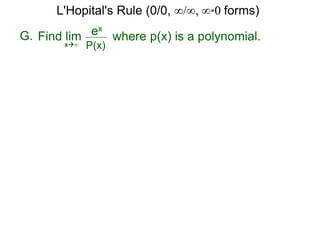
G. ex
P(x)x∞
where p(x) is a polynomial.Find lim
L'Hopital's Rule (0/0, ∞/∞, ∞*0 forms)
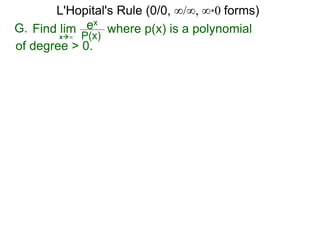
G. ex
P(x)x∞
where p(x) is a polynomialFind lim
L'Hopital's Rule (0/0, ∞/∞, ∞*0 forms)
of degree > 0.
It’s the form." ∞ "
∞
Hence limx∞ = limx∞
ex
P(x)
[ex]'
[P(x)]'
L'Hopital's Rule (0/0, ∞/∞, ∞*0 forms)
G. ex
P(x)x∞
where p(x) is a polynomialFind lim
of degree > 0.
It’s the form." ∞ "
∞
Hence limx∞ = limx∞
ex
P(x)
[ex]'
[P(x)]'
= limx∞
ex
[P(x)]'
L'Hopital's Rule (0/0, ∞/∞, ∞*0 forms)
G. ex
P(x)x∞
where p(x) is a polynomialFind lim
of degree > 0.
It’s the form." ∞ "
∞
Hence limx∞ = limx∞
ex
P(x)
[ex]'
[P(x)]'
= limx∞
ex
[P(x)]'
Use the L'Hopital's Rule repeatedly if necessary,
eventually the denominator is a non-zero constant K.
L'Hopital's Rule (0/0, ∞/∞, ∞*0 forms)
G. ex
P(x)x∞
where p(x) is a polynomialFind lim
of degree > 0.
It’s the form." ∞ "
∞
Hence limx∞ = limx∞
= limx∞
ex
K
ex
P(x)
[ex]'
[P(x)]'
= limx∞
ex
[P(x)]'
Use the L'Hopital's Rule repeatedly if necessary,
eventually the denominator is a non-zero constant K.
Hence limx∞
ex
P(x)
L'Hopital's Rule (0/0, ∞/∞, ∞*0 forms)
G. ex
P(x)x∞
where p(x) is a polynomialFind lim
of degree > 0.
It’s the form." ∞ "
∞
Hence limx∞ = limx∞
= limx∞
ex
K
= ∞
ex
P(x)
[ex]'
[P(x)]'
= limx∞
ex
[P(x)]'
Use the L'Hopital's Rule repeatedly if necessary,
eventually the denominator is a non-zero constant K.
Hence limx∞
ex
P(x)
L'Hopital's Rule (0/0, ∞/∞, ∞*0 forms)
G. ex
P(x)x∞
where p(x) is a polynomialFind lim
of degree > 0.
It’s the form." ∞ "
∞
Hence limx∞ = limx∞
= limx∞
ex
K
We say that ex goes to ∞ faster than any polynomial.
= ∞
ex
P(x)
[ex]'
[P(x)]'
= limx∞
ex
[P(x)]'
Use the L'Hopital's Rule repeatedly if necessary,
eventually the denominator is a non-zero constant K.
Hence limx∞
ex
P(x)
L'Hopital's Rule (0/0, ∞/∞, ∞*0 forms)
G. ex
P(x)x∞
where p(x) is a polynomialFind lim
of degree > 0.
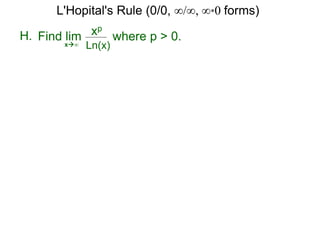
H. xp
Ln(x)x∞
where p > 0.Find lim
L'Hopital's Rule (0/0, ∞/∞, ∞*0 forms)
H. xp
Ln(x)x∞
It’s the form." ∞ "
∞
where p > 0.Find lim
L'Hopital's Rule (0/0, ∞/∞, ∞*0 forms)
H. xp
Ln(x)x∞
It’s the form." ∞ "
∞
Hence limx∞ =
where p > 0.Find lim
limx∞
xp
Ln(x)
[xp]'
[Ln(x)]'
L'Hopital's Rule (0/0, ∞/∞, ∞*0 forms)
H. xp
Ln(x)x∞
It’s the form." ∞ "
∞
Hence limx∞ =
where p > 0.Find lim
limx∞
= limx∞
pxp-1
x-1
xp
Ln(x)
[xp]'
[Ln(x)]'
L'Hopital's Rule (0/0, ∞/∞, ∞*0 forms)
H. xp
Ln(x)x∞
It’s the form." ∞ "
∞
Hence limx∞ =
where p > 0.Find lim
limx∞
= limx∞
pxp-1
x-1
xp
Ln(x)
[xp]'
[Ln(x)]'
= limx∞
pxp
L'Hopital's Rule (0/0, ∞/∞, ∞*0 forms)
H. xp
Ln(x)x∞
It’s the form." ∞ "
∞
Hence limx∞ =
where p > 0.Find lim
limx∞
= limx∞
pxp-1
x-1
xp
Ln(x)
[xp]'
[Ln(x)]'
= limx∞
pxp = ∞
L'Hopital's Rule (0/0, ∞/∞, ∞*0 forms)
H. xp
Ln(x)x∞
It’s the form." ∞ "
∞
Hence limx∞ =
where p > 0.Find lim
limx∞
= limx∞
pxp-1
x-1
We say that xp (p > 0) goes to ∞ faster than Ln(x).
xp
Ln(x)
[xp]'
[Ln(x)]'
= limx∞
pxp = ∞
L'Hopital's Rule (0/0, ∞/∞, ∞*0 forms)
H. xp
Ln(x)x∞
It’s the form." ∞ "
∞
Hence limx∞ =
where p > 0.Find lim
limx∞
= limx∞
pxp-1
x-1
We say that xp (p > 0) goes to ∞ faster than Ln(x).
xp
Ln(x)
[xp]'
[Ln(x)]'
= limx∞
pxp = ∞
The ∞/∞ form is the same as ∞*0 form since
∞/∞ = ∞ * (1/∞) and we may view that 1/∞ as 0.
L'Hopital's Rule (0/0, ∞/∞, ∞*0 forms)
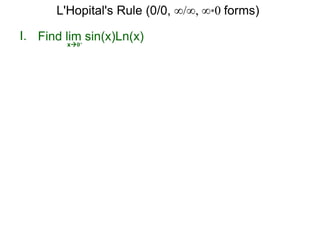
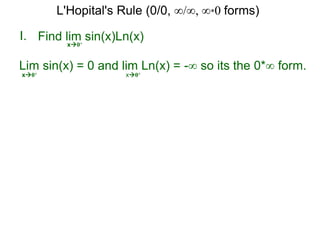
I.
x0+
Find lim sin(x)Ln(x)
L'Hopital's Rule (0/0, ∞/∞, ∞*0 forms)
I.
x0+
Find lim sin(x)Ln(x)
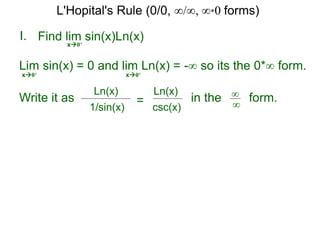
Lim sin(x) = 0 and lim Ln(x) = -∞ so its the 0*∞ form.
x0+ x0+
L'Hopital's Rule (0/0, ∞/∞, ∞*0 forms)
I.
x0+
Find lim sin(x)Ln(x)
Lim sin(x) = 0 and lim Ln(x) = -∞ so its the 0*∞ form.
x0+ x0+
Write it as
1/sin(x)
Ln(x)
L'Hopital's Rule (0/0, ∞/∞, ∞*0 forms)
I.
x0+
in the form.∞
∞
Find lim sin(x)Ln(x)
Lim sin(x) = 0 and lim Ln(x) = -∞ so its the 0*∞ form.
x0+ x0+
Write it as
csc(x)
Ln(x)
1/sin(x)
Ln(x)
=
L'Hopital's Rule (0/0, ∞/∞, ∞*0 forms)
I.
x0+
in the form.∞
∞
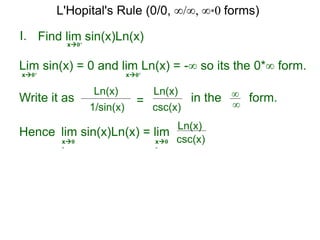
Hence lim sin(x)Ln(x) = lim
Find lim sin(x)Ln(x)
Lim sin(x) = 0 and lim Ln(x) = -∞ so its the 0*∞ form.
x0+ x0+
Write it as
csc(x)
Ln(x)
csc(x)
Ln(x)
x0
+
x0
+
1/sin(x)
Ln(x)
=
L'Hopital's Rule (0/0, ∞/∞, ∞*0 forms)
I.
x0+
in the form.∞
∞
Hence lim sin(x)Ln(x) = lim
=
Find lim sin(x)Ln(x)
lim
Lim sin(x) = 0 and lim Ln(x) = -∞ so its the 0*∞ form.
x0+ x0+
Write it as
csc(x)
Ln(x)
csc(x)
Ln(x)
x0
+
x0
+
[csc(x)]'
[Ln(x)]'
x0
+
=
1/sin(x)
Ln(x)
=
L'Hopital's Rule (0/0, ∞/∞, ∞*0 forms)
I.
x0+
in the form.∞
∞
Hence lim sin(x)Ln(x) = lim
=
Find lim sin(x)Ln(x)
lim
Lim sin(x) = 0 and lim Ln(x) = -∞ so its the 0*∞ form.
x0+ x0+
Write it as
csc(x)
Ln(x)
csc(x)
Ln(x)
x0
+
x0
+
[csc(x)]'
[Ln(x)]'
x0
+
= lim
-csc(x)cot(x)
1/x
x0
+
1/sin(x)
Ln(x)
=
L'Hopital's Rule (0/0, ∞/∞, ∞*0 forms)
I.
x0+
in the form.∞
∞
Hence lim sin(x)Ln(x) = lim
=
Find lim sin(x)Ln(x)
lim
Lim sin(x) = 0 and lim Ln(x) = -∞ so its the 0*∞ form.
x0+ x0+
Write it as
csc(x)
Ln(x)
csc(x)
Ln(x)
x0
+
x0
+
[csc(x)]'
[Ln(x)]'
x0
+
= lim
-csc(x)cot(x)
1/x
x0
+
= lim
x
- sin(x)tan(x)
x0
+
1/sin(x)
Ln(x)
=
L'Hopital's Rule (0/0, ∞/∞, ∞*0 forms)
I.
x0+
in the form.∞
∞
Hence lim sin(x)Ln(x) = lim
=
Find lim sin(x)Ln(x)
lim
Lim sin(x) = 0 and lim Ln(x) = -∞ so its the 0*∞ form.
x0+ x0+
Write it as
csc(x)
Ln(x)
csc(x)
Ln(x)
x0
+
x0
+
[csc(x)]'
[Ln(x)]'
x0
+
= lim
-csc(x)cot(x)
1/x
x0
+
= lim
x
- sin(x)tan(x)
x0
+
=
x
-sin(x)lim
x0
+
tan(x)lim
x0
+
1/sin(x)
Ln(x)
=
L'Hopital's Rule (0/0, ∞/∞, ∞*0 forms)
I.
x0+
in the form.∞
∞
Hence lim sin(x)Ln(x) = lim
=
Find lim sin(x)Ln(x)
lim
Lim sin(x) = 0 and lim Ln(x) = -∞ so its the 0*∞ form.
x0+ x0+
Write it as
csc(x)
Ln(x)
csc(x)
Ln(x)
x0
+
x0
+
[csc(x)]'
[Ln(x)]'
x0
+
= lim
-csc(x)cot(x)
1/x
x0
+
= lim
x
- sin(x)tan(x)
x0
+
=
x
-sin(x)lim
x0
+
tan(x)lim
x0
+
1
1/sin(x)
Ln(x)
=
L'Hopital's Rule (0/0, ∞/∞, ∞*0 forms)
I.
x0+
in the form.∞
∞
Hence lim sin(x)Ln(x) = lim
=
Find lim sin(x)Ln(x)
lim
L'Hopital's Rule (0/0, ∞/∞, ∞*0 forms)
Lim sin(x) = 0 and lim Ln(x) = -∞ so its the 0*∞ form.
x0+ x0+
Write it as
csc(x)
Ln(x)
csc(x)
Ln(x)
x0
+
x0
+
[csc(x)]'
[Ln(x)]'
x0
+
= lim
-csc(x)cot(x)
1/x
x0
+
= lim
x
- sin(x)tan(x)
x0
+
=
x
-sin(x)lim
x0
+
tan(x)lim
x0
+
0-1
1/sin(x)
Ln(x)
=
I.
x0+
in the form.∞
∞
Hence lim sin(x)Ln(x) = lim
=
Find lim sin(x)Ln(x)
lim
L'Hopital's Rule (0/0, ∞/∞, ∞*0 forms)
Lim sin(x) = 0 and lim Ln(x) = -∞ so its the 0*∞ form.
x0+ x0+
Write it as
csc(x)
Ln(x)
csc(x)
Ln(x)
x0
+
x0
+
[csc(x)]'
[Ln(x)]'
x0
+
= lim
-csc(x)cot(x)
1/x
x0
+
= lim
x
- sin(x)tan(x)
x0
+
=
x
-sin(x)lim
x0
+
tan(x) = 0lim
x0
+
0-1
1/sin(x)
Ln(x)
=

L'Hopital's rule i

  • 1.
    L'Hopital's Rule (0/0,∞/∞, ∞*0 forms)
  • 2.
    L'Hopital's Rule: Givenlim f(x) = lim g(x) = 0, then then lim f(x) g(x) = lim f '(x) g'(x) if the limit exists, or its ±∞ . xa xa xa xa L'Hopital's Rule (0/0, ∞/∞, ∞*0 forms)
  • 3.
    L'Hopital's Rule: Givenlim f(x) = lim g(x) = 0, then then lim f(x) g(x) = lim f '(x) g'(x) if the limit exists, or its ±∞ . xa xa xa xa We call this type of limit as the " 0 " 0 indeterminate type. L'Hopital's Rule (0/0, ∞/∞, ∞*0 forms)
  • 4.
    L'Hopital's Rule: Givenlim f(x) = lim g(x) = 0, then then lim f(x) g(x) = lim f '(x) g'(x) if the limit exists, or its ±∞ . xa xa xa xa We call this type of limit as the " 0 " 0 indeterminate L'Hopital's rule passes the calculation of the " 0 " 0 form to the calculation of derivatives. L'Hopital's Rule (0/0, ∞/∞, ∞*0 forms) type.
  • 5.
    L'Hopital's Rule: Givenlim f(x) = lim g(x) = 0, then then lim f(x) g(x) = lim f '(x) g'(x) if the limit exists, or its ±∞ . xa xa xa xa We call this type of limit as the " 0 " 0 indeterminate L'Hopital's rule passes the calculation of the " 0 " 0 form to the calculation of derivatives. Example: A. Find lim sin(x) xx0 L'Hopital's Rule (0/0, ∞/∞, ∞*0 forms) type.
  • 6.
    L'Hopital's Rule: Givenlim f(x) = lim g(x) = 0, then then lim f(x) g(x) = lim f '(x) g'(x) if the limit exists, or its ±∞ . xa xa xa xa We call this type of limit as the " 0 " 0 indeterminate L'Hopital's rule passes the calculation of the " 0 " 0 form to the calculation of derivatives. Example: A. Find lim sin(x) xx0 Since lim sin(x) = 0 and lim x = 0, x0 x0 L'Hopital's Rule (0/0, ∞/∞, ∞*0 forms) type.
  • 7.
    L'Hopital's Rule: Givenlim f(x) = lim g(x) = 0, then then lim f(x) g(x) = lim f '(x) g'(x) if the limit exists, or its ±∞ . xa xa xa xa We call this type of limit as the " 0 " 0 indeterminate L'Hopital's rule passes the calculation of the " 0 " 0 form to the calculation of derivatives. Example: A. Find lim sin(x) xx0 Since lim sin(x) = 0 and lim x = 0, use the L'Hopital's rule: x0 x0 L'Hopital's Rule (0/0, ∞/∞, ∞*0 forms) type.
  • 8.
    L'Hopital's Rule: Givenlim f(x) = lim g(x) = 0, then then lim f(x) g(x) = lim f '(x) g'(x) if the limit exists, or its ±∞ . xa xa xa xa We call this type of limit as the " 0 " 0 indeterminate L'Hopital's rule passes the calculation of the " 0 " 0 form to the calculation of derivatives. Example: A. Find lim sin(x) xx0 Since lim sin(x) = 0 and lim x = 0, use the L'Hopital's rule: x0 x0 lim sin(x) x = lim [sin(x)]' [x]'x0 x0 L'Hopital's Rule (0/0, ∞/∞, ∞*0 forms) type.
  • 9.
    L'Hopital's Rule: Givenlim f(x) = lim g(x) = 0, then then lim f(x) g(x) = lim f '(x) g'(x) if the limit exists, or its ±∞ . xa xa xa xa We call this type of limit as the " 0 " 0 indeterminate L'Hopital's rule passes the calculation of the " 0 " 0 form to the calculation of derivatives. Example: A. Find lim sin(x) xx0 Since lim sin(x) = 0 and lim x = 0, use the L'Hopital's rule: x0 x0 lim sin(x) x = lim [sin(x)]' [x]'x0 x0 = lim cos(x) 1x0 L'Hopital's Rule (0/0, ∞/∞, ∞*0 forms) type.
  • 10.
    L'Hopital's Rule: Givenlim f(x) = lim g(x) = 0, then then lim f(x) g(x) = lim f '(x) g'(x) if the limit exists, or its ±∞ . xa xa xa xa We call this type of limit as the " 0 " 0 indeterminate L'Hopital's rule passes the calculation of the " 0 " 0 form to the calculation of derivatives. Example: A. Find lim sin(x) xx0 Since lim sin(x) = 0 and lim x = 0, use the L'Hopital's rule: x0 x0 lim sin(x) x = lim [sin(x)]' [x]'x0 x0 = lim cos(x) 1x0 = 1. L'Hopital's Rule (0/0, ∞/∞, ∞*0 forms) type.
  • 11.
    B. Find limex – 1 xx0 L'Hopital's Rule (0/0, ∞/∞, ∞*0 forms)
  • 12.
    B. Find limex – 1 xx0 Since lim ex – 1 = 0 and lim x = 0, use the L'Hopital's rule: x0 x0 L'Hopital's Rule (0/0, ∞/∞, ∞*0 forms)
  • 13.
    B. Find limex – 1 xx0 Since lim ex – 1 = 0 and lim x = 0, use the L'Hopital's rule: x0 x0 lim ex – 1 x = lim [ex – 1 ]' [x]'x0 x0 L'Hopital's Rule (0/0, ∞/∞, ∞*0 forms)
  • 14.
    B. Find limex – 1 xx0 Since lim ex – 1 = 0 and lim x = 0, use the L'Hopital's rule: x0 x0 lim ex – 1 x = lim [ex – 1 ]' [x]'x0 x0 = lim ex 1x0 L'Hopital's Rule (0/0, ∞/∞, ∞*0 forms)
  • 15.
    B. Find limex – 1 xx0 Since lim ex – 1 = 0 and lim x = 0, use the L'Hopital's rule: x0 x0 lim ex – 1 x = lim [ex – 1 ]' [x]'x0 x0 = lim ex 1x0 = 1. L'Hopital's Rule (0/0, ∞/∞, ∞*0 forms)
  • 16.
    B. Find limex – 1 xx0 Since lim ex – 1 = 0 and lim x = 0, use the L'Hopital's rule: x0 x0 lim ex – 1 x = lim [ex – 1 ]' [x]'x0 x0 = lim ex 1x0 = 1. C. Find lim ex – 1 x2x0+ L'Hopital's Rule (0/0, ∞/∞, ∞*0 forms)
  • 17.
    B. Find limex – 1 xx0 Since lim ex – 1 = 0 and lim x = 0, use the L'Hopital's rule: x0 x0 lim ex – 1 x = lim [ex – 1 ]' [x]'x0 x0 = lim ex 1x0 = 1. C. Find lim ex – 1 x2x0+ Since lim ex – 1 = 0 and lim x2 = 0, use the L'Hopital's rule: x0+ x0+ L'Hopital's Rule (0/0, ∞/∞, ∞*0 forms)
  • 18.
    B. Find limex – 1 xx0 Since lim ex – 1 = 0 and lim x = 0, use the L'Hopital's rule: x0 x0 lim ex – 1 x = lim [ex – 1 ]' [x]'x0 x0 = lim ex 1x0 = 1. C. Find lim ex – 1 x2x0+ Since lim ex – 1 = 0 and lim x2 = 0, use the L'Hopital's rule: lim ex – 1 x2 = lim [ex – 1 ]' [x2]'x0+ x0+ x0+ x0+ L'Hopital's Rule (0/0, ∞/∞, ∞*0 forms)
  • 19.
    B. Find limex – 1 xx0 Since lim ex – 1 = 0 and lim x = 0, use the L'Hopital's rule: x0 x0 lim ex – 1 x = lim [ex – 1 ]' [x]'x0 x0 = lim ex 1x0 = 1. C. Find lim ex – 1 x2x0+ Since lim ex – 1 = 0 and lim x2 = 0, use the L'Hopital's rule: lim ex – 1 x2 = lim [ex – 1 ]' [x2]'x0+ = lim ex 2xx0+ x0+ x0+ x0+ L'Hopital's Rule (0/0, ∞/∞, ∞*0 forms)
  • 20.
    B. Find limex – 1 xx0 Since lim ex – 1 = 0 and lim x = 0, use the L'Hopital's rule: x0 x0 lim ex – 1 x = lim [ex – 1 ]' [x]'x0 x0 = lim ex 1x0 = 1. C. Find lim ex – 1 x2x0+ Since lim ex – 1 = 0 and lim x2 = 0, use the L'Hopital's rule: lim ex – 1 x2 = lim [ex – 1 ]' [x2]'x0+ = lim ex 2xx0+ = ∞. x0+ x0+ x0+ L'Hopital's Rule (0/0, ∞/∞, ∞*0 forms)
  • 21.
    D. Find lim1 x(sin(1/x2))x+∞ L'Hopital's Rule (0/0, ∞/∞, ∞*0 forms)
  • 22.
    D. Find lim1 x(sin(1/x2))x+∞ Put the limit in the form of . 1/x sin(1/x2) L'Hopital's Rule (0/0, ∞/∞, ∞*0 forms)
  • 23.
    D. Find lim1 x(sin(1/x2))x+∞ Put the limit in the form of . lim 1/x x+∞ 1/x = lim x+∞ sin(1/x2) = 0, use the L'Hopital's rule: sin(1/x2) L'Hopital's Rule (0/0, ∞/∞, ∞*0 forms)
  • 24.
    D. Find lim1 x(sin(1/x2))x+∞ Put the limit in the form of . lim 1/x x+∞ 1/x = lim x+∞ sin(1/x2) = 0, use the L'Hopital's rule: lim 1 x(sin(1/x2))x+∞ sin(1/x2) = lim 1/x sin(1/x2)x+∞ L'Hopital's Rule (0/0, ∞/∞, ∞*0 forms)
  • 25.
    D. Find lim1 x(sin(1/x2))x+∞ Put the limit in the form of . lim 1/x x+∞ 1/x = lim x+∞ sin(1/x2) = 0, use the L'Hopital's rule: lim 1 x(sin(1/x2))x+∞ sin(1/x2) = lim 1/x sin(1/x2)x+∞ = lim [1/x]' [sin(1/x2)]'x+∞ L'Hopital's Rule (0/0, ∞/∞, ∞*0 forms)
  • 26.
    D. Find lim1 x(sin(1/x2))x+∞ Put the limit in the form of . lim 1/x x+∞ 1/x = lim x+∞ sin(1/x2) = 0, use the L'Hopital's rule: lim 1 x(sin(1/x2))x+∞ sin(1/x2) = lim 1/x sin(1/x2)x+∞ = lim [1/x]' [sin(1/x2)]'x+∞ = lim -x-2 cos(1/x2)(-2x-3)x+∞ L'Hopital's Rule (0/0, ∞/∞, ∞*0 forms)
  • 27.
    D. Find lim1 x(sin(1/x2))x+∞ Put the limit in the form of . lim 1/x x+∞ 1/x = lim x+∞ sin(1/x2) = 0, use the L'Hopital's rule: lim 1 x(sin(1/x2))x+∞ sin(1/x2) = lim 1/x sin(1/x2)x+∞ = lim [1/x]' [sin(1/x2)]'x+∞ = lim -x-2 cos(1/x2)(-2x-3)x+∞ = lim x 2cos(1/x2)x+∞ L'Hopital's Rule (0/0, ∞/∞, ∞*0 forms)
  • 28.
    D. Find lim1 x(sin(1/x2))x+∞ Put the limit in the form of . lim 1/x x+∞ 1/x = lim x+∞ sin(1/x2) = 0, use the L'Hopital's rule: lim 1 x(sin(1/x2))x+∞ sin(1/x2) = lim 1/x sin(1/x2)x+∞ = lim [1/x]' [sin(1/x2)]'x+∞ = lim -x-2 cos(1/x2)(-2x-3)x+∞ = lim x 2cos(1/x2)x+∞ = ∞ L'Hopital's Rule (0/0, ∞/∞, ∞*0 forms)
  • 29.
    Remark: We needlim f(x) = lim g(x) = 0 for L'Hopital's Rule (for the 0/0-form). xa xa L'Hopital's Rule (0/0, ∞/∞, ∞*0 forms)
  • 30.
    Remark: We needlim f(x) = lim g(x) = 0 for L'Hopital's Rule (for the 0/0-form). xa xa E. lim 2x 3x + 2x0 Example: = 0 L'Hopital's Rule (0/0, ∞/∞, ∞*0 forms)
  • 31.
    Remark: We needlim f(x) = lim g(x) = 0 for L'Hopital's Rule (for the 0/0-form). xa xa E. lim 2x 3x + 2x0 Example: = 0 = lim [2x]' [3x + 2]'x0 L'Hopital's Rule (0/0, ∞/∞, ∞*0 forms)
  • 32.
    Remark: We needlim f(x) = lim g(x) = 0 for L'Hopital's Rule (for the 0/0-form). xa xa E. lim 2x 3x + 2x0 Example: = 0 = lim [2x]' [3x + 2]'x0 = 2 3 . L'Hopital's Rule (0/0, ∞/∞, ∞*0 forms)
  • 33.
    Remark: We needlim f(x) = lim g(x) = 0 for L'Hopital's Rule (for the 0/0-form). xa xa E. lim 2x 3x + 2x0 Example: = 0 = lim [2x]' [3x + 2]'x0 = 2 3 . are of the " ∞ " indeterminate forms.∞ If lim f(x) = lim g(x) = ∞, then limxa xa f(x) g(x)xa L'Hopital's Rule (0/0, ∞/∞, ∞*0 forms)
  • 34.
    Remark: We needlim f(x) = lim g(x) = 0 for L'Hopital's Rule (for the 0/0-form). xa xa E. lim 2x 3x + 2x0 Example: = 0 = lim [2x]' [3x + 2]'x0 = 2 3 . are of the " ∞ " indeterminate forms. L'Hopital’s Rule applies∞ If lim f(x) = lim g(x) = ∞, then limxa xa f(x) g(x)xa in these situations also, L'Hopital's Rule (0/0, ∞/∞, ∞*0 forms)
  • 35.
    Remark: We needlim f(x) = lim g(x) = 0 for L'Hopital's Rule (for the 0/0-form). xa xa E. lim 2x 3x + 2x0 Example: = 0 = lim [2x]' [3x + 2]'x0 = 2 3 . are of the " ∞ " indeterminate forms. L'Hopital’s Rule applies∞ If lim f(x) = lim g(x) = ∞, then limxa xa f(x) g(x)xa in these situations also, lim f(x) g(x) = lim f '(x) g'(x).xa xa that is L'Hopital's Rule (0/0, ∞/∞, ∞*0 forms)
  • 36.
    Example: F. Findlim 3x2 – 4 2x2 + x – 5x∞ L'Hopital's Rule (0/0, ∞/∞, ∞*0 forms)
  • 37.
    Example: F. Findlim 3x2 – 4 2x2 + x – 5x∞ It’s the form." ∞ " ∞ L'Hopital's Rule (0/0, ∞/∞, ∞*0 forms)
  • 38.
    Example: F. Findlim 3x2 – 4 2x2 + x – 5x∞ It’s the form." ∞ " ∞ Hence 3x2 – 4 2x2 + x – 5 limx∞ = [3x2 – 4]' [2x2 + x – 5]' limx∞ L'Hopital's Rule (0/0, ∞/∞, ∞*0 forms)
  • 39.
    Example: F. Findlim 3x2 – 4 2x2 + x – 5x∞ It’s the form." ∞ " ∞ Hence 3x2 – 4 2x2 + x – 5 limx∞ = [3x2 – 4]' [2x2 + x – 5]' limx∞ 6x 4x + 1 limx∞ = L'Hopital's Rule (0/0, ∞/∞, ∞*0 forms)
  • 40.
    Example: F. Findlim 3x2 – 4 2x2 + x – 5x∞ It’s the form." ∞ " ∞ Hence 3x2 – 4 2x2 + x – 5 limx∞ = [3x2 – 4]' [2x2 + x – 5]' limx∞ 6x 4x + 1 limx∞ = use L'Hopital's Rule again L'Hopital's Rule (0/0, ∞/∞, ∞*0 forms)
  • 41.
    Example: F. Findlim 3x2 – 4 2x2 + x – 5x∞ It’s the form." ∞ " ∞ Hence 3x2 – 4 2x2 + x – 5 limx∞ = [3x2 – 4]' [2x2 + x – 5]' limx∞ 6x 4x + 1 limx∞ = = use L'Hopital's Rule again [6x]' [4x + 1]' limx∞ L'Hopital's Rule (0/0, ∞/∞, ∞*0 forms)
  • 42.
    Example: F. Findlim 3x2 – 4 2x2 + x – 5x∞ It’s the form." ∞ " ∞ Hence 3x2 – 4 2x2 + x – 5 limx∞ = [3x2 – 4]' [2x2 + x – 5]' limx∞ 6x 4x + 1 limx∞ = = use L'Hopital's Rule again [6x]' [4x + 1]' limx∞ = 6 4 L'Hopital's Rule (0/0, ∞/∞, ∞*0 forms) = 3 2
  • 43.
    G. ex P(x)x∞ where p(x)is a polynomial.Find lim L'Hopital's Rule (0/0, ∞/∞, ∞*0 forms)
  • 44.
    G. ex P(x)x∞ where p(x)is a polynomialFind lim L'Hopital's Rule (0/0, ∞/∞, ∞*0 forms) of degree > 0.
  • 45.
    It’s the form."∞ " ∞ Hence limx∞ = limx∞ ex P(x) [ex]' [P(x)]' L'Hopital's Rule (0/0, ∞/∞, ∞*0 forms) G. ex P(x)x∞ where p(x) is a polynomialFind lim of degree > 0.
  • 46.
    It’s the form."∞ " ∞ Hence limx∞ = limx∞ ex P(x) [ex]' [P(x)]' = limx∞ ex [P(x)]' L'Hopital's Rule (0/0, ∞/∞, ∞*0 forms) G. ex P(x)x∞ where p(x) is a polynomialFind lim of degree > 0.
  • 47.
    It’s the form."∞ " ∞ Hence limx∞ = limx∞ ex P(x) [ex]' [P(x)]' = limx∞ ex [P(x)]' Use the L'Hopital's Rule repeatedly if necessary, eventually the denominator is a non-zero constant K. L'Hopital's Rule (0/0, ∞/∞, ∞*0 forms) G. ex P(x)x∞ where p(x) is a polynomialFind lim of degree > 0.
  • 48.
    It’s the form."∞ " ∞ Hence limx∞ = limx∞ = limx∞ ex K ex P(x) [ex]' [P(x)]' = limx∞ ex [P(x)]' Use the L'Hopital's Rule repeatedly if necessary, eventually the denominator is a non-zero constant K. Hence limx∞ ex P(x) L'Hopital's Rule (0/0, ∞/∞, ∞*0 forms) G. ex P(x)x∞ where p(x) is a polynomialFind lim of degree > 0.
  • 49.
    It’s the form."∞ " ∞ Hence limx∞ = limx∞ = limx∞ ex K = ∞ ex P(x) [ex]' [P(x)]' = limx∞ ex [P(x)]' Use the L'Hopital's Rule repeatedly if necessary, eventually the denominator is a non-zero constant K. Hence limx∞ ex P(x) L'Hopital's Rule (0/0, ∞/∞, ∞*0 forms) G. ex P(x)x∞ where p(x) is a polynomialFind lim of degree > 0.
  • 50.
    It’s the form."∞ " ∞ Hence limx∞ = limx∞ = limx∞ ex K We say that ex goes to ∞ faster than any polynomial. = ∞ ex P(x) [ex]' [P(x)]' = limx∞ ex [P(x)]' Use the L'Hopital's Rule repeatedly if necessary, eventually the denominator is a non-zero constant K. Hence limx∞ ex P(x) L'Hopital's Rule (0/0, ∞/∞, ∞*0 forms) G. ex P(x)x∞ where p(x) is a polynomialFind lim of degree > 0.
  • 51.
    H. xp Ln(x)x∞ where p> 0.Find lim L'Hopital's Rule (0/0, ∞/∞, ∞*0 forms)
  • 52.
    H. xp Ln(x)x∞ It’s theform." ∞ " ∞ where p > 0.Find lim L'Hopital's Rule (0/0, ∞/∞, ∞*0 forms)
  • 53.
    H. xp Ln(x)x∞ It’s theform." ∞ " ∞ Hence limx∞ = where p > 0.Find lim limx∞ xp Ln(x) [xp]' [Ln(x)]' L'Hopital's Rule (0/0, ∞/∞, ∞*0 forms)
  • 54.
    H. xp Ln(x)x∞ It’s theform." ∞ " ∞ Hence limx∞ = where p > 0.Find lim limx∞ = limx∞ pxp-1 x-1 xp Ln(x) [xp]' [Ln(x)]' L'Hopital's Rule (0/0, ∞/∞, ∞*0 forms)
  • 55.
    H. xp Ln(x)x∞ It’s theform." ∞ " ∞ Hence limx∞ = where p > 0.Find lim limx∞ = limx∞ pxp-1 x-1 xp Ln(x) [xp]' [Ln(x)]' = limx∞ pxp L'Hopital's Rule (0/0, ∞/∞, ∞*0 forms)
  • 56.
    H. xp Ln(x)x∞ It’s theform." ∞ " ∞ Hence limx∞ = where p > 0.Find lim limx∞ = limx∞ pxp-1 x-1 xp Ln(x) [xp]' [Ln(x)]' = limx∞ pxp = ∞ L'Hopital's Rule (0/0, ∞/∞, ∞*0 forms)
  • 57.
    H. xp Ln(x)x∞ It’s theform." ∞ " ∞ Hence limx∞ = where p > 0.Find lim limx∞ = limx∞ pxp-1 x-1 We say that xp (p > 0) goes to ∞ faster than Ln(x). xp Ln(x) [xp]' [Ln(x)]' = limx∞ pxp = ∞ L'Hopital's Rule (0/0, ∞/∞, ∞*0 forms)
  • 58.
    H. xp Ln(x)x∞ It’s theform." ∞ " ∞ Hence limx∞ = where p > 0.Find lim limx∞ = limx∞ pxp-1 x-1 We say that xp (p > 0) goes to ∞ faster than Ln(x). xp Ln(x) [xp]' [Ln(x)]' = limx∞ pxp = ∞ The ∞/∞ form is the same as ∞*0 form since ∞/∞ = ∞ * (1/∞) and we may view that 1/∞ as 0. L'Hopital's Rule (0/0, ∞/∞, ∞*0 forms)
  • 59.
    I. x0+ Find lim sin(x)Ln(x) L'Hopital'sRule (0/0, ∞/∞, ∞*0 forms)
  • 60.
    I. x0+ Find lim sin(x)Ln(x) Limsin(x) = 0 and lim Ln(x) = -∞ so its the 0*∞ form. x0+ x0+ L'Hopital's Rule (0/0, ∞/∞, ∞*0 forms)
  • 61.
    I. x0+ Find lim sin(x)Ln(x) Limsin(x) = 0 and lim Ln(x) = -∞ so its the 0*∞ form. x0+ x0+ Write it as 1/sin(x) Ln(x) L'Hopital's Rule (0/0, ∞/∞, ∞*0 forms)
  • 62.
    I. x0+ in the form.∞ ∞ Findlim sin(x)Ln(x) Lim sin(x) = 0 and lim Ln(x) = -∞ so its the 0*∞ form. x0+ x0+ Write it as csc(x) Ln(x) 1/sin(x) Ln(x) = L'Hopital's Rule (0/0, ∞/∞, ∞*0 forms)
  • 63.
    I. x0+ in the form.∞ ∞ Hencelim sin(x)Ln(x) = lim Find lim sin(x)Ln(x) Lim sin(x) = 0 and lim Ln(x) = -∞ so its the 0*∞ form. x0+ x0+ Write it as csc(x) Ln(x) csc(x) Ln(x) x0 + x0 + 1/sin(x) Ln(x) = L'Hopital's Rule (0/0, ∞/∞, ∞*0 forms)
  • 64.
    I. x0+ in the form.∞ ∞ Hencelim sin(x)Ln(x) = lim = Find lim sin(x)Ln(x) lim Lim sin(x) = 0 and lim Ln(x) = -∞ so its the 0*∞ form. x0+ x0+ Write it as csc(x) Ln(x) csc(x) Ln(x) x0 + x0 + [csc(x)]' [Ln(x)]' x0 + = 1/sin(x) Ln(x) = L'Hopital's Rule (0/0, ∞/∞, ∞*0 forms)
  • 65.
    I. x0+ in the form.∞ ∞ Hencelim sin(x)Ln(x) = lim = Find lim sin(x)Ln(x) lim Lim sin(x) = 0 and lim Ln(x) = -∞ so its the 0*∞ form. x0+ x0+ Write it as csc(x) Ln(x) csc(x) Ln(x) x0 + x0 + [csc(x)]' [Ln(x)]' x0 + = lim -csc(x)cot(x) 1/x x0 + 1/sin(x) Ln(x) = L'Hopital's Rule (0/0, ∞/∞, ∞*0 forms)
  • 66.
    I. x0+ in the form.∞ ∞ Hencelim sin(x)Ln(x) = lim = Find lim sin(x)Ln(x) lim Lim sin(x) = 0 and lim Ln(x) = -∞ so its the 0*∞ form. x0+ x0+ Write it as csc(x) Ln(x) csc(x) Ln(x) x0 + x0 + [csc(x)]' [Ln(x)]' x0 + = lim -csc(x)cot(x) 1/x x0 + = lim x - sin(x)tan(x) x0 + 1/sin(x) Ln(x) = L'Hopital's Rule (0/0, ∞/∞, ∞*0 forms)
  • 67.
    I. x0+ in the form.∞ ∞ Hencelim sin(x)Ln(x) = lim = Find lim sin(x)Ln(x) lim Lim sin(x) = 0 and lim Ln(x) = -∞ so its the 0*∞ form. x0+ x0+ Write it as csc(x) Ln(x) csc(x) Ln(x) x0 + x0 + [csc(x)]' [Ln(x)]' x0 + = lim -csc(x)cot(x) 1/x x0 + = lim x - sin(x)tan(x) x0 + = x -sin(x)lim x0 + tan(x)lim x0 + 1/sin(x) Ln(x) = L'Hopital's Rule (0/0, ∞/∞, ∞*0 forms)
  • 68.
    I. x0+ in the form.∞ ∞ Hencelim sin(x)Ln(x) = lim = Find lim sin(x)Ln(x) lim Lim sin(x) = 0 and lim Ln(x) = -∞ so its the 0*∞ form. x0+ x0+ Write it as csc(x) Ln(x) csc(x) Ln(x) x0 + x0 + [csc(x)]' [Ln(x)]' x0 + = lim -csc(x)cot(x) 1/x x0 + = lim x - sin(x)tan(x) x0 + = x -sin(x)lim x0 + tan(x)lim x0 + 1 1/sin(x) Ln(x) = L'Hopital's Rule (0/0, ∞/∞, ∞*0 forms)
  • 69.
    I. x0+ in the form.∞ ∞ Hencelim sin(x)Ln(x) = lim = Find lim sin(x)Ln(x) lim L'Hopital's Rule (0/0, ∞/∞, ∞*0 forms) Lim sin(x) = 0 and lim Ln(x) = -∞ so its the 0*∞ form. x0+ x0+ Write it as csc(x) Ln(x) csc(x) Ln(x) x0 + x0 + [csc(x)]' [Ln(x)]' x0 + = lim -csc(x)cot(x) 1/x x0 + = lim x - sin(x)tan(x) x0 + = x -sin(x)lim x0 + tan(x)lim x0 + 0-1 1/sin(x) Ln(x) =
  • 70.
    I. x0+ in the form.∞ ∞ Hencelim sin(x)Ln(x) = lim = Find lim sin(x)Ln(x) lim L'Hopital's Rule (0/0, ∞/∞, ∞*0 forms) Lim sin(x) = 0 and lim Ln(x) = -∞ so its the 0*∞ form. x0+ x0+ Write it as csc(x) Ln(x) csc(x) Ln(x) x0 + x0 + [csc(x)]' [Ln(x)]' x0 + = lim -csc(x)cot(x) 1/x x0 + = lim x - sin(x)tan(x) x0 + = x -sin(x)lim x0 + tan(x) = 0lim x0 + 0-1 1/sin(x) Ln(x) =