Double Integrals
Double Integrals
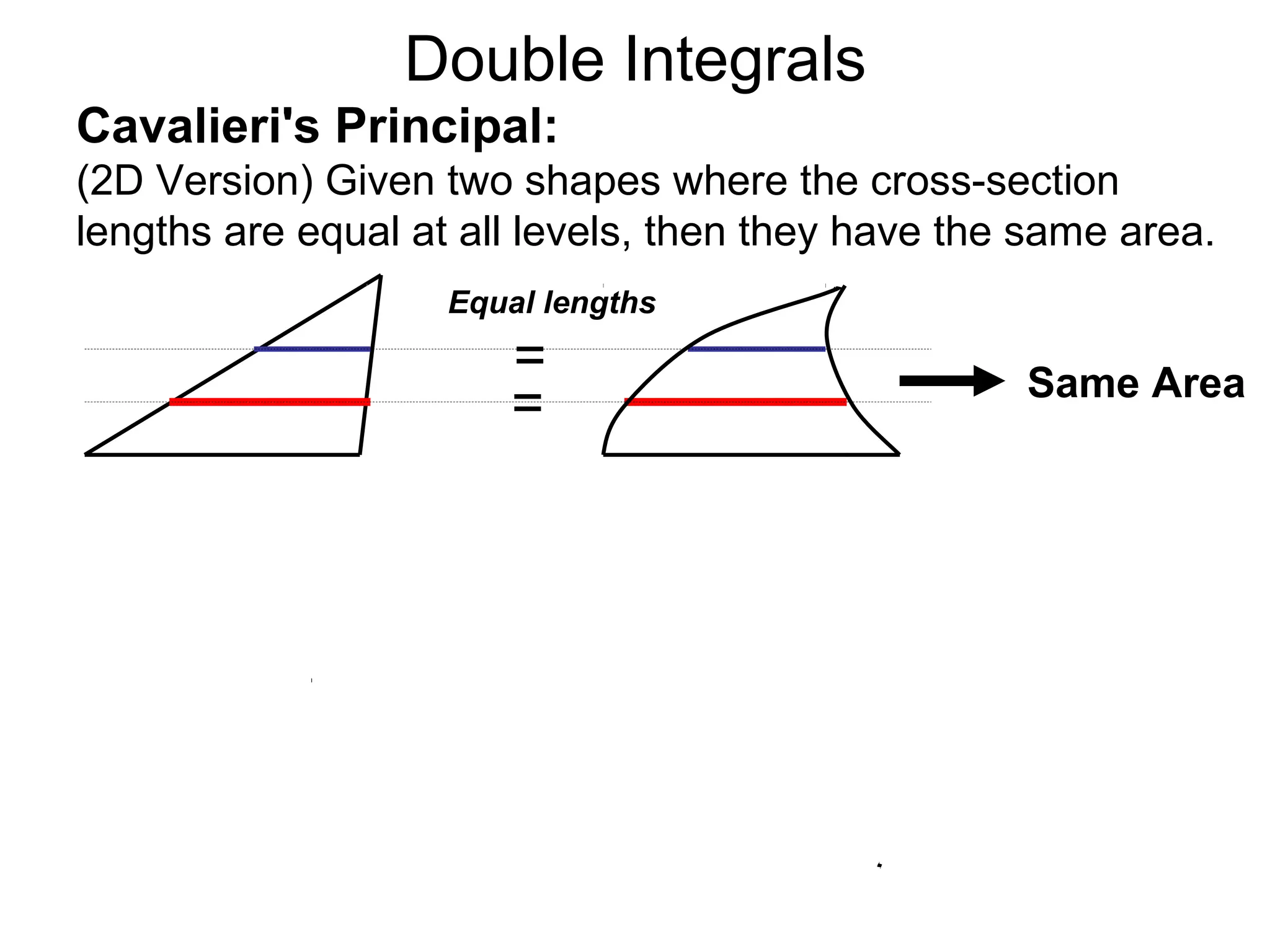
Cavalieri's Principal:
(2D Version) Given two shapes where the cross-section
lengths are equal at all levels, then they have the same area.
=
= Same Area
Equal lengths
Double Integrals
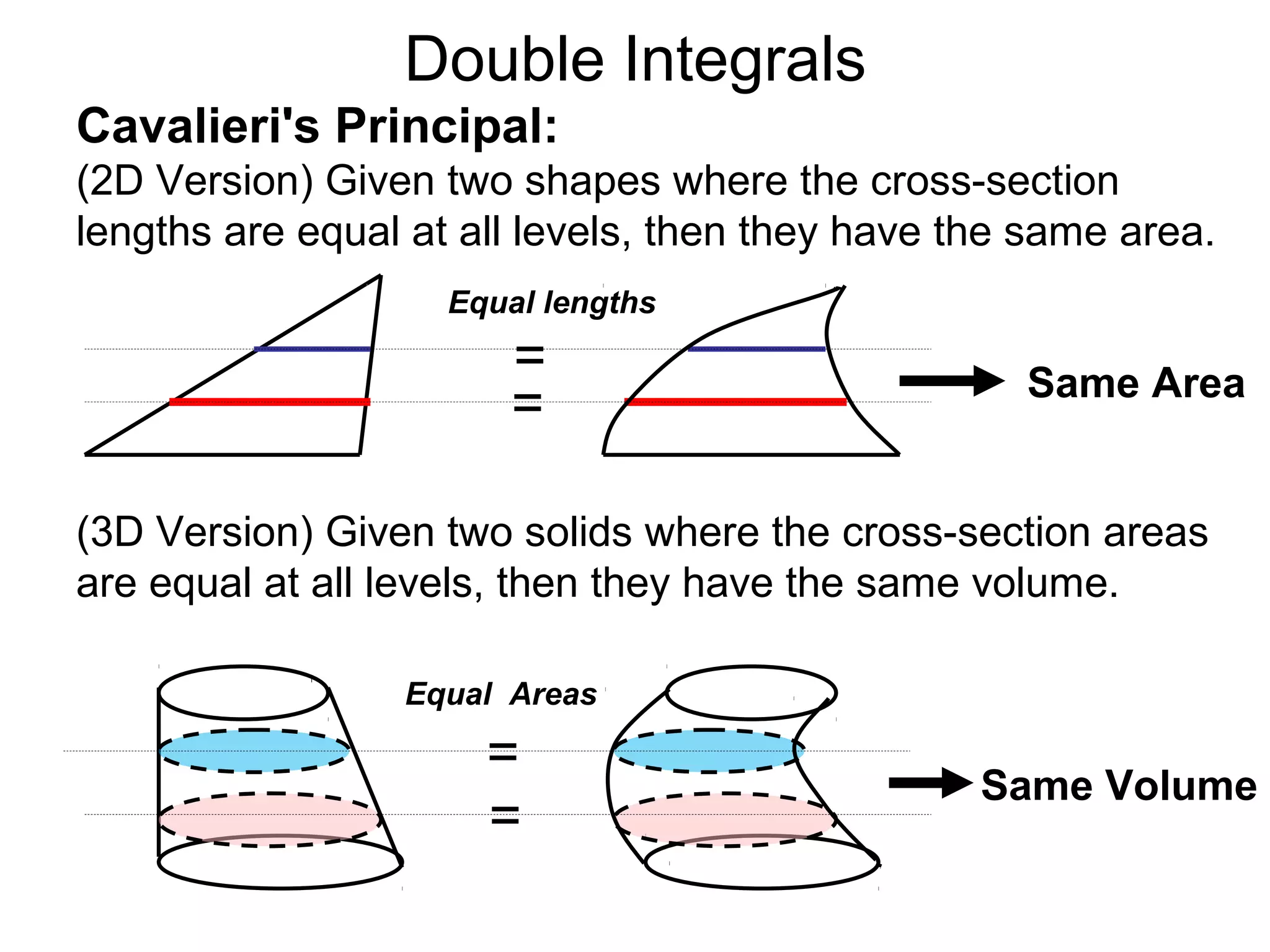
Cavalieri's Principal:
(2D Version) Given two shapes where the cross-section
lengths are equal at all levels, then they have the same area.
(3D Version) Given two solids where the cross-section areas
are equal at all levels, then they have the same volume.
=
=
=
=
Same Area
Same Volume
Equal lengths
Equal Areas
Double Integrals
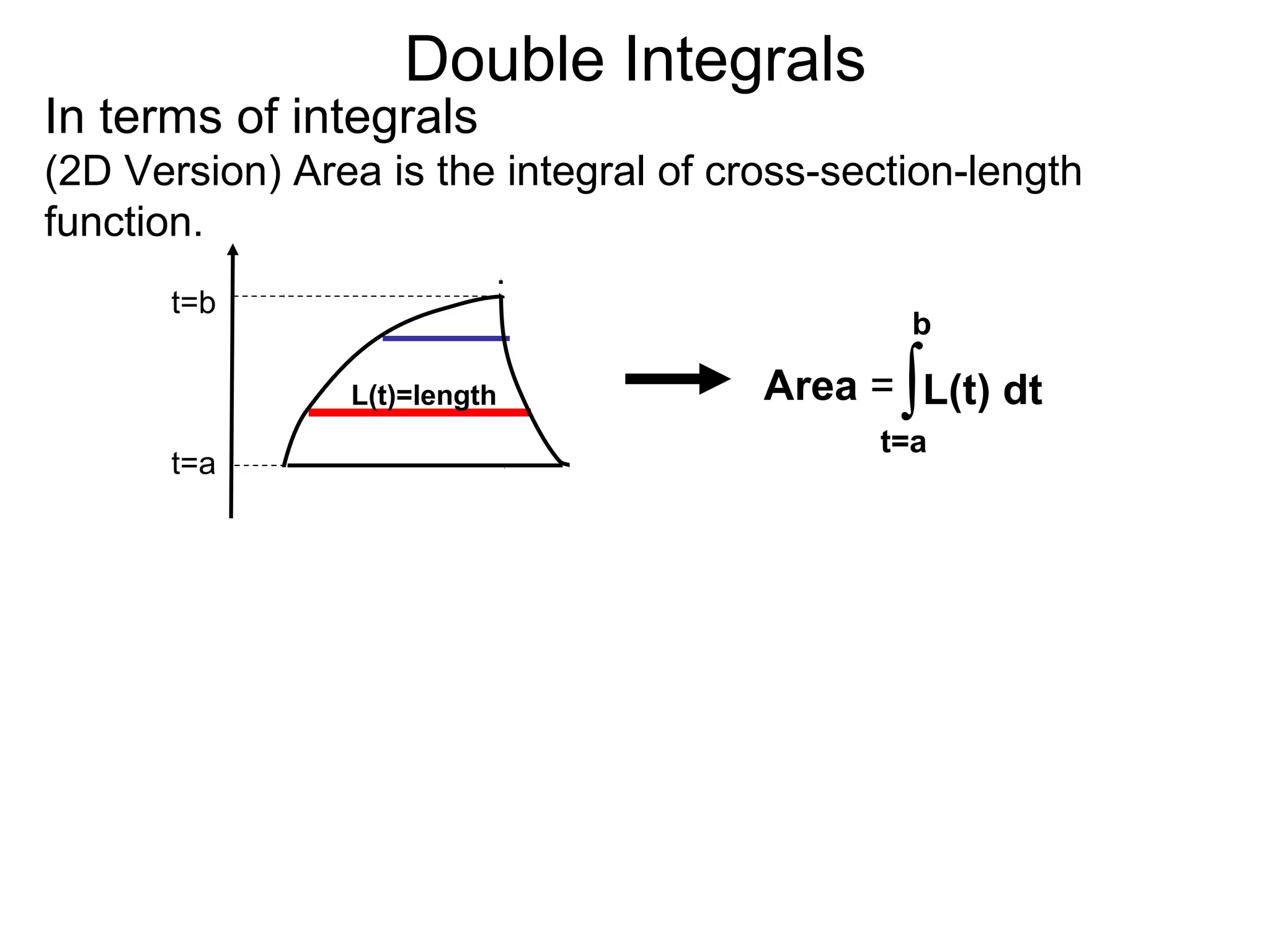
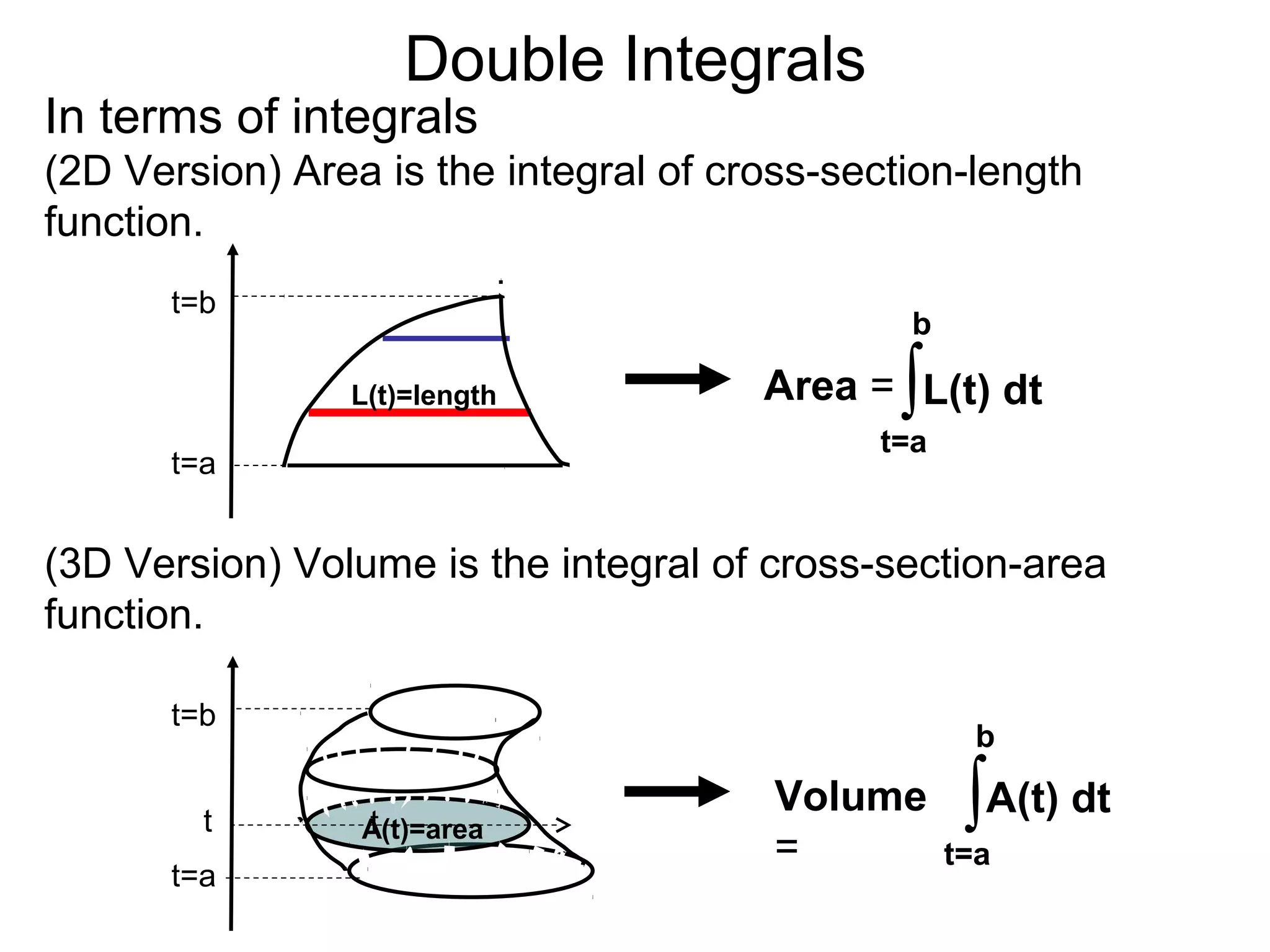
In terms of integrals
(2D Version) Area is the integral of cross-section-length
function.
Area =
t=b
t=a
L(t)=length
t=a
b
L(t) dt∫
Double Integrals
In terms of integrals
(2D Version) Area is the integral of cross-section-length
function.
Area =
t=b
t=a
L(t)=length
t=a
b
L(t) dt
t=b
t=a
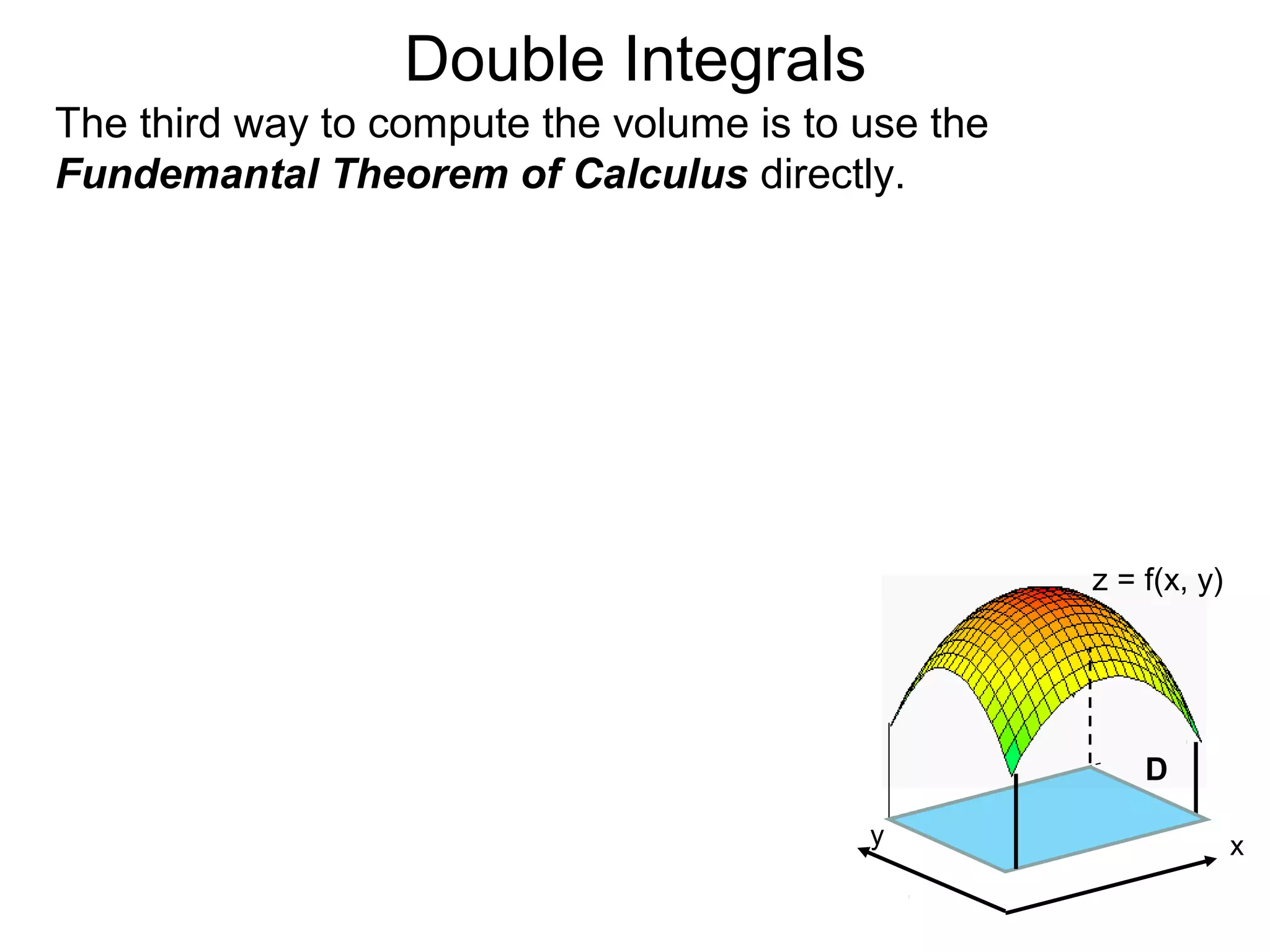
A(t)=area
(3D Version) Volume is the integral of cross-section-area
function.
∫
t=a
b
A(t) dtVolume
=
∫tt
Double Integrals
We write the rectangular area
{(x, y)| a ≤ x ≤ b and c ≤ y ≤ d}
as [a, b] x [c, d]. a b
c
d
[a, b] x [c, d]
Double Integrals
Given z = f(x, y) ≥ 0 over the domain D = [a, b] x [c, d],
it defines a solid over D.
x
y
We write the rectangular area
{(x, y)| a ≤ x ≤ b and c ≤ y ≤ d}
as [a, b] x [c, d].
z = f(x, y)
a
b
c
d
D
a b
c
d
[a, b] x [c, d]
D
Double Integrals
Given z = f(x, y) ≥ 0 over the domain D = [a, b] x [c, d],
it defines a solid over D. Hence the volume V of this solid is
x
y
We write the rectangular area
{(x, y)| a ≤ x ≤ b and c ≤ y ≤ d}
as [a, b] x [c, d].
z = f(x, y)
a
b
c
d
D
a b
c
d
[a, b] x [c, d]
D
x=a
b
A(x) dx, where A(x) is the cross-sectional area
function.
V = ∫
Double Integrals
Given z = f(x, y) ≥ 0 over the domain D = [a, b] x [c, d],
it defines a solid over D. Hence the volume V of this solid is
x
y
We write the rectangular area
{(x, y)| a ≤ x ≤ b and c ≤ y ≤ d}
as [a, b] x [c, d].
z = f(x, y)
a
b
c
d
D
x
a b
c
d
[a, b] x [c, d]
A(x)
D
x=a
b
A(x) dx, where A(x) is the cross-sectional area
function.
V = ∫
Double Integrals
Given z = f(x, y) ≥ 0 over the domain D = [a, b] x [c, d],
it defines a solid over D. Hence the volume V of this solid is
x
y
We write the rectangular area
{(x, y)| a ≤ x ≤ b and c ≤ y ≤ d}
as [a, b] x [c, d].
z = f(x, y)
a
b
c
d
D
x
a b
c
d
[a, b] x [c, d]
A(x)
D
x=a
b
A(x) dx, where A(x) is the cross-sectional area
function.
V =
d
∫
On the other hand A(x) =
y=c
f(x, y) dy
where the integral is taken by
treating x as a constant.
∫
Double Integrals
Given z = f(x, y) ≥ 0 over the domain D = [a, b] x [c, d],
it defines a solid over D. Hence the volume V of this solid is
x
y
We write the rectangular area
{(x, y)| a ≤ x ≤ b and c ≤ y ≤ d}
as [a, b] x [c, d].
z = f(x, y)
a
b
c
d
D
x
Hence the volume V is
V = [
x=a
x=b
dx.
y=c
y=d
f(x, y) dy ]∫ ∫
a b
c
d
[a, b] x [c, d]
A(x)
D
x=a
b
A(x) dx, where A(x) is the cross-sectional area
function.
V =
d
∫
On the other hand A(x) =
y=c
f(x, y) dy
where the integral is taken by
treating x as a constant.
∫
Double Integrals
x
y
z = f(x, y)
a
b
c
d
D
x
A(x)
D
f(x, y) dy ] dxThe integral
is called the double integral with respect to y then x.
f(x, y) dy dx =∫∫ ∫ ∫[ A(x) dx∫=
Double Integrals
x
y
z = f(x, y)
a
b
c
d
D
x
A(x)
D
f(x, y) dy ] dxThe integral
is called the double integral with respect to y then x.
f(x, y) dy dx =∫∫ ∫ ∫[
f(x, y) dx ] dySimilarly,
is called the double integral with respect to x then y.
f(x, y) dx dy =∫∫ ∫ ∫[
A(x) dx∫=
A(y) dy∫=
Double Integrals
x
y
z = f(x, y)
a
b
c
d
D
x
A(x)
D
f(x, y) dy ] dxThe integral
is called the double integral with respect to y then x.
f(x, y) dy dx =∫∫ ∫ ∫[
x
y
z = f(x, y)
a
b
c
d
D
y
A(y)
f(x, y) dx ] dySimilarly,
is called the double integral with respect to x then y.
f(x, y) dx dy =∫∫ ∫ ∫[
It represents the volume integration over the cross sectional
areas A(y) by setting y as a constant
A(x) dx∫=
A(y) dy∫=
Double Integrals
x
y
z = f(x, y)
a
b
c
d
D
x
A(x)
D
f(x, y) dy ] dxThe integral
is called the double integral with respect to y then x.
f(x, y) dy dx =∫∫ ∫ ∫[
x
y
z = f(x, y)
a
b
c
d
D
y
A(y)
f(x, y) dx ] dySimilarly,
is called the double integral with respect to x then y.
f(x, y) dx dy =∫∫ ∫ ∫[
f(x, y) dx = A(y)∫ is calculated by treating y as a constant.
It represents the volume integration over the cross sectional
areas A(y) by setting y as a constant and that
A(x) dx∫=
A(y) dy∫=
Double Integrals
z = f(x, y)
D
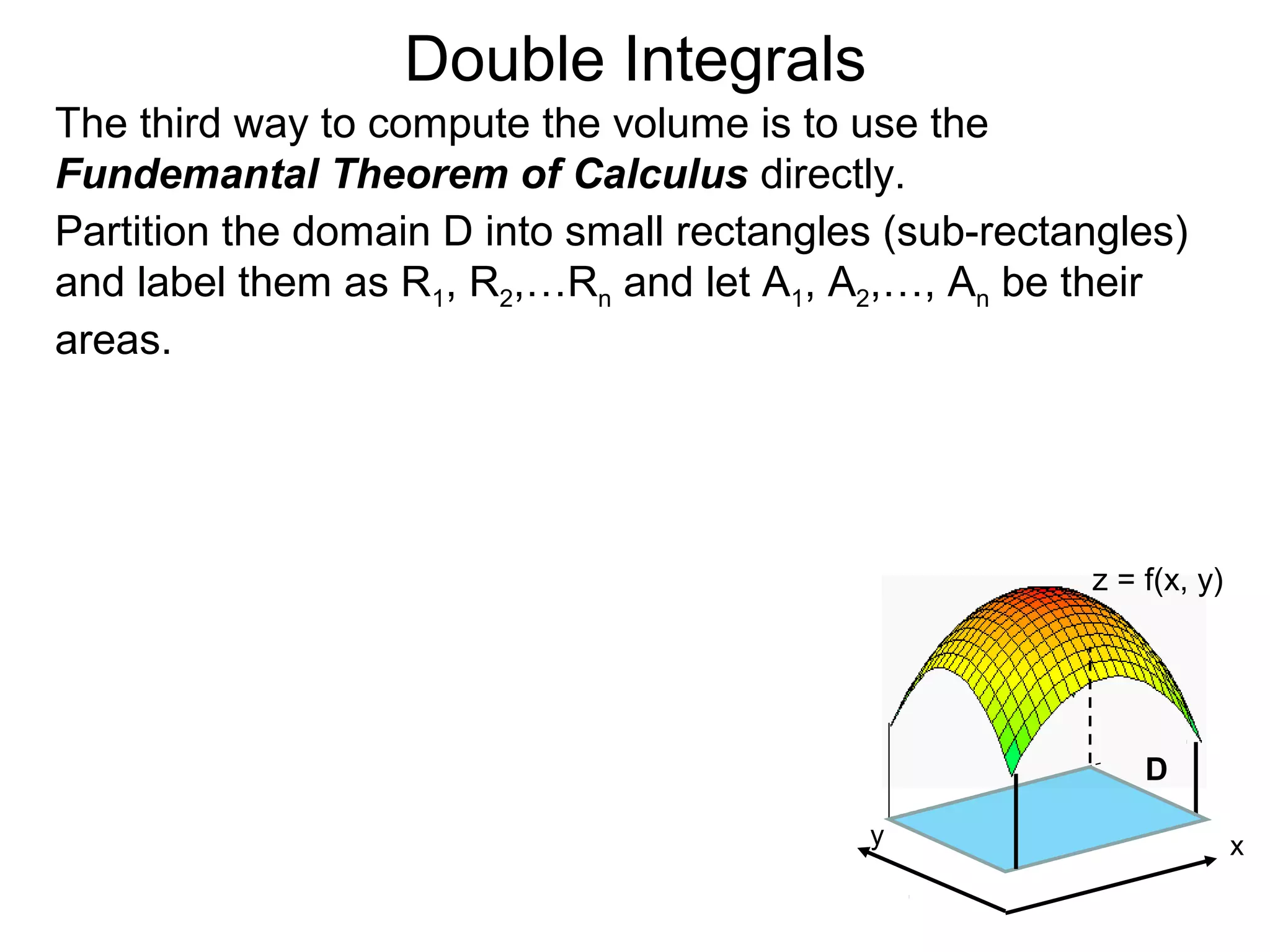
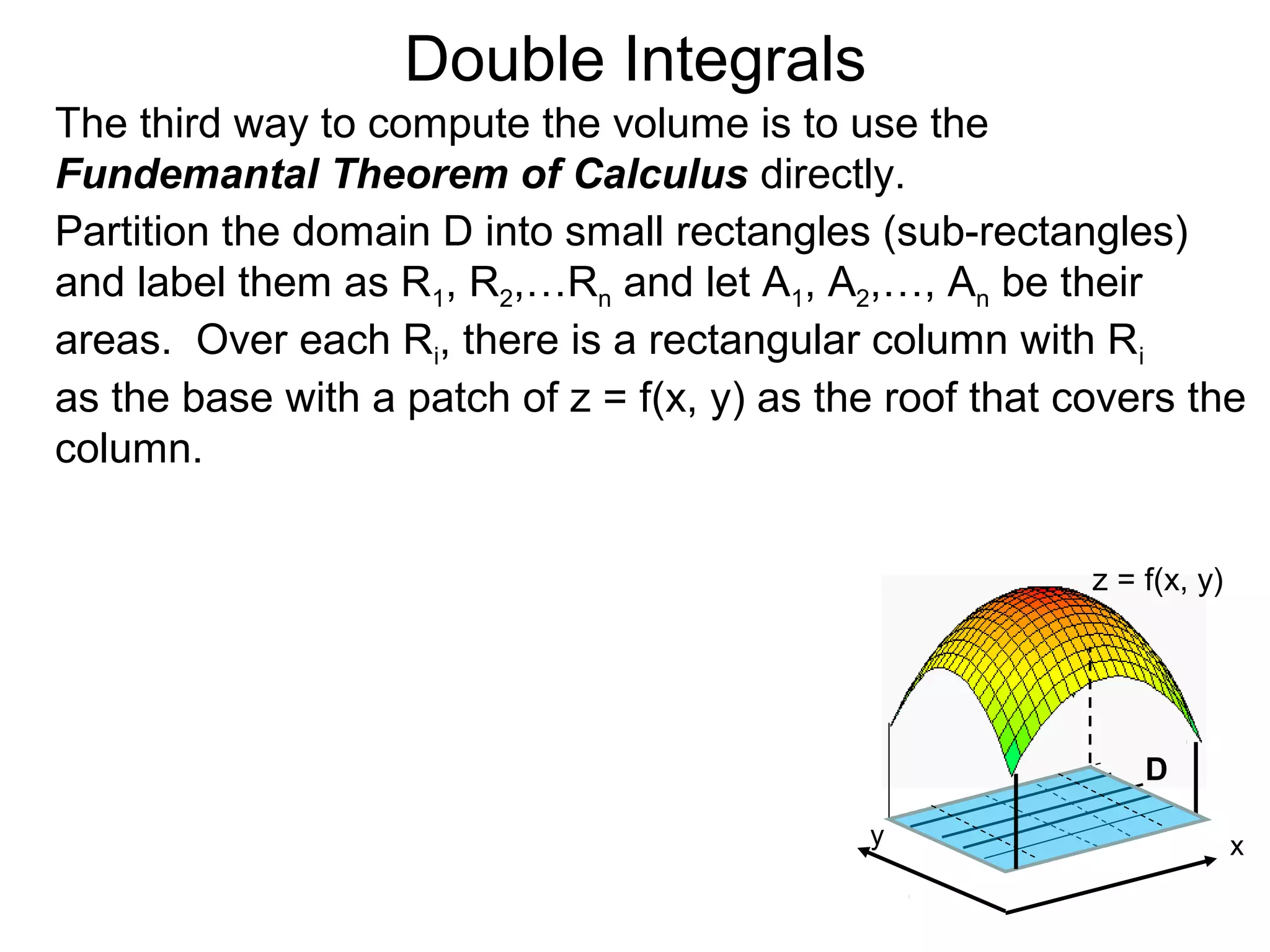
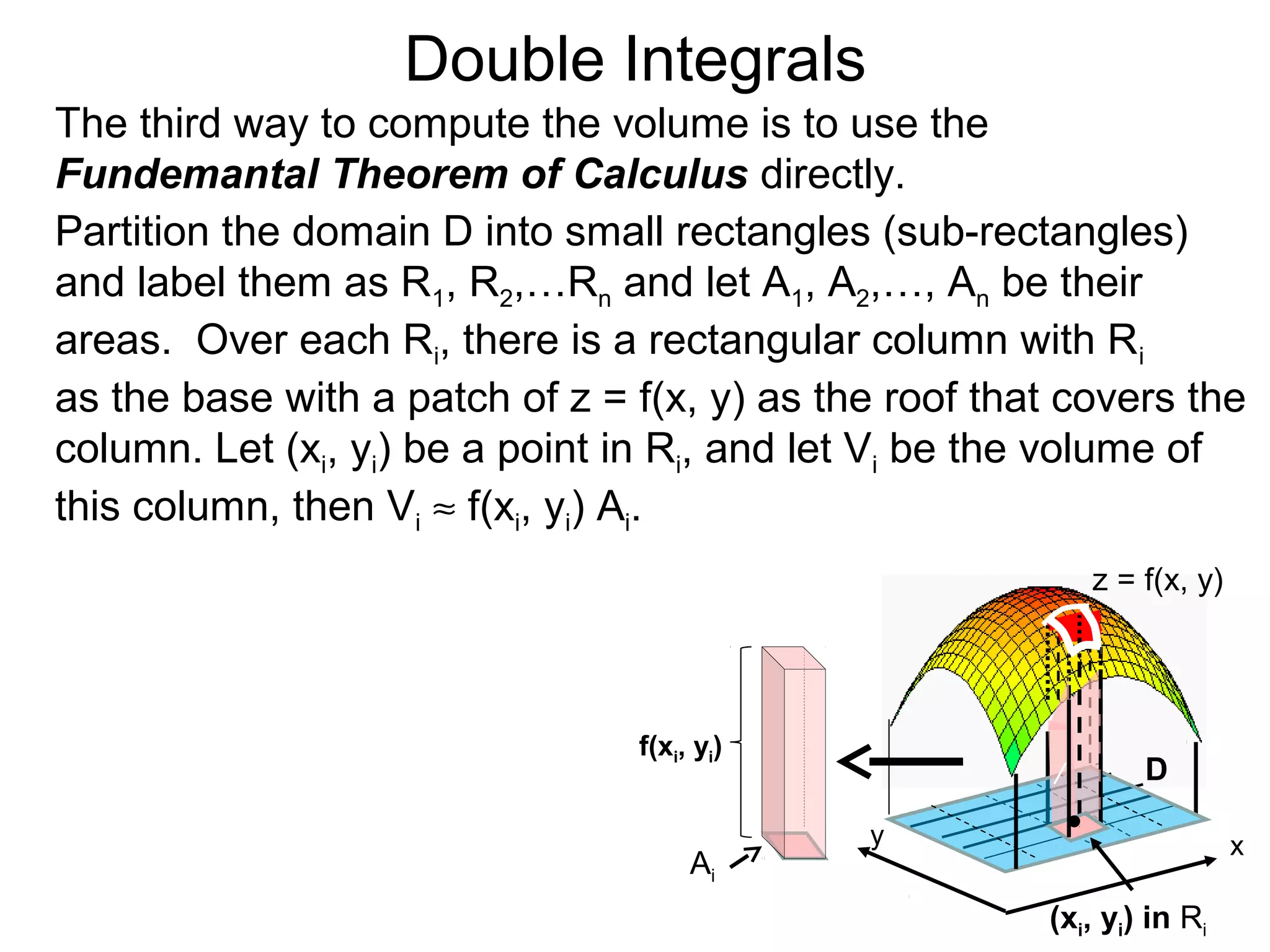
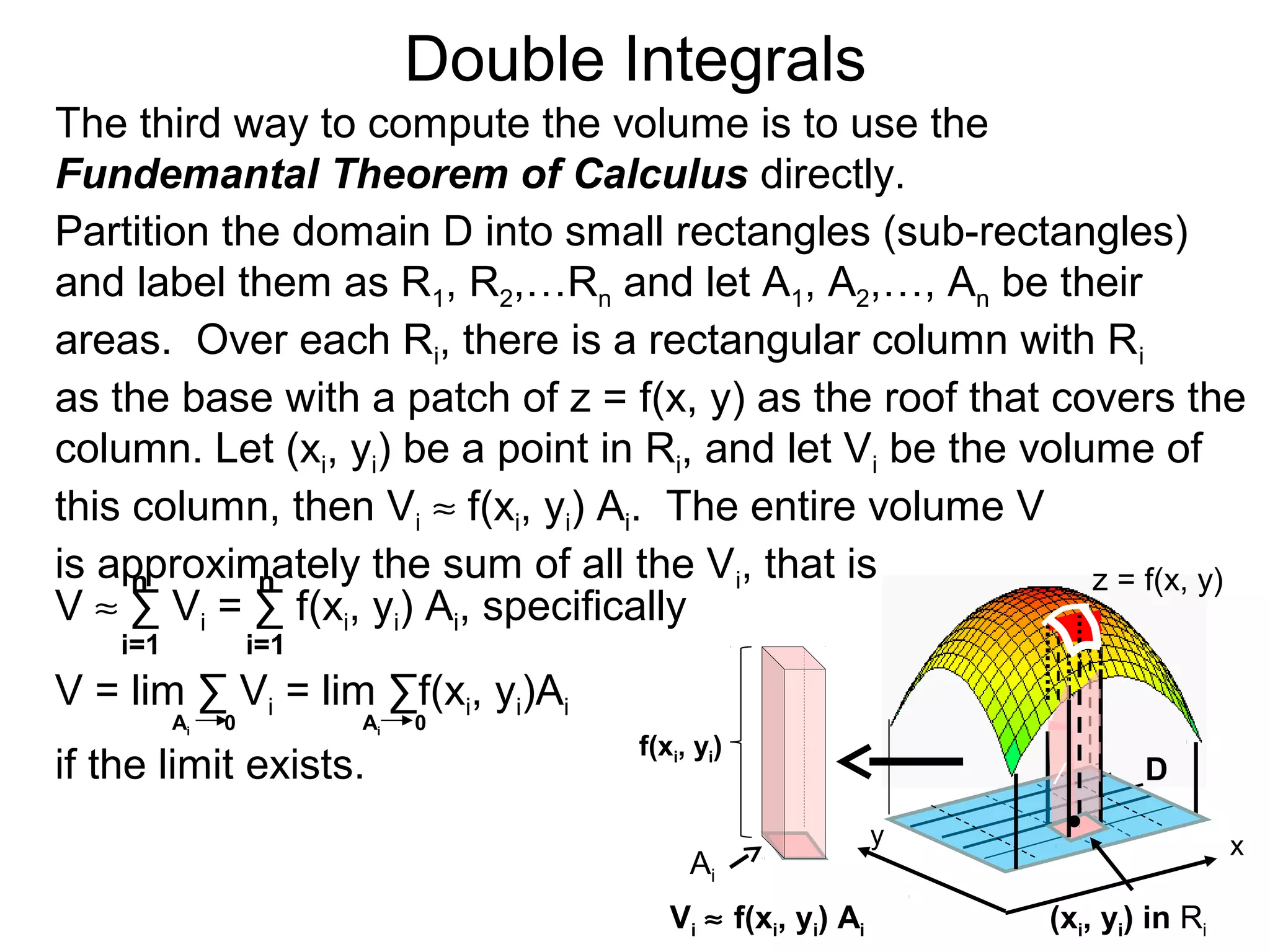
The third way to compute the volume is to use the
Fundemantal Theorem of Calculus directly.
xy
Double Integrals
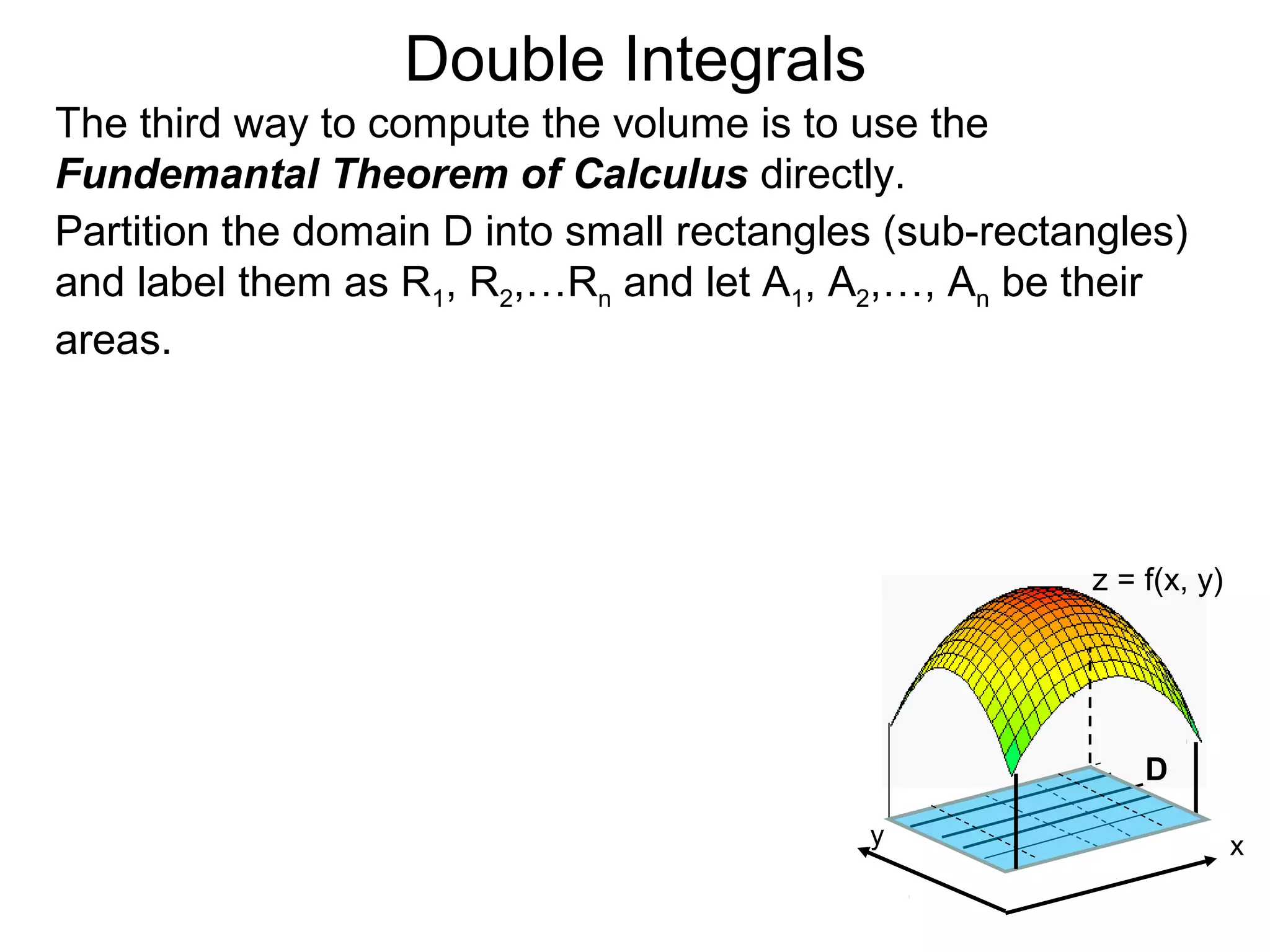
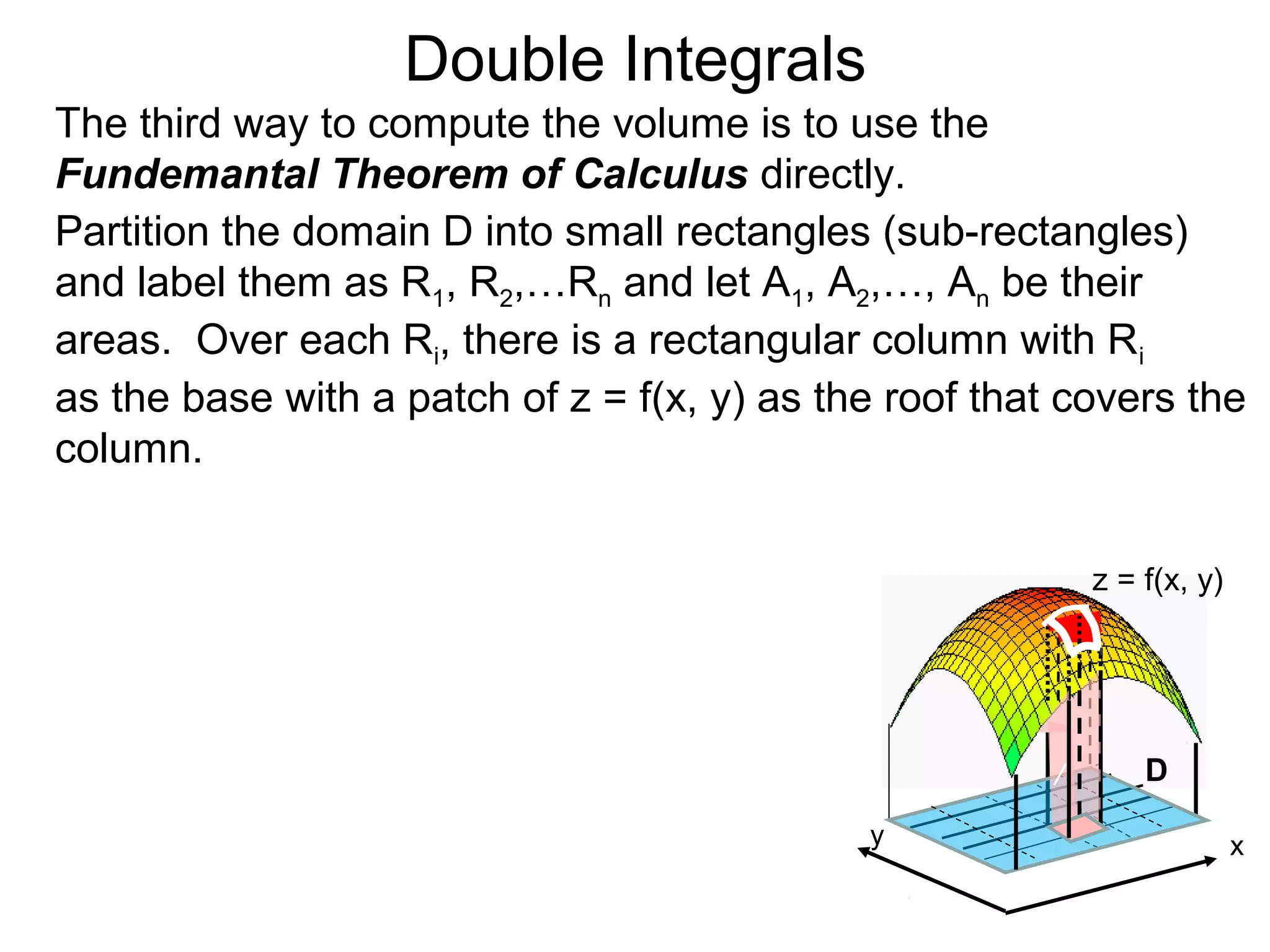
The third way to compute the volume is to use the
Fundemantal Theorem of Calculus directly.
Partition the domain D into small rectangles (sub-rectangles)
and label them as R1, R2,…Rn and let A1, A2,…, An be their
areas.
z = f(x, y)
D
xy
Double Integrals
The third way to compute the volume is to use the
Fundemantal Theorem of Calculus directly.
Partition the domain D into small rectangles (sub-rectangles)
and label them as R1, R2,…Rn and let A1, A2,…, An be their
areas.
z = f(x, y)
D
xy
Double Integrals
The third way to compute the volume is to use the
Fundemantal Theorem of Calculus directly.
Partition the domain D into small rectangles (sub-rectangles)
and label them as R1, R2,…Rn and let A1, A2,…, An be their
areas. Over each Ri, there is a rectangular column with Ri
as the base with a patch of z = f(x, y) as the roof that covers the
column.
z = f(x, y)
D
xy
Double Integrals
The third way to compute the volume is to use the
Fundemantal Theorem of Calculus directly.
Partition the domain D into small rectangles (sub-rectangles)
and label them as R1, R2,…Rn and let A1, A2,…, An be their
areas. Over each Ri, there is a rectangular column with Ri
as the base with a patch of z = f(x, y) as the roof that covers the
column.
z = f(x, y)
D
/
y x
Double Integrals
The third way to compute the volume is to use the
Fundemantal Theorem of Calculus directly.
Partition the domain D into small rectangles (sub-rectangles)
and label them as R1, R2,…Rn and let A1, A2,…, An be their
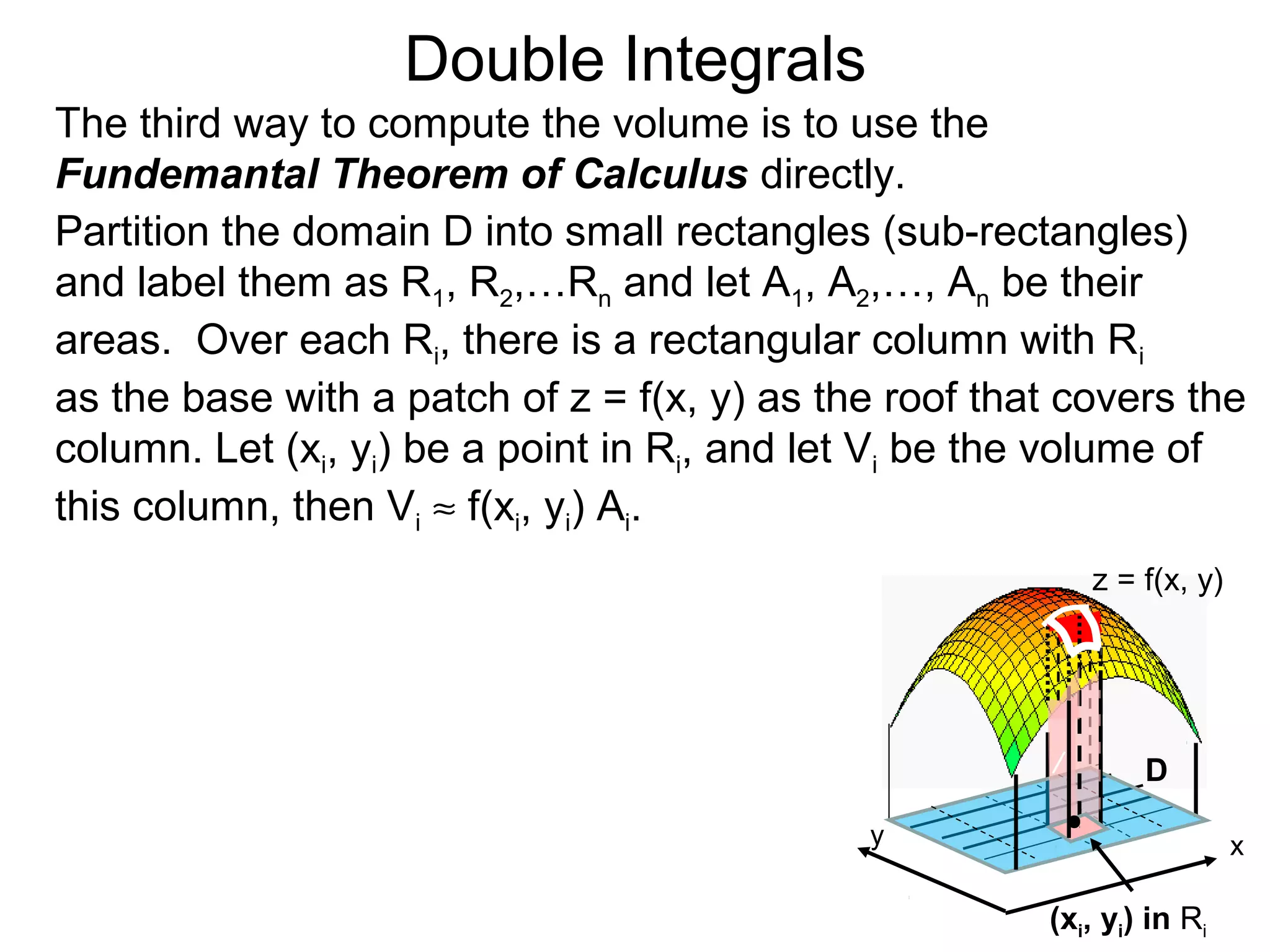
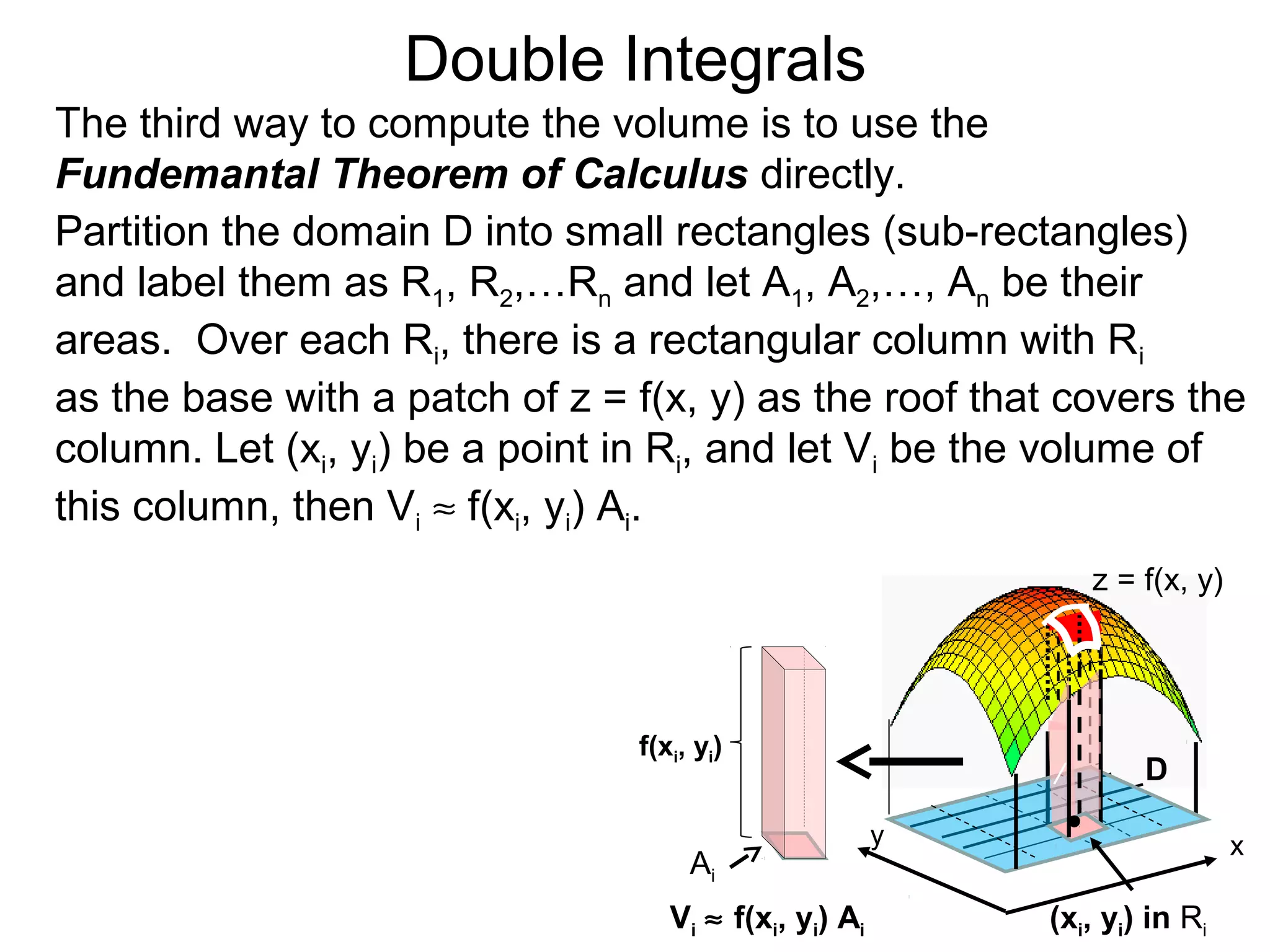
areas. Over each Ri, there is a rectangular column with Ri
as the base with a patch of z = f(x, y) as the roof that covers the
column. Let (xi, yi) be a point in Ri, and let Vi be the volume of
this column, then Vi ≈ f(xi, yi) Ai.
z = f(x, y)
D
(xi, yi) in Ri
/
y x
Double Integrals
y
z = f(x, y)
D
(xi, yi) in Ri
The third way to compute the volume is to use the
Fundemantal Theorem of Calculus directly.
Partition the domain D into small rectangles (sub-rectangles)
and label them as R1, R2,…Rn and let A1, A2,…, An be their
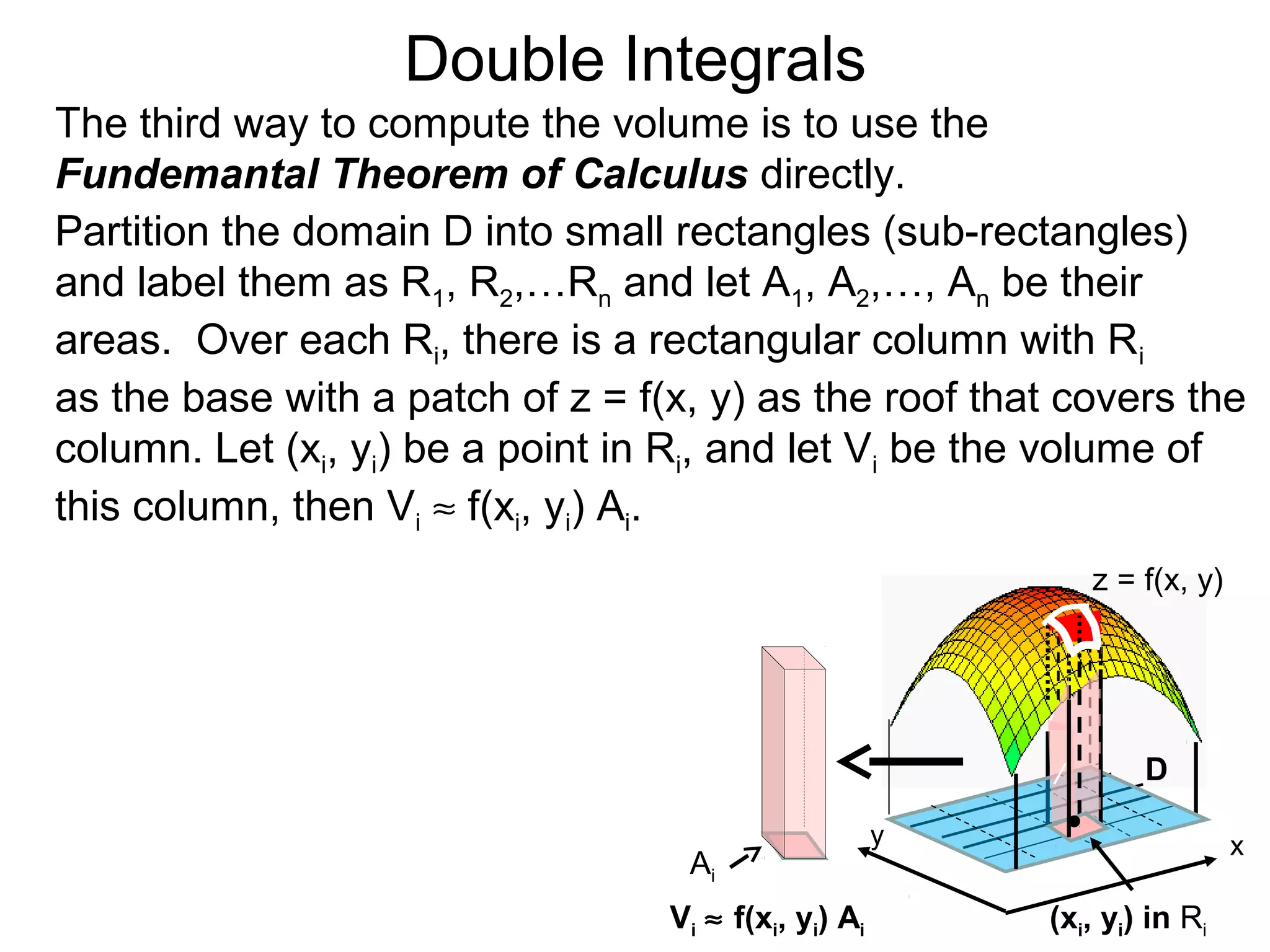
areas. Over each Ri, there is a rectangular column with Ri
as the base with a patch of z = f(x, y) as the roof that covers the
column. Let (xi, yi) be a point in Ri, and let Vi be the volume of
this column, then Vi ≈ f(xi, yi) Ai.
x
/
Vi ≈ f(xi, yi) Ai
Ai
Double Integrals
y
z = f(x, y)
D
(xi, yi) in Ri
The third way to compute the volume is to use the
Fundemantal Theorem of Calculus directly.
Partition the domain D into small rectangles (sub-rectangles)
and label them as R1, R2,…Rn and let A1, A2,…, An be their
areas. Over each Ri, there is a rectangular column with Ri
as the base with a patch of z = f(x, y) as the roof that covers the
column. Let (xi, yi) be a point in Ri, and let Vi be the volume of
this column, then Vi ≈ f(xi, yi) Ai.
x
/
Ai
f(xi, yi)
Double Integrals
y
z = f(x, y)
D
(xi, yi) in Ri
The third way to compute the volume is to use the
Fundemantal Theorem of Calculus directly.
Partition the domain D into small rectangles (sub-rectangles)
and label them as R1, R2,…Rn and let A1, A2,…, An be their
areas. Over each Ri, there is a rectangular column with Ri
as the base with a patch of z = f(x, y) as the roof that covers the
column. Let (xi, yi) be a point in Ri, and let Vi be the volume of
this column, then Vi ≈ f(xi, yi) Ai.
x
/
Vi ≈ f(xi, yi) Ai
Ai
f(xi, yi)
Double Integrals
y
z = f(x, y)
D
(xi, yi) in Ri
The third way to compute the volume is to use the
Fundemantal Theorem of Calculus directly.
Partition the domain D into small rectangles (sub-rectangles)
and label them as R1, R2,…Rn and let A1, A2,…, An be their
areas. Over each Ri, there is a rectangular column with Ri
as the base with a patch of z = f(x, y) as the roof that covers the
column. Let (xi, yi) be a point in Ri, and let Vi be the volume of
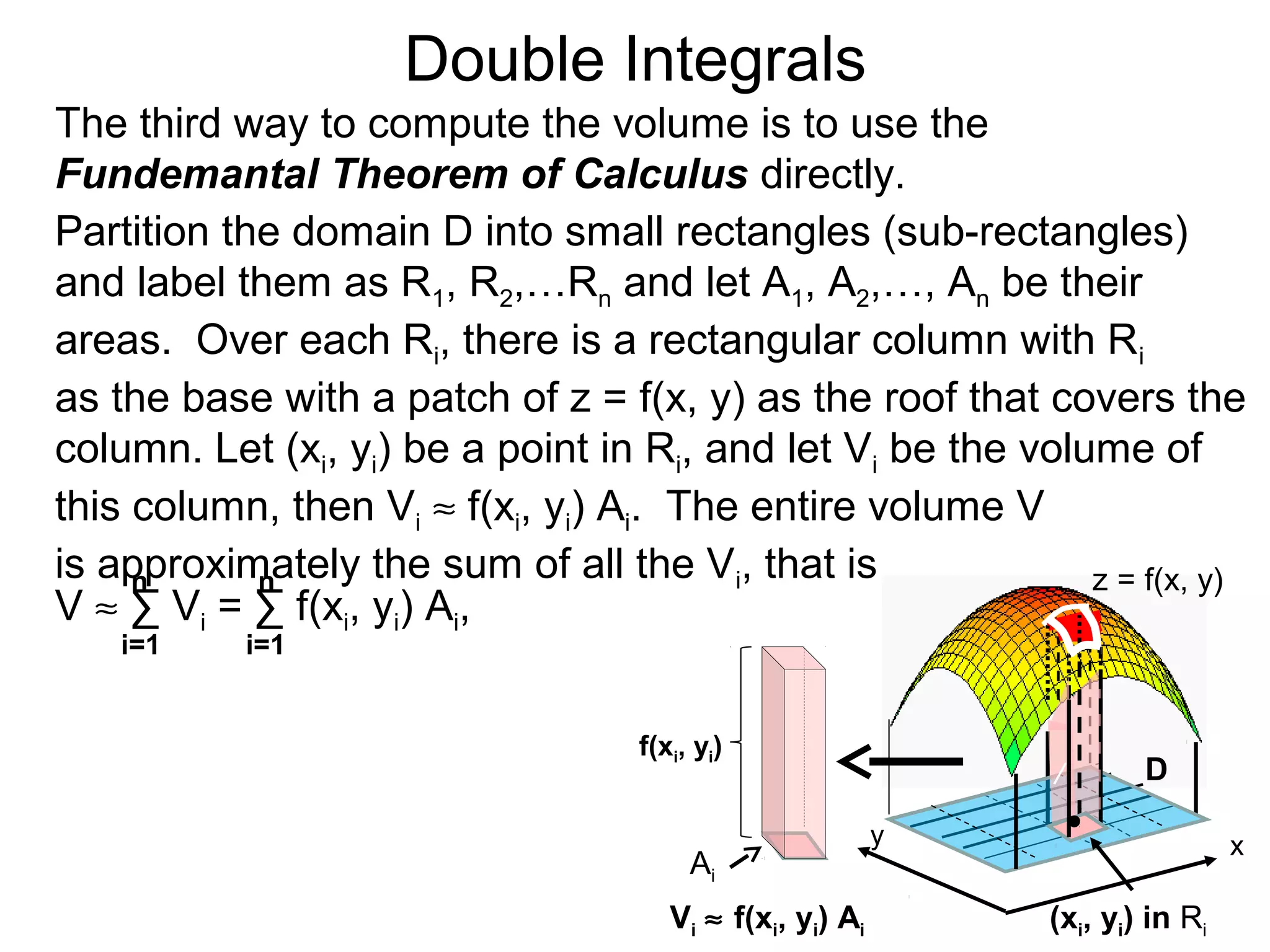
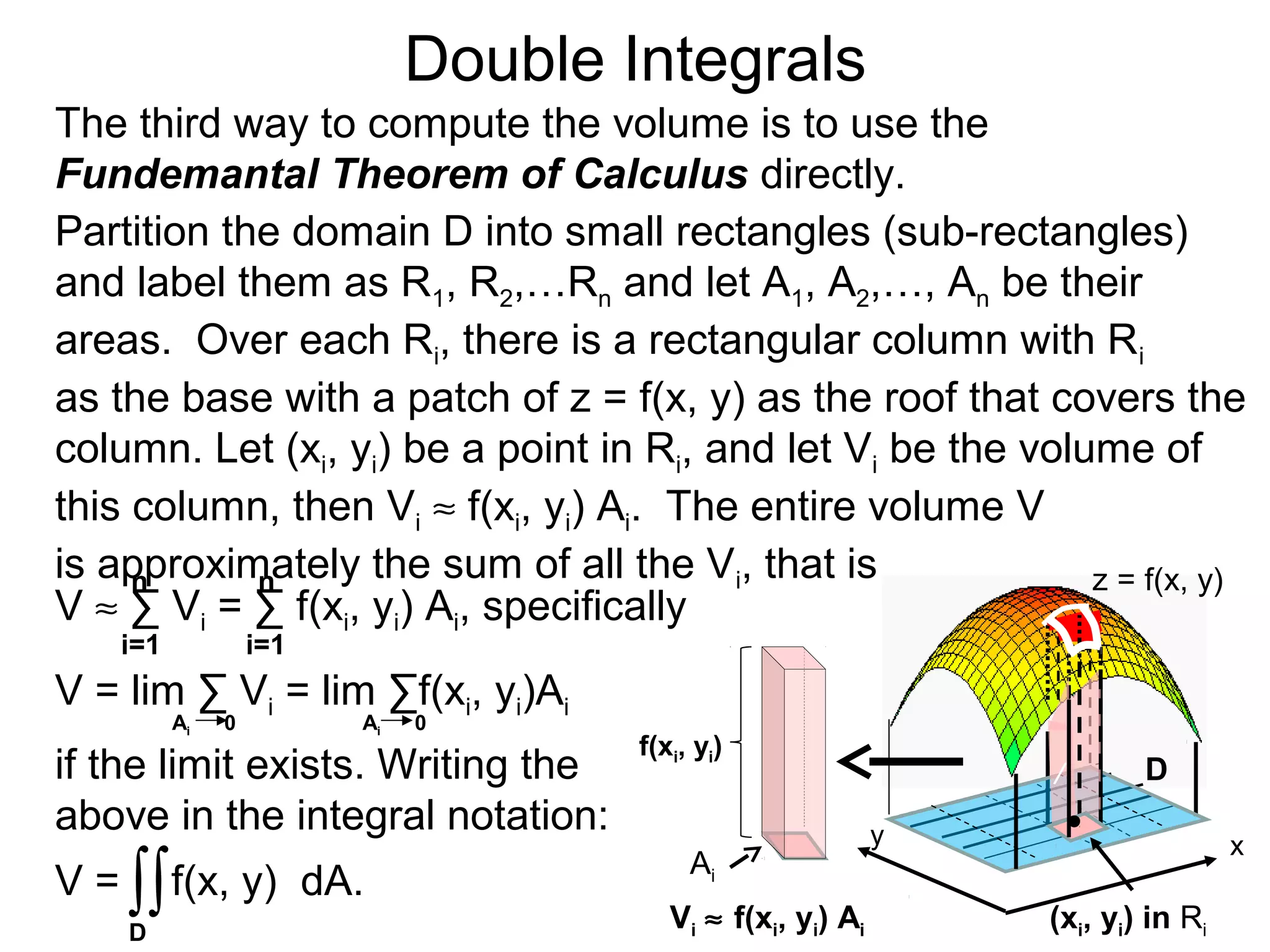
this column, then Vi ≈ f(xi, yi) Ai. The entire volume V
is approximately the sum of all the Vi, that is
x
/
i=1 i=1
nn
V ≈ ∑ Vi = ∑ f(xi, yi) Ai,
Vi ≈ f(xi, yi) Ai
Ai
f(xi, yi)
Double Integrals
y
z = f(x, y)
D
(xi, yi) in Ri
The third way to compute the volume is to use the
Fundemantal Theorem of Calculus directly.
Partition the domain D into small rectangles (sub-rectangles)
and label them as R1, R2,…Rn and let A1, A2,…, An be their
areas. Over each Ri, there is a rectangular column with Ri
as the base with a patch of z = f(x, y) as the roof that covers the
column. Let (xi, yi) be a point in Ri, and let Vi be the volume of
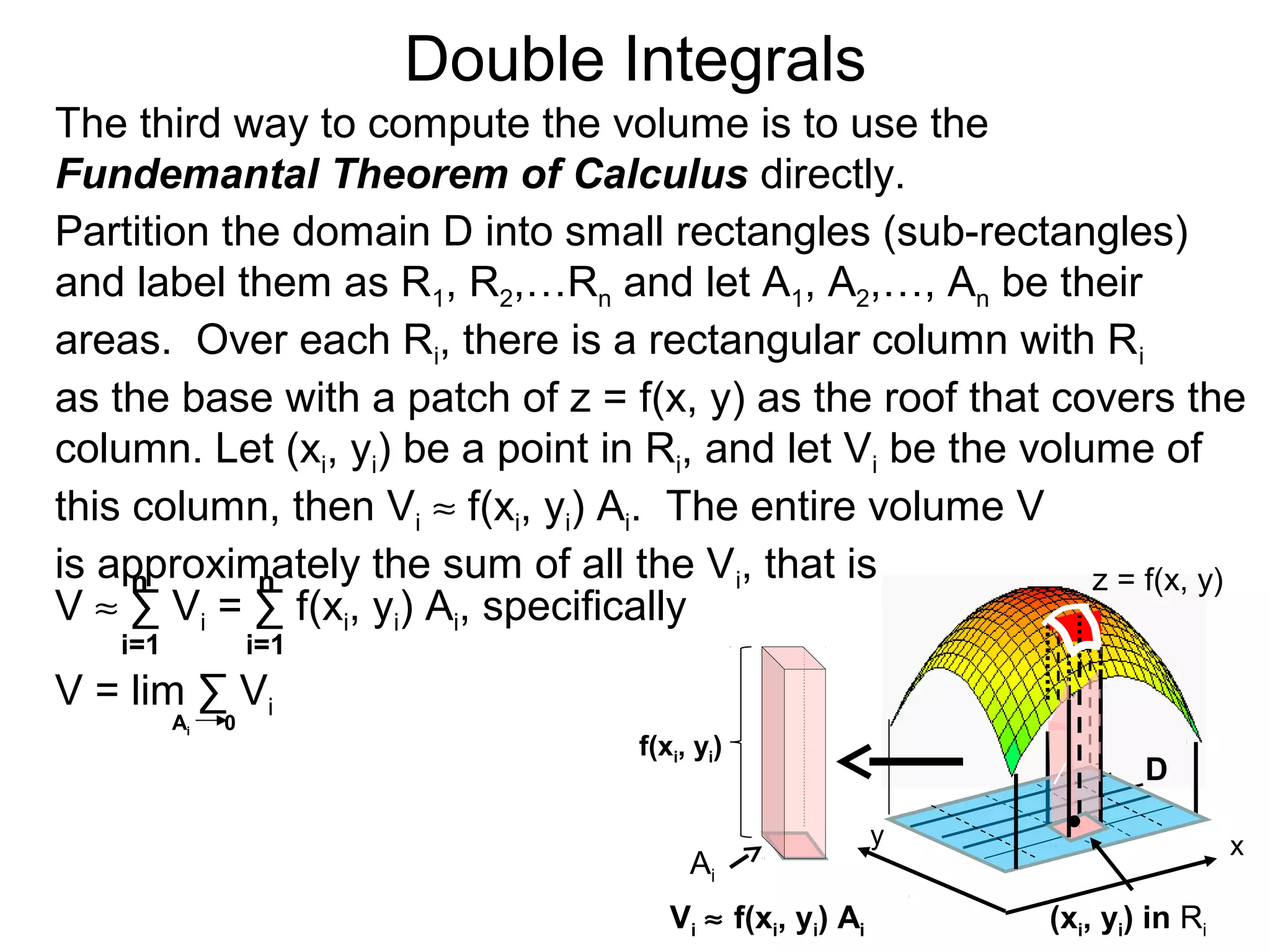
this column, then Vi ≈ f(xi, yi) Ai. The entire volume V
is approximately the sum of all the Vi, that is
x
/
i=1 i=1
nn
V = lim ∑ Vi
Ai 0
V ≈ ∑ Vi = ∑ f(xi, yi) Ai, specifically
Vi ≈ f(xi, yi) Ai
Ai
f(xi, yi)
Double Integrals
y
z = f(x, y)
D
(xi, yi) in Ri
The third way to compute the volume is to use the
Fundemantal Theorem of Calculus directly.
Partition the domain D into small rectangles (sub-rectangles)
and label them as R1, R2,…Rn and let A1, A2,…, An be their
areas. Over each Ri, there is a rectangular column with Ri
as the base with a patch of z = f(x, y) as the roof that covers the
column. Let (xi, yi) be a point in Ri, and let Vi be the volume of
this column, then Vi ≈ f(xi, yi) Ai. The entire volume V
is approximately the sum of all the Vi, that is
x
/
i=1 i=1
nn
V = lim ∑ Vi = lim ∑f(xi, yi)Ai
Ai 0 Ai 0
V ≈ ∑ Vi = ∑ f(xi, yi) Ai, specifically
if the limit exists.
Vi ≈ f(xi, yi) Ai
Ai
f(xi, yi)
Double Integrals
y
z = f(x, y)
D
(xi, yi) in Ri
The third way to compute the volume is to use the
Fundemantal Theorem of Calculus directly.
Partition the domain D into small rectangles (sub-rectangles)
and label them as R1, R2,…Rn and let A1, A2,…, An be their
areas. Over each Ri, there is a rectangular column with Ri
as the base with a patch of z = f(x, y) as the roof that covers the
column. Let (xi, yi) be a point in Ri, and let Vi be the volume of
this column, then Vi ≈ f(xi, yi) Ai. The entire volume V
is approximately the sum of all the Vi, that is
x
/
V = f(x, y) dA.∫∫
i=1 i=1
nn
V = lim ∑ Vi = lim ∑f(xi, yi)Ai
Ai 0 Ai 0
D
V ≈ ∑ Vi = ∑ f(xi, yi) Ai, specifically
if the limit exists. Writing the
above in the integral notation:
Vi ≈ f(xi, yi) Ai
Ai
f(xi, yi)
Double Integrals
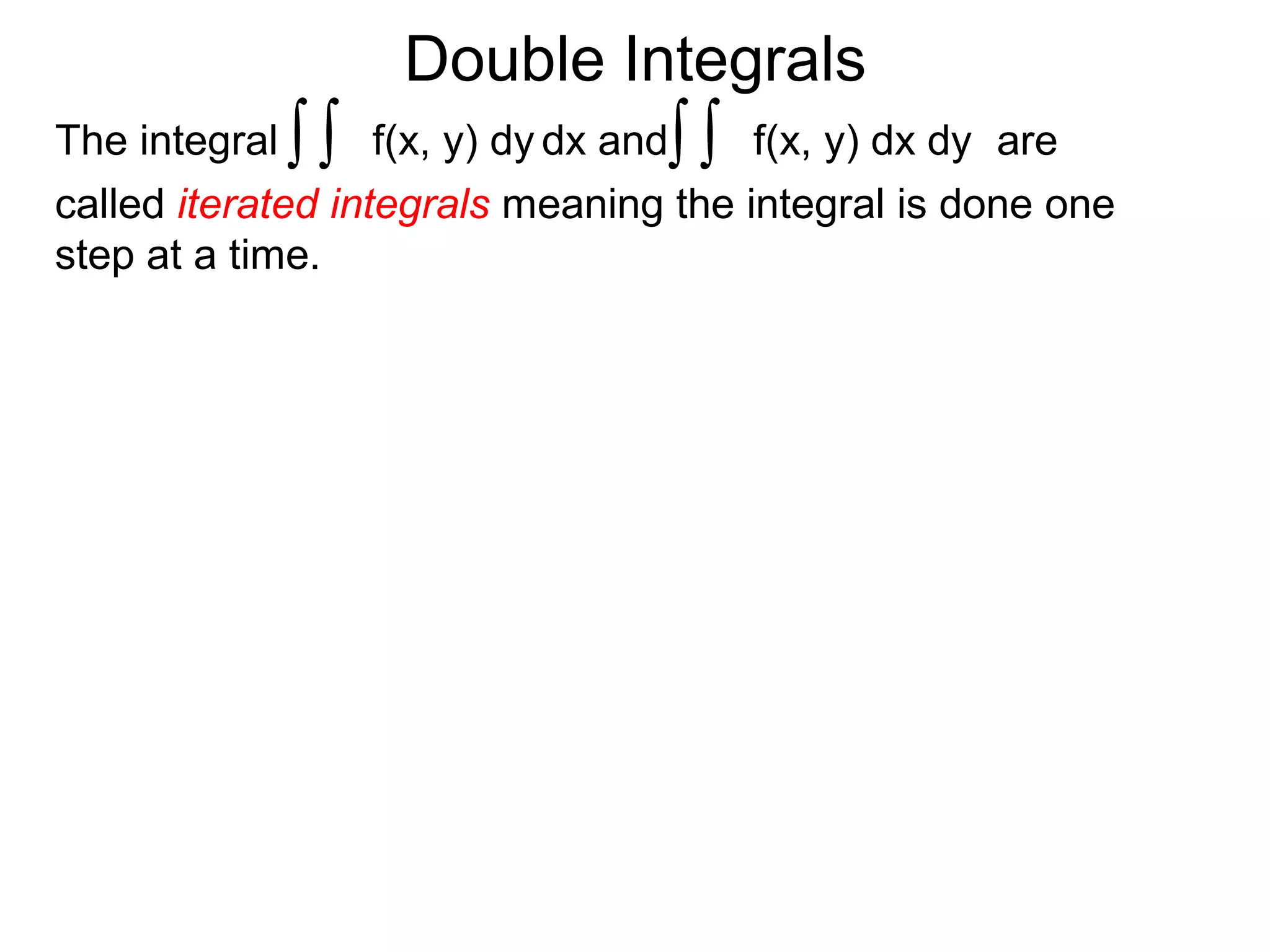
f(x, y) dx dyThe integral dx andf(x, y) dy ∫∫∫∫ are
called iterated integrals meaning the integral is done one
step at a time.
Double Integrals
Theorem: Given z = f(x, y) > 0 a continuous function over the
domnain [a, b] x [c. d], then the following are equal:
f(x, y) dx dyThe integral dx andf(x, y) dy ∫∫∫∫ are
called iterated integrals meaning the integral is done one
step at a time.
Double Integrals
Theorem: Given z = f(x, y) > 0 a continuous function over the
domnain [a, b] x [c. d], then the following are equal:
[
x=a
b
dy
y=c
d
f(x, y) dx ]∫∫V = f(x, y) dA =∫∫D
= [
x=a
b
dx
y=c
d
f(x, y) dy ]∫ ∫
f(x, y) dx dyThe integral dx andf(x, y) dy ∫∫∫∫ are
called iterated integrals meaning the integral is done one
step at a time.
Double Integrals
Theorem: Given z = f(x, y) > 0 a continuous function over the
domnain [a, b] x [c. d], then the following are equal:
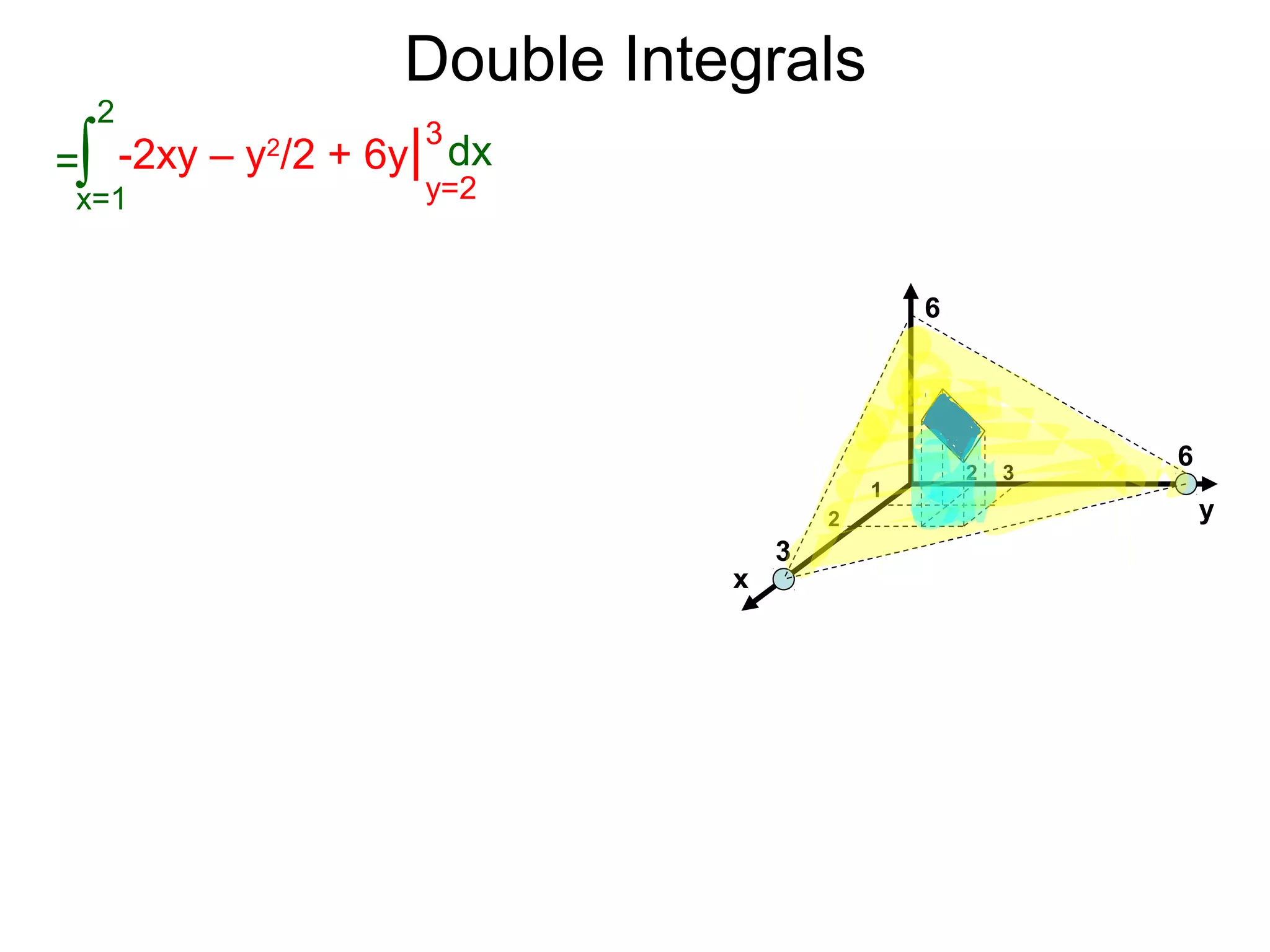
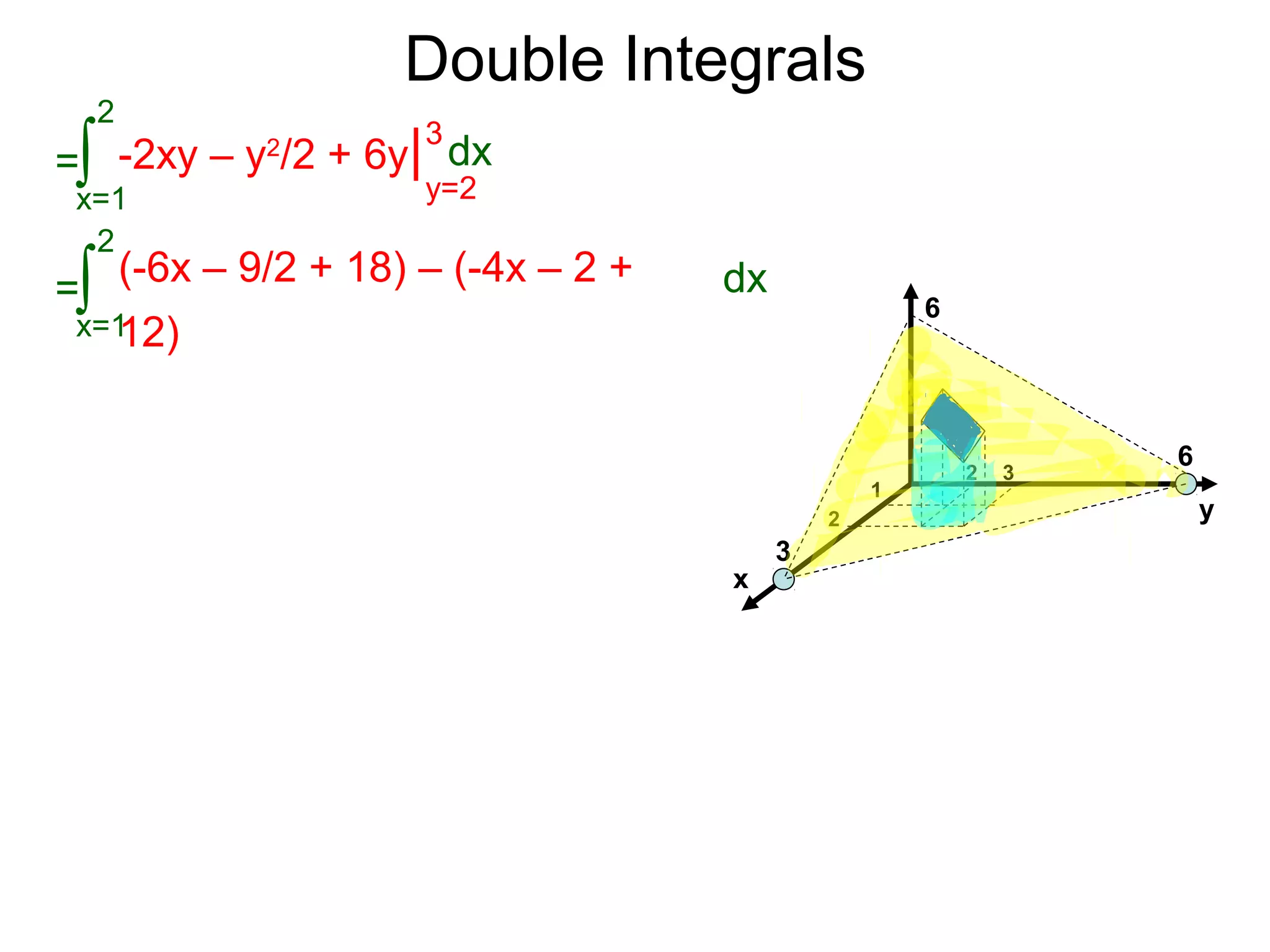
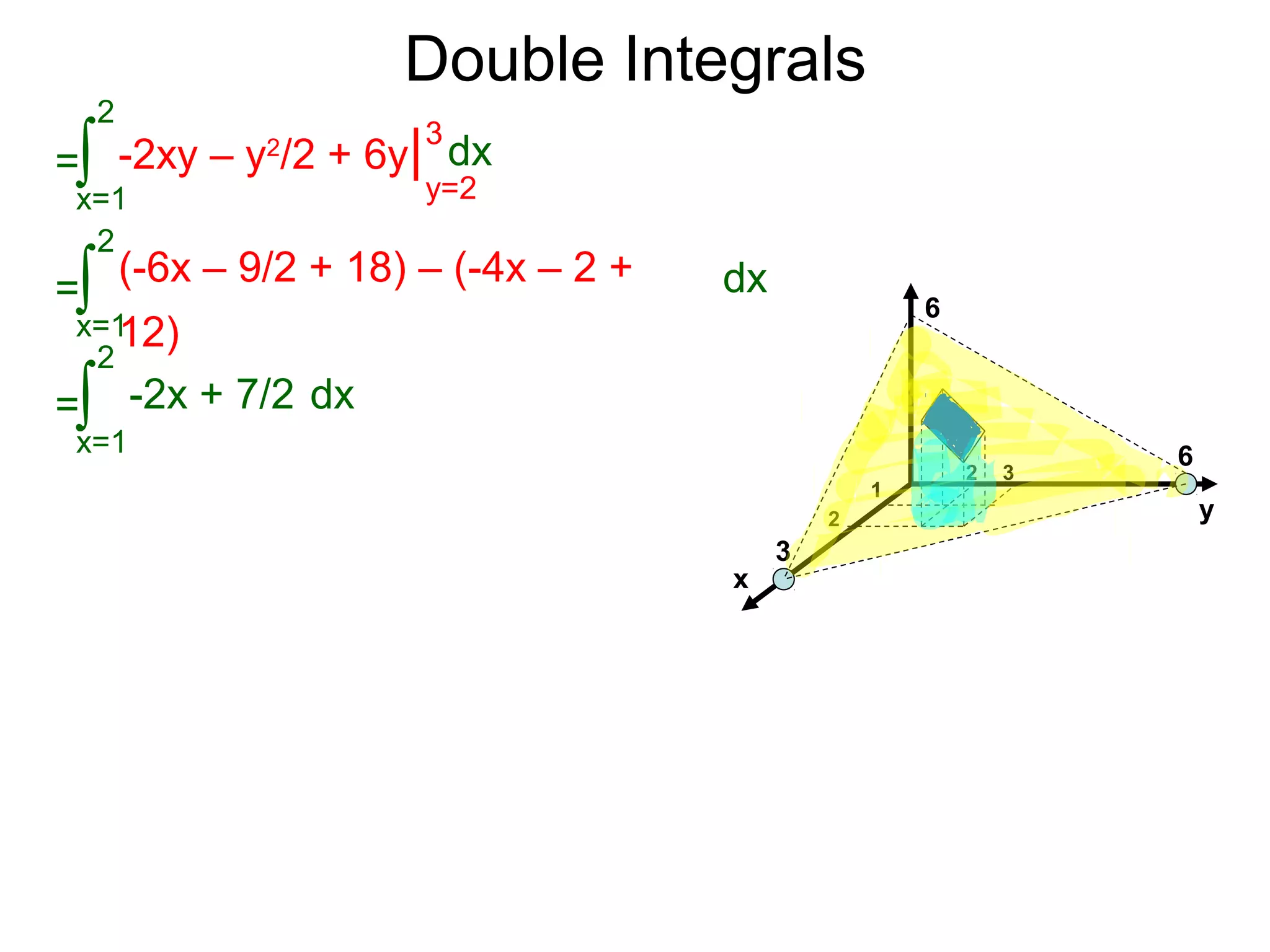
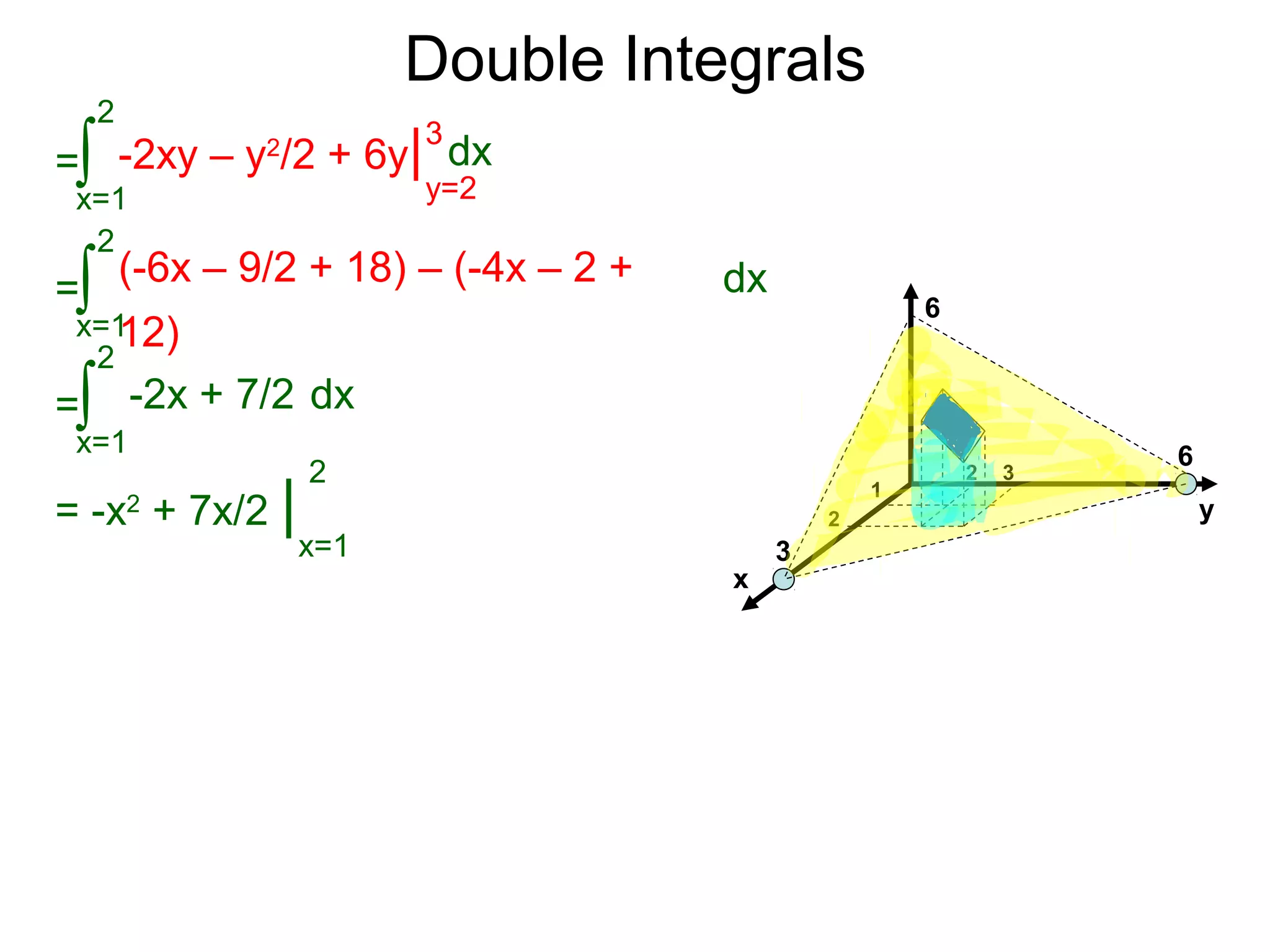
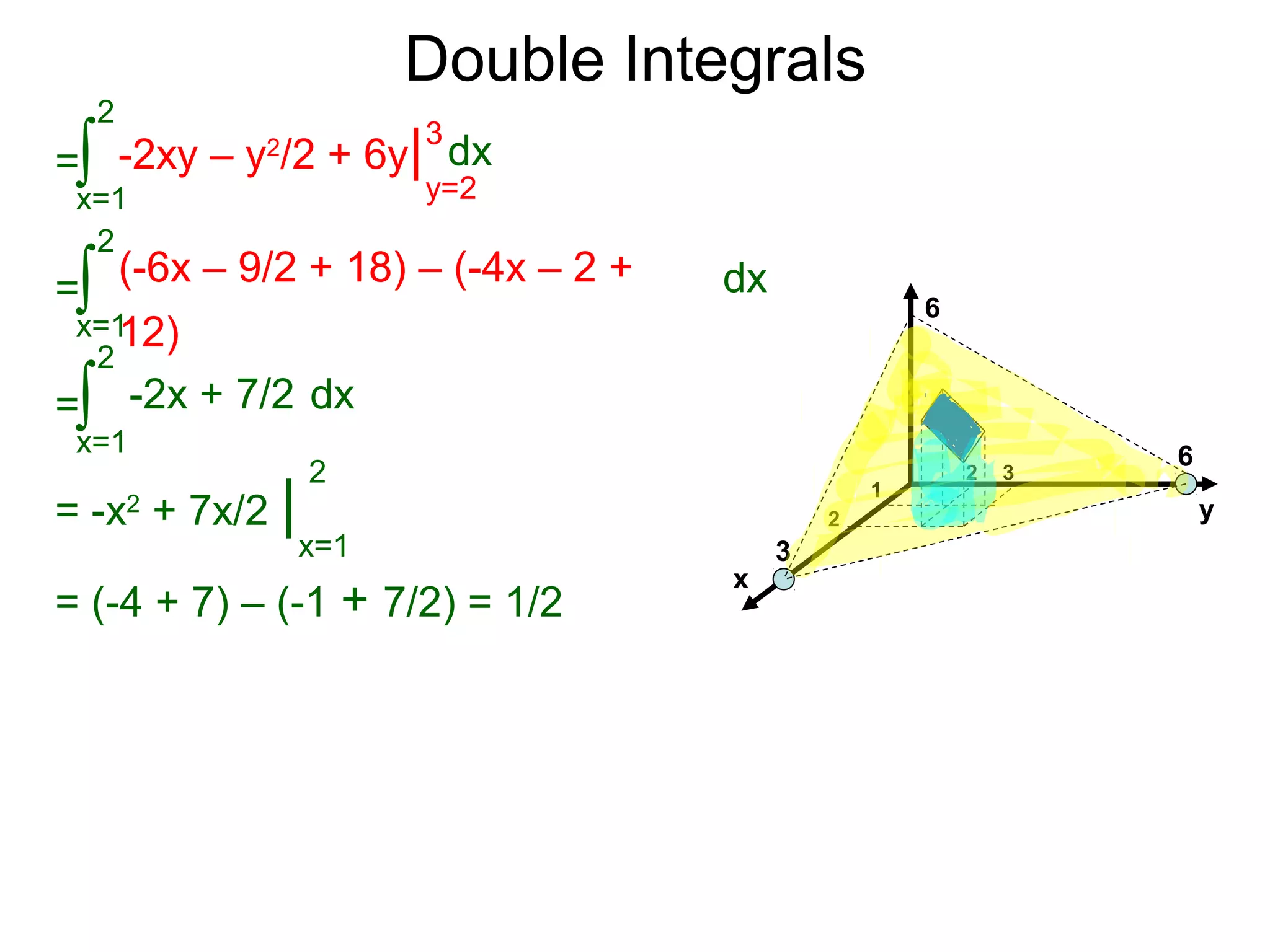
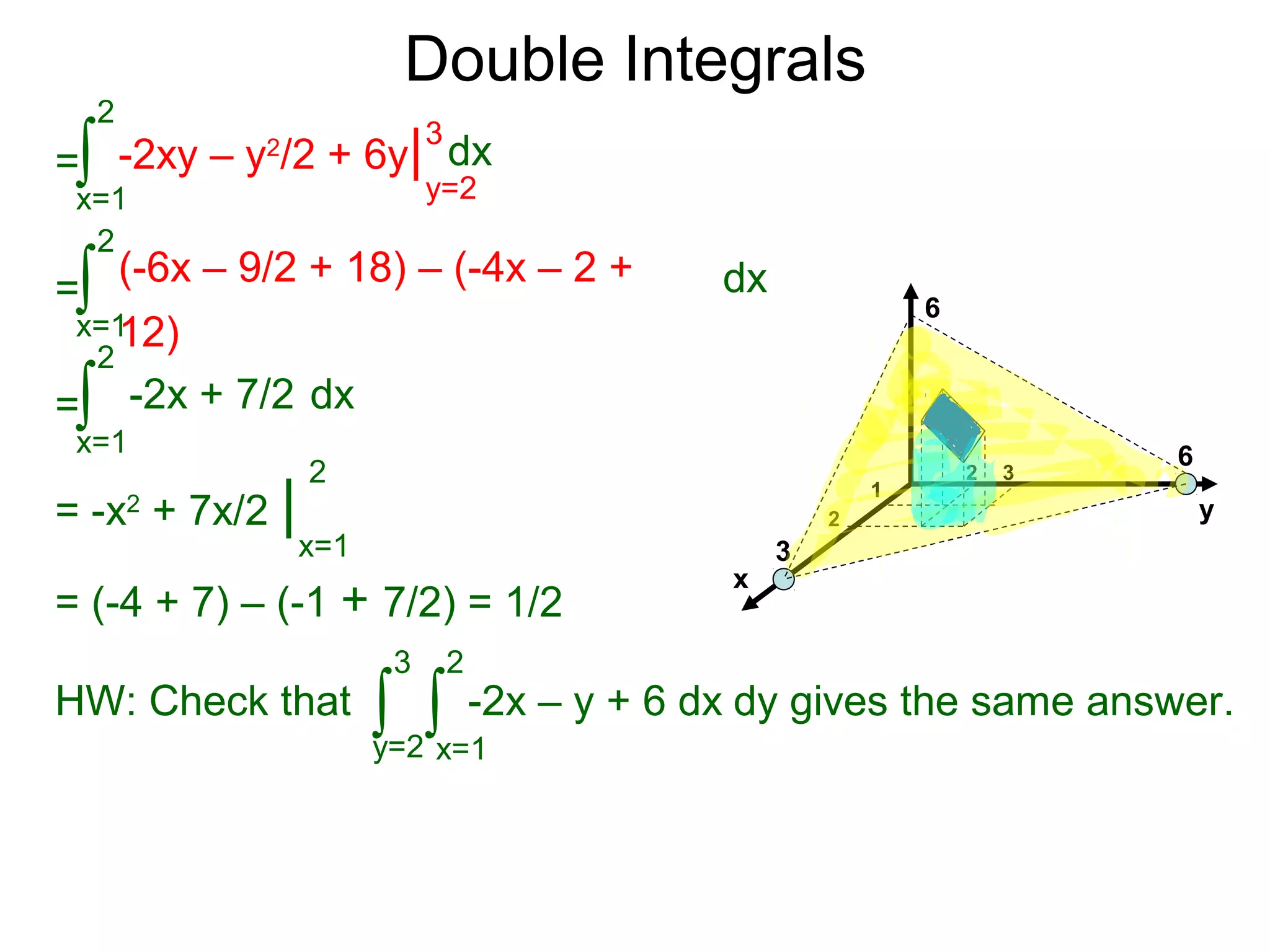
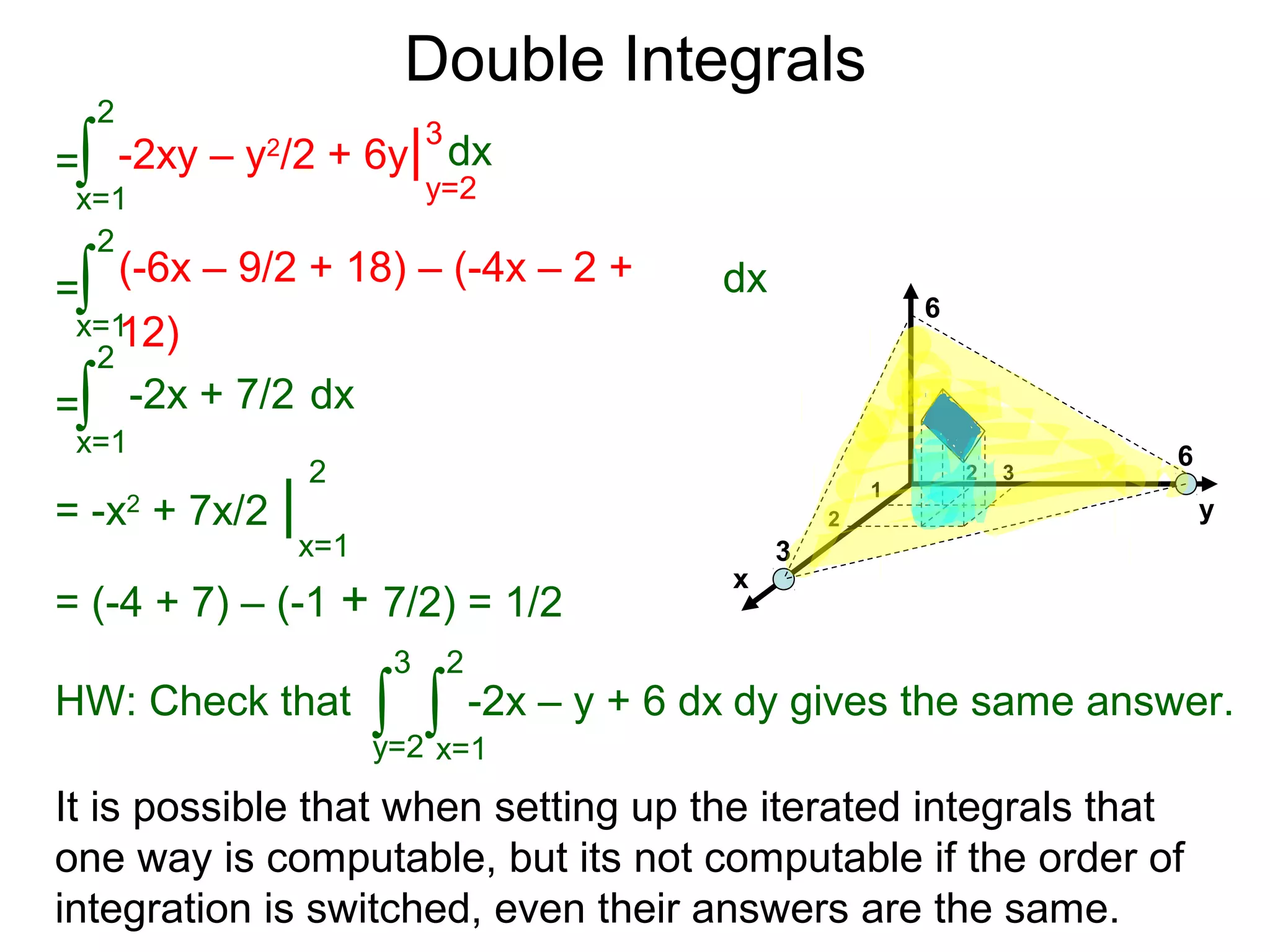
Example: Fid the volume of z = f(x, y) = -2x – y + 6 over the
domain [1, 2] x [2, 3]
f(x, y) dx dyThe integral dx andf(x, y) dy ∫∫∫∫ are
called iterated integrals meaning the integral is done one
step at a time.
[
x=a
b
dy
y=c
d
f(x, y) dx ]∫∫V = f(x, y) dA =∫∫D
= [
x=a
b
dx
y=c
d
f(x, y) dy ]∫ ∫
Double Integrals
Theorem: Given z = f(x, y) > 0 a continuous function over the
domnain [a, b] x [c. d], then the following are equal:
Example: Fid the volume of z = f(x, y) = -2x – y + 6 over the
domain [1, 2] x [2, 3]
x
y
6
6
3
1
2
2 3
f(x, y) dx dyThe integral dx andf(x, y) dy ∫∫∫∫ are
called iterated integrals meaning the integral is done one
step at a time.
[
x=a
b
dy
y=c
d
f(x, y) dx ]∫∫V = f(x, y) dA =∫∫D
= [
x=a
b
dx
y=c
d
f(x, y) dy ]∫ ∫
Double Integrals
Theorem: Given z = f(x, y) > 0 a continuous function over the
domnain [a, b] x [c. d], then the following are equal:
Example: Fid the volume of z = f(x, y) = -2x – y + 6 over the
domain [1, 2] x [2, 3]
x
y
6
6
3
1
2
2 3
The volume is
x=1
2
dx
y=2
3
-2x – y + 6 dy∫ ∫
f(x, y) dx dyThe integral dx andf(x, y) dy ∫∫∫∫ are
called iterated integrals meaning the integral is done one
step at a time.
[
x=a
b
dy
y=c
d
f(x, y) dx ]∫∫V = f(x, y) dA =∫∫D
= [
x=a
b
dx
y=c
d
f(x, y) dy ]∫ ∫
Double Integrals
Theorem: Given z = f(x, y) > 0 a continuous function over the
domnain [a, b] x [c. d], then the following are equal:
Example: Fid the volume of z = f(x, y) = -2x – y + 6 over the
domain [1, 2] x [2, 3]
x
y
6
6
3
1
2
2 3
The volume is
x=1
2
dx
y=2
3
-2x – y + 6 dy∫ ∫
=
x=1
2
∫ -2xy – y2
/2 + 6y| dx
y=2
3
f(x, y) dx dyThe integral dx andf(x, y) dy ∫∫∫∫ are
called iterated integrals meaning the integral is done one
step at a time.
[
x=a
b
dy
y=c
d
f(x, y) dx ]∫∫V = f(x, y) dA =∫∫D
= [
x=a
b
dx
y=c
d
f(x, y) dy ]∫ ∫
Double Integrals
x
y
6
6
3
1
2
2 3
=
x=1
2
∫ -2xy – y2
/2 + 6y| dx
y=2
3
Double Integrals
x
y
6
6
3
1
2
2 3
=
x=1
2
∫ -2xy – y2
/2 + 6y| dx
y=2
3
=
x=1
2
∫ (-6x – 9/2 + 18) – (-4x – 2 +
12)
dx
Double Integrals
x
y
6
6
3
1
2
2 3
=
x=1
2
∫ -2xy – y2
/2 + 6y| dx
y=2
3
=
x=1
2
∫ (-6x – 9/2 + 18) – (-4x – 2 +
12)
dx
=
x=1
2
∫ -2x + 7/2 dx
Double Integrals
x
y
6
6
3
1
2
2 3
=
x=1
2
∫ -2xy – y2
/2 + 6y| dx
y=2
3
=
x=1
2
∫ (-6x – 9/2 + 18) – (-4x – 2 +
12)
dx
=
x=1
2
∫ -2x + 7/2 dx
= -x2
+ 7x/2 |
x=1
2
Double Integrals
x
y
6
6
3
1
2
2 3
=
x=1
2
∫ -2xy – y2
/2 + 6y| dx
y=2
3
=
x=1
2
∫ (-6x – 9/2 + 18) – (-4x – 2 +
12)
dx
=
x=1
2
∫ -2x + 7/2 dx
= -x2
+ 7x/2 |
x=1
2
= (-4 + 7) – (-1 + 7/2) = 1/2
Double Integrals
x
y
6
6
3
1
2
2 3
=
x=1
2
∫ -2xy – y2
/2 + 6y| dx
y=2
3
=
x=1
2
∫ (-6x – 9/2 + 18) – (-4x – 2 +
12)
dx
=
x=1
2
∫ -2x + 7/2 dx
= -x2
+ 7x/2 |
x=1
2
= (-4 + 7) – (-1 + 7/2) = 1/2
HW: Check that
2
dy gives the same answer.
3
-2x – y + 6 dx∫ ∫x=1y=2
Double Integrals
x
y
6
6
3
1
2
2 3
=
x=1
2
∫ -2xy – y2
/2 + 6y| dx
y=2
3
=
x=1
2
∫ (-6x – 9/2 + 18) – (-4x – 2 +
12)
dx
=
x=1
2
∫ -2x + 7/2 dx
= -x2
+ 7x/2 |
x=1
2
= (-4 + 7) – (-1 + 7/2) = 1/2
HW: Check that
2
dy gives the same answer.
3
-2x – y + 6 dx∫ ∫x=1y=2
It is possible that when setting up the iterated integrals that
one way is computable, but its not computable if the order of
integration is switched, even their answers are the same.
Double Integrals
Example: Find the where D = [0, 1] x [0, 1]
D
ex+2y
dA∫ ∫
Double Integrals
Since ex+2y
is continuous, we may change the integral to
an iterated integral, say
0
1
dy
1
ex+2y
dx∫ ∫x=0
Example: Find the where D = [0, 1] x [0, 1]
D
ex+2y
dA∫ ∫
Double Integrals
Since ex+2y
is continuous, we may change the integral to
an iterated integral, say
0
1
dy
1
ex+2y
dx∫ ∫x=0
=
0
1 1
ex+2y
| dy∫ x=0
Example: Find the where D = [0, 1] x [0, 1]
D
ex+2y
dA∫ ∫
Double Integrals
Since ex+2y
is continuous, we may change the integral to
an iterated integral, say
0
1
dy
1
ex+2y
dx∫ ∫x=0
=
0
1 1
ex+2y
| dy∫ x=0
=
0
1
e1+2y
– e2y
dy∫
Example: Find the where D = [0, 1] x [0, 1]
D
ex+2y
dA∫ ∫
Double Integrals
Since ex+2y
is continuous, we may change the integral to
an iterated integral, say
0
1
dy
1
ex+2y
dx∫ ∫x=0
=
0
1 1
ex+2y
| dy∫ x=0
=
0
1
e1+2y
– e2y
dy∫
= (e1+2y
– e2y
) |
1
y=0
1
2
Example: Find the where D = [0, 1] x [0, 1]
D
ex+2y
dA∫ ∫
Double Integrals
Since ex+2y
is continuous, we may change the integral to
an iterated integral, say
0
1
dy
1
ex+2y
dx∫ ∫x=0
=
0
1 1
ex+2y
| dy∫ x=0
=
0
1
e1+2y
– e2y
dy∫
= (e1+2y
– e2y
) |
1
y=0
= [(e3
– e2
) – (e – 1)] =
e3
– e2
– e +1
2
1
2
1
2
Example: Find the where D = [0, 1] x [0, 1]
D
ex+2y
dA∫ ∫
Double Integrals
Lastly, we note that using the Fundemantal Theorem of
Calculus to find volume, its not necessary that the D is a
rectangle.
Double Integrals
Lastly, we note that using the Fundemantal Theorem of
Calculus to find volume, its not necessary that the D is a
rectangle.
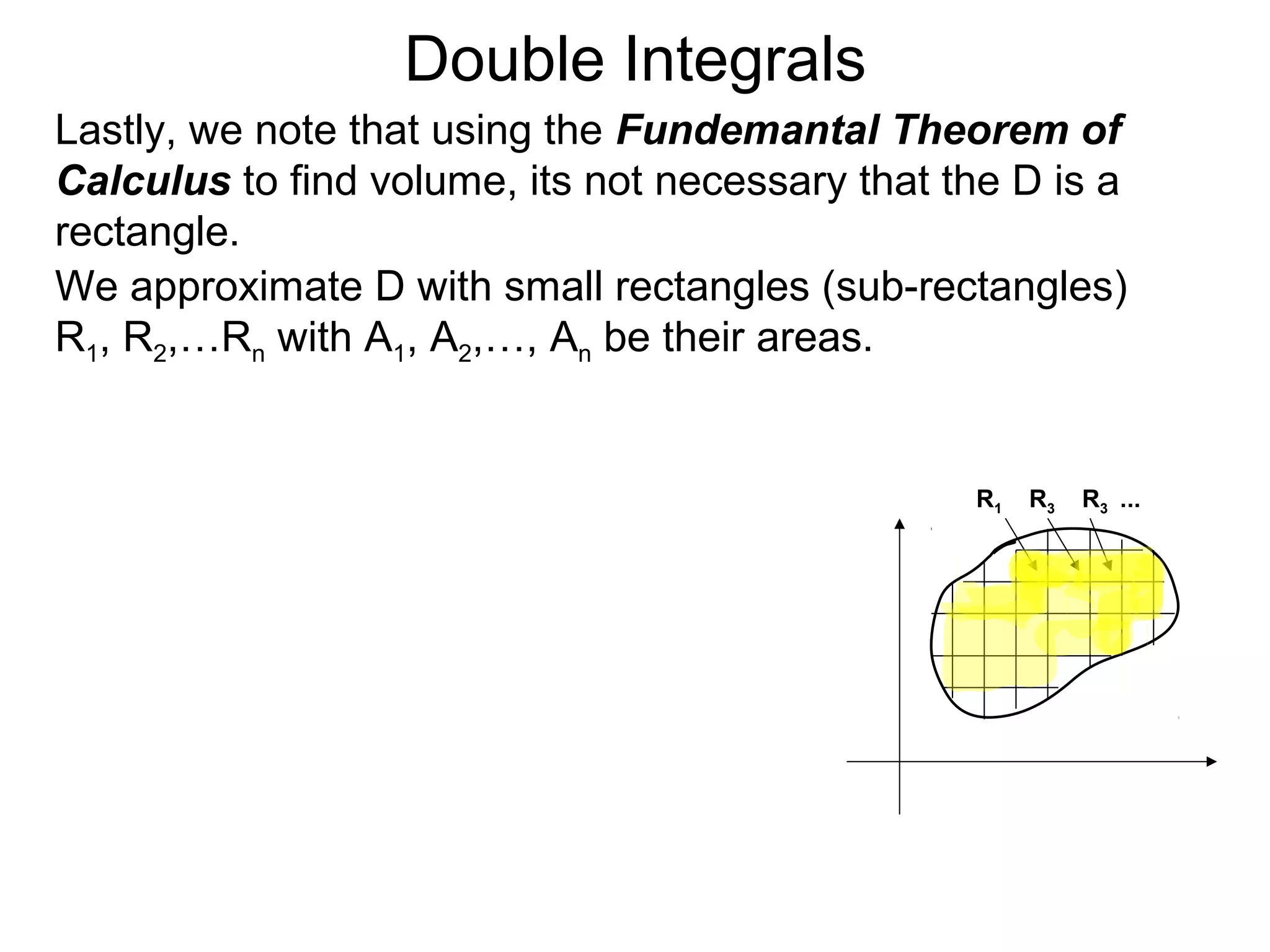
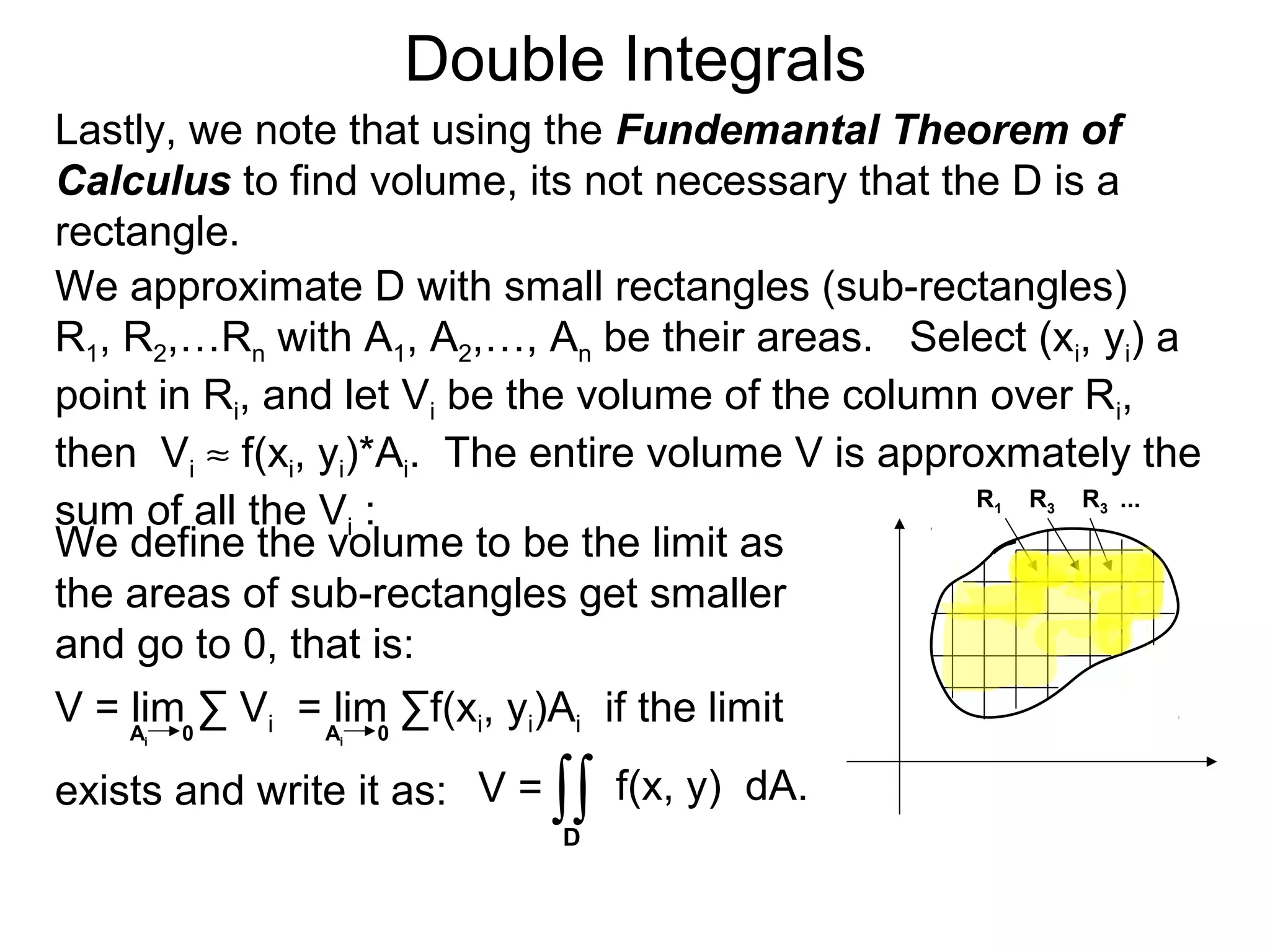
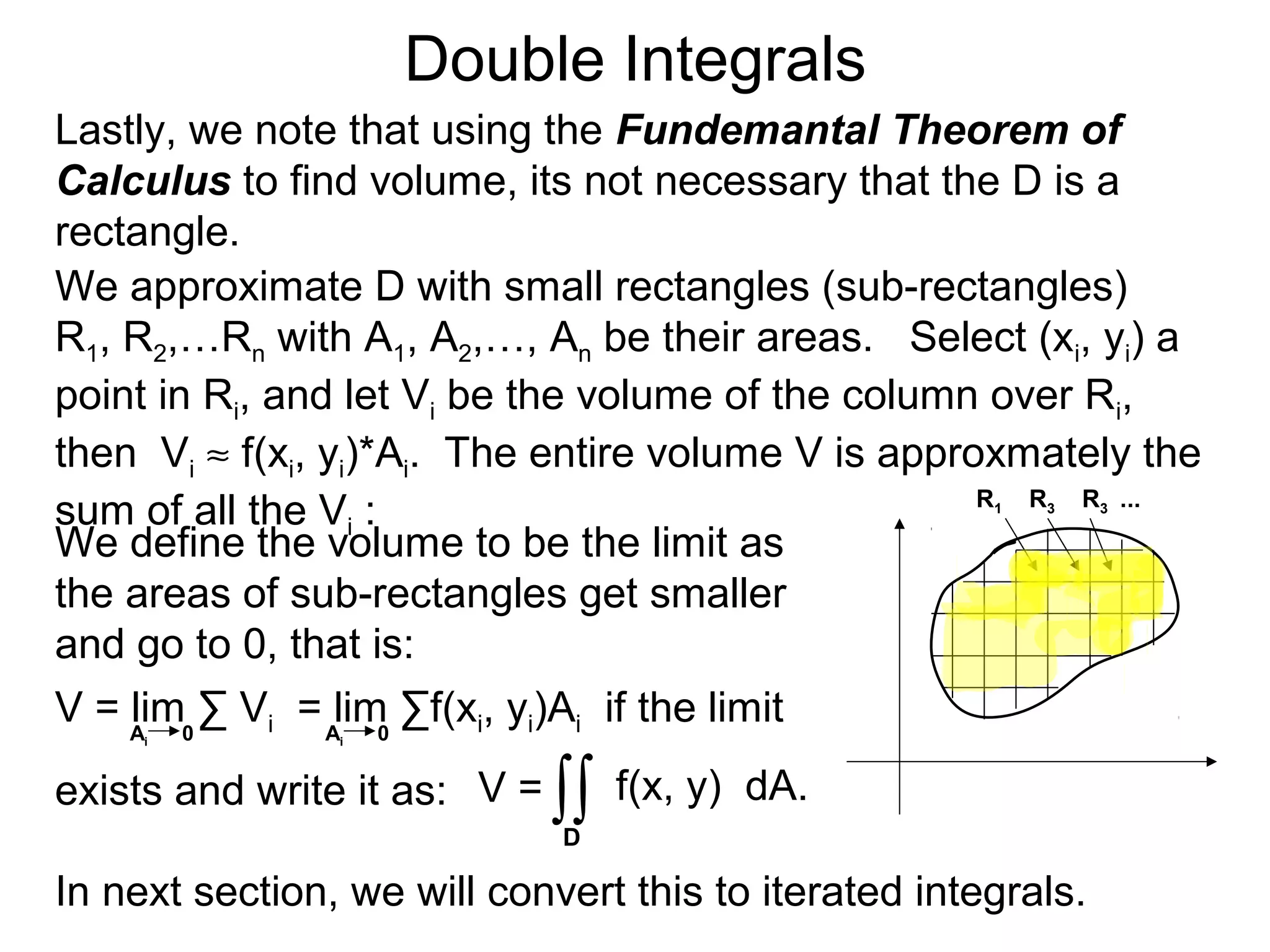
We approximate D with small rectangles (sub-rectangles)
R1, R2,…Rn with A1, A2,…, An be their areas.
Double Integrals
Lastly, we note that using the Fundemantal Theorem of
Calculus to find volume, its not necessary that the D is a
rectangle.
We approximate D with small rectangles (sub-rectangles)
R1, R2,…Rn with A1, A2,…, An be their areas.
R1 R3 R3 ...
Double Integrals
Lastly, we note that using the Fundemantal Theorem of
Calculus to find volume, its not necessary that the D is a
rectangle.
We approximate D with small rectangles (sub-rectangles)
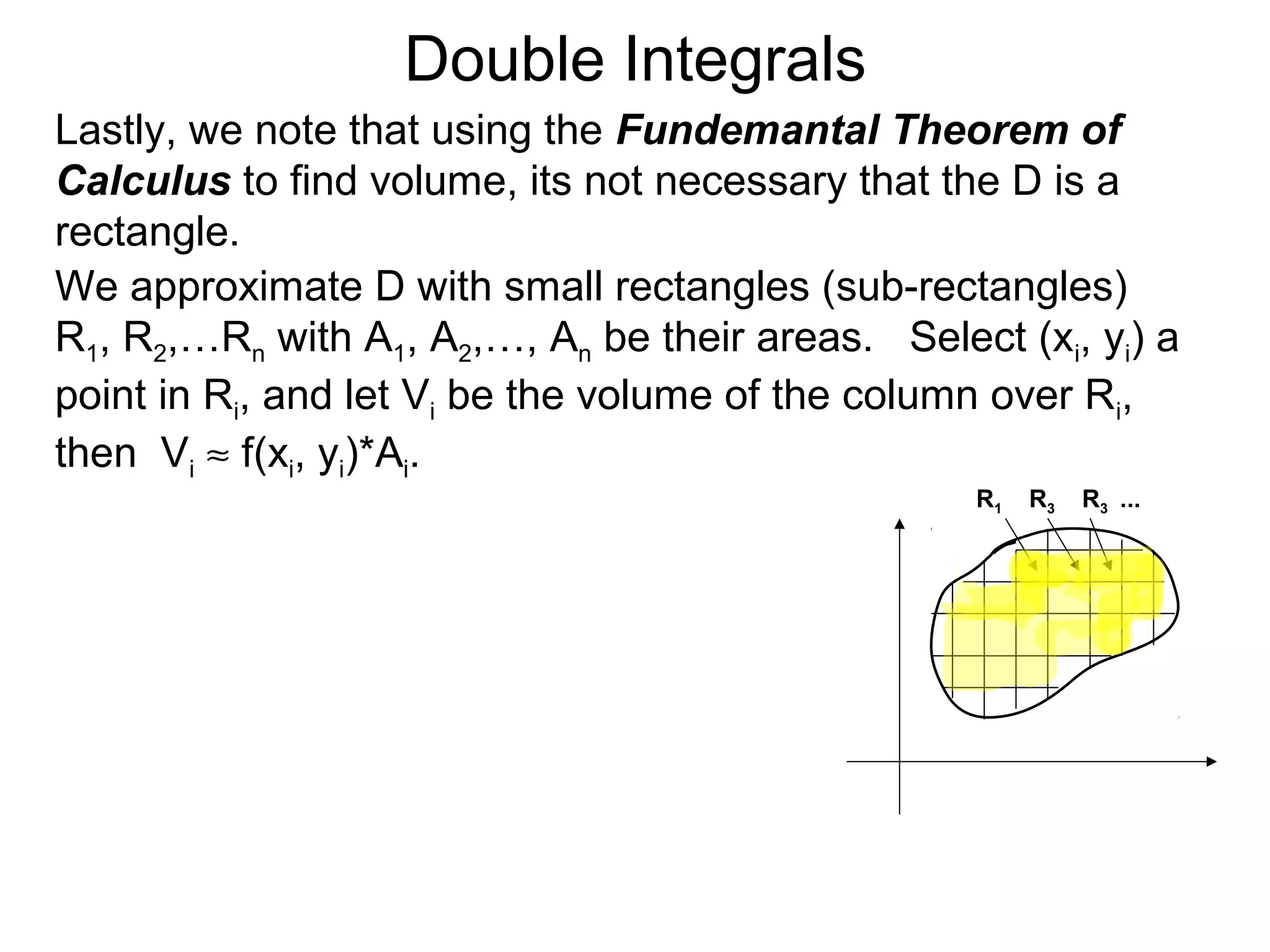
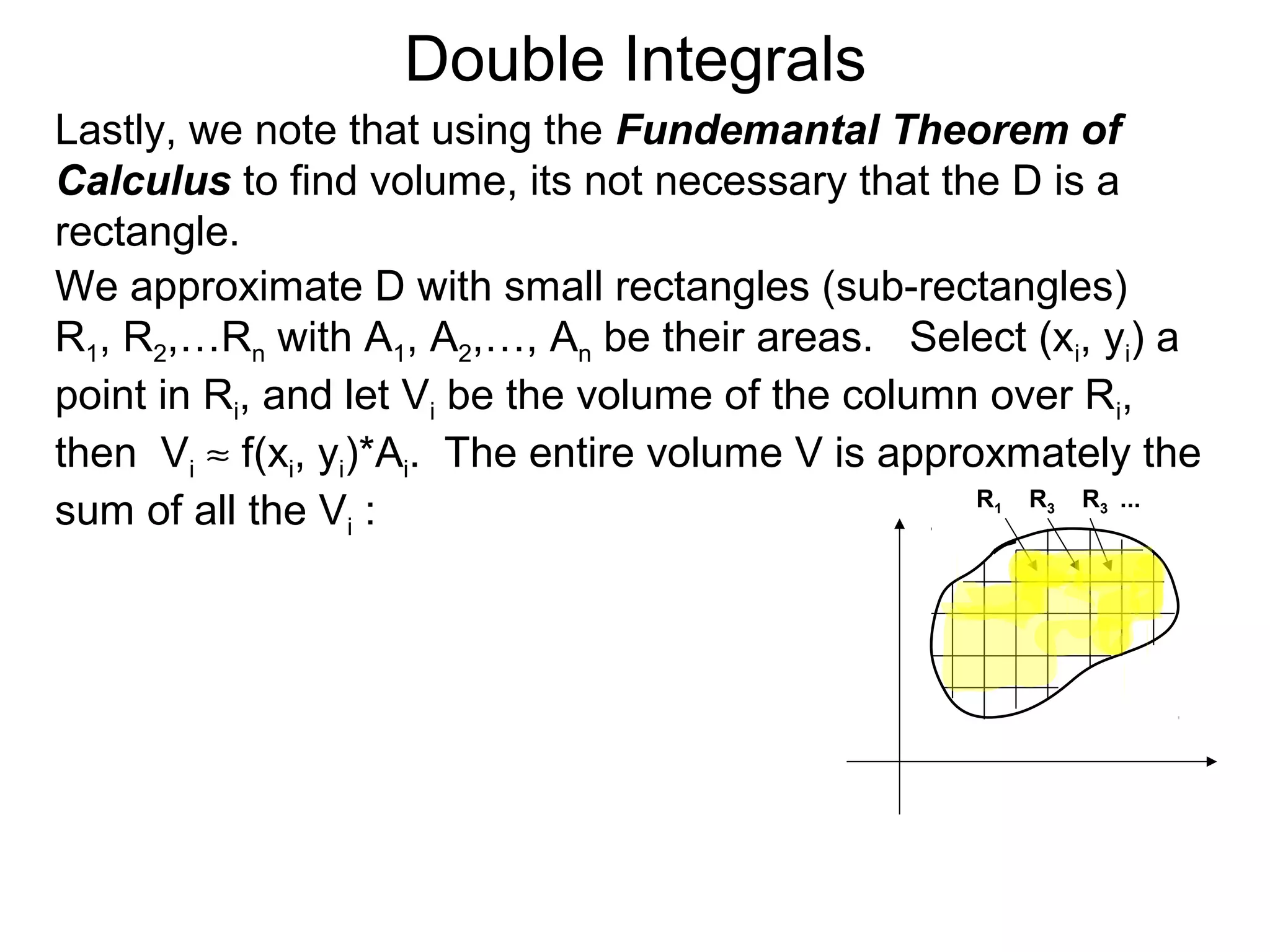
R1, R2,…Rn with A1, A2,…, An be their areas. Select (xi, yi) a
point in Ri, and let Vi be the volume of the column over Ri,
then Vi ≈ f(xi, yi)*Ai.
R1 R3 R3 ...
Double Integrals
Lastly, we note that using the Fundemantal Theorem of
Calculus to find volume, its not necessary that the D is a
rectangle.
We approximate D with small rectangles (sub-rectangles)
R1, R2,…Rn with A1, A2,…, An be their areas. Select (xi, yi) a
point in Ri, and let Vi be the volume of the column over Ri,
then Vi ≈ f(xi, yi)*Ai. The entire volume V is approxmately the
sum of all the Vi : R1 R3 R3 ...
Double Integrals
Lastly, we note that using the Fundemantal Theorem of
Calculus to find volume, its not necessary that the D is a
rectangle.
We approximate D with small rectangles (sub-rectangles)
R1, R2,…Rn with A1, A2,…, An be their areas. Select (xi, yi) a
point in Ri, and let Vi be the volume of the column over Ri,
then Vi ≈ f(xi, yi)*Ai. The entire volume V is approxmately the
sum of all the Vi :
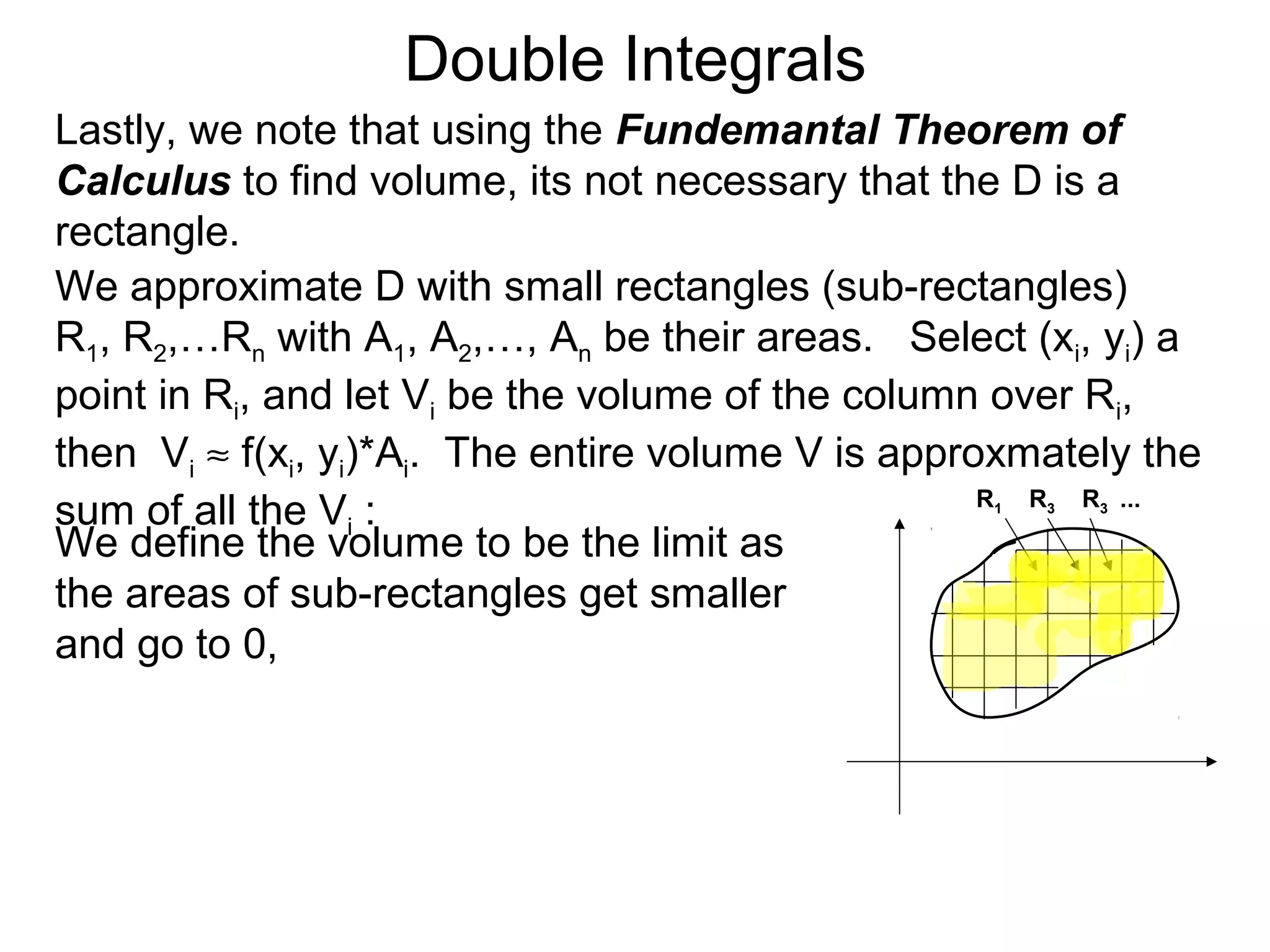
We define the volume to be the limit as
the areas of sub-rectangles get smaller
and go to 0,
R1 R3 R3 ...
Double Integrals
Lastly, we note that using the Fundemantal Theorem of
Calculus to find volume, its not necessary that the D is a
rectangle.
V = f(x, y) dA.
We approximate D with small rectangles (sub-rectangles)
R1, R2,…Rn with A1, A2,…, An be their areas. Select (xi, yi) a
point in Ri, and let Vi be the volume of the column over Ri,
then Vi ≈ f(xi, yi)*Ai. The entire volume V is approxmately the
sum of all the Vi :
∫∫
We define the volume to be the limit as
the areas of sub-rectangles get smaller
and go to 0, that is:
V = lim ∑ Vi = lim ∑f(xi, yi)Ai if the limit
exists and write it as:
Ai 0 Ai 0
D
R1 R3 R3 ...
Double Integrals
Lastly, we note that using the Fundemantal Theorem of
Calculus to find volume, its not necessary that the D is a
rectangle.
V = f(x, y) dA.
We approximate D with small rectangles (sub-rectangles)
R1, R2,…Rn with A1, A2,…, An be their areas. Select (xi, yi) a
point in Ri, and let Vi be the volume of the column over Ri,
then Vi ≈ f(xi, yi)*Ai. The entire volume V is approxmately the
sum of all the Vi :
∫∫
We define the volume to be the limit as
the areas of sub-rectangles get smaller
and go to 0, that is:
V = lim ∑ Vi = lim ∑f(xi, yi)Ai if the limit
exists and write it as:
Ai 0 Ai 0
D
R1 R3 R3 ...
In next section, we will convert this to iterated integrals.

22 double integrals

  • 1.
  • 2.
    Double Integrals Cavalieri's Principal: (2DVersion) Given two shapes where the cross-section lengths are equal at all levels, then they have the same area. = = Same Area Equal lengths
  • 3.
    Double Integrals Cavalieri's Principal: (2DVersion) Given two shapes where the cross-section lengths are equal at all levels, then they have the same area. (3D Version) Given two solids where the cross-section areas are equal at all levels, then they have the same volume. = = = = Same Area Same Volume Equal lengths Equal Areas
  • 4.
    Double Integrals In termsof integrals (2D Version) Area is the integral of cross-section-length function. Area = t=b t=a L(t)=length t=a b L(t) dt∫
  • 5.
    Double Integrals In termsof integrals (2D Version) Area is the integral of cross-section-length function. Area = t=b t=a L(t)=length t=a b L(t) dt t=b t=a A(t)=area (3D Version) Volume is the integral of cross-section-area function. ∫ t=a b A(t) dtVolume = ∫tt
  • 6.
    Double Integrals We writethe rectangular area {(x, y)| a ≤ x ≤ b and c ≤ y ≤ d} as [a, b] x [c, d]. a b c d [a, b] x [c, d]
  • 7.
    Double Integrals Given z= f(x, y) ≥ 0 over the domain D = [a, b] x [c, d], it defines a solid over D. x y We write the rectangular area {(x, y)| a ≤ x ≤ b and c ≤ y ≤ d} as [a, b] x [c, d]. z = f(x, y) a b c d D a b c d [a, b] x [c, d] D
  • 8.
    Double Integrals Given z= f(x, y) ≥ 0 over the domain D = [a, b] x [c, d], it defines a solid over D. Hence the volume V of this solid is x y We write the rectangular area {(x, y)| a ≤ x ≤ b and c ≤ y ≤ d} as [a, b] x [c, d]. z = f(x, y) a b c d D a b c d [a, b] x [c, d] D x=a b A(x) dx, where A(x) is the cross-sectional area function. V = ∫
  • 9.
    Double Integrals Given z= f(x, y) ≥ 0 over the domain D = [a, b] x [c, d], it defines a solid over D. Hence the volume V of this solid is x y We write the rectangular area {(x, y)| a ≤ x ≤ b and c ≤ y ≤ d} as [a, b] x [c, d]. z = f(x, y) a b c d D x a b c d [a, b] x [c, d] A(x) D x=a b A(x) dx, where A(x) is the cross-sectional area function. V = ∫
  • 10.
    Double Integrals Given z= f(x, y) ≥ 0 over the domain D = [a, b] x [c, d], it defines a solid over D. Hence the volume V of this solid is x y We write the rectangular area {(x, y)| a ≤ x ≤ b and c ≤ y ≤ d} as [a, b] x [c, d]. z = f(x, y) a b c d D x a b c d [a, b] x [c, d] A(x) D x=a b A(x) dx, where A(x) is the cross-sectional area function. V = d ∫ On the other hand A(x) = y=c f(x, y) dy where the integral is taken by treating x as a constant. ∫
  • 11.
    Double Integrals Given z= f(x, y) ≥ 0 over the domain D = [a, b] x [c, d], it defines a solid over D. Hence the volume V of this solid is x y We write the rectangular area {(x, y)| a ≤ x ≤ b and c ≤ y ≤ d} as [a, b] x [c, d]. z = f(x, y) a b c d D x Hence the volume V is V = [ x=a x=b dx. y=c y=d f(x, y) dy ]∫ ∫ a b c d [a, b] x [c, d] A(x) D x=a b A(x) dx, where A(x) is the cross-sectional area function. V = d ∫ On the other hand A(x) = y=c f(x, y) dy where the integral is taken by treating x as a constant. ∫
  • 12.
    Double Integrals x y z =f(x, y) a b c d D x A(x) D f(x, y) dy ] dxThe integral is called the double integral with respect to y then x. f(x, y) dy dx =∫∫ ∫ ∫[ A(x) dx∫=
  • 13.
    Double Integrals x y z =f(x, y) a b c d D x A(x) D f(x, y) dy ] dxThe integral is called the double integral with respect to y then x. f(x, y) dy dx =∫∫ ∫ ∫[ f(x, y) dx ] dySimilarly, is called the double integral with respect to x then y. f(x, y) dx dy =∫∫ ∫ ∫[ A(x) dx∫= A(y) dy∫=
  • 14.
    Double Integrals x y z =f(x, y) a b c d D x A(x) D f(x, y) dy ] dxThe integral is called the double integral with respect to y then x. f(x, y) dy dx =∫∫ ∫ ∫[ x y z = f(x, y) a b c d D y A(y) f(x, y) dx ] dySimilarly, is called the double integral with respect to x then y. f(x, y) dx dy =∫∫ ∫ ∫[ It represents the volume integration over the cross sectional areas A(y) by setting y as a constant A(x) dx∫= A(y) dy∫=
  • 15.
    Double Integrals x y z =f(x, y) a b c d D x A(x) D f(x, y) dy ] dxThe integral is called the double integral with respect to y then x. f(x, y) dy dx =∫∫ ∫ ∫[ x y z = f(x, y) a b c d D y A(y) f(x, y) dx ] dySimilarly, is called the double integral with respect to x then y. f(x, y) dx dy =∫∫ ∫ ∫[ f(x, y) dx = A(y)∫ is calculated by treating y as a constant. It represents the volume integration over the cross sectional areas A(y) by setting y as a constant and that A(x) dx∫= A(y) dy∫=
  • 16.
    Double Integrals z =f(x, y) D The third way to compute the volume is to use the Fundemantal Theorem of Calculus directly. xy
  • 17.
    Double Integrals The thirdway to compute the volume is to use the Fundemantal Theorem of Calculus directly. Partition the domain D into small rectangles (sub-rectangles) and label them as R1, R2,…Rn and let A1, A2,…, An be their areas. z = f(x, y) D xy
  • 18.
    Double Integrals The thirdway to compute the volume is to use the Fundemantal Theorem of Calculus directly. Partition the domain D into small rectangles (sub-rectangles) and label them as R1, R2,…Rn and let A1, A2,…, An be their areas. z = f(x, y) D xy
  • 19.
    Double Integrals The thirdway to compute the volume is to use the Fundemantal Theorem of Calculus directly. Partition the domain D into small rectangles (sub-rectangles) and label them as R1, R2,…Rn and let A1, A2,…, An be their areas. Over each Ri, there is a rectangular column with Ri as the base with a patch of z = f(x, y) as the roof that covers the column. z = f(x, y) D xy
  • 20.
    Double Integrals The thirdway to compute the volume is to use the Fundemantal Theorem of Calculus directly. Partition the domain D into small rectangles (sub-rectangles) and label them as R1, R2,…Rn and let A1, A2,…, An be their areas. Over each Ri, there is a rectangular column with Ri as the base with a patch of z = f(x, y) as the roof that covers the column. z = f(x, y) D / y x
  • 21.
    Double Integrals The thirdway to compute the volume is to use the Fundemantal Theorem of Calculus directly. Partition the domain D into small rectangles (sub-rectangles) and label them as R1, R2,…Rn and let A1, A2,…, An be their areas. Over each Ri, there is a rectangular column with Ri as the base with a patch of z = f(x, y) as the roof that covers the column. Let (xi, yi) be a point in Ri, and let Vi be the volume of this column, then Vi ≈ f(xi, yi) Ai. z = f(x, y) D (xi, yi) in Ri / y x
  • 22.
    Double Integrals y z =f(x, y) D (xi, yi) in Ri The third way to compute the volume is to use the Fundemantal Theorem of Calculus directly. Partition the domain D into small rectangles (sub-rectangles) and label them as R1, R2,…Rn and let A1, A2,…, An be their areas. Over each Ri, there is a rectangular column with Ri as the base with a patch of z = f(x, y) as the roof that covers the column. Let (xi, yi) be a point in Ri, and let Vi be the volume of this column, then Vi ≈ f(xi, yi) Ai. x / Vi ≈ f(xi, yi) Ai Ai
  • 23.
    Double Integrals y z =f(x, y) D (xi, yi) in Ri The third way to compute the volume is to use the Fundemantal Theorem of Calculus directly. Partition the domain D into small rectangles (sub-rectangles) and label them as R1, R2,…Rn and let A1, A2,…, An be their areas. Over each Ri, there is a rectangular column with Ri as the base with a patch of z = f(x, y) as the roof that covers the column. Let (xi, yi) be a point in Ri, and let Vi be the volume of this column, then Vi ≈ f(xi, yi) Ai. x / Ai f(xi, yi)
  • 24.
    Double Integrals y z =f(x, y) D (xi, yi) in Ri The third way to compute the volume is to use the Fundemantal Theorem of Calculus directly. Partition the domain D into small rectangles (sub-rectangles) and label them as R1, R2,…Rn and let A1, A2,…, An be their areas. Over each Ri, there is a rectangular column with Ri as the base with a patch of z = f(x, y) as the roof that covers the column. Let (xi, yi) be a point in Ri, and let Vi be the volume of this column, then Vi ≈ f(xi, yi) Ai. x / Vi ≈ f(xi, yi) Ai Ai f(xi, yi)
  • 25.
    Double Integrals y z =f(x, y) D (xi, yi) in Ri The third way to compute the volume is to use the Fundemantal Theorem of Calculus directly. Partition the domain D into small rectangles (sub-rectangles) and label them as R1, R2,…Rn and let A1, A2,…, An be their areas. Over each Ri, there is a rectangular column with Ri as the base with a patch of z = f(x, y) as the roof that covers the column. Let (xi, yi) be a point in Ri, and let Vi be the volume of this column, then Vi ≈ f(xi, yi) Ai. The entire volume V is approximately the sum of all the Vi, that is x / i=1 i=1 nn V ≈ ∑ Vi = ∑ f(xi, yi) Ai, Vi ≈ f(xi, yi) Ai Ai f(xi, yi)
  • 26.
    Double Integrals y z =f(x, y) D (xi, yi) in Ri The third way to compute the volume is to use the Fundemantal Theorem of Calculus directly. Partition the domain D into small rectangles (sub-rectangles) and label them as R1, R2,…Rn and let A1, A2,…, An be their areas. Over each Ri, there is a rectangular column with Ri as the base with a patch of z = f(x, y) as the roof that covers the column. Let (xi, yi) be a point in Ri, and let Vi be the volume of this column, then Vi ≈ f(xi, yi) Ai. The entire volume V is approximately the sum of all the Vi, that is x / i=1 i=1 nn V = lim ∑ Vi Ai 0 V ≈ ∑ Vi = ∑ f(xi, yi) Ai, specifically Vi ≈ f(xi, yi) Ai Ai f(xi, yi)
  • 27.
    Double Integrals y z =f(x, y) D (xi, yi) in Ri The third way to compute the volume is to use the Fundemantal Theorem of Calculus directly. Partition the domain D into small rectangles (sub-rectangles) and label them as R1, R2,…Rn and let A1, A2,…, An be their areas. Over each Ri, there is a rectangular column with Ri as the base with a patch of z = f(x, y) as the roof that covers the column. Let (xi, yi) be a point in Ri, and let Vi be the volume of this column, then Vi ≈ f(xi, yi) Ai. The entire volume V is approximately the sum of all the Vi, that is x / i=1 i=1 nn V = lim ∑ Vi = lim ∑f(xi, yi)Ai Ai 0 Ai 0 V ≈ ∑ Vi = ∑ f(xi, yi) Ai, specifically if the limit exists. Vi ≈ f(xi, yi) Ai Ai f(xi, yi)
  • 28.
    Double Integrals y z =f(x, y) D (xi, yi) in Ri The third way to compute the volume is to use the Fundemantal Theorem of Calculus directly. Partition the domain D into small rectangles (sub-rectangles) and label them as R1, R2,…Rn and let A1, A2,…, An be their areas. Over each Ri, there is a rectangular column with Ri as the base with a patch of z = f(x, y) as the roof that covers the column. Let (xi, yi) be a point in Ri, and let Vi be the volume of this column, then Vi ≈ f(xi, yi) Ai. The entire volume V is approximately the sum of all the Vi, that is x / V = f(x, y) dA.∫∫ i=1 i=1 nn V = lim ∑ Vi = lim ∑f(xi, yi)Ai Ai 0 Ai 0 D V ≈ ∑ Vi = ∑ f(xi, yi) Ai, specifically if the limit exists. Writing the above in the integral notation: Vi ≈ f(xi, yi) Ai Ai f(xi, yi)
  • 29.
    Double Integrals f(x, y)dx dyThe integral dx andf(x, y) dy ∫∫∫∫ are called iterated integrals meaning the integral is done one step at a time.
  • 30.
    Double Integrals Theorem: Givenz = f(x, y) > 0 a continuous function over the domnain [a, b] x [c. d], then the following are equal: f(x, y) dx dyThe integral dx andf(x, y) dy ∫∫∫∫ are called iterated integrals meaning the integral is done one step at a time.
  • 31.
    Double Integrals Theorem: Givenz = f(x, y) > 0 a continuous function over the domnain [a, b] x [c. d], then the following are equal: [ x=a b dy y=c d f(x, y) dx ]∫∫V = f(x, y) dA =∫∫D = [ x=a b dx y=c d f(x, y) dy ]∫ ∫ f(x, y) dx dyThe integral dx andf(x, y) dy ∫∫∫∫ are called iterated integrals meaning the integral is done one step at a time.
  • 32.
    Double Integrals Theorem: Givenz = f(x, y) > 0 a continuous function over the domnain [a, b] x [c. d], then the following are equal: Example: Fid the volume of z = f(x, y) = -2x – y + 6 over the domain [1, 2] x [2, 3] f(x, y) dx dyThe integral dx andf(x, y) dy ∫∫∫∫ are called iterated integrals meaning the integral is done one step at a time. [ x=a b dy y=c d f(x, y) dx ]∫∫V = f(x, y) dA =∫∫D = [ x=a b dx y=c d f(x, y) dy ]∫ ∫
  • 33.
    Double Integrals Theorem: Givenz = f(x, y) > 0 a continuous function over the domnain [a, b] x [c. d], then the following are equal: Example: Fid the volume of z = f(x, y) = -2x – y + 6 over the domain [1, 2] x [2, 3] x y 6 6 3 1 2 2 3 f(x, y) dx dyThe integral dx andf(x, y) dy ∫∫∫∫ are called iterated integrals meaning the integral is done one step at a time. [ x=a b dy y=c d f(x, y) dx ]∫∫V = f(x, y) dA =∫∫D = [ x=a b dx y=c d f(x, y) dy ]∫ ∫
  • 34.
    Double Integrals Theorem: Givenz = f(x, y) > 0 a continuous function over the domnain [a, b] x [c. d], then the following are equal: Example: Fid the volume of z = f(x, y) = -2x – y + 6 over the domain [1, 2] x [2, 3] x y 6 6 3 1 2 2 3 The volume is x=1 2 dx y=2 3 -2x – y + 6 dy∫ ∫ f(x, y) dx dyThe integral dx andf(x, y) dy ∫∫∫∫ are called iterated integrals meaning the integral is done one step at a time. [ x=a b dy y=c d f(x, y) dx ]∫∫V = f(x, y) dA =∫∫D = [ x=a b dx y=c d f(x, y) dy ]∫ ∫
  • 35.
    Double Integrals Theorem: Givenz = f(x, y) > 0 a continuous function over the domnain [a, b] x [c. d], then the following are equal: Example: Fid the volume of z = f(x, y) = -2x – y + 6 over the domain [1, 2] x [2, 3] x y 6 6 3 1 2 2 3 The volume is x=1 2 dx y=2 3 -2x – y + 6 dy∫ ∫ = x=1 2 ∫ -2xy – y2 /2 + 6y| dx y=2 3 f(x, y) dx dyThe integral dx andf(x, y) dy ∫∫∫∫ are called iterated integrals meaning the integral is done one step at a time. [ x=a b dy y=c d f(x, y) dx ]∫∫V = f(x, y) dA =∫∫D = [ x=a b dx y=c d f(x, y) dy ]∫ ∫
  • 36.
  • 37.
    Double Integrals x y 6 6 3 1 2 2 3 = x=1 2 ∫-2xy – y2 /2 + 6y| dx y=2 3 = x=1 2 ∫ (-6x – 9/2 + 18) – (-4x – 2 + 12) dx
  • 38.
    Double Integrals x y 6 6 3 1 2 2 3 = x=1 2 ∫-2xy – y2 /2 + 6y| dx y=2 3 = x=1 2 ∫ (-6x – 9/2 + 18) – (-4x – 2 + 12) dx = x=1 2 ∫ -2x + 7/2 dx
  • 39.
    Double Integrals x y 6 6 3 1 2 2 3 = x=1 2 ∫-2xy – y2 /2 + 6y| dx y=2 3 = x=1 2 ∫ (-6x – 9/2 + 18) – (-4x – 2 + 12) dx = x=1 2 ∫ -2x + 7/2 dx = -x2 + 7x/2 | x=1 2
  • 40.
    Double Integrals x y 6 6 3 1 2 2 3 = x=1 2 ∫-2xy – y2 /2 + 6y| dx y=2 3 = x=1 2 ∫ (-6x – 9/2 + 18) – (-4x – 2 + 12) dx = x=1 2 ∫ -2x + 7/2 dx = -x2 + 7x/2 | x=1 2 = (-4 + 7) – (-1 + 7/2) = 1/2
  • 41.
    Double Integrals x y 6 6 3 1 2 2 3 = x=1 2 ∫-2xy – y2 /2 + 6y| dx y=2 3 = x=1 2 ∫ (-6x – 9/2 + 18) – (-4x – 2 + 12) dx = x=1 2 ∫ -2x + 7/2 dx = -x2 + 7x/2 | x=1 2 = (-4 + 7) – (-1 + 7/2) = 1/2 HW: Check that 2 dy gives the same answer. 3 -2x – y + 6 dx∫ ∫x=1y=2
  • 42.
    Double Integrals x y 6 6 3 1 2 2 3 = x=1 2 ∫-2xy – y2 /2 + 6y| dx y=2 3 = x=1 2 ∫ (-6x – 9/2 + 18) – (-4x – 2 + 12) dx = x=1 2 ∫ -2x + 7/2 dx = -x2 + 7x/2 | x=1 2 = (-4 + 7) – (-1 + 7/2) = 1/2 HW: Check that 2 dy gives the same answer. 3 -2x – y + 6 dx∫ ∫x=1y=2 It is possible that when setting up the iterated integrals that one way is computable, but its not computable if the order of integration is switched, even their answers are the same.
  • 43.
    Double Integrals Example: Findthe where D = [0, 1] x [0, 1] D ex+2y dA∫ ∫
  • 44.
    Double Integrals Since ex+2y iscontinuous, we may change the integral to an iterated integral, say 0 1 dy 1 ex+2y dx∫ ∫x=0 Example: Find the where D = [0, 1] x [0, 1] D ex+2y dA∫ ∫
  • 45.
    Double Integrals Since ex+2y iscontinuous, we may change the integral to an iterated integral, say 0 1 dy 1 ex+2y dx∫ ∫x=0 = 0 1 1 ex+2y | dy∫ x=0 Example: Find the where D = [0, 1] x [0, 1] D ex+2y dA∫ ∫
  • 46.
    Double Integrals Since ex+2y iscontinuous, we may change the integral to an iterated integral, say 0 1 dy 1 ex+2y dx∫ ∫x=0 = 0 1 1 ex+2y | dy∫ x=0 = 0 1 e1+2y – e2y dy∫ Example: Find the where D = [0, 1] x [0, 1] D ex+2y dA∫ ∫
  • 47.
    Double Integrals Since ex+2y iscontinuous, we may change the integral to an iterated integral, say 0 1 dy 1 ex+2y dx∫ ∫x=0 = 0 1 1 ex+2y | dy∫ x=0 = 0 1 e1+2y – e2y dy∫ = (e1+2y – e2y ) | 1 y=0 1 2 Example: Find the where D = [0, 1] x [0, 1] D ex+2y dA∫ ∫
  • 48.
    Double Integrals Since ex+2y iscontinuous, we may change the integral to an iterated integral, say 0 1 dy 1 ex+2y dx∫ ∫x=0 = 0 1 1 ex+2y | dy∫ x=0 = 0 1 e1+2y – e2y dy∫ = (e1+2y – e2y ) | 1 y=0 = [(e3 – e2 ) – (e – 1)] = e3 – e2 – e +1 2 1 2 1 2 Example: Find the where D = [0, 1] x [0, 1] D ex+2y dA∫ ∫
  • 49.
    Double Integrals Lastly, wenote that using the Fundemantal Theorem of Calculus to find volume, its not necessary that the D is a rectangle.
  • 50.
    Double Integrals Lastly, wenote that using the Fundemantal Theorem of Calculus to find volume, its not necessary that the D is a rectangle. We approximate D with small rectangles (sub-rectangles) R1, R2,…Rn with A1, A2,…, An be their areas.
  • 51.
    Double Integrals Lastly, wenote that using the Fundemantal Theorem of Calculus to find volume, its not necessary that the D is a rectangle. We approximate D with small rectangles (sub-rectangles) R1, R2,…Rn with A1, A2,…, An be their areas. R1 R3 R3 ...
  • 52.
    Double Integrals Lastly, wenote that using the Fundemantal Theorem of Calculus to find volume, its not necessary that the D is a rectangle. We approximate D with small rectangles (sub-rectangles) R1, R2,…Rn with A1, A2,…, An be their areas. Select (xi, yi) a point in Ri, and let Vi be the volume of the column over Ri, then Vi ≈ f(xi, yi)*Ai. R1 R3 R3 ...
  • 53.
    Double Integrals Lastly, wenote that using the Fundemantal Theorem of Calculus to find volume, its not necessary that the D is a rectangle. We approximate D with small rectangles (sub-rectangles) R1, R2,…Rn with A1, A2,…, An be their areas. Select (xi, yi) a point in Ri, and let Vi be the volume of the column over Ri, then Vi ≈ f(xi, yi)*Ai. The entire volume V is approxmately the sum of all the Vi : R1 R3 R3 ...
  • 54.
    Double Integrals Lastly, wenote that using the Fundemantal Theorem of Calculus to find volume, its not necessary that the D is a rectangle. We approximate D with small rectangles (sub-rectangles) R1, R2,…Rn with A1, A2,…, An be their areas. Select (xi, yi) a point in Ri, and let Vi be the volume of the column over Ri, then Vi ≈ f(xi, yi)*Ai. The entire volume V is approxmately the sum of all the Vi : We define the volume to be the limit as the areas of sub-rectangles get smaller and go to 0, R1 R3 R3 ...
  • 55.
    Double Integrals Lastly, wenote that using the Fundemantal Theorem of Calculus to find volume, its not necessary that the D is a rectangle. V = f(x, y) dA. We approximate D with small rectangles (sub-rectangles) R1, R2,…Rn with A1, A2,…, An be their areas. Select (xi, yi) a point in Ri, and let Vi be the volume of the column over Ri, then Vi ≈ f(xi, yi)*Ai. The entire volume V is approxmately the sum of all the Vi : ∫∫ We define the volume to be the limit as the areas of sub-rectangles get smaller and go to 0, that is: V = lim ∑ Vi = lim ∑f(xi, yi)Ai if the limit exists and write it as: Ai 0 Ai 0 D R1 R3 R3 ...
  • 56.
    Double Integrals Lastly, wenote that using the Fundemantal Theorem of Calculus to find volume, its not necessary that the D is a rectangle. V = f(x, y) dA. We approximate D with small rectangles (sub-rectangles) R1, R2,…Rn with A1, A2,…, An be their areas. Select (xi, yi) a point in Ri, and let Vi be the volume of the column over Ri, then Vi ≈ f(xi, yi)*Ai. The entire volume V is approxmately the sum of all the Vi : ∫∫ We define the volume to be the limit as the areas of sub-rectangles get smaller and go to 0, that is: V = lim ∑ Vi = lim ∑f(xi, yi)Ai if the limit exists and write it as: Ai 0 Ai 0 D R1 R3 R3 ... In next section, we will convert this to iterated integrals.