Presentation on:double integral
 
0 2
sin(y) cos(x) 1 dy dx
 
 
  
y
y 2
0
cos(y) ycos(x) y dx


 
     
0
2 3 3 cos(x d) x

    
0
2x 3 x 3 sin(x)

      
2
2 3   
R
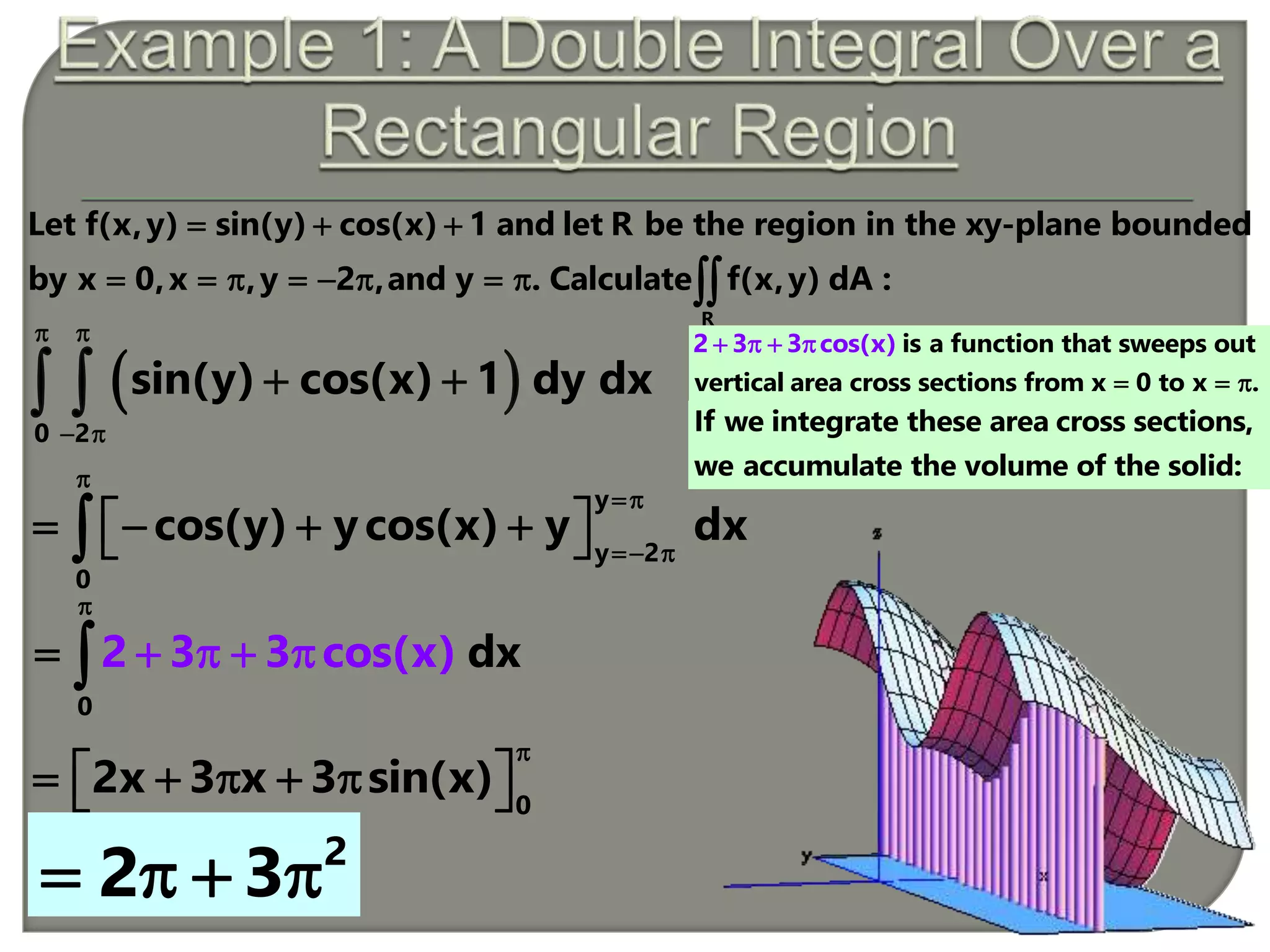
Let f(x,y) sin(y) cos(x) 1 and let R be the region in the xy-plane bounded
by x 0,x ,y 2 ,and y . Calculate f(x,y) dA :
  
        
is a function that sweeps out
vertical area cross sections f
2 3 3 cos(x)
rom x 0 to x .
   
  
If we integrate these area cross sections,
we accumulate the volume of the solid:
 
2 0
sin(y) cos(x) 1 dx dy
 
 
  
x
x 0
2
xsin(y) sin(x) x dy



 
    
2
sin(y dy)

 
  

 
      2
y cos(y)
2
2 3   
R R R
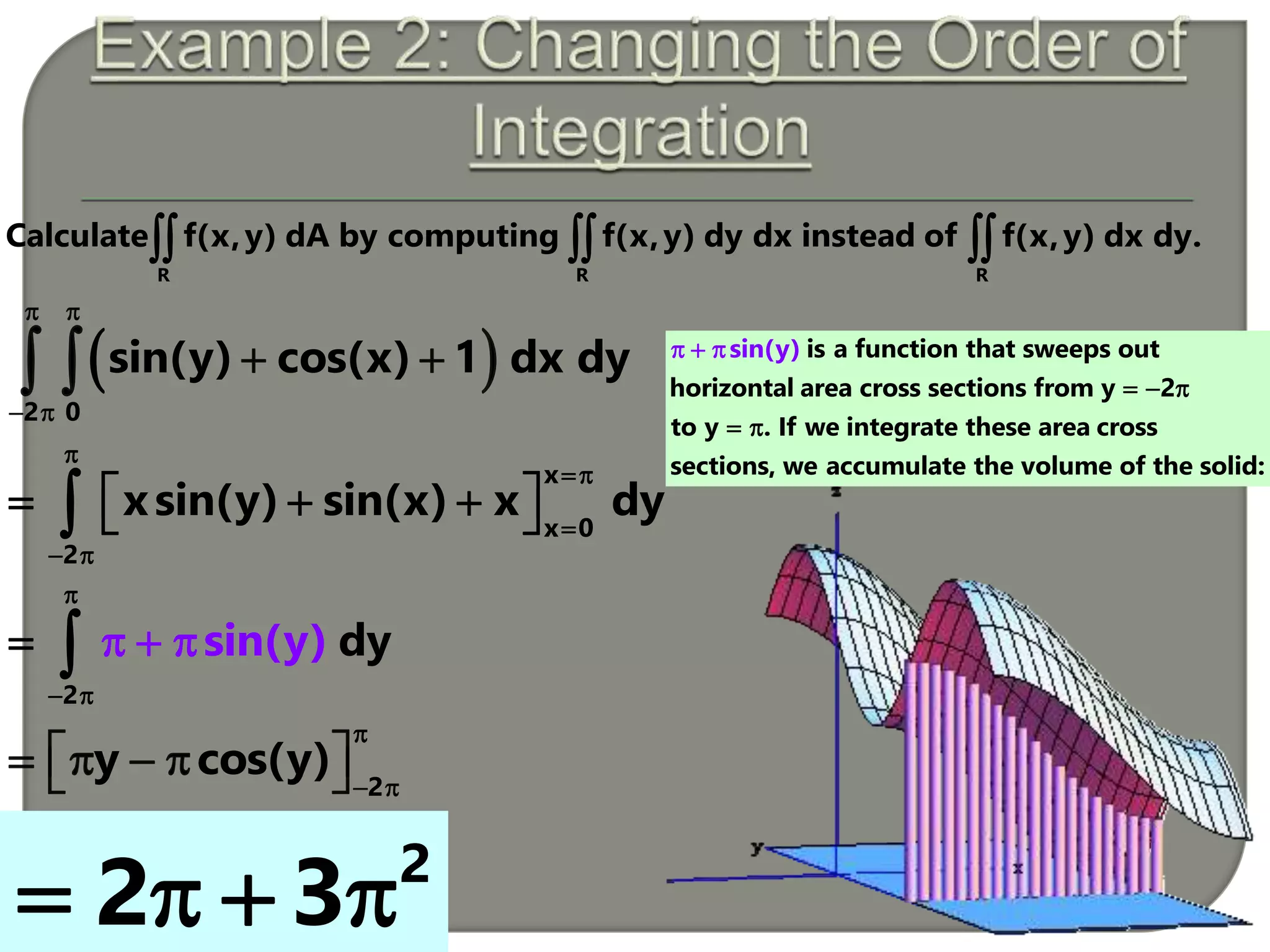
Calculate f(x,y) dA by computing f(x,y) dy dx instead of f(x,y) dx dy.  
is a function that sweeps out
horizontal area cross sections from y 2
to y . If we integrate these area cross
sections, we accumulate the volume of the solid:
sin(y)
  
 
  
d b
c a
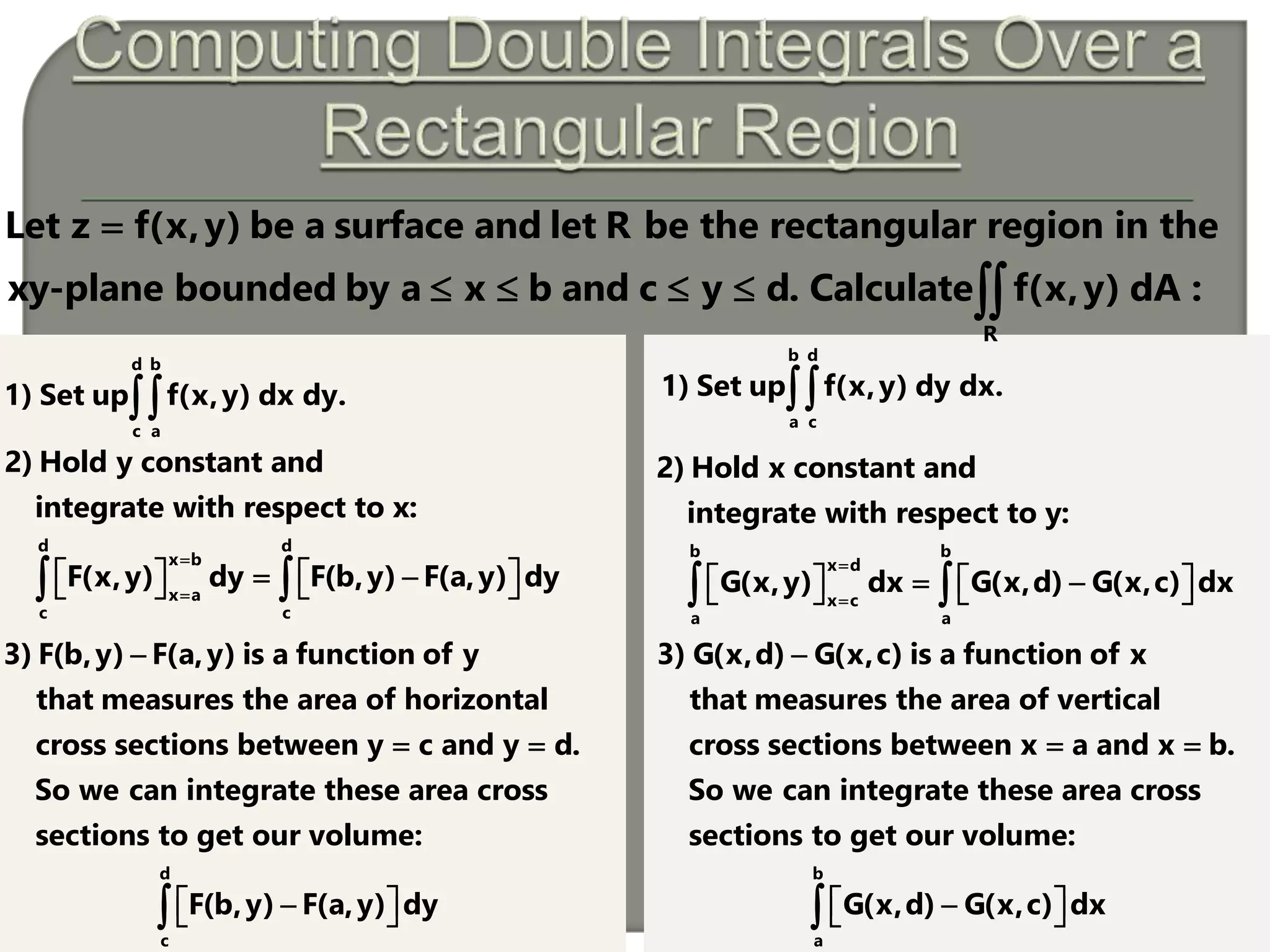
1) Set up f(x,y) dx dy.
d d
x b
x a
c c
2) Hold y constant and
integrate with respect to x:
F(x,y) dy F(b,y) F(a,y) dy


        
R
Let z f(x,y) be a surface and let R be the rectangular region in the
xy-plane bounded by a x b and c y d. Calculate f(x,y) dA :

    
d
c
3) F(b,y) F(a,y) is a function of y
that measures the area of horizontal
cross sections between y c and y d.
So we can integrate these area cross
sections to get our volume:
F(b,y) F(a,y) dy

 
  
b d
a c
1) Set up f(x,y) dy dx.
b b
x d
x c
a a
2) Hold x constant and
integrate with respect to y:
G(x,y) dx G(x,d) G(x,c) dx


        
b
a
3) G(x,d) G(x,c) is a function of x
that measures the area of vertical
cross sections between x a and x b.
So we can integrate these area cross
sections to get our volume:
G(x,d) G(x,c) dx

 
  
 
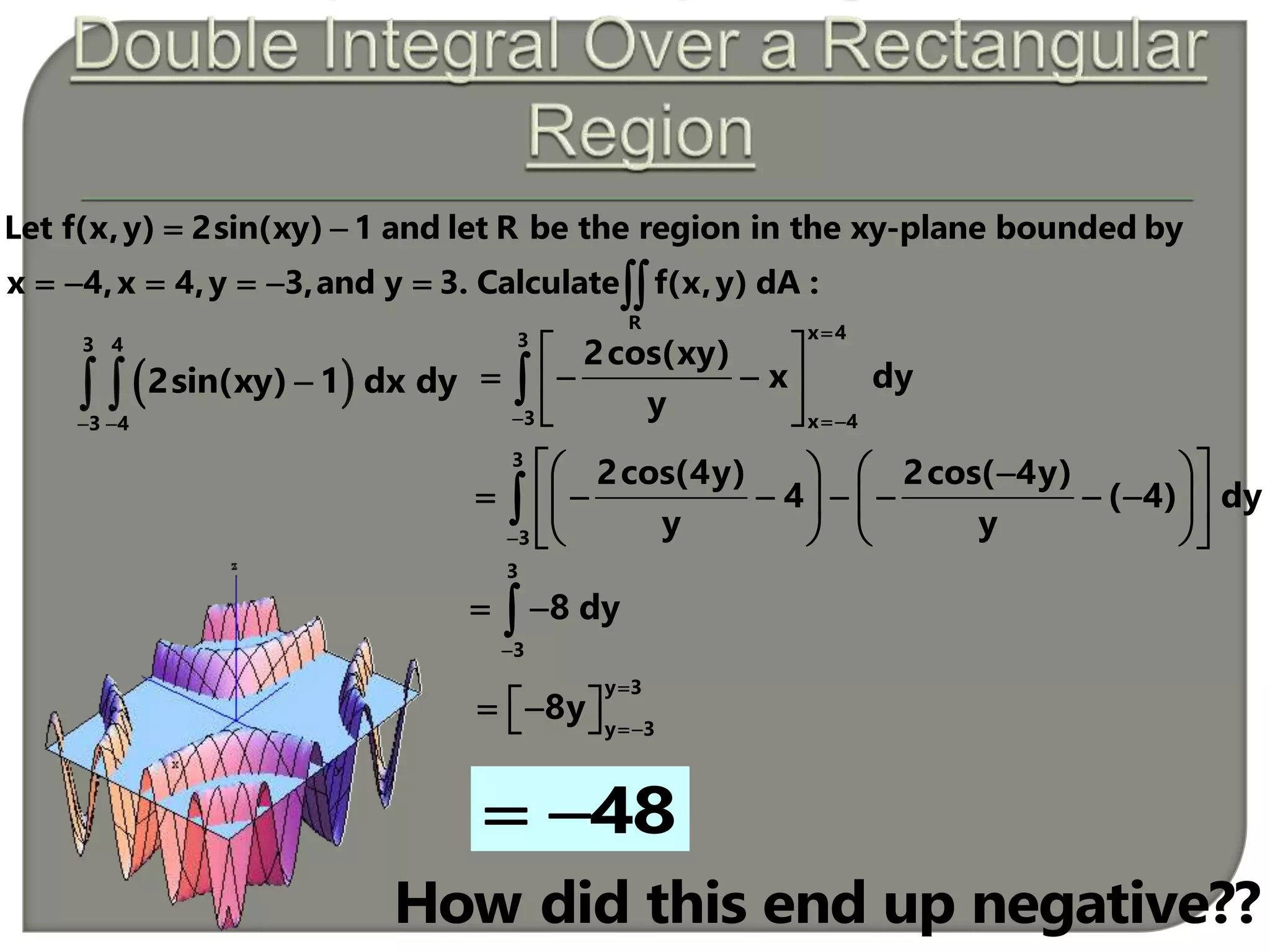
3 4
3 4
2sin(xy) 1 dx dy
 
 
x 43
3 x 4
2cos(xy)
x dy
y

 
 
   
 

3
3
2cos(4y) 2cos( 4y)
4 ( 4) dy
y y
    
          
    

3
3
8 dy

 
y 3
y 3
8y


   
48 
R
Let f(x,y) 2sin(xy) 1 and let R be the region in the xy-plane bounded by
x 4,x 4,y 3,and y 3. Calculate f(x,y) dA :
 
      
How did this end up negative??
2 2
2
R
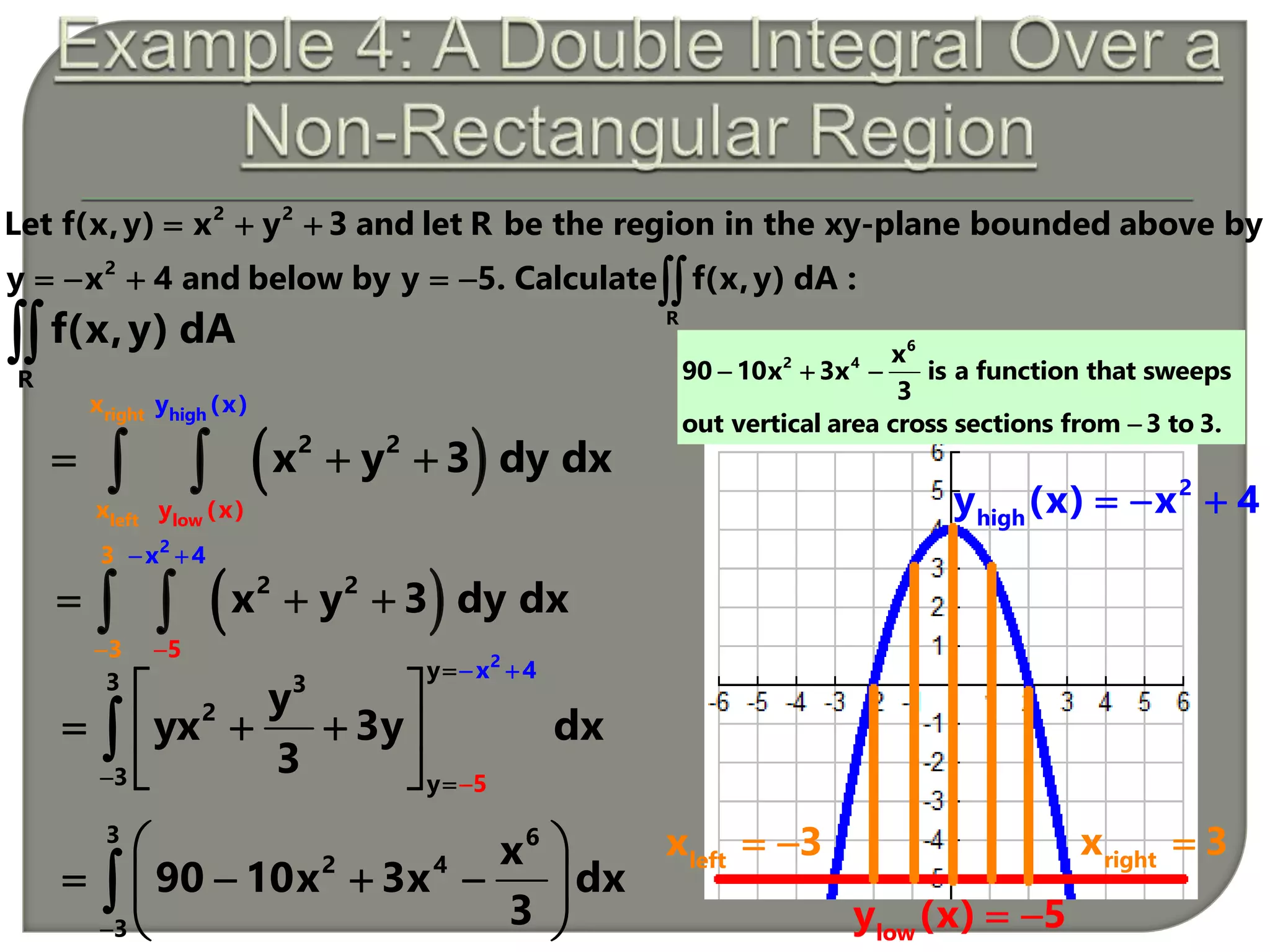
Let f(x,y) x y 3 and let R be the region in the xy-plane bounded above by
y x 4 and below by y 5. Calculate f(x,y) dA :
  
     
2
y3 3
2
3 y 5
x 4
y
yx 3y dx
3
 
 
 
   
 

6
2 4
3
3
x
90 10x 3x dx
3
 
  
 
  
R
f(x,y) dA
 
highright
left lowy (x)
y (x)x
2 2
x
x y 3 dy dx    2
high
y (x) x 4  
low
y (x) 5 
left
x 3  right
x 3
 
2
2 2
3
5
4
3
x
x y 3 dy dx

 

   
6
2 4 x
90 10x 3x is a function that sweeps
3
out vertical area cross sections from 3 to 3.
  

6
2 4
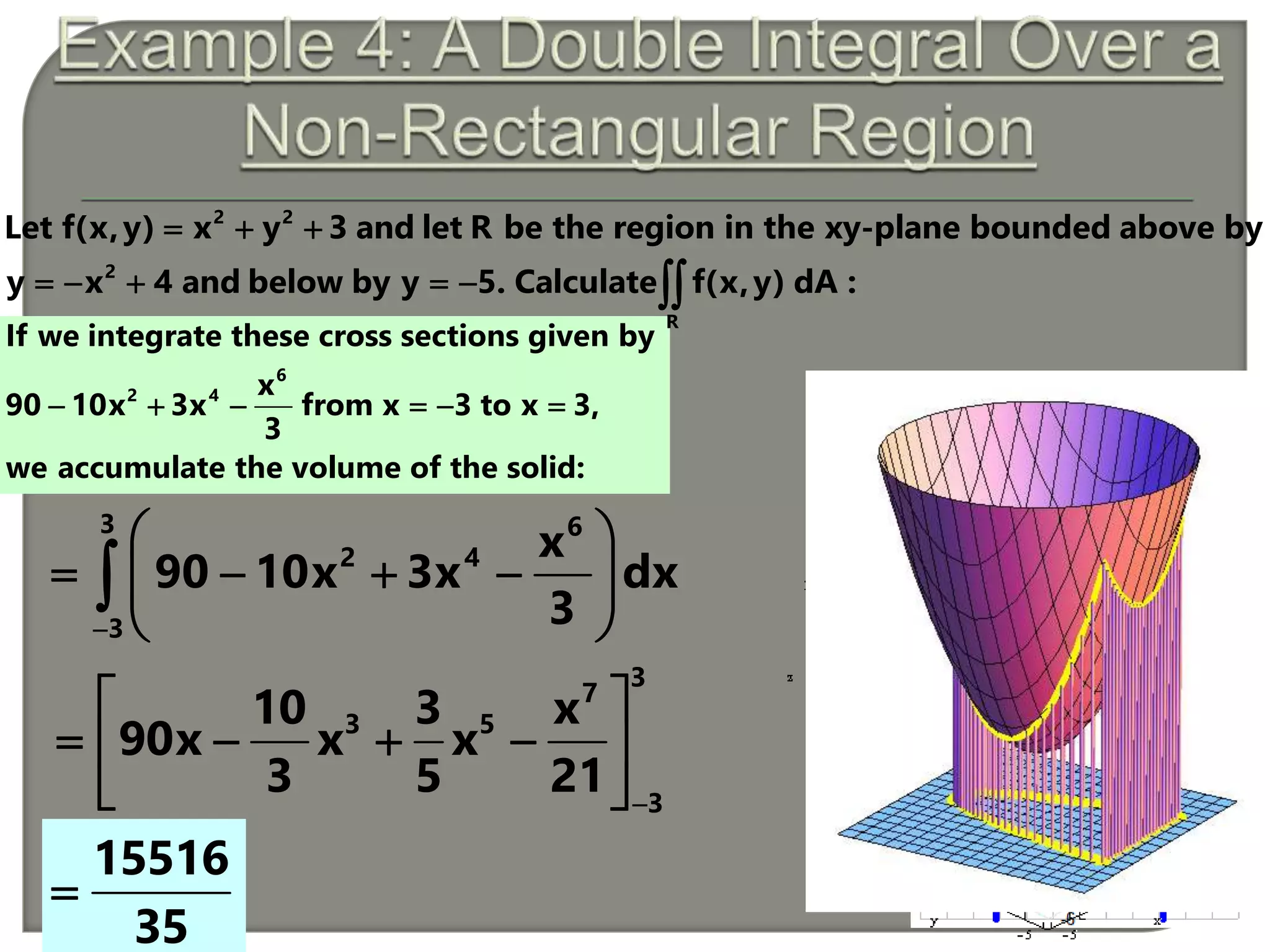
If we integrate these cross sections given by
x
90 10x 3x from x 3 to x 3,
3
we accumulate the volume of the solid:
     
2 2
2
R
Let f(x,y) x y 3 and let R be the region in the xy-plane bounded above by
y x 4 and below by y 5. Calculate f(x,y) dA :
  
     
6
2 4
3
3
x
90 10x 3x dx
3
 
  
 
  
7
3 5
3
3
10 3 x
21
90x x x
3 5 
 
  
 
  
15516
35

R
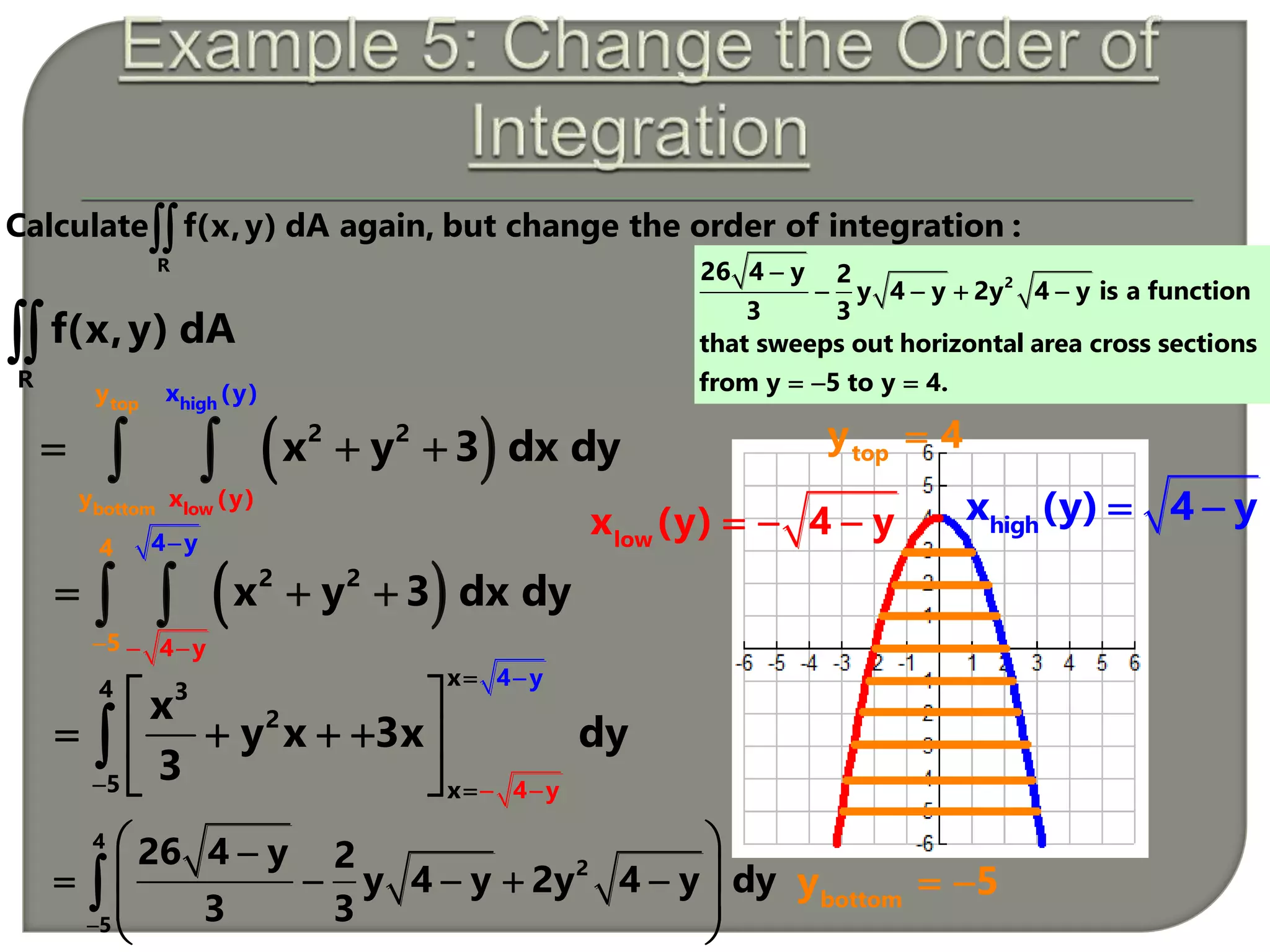
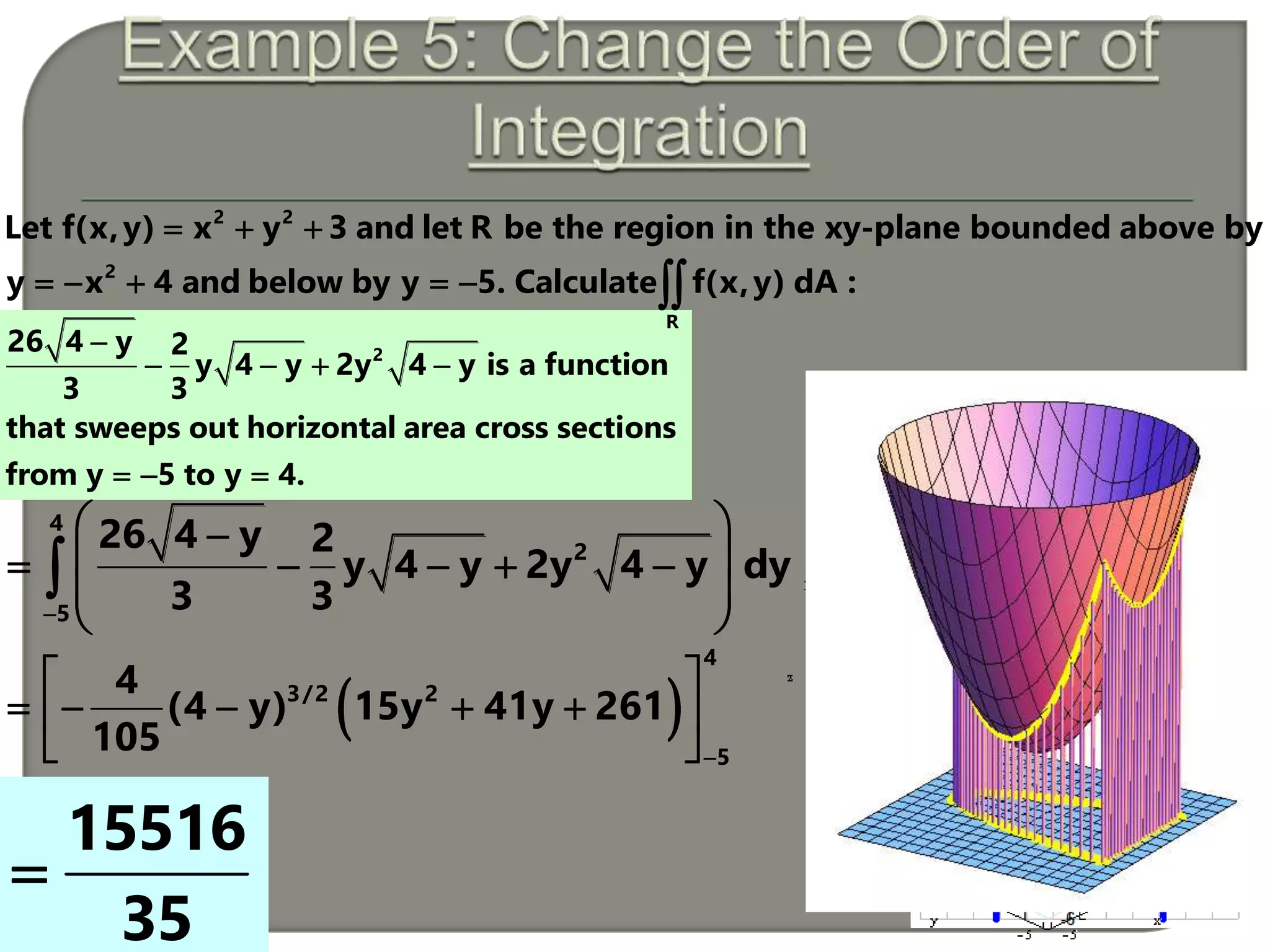
Calculate f(x,y) dA again, but change the order of integration :
4 yx4
5 y
3
2
4x
x
y x 3x dy
3

 

 
    
 

2
4
5
26 4 y 2
y 4 y 2y 4 dyy
3 3
 
 


   

 

R
f(x,y) dA
 
ht ighop
bottom lowx (y)
x (y)y
y
2 2
x y 3 dx dy   
high
x (y) 4 y 
low
x (y) 4 y  
top
y 4
 2 2
44
4
y
5 y
x y 3 dx dy
 


   
2
26 4 y 2
y 4 y 2y 4 y is a function
3 3
that sweeps out horizontal area cross sections
from y 5 to y 4.

   
  
bottom
y 5 
2
26 4 y 2
y 4 y 2y 4 y is a function
3 3
that sweeps out horizontal area cross sections
from y 5 to y 4.

   
  
2 2
2
R
Let f(x,y) x y 3 and let R be the region in the xy-plane bounded above by
y x 4 and below by y 5. Calculate f(x,y) dA :
  
     
2
4
5
26 4 y 2
y 4 y 2y 4 dyy
3 3
 
 


   

 

 
4
3/2 2
5
4
(4 y) 15y 41y 261
105 
 
    
 

15516
35

   
 






      
2
5 4 y
2 2 2
4 yx3 44
3
2
5
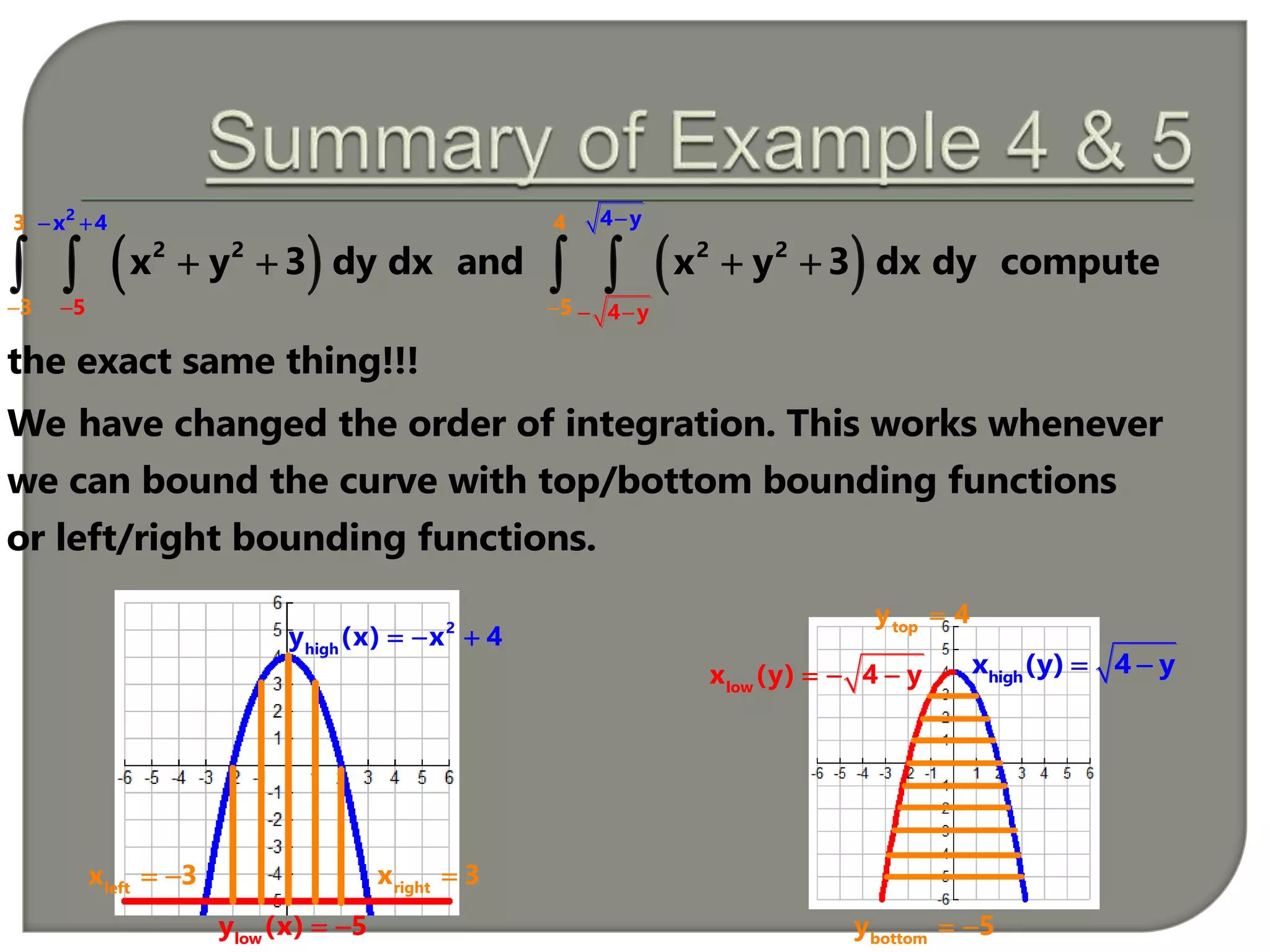
x y 3 dy dx and x y 3 dx dy compute
the exact same thing!!!
high
x (y) 4 y 
low
x (y) 4 y  
top
y 4
bottom
y 5 
2
high
y (x) x 4  
low
y (x) 5 
left
x 3  right
x 3
We have changed the order of integration. This works whenever
we can bound the curve with top/bottom bounding functions
or left/right bounding functions.
right high
left low
x y (x)
x y (x)
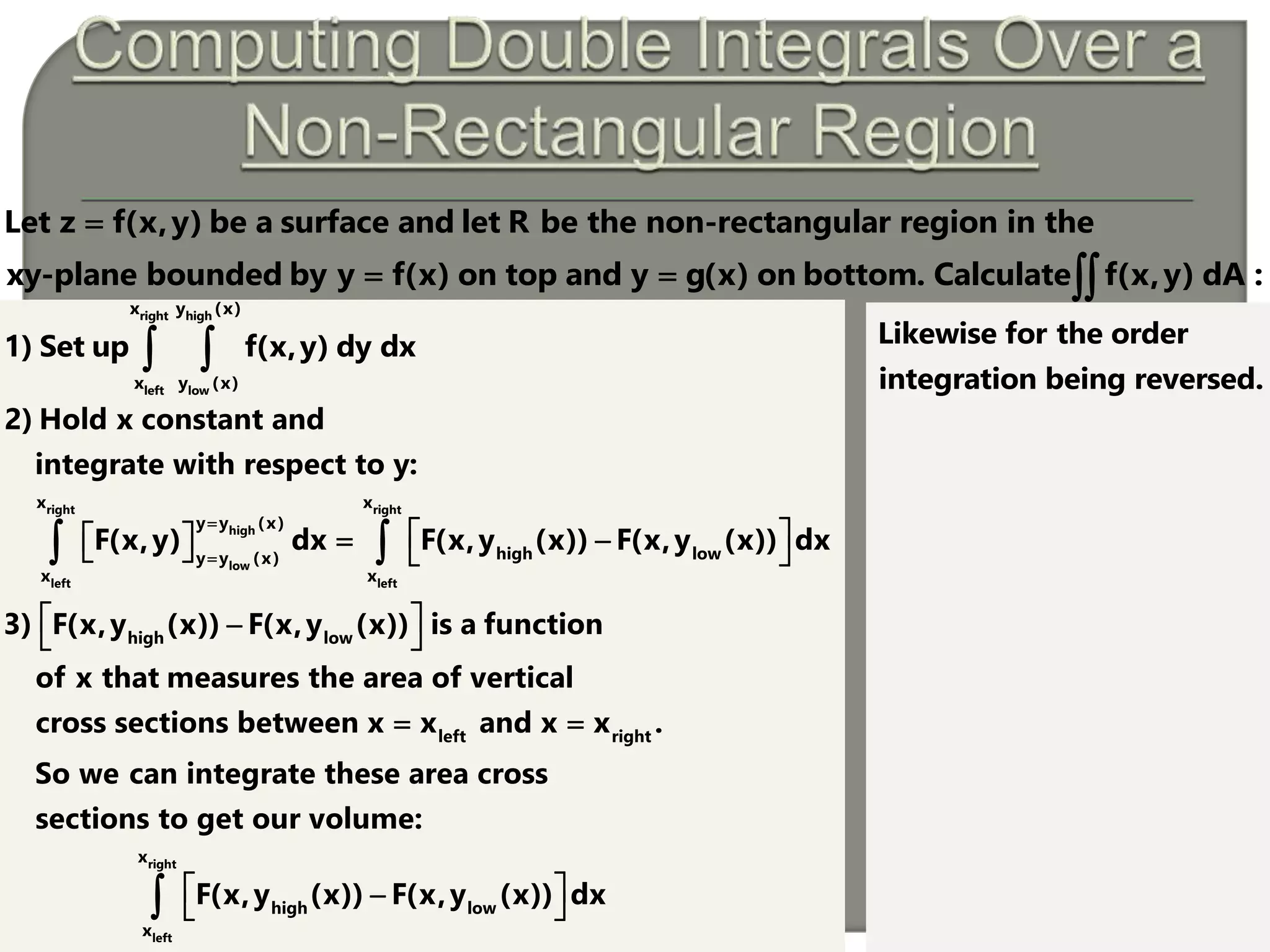
1) Set up f(x,y) dy dx 
right right
high
low
left left
x x
y y (x)
high lowy y (x)
x x
2) Hold x constant and
integrate with respect to y:
F(x,y) dx F(x,y (x)) F(x,y (x)) dx


        
R
Let z f(x,y) be a surface and let R be the non-rectangular region in the
xy-plane bounded by y f(x) on top and y g(x) on bottom. Calculate f(x,y) dA :

  
high low
left right
high
3) F(x,y (x)) F(x,y (x)) is a function
of x that measures the area of vertical
cross sections between x x and x x .
So we can integrate these area cross
sections to get our volume:
F(x,y (x)) F(x
  
 

right
left
x
low
x
,y (x)) dx 
 
Likewise for the order
integration being reversed.
Old Way:
    2
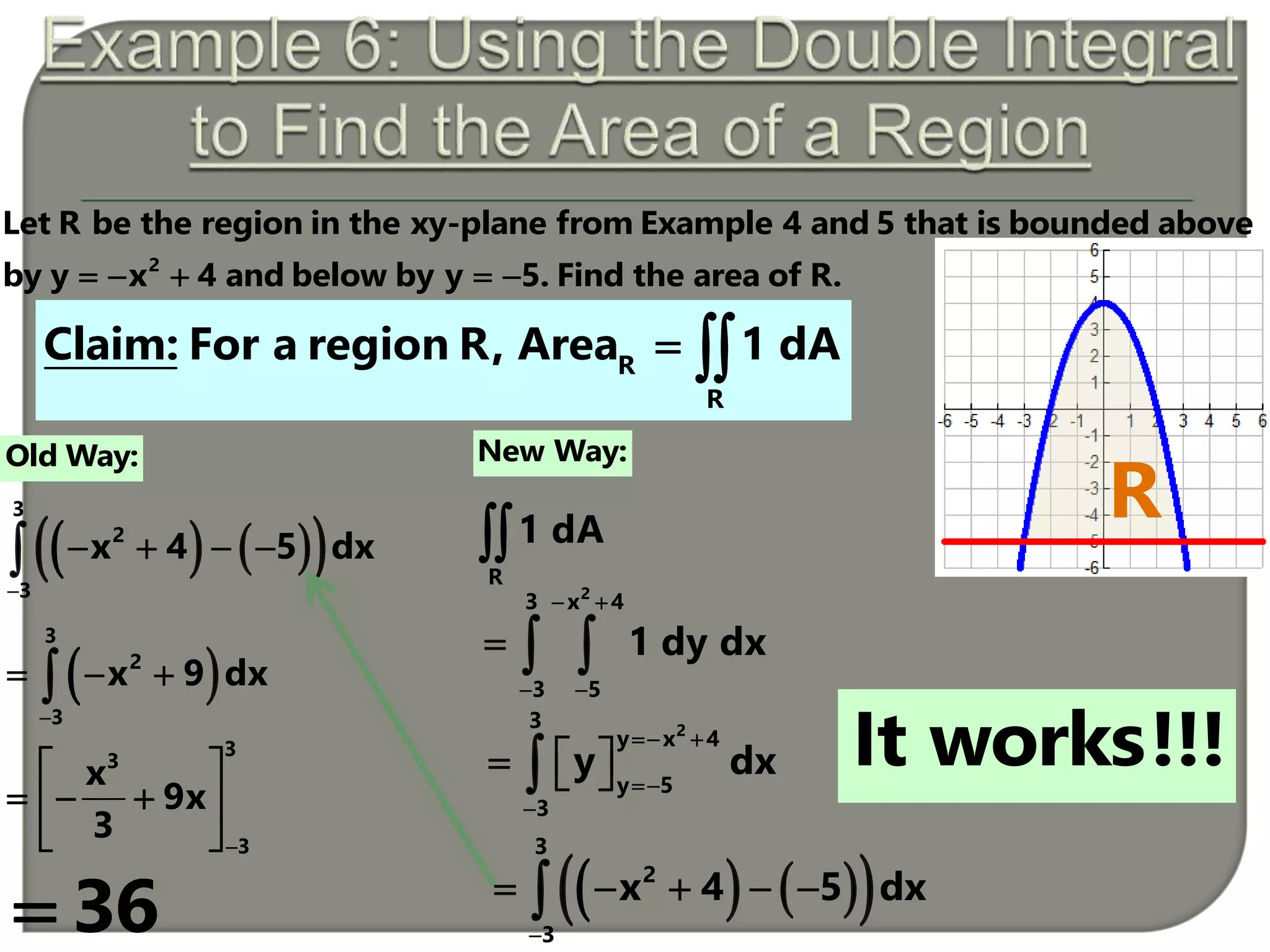
Let R be the region in the xy-plane from Example 4 and 5 that is bounded above
by y x 4 and below by y 5. Find the area of R.
    
   
3
2
3
x 4 5 dx
R
New Way:
 

  
3
2
3
x 9 dx

 
   
 
3
3
3
x
9x
3
 36
 
 
  
2
3 x 4
3 5
1 dy dx
R
1 dA
 


   
23
y x 4
y 5
3
y dx
    
    
3
2
3
x 4 5 dx
 R
R
Claim: For a region R, Area 1 dA
It works!!!
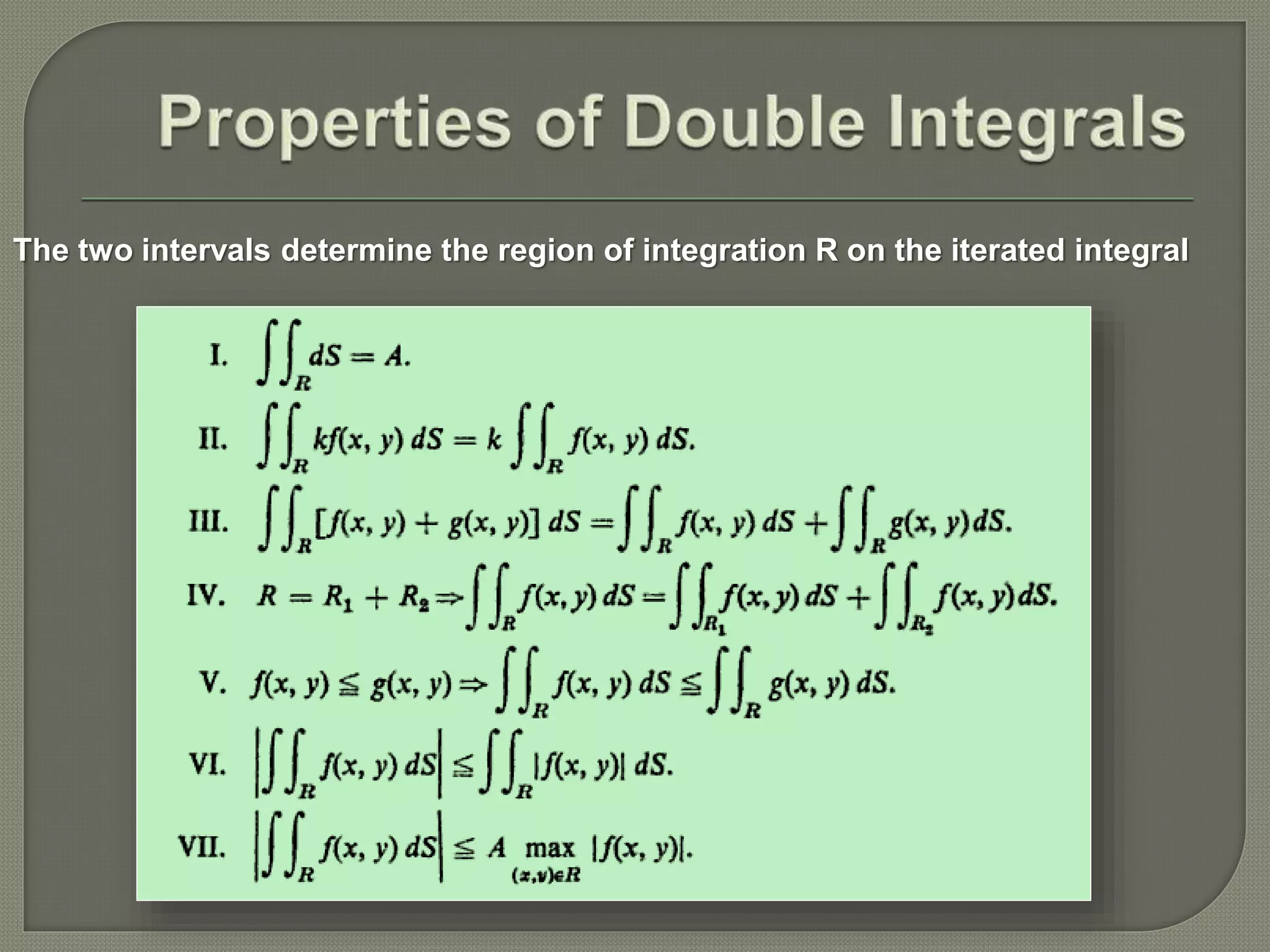
The two intervals determine the region of integration R on the iterated integral
    
high
low
t
R t
x' n x((t)
n m
dA dtm x(t),y(t t),
x y
y() '(t)t) y
  
   
  
 
low high
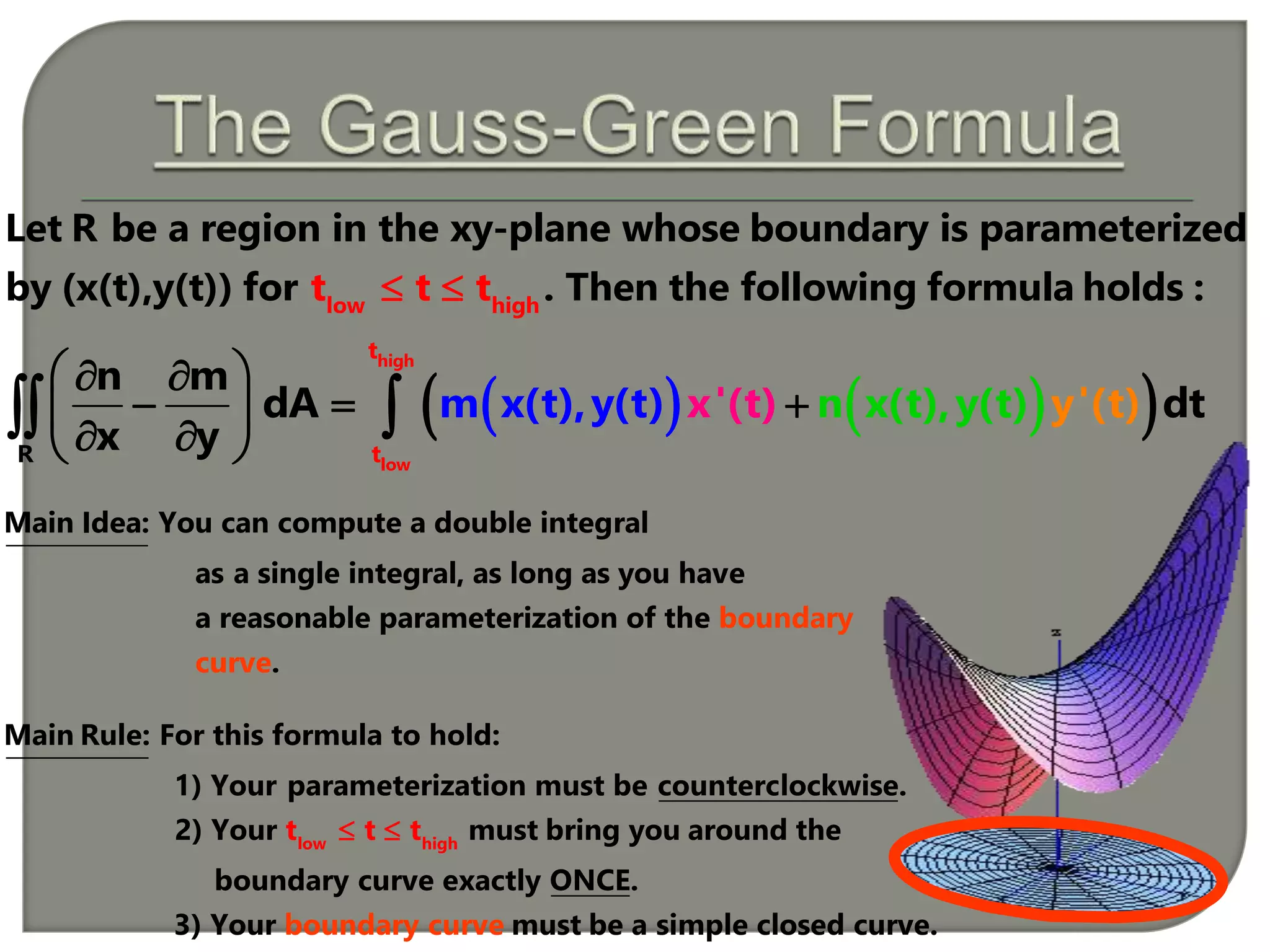
Let R be a region in the xy-plane whose boundary is parameterized
by (x(t),y(t)) for . Then the following formula hot :t st ld 
Main Idea: You can compute a double integral
as a single integral, as long as you have
a reasonable parameterization of th boundary
cu
e
rve.
low high
Main Rule: For this formula to hold:
1) Your parameterization must be counterclockwise.
2) Your must bring you around the
boundary curve exactly ONCE.
3) Your must be a sibound mple
t
c
t
l
t
oary sedcu curve.rve
 
22
R
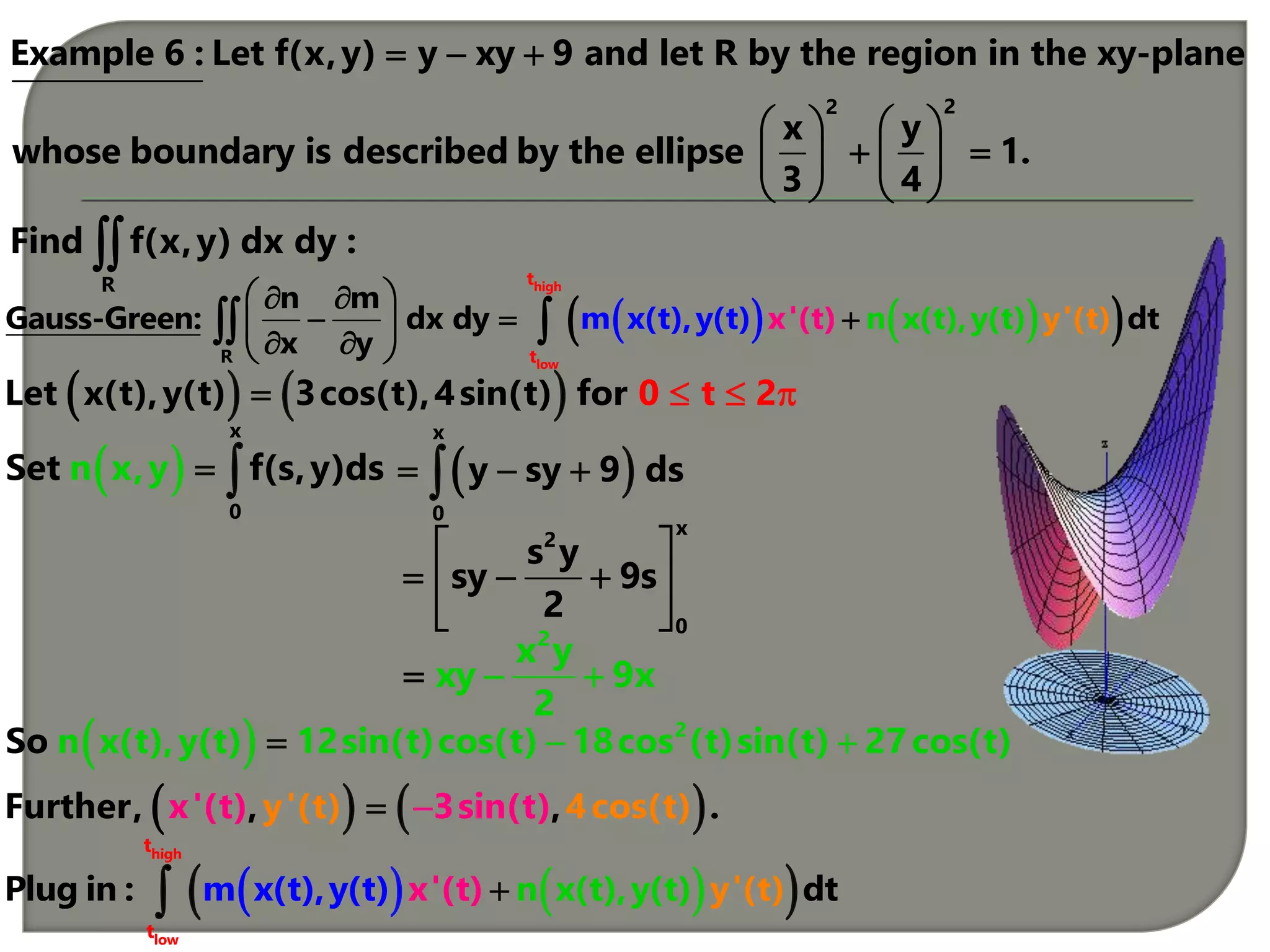
Example 6 : Let f(x,y) y xy 9 and let R by the region in the xy-plane
yx
whose boundary is described by the ellipse 1.
3 4
Find f(x,y) dx dy :
  
  
   
   

   Let x(t),y(t) 3cos(t),4sin(t) tfor 0 2  
    
high
lowR
t
t
m x(t x'),y(t
n m
Gauss-Green: dx dy dt
x
n x(t),y(t y( '
y
() tt) ))
  
   
  
 
 
x
0
Set f(s,y)n ,y dsx    
x
0
y sy 9 ds  
x
2
0
s y
sy 9s
2
 
   
 2
x y
xy 9x
2
 
   y'(t)x'(t) 3sin(tFurther, , ,4co )) .s(t
    
high
low
t
t
n x(t),y(t y'(x'(t t)Plug in : dm x(t), t)t )y( ) 
  2
n x(t),y(t) 12sin(t)cos(t) 18cos (t)sin(t) 27S to cos( ) 
22
Example 6 : Let f(x,y) y xy 9 and let R by the region in the xy-plane
yx
whose boundary is described by the ellipse 1.
3 4
  
  
   
   
    
high
low
t
t
x' n x
Plug into Gaus
(t),y(t y'(t(t) )m x(t),y(t
s-Green :
) dt) 
  2
2
0
12sin(t)cos(t) 18cos (t)sin d(t) 27co( 3si s(t) t(4cos(t)t )n( ))0

  
 
2
2 3 2
0
48cos (t)sin(t) 72cos (t)sin(t) 108cos (t) dt

  
 
  2
low high
n x(t),y(t) 12sin(t)cos(t) 18cos (t)sin(t)
[t ,t ] [0
y'(t) 4cos(t)
x'(t) 3si
m x(t),y(t) 0
,2 ]
27cos(t)
n(t)
 


k 1 k 1
b
k
a
k 1 k 1
b
k
a
2
(
c
(a)
(
sin (b) sin a)
Hint: sin (t) os(t)dt
k 1 k 1
cos (b) cos
and cos in(t)dt
k 1 k 1
1 cos(2t)
and cos (t)
t)
2
s
 
 
 
 

 
 




108 
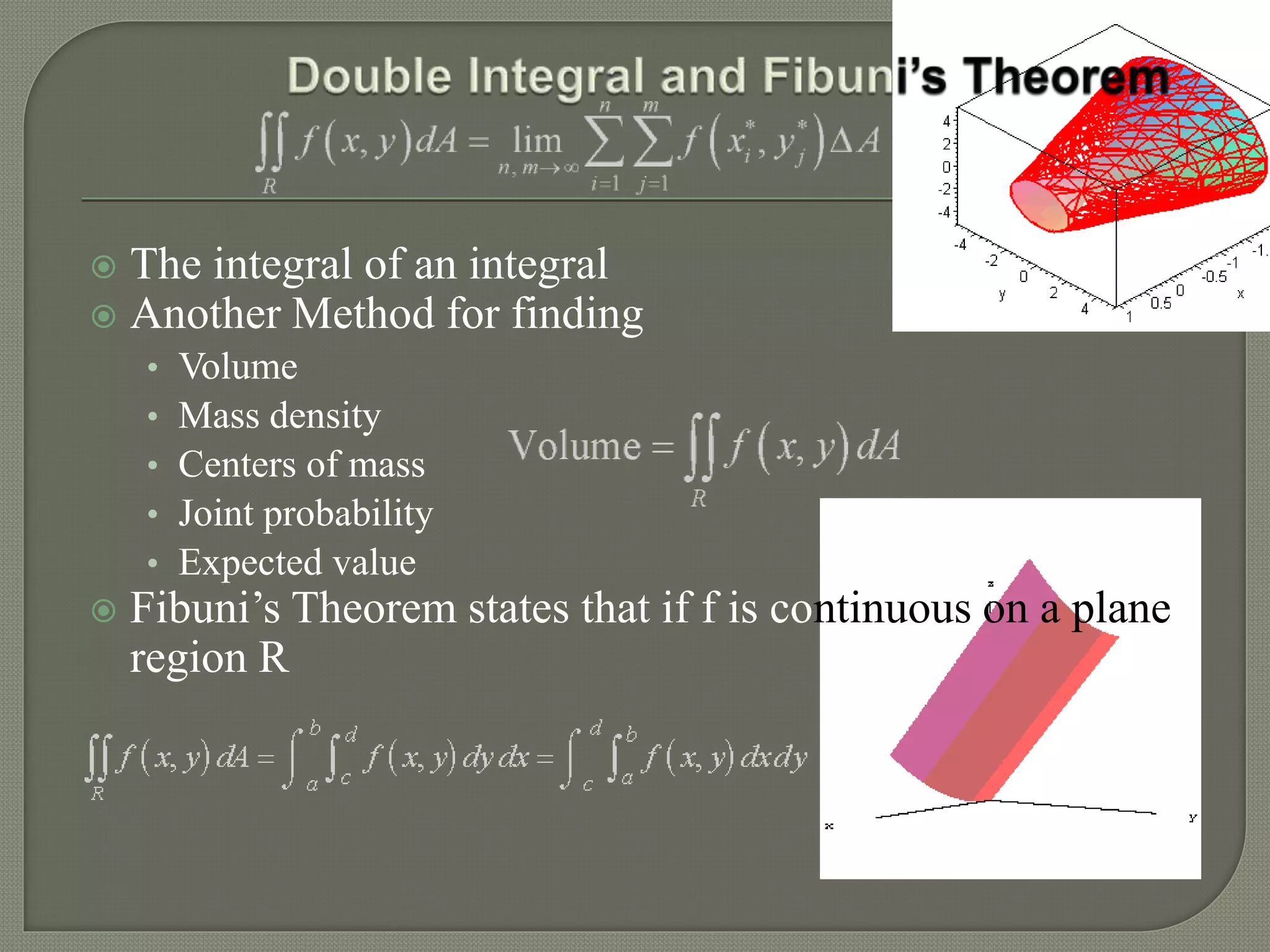
 The integral of an integral
 Another Method for finding
• Volume
• Mass density
• Centers of mass
• Joint probability
• Expected value
 Fibuni’s Theorem states that if f is continuous on a plane
region R
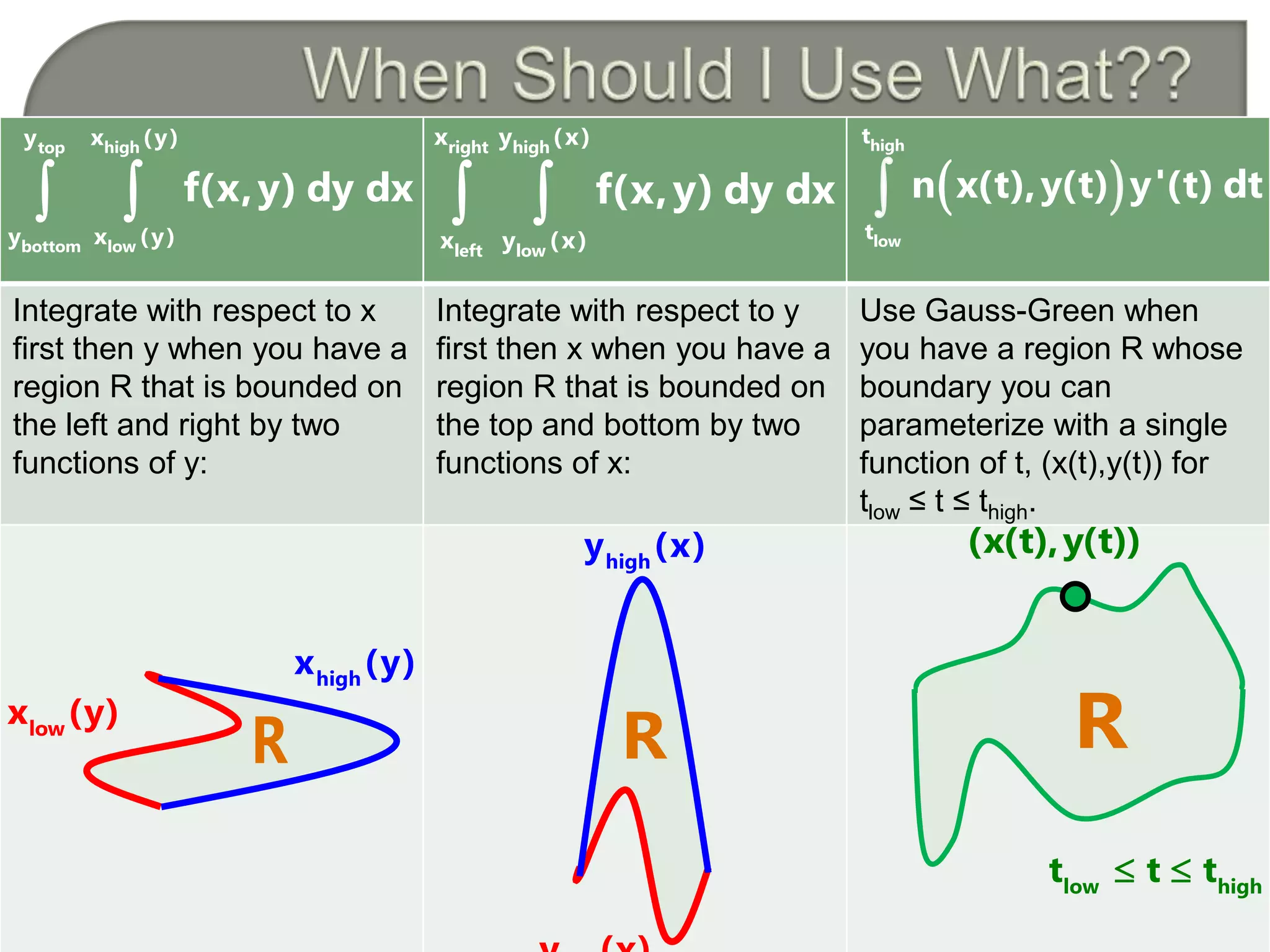
Integrate with respect to x
first then y when you have a
region R that is bounded on
the left and right by two
functions of y:
Integrate with respect to y
first then x when you have a
region R that is bounded on
the top and bottom by two
functions of x:
Use Gauss-Green when
you have a region R whose
boundary you can
parameterize with a single
function of t, (x(t),y(t)) for
tlow ≤ t ≤ thigh.
 
right high
left low
x y (x)
x y (x)
f(x,y) dy dx  
high
low
t
t
n x(t),y(t) y'(t) dt
 low high
t t t
(x(t),y(t))
R
 
hightop
bottom low
x (y)y
y x (y)
f(x,y) dy dx
high
y (x)
Rlow
x (y)
high
x (y)
R

Maths-double integrals

  • 1.
  • 2.
      0 2 sin(y)cos(x) 1 dy dx        y y 2 0 cos(y) ycos(x) y dx           0 2 3 3 cos(x d) x       0 2x 3 x 3 sin(x)         2 2 3    R Let f(x,y) sin(y) cos(x) 1 and let R be the region in the xy-plane bounded by x 0,x ,y 2 ,and y . Calculate f(x,y) dA :             is a function that sweeps out vertical area cross sections f 2 3 3 cos(x) rom x 0 to x .        If we integrate these area cross sections, we accumulate the volume of the solid:
  • 3.
      2 0 sin(y)cos(x) 1 dx dy        x x 0 2 xsin(y) sin(x) x dy           2 sin(y dy)                2 y cos(y) 2 2 3    R R R Calculate f(x,y) dA by computing f(x,y) dy dx instead of f(x,y) dx dy.   is a function that sweeps out horizontal area cross sections from y 2 to y . If we integrate these area cross sections, we accumulate the volume of the solid: sin(y)        
  • 4.
    d b c a 1)Set up f(x,y) dx dy. d d x b x a c c 2) Hold y constant and integrate with respect to x: F(x,y) dy F(b,y) F(a,y) dy            R Let z f(x,y) be a surface and let R be the rectangular region in the xy-plane bounded by a x b and c y d. Calculate f(x,y) dA :       d c 3) F(b,y) F(a,y) is a function of y that measures the area of horizontal cross sections between y c and y d. So we can integrate these area cross sections to get our volume: F(b,y) F(a,y) dy       b d a c 1) Set up f(x,y) dy dx. b b x d x c a a 2) Hold x constant and integrate with respect to y: G(x,y) dx G(x,d) G(x,c) dx            b a 3) G(x,d) G(x,c) is a function of x that measures the area of vertical cross sections between x a and x b. So we can integrate these area cross sections to get our volume: G(x,d) G(x,c) dx      
  • 5.
      3 4 34 2sin(xy) 1 dx dy     x 43 3 x 4 2cos(xy) x dy y             3 3 2cos(4y) 2cos( 4y) 4 ( 4) dy y y                       3 3 8 dy    y 3 y 3 8y       48  R Let f(x,y) 2sin(xy) 1 and let R be the region in the xy-plane bounded by x 4,x 4,y 3,and y 3. Calculate f(x,y) dA :          How did this end up negative??
  • 6.
    2 2 2 R Let f(x,y)x y 3 and let R be the region in the xy-plane bounded above by y x 4 and below by y 5. Calculate f(x,y) dA :          2 y3 3 2 3 y 5 x 4 y yx 3y dx 3              6 2 4 3 3 x 90 10x 3x dx 3           R f(x,y) dA   highright left lowy (x) y (x)x 2 2 x x y 3 dy dx    2 high y (x) x 4   low y (x) 5  left x 3  right x 3   2 2 2 3 5 4 3 x x y 3 dy dx         6 2 4 x 90 10x 3x is a function that sweeps 3 out vertical area cross sections from 3 to 3.    
  • 7.
    6 2 4 If weintegrate these cross sections given by x 90 10x 3x from x 3 to x 3, 3 we accumulate the volume of the solid:       2 2 2 R Let f(x,y) x y 3 and let R be the region in the xy-plane bounded above by y x 4 and below by y 5. Calculate f(x,y) dA :          6 2 4 3 3 x 90 10x 3x dx 3           7 3 5 3 3 10 3 x 21 90x x x 3 5            15516 35 
  • 8.
    R Calculate f(x,y) dAagain, but change the order of integration : 4 yx4 5 y 3 2 4x x y x 3x dy 3               2 4 5 26 4 y 2 y 4 y 2y 4 dyy 3 3               R f(x,y) dA   ht ighop bottom lowx (y) x (y)y y 2 2 x y 3 dx dy    high x (y) 4 y  low x (y) 4 y   top y 4  2 2 44 4 y 5 y x y 3 dx dy         2 26 4 y 2 y 4 y 2y 4 y is a function 3 3 that sweeps out horizontal area cross sections from y 5 to y 4.         bottom y 5 
  • 9.
    2 26 4 y2 y 4 y 2y 4 y is a function 3 3 that sweeps out horizontal area cross sections from y 5 to y 4.         2 2 2 R Let f(x,y) x y 3 and let R be the region in the xy-plane bounded above by y x 4 and below by y 5. Calculate f(x,y) dA :          2 4 5 26 4 y 2 y 4 y 2y 4 dyy 3 3                 4 3/2 2 5 4 (4 y) 15y 41y 261 105            15516 35 
  • 10.
                      2 5 4 y 2 2 2 4 yx3 44 3 2 5 x y 3 dy dx and x y 3 dx dy compute the exact same thing!!! high x (y) 4 y  low x (y) 4 y   top y 4 bottom y 5  2 high y (x) x 4   low y (x) 5  left x 3  right x 3 We have changed the order of integration. This works whenever we can bound the curve with top/bottom bounding functions or left/right bounding functions.
  • 11.
    right high left low xy (x) x y (x) 1) Set up f(x,y) dy dx  right right high low left left x x y y (x) high lowy y (x) x x 2) Hold x constant and integrate with respect to y: F(x,y) dx F(x,y (x)) F(x,y (x)) dx            R Let z f(x,y) be a surface and let R be the non-rectangular region in the xy-plane bounded by y f(x) on top and y g(x) on bottom. Calculate f(x,y) dA :     high low left right high 3) F(x,y (x)) F(x,y (x)) is a function of x that measures the area of vertical cross sections between x x and x x . So we can integrate these area cross sections to get our volume: F(x,y (x)) F(x       right left x low x ,y (x)) dx    Likewise for the order integration being reversed.
  • 12.
    Old Way:    2 Let R be the region in the xy-plane from Example 4 and 5 that is bounded above by y x 4 and below by y 5. Find the area of R.          3 2 3 x 4 5 dx R New Way:       3 2 3 x 9 dx          3 3 3 x 9x 3  36        2 3 x 4 3 5 1 dy dx R 1 dA         23 y x 4 y 5 3 y dx           3 2 3 x 4 5 dx  R R Claim: For a region R, Area 1 dA It works!!!
  • 13.
    The two intervalsdetermine the region of integration R on the iterated integral
  • 14.
        high low t R t x' n x((t) n m dA dtm x(t),y(t t), x y y() '(t)t) y             low high Let R be a region in the xy-plane whose boundary is parameterized by (x(t),y(t)) for . Then the following formula hot :t st ld  Main Idea: You can compute a double integral as a single integral, as long as you have a reasonable parameterization of th boundary cu e rve. low high Main Rule: For this formula to hold: 1) Your parameterization must be counterclockwise. 2) Your must bring you around the boundary curve exactly ONCE. 3) Your must be a sibound mple t c t l t oary sedcu curve.rve  
  • 15.
    22 R Example 6 :Let f(x,y) y xy 9 and let R by the region in the xy-plane yx whose boundary is described by the ellipse 1. 3 4 Find f(x,y) dx dy :                   Let x(t),y(t) 3cos(t),4sin(t) tfor 0 2        high lowR t t m x(t x'),y(t n m Gauss-Green: dx dy dt x n x(t),y(t y( ' y () tt) ))               x 0 Set f(s,y)n ,y dsx     x 0 y sy 9 ds   x 2 0 s y sy 9s 2        2 x y xy 9x 2      y'(t)x'(t) 3sin(tFurther, , ,4co )) .s(t      high low t t n x(t),y(t y'(x'(t t)Plug in : dm x(t), t)t )y( )    2 n x(t),y(t) 12sin(t)cos(t) 18cos (t)sin(t) 27S to cos( ) 
  • 16.
    22 Example 6 :Let f(x,y) y xy 9 and let R by the region in the xy-plane yx whose boundary is described by the ellipse 1. 3 4                    high low t t x' n x Plug into Gaus (t),y(t y'(t(t) )m x(t),y(t s-Green : ) dt)    2 2 0 12sin(t)cos(t) 18cos (t)sin d(t) 27co( 3si s(t) t(4cos(t)t )n( ))0       2 2 3 2 0 48cos (t)sin(t) 72cos (t)sin(t) 108cos (t) dt         2 low high n x(t),y(t) 12sin(t)cos(t) 18cos (t)sin(t) [t ,t ] [0 y'(t) 4cos(t) x'(t) 3si m x(t),y(t) 0 ,2 ] 27cos(t) n(t)     k 1 k 1 b k a k 1 k 1 b k a 2 ( c (a) ( sin (b) sin a) Hint: sin (t) os(t)dt k 1 k 1 cos (b) cos and cos in(t)dt k 1 k 1 1 cos(2t) and cos (t) t) 2 s                  108 
  • 17.
     The integralof an integral  Another Method for finding • Volume • Mass density • Centers of mass • Joint probability • Expected value  Fibuni’s Theorem states that if f is continuous on a plane region R
  • 18.
    Integrate with respectto x first then y when you have a region R that is bounded on the left and right by two functions of y: Integrate with respect to y first then x when you have a region R that is bounded on the top and bottom by two functions of x: Use Gauss-Green when you have a region R whose boundary you can parameterize with a single function of t, (x(t),y(t)) for tlow ≤ t ≤ thigh.   right high left low x y (x) x y (x) f(x,y) dy dx   high low t t n x(t),y(t) y'(t) dt  low high t t t (x(t),y(t)) R   hightop bottom low x (y)y y x (y) f(x,y) dy dx high y (x) Rlow x (y) high x (y) R